
Rocket.new vs Hostinger Horizons compared across features, pricing, mobile apps, and deployment. One builds websites fast. The other builds full products, from research to launch, across web and mobile.
Why do some AI builders ship a finished website in minutes while others ship an entire product platform? The answer comes down to scope.
Most AI builders focus on websites. You describe what you want, get a styled output, customize it, and you're live. That serves a landing page or a small business site perfectly well.
But if you're building a SaaS product, a mobile app, or a business tool that needs real logic and real users, you need something more. That gap is exactly what this comparison examines.
One platform stays in the web lane. The other spans web, mobile, and strategic intelligence in one place. According to Capterra, over 516 website builder tools now compete in the market, reflecting just how fast this category has grown.
What Sets These Two AI Builders Apart?
Both platforms let you type an idea and watch something get built. The similarity ends there.
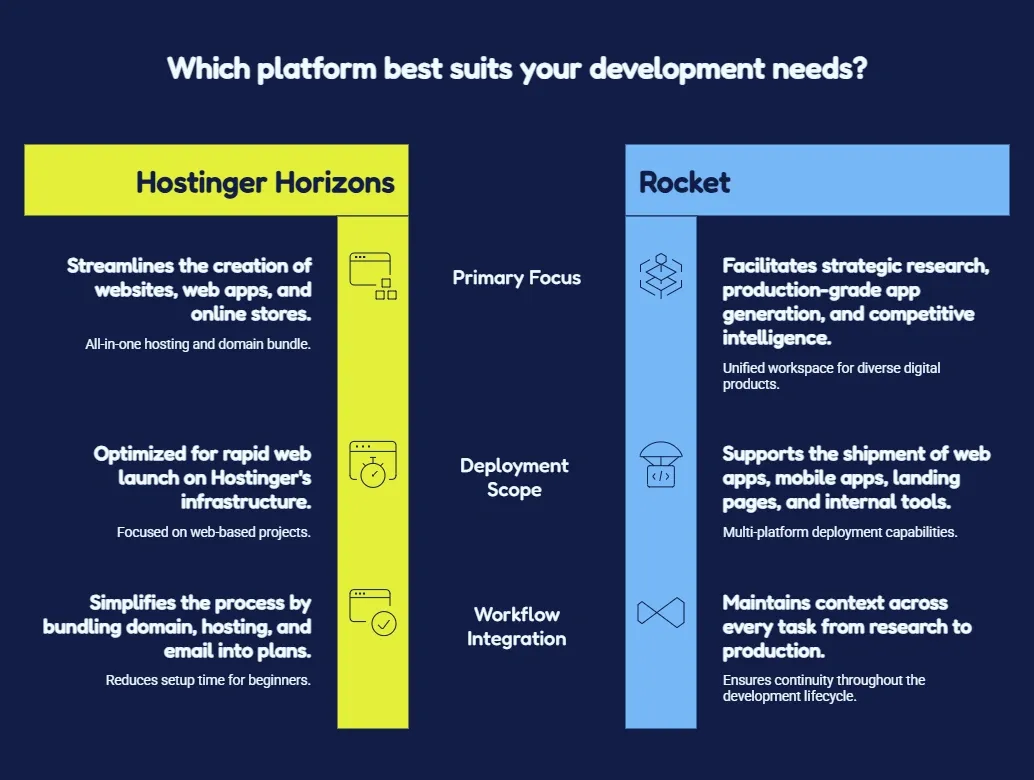
Hostinger Horizons is an AI-powered builder from Hostinger, one of the largest hosting companies globally. It builds websites, web apps, and online stores, all hosted on Hostinger's infrastructure. You get a domain, hosting, and email bundled into most plans, making web launch fast.
Rocket describes itself as the world's first Vibe Solutioning platform. It covers strategic research (Solve), production-grade app generation (Build), and competitive intelligence, all in one workspace. Web apps, mobile apps, landing pages, and internal tools ship from the same system. Context carries forward between every task.
The core difference: Hostinger Horizons builds websites. Rocket builds products. That's the frame to hold as you read through each comparison below.
How Do Their Core Features Compare?
The prompt-to-build experience feels similar on both platforms at first. Dig into the output and the gaps become clear.
Rocket assigns the right framework automatically: Next.js for web, Flutter for mobile. Every build ships with SEO-ready structure, WCAG accessibility compliance, GDPR coverage, and performance quality by default. These are the baseline, not optional extras.
Rocket gives you 25+ connectors including Stripe, Supabase, Notion, Airtable, and Mailchimp, all authenticating once across every build. You can explore how 25 integrations flow directly into generation to understand what that means in practice.
Hostinger Horizons generates web output only, with databases, user accounts, and file storage built in. Stripe, PayPal, and AdSense are included as payment and monetization options.
Hostinger Horizons bundles hosting natively, so you're not configuring DNS separately. It's all handled directly through the Hostinger ecosystem.
The table below captures where each platform stands on specific capabilities:
| Feature | Rocket | Hostinger Horizons |
|---|---|---|
| Web apps | Yes (Next.js) | Yes |
| Mobile apps (iOS + Android) | Yes (Flutter) | No |
| Custom code access | Yes (all plans) | Hobbyist plan+ |
| Competitive intelligence | Yes | No |
| Strategic research tools | Yes (Solve) | No |
| App Store / Play Store deployment | Yes | No |
| Built-in analytics | Yes | Starter plan+ |
| Collaboration | Unlimited members, free | Starter plan+ |
| Connectors | 25+ | Stripe, PayPal, AdSense |
| Free plan | Yes | No |
| Hosting included | Yes | Yes |
Hostinger reports serving 5 million clients across 150+ countries, a signal of just how large the demand for accessible web tools has become.
Where Do These Platforms Fall Short?
No tool is perfect. Comparing honestly means looking at where each one hits a ceiling.
Hostinger Horizons has no native mobile output. Nothing built here can publish to the App Store or Google Play. The entry plan offers just 30 AI credits per month, which limits active development cycles.
There's also no strategic research layer. You arrive with an idea and build it, without any built-in validation or market context.
Rocket is a broader platform, which means the onboarding covers more ground. Users who need only a simple static website may find the depth unnecessary for their scope. Pricing for serious production use starts at \$25/month, which sits above Horizons' entry tier.
Both platforms tie certain features to higher-tier plans. Collaboration, analytics, and code access all require plan upgrades specifically on Horizons.
The right platform depends on the gap you're trying to close. Speed to a basic website or depth for a full product: those lead to different answers.
Which Pricing Model Actually Works for You?
Pricing structure matters as much as the numbers. These two platforms take meaningfully different approaches.
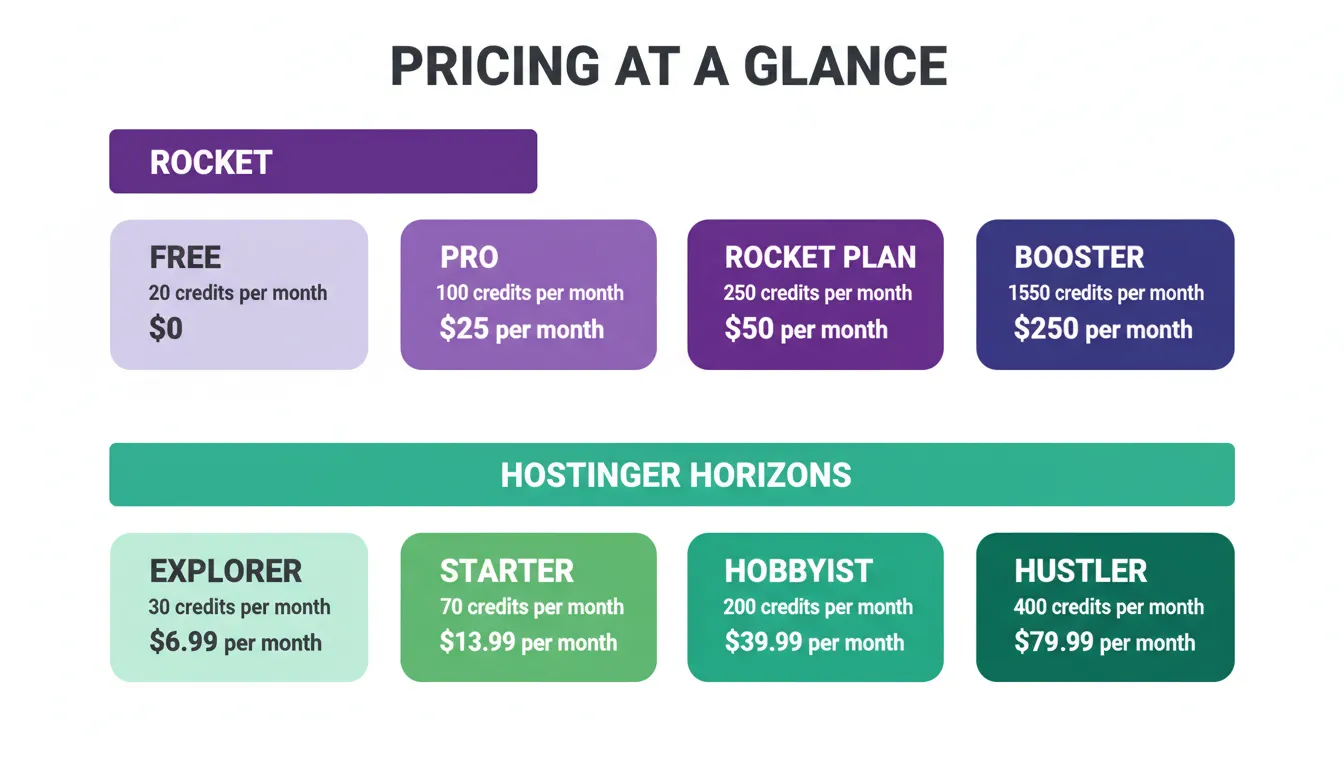
Rocket uses a credit system with no per-seat fees. Every team member gets access, and you spend credits based on what you build, not how many people use the workspace. Unused credits roll over month to month on all paid plans.
-
Free: \$0, 20 credits
-
Pro: \$25/mo, 100 monthly credits
-
Rocket plan: \$50/mo, 250 monthly credits
-
Booster: \$250/mo, 1,500 monthly credits
Hostinger Horizons tiers plans by feature access and website count, with AI credits allocated monthly:
-
Explorer: \$6.99/mo, 30 credits, 1 website
-
Starter: \$13.99/mo, 70 credits, 25 websites
-
Hobbyist: \$39.99/mo, 200 credits, 50 websites + code editor
-
Hustler: \$79.99/mo, 400 credits, early access to new features
Rocket's model favors growing teams. Unlimited members at every tier, with pricing tied purely to usage. Horizons' model suits solo creators and small agencies managing multiple sites.
Mobile Apps: The Biggest Gap in This Comparison
This is where the two platforms diverge most sharply. Rocket generates Flutter mobile apps with production-level theming, animations, and fluid navigation.
These apps can be downloaded as APKs for Android testing, submitted to Google Play, or sent through App Store Connect. No AI website builder in this category ships to app stores. To understand how Rocket approaches this, see the full breakdown of building a mobile-native app.
Hostinger Horizons is a web-only platform. The output is browser-based only. If mobile distribution matters to your project, Horizons is not a viable option.
How Does Performance Actually Hold Up?
Deployment quality matters as much as the build experience, especially for teams shipping real products.
Rocket deploys web apps to staging first, then to production with a custom domain and automatic HTTPS. Version history, one-click rollback, and built-in analytics covering visitors, conversions, and Core Web Vitals are all included post-launch.
Rocket's Intelligence pillar runs in the background after launch. It monitors competitors, surfaces pricing changes, product updates, and messaging shifts. That's a layer Hostinger Horizons doesn't touch.
Hostinger Horizons deploys directly to Hostinger's infrastructure, fast for simple sites and well-suited for content-driven projects. Base plans don't include a staging/production split, and rollback is available through version history only.
Post-launch is where the gap becomes most visible. Horizons keeps your site live. Rocket keeps your product ahead. For a deeper look at how competitive monitoring works, see how Rocket's Intelligence informs pricing decisions.
Why Rocket Goes Further Than Any Website Builder
Rocket isn't trying to be a better website builder. It's built for the problem that comes before and after the website.
Research before you build: The Solve pillar takes any business question, market sizing, feature prioritization, competitive positioning, and returns a structured brief with evidence and a clear recommendation. That output flows directly into Build, so the first generation reflects real product thinking.
Intelligence after you launch: Rocket monitors every public platform your competitors operate on. Pricing shifts, product launches, messaging updates, all surfaced automatically, without manual tracking on your end.
25,000+ templates covering landing pages, SaaS, mobile apps, dashboards, and more. Start from something close rather than from nothing. You can also learn how to use Rocket templates to get started faster.
Hostinger Horizons is excellent for what it's built for: websites. When you need a real product with real users across web and mobile, the platform gap becomes significant.
Who Should Actually Choose Each Platform?
The answer here isn't about which platform is "better." It's about what you're building and what you need it to do.
Choose Hostinger Horizons if:
-
You need a business website, portfolio, or online store without technical setup
-
Your project is web-only and mobile distribution isn't part of the plan
-
You're already in the Hostinger ecosystem and want everything in one account
-
Budget is the primary constraint and the low entry price fits your scope
Choose Rocket if:
-
You're building a product, web or mobile, that needs to scale with your team
-
You want Flutter apps published to the App Store and Google Play
-
Your team needs research and competitive intelligence alongside the build
-
You want unlimited team access without paying per seat
The connectors system shows the depth difference well. Rocket's connectors documentation shows how 25+ services fit into complex product workflows, from Supabase for backend data to Stripe for payments. Horizons covers the basics well, but the depth isn't there for more demanding use cases.
For teams deciding between the two, this decision flowchart captures the key questions:
The Right Tool for the Job You're Actually Doing
Hostinger Horizons earns its place for anyone who needs a web presence built quickly and cleanly. The pricing is accessible, the infrastructure is solid, and for straightforward web projects the experience is genuinely smooth. It's a strong option in the website builder category.
Rocket operates on a different premise: thinking, building, and tracking all in one place. When you need a mobile app on the App Store, a product informed by real research, and competitive intelligence running while you ship, one platform is built for that work. When the stakes are higher, the platform should be too.
Ready to build something real? Start for free at Rocket.new, no credit card required. Your first 20 credits are free, and the first generation takes minutes.
Table of contents
- -What Sets These Two AI Builders Apart?
- -How Do Their Core Features Compare?
- -Where Do These Platforms Fall Short?
- -Which Pricing Model Actually Works for You?
- -Mobile Apps: The Biggest Gap in This Comparison
- -How Does Performance Actually Hold Up?
- -Why Rocket Goes Further Than Any Website Builder
- -Who Should Actually Choose Each Platform?
- -The Right Tool for the Job You're Actually Doing