Rocket.new replaces blank prompts with a guided, structured workflow that builds full-stack apps instantly. It automates backend logic, reduces iteration errors, and deploys apps with one click. Unlike traditional AI builders, it takes you from idea to a live product, not just code.
Does the way you start building an app change what you end up with?
The low-code/no-code market is growing at 25% annually, now a $50 billion global opportunity. Teams choose between guided systems like Rocket.new and blank prompt AI tools. The difference shapes key features like automated backends, responsive layouts, and whether your app reaches real users.
What Makes Rocket.new's Build Different from Every Other AI Builder
-
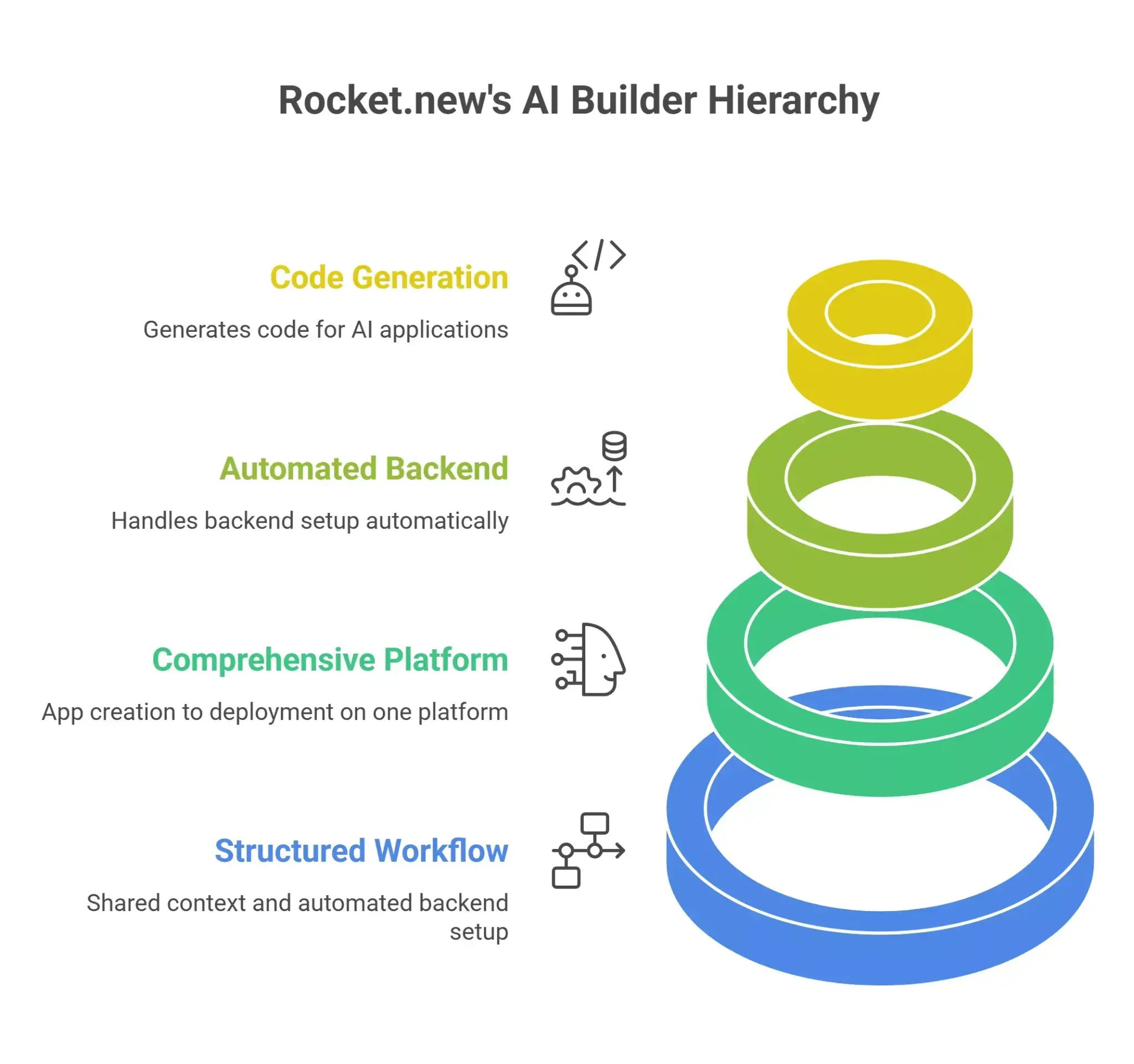
Rocket.new uses a structured workflow with shared context and automated backend setup
-
Blank prompt builders drop you into an empty field
-
Rocket handles the entire process from app creation to deployment on one platform
-
Blank prompt builders typically stop at code generation
Starting a Project: Guided Setup vs Blank Canvas
Rocket.new's Guided Approach
Rocket.new generates full-stack applications from a single natural language prompt, producing both frontend and backend components simultaneously, making app building faster and more accessible for both technical and non-technical users.
-
The AI-powered platform asks about your app type, then offers framework selection before you write a prompt
-
Users select from 25,000+ templates covering internal tools, landing pages, SaaS products, and mobile apps
-
Non-technical users get guardrails without coding knowledge
Rocket.new integrates AI-powered market research, database setup, and one-click deployment into a single, continuous workflow. This allows users to create production-ready applications in minutes, significantly reducing the time typically required for app development.
Blank Prompt Builders
-
An empty prompt box with minimal guidance
-
Users specify every detail: database schemas, api endpoints, deployment configuration
-
Effective prompts require understanding software architecture
Building Features and Iterating
Template-Driven Development
-
25,000+ templates reduce token consumption by up to 80% compared to blank prompt code generation
-
The visual editor allows UI adjustments without new prompts
-
Shared context means the AI assistant builds on what exists when you add meaningful features
Rocket.new supports vibe coding for refining projects through natural language, along with structured commands for granular control.
Blank Prompt Iteration
-
Users re-prompt for each modification, risking breaks to earlier functionality
-
Without templates or shared context, generated code may conflict with prior decisions, requiring manual fixes
-
Community feedback cites degradation when building beyond simple prototypes
Backend Logic and Infrastructure
Automated Backend Generation
-
Rocket.new handles database management, api endpoints, user authentication, and role-based access control
-
Multiple AI agents manage frontend, backend code, and database schema simultaneously
-
Built-in connectors for Stripe, Supabase, and data protection
This full-stack generation means users get exportable code with proper backend setup.
Blank Prompt Backend Gaps
-
Users manually specify database schemas and API structures
-
Vague prompts produce gaps: missing authentication, malformed schemas, incomplete errors
-
Many builders focus on UI only, leaving full-stack capabilities to the user
Deployment and Production Readiness
One-Click Deployment
The platform goes from local builds to a live website quickly with one-click deployment.
-
Automated pipeline with hosting, custom domains, and SSL
-
GitHub sync enables version control and code export
-
The app development platform handles bundling and server setup
Rocket supports web apps (Next.js) and native mobile apps (Flutter/React Native) from a single prompt. Blank prompt builders stop at generating code, and the gap between rapid prototyping and production-ready applications stays wide.
| Feature | Rocket.new | Blank Prompt Builders |
|---|---|---|
| Project setup | Guided workflow | Empty prompt box |
| Backend logic | Auto-generated | User-specified |
| Deployment | One-click | Manual configuration |
| Context | Shared across sessions | Resets per prompt |
| Code ownership | Full GitHub export | Varies |
| Mobile apps | Flutter and React Native | Rarely supported |
| Custom domains | Included | User handles separately |
Rocket.new vs Blank Prompt Builders: Choosing the Right Approach
-
Pick Rocket for faster app development with production-ready code and deployment included
-
The AI app builder works well for SaaS products, internal tools, or web and mobile apps
-
Pick blank prompt builders if you need maximum manual control
-
Rocket's unified workflow from one prompt to a live app suits users who want working software quickly
Rocket.new generates a complete production-ready app in minutes. Blank prompt AI-assisted development suits developers who prefer building from scratch.
What People Are Saying
"For small business owners who understand what it can do, it will save them insane capital. Build your own micro services to do the work you pay 10 different subscriptions for." - Source: Reddit
That matches what teams experience comparing guided builds to blank prompt no-code tools. The no-code builder approach removes the need to write code for every feature.
How Rocket.new Handles the Full Build Process
Rocket.new vs blank prompt AI builders comes down to coverage. The AI app builder uses advanced models to take a single natural language prompt and produce full-stack applications. Designers import Figma designs directly into functional, responsive code. The platform tracks competitor changes for deep research.
-
Vibe-solutioning platform: Describe what you want in conversational language. Rocket generates a working web app or mobile app.
-
Figma-to-Code: Import Figma designs into functional code with real-time collaboration.
-
25k+ templates library: Start from a template for reporting views, landing pages, or management panels.
-
Saves up to 80% tokens: Fewer prompts mean faster builds across paid plans.
-
Supports Flutter (mobile) and Next.js (web): Build across multiple platforms.
-
Collaboration built in: Team members share one project with version control.
-
3 Products in One: Solve handles research. Build creates your app. Intelligence delivers briefs.
Rocket.new uses a token-based pricing model where consumption varies by complexity. The free tier offers 1 million tokens. Paid plans include Starter at $25/month for 5 million tokens and Pro at $100/month ($80/month annually). Rocket automates app creation end-to-end, producing clean, exportable code for live deployment serving real data.
Where this works best:
-
A startup uses natural language prompts to build a web and mobile SaaS product handling complex business logic
-
A no-code user imports a Figma design with AI features and Google Docs-style collaboration
-
A product team builds internal tools with AI-powered backend logic and AI assistance
Better Apps Start with Better Build Processes
Rocket.new's build process vs. blank prompt AI builders comes down to how much structure you want. Guided workflows with templates, automated backends, and one-click deployment ship production-ready code faster.
For teams that want a live app rather than code fragments, the guided approach closes the gap between idea and real users.
Table of contents
- -What Makes Rocket.new's Build Different from Every Other AI Builder
- -Starting a Project: Guided Setup vs Blank Canvas
- -Rocket.new's Guided Approach
- -Blank Prompt Builders
- -Building Features and Iterating
- -Template-Driven Development
- -Blank Prompt Iteration
- -Backend Logic and Infrastructure
- -Automated Backend Generation
- -Blank Prompt Backend Gaps
- -Deployment and Production Readiness
- -One-Click Deployment
- -Rocket.new vs Blank Prompt Builders: Choosing the Right Approach
- -What People Are Saying
- -How Rocket.new Handles the Full Build Process
- -Better Apps Start with Better Build Processes