
Rocket.new catches competitive signals across pricing changes, hiring patterns, messaging shifts, and social media in real time from multiple sources. Here is how its AI-powered intelligence system spots the moves that even experienced analysts miss.
The Speed Problem in Competitive Intelligence
What happens when a competitor changes pricing on a Tuesday afternoon and your sales team does not find out until the following quarter?
They lose deals. AI-powered competitive intelligence tools are projected to grow from $557.6 million in 2026 to $1.28 billion by 2033, and the reason is straightforward: competitor signals now move faster than any human analyst can track them manually.
The market has shifted. Companies and businesses that still rely on periodic reports miss the signals their competitors act on daily. Customers are choosing companies whose positioning reflects the latest market reality, and revenue growth depends on catching those signals early.
The shift toward AI-powered monitoring systems is not a trend. It is a response to a real problem: human analysts cannot process enough data fast enough.
Why Most Competitive Intelligence Runs on Stale Data
The Quarterly Report Trap
-
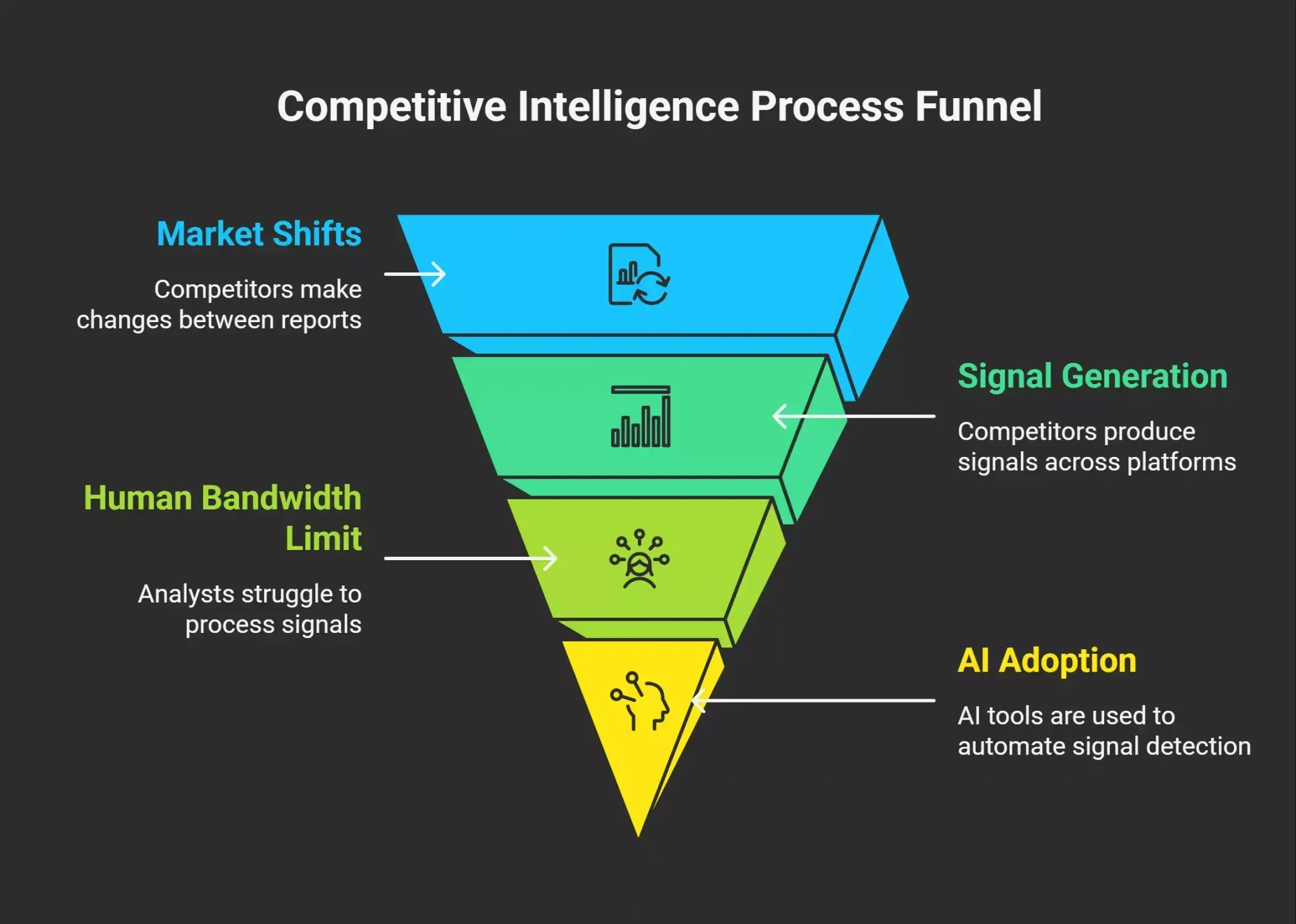
Traditional competitive intelligence methods rely on quarterly reports, and those reports create a false sense of completeness. Companies treat these snapshots as market analysis, but the market moves between reports.
-
A competitor can shift pricing, launch new messaging, and restructure their sales team in the 90 days between reports. Market shifts in positioning and customer targeting all happen between cycles.
-
Competitor activity does not pause. Pricing changes happen mid-week. Hiring patterns shift overnight. New positioning appears without press releases. Customers switch to competitors whose positioning better matches their needs, and businesses that miss those signals lose revenue.
So the real problem is timing. By the time a senior analyst finishes a competitor report, the market has already moved. Companies that save time by automating signal detection stay ahead.
How Signal Volume Outpaces Human Bandwidth
-
A single competitor generates signals across their website, job boards, social media, review platforms, press releases, ad campaigns, and pricing pages simultaneously. Each signal carries information about its positioning, customers, and strategic shift in market focus.
-
Most companies and businesses cannot dedicate an analyst to this process alone. Monitoring four or six competitors becomes a full-time job.
-
AI adoption in competitive intelligence grew 76% year over year, with 60% of teams now using AI tools daily. AI agents now save time by scanning signals that would take an analyst days to review.
The bottleneck is throughput. Even the best analyst can only process one signal at a time, and competitors generate hundreds of signals per week. Market analysis at this speed requires AI agents. For marketing teams, this gap is especially costly. Learn how marketing teams use Rocket.new's Intelligence before committing campaign budget to stay ahead of competitor moves.
Competitive Signals That Move Faster Than Any Analyst
Pricing Changes Across Competitor Product Pages
-
Pricing changes are among the fastest-moving signals in competitive markets. A competitor can adjust pricing tiers, add new plans, or shift their pricing positioning in minutes. Companies that monitor competitor pricing in real time gain a competitive edge in sales calls.
-
These pricing changes happen without press releases. Your sales team only finds out when a customer mentions it during a call. Meanwhile, customers shopping between companies see updated positioning and pricing before your sales team does.
-
In competitive markets where deals close quickly, learning about pricing changes late directly affects revenue.
-
Small pricing changes often signal a bigger strategic shift. When a competitor moves from per-seat to usage-based pricing, that strategic shift affects their entire market positioning. It tells you where that competitor expects future revenue growth. An AI-powered system catches that shift within hours.
Hiring Patterns and Hiring Signals That Reveal Strategic Direction
-
Hiring patterns are one of the most reliable early indicators of a competitor's strategic direction. When a competitor starts hiring AI engineers, they are building AI features months before any public announcement. Companies reveal their market strategy through who they hire.
-
Hiring signals go beyond individual job postings. A burst of hiring signals in a specific region signals a market expansion that no press release has mentioned. Customers in that region will see new competitor positioning soon.
-
A co-founder or executive hiring spree in a new product area signals a strategic shift in market segment focus. Hiring patterns also reveal contraction: fewer jobs posted quarter over quarter tells you about their growth trajectory and revenue outlook.
-
AI-powered systems track hiring signals continuously, spotting changes in team size and strategic direction that an analyst would need weeks to piece together. AI agents save time by correlating hiring signals with other competitor signals automatically.
Messaging Shifts and New Messaging on Competitor Sites
-
Messaging shifts are subtle. A competitor changes "affordable" to "enterprise grade" on their homepage. That is a strategic shift in positioning. Their positioning now targets different customers in a different market segment.
-
New messaging on product pages and ad campaigns reveals where a competitor sees their next market. That positioning shift tells you which customers they plan to go after next. A monitoring system catches each shift as it happens.
-
These messaging shifts happen constantly across landing pages, ad copy, and product descriptions. Each change is a signal about market positioning. Together, the signals form a clear pattern of strategic direction that companies need to track.
-
Sales teams that catch new messaging early can adjust their own positioning in real time. AI-powered tools flag new messaging within hours, giving teams the context to respond. That analysis of competitor positioning happens automatically.
Social Media Signals and Customer Feedback
-
Social media signals include competitor activity on their own channels, plus what customers are saying on review platforms and forums. Customer signals on social media reveal market sentiment that surveys miss.
-
Customer feedback on review sites reveals customer pain points with a competitor's product. A spike in negative reviews is a signal your sales team can act on. Those customers may be open to switching.
-
When customers complain about a competitor's pricing changes or missing features, that data feeds directly into your positioning strategy. Businesses that track customer feedback signals across social media and review sites get a clearer picture of competitor weaknesses.
-
Social media also reveals competitor campaigns and co-founder commentary that hints at strategic decisions before formal announcements. The market signals are there.
-
AI agents monitor social media and customer signals in real time, surface signals that indicate a strategic shift, and connect those signals to other competitor activity. This analysis covers more market signals than any analyst could. Every shift in competitor behavior becomes visible.
Competitor Ad Spend as a Competitive Signal
Tracking where competitors invest their ad budgets across platforms like LinkedIn, Meta, and Google reveals intent data that most teams overlook. A sudden increase in ad spend targeting a new audience segment is a buying signal for the market, not just a media buy.
Rocket.new tracks competitor ad spend on LinkedIn, Meta, and Google and connects those budget shifts to strategy changes automatically, giving sales teams and marketing teams the context they need before a campaign launches.
How AI-Powered Systems Read Patterns Across Multiple Data Sources
Connecting Raw Data Into Strategic Context
-
The real value of AI-powered competitive intelligence is pattern recognition across multiple data sources. Businesses that focus on connecting signals across channels get a competitive edge in positioning and market analysis.
-
A pricing change viewed alone is just a number. But pair that pricing change with enterprise sales hires, new messaging targeting larger companies, and a press release about an enterprise partnership, and a clear picture emerges: this competitor is going upmarket. Their positioning, customers, and market focus are all shifting.
-
Competitor signals arrive at different times from different channels. For companies monitoring multiple competitors in competitive markets, manual connection breaks down.
-
AI agents process signals from multiple data sources simultaneously, synthesizing raw data into a single strategic alert. This competitor analysis happens in hours.
-
The real power of pattern recognition is speed. An AI-powered system can connect signals early, while a human analyst might not notice the pattern until the next quarterly review. That speed difference can mean the difference between winning and losing customers.
Predictive Intelligence From Structured Data
-
Predictive intelligence uses historical data and current signals to forecast competitor moves. When a competitor increases ad spend in a new region and starts hiring sales reps fluent in that region's language, the system flags a probable market expansion before any announcement. That early signal gives teams time to adjust positioning and focus.
-
By combining hiring patterns, pricing changes, and ad spend patterns, predictive intelligence surfaces competitor moves weeks before they become public. Companies that act on these signals early protect their market position and revenue.
-
Structured data makes this possible. Raw data becomes structured data when organized by signal type, timestamp, and competitor. That structured data feeds predictive models that help businesses anticipate market shifts. Product market fit analysis improves when teams see where competitors are losing customers.
-
Real-time data enrichment can lead to 25% faster decision-making and 30% higher revenue growth, according to the Competitive Intelligence Alliance.
Signal Type Comparison: Human Analyst vs. AI-Powered Intelligence
| Capability | Senior Human Analyst | AI-Powered Intelligence System |
|---|---|---|
| Pricing changes detected | Checks weekly or when remembered | Monitors continuously, alerts within hours |
| Hiring signals tracked | Scans job boards manually, limited to 2 to 4 competitors | Tracks all competitors across all job sources in real time |
| Messaging shifts caught | Notices obvious rebrand, misses subtle copy changes | Flags every text change on monitored pages |
| Signals connected across sources | Connects patterns with effort over weeks | Links signals across multiple data sources automatically |
| Time to strategic insight | Days to weeks | Hours |
| Coverage of competitor activity | Partial, depends on analyst's focus and bandwidth | Full coverage across 150+ sources, 24/7 |
| Predictive intelligence | Based on experience and intuition | Based on structured data and historical patterns |
What the Community is Saying
Sales teams and product teams are feeling the shift from static competitive intelligence to continuous signal monitoring. Bryn Harrington, Product Marketing Lead at Oura, described the change in the Competitive Intelligence Alliance's 2025 trends report:
"I use AI really frequently for competitive analysis and market insights. So, trying to understand what our competitors in the consumer wearable space are doing and looking at new market entries." - Source: Competitive Intelligence Alliance
That reflects what many teams are experiencing: competitive intelligence has moved from an occasional project to a daily operational need. The companies that treat competitor analysis as a continuous process are the ones pulling ahead.
How Rocket.new Catches the Competitive Signals That Teams Miss
Rocket.new is a Vibe Solutioning platform that combines strategic research, software development, and competitive intelligence into one platform. Rocket connects the thinking, building, and competitor tracking into a single system with shared context. For companies in competitive markets, every market signal feeds directly into product decisions and positioning.
Rocket continuously scans over multiple sources, including competitor websites, job postings, review platforms, social media, and press releases. It identifies messaging changes, hiring patterns, and pricing changes within hours, connecting those signals so teams see the full picture. Rocket.new Intelligence gives companies the coverage that used to require a dedicated analyst team.
Here is what Rocket.new brings to competitive intelligence specifically:
-
Vibe Solutioning platform: Rocket is the only platform where teams can research what to build (Solve), build it (Build), and track competitors (Intelligence) without switching tools. Three products, one platform.
-
25,000+ templates library, free to use: Teams starting new projects pick from 25k+ templates that Rocket adapts to their brand, stack, and goals.
-
Supports Flutter (mobile) and Next.js (web): Build production-ready mobile apps and web apps directly from your competitive intelligence findings.
-
Collaboration features built in: Cross-functional teams share signal dashboards, reports, and project context without leaving the platform.
-
3 Products, One Platform: Solve, Build, and Intelligence: Solve handles strategic research and market analysis. Build turns decisions into production code. Intelligence watches every competitor move continuously.
Use Cases That Connect Competitive Signals to Action
-
Sales team deal prep: Your sales team gets a daily brief showing every competitor pricing change, new messaging update, and product launch. They walk into calls with current competitor intelligence. The background for the call is ready before anyone asks. Sales teams that use real-time competitor signals know competitive risks before the call starts and close more deals because their positioning matches the current market.
-
Product market fit tracking: A product team monitoring competitor customer feedback and hiring signals spots a gap. A competitor's customers complain about slow onboarding, and the competitor just cut their customer success team size. Rocket connects the signals early and feeds context into a Solve task, improving product market fit analysis with live market data.
-
Strategic response to competitor moves: A competitor shifts new messaging toward enterprise, raises pricing, and starts hiring enterprise sales reps. Rocket connects these signals into a single alert. Your team launches a strategic response within days. Companies that respond to market shifts this fast protect their positioning and revenue.
-
Co-founder and leadership monitoring: A competitor's co-founder starts posting about AI on social media and the company posts 12 new AI engineering roles. Rocket spots the hiring signals and messaging shift together. Your product team adjusts their strategic direction before the competitor announces the feature.
Rocket does not just collect raw data. It synthesizes scattered competitor activity, pricing changes paired with job listings and new messaging, into strategic alerts. It builds persistent project memory that stores every historical signal and market trend inside the platform, so intelligence compounds over time. To see how this plays out before a high-stakes deal, read what Rocket.new Intelligence surfaces for sales teams before an enterprise deal closes.
Where Small Teams and Sales Teams Get the Most Real Value
Why Team Size Matters for Competitive Intelligence
-
Small teams cannot afford a dedicated competitive intelligence analyst. Signals get missed. Customers go to competitors whose positioning is sharper because those companies invested in market signal tracking.
-
For small teams, Rocket replaces the need for a full-time analyst. A team of four gets the same competitor coverage as a company with a 20-person team. That team size advantage disappears when businesses use AI-powered intelligence.
-
Sales teams get more value from continuous signals than from periodic reports. Real time data on pricing changes lets your sales team adjust positioning before closing deals. Revenue depends on having the latest competitor positioning and market data.
-
Growth stage companies in competitive markets need to react to market changes quickly. Rocket gives small teams the ability to focus on strategic decisions. The growth comes from acting on signals, not spending hours collecting them.
Turning Intelligence Into Revenue
-
Competitive intelligence creates real value only when it reaches the right people. Sales teams need competitor signals before calls. Revenue growth requires that intelligence reaches the teams that act on market signals.
-
Rocket delivers intelligence to teams that act on it. Daily briefs go to sales. Signal dashboards go to product. Each team gets the competitor positioning and market analysis relevant to their focus.
-
Companies that activate competitive intelligence across cross-functional teams report an 84% lift in competitive sales effectiveness when sales teams receive AI summarized intelligence daily.
-
The difference between data and intelligence is context. Raw data is a pricing change. Intelligence is that pricing change combined with hiring signals, messaging shifts, and customer feedback, connected into a recommendation. Businesses that treat competitor signals as context for strategic decisions see the most growth.
For a deeper look at how Rocket.new turns competitor ad spend into actionable signal, see how Rocket.new converts competitor ad spend into strategic intelligence.
Building an Intelligence System That Compounds Over Time
Why Persistent Memory Changes the Process
-
Most competitive intelligence tools reset every session. Companies lose their competitive analysis history and repeat the same market research quarterly.
-
Rocket.new Intelligence builds persistent project memory that stores every historical signal and market trend inside the platform. Customers who use Rocket over time report that the system surfaces competitor positioning shifts they would have missed entirely.
-
The system learns what normal competitor activity looks like for your market, and flags signals that deviate from the pattern. That process compounds: the more signals it collects, the more accurately it spots strategic shifts.
-
For businesses that compete over long sales cycles, this compound intelligence is where the real power sits. Customers benefit from an intelligence system that remembers every past competitor move.
From Reactive Monitoring to Predictive Intelligence
-
Traditional competitive intelligence is reactive. That process costs companies market position and revenue.
-
AI-powered systems generate predictive intelligence. They spot signals early, connect them to historical patterns, and flag probable competitor moves. Companies that use predictive intelligence make better strategic decisions because they anticipate market changes.
-
Rocket processes real-time data from over 150 sources to detect intent rather than isolated events. When a competitor's hiring patterns, messaging, and pricing all point in the same strategic direction, Rocket identifies the pattern and alerts your team. That market analysis happens automatically, letting teams focus on the strategic response.
-
The shift from reactive to predictive changes how teams make strategic decisions. Instead of responding to market shifts after they happen, teams anticipate market changes and position ahead. Businesses that make this shift gain a positioning advantage that grows over time.
If your team is still waiting for the bi-weekly analyst brief, see what Rocket.new catches before that report even arrives.
Staying Ahead When Competitive Signals Never Stop
The market does not wait for quarterly reviews. Competitor signals flow continuously through pricing changes, hiring patterns, messaging shifts, social media, customer feedback, and press releases. Asking which competitive signals does Rocket.new catch that a senior human analyst would be too slow to identify leads to a clear answer: the ones that happen simultaneously across multiple channels, too fast for any single person to track. The competitive edge belongs to teams that let AI-powered intelligence handle the monitoring while they focus on the strategic response.
Stop reacting to competitor moves after they happen. Start catching competitive signals before your rivals act on them with Rocket.new.
Table of contents
- -The Speed Problem in Competitive Intelligence
- -Why Most Competitive Intelligence Runs on Stale Data
- -The Quarterly Report Trap
- -How Signal Volume Outpaces Human Bandwidth
- -Competitive Signals That Move Faster Than Any Analyst
- -Pricing Changes Across Competitor Product Pages
- -Hiring Patterns and Hiring Signals That Reveal Strategic Direction
- -Messaging Shifts and New Messaging on Competitor Sites
- -Social Media Signals and Customer Feedback
- -Competitor Ad Spend as a Competitive Signal
- -How AI-Powered Systems Read Patterns Across Multiple Data Sources
- -Connecting Raw Data Into Strategic Context
- -Predictive Intelligence From Structured Data
- -Signal Type Comparison: Human Analyst vs. AI-Powered Intelligence
- -What the Community is Saying
- -How Rocket.new Catches the Competitive Signals That Teams Miss
- -Use Cases That Connect Competitive Signals to Action
- -Where Small Teams and Sales Teams Get the Most Real Value
- -Why Team Size Matters for Competitive Intelligence
- -Turning Intelligence Into Revenue
- -Building an Intelligence System That Compounds Over Time
- -Why Persistent Memory Changes the Process
- -From Reactive Monitoring to Predictive Intelligence
- -Staying Ahead When Competitive Signals Never Stop