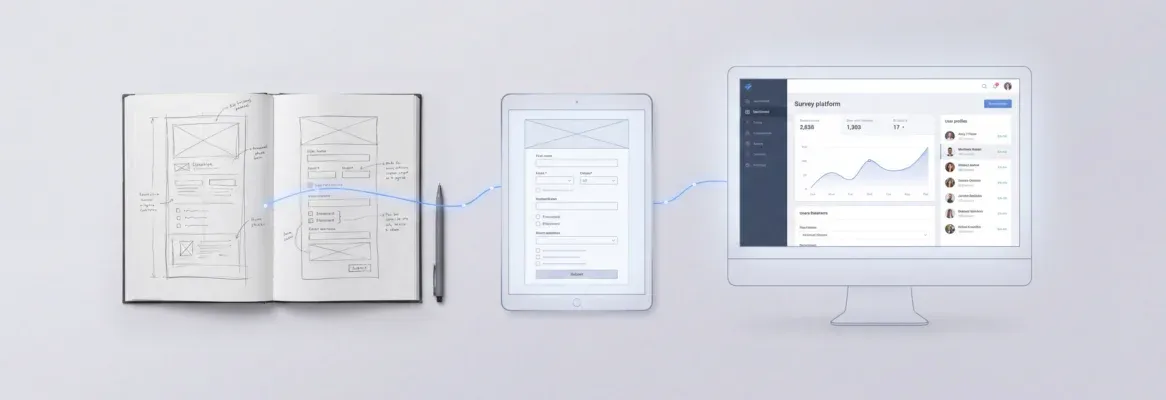
Rocket.new tracks competitor pricing, hiring, ads, customer sentiment, and positioning changes in real time instead of waitin. g 14 days for analyst reports. By connecting live market signals with AI-driven insights, teams can react faster, plan smarter, and stay ahead of competitors.
Why Does a 14-Day Delay Still Exist in Competitive Intelligence?
What happens to your strategy when competitor data arrives two weeks after competitors have already moved?
-
The short answer: you lose. A competitor changes pricing on a Tuesday, shifts positioning on a Thursday, and starts a new campaign on Friday. Your biweekly analyst brief covers none of it until the next cycle.
-
According to the Competitive Intelligence Alliance, real-time data enrichment enables 25% faster decision-making and drives 30% higher revenue growth.
-
That gap between "it happened" and "we know about it" is where market share changes hands.
The Timing Problem With Traditional Research Agencies
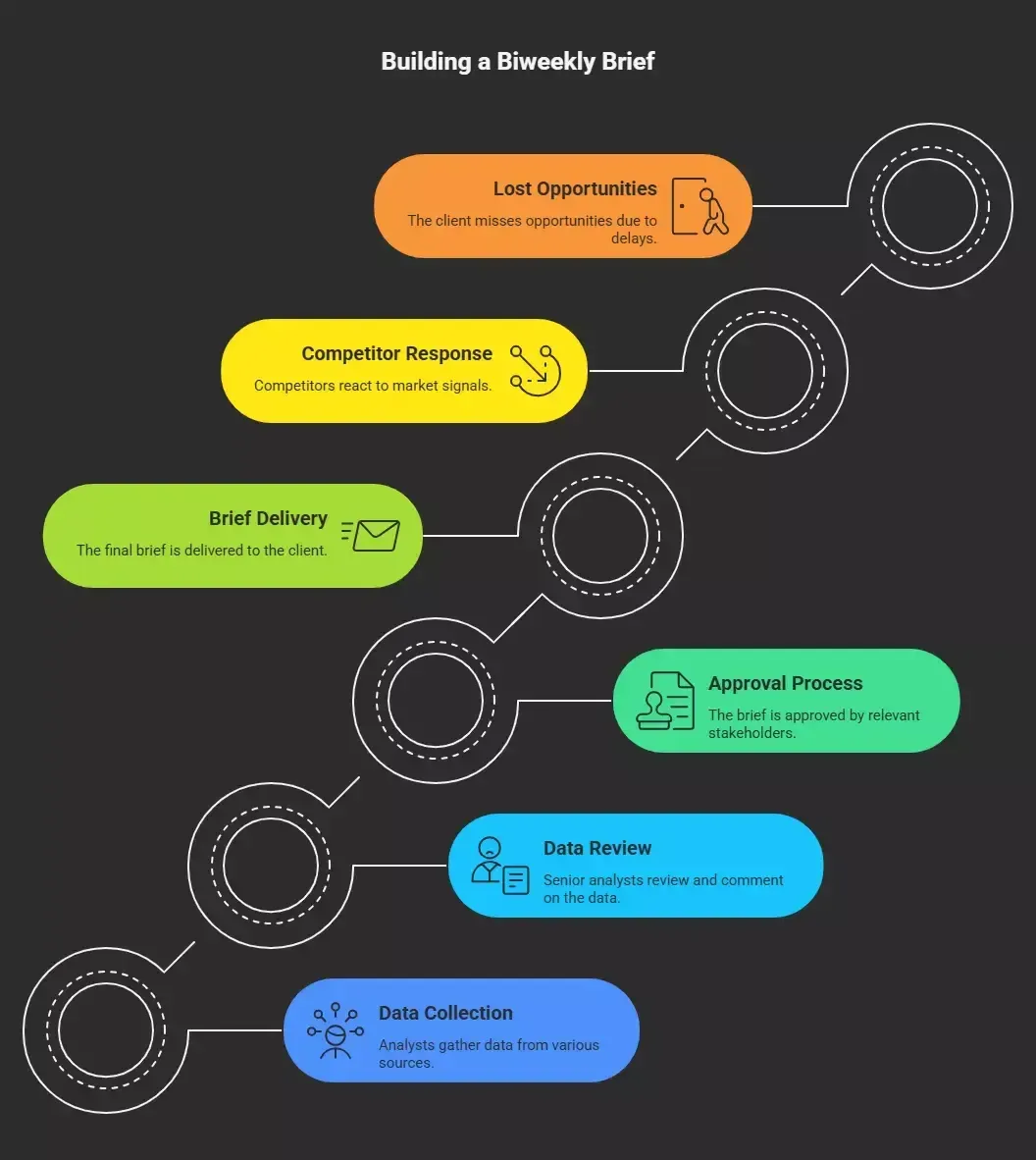
How a Biweekly Brief Gets Built
-
An analyst at a research agency collects data from data sources like competitor websites, press releases, job boards, and social media posts.
-
That data goes through a review process. A senior analyst checks it, writes commentary, and routes it for approval.
-
The final product lands in your inbox between days 10 and 14.
-
By then, your competitors have already responded to the same market signal.
What a 14-Day Window Actually Costs
-
A competitor drops pricing by 15% to win a contract. Your sales team does not know for 14 days. They lose the deal. You can expect this pattern to repeat.
-
A rival posts eight new engineering team job listings for a product you own. That hiring signal tells you they plan to compete directly.
-
A competitor redesigns their landing page to target your best segment. Your marketing team keeps running last month's strategy.
The cost is not just lost deals. It is the inability to fix your plan while a fix still matters.
Six Signal Categories That Move Faster Than Any Analyst Brief
Rocket.new uses parallel AI agents to monitor and connect six categories of real-time public data. Each moves on its own timeline, and none waits for a biweekly publishing schedule.
Pricing and Packaging Changes
-
A competitor updates their pricing page. Rocket.new flags, code-level page adjustments, pricing updates, and plan structure changes automatically.
-
Your team sees the alert within 90 minutes of detection.
-
With that evidence in hand, your team can adjust its own pricing strategy before prospects start comparing.
Website and Competitor Positioning Shifts
-
Website changes often signal a pivot in messaging, audience targeting, or product direction. Rocket automatically flags competitor page rewrites across their web properties.
-
A research agency analyst checking a site every 14 days catches the "after" state. They miss the context involved.
-
A positioning change paired with a new ad campaign tells a different story than a quiet update.
Hiring and Team Expansion Signals
-
Rocket.new tracks job postings by department to indicate potential competitor pivots before public announcements.
-
When a competitor posts for six machine learning AI engineers and a Head of AI, that is a strategy signal. It tells your team where they plan to invest before any press release confirms it.
-
A biweekly brief might note "Competitor X is hiring." Rocket tells you which roles, which departments, and what the pattern means for their product roadmap.
Ad Spend and Campaign Activity
-
Rocket.new continuously monitors live ad spend shifts and new campaign activity across platforms like LinkedIn, Meta, and TikTok.
-
If competitors double their LinkedIn ad budget targeting your buyer persona, you want to know today.
-
Rocket connects ad spend data and hiring trends to predict market directions ahead of quarterly planning.
Social Media, Press, and Partnerships
-
Rocket.new monitors real-time posts, press coverage, and partnerships on social media and the web.
-
Competitors announcing a partnership with a major channel player is a signal that changes your go-to-market plan for that segment.
-
A research agency might include this in their next brief, but only if their analyst saw the post before the reporting deadline.
Customer Review Sentiment
-
Rocket.new tracks customer review sentiment shifts on sites like G2, Capterra, and Glassdoor.
-
If a competitor's G2 rating drops from 4.5 to 3.8 in a single sprint because of a buggy release, that is a window your sales team can use immediately.
-
Product teams that synthesize customer feedback into structured insights can identify patterns related to feature requests, customer journey breakdowns, and churn drivers, which are crucial for informed decision-making.
-
Research from Bain and Company shows that while 80% of companies believe they are customer-centric, only 8% of customers agree, highlighting a significant disconnect that can impact product development and customer experience.
-
If your own reviews trend negative, you need that data now so your team can fix the issue, not read about it later.
What Moves in 14 Days: A Side-by-Side Comparison
| Signal Type | Biweekly Analyst Brief | Rocket.new Intelligence |
|---|---|---|
| Pricing change | Noted in next scheduled report (7 to 14 day delay) | Flagged within 90 minutes of detection |
| New job posting cluster | Mentioned if the analyst checks job boards | Tracked by department, the pattern surfaced daily |
| Ad campaign starts | Rarely covered unless specifically requested | Monitored continuously across ad platforms |
| Website positioning shift | Captured as a static screenshot, if at all | Code-level diff detection with timestamp |
| Customer review drop | Summarized at the end of the reporting period | Sentiment shift flagged same-day |
| Partnership announcement | Included if the analyst monitors that news source | Detected and linked to competitor profile automatically |
👉Start using Rocket.new today to turn real-time competitor signals into faster strategic decisions and shipped products.
How Real-Time Competitive Intelligence Changes Your Strategy
Moving From Reactive to Anticipatory
-
AI tools that surface predictive analytics allow product teams to shift from reactive to anticipatory decision-making, modeling likely future outcomes instead of reviewing past performance.
-
Rocket.new evaluates ongoing market changes rather than reporting historical data after delays.
-
BCG's research on strategic foresight found that strategists need the ability to detect and decipher signals of potential disruptions, which can be weak but materialize fast (BCG, January 2025).
Connecting Signals Across Data Points
-
A single signal is easy to misread. A pricing change alone could be a promotion. A pricing change combined with new hires, a shifted ad strategy, and updated web code tells a clearer story.
-
Rocket.new connects these data points and generates structured, evidence-backed reports recommending specific actions rather than listing raw data.
-
Research agencies typically deliver their competitive analysis in isolation. Pricing sits separately from hiring data.
-
Rocket identifies patterns that signal competitor expansion plans or product direction before they are publicly announced.
Building a Living Project From Your Market Intelligence
-
All past insights and competitor signals are stored in a single workspace in Rocket.new, giving your project continuity.
-
When a new team member joins, they access the same project history and context that everyone else on the team uses.
-
A research agency sends you a PDF or a zip file. When the engagement ends, your project history walks out the door with them.
From Quarterly Planning to Continuous Strategy
Why Quarterly Reviews Are Not Enough Anymore
-
Continuous monitoring of competitor activity replaces the old model of doing a deep dive once per quarter, allowing teams to monitor signals like pricing shifts, hiring patterns, product launches, and messaging changes from multiple sources.
-
A strategy brief should include competitive analysis, customer feedback patterns, usage data highlights, and a clear recommendation on what to build next, serving as a shared context layer during quarterly planning.
-
Product teams that track competitors and customer feedback in real time spot market openings that others miss.
-
Research shows that organizations using product-led growth strategies create faster feedback loops, allowing them to build products that better match market demands during quarterly planning.
Creating a Strategy Brief in 60 to 90 Minutes
-
A strategy brief should include competitive analysis, customer feedback patterns, usage data highlights, and a clear recommendation on what to build next.
-
On Rocket.new, your team can generate a strategic brief in 60 to 90 minutes because the research, competitor data, and project context are already in the platform.
-
Compare that to the traditional process: wait for the analyst brief, cross-reference with internal data, build slides, and present. That takes seven days at a minimum.
Using Structured Data to Plan Better
-
Structured data transforms raw data into organized insights, enabling product teams to prioritize initiatives before planning begins.
-
Using structured data allows product managers to shift from gathering data to interpreting it, leading to faster decisions and more value delivered per quarter.
-
Product teams that synthesize customer feedback into structured insights can identify patterns: which features customers ask for most and where the customer journey breaks down.
-
Companies adopting AI in product development have seen efficiency improvements of 25 to 30%, reducing manual effort in preparation for planning sessions.
What the Community Is Saying
Wade Allen, Executive Leadership Advisor, recently posted about this gap on LinkedIn:
"Most leadership teams don't get this signal in time. They rely on internal reporting, secondhand summaries, filtered feedback. By the time the truth is obvious, the market has already moved." - Source: Wade Allen on LinkedIn
That observation matches what the data shows. Bain and Company found that 80% of companies believe they deliver a superior customer experience, but only 8% of their customers agree. The disconnect comes from relying on internal views instead of current data from the market.
How Rocket.new Catches What Biweekly Analyst Briefs Cannot
So what specifically does Rocket.new catch that a BI weekly analyst brief from a research agency would arrive too late to use? Every signal that moves faster than a 14-day publishing cycle. The platform catches it, connects it, contextualizes it, and tells your team what it means for your next move.
Rocket.new is the world's first vibe solutioning platform. It integrates research, AI-driven analysis, and execution into a single, continuous workflow. Where other AI tools help you build faster, Rocket tells you what to build and tracks what your competitors do after you build it.
Here is what the platform includes:
-
Vibe solutioning platform that combines research (Solve), app building (Build), and competitive intelligence (Intelligence) into one platform
-
25,000+ templates library, free to use across web app projects, mobile app projects, landing pages, and dashboards
-
Supports Flutter for mobile and Next.js for web, with staging and production environments for deployment
-
Collaboration features built in: unlimited team members across all paid plans, with role-based access and shared project context
-
3 Products, One platform: Solve, Build, and Intelligence, each working independently or together with shared context
Use Cases That Link Competitor Tracking to Action
-
Track and respond to competitor pricing in the same day. Rocket flags a pricing change, your team runs a Solve task to analyze risk and impact, and a Build task creates a response landing page. All with no context lost.
-
Spot a hiring pattern and adjust your roadmap. The tracking module surfaces a cluster of competitor hires in a new product area. Your engineering team reviews the signals and creates a plan to accelerate development.
-
Turn customer feedback into an advantage. Rocket monitors review sentiment across G2 and Capterra. When competitors drop in service quality, your team can create targeted messaging and launch it the same sprint.
-
Run a competitive analysis before a board meeting. Instead of waiting for an agency report, your team pulls live data from Rocket, generates a strategy brief through Solve, and presents market data instead of stale research.
Getting Started: From Free Plan to Full Coverage
-
Rocket offers a free plan with 20 credits and access to all Build capabilities. Start building and testing the platform without a credit card.
-
The free tier lets you experience vibe coding, code generation, and AI-powered app building firsthand.
-
The Build plan starts at $25 per month with 100 credits, unlimited team members, and deployment to custom domains.
-
The Solve plus Build plan at $250 per month adds research capabilities, prompt features, and structured project outputs.
-
The full plan at $350 per month adds 24/7 tracking, daily briefs, and trend synthesis.
-
All plans include unlimited team members and credits that never expire.
-
Create an account at Rocket.new and start building in minutes.
How Rocket Support Helps Your Team
-
Rocket support includes documentation at Rocket docs covering every feature of the service, from Figma design imports to connector setup.
-
The platform's prompt features help generate better code and project outputs by suggesting improvements before you submit.
-
Rocket support is also available through the help service and active Discord community when your team hits a blocker.
-
For enterprise needs like SSO and data localization, teams can link with the support service directly to create a custom plan. Teams can also expect messaging updates on new features through the platform.
Bridging the Gap Between Customer Feedback and Product Development
Why Most Teams Misread Their Own Customers
-
Customer feedback arrives through support tickets, NPS surveys, sales call transcripts, social channels, and review sites.
-
Without a system to aggregate and fix these blind spots, teams involved in product development build features nobody asked for.
Using AI to Aggregate Feedback Across Channels
-
Generative artificial intelligence can summarize customer feedback from various channels into a single pattern, helping product teams identify key insights without manual aggregation.
-
On Rocket, you can run a Solve task that pulls from review sites, support tickets, and survey results to generate a report with clear recommendations. The process takes minutes, not days.
-
That report feeds directly into your Build workflow. No re-explaining the project context to a separate tool.
-
The ability to go from research to code generation in the same project is what separates a single platform from a stack of disconnected AI tools.
Why Speed Without Context Fails Too
The Risk of Alerts Without Interpretation
-
Raw alerts without analysis create noise. Getting 40 notifications a day about minor web code edits is not actionable.
-
Rocket.new provides automated daily briefs that synthesize competitor signals into a cohesive strategic narrative. The brief tells you what changed, why it matters, and how to respond.
-
The risk of acting on a single data point without connecting it to the broader strategy is that you overreact to noise or miss the signal that matters.
How Context Carries Across Every Project and Prompt
-
Rocket.new gives teams the ability to adjust app roadmaps in real-time based on newly detected competitor features.
-
The platform stores every previous Solve task, Build task, and competitor signal in a shared project, so your plan starts with full context.
-
When you write code or generate a web app in response to a competitor signal, the AI already knows your product, your market, and your previous decisions.
-
By integrating research, app building, and tracking tools into the platform, Rocket reduces the need for switching, giving team members access to every piece of evidence and all features in one place.
When Waiting is the Wrong Strategy
Traditional competitive intelligence had a fixed rhythm: quarterly deep-dives, biweekly briefs, and monthly check-ins. That rhythm matched a market that moved at the same pace. Today's market does not wait for your publishing schedule.
Rocket.new eliminates the need for waiting periods by providing immediate answers about competitors. It delivers continuous, AI-powered data and actionable clusters you can expect to act on the same day. If your team can test a response, launch a deployment, and fix your messaging before competitors know you saw the signal, you are not keeping up. You are ahead.
Table of contents
- -Why Does a 14-Day Delay Still Exist in Competitive Intelligence?
- -The Timing Problem With Traditional Research Agencies
- -How a Biweekly Brief Gets Built
- -What a 14-Day Window Actually Costs
- -Six Signal Categories That Move Faster Than Any Analyst Brief
- -Pricing and Packaging Changes
- -Website and Competitor Positioning Shifts
- -Hiring and Team Expansion Signals
- -Ad Spend and Campaign Activity
- -Social Media, Press, and Partnerships
- -Customer Review Sentiment
- -What Moves in 14 Days: A Side-by-Side Comparison
- -How Real-Time Competitive Intelligence Changes Your Strategy
- -Moving From Reactive to Anticipatory
- -Connecting Signals Across Data Points
- -Building a Living Project From Your Market Intelligence
- -From Quarterly Planning to Continuous Strategy
- -Why Quarterly Reviews Are Not Enough Anymore
- -Creating a Strategy Brief in 60 to 90 Minutes
- -Using Structured Data to Plan Better
- -What the Community Is Saying
- -How Rocket.new Catches What Biweekly Analyst Briefs Cannot
- -Use Cases That Link Competitor Tracking to Action
- -Getting Started: From Free Plan to Full Coverage
- -How Rocket Support Helps Your Team
- -Bridging the Gap Between Customer Feedback and Product Development
- -Why Most Teams Misread Their Own Customers
- -Using AI to Aggregate Feedback Across Channels
- -Why Speed Without Context Fails Too
- -The Risk of Alerts Without Interpretation
- -How Context Carries Across Every Project and Prompt
- -When Waiting is the Wrong Strategy