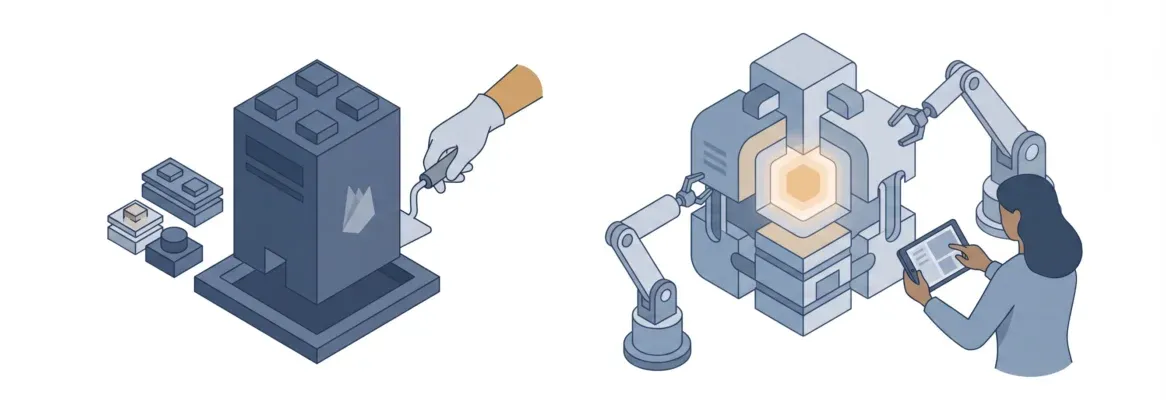
Rocket.new vs Softr comparison reveals two platforms built for different goals: Rocket generates production-grade web and mobile apps with full code ownership, while Softr builds portals from existing data sources.
Which AI app builder actually fits your project in 2026: Rocket or Softr?
Softr is rated 4.7 out of 5 on G2 with 721 reviews, and over one million teams have used it to build business apps without writing code. That popularity puts it on every shortlist.
But the gap between "build a portal from your Airtable base" and "generate production-ready software from a prompt" is wider than most comparison articles admit.
This blog breaks down the real differences in features, pricing, mobile capabilities, and output quality so you know exactly which platform fits your project.
What Does Each Platform Actually Do?
These two platforms share a category label but operate on completely different foundations.
Rocket is the world's first Vibe Solutioning platform, where research, building, and competitive monitoring happen in one place with shared context. It ships with three pillars: Solve for idea validation and market research, Build for generating production-ready web and mobile apps, and Intelligence for continuous competitor monitoring.
Softr is a no-code platform focused on building portals, internal tools, and dashboards on top of existing data sources like Airtable, Google Sheets, or Notion. It turns spreadsheets into functional interfaces fast, without any code.
The output types diverge sharply. Rocket produces SaaS products, marketplaces, e-commerce stores, and landing pages with custom design. Softr produces CRMs, client portals, knowledge bases, and internal tools from pre-built blocks.
Code ownership separates them. Rocket gives you downloadable source code you own and can take anywhere. Softr does not export code at all.
Teams exploring alternatives to Softr often land here because the use case has outgrown what a no-code portal builder can deliver.
Rocket's three pillars form a continuous loop: research informs the build, the build surfaces new research needs, and Intelligence keeps both current. Softr follows a linear flow from data source to published portal.
How Do Their Features Compare Side by Side?
Here is what each platform offers across the categories that matter most for choosing an AI app builder.
| Feature | Rocket | Softr |
|---|---|---|
| App types | Web apps, mobile apps, landing pages, e-commerce, SaaS | Portals, internal tools, dashboards, CRMs |
| Code output | Full Next.js and Flutter source code | No code export |
| Mobile apps | Native Flutter (iOS and Android, App Store ready) | PWA only (no native mobile) |
| AI generation | Plain language prompt, builds from scratch in 1-3 min | AI assists with layout and configuration |
| Design quality | Custom design system per project, dark/light theming | Template-based blocks, limited customization |
| Integrations | 25+ native (Stripe, Supabase, OpenAI, Mailchimp, Analytics) | 17+ data sources (Airtable, Notion, Google Sheets, HubSpot) |
| Deployment | One-click staging and production, custom domains | Built-in hosting, custom domain |
| Backend | Supabase (PostgreSQL, auth, storage, edge functions) | Relies on external data sources |
| Pre-build research | Solve: market sizing, competitive analysis, PRDs | None |
| Competitive monitoring | Intelligence: website, social, reviews, advertising | None |
| Version history | Full version history, one-click rollback | None |
| Built-in analytics | Visitors, conversions, Core Web Vitals | Basic |
| Collaboration | Admin/Creator/Viewer RBAC, inline comments | Unlimited collaborators, user groups |
| Compliance defaults | WCAG, GDPR, SEO-ready by default | Manual |
| Pricing starts | Free tier | Free tier ($49/mo Basic) |
Code ownership matters for long-term projects. Rocket lets you download your entire codebase and continue development locally or hand it to any developer. Softr keeps everything inside their platform with no export path.
Platform depth differs substantially. Rocket ships with separate staging and production environments, full version history, and one-click rollback. Softr offers simpler deployment without these safeguards.
In short, Softr wins on speed-to-portal. Rocket wins on scope, code access, and long-term flexibility. Your project type decides which tradeoff matters.
Which One Handles Mobile Apps Better?
Mobile app support is one of the clearest differentiators between these two platforms.
Rocket generates native Flutter apps that run on both iOS and Android from a single codebase. These are real apps you can submit to the App Store and Google Play, with proper navigation, animations, and device-specific patterns. Teams looking to build a mobile app with AI can go from prompt to App Store-ready build without switching platforms or hiring a separate mobile team.
Softr offers PWA (Progressive Web App) support, which means your app can be "installed" on a phone but runs in the browser. It does not produce native mobile experiences or support app store distribution.
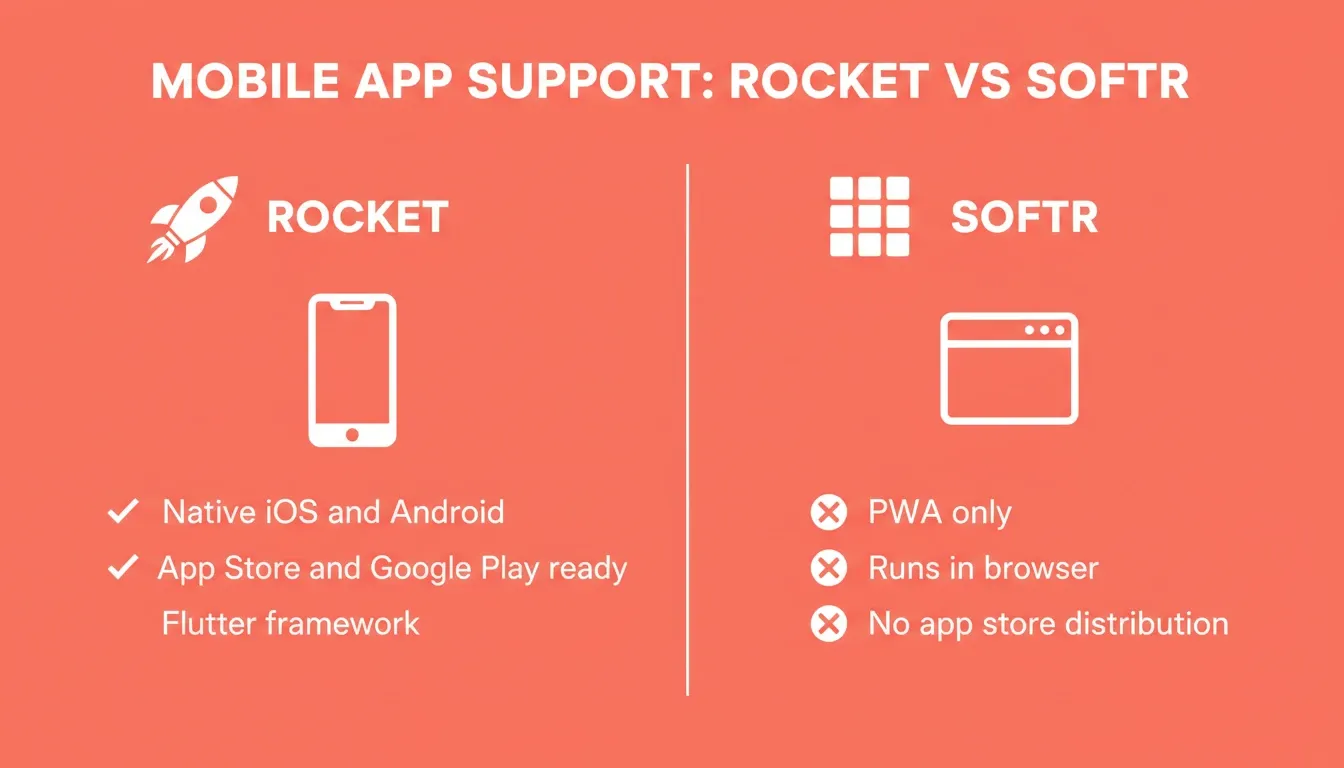
Rocket generates native Flutter apps for iOS and Android app stores. Softr supports PWAs only, which run in a browser with no app store distribution.
What About Pricing and Value?
Both platforms offer free tiers, but what you get at each price point differs considerably.
| Plan Level | Rocket | Softr |
|---|---|---|
| Free | Available (limited credits) | 10 app users, 5K records |
| Starter / Basic | Paid plans scale with usage | $49/mo (20 users, 50K records) |
| Professional | Team features, more credits | $139/mo (100 users, 500K records) |
| Business / Enterprise | Custom pricing, dedicated support | $269/mo (500 users, 1M records) |
Softr charges based on app users and database records. Adding more users gets expensive quickly. The jump from 100 to 500 users costs an extra $130 per month, as confirmed on the Softr pricing page.
Rocket pricing is credit-based. You pay for generation and iteration, not per end-user. Once you deploy, your app can serve unlimited users without additional platform fees.
For small internal tools with a fixed user base, Softr's pricing is straightforward. For products that need to scale without per-user costs, Rocket's model fits better.
Why Builders Choose Rocket for Production Apps
1.5 million people have tried Rocket across 180 countries, from solopreneurs shipping MVPs to enterprise teams running strategy and execution on the same platform. Rocket is backed by Salesforce Ventures and Accel.
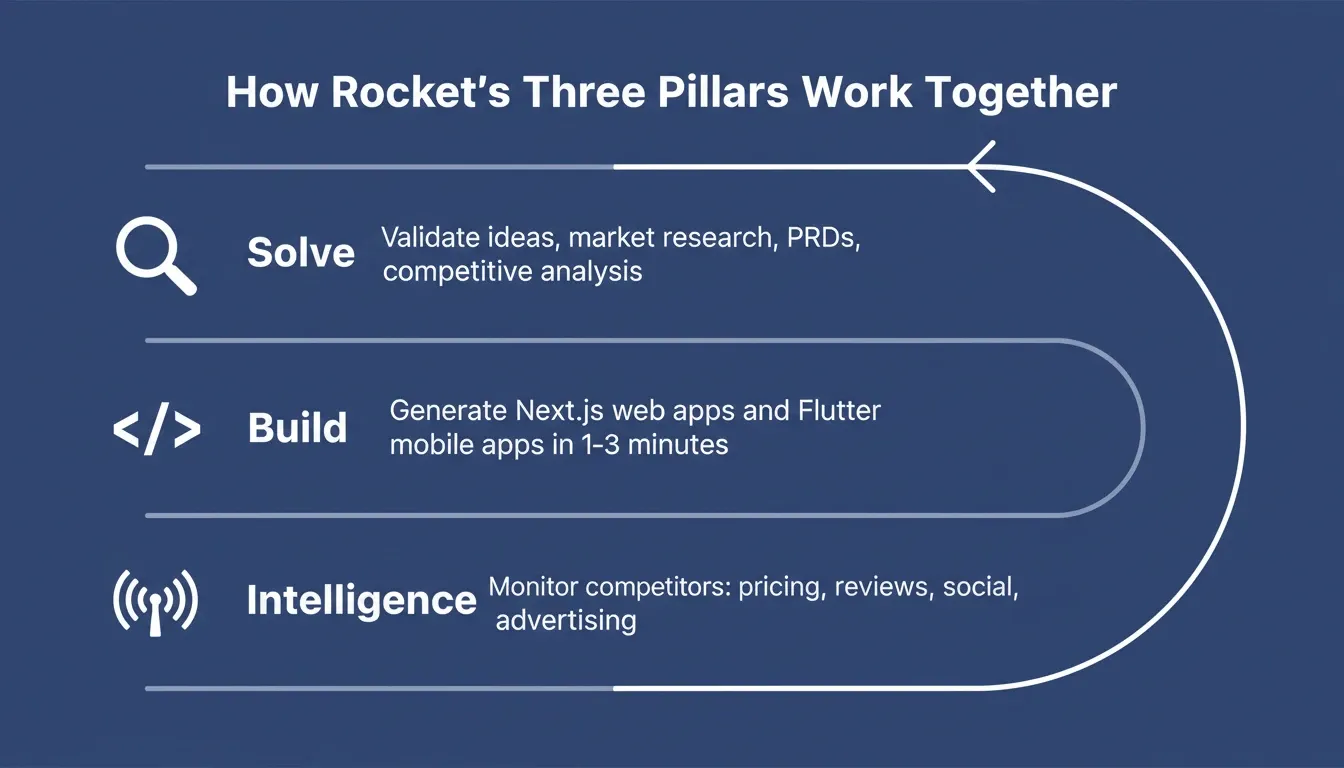
Rocket's three pillars connect in a continuous loop. Research from Solve informs the Build, and Intelligence keeps the product sharp after launch.
Full-Stack Generation from a Single Prompt
Describe your idea, and Rocket produces a working application with UI, navigation, logic, database connections, and deployment configuration. Most apps generate in 1-3 minutes. The framework is assigned automatically: Next.js for web, Flutter for mobile.
Teams exploring what it means to build a full-stack app with an AI prompt will find Rocket covers the complete arc, from the first question to a deployed product. Every build ships with SEO-ready structure, WCAG accessibility compliance, GDPR coverage, and performance optimization by default. These are the baseline, not optional extras.
Pre-Build Intelligence with Solve
Rocket's Solve turns any business question into a structured, evidence-backed report. It queries 150+ sources simultaneously and delivers outputs in 60-90 minutes, covering market sizing, competitive landscape, pricing benchmarks, and actionable recommendations. Export as PDF or PPT.
The research flows directly into your Build task through shared context. You never re-explain your market or product direction. Softr has no equivalent capability.
Continuous Competitive Monitoring with Intelligence
Rocket's Intelligence monitors every public platform a competitor operates on: pricing pages, product updates, social media, customer reviews, job postings, and advertising. It covers four signal categories simultaneously and delivers daily or weekly briefs with interpreted signals, not just raw data.
No other AI app builder includes built-in competitive intelligence alongside building.
25+ Integrations Wired Into Generation
Stripe, Google Analytics, Supabase, OpenAI, Anthropic, Gemini, Mailchimp, Mixpanel, and more connect during the build process, not after it. Authenticate once and they flow into every build.
Code You Own and Can Take Anywhere
Download the full Next.js or Flutter source, continue development locally, or connect your GitHub repository for two-way sync (available for Next.js TypeScript projects). You can also start from an existing Figma design, an existing Next.js codebase, or a URL you want to redesign.
Softr cannot generate custom applications from scratch. It cannot produce native mobile apps. It does not offer source code export. And it has no pre-build research or intelligence layer.
Where Does Softr Still Make Sense?
Softr has genuine strengths for specific use cases that do not require custom software development.
-
Internal tools from existing databases. If your team already lives in Airtable or Google Sheets, Softr turns that data into usable portals without migrating anything.
-
Client portals with role-based access. Softr's user group and permissions system works well for gated content delivery and restricted data views.
-
Non-technical teams building operational tools. Operations, HR, and finance teams can build workflow apps without involving developers at all.
-
Quick prototypes that do not need custom code. When you need something functional by end of day and it does not need to scale or look unique, Softr delivers.
Zapier's 2026 no-code builder roundup names Softr the best option for complete beginners but explicitly notes it is "not a good match for building SaaS products, or anywhere you want unrestricted user growth."
If your needs stay within the portal-and-internal-tool category, Softr remains a solid option for non-technical teams.
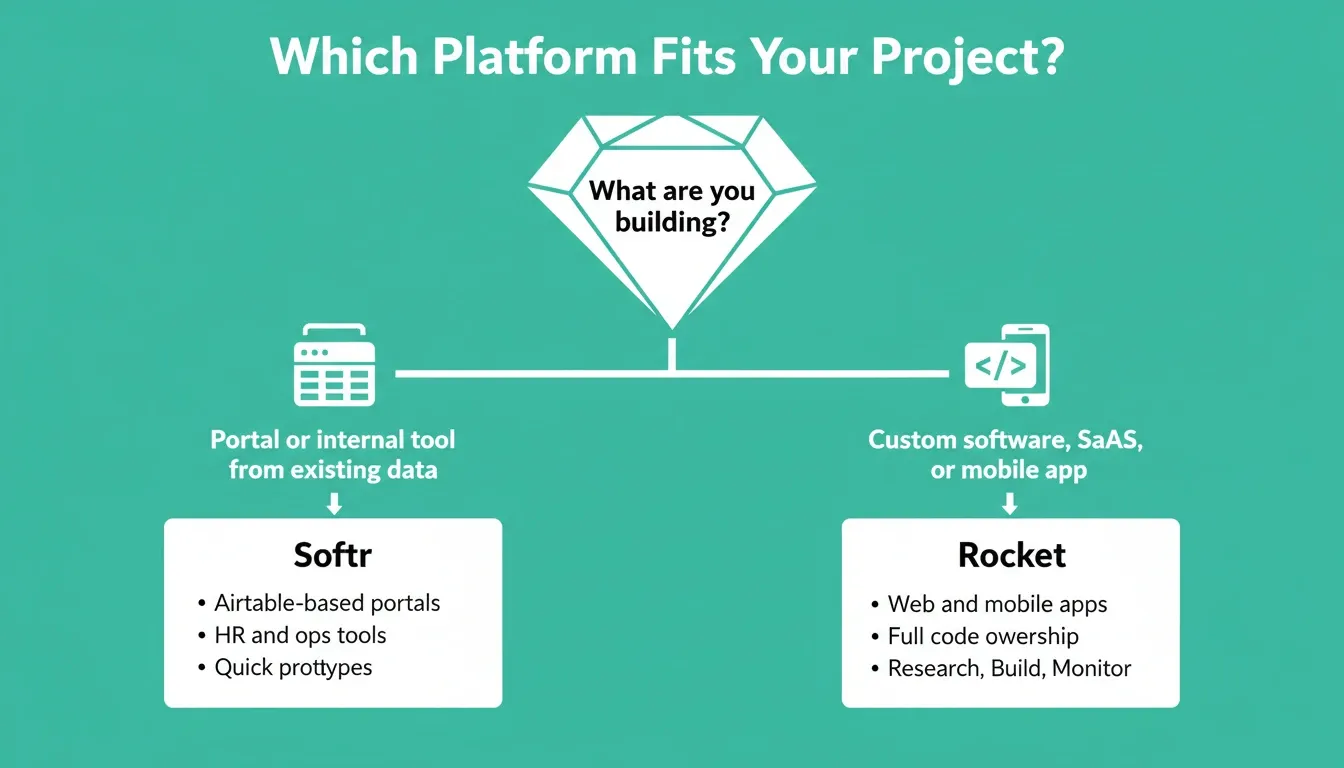
Use this decision framework to match your project type to the right platform. The key question: are you building from existing data, or building new software?
What Happens When You Outgrow Softr?
Softr is excellent for getting something working quickly, but it has hard ceilings worth knowing before you commit.
No code export means you cannot hand the project to a developer to extend it. You are locked into Softr's block system permanently. No native mobile means a separate app requires a completely separate platform and budget. Per-user pricing means costs scale linearly with your audience, and no version history means a bad change can be difficult to reverse cleanly.
When teams hit these ceilings, migration means rebuilding from scratch, because Softr provides no source code to take elsewhere. Starting on Rocket gives you code ownership from day one, which makes future changes, hosting switches, and team handoffs straightforward.
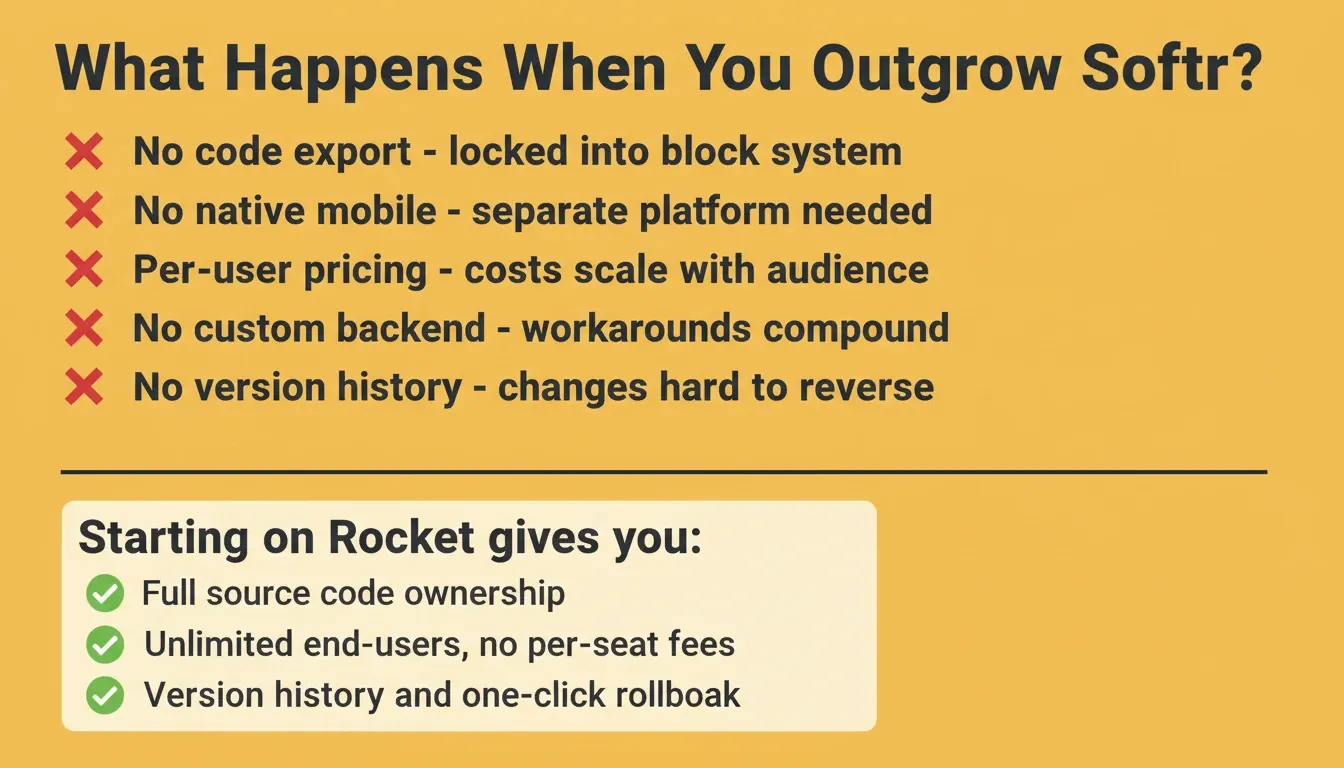
Five hard ceilings teams hit when they outgrow Softr, and what Rocket provides by default from day one.
The Right Platform for the Right Project
Choosing between Rocket.new vs Softr comes down to one question: are you building internal operational tools from existing data, or shipping software that users will interact with daily?
Softr handles the first category with speed and simplicity. Rocket covers both, and gives you the code, the research, the competitive intelligence, and the production infrastructure when you are done.
The AI builder space moves fast. Picking the right foundation now saves months of migration later. Start with what your project actually needs, not what feels fastest today.
Ready to go from idea to deployed product? Start building on Rocket: research, build, and monitor, all in one place.
Table of contents
- -What Does Each Platform Actually Do?
- -How Do Their Features Compare Side by Side?
- -Which One Handles Mobile Apps Better?
- -What About Pricing and Value?
- -Why Builders Choose Rocket for Production Apps
- -Full-Stack Generation from a Single Prompt
- -Pre-Build Intelligence with Solve
- -Continuous Competitive Monitoring with Intelligence
- -25+ Integrations Wired Into Generation
- -Code You Own and Can Take Anywhere
- -Where Does Softr Still Make Sense?
- -What Happens When You Outgrow Softr?
- -The Right Platform for the Right Project