
Use structured, role-separated AI prompts across six phases to build a complete food delivery platform with multi-role auth, real-time tracking, Stripe payments, and admin analytics on Rocket.new without writing traditional code from scratch.
Use these AI prompts for building food delivery app features across six phases: multi-role authentication, real-time GPS tracking, Stripe payments, restaurant dashboards, driver flows, and admin analytics, all from a single prompt-to-production workflow on Rocket's vibe solutioning platform.
Why Do Multi-Role Apps Need Structured Prompts?
Structured prompts are the fastest path to a working food delivery platform because they give the AI the role boundaries, data relationships, and screen logic it needs to generate connected code rather than isolated mockups.
A food delivery app isn't a single product. It's three apps stitched together by shared data, authentication, and order-tracking logic. Without structured prompts, most AI tools generate a generic storefront that misses the authentication layer separating these user roles.
-
Customers need to browse restaurants, filter menu items, add to cart, process payments, and track their delivery in real time on a map
-
Restaurant owners need an order management dashboard, menu management tools, and a system to update preparation status
-
Drivers need to accept orders, view pickup addresses, navigate routes, and update delivery status
-
Admin users need visibility into all transactions, refund controls, delivery time monitoring, and quality control
A vague prompt like "build me a delivery app" gives you a single-page mockup. A structured prompt that specifies role-based authentication, row-level security, and separate navigation flows for each user type produces a functional multi-panel platform. Understanding prompt engineering best practices before you start dramatically improves the quality of every screen you generate.
The global online food delivery market hit $1.51 trillion in revenue for 2026, growing 9.5% year-over-year. That demand means founders and small businesses are racing to launch their own delivery services faster than competitors.
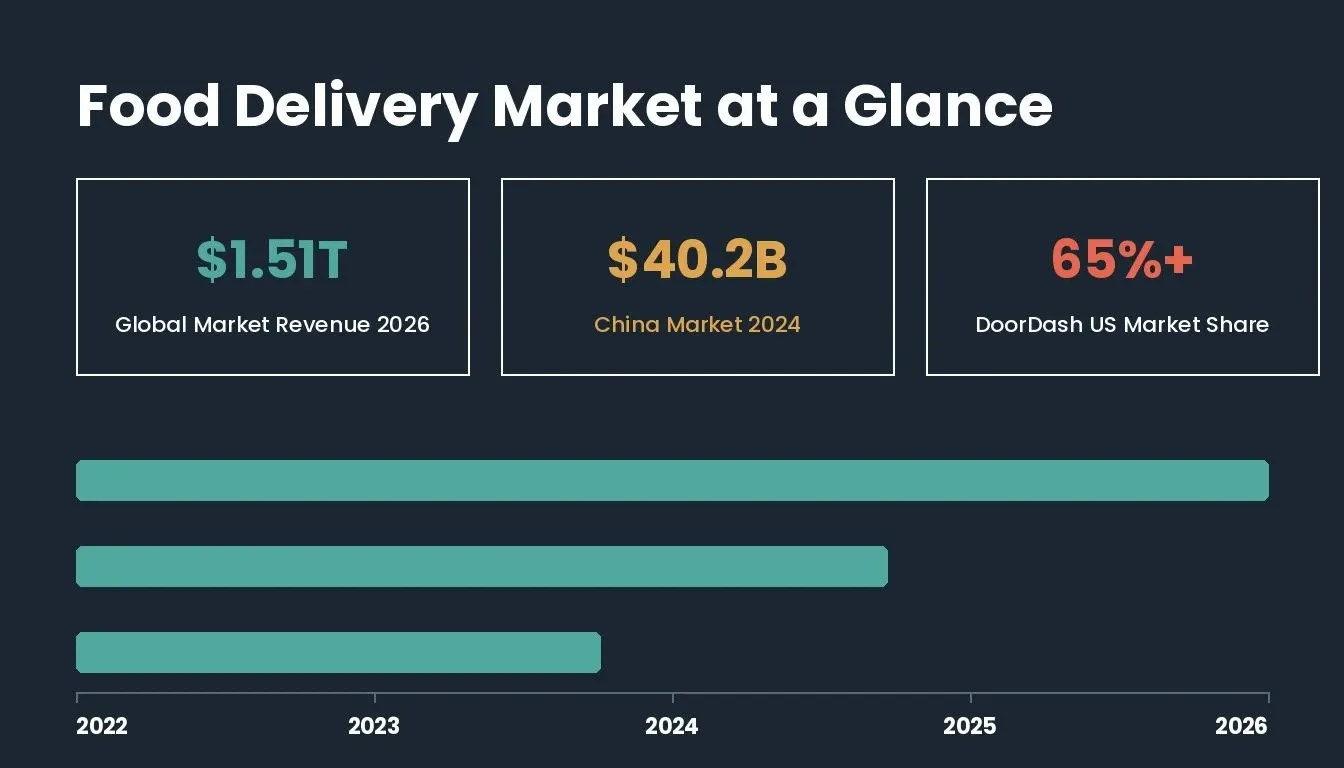
Key food delivery market figures that show why speed-to-launch matters for new platforms
The six-phase approach below gives you ready-to-use AI prompts for building food delivery app features for each role, each feature, and each connection point.
Rocket.new is the vibe solutioning platform built on three pillars: Solve (market research and PRDs), Build (full-stack app generation), and Intelligence (competitor monitoring). Every prompt in this guide runs inside Build, and you can use Solve first to validate your delivery market before writing a single line of code. You can learn more about this approach in the vibe solutioning platform guide.
Rocket.new's three-pillar workflow: research your market in Solve, generate your app in Build, then monitor competitors with Intelligence
Rocket.new's end-to-end workflow from market validation to live deployment
How Should You Prompt for Customer-Facing Features?
Customer-facing prompts should specify the exact layout, filter logic, and payment flow you want — the more precise the prompt, the less iteration the AI needs to produce a working screen.
| Prompt | Expected Output | Verification |
|---|---|---|
| Create a home screen where customers browse restaurants by category. Each card shows name, rating, delivery time, and a food photo. Add filters for dietary preferences, price range, and delivery fees. | Home screen with category filters, restaurant cards, and dual-scroll layout | Cards render with photos; filters narrow results; layout scrolls smoothly on mobile |
| Add a search bar that suggests meals based on past order history and popular items in the user's area. | Search bar with autocomplete and personalized suggestions | Suggestions appear on keystroke; past orders surface correctly |
| Build a cart screen with quantity controls, subtotal, delivery fees, and total. Connect checkout to Stripe with saved cards, Apple Pay, and Google Pay. Redirect to order tracking after payment. | Cart screen with live totals and Stripe checkout | Quantities update total in real time; Stripe test mode processes payment; redirect happens on success |
| After checkout, show a live order status screen with five stages: Confirmed, Preparing, Picked Up, On the Way, Delivered. Include a countdown and map view updating every 10 seconds via the API importer for a mapping provider. | Order tracking screen with status stages, countdown, and live map | Status transitions update correctly; map renders with moving marker; ETA adjusts based on proximity |
| Integrate SMS order updates via Twilio so customers receive a text at each status change. | Twilio SMS connector wired to order status transitions | SMS fires on correct transitions; customers can opt out from settings |
The customer experience layer accounts for about 40% of your total app complexity. These AI prompts for building food delivery app customer flows cover browse, select, pay, and track without leaving gaps that force manual coding later. For a deeper look at building full-stack apps with an AI app builder, Rocket handles the entire stack from a single prompt.
What Prompts Generate a Working Restaurant Dashboard?
Restaurant dashboard prompts should specify the exact columns, data fields, and automation rules. Rocket generates the full Kanban board, CRUD interface, and analytics panel from a single well-structured prompt.
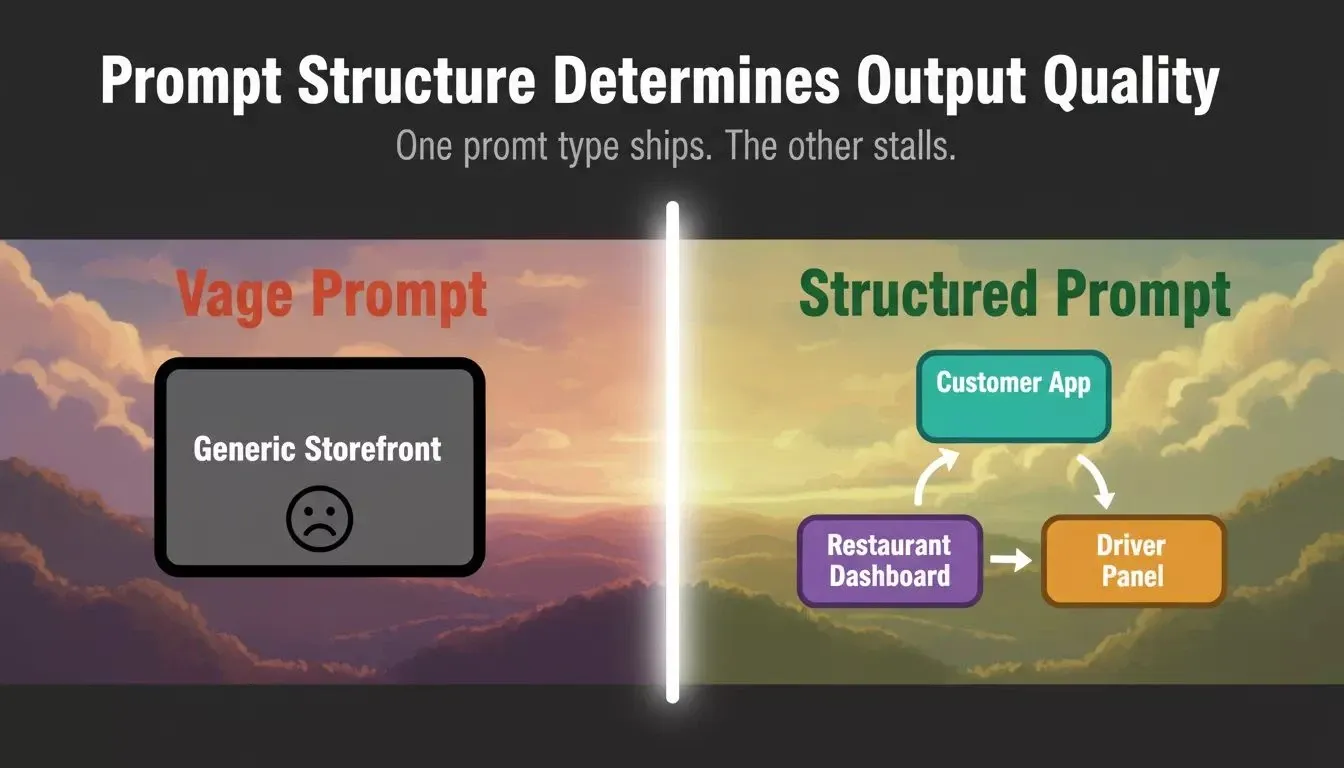
Vague prompts produce isolated mockups. Structured prompts generate connected, multi-role platforms.
| Prompt | Expected Output | Verification | Follow-Up |
|---|---|---|---|
| Create a restaurant dashboard showing incoming orders in three columns: New, Preparing, Ready for Pickup. Each card shows items, customer name, order time, and a timer. | Kanban board with drag-and-drop order cards | Cards move between columns; timer counts up from order placement | Add sound notification when new orders arrive and auto-sort by oldest first |
| Build a menu management screen where restaurants can add, edit, and remove items. Each item has name, description, price, category, photo upload, and availability toggle. | CRUD interface with photo upload and category filters | Items save to database; toggling availability hides from customer view | Add bulk price update and seasonal menu scheduling |
| Generate an inventory panel showing stock levels per ingredient. When stock drops below threshold, mark the item unavailable and send an alert. | Dashboard with stock indicators and automated status changes | Low-stock items auto-disable on customer app; alert fires | Add supplier reorder triggers and weekly usage reports |
| Create a restaurant analytics screen showing daily order count, average prep time, ratings breakdown, and revenue by menu category. | Analytics dashboard with charts and KPI cards | Data matches order history; ratings display accurately | Add comparison to previous week and export to CSV |
The food delivery industry generated $40.2 billion in China alone during 2024, with DoorDash holding over 65% market share in the US. Restaurants handling orders manually at this scale simply cannot keep up. Each prompt above specifies the exact layout, data fields, and user interactions needed, removing guesswork from the AI generation process.
Which Prompts Handle Driver Assignment and Live Tracking?
Driver-side prompts need to specify timing intervals, sync targets, and fallback behaviors explicitly — the AI generates working real-time logic only when the prompt names the exact data that must flow between driver, restaurant, and customer views.
| Prompt | Expected Output | Verification | Follow-Up |
|---|---|---|---|
| Create a driver registration flow with document upload (license, vehicle registration, insurance), background check consent, and bank account setup. After approval, show a home screen with an Available toggle and earnings summary. | Multi-step registration with document upload and driver home screen | Document uploads save correctly; toggle changes availability in dispatch system | Add a weekly earnings breakdown showing deliveries, tips, bonuses, and payout schedule |
| When a driver is available, show incoming requests with restaurant name, pickup address, distance, ETA, and payout. Include Accept and Decline buttons with a 30-second countdown timer. | Request card with countdown and accept/decline flow | Only available drivers see requests; declining returns order to queue; accepting assigns exclusively | Add batch delivery support for two orders from the same restaurant to nearby addresses |
| Use the API importer to connect a mapping provider (such as Google Maps) for real-time driver location tracking. Update position every 5 seconds. Show optimal route with turn-by-turn overlay. Sync driver location to customer tracking screen and restaurant dashboard. | Map screen with live driver marker, route overlay, and cross-role sync | Map renders without lag; location updates propagate to customer view within 5 seconds; route recalculates on deviation | Add traffic-aware routing that recalculates ETA when driver hits congestion |
| After the driver marks an order as delivered, prompt for a delivery photo, update order status across all views, trigger a rating request SMS via Twilio, and return the driver to Available status in Supabase. | Delivery completion flow with photo upload, status sync, and SMS trigger | Photo saves to order record; status updates in real time for all users; driver becomes available immediately | Add a dispute flow where drivers can flag incorrect addresses with photo evidence |
Speed matters for couriers. Each prompt specifies exact timing intervals, data sync requirements, and fallback behaviors so the generated code handles edge cases from day one. The Supabase integration in Rocket.new handles real-time subscriptions, row-level security, and multi-role auth automatically when you describe user roles in your prompt.
How Does Rocket Turn These Prompts Into Production Apps?
Rocket generates full-stack Next.js and Flutter code from natural language prompts, connecting all three user roles to the same database, authentication layer, and real-time subscription system in a single build session.
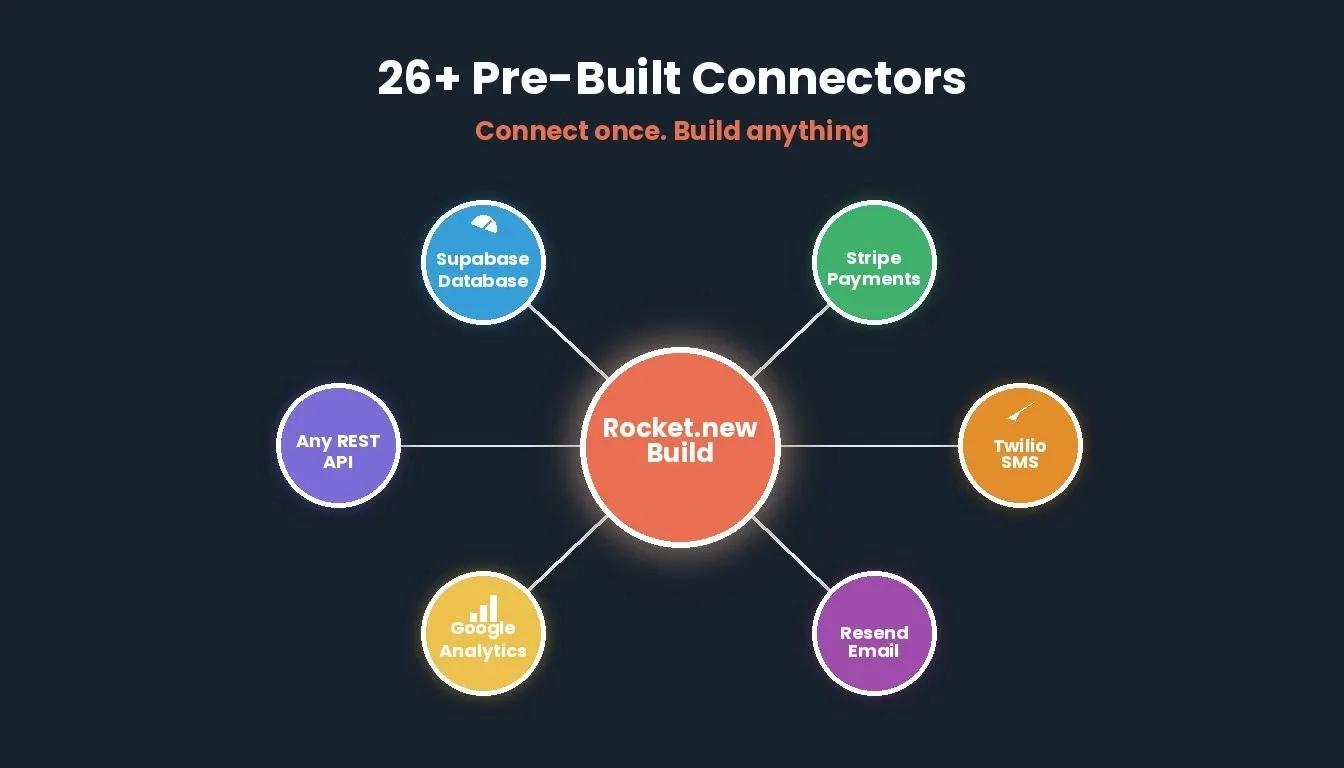
Rocket.new's connector library spans payments, databases, SMS, email, analytics, and any REST API via the importer
-
Built-in Supabase connector means your authentication, database tables, and row-level security policies generate automatically when you describe user roles in your prompt
-
26+ pre-built connectors span payments (Stripe, Razorpay), email (Resend, SendGrid, Brevo, Mailchimp, MailerLite), SMS (Twilio), AI models (OpenAI, Anthropic, Gemini), databases (Supabase, Airtable), analytics (Google Analytics, Mixpanel), CRM (HubSpot), and more
-
Any REST API can be imported via Postman collection, cURL command, or Swagger spec, so mapping providers, push notification services, and any third-party tool can be wired in even if not in the pre-built connector list
-
The builder understands context across prompts so when you generate a restaurant dashboard after creating customer flows, Rocket connects them to the same order table, the same status workflow, and the same real-time subscription layer
-
One-click deployment takes your project from local preview to a live URL with SSL, CDN, and scalable hosting in a single step
-
Credits power every action across Solve, Build, and Intelligence from a single shared balance
Many AI builders generate frontend-only prototypes that lack database connectivity and multi-role authentication. Rocket handles the full stack: frontend, backend, database, auth, and deployment from a single prompt-to-production workflow. This is why building a startup with vibe coding on Rocket produces deployable apps rather than static prototypes.
"97% of developers on enterprise teams have used AI coding tools at some point in their workflow."* — GitHub 2024 Developer Survey*
What Prompts Add Notifications, Payments, and Compliance?
Real-time notification and compliance prompts should name the exact connector, trigger condition, and user preference toggle; this gives Rocket the specificity it needs to generate working integration code rather than placeholder comments.
| Prompt | Expected Output | Verification | Follow-Up |
|---|---|---|---|
| Integrate Twilio SMS notifications. Send a text to customers when order status changes (confirmed, preparing, picked up, delivered). Send SMS alerts to drivers for new requests. Send SMS to restaurants for new orders. Include opt-out preferences in each user's settings. | Twilio connector wired to order status transitions across all three roles | SMS fires on correct transitions; users can toggle categories on/off; delivery confirmation triggers feedback request | Add email order updates via Resend for customers who prefer email. Include order summary, ETA, and support contact. |
| After each completed order, generate a payment summary showing the split: 70% to restaurant, 15% to driver, 15% platform fee. Display pending and completed payout totals in each user's earnings section. Configure actual multi-party payouts in the Stripe Dashboard using Stripe Connect after generation. | Earnings summary screens for restaurant and driver with split breakdown | Split percentages display correctly; earnings history is accurate; Stripe Dashboard link is accessible | Add a refund flow: if a customer reports a missing item, allow support to issue a partial refund from the admin panel |
| Add GDPR compliance: cookie consent banner, data export for users, account deletion with 30-day grace period, and encrypted storage for payment info. Include PCI DSS compliance by never storing raw card numbers and rely on Stripe tokens only. | GDPR banner, data export endpoint, deletion workflow, and tokenized payment storage | Cookie banner blocks tracking until consent; data export generates downloadable JSON; deletion removes personal data after a grace period | Add food safety compliance: require restaurants to confirm allergen info per item and display warnings at checkout |
These food delivery services prompts handle the invisible infrastructure that keeps your platform compliant, your users informed, and your payment flows working smoothly. Rocket's AI-powered API builder with built-in authentication ensures that security and compliance layers generate alongside your feature code, not as an afterthought.
How Do You Prompt for Admin Analytics and Quality Control?
Admin analytics prompts should specify every KPI, chart type, and automation threshold explicitly, Rocket generates the full dashboard from a single prompt when the data model and trigger conditions are clearly stated.
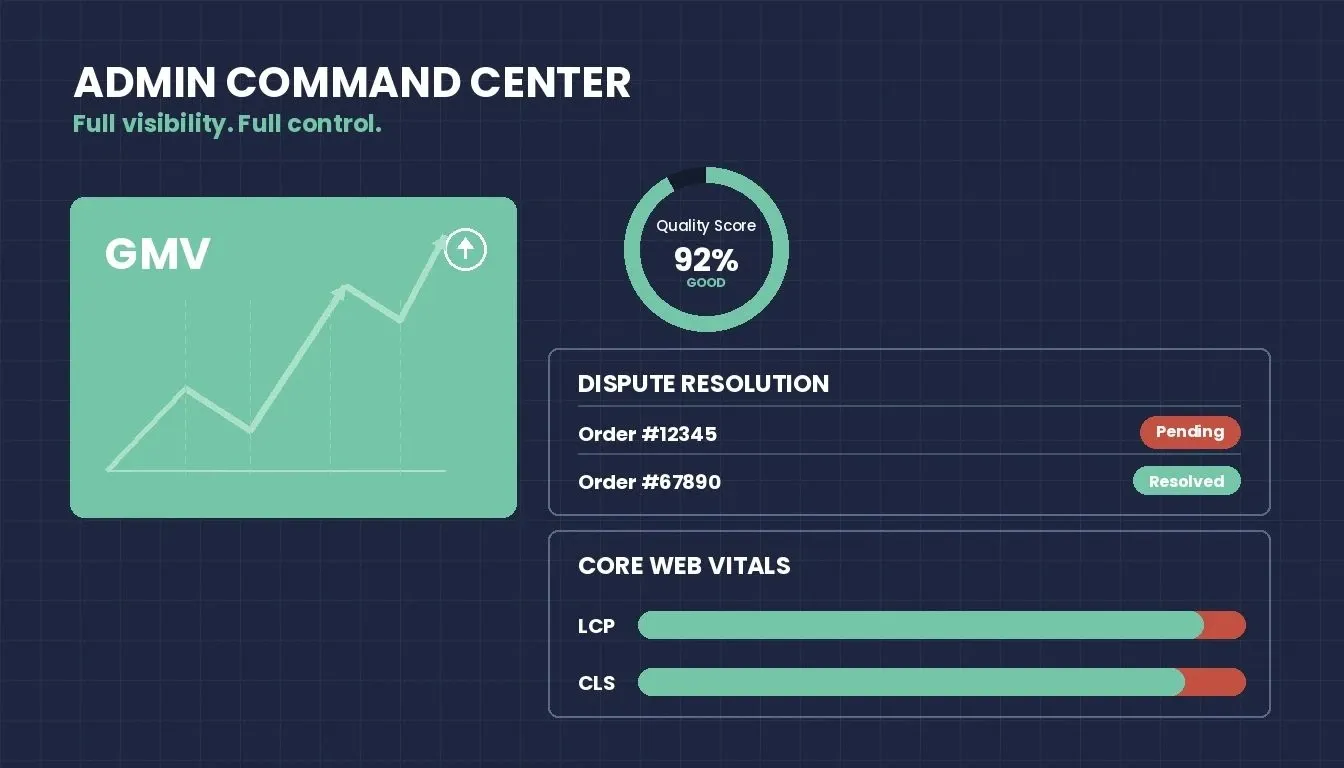
The admin layer gives platform operators full visibility into GMV, quality scores, disputes, and performance metrics
| Prompt | Expected Output | Verification | Follow-Up |
|---|---|---|---|
| Create an admin analytics dashboard showing: total GMV with daily/weekly/monthly toggles, active restaurants, total orders processed, average delivery time, and customer satisfaction score. Include line charts for revenue trends and bar charts for order volume by region. | Analytics dashboard with KPI cards and chart components | GMV matches actual transaction totals; date filters update all charts; export to CSV works | Add demand forecasting that predicts peak ordering hours and suggests when to increase driver availability |
| Build a dispute resolution panel where admins can view complaints, see order details with timestamps, photos, and chat history. Include one-click refund options: full, partial, or credit. Log every action with admin name and timestamp. | Dispute panel with chronological complaint view and refund actions | Disputes display chronologically; refund actions update customer balance immediately; audit log is immutable | Add automated refund rules: orders delivered 20+ minutes late get automatic 15% credit |
| Generate a performance monitoring panel showing Core Web Vitals (LCP, FID, CLS) for both customer app and restaurant dashboard. Flag pages exceeding Google's thresholds and suggest fixes. Include a weekly performance digest email. | Performance panel with Core Web Vitals scores and fix suggestions | Metrics pulled from real Lighthouse data; flags appear for pages above threshold; email digest sends on schedule | Add traffic spike alerts when concurrent users exceed 80% of server capacity |
| Create a restaurant quality control scoring system based on: average prep time, customer ratings, order accuracy, and response time. Restaurants below 3.5 stars for two consecutive weeks receive an automated warning. Those below 3.0 get temporarily suspended with a reactivation workflow. | Quality scoring dashboard with automated warning and suspension logic | Scores calculate from real order data; warnings send at correct thresholds; suspension removes restaurant from search | Add customer behavior analytics showing repeat order rates, average basket value by time of day, and churn prediction |
The admin analytics layer turns raw operational data into insights that help you scale. With these AI prompts for building food delivery app admin tools, your AI app builder creates monitoring dashboards that would cost months of custom development time. The AI app builder vs hiring a developer comparison shows exactly how much time and cost this approach saves.
Rocket vs. Other AI App Builders
Rocket's full-stack generation, built-in Supabase backend, and 26+ pre-wired connectors make it the strongest choice for multi-role platforms like food delivery apps that require authentication, real-time data, and payment processing from day one.
| Feature | Rocket.new | Other AI Builders |
|---|---|---|
| Full-stack output | Next.js + Flutter + Supabase | Varies; many frontend-only |
| Multi-role authentication | Built-in via Supabase RLS | Requires manual setup |
| Pre-built payment connector | Stripe + Razorpay | Varies |
| SMS connector | Twilio (SMS) | Varies |
| Real-time subscriptions | Supabase real-time | Varies |
| Custom API import | Any REST API via importer | Varies |
| One-click deployment | Netlify + custom domain | Varies |
| Research + build + intelligence | Solve + Build + Intelligence | Build only |
| Billing model | Unified credit balance | Varies |
Capabilities of other AI builders vary by platform and change frequently. Verify current features on each vendor's documentation before making a final decision.
Your Prompt Library Starts Here
Six phases, twenty-plus prompts, and a clear expected output for each one. That's what separates founders who ship from those still writing specifications.
The structured approach covered here, from multi-role authentication through admin analytics, gives any AI app builder the context it needs to generate a complete food delivery platform. Use Solve to validate your delivery market, paste your first Build prompt, watch it generate connected screens with real database tables, and deploy to a live URL the same day.
Ready to ship your food delivery platform? Start with Rocket.new today, paste the foundation prompt from Phase 1, and go from idea to deployed MVP before the week ends.
Table of contents
- -Why Do Multi-Role Apps Need Structured Prompts?
- -How Should You Prompt for Customer-Facing Features?
- -What Prompts Generate a Working Restaurant Dashboard?
- -Which Prompts Handle Driver Assignment and Live Tracking?
- -How Does Rocket Turn These Prompts Into Production Apps?
- -What Prompts Add Notifications, Payments, and Compliance?
- -How Do You Prompt for Admin Analytics and Quality Control?
- -Rocket vs. Other AI App Builders
- -Your Prompt Library Starts Here