Consultants already own the asset. Proven frameworks, repeatable processes, and years of client-tested methodology are sitting idle. The gap is not expertise. It is the structure that turns that expertise into monthly recurring revenue.
What if your best thinking kept earning after the engagement ended?
For most consultants, every dollar earned requires showing up. The delivery model ties income directly to hours worked, and that ceiling does not move regardless of how strong the results are.
The global subscription economy reached $557.7 billion in 2025 and is growing at a 16.3% CAGR, projected to hit $2.52 trillion by 2035. Consultants sitting on years of accumulated frameworks, templates, and methodologies are realizing those assets can generate revenue independently.
The move from hourly billing to subscription-based delivery is not theoretical. It is already happening across professional services.
Why Hourly Billing Creates A Revenue Ceiling
The traditional consulting model rewards effort, not leverage. The more experienced a consultant becomes, the faster they solve problems. This paradoxically means earning less per engagement unless rates keep climbing.
-
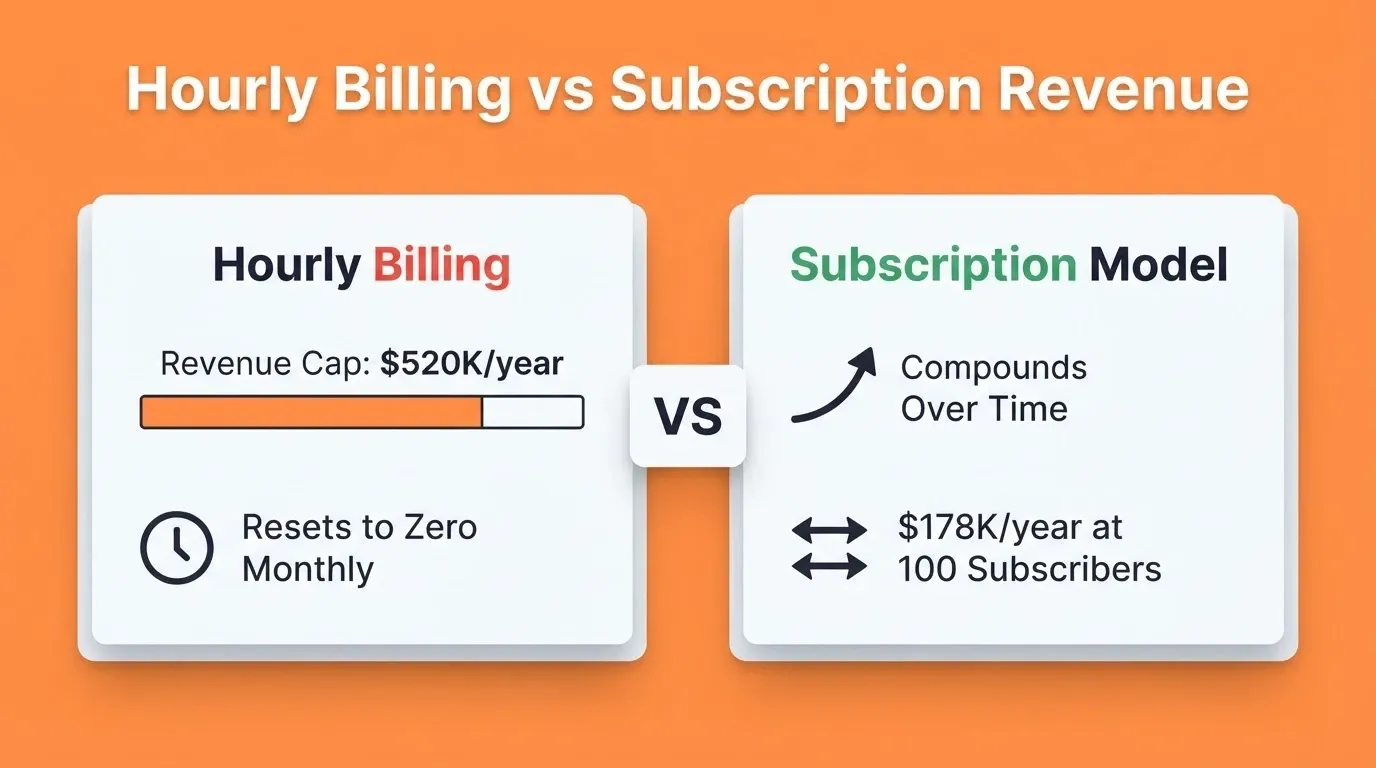
Revenue is capped by available hours. A consultant working 40 billable hours per week at $250/hour tops out at $520,000 annually. That number assumes zero vacation, zero sick days, and zero business development time.
-
Client acquisition never stops. Every completed engagement creates a new gap in the pipeline. There is no compounding effect. Each project starts and ends without building toward the next.
-
Scaling requires duplicating yourself. Hiring junior consultants introduces management overhead, quality control challenges, and margin compression. The business grows linearly, not exponentially.
-
Knowledge depreciates in silence. Frameworks developed for one client sit in shared drives after delivery. They hold value, but that value gets extracted only once.
The gap between a consulting business and a scalable business is not talent. It is structure. Other business models, from SaaS companies to membership sites, generate income from assets that work without the founder present. Recognizing that the delivery model itself needs to change is the first step toward building something that compounds.
Which Types Of Consulting Expertise Translate To Subscriptions?
Not everything a consultant knows belongs behind a subscription paywall. The strongest candidates are knowledge assets that clients revisit repeatedly and that retain value over time.
| Knowledge Type | Subscription Fit | Example |
|---|---|---|
| Repeatable frameworks | High | Quarterly planning templates, audit checklists |
| Industry benchmarks | High | Salary surveys, pricing guides, market sizing |
| Process documentation | Medium-High | Execution playbooks, onboarding sequences |
| Live group coaching | Medium-High | Monthly Q&A calls, peer accountability groups |
| Custom strategic advice | Low | One-off evaluations, unique market entries |
| Relationship-dependent work | Low | Board advisory, executive coaching (1:1) |
Digital products like online courses, downloadable toolkits, and template libraries are the most common starting points. A full membership site goes even further. It combines content with community access, live coaching sessions, and ongoing updates that keep the value proposition fresh.
Mike Gammarino, a consultant who productized his expertise, found that 90% of prospects asked about the same core challenges. He built systematic solutions around those repeating problems. He then turned a $2,500 productized audit into a gateway for $25,000+ engagements.
Knowledge that is repeatable, stackable, and outcome-oriented has the highest subscription potential. One-off strategic advice still belongs in custom engagements. However, the frameworks underneath that advice are the subscription goldmine. For a deeper look at how practitioners are packaging their methodologies, see how consultants are transforming playbooks into paid digital services.
Validate Before You Build
Before investing weeks in platform setup, validate that your specific audience will pay for subscription access. Use Rocket's Solve to run a structured market analysis. Frame the question, and Solve returns evidence-backed findings: competitor landscape, pricing benchmarks, audience demand signals, and a clear recommendation.
This compresses weeks of research into hours. As a result, the subscription model you build is grounded in real market data, not assumption.
How To Structure Subscription Tiers That Convert
The biggest mistake consultants make when building a subscription model is offering a single "all access" tier. Tiered pricing creates natural upgrade paths and serves clients at different stages of readiness.
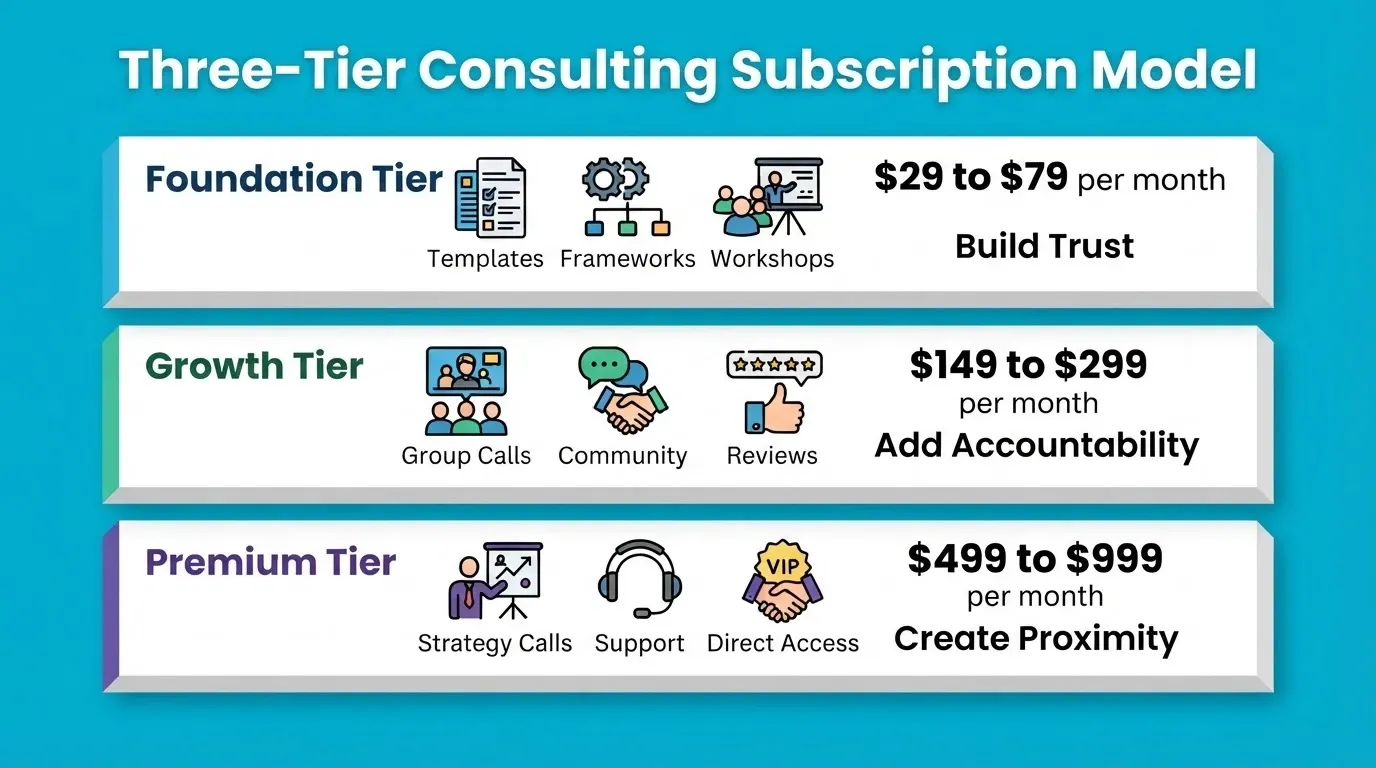
A three-tier model tends to work best for knowledge-based subscriptions:
-
Foundation tier ($29 to $79/month): Templates, frameworks, and recorded workshops. Subscribers get access to the full content library and monthly updates. This tier attracts the widest audience and establishes trust.
-
Growth tier ($149 to $299/month): Everything in Foundation, plus live group calls, community access, and quarterly reviews. This is where most revenue concentrates because it adds accountability without requiring 1:1 time.
-
Premium tier ($499 to $999/month): Everything in Growth, plus limited direct access. Monthly strategy calls, priority support, or personalized feedback. This tier generates the highest per-subscriber revenue while staying scalable through small group formats.
As consultant and recurring revenue advisor Cory Roberson shared on LinkedIn:
"Turn their process into a system. Build a subscription offer clients love. Add $5K to $10K/month in recurring revenue. Work less, earn consistently."
The key is connecting each tier to a clear outcome. Foundation gives subscribers the tools. Growth guides them. Premium gives them proximity.
Mapping Consulting Expertise To Scalable Recurring Revenue
What A Subscriber-Ready Membership Platform Actually Needs
Knowing what to package is the first challenge. Knowing where to put it is the second. A subscriber-ready membership platform needs more than a document library behind a login screen.
Here is what separates platforms that retain subscribers from those that churn after the first month:
Gated content with tiered access. Different subscription levels unlock different sections. A Foundation subscriber sees the template library. A Premium subscriber also gets the strategy call booking page. This requires a real authentication layer with role-based access control, not a password-protected PDF.
Automated billing and recurring payments. Subscribers expect monthly charges handled automatically, easy cancellation, and clear receipts. Manual invoicing signals "side project," not professional service.
Booking integration for live sessions. Premium and Growth tiers typically include live calls. Calendly or Cal.com embedded directly into the platform lets subscribers book without leaving the membership area.
Email automation for onboarding and retention. New subscribers need a structured onboarding sequence. Churning subscribers need re-engagement. Connecting Mailchimp, SendGrid, or MailerLite to your platform handles both automatically based on subscriber behavior.
Content delivery cadence. New frameworks, updated benchmarks, or fresh case studies on a predictable schedule give subscribers a reason to stay. Strong content habits directly reduce churn rate. When subscribers see consistent value, retention improves and cancellation conversations drop.
Analytics and subscriber insights. Understanding which content gets used, which tiers convert, and where subscribers drop off is the difference between growing and guessing. Built-in analytics tracking visits, conversions, and engagement patterns should be included from day one.
Most consultants stall at this stage because building a membership platform traditionally means hiring developers, managing a tech stack, and maintaining infrastructure. For a broader view of how subscription software supports business growth, see the best subscription software options for small business growth. That bottleneck is exactly what the next section addresses.
How To Build Your Consulting Subscription Platform
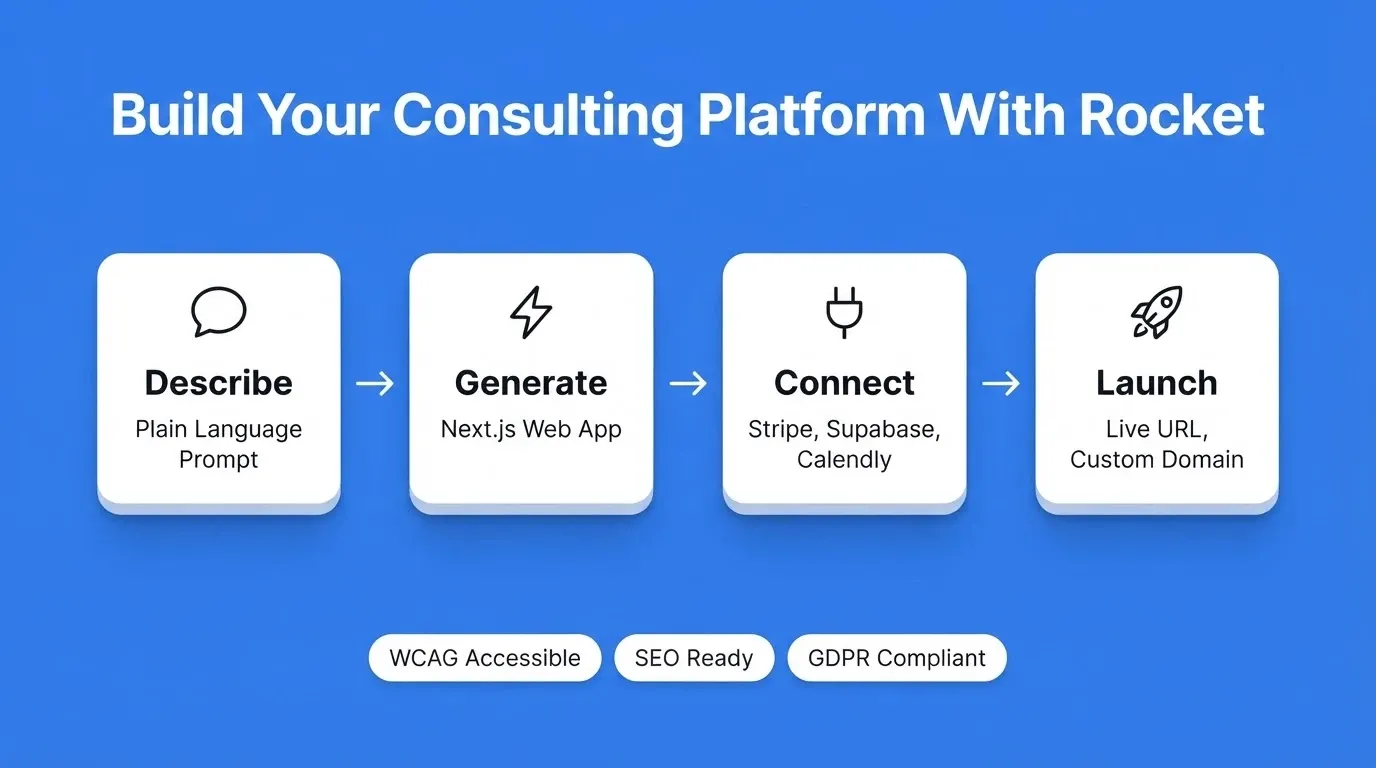
You describe the platform in plain language. Rocket generates the production-ready web application, with UI, backend logic, authentication, and payment integration already wired together.
Here is exactly what gets built for a consulting membership platform:
Member portal with tiered access. Supabase handles authentication and role-based permissions. Foundation subscribers see the template library. Growth subscribers see group call recordings and the community forum. Premium subscribers get the strategy session booking page.
Stripe subscription billing. Describe the payment flow and Rocket generates the complete checkout experience: pricing pages, payment forms, webhook handlers, and subscription management. Stripe handles recurring billing, plan management, and a professional subscriber dashboard automatically. For full setup details, see the Stripe connector documentation.
Booking system for live sessions. Calendly or Cal.com gets embedded directly into the Premium tier page. Subscribers book strategy sessions without leaving the platform.
Email onboarding sequences. Mailchimp or SendGrid connects to trigger welcome sequences, content drop notifications, and renewal reminders automatically.
Built-in analytics. Every deployed project includes visitor tracking, conversion analytics, and Core Web Vitals monitoring. Zero setup required. It starts collecting data the moment the platform goes live.
SEO-ready and accessible by default. Every build ships with clean semantic HTML, optimized meta tags, WCAG 2.1 AA accessibility compliance, and GDPR cookie consent. These are the baseline, not optional extras.
Deploy and iterate in the same session. Launch to a live URL with one click. Custom domains, HTTPS, staging and production environments, full version history, and one-click rollback are all included. Want to add a new content category or change the pricing page layout? Describe the change in chat. Rocket applies it in context without re-explaining what already exists.
The result: a consultant can go from "I have a framework deck" to "I have a live subscription platform with paying members" in a single afternoon.
Platform Comparison: What It Actually Costs To Build Your Membership Site
Before choosing a platform, understand the full cost. Look beyond the monthly fee and consider revenue sharing, feature gates, and code ownership.
| Platform | Monthly Cost | Revenue Share | Code Ownership | Custom Domain | Gated Tiers |
|---|---|---|---|---|---|
| Kajabi | $149 to $399/mo | 0% | None | Yes | Yes |
| Teachable | $39 to $199/mo | 0 to 5% | None | Yes | Limited |
| Podia | $39 to $89/mo | 0% | None | Yes | Limited |
| Custom Dev | Variable | 0% | Full | Yes | Yes |
| Rocket | Subscription plan | 0% | Full (Next.js) | Yes | Yes |
Rocket generates production-grade Next.js code with zero revenue sharing. Unlike template-based platforms, every build ships with SEO-ready structure, WCAG accessibility compliance, and GDPR coverage by default.
From First Subscriber To A Recurring Revenue Pipeline
Getting the platform live is the starting line, not the finish. The real leverage comes from building a subscriber acquisition and retention system that compounds over time.
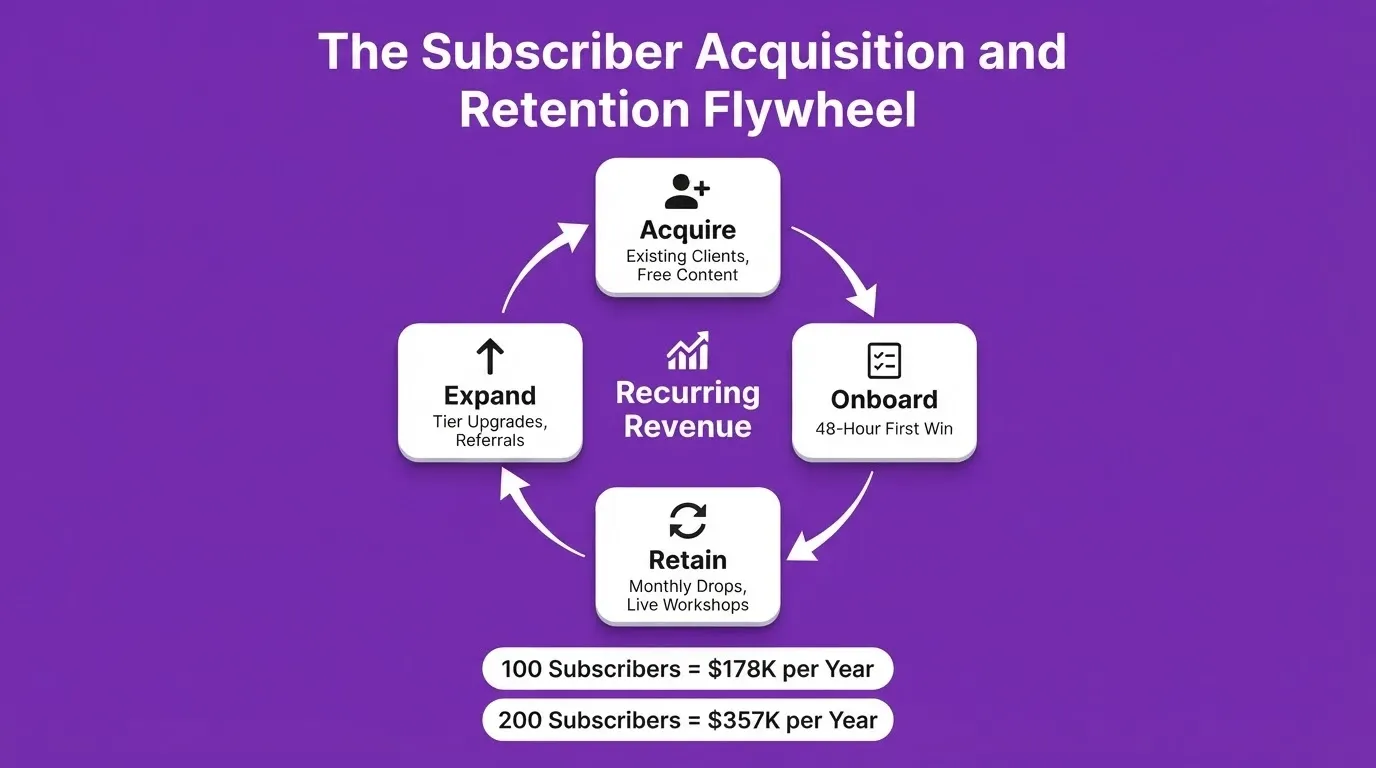
Start with existing clients. Every past engagement produced a client who already trusts your expertise. Offer them founding member pricing, typically 30 to 50% off the standard rate, on the subscription tier that matches their needs. This validates your content, creates early testimonials, and generates the first revenue without any marketing spend.
Use free content as a funnel. Publish portions of your framework library as blog posts, LinkedIn articles, or newsletter issues. Each piece demonstrates the depth behind the paywall and drives qualified traffic. The goal is not to give everything away. It is to show enough that the right reader immediately understands the value of the full library.
Build a renewal-worthy cadence. Monthly content drops, quarterly live workshops, and annual benchmark updates give subscribers clear reasons to stay. Predictable value delivery drives predictable retention. The single biggest driver of churn in knowledge subscriptions is the feeling that nothing new is coming.
The financial math shifts dramatically. A consultant with 100 subscribers at an average of $149/month generates $14,900 in recurring revenue. That is $178,800 annually, without a single additional billable hour. At 200 subscribers, that figure reaches $357,600.
While a subscription platform is not truly passive income, it is dramatically more leveraged than trading hours for fees. Content needs regular updates, but a scalable pricing strategy paired with digital products creates compounding value that a one-on-one service model simply cannot match.
Recurring revenue compounds. Hourly billing resets to zero every month.
Monitor Your Competitive Landscape
Once your subscription platform is live, staying ahead of competing platforms in your niche becomes a strategic priority. Use Rocket's Intelligence to monitor competitor subscription platforms continuously. It tracks pricing changes, new content additions, messaging pivots, and feature launches across their websites, social channels, and review platforms.
Set up Intelligence to follow the three to five platforms most directly competing with yours. Daily signals show when a competitor drops their price, launches a new tier, or starts promoting a new content category. This way, you can respond before a competitor move affects your subscriber retention.
Your Expertise Already Has Subscribers Waiting
The knowledge that drives client outcomes does not have to stay locked inside one-off engagements. Frameworks, templates, and processes built over years of work are exactly the assets subscribers pay monthly to access. The shift from billing hours to packaging expertise is not a pivot. It is an expansion of what you already do well.
1.5 million people have tried Rocket across 180 countries, from solo consultants to enterprise teams. Your content is ready. Your audience already exists.
The Future Of Consulting Knowledge As Recurring Revenue
The shift from hourly billing to a consulting knowledge into a subscription-based platform model is not a trend. It is the next structural step for any practitioner with a proven methodology. As AI-powered platforms continue to lower the technical barrier to building, the competitive advantage shifts entirely to the quality of the underlying framework and the speed of execution.
Consultants who act now will own the positioning in their niche before it becomes crowded. The infrastructure exists. The buyer behavior exists. The only variable is whether you package your expertise before someone else in your niche does. Describe your methodology, deploy your platform, and start generating revenue from work you have already done. Start building on Rocket today.
Table of contents
- -Why Hourly Billing Creates A Revenue Ceiling
- -Which Types Of Consulting Expertise Translate To Subscriptions?
- -Validate Before You Build
- -How To Structure Subscription Tiers That Convert
- -What A Subscriber-Ready Membership Platform Actually Needs
- -How To Build Your Consulting Subscription Platform
- -Platform Comparison: What It Actually Costs To Build Your Membership Site
- -From First Subscriber To A Recurring Revenue Pipeline
- -Monitor Your Competitive Landscape
- -Your Expertise Already Has Subscribers Waiting
- -The Future Of Consulting Knowledge As Recurring Revenue