
Choosing the right website builder for ecommerce is one of the most consequential decisions a founder makes. In 2026, thousands of store owners left Shopify, Wix, and Squarespace for Rocket.new, an AI-powered ecommerce platform that generates fully functional online stores in minutes, with backend logic, payment gateways, and built-in analytics included from day one.
The Ecommerce Opportunity Is Real, But So Is the Pressure
Global e-commerce is expected to hit $6.88 trillion by the end of 2026, according to eMarketer, and the US market alone is projected to generate $1.3 trillion in 2025, per Statista. The opportunity is real. But the tools most founders started with were quietly working against them.
E-commerce now accounts for 20.5% of all worldwide retail sales, up from 19.9% in 2024. Social commerce hit $821 billion in 2025 and is on pace to cross $1 trillion by 2028. Mobile cart abandonment sits at 85%, per Statista. And 76% of Gen Z now discover products on social media before ever visiting a brand's website.
The window to capture attention is narrow. A slow, generic, or clunky e-commerce site does not just lose sales; it loses trust. So the question is not whether you need a great website. The question is which site builder gets you there fastest, without locking you into a system that fights you at every turn.
Why Founders Started Looking for Alternatives
Most ecommerce founders started on one of the big names: Shopify, Wix, Squarespace, or a custom WordPress build. For a while, those platforms worked. Then the friction started stacking up, not just for beginners, but for store owners who had been running ecommerce brands for years.
Here is what the data and community conversations revealed about where traditional e-commerce website builders fall short.
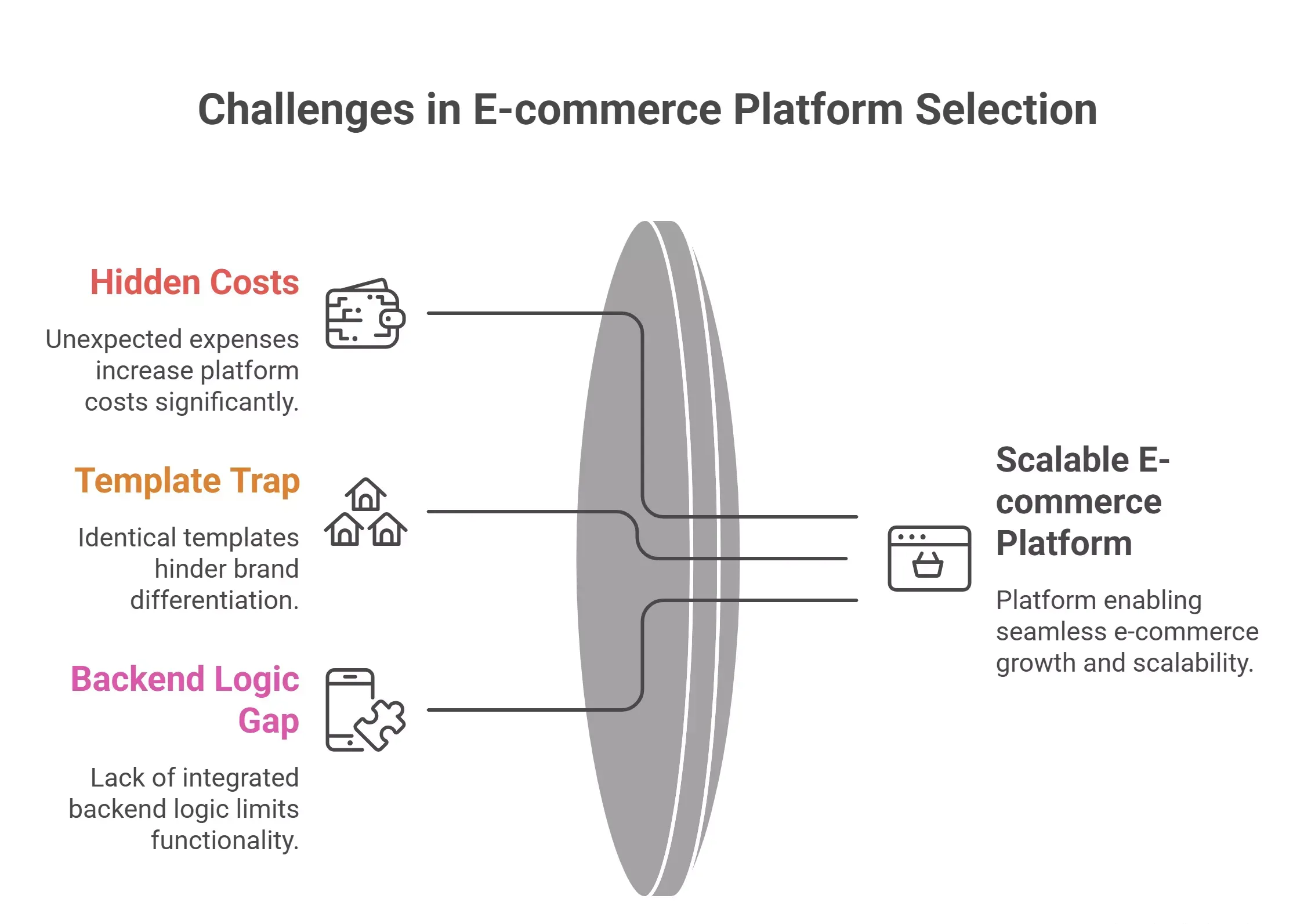
The Hidden Cost Problem
Traditional website builders look affordable at first glance. The real cost only becomes visible after a few months of operation.
- Shopify's Basic plan starts at $29/month (US pricing), but adds a 2% transaction fee on every sale when using a third-party payment provider
- Premium themes cost $150 to $350 as a one-time purchase, with no guarantee of future compatibility
- Most advanced e-commerce features, including abandoned cart recovery, advanced analytics, and loyalty programs, require paid add-ons from the app store
- A small online store doing $10,000/month in sales can easily spend $300 to $500/month in platform costs before a single dollar goes to advertising
- Wix and Squarespace are cheaper on paper, but restrict checkout customization, limit product variants, and do not scale for serious ecommerce operations
The cost is not just financial. It is the time spent managing a patchwork of tools that were never designed to work together. So, founders started asking: Is there a better way to build a fully functional e-commerce website without paying for five separate tools to cover the gaps?
The Template Trap
Drag-and-drop website builders promised creative freedom. In practice, they delivered a different kind of constraint.
- Every e-commerce store built on the same template library started looking identical: same card layouts, same grid patterns, same predictable structure
- Customers noticed. Brand differentiation became nearly impossible without hiring a designer
- Drag and drop interfaces let you move blocks around, but they do not let you change how the site thinks. The underlying logic stays the same regardless of how much you customize the surface
- AI-generated content from earlier tools made the problem worse: the output looked like AI made it, with generic layouts that announced themselves as template-based
- Store owners who wanted a site that felt like their brand, not a theme someone else designed, had no real path forward without a developer
The result was a generation of ecommerce brands that looked like each other and converted like each other. Designer-made templates from the same shared library are not a path to differentiation; they are a path to sameness.
The Backend Logic Gap
Building a fully functional e-commerce store is not just a front-end problem. This is where most website builders quietly fail.
- Inventory management, payment flows, customer account systems, abandoned carts, and analytics all require backend logic that most drag-and-drop builders either do not support or gate behind expensive add-ons
- Solo operators and small business owners ended up stitching together five or six separate tools just to run one store: one platform for the website, another for email marketing, another for analytics, another for customer support
- Every new tool added another monthly cost, another login, another potential point of failure
- When one tool updated its API, the integrations broke, and the founder spent a weekend fixing connections instead of growing the business
- The overhead was not just financial. It was cognitive. Managing tool sprawl became a part-time job
The backend logic gap is the reason so many e-commerce brands plateau. The store works well enough to get started, but not well enough to scale. Modern ecommerce platforms need to handle this natively, not as an afterthought.
What Changed in 2026: The AI-Powered Shift
The shift did not happen overnight. But by 2026, a new category of AI-powered website builders had matured enough to make the old way look genuinely outdated.
The key difference was not just speed. It was intelligence. Earlier AI builders could generate a website from a prompt. That was useful. But they still produced output that looked like AI made it, and they still required the founder to figure out the backend logic, the integrations, and the launch sequence on their own.
What founders actually needed was an e-commerce platform that could:
- Think through the product before building it
- Generate a fully functional e-commerce website, not a mockup
- Handle backend logic without requiring a developer
- Connect integrations in one place, authenticate once
- Launch with one click while tracking performance from day one
That is the gap Rocket.new was built to fill. For founders evaluating the best e-commerce website builder options in 2026, Rocket.new represents a fundamentally different category.
Rocket.new vs. Traditional Ecommerce Website Builders
| Feature | Shopify | Wix / Squarespace | Rocket.new |
|---|---|---|---|
| Build method | Template + drag and drop | Drag and drop | AI generation from natural language |
| Design quality | Template-based | Template-based | Custom, brand-specific, non-generic |
| Backend logic | App ecosystem (mostly paid) | Limited | Built into the generation |
| Time to first working version | Days to weeks | Days | 1 to 3 minutes |
| Transaction fees | 0.5 to 2% (non-Shopify Payments) | None | None |
| Integrations | 8,000+ apps (most paid) | Limited | 25+ built-in, authenticate once |
| Competitor monitoring | Not included | Not included | Built-in Intelligence feature |
| Redesign from heatmap data | Not available | Not available | Available via slash command |
| Built-in analytics | Separate dashboard | Basic | Zero-setup, live from launch |
| Inventory management | Via paid apps | Basic | Built into the generation |
| Abandoned cart recovery | Paid plan required | Paid plan required | Included |
| Payment gateways | Stripe, PayPal (fees apply) | Limited | Stripe, PayPal, 25+ built-in |
The table tells part of the story. The bigger shift is philosophical. Shopify and Wix are tools you operate. Rocket.new is an ecommerce platform that thinks with you.
Launching an Ecommerce store on Rocket.new: How It Works
The flow from idea to live store on Rocket.new is different from anything traditional website builders offer. Every step stays inside one platform. No switching tools. No re-explaining context. The thinking from the research phase carries directly into the build. The data from the live store informs the next redesign. Everything compounds.
Rocket.new: The Website Builder for Ecommerce That Thinks First
Rocket.new is not a traditional site builder. It is an AI platform that covers the full arc from research to build to launch inside one shared workspace. For e-commerce brands, this changes the game in several specific ways.
AI-Powered Store Generation from Natural Language
You describe your store in plain language. Rocket generates a fully functional ecommerce website, not a wireframe, not a template, with real product catalog structure, checkout flows, payment integrations, and SEO-ready architecture.
- The output is built in Next.js: fast, scalable, and production-grade from the first generation
- Most stores generate in 1 to 3 minutes. The first version is not a starting point to rebuild; it is a working product
- The design is intentional: considered typography, real visual hierarchy, brand-specific identity. Nothing reads as AI-made
- Customer confidence is built in the first three seconds on a site. Rocket's output is designed to pass that test
- Product pages are structured for conversion from the first build, with product descriptions, images, and checkout flows ready to go
For founders who spent weeks building and rebuilding on drag-and-drop platforms, this is a fundamentally different experience. You can build an ecommerce store app with Rocket.new without any technical expertise.
Backend Logic Built In, No App Store Required
This is where Rocket.new separates from every drag and drop builder on the market. Backend logic is not an add-on. It is part of the build.
- Backend logic, including user accounts, payment flows, data models, inventory management, and product management, is handled as part of the generation, not bolted on afterward
- Stripe, PayPal, Supabase, and 25+ other integrations connect directly into the build
- Authenticate once, and they flow into every build. No separate activation, no third-party setup fees
- Abandoned cart recovery, checkout flows, and payment confirmation pages are all handled as part of the generation
- Shipping management tools and sales tax handling are built into the e-commerce solution, not gated behind a higher-tier plan
- For store owners who spent years managing a patchwork of apps and add-ons, this is the moment things click
The result is a fully functional online store that works from day one. No stitching, no patching, no weekend spent fixing broken integrations. This is what a full ecommerce solution looks like when backend logic is treated as a first-class concern.
Redesign from Heatmap: Conversion Improvement from Real Data
Most website builders let you change the design. Rocket.new lets you change the design based on what your data actually shows.
- Upload a heatmap of your existing ecommerce store, and Rocket rebuilds the layout around where attention drops and where paths lead to checkout
- This is not a cosmetic update. It is a data-driven rebuild that directly addresses conversion drop-off
- The Redesign feature uses eight slash commands across three categories: Reimagine, Insight-Driven, and Brand and Consistency
- Store owners using this feature report measurable improvements in conversion without guessing what to change
- The same feature works for competitor-inspired redesigns: paste two URLs and apply the design style of one to your content
Conversion optimization stops being a guessing game when the data drives the rebuild. This is the kind of built-in SEO and analytics capability that most e-commerce website builders charge extra for, or do not offer at all.
Built-in Competitive Intelligence for Ecommerce Brands
Traditional website builders stop at the store. Rocket.new keeps going after launch, and that is where the real competitive advantage compounds.
- Rocket's Intelligence feature monitors every public platform your competitors operate on: pricing pages, product launches, ad activity, social media posts
- Signals are interpreted, not just collected. You get structured insights on what competitor moves mean for your business
- Daily, weekly, and monthly briefs delivered where you work
- Ecommerce brands using this feature stop being surprised by competitor pricing changes or new product launches
- The intelligence feeds back into the build: when a competitor shifts strategy, you can respond with a redesign or a new landing page without starting from scratch
Staying ahead of the competition is not a manual research task anymore. It is a built-in feature of the best e-commerce website builder for founders who want to grow.
"I've been trying out every no-code AI website/app builder you can think of for months, and Rocket is 100x better than anything else." — Solopr11, Rocket.new user
The Social Commerce and Augmented Reality Shift
Two trends are reshaping what ecommerce websites need to do in 2026, and both expose the limits of traditional website builders.
Social commerce is no longer a nice-to-have for e-commerce brands. With 76% of Gen Z discovering products on social media and the market approaching $1 trillion, stores need social commerce connections built natively, not through a third-party plugin that breaks on every platform update.
Augmented reality is moving from novelty to expectation in categories like furniture, fashion, and beauty. Shoppers want to see products in context before buying, and return rates in these categories run high precisely because the online experience does not match reality.
- Social commerce integrations need to be part of the build, not an afterthought bolted on through a plugin
- AR-ready product page structures require backend logic that most drag-and-drop builders cannot generate
- Voice commands are emerging as a shopping interface, especially on mobile, and stores built on rigid templates cannot adapt without a full rebuild
- Personalization at scale requires a data layer that connects customer data to product display in real time
- Ecommerce brands that cannot connect these channels from one platform will spend more time managing tools than growing the business
Rocket.new builds ecommerce sites that are ready for all of this. Social commerce integrations flow into the build. Product pages can be structured to support AR experiences. The backend logic handles the data layer that makes personalization possible at scale. For brands selling physical products or digital products, the infrastructure is built to handle both.
The Right Website Builder for Ecommerce in 2026
The e-commerce market is growing fast. Traditional website builders built around drag-and-drop interfaces, and app ecosystems were designed for a world where speed and intelligence were separate concerns. That world is gone.
The founders who moved to Rocket.new in 2026 were solving a real problem: the gap between having a product idea and having a fully functional, conversion-ready ecommerce website live in the market. The best ecommerce website builder in this environment is the one that closes that gap fastest, without sacrificing design quality, backend logic, or the ability to learn and improve from real data.
Whether you are launching your online store for the first time, migrating from Shopify, or looking for Shopify alternatives that actually scale, Rocket.new closes that gap. One platform. One workspace. From the first idea to the first sale.
Ready to stop managing tools and start growing your store?
Build your ecommerce website on Rocket.new today and go from idea to live store in minutes, with no transaction fees, no app store required, and no developer needed.
Table of contents
- -The Ecommerce Opportunity Is Real, But So Is the Pressure
- -Why Founders Started Looking for Alternatives
- -The Hidden Cost Problem
- -The Template Trap
- -The Backend Logic Gap
- -What Changed in 2026: The AI-Powered Shift
- -Rocket.new vs. Traditional Ecommerce Website Builders
- -Launching an Ecommerce store on Rocket.new: How It Works
- -Rocket.new: The Website Builder for Ecommerce That Thinks First
- -AI-Powered Store Generation from Natural Language
- -Backend Logic Built In, No App Store Required
- -Redesign from Heatmap: Conversion Improvement from Real Data
- -Built-in Competitive Intelligence for Ecommerce Brands
- -The Social Commerce and Augmented Reality Shift
- -The Right Website Builder for Ecommerce in 2026