
About this article: This piece draws on publicly documented patterns from B2B sales research, practitioner experience across revenue teams, and Rocket.new's own product documentation. Where specific statistics are cited, the original source is linked. Where patterns are described without a number, they reflect widely observed practitioner experience rather than a single proprietary survey.
Dark funnel intelligence is the practice of reading buyer signals that never appear in your CRM: anonymous site visits, peer recommendations, review site research, and AI-assisted vendor comparisons. Most B2B evaluation happens before a prospect ever identifies themselves. Teams that build systems to read these signals reach buyers earlier and win more deals.
Why do B2B marketing teams always feel like they're arriving late to decisions already made? Most analytics platforms only log form fills, email clicks, and direct traffic. The rest of the buyer's journey disappears into what practitioners call the dark funnel.
The conversation that sent a prospect to your pricing page was probably a Slack message. The moment they shortlisted you happened in a peer recommendation, not a tracked UTM. This gap between what buyers actually do and what your data shows is real, growing, and costly.
What Is the Dark Funnel?
The dark funnel describes all buying activity that happens before a prospect identifies themselves to your sales team. It covers every piece of research buyers do, every peer conversation they have, and every review site they check during the evaluation process, none of which surfaces in your CRM or analytics.
Think of your sales funnel as an iceberg. Tracked clicks, form fills, and demo requests represent only the visible tip of the actual customer journey. The larger portion sits below the waterline: anonymous browsing, peer word of mouth, private community conversations, and third-party comparisons.
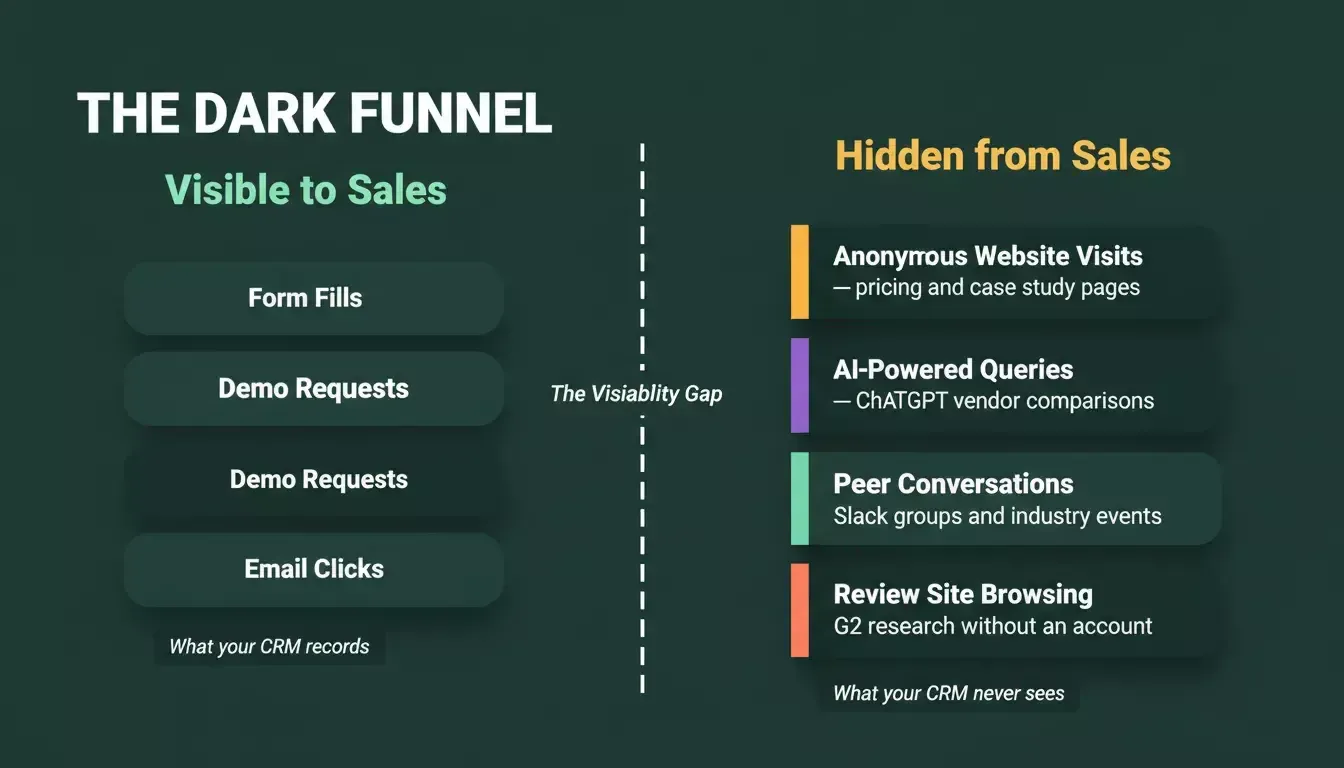
Key activities that make up the hidden dark funnel:
-
Anonymous website visits: Buyers from target accounts browse your pricing and case study pages without filling in a single field
-
AI-powered queries: Decision-makers ask ChatGPT to compare vendors before any sales contact happens
-
Peer conversations: Buying committees form strong opinions in Slack channels and at industry events, long before a rep gets involved
-
Review site browsing: Prospects spend hours on G2 without creating accounts, leaving zero trackable data behind
A buyer intent data platform connects these touchpoints to real accounts, shifting teams from reacting to inbound, to anticipating buyer intent before it shows up.
The Dark Funnel: a side-by-side view of what your CRM records versus what it never sees across the full buyer journey
Why the Dark Funnel Keeps Getting Bigger
Three forces are making the dark funnel harder to see every year. Privacy regulations, AI-assisted research, and the rise of dark social have stripped away the tracking mechanisms B2B marketing teams depended on.
-
Privacy rules: GDPR and the end of third-party cookies have shrunk retargeting pools and shut down cross-site tracking for most companies
-
AI research: Buyers doing their own research inside LLMs generate zero UTMs, no session data, and nothing in your analytics dashboard
-
Dark social: Links shared inside private communities, Slack groups, and industry forums register as direct traffic in analytics, with no referrer or source attached
-
Word of mouth: Peer conversations across online groups have become a major buying signal that leaves almost no trace
The buyer's journey has shifted into spaces not built for tracking. B2B marketing teams that adapt their strategy to this reality will reach buyers before competitors even know there is interest.
Where Do Buyers Actually Research?
Multiple independent research programmes, including work published by Forrester and Gartner, consistently show that B2B buying committees complete the majority of their evaluation before initiating contact with a vendor. The exact share varies by deal size and category, but the pattern is consistent: most of the decision-making work is done before your sales team is involved.
Understanding where buyers spend their time reshapes how you approach your marketing strategy. Most companies measure only what their analytics can see. Buyers make their real decisions somewhere else entirely.
-
Review sites: G2, Capterra, and TrustRadius dominate top-of-funnel research. Buyers compare ratings and read reviews without contacting vendors, leaving no first-party data for your team to act on
-
AI tools: Buyers increasingly use LLMs for vendor comparisons before requesting demos. Your brand either surfaces in those answers or it does not, and shortlists form before a call is booked
-
Social media: LinkedIn posts and published content shape buyer opinions weeks before any sales call. Social media engagement data captures only the public surface of these interactions
-
Third-party sites: Analyst reports and comparison articles on third-party sites get consulted heavily, adding signal layers that no single analytics stack sees fully
Tracking B2B buying signals across these channels is the first step toward closing the visibility gap that costs most teams their best deals.
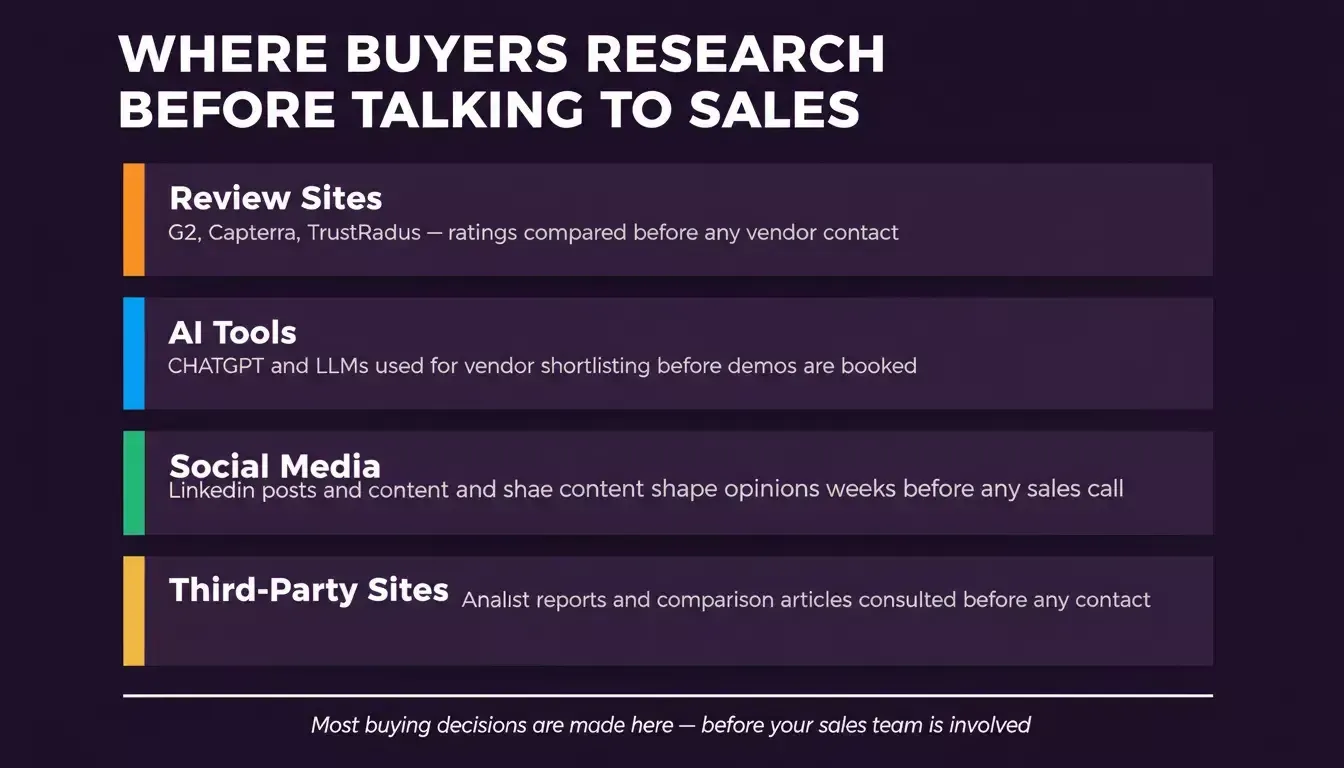
Where buyers actually research: four channels that shape shortlists before your sales team is ever involved
Dark Social: The Signal Hiding in Plain Sight
Dark social is the largest contributor to untraceable B2B influence. When someone shares your product page inside a Slack community, it shows up in your analytics as direct traffic: no referrer, no campaign source, no context.
-
Where it lives: Private Slack workspaces, closed LinkedIn groups, and email threads between buying committee members
-
What marketing teams miss: Social media engagement data captures only public interactions. The conversations driving buying decisions inside those same platforms stay completely invisible
-
Why it shapes outcomes: Word of mouth inside trusted peer networks carries more weight than any branded content. A genuine colleague recommendation sets shortlist positions that paid campaigns cannot move
Brand trust gets built here before formal evaluation begins, and most marketing intelligence tools have no view into it.
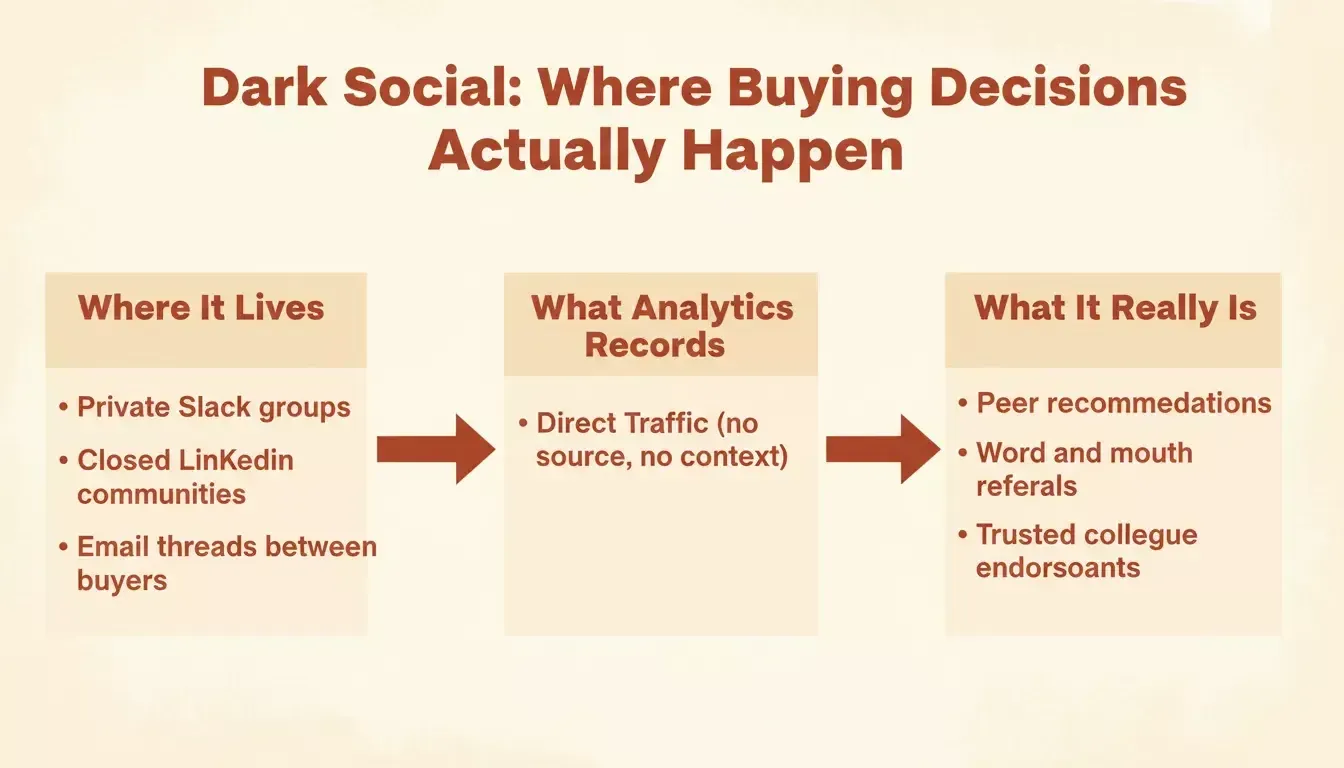
Dark social: how peer recommendations and private shares become untraceable direct traffic in your CRM
Why Traditional Analytics Fails B2B Marketing Teams
Traditional analytics was built around clicks, sessions, and conversions. The dark funnel operates in none of those spaces. For B2B buying cycles spanning months across dozens of off-platform touchpoints, standard tools produce a deeply incomplete picture of how purchasing decisions actually get made.
When a buyer submits a form after months of research, last-touch attribution models give credit to whichever ad they clicked last. The review sites visited, the social media debates followed, the peer conversations held: all of it gets zero credit and zero data.
| Signal Type | Traditional Analytics | Signal-Aware Approach |
|---|---|---|
| Anonymous website visits | Not tracked | Company-level identification |
| Review site activity | Invisible | Third-party intent data |
| Peer conversations | Not captured | Self-reported attribution |
| Direct traffic spikes | Unknown source | Account-level correlation |
| Multi-touch paths | Last click only | Attribution models across channels |
Sales and marketing alignment starts with accepting what you can and cannot see. Multi-touch attribution tells part of the story. The customer journey outside tracked channels tells the rest.
A Practical Dark Funnel Audit: Where to Start
Before investing in new tooling, most revenue teams benefit from auditing what they already have. These four steps cost nothing and typically reveal that more pipeline was influenced by unmeasured channels than most teams expect.
Step 1: Check your direct traffic share. Open your analytics and look at the percentage of traffic arriving as "direct." If it exceeds 25–30% of total sessions, a meaningful portion of that is dark social: shared links arriving with no referrer. That is your first signal gap.
Step 2: Run a deal-close interview. Ask your last ten closed-won customers: "How did you first hear about us?" Compare their answers to what your CRM records as the first touch. The gap between those two answers is your dark funnel attribution loss.
Step 3: Search for your brand in ChatGPT and Perplexity. Ask: "What are the best tools for [your category]?" If your product does not appear in the top results, you are invisible to buyers using AI for research. This is now a primary discovery channel for many B2B categories.
Step 4: Check your G2 profile without logging in. Open an incognito browser and browse your G2 listing as a buyer would. Note what a prospect sees before they ever contact you. That review page is often the last thing they read before shortlisting or eliminating you.
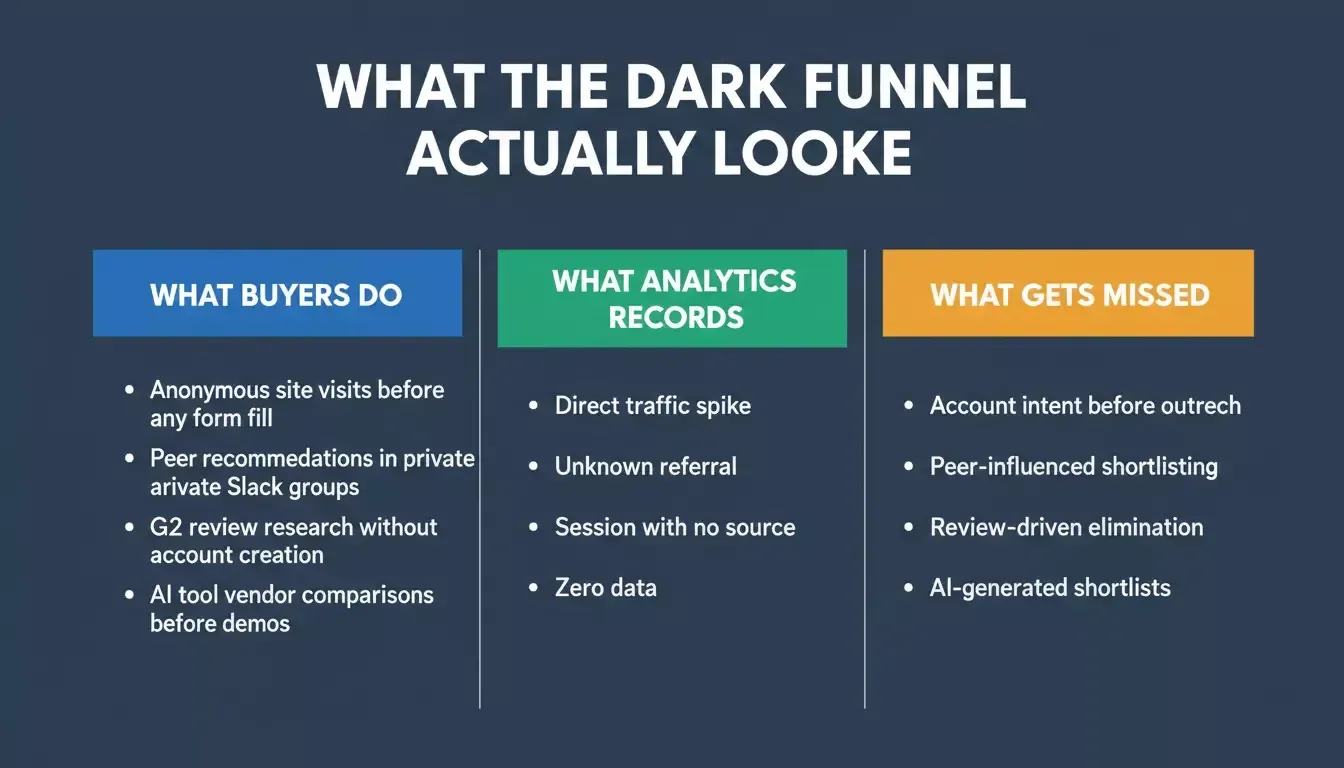
Observable dark funnel patterns: what buyers actually do, what analytics records, and what gets missed entirely
Can Intent Data Fix the Attribution Gap?
Intent data closes a meaningful part of the attribution gap by surfacing signals from third-party content networks and review site activity. It tells you which companies are researching your product category before they visit your site, far more actionable than anything last-touch attribution models offer.
-
First-party intent: Return visits, time on site, and content downloads are signals your website already generates that rarely get acted on at scale
-
Third-party intent data: Category research aggregated across thousands of sites by data providers, matched to company-level accounts
-
Buyer intent scoring: Combined intent signals turned into a prioritized list for demand generation teams to act on each morning
-
Branded search volume trends: A steady rise in branded search volume for your company name often predicts inbound pipeline before it actually arrives
Layered together, these signals turn scattered data into actionable intelligence and bring a meaningful portion of the dark funnel into view.
How to Build a Dark Funnel Signal Strategy
Building a strategy around invisible buyer signals starts with accepting no single tool sees everything. The goal is enough signal coverage across channels to prioritize the right accounts at the right time and act before competitors do.
-
Website visitor identification: Matching anonymous traffic to company accounts gives sales teams a list of active potential customers without waiting for form fills
-
Third-party intent data: Data providers aggregate research signals across thousands of sites and match them to company accounts. When buying committees consume content in your category, you identify those potential leads before any sales conversation starts
-
Self-reported attribution: Asking buyers how they found you at deal close reveals which channels are actually sourcing revenue. It is one of the most underrated practices in B2B lead generation
-
Dark social listening: Social media monitoring across Slack, Reddit, and closed LinkedIn groups gives partial visibility into peer conversations that analytics tools cannot reach
-
Signal correlation: Combining multiple sources, including branded search volume spikes and job postings at target accounts, helps credit channels that never appear in a last-click report
Reading Behavioral Patterns and Buyer Intent
The real signal is not a single data point. It is the pattern. When multiple stakeholders from the same account collectively research your product category, those behavioral patterns reveal far more than any individual click could.
-
Account-level clustering: Multiple stakeholders from the same company hitting your pricing page within a week creates buyer intent evidence strong enough to trigger an outreach sequence
-
Content progression: A prospect moving from educational articles to competitor comparisons to your pricing page in sequence shows the evaluation process happening in real time
-
Long sales cycles: B2B sales cycles mean signals compound over months; low research interest in January that spikes in March often points to budget readiness
-
AI agents in the research stack: AI agents increasingly handle parts of the research phase for buying teams, pulling from multiple sources and adding invisible touchpoints to the customer journey
This is the core principle behind intent-based product development, and a key reason dark funnel visibility matters beyond just fixing analytics.
How Rocket.new Approaches Dark Funnel Intelligence
This section describes how Rocket.new Intelligence works, based on its published product documentation. It is not a substitute for evaluating whether it fits your specific needs. Independent tools such as 6sense, Bombora, and Demandbase address overlapping problems and are worth evaluating alongside any platform.
Rocket.new is the vibe solutioning platform for builders and founders. The Intelligence pillar watches competitors continuously across nine signal dimensions.
Its three capabilities: research markets with Solve, build production-ready apps with Build, and watch competitors continuously with Intelligence. The Intelligence pillar is directly relevant to the dark funnel problem because it watches companies across public signals that most analytics tools ignore entirely.
The Nine Pillars of Rocket.new Intelligence
Rocket.new Intelligence watches every company you follow across nine distinct signal pillars simultaneously. According to the product documentation, its core value is cross-pillar pattern detection: connecting signals across multiple dimensions to surface a strategic interpretation rather than an isolated alert.
| Pillar | What It Watches |
|---|---|
| Website Intelligence | Messaging, pricing, features, and content changes on the company's own site |
| Social Media | Posts, engagement, and executive activity across platforms |
| News & Media | Third-party press and editorial coverage the company does not control |
| GTM | Paid campaigns, creator partnerships, SEO, and developer marketing |
| Traffic | Who visits and from where (coming soon) |
| Product & Technology | Releases, API changes, GitHub activity, and changelog updates |
| People & Hiring | Hiring velocity, leadership moves, and what headcount implies about strategy |
| Business & Finance | Funding rounds, partnerships, and pricing strategy evolution |
| Reviews & Community | Customer reviews, ratings, and sentiment across G2, Reddit, and app stores |
A pricing page change (Website) combined with enterprise sales hiring (People) and LinkedIn ads targeting IT leaders (GTM) is one story visible across three pillars simultaneously, a company making an enterprise push.
Rocket.new Intelligence: nine signal pillars that together surface cross-pillar patterns standard monitoring tools miss
How Intel Cards Work
Every finding in Rocket.new Intelligence is delivered as a structured Intel card. Per the product documentation, each card includes: what happened, what it means, why it matters, a Magnitude rating (High, Medium, or Low), the evidence behind the finding, a full Trail of sources and methodology, a confidence score, and a counter-narrative with alternative explanations.
Magnitude is personalized. The same underlying signal may be rated High for a sales leader and Medium for a product manager, based on their role and the companies they follow.
Watchlists and Lenses
Rocket.new Intelligence lets you group companies into Watchlists with a Lens: a plain-language description of the strategic question you want answered. Two watchlists can contain the same companies but produce completely different Intel because they ask different questions, for example, "Which of these companies are moving upmarket toward enterprise?" versus "Who is hiring aggressively in APAC?"
Absence Detection
One capability worth noting: Intelligence surfaces both activity and absence. When a competitor's content publishing goes quiet for six weeks after running weekly, that silence is a signal. When a company stops running paid campaigns on LinkedIn after months of consistent spend, that absence tells a story.
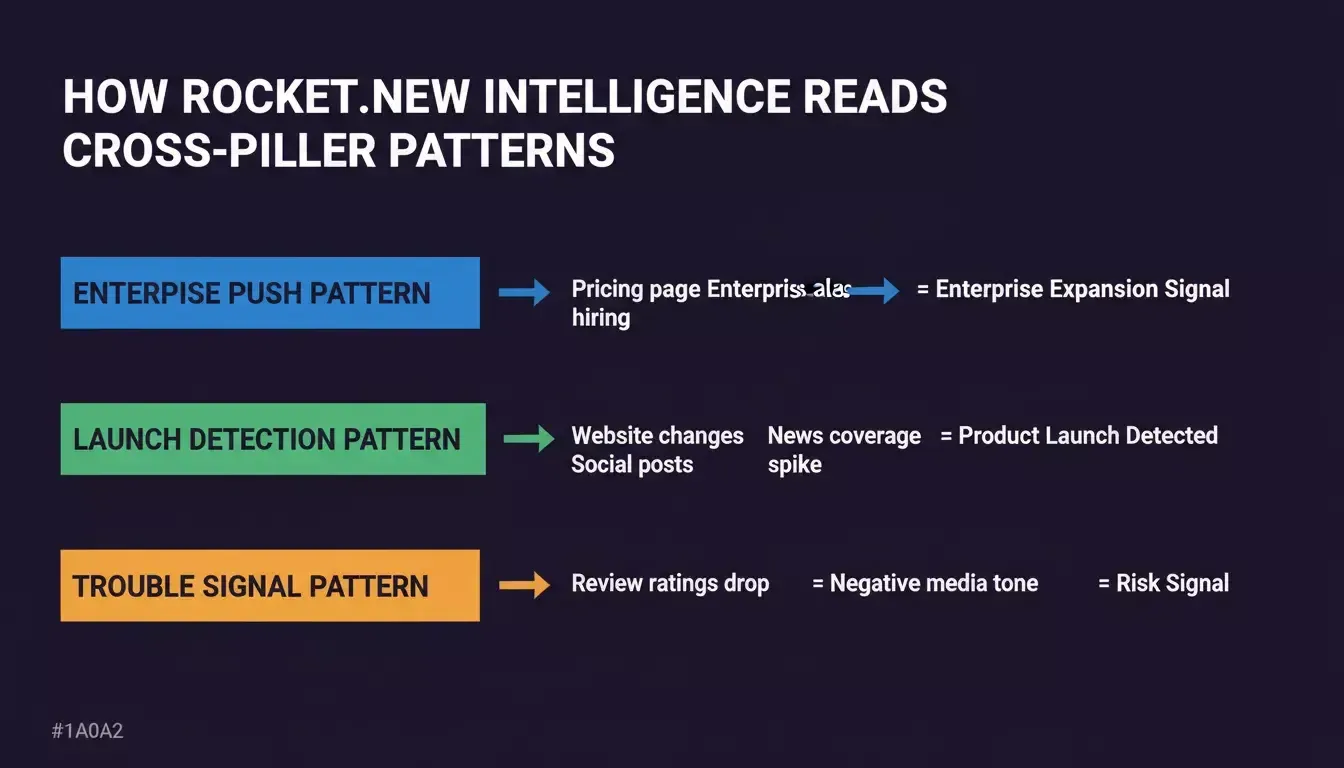
Cross-pillar pattern detection: three signal combinations that reveal enterprise push, product launch, and risk signals
What Practitioners Report After Adding Signal Coverage
The following patterns are drawn from practitioner accounts and are representative of commonly reported outcomes, not controlled studies.
-
Attribution shift: Teams that add self-reported attribution at deal close consistently find that a significant share of new customers cite a peer recommendation or social post as their first real touchpoint, a channel that appeared nowhere in their CRM data
-
Pricing page signals: Visitor identification tools regularly surface high-value accounts that visited pricing pages multiple times before any form submission. Acting on those signals earlier compresses sales cycles
-
AI search visibility: Teams that audit their brand presence in LLM outputs and update their comparison content report measurable improvements in both branded search volume and inbound lead quality
The signals were already there. The gap was not in buyer intent but in the team's ability to read it.
Building an AI-powered sales platform that surfaces these signals automatically is now within reach for any revenue team, without a dedicated engineering team or months of implementation.
Stop Waiting for the Form Fill
The form fill is not the beginning of a buying relationship. It is the end of a months-long evaluation that your analytics never tracked. By the time a buyer submits that form, they have already visited your site, read reviews, asked peers, and compared you against competitors. Your sales team just got the memo last.
The shift to reading dark funnel signals is not about perfect data. It is about acting earlier on signals that already exist. Companies that build their revenue systems around this reality will find their funnel gaps closing, not because they found more leads, but because they stopped losing the ones already in the dark funnel.
Rocket.new is the vibe solutioning platform that gives revenue teams both the Intelligence pillar to watch competitors continuously across nine signal dimensions and the Build pillar to create custom signal intelligence tools without an engineering team.
Table of contents
- -What Is the Dark Funnel?
- -Why the Dark Funnel Keeps Getting Bigger
- -Where Do Buyers Actually Research?
- -Dark Social: The Signal Hiding in Plain Sight
- -Why Traditional Analytics Fails B2B Marketing Teams
- -A Practical Dark Funnel Audit: Where to Start
- -Can Intent Data Fix the Attribution Gap?
- -How to Build a Dark Funnel Signal Strategy
- -Reading Behavioral Patterns and Buyer Intent
- -How Rocket.new Approaches Dark Funnel Intelligence
- -The Nine Pillars of Rocket.new Intelligence
- -How Intel Cards Work
- -Watchlists and Lenses
- -Absence Detection
- -What Practitioners Report After Adding Signal Coverage
- -Stop Waiting for the Form Fill