
Rocket.new is an AI app builder that turns natural language into production-ready internal tools in minutes. It can create CRUD apps, dashboards, admin panels, and automated workflows without coding. In 2026, teams use it to cut development time, reduce manual work, and deploy apps in a single session.
How much time does your dev team lose building internal tools that should already exist?
According to Fortune Business Insights, the no-code platform market will reach USD 8.6 billion in 2026, growing at 31.13% CAGR. Companies want a working app in hours, not months.
Rocket.new is an AI app builder that turns natural language into production-ready web apps and mobile apps with backend logic, databases, and UI elements included. No coding required.
Why Internal Tools Still Cost Too Much
Most dev team members build internal tools on top of Google Sheets, duct-taped scripts, and off-the-shelf SaaS.
The gap between what technical users and non-technical users actually need and what generic software delivers is where internal tools belong. Yet the real cost isn't just in development, it's in the lost efficiency, slower decisions, and manual work that piles up when teams lack the right tools.
-
86% of organizations plan to increase or maintain spending on internal tools this year
-
Over 40% of workers spend at least a quarter of their week on repetitive tasks that productivity tools could handle
-
Companies using internal tools report up to 30% improvement in efficiency compared to teams on general-purpose software
-
70% of new enterprise applications will use low-code tools by 2026
-
Over 50% of companies worldwide are already using AI in some capacity, indicating a significant trend towards AI integration in business operations
Non-developers and business users need to manage data without writing code or waiting on engineering teams. With over 216 workflow automations available out of the box, the barrier to building functional internal tools has never been lower.
AI-powered internal tools are becoming essential for automating workflows, reducing manual work, and enabling non-developers to create their own applications, directly enhancing operational efficiency across teams of every size.
The rise of AI and automation is transforming internal tools from simple utilities into intelligent assistants that help teams make smarter decisions and uncover trends faster.
AI-powered app generation removes the bottleneck of traditional coding approaches and puts app building in the hands of the people closest to the problem.
Core Internal Tool Types You Can Build
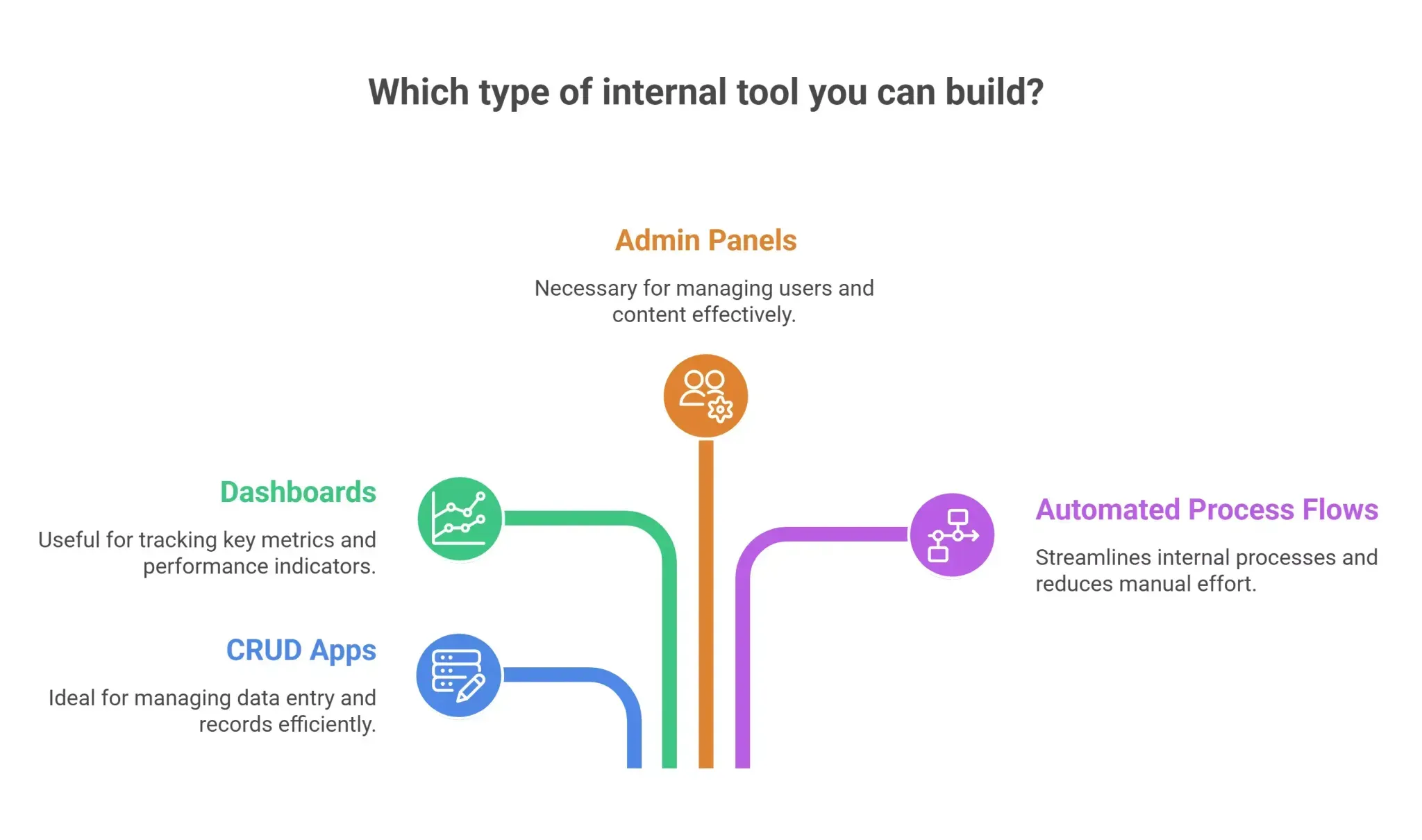
Rocket covers the most common internal tools categories. Internal tools are custom-built applications used by teams within an organization to streamline internal processes, from admin panels and dashboards to full workflow engines.
Describe what you need, and the platform generates a working app.
CRUD Apps for Data Entry and Records
Every business runs on create, read, update, and delete operations. Inventory lists, contact data registries, and order trackers all fall here. Data entry apps are foundational for any data-driven team.
-
Describe the app, and Rocket generates forms, list views, and search filters
-
Layouts work on web apps and mobile apps
CRUD apps are the backbone of internal operations. An AI app builder that handles them from a single prompt removes weeks of backend logic work.
Dashboards for Tracking Metrics
Dashboards turn raw numbers into something a team can act on. Operational dashboards and admin panels can automate the generation of internal interfaces to manage company data and workflows — cutting down manual effort across hundreds of use cases.
-
Ask for specific metrics, charts, and filters
-
Rocket builds summary cards and filterable tables
Teams use dashboards as daily control panels. The best AI app builder stands out in a single session with no complex setup.
Admin Panels for User and Content Management
Admin panels give managers a control center for user permissions and settings. Role-based access control keeps each person seeing only what they should.
-
Describe sections you need (users, settings, content)
-
Rocket generates access controls and a visual editor
Internal admin panels sit behind the scenes, but every team managing configurations needs one. In 2026, internal tools are increasingly being built using low-code and no-code platforms, allowing non-technical users to create functional applications without deep programming knowledge, and Rocket is built for exactly that.
Automated Process Flows
Automated flows replace manual handoffs. When someone submits a form, the app routes it or updates a database.
-
Describe the steps, and Rocket generates the business logic
-
Connections to databases and APIs come through 25+ connectors
These process flows are where internal tools save the most time for support teams, and with over 217 workflow types supported and more than 481,315 processes automated to date, Rocket continues to expand what's possible without writing a single line of code.
Advanced Internal Tools for Growing Teams
As teams grow, their internal tools need to handle more control, tighter user permissions, and cross-department flows.
These builds go beyond simple apps into more complex logic.
Approval Workflows and Multi-Step Review
Approval workflows route requests through reviewers before an action is finalized.
-
Describe the chain, and Rocket builds the form with status tracking
-
Every decision gets logged
Centralized Data Management and Reporting
When data lives in different systems, reporting breaks down.
-
Build a tool that connects to multiple sources
-
AI-powered query generation means non-technical users pull reports without coding knowledge
Purpose-Built Tools for Niche Processes
Not every process fits a standard template.
-
Describe your niche process, and Rocket generates a purpose-built app
-
An internal tool builder that handles natural language makes these builds accessible to ops managers with no technical background
| Tool Type | Example | Build Time |
|---|---|---|
| CRUD apps | Inventory tracker | Minutes |
| Dashboards | Sales metrics | Minutes |
| Admin controls | User management | Minutes |
| Process flows | Onboarding | Under an hour |
| Approval workflows | Budget sign-off | Under an hour |
How AI App Builders Handle Internal Tool Building
Traditional development follows a long loop: requirements, design, build, QA, deploy.
App builders that use AI compress that into a conversation. The best AI platforms go further with production-grade code, not drag-and-drop mockups.
-
84% of developers already use AI tools regularly for app development
-
Large language models interpret plain English and write the custom code
Technical users can build internal tools without filing a ticket with engineering teams. No code platform options and low code alternatives let non-developers build apps with drag and drop. AI-powered code development goes further: you describe the outcome, and the platform handles it.
App builders powered by AI agents are becoming AI assistant tools that help teams uncover trends and make faster decisions.
Low-code platforms serve as a middle ground, but AI app builder tools like Rocket remove the need for writing code entirely. The AI agents on these code platforms and app builders handle complex logic behind the scenes.
From Build to Deploy in One Session
Rocket handles deployment as part of the build. There is no separate ops step.
-
One-click deployment publishes your tool to a live URL
-
Web apps run on Next.js with full backend logic; mobile apps run on Flutter
-
Collaboration tools let team members edit, review, and test before publishing
-
Every deployment saves a version with version control, so rollback takes one click
-
Staging and production environments come standard with paid plans
-
The free tier includes 20 credits to build and ship
App building closes the loop, so your team uses the tool the same day you build it.
What People Are Saying
"For small business owners who understand what it can do, it will save them insane capital. Build your own micro services to do the work you pay 10 different subscriptions for." - Source: Reddit
That lines up with what teams building powerful internal tools experience.
How Rocket Fits into Your Workflow
Rocket.new can target high-complexity business operations by leveraging Agentic AI, which acts on a user's behalf rather than just answering prompts.
So, when you need internal tools that match your actual process, this AI app builder takes natural language and generates deployable applications.
Here is what sets Rocket apart from other internal tool builders.
-
Vibe-solutioning platform: Describe what you want. Rocket interprets your intent and generates a working app.
-
Single-line code edits: Precision mode in Vibe solutioning allows for granular, single-line code edits through a chat interface.
-
Figma-to-Code: Figma-to-Code functionality translates design files directly into functional frontend code rather than just visual replicas.
-
25k+ templates, free to use: Start from a template for dashboards, admin panels, CRUD apps, or mobile apps. Customize with natural language prompts.
-
Saves up to 80% tokens: Fewer prompts mean faster app building at scale.
-
Supports Flutter (mobile) and Next.js (web): Build web apps and mobile apps from one platform.
-
Collaboration built in: Multiple team members work on the same project with tracked versions.
-
3 Products, One Platform: Solve, Build, and Intelligence: Solve handles research. Build creates your app. Intelligence delivers daily briefs. These key features set Rocket apart from other app builders and code platforms.
"Rocket.new's focus in 2026 is on automating "Day 2" problems, such as maintenance, monitoring, and scaling of apps." - Source, LinkedIn
AI features like AI agents handle ongoing tasks, and AI models power the code quality behind every build. Enterprise-grade security with SOC 2, ISO 27001, and role-based access control comes standard.
Above all, Rocket.new's "Intelligence" pillar provides daily briefs and real-time alerts to inform product roadmaps.
Where this works best:
-
A logistics team builds a shipment tracking dashboard with delivery metrics
-
An HR department creates simple apps for onboarding with automated task assignments
-
A finance team builds an expense approval workflow for managers and auditors without self-hosting
-
A product team creates a bug ticketing system deployed in one session
Internal Tools That Grow With Your Team
The answer to what types of internal tools Rocket can build in 2026 covers a wide range. Whether you need to create simple apps that replace Google Sheets, build internal tools for your team, or set up workflow automation, Rocket handles it.
The AI app builder approach removes the wait for developer availability. App building with AI-powered tools is how modern platforms deliver minimal setup, no traditional coding, and immediate results for technical users and non-technical users.
Build your next internal tool in minutes: describe it once and watch how Rocket.new turns it into a live, production-ready app.
Table of contents
- -Why Internal Tools Still Cost Too Much
- -Core Internal Tool Types You Can Build
- -CRUD Apps for Data Entry and Records
- -Dashboards for Tracking Metrics
- -Admin Panels for User and Content Management
- -Automated Process Flows
- -Advanced Internal Tools for Growing Teams
- -Approval Workflows and Multi-Step Review
- -Centralized Data Management and Reporting
- -Purpose-Built Tools for Niche Processes
- -How AI App Builders Handle Internal Tool Building
- -From Build to Deploy in One Session
- -What People Are Saying
- -How Rocket Fits into Your Workflow
- -Internal Tools That Grow With Your Team