
Blank prompts lead to guesswork, causing poor product-market fit and costly rework. Rocket.new uses research, CRM data, and competitor insights before generating code. This research-first approach builds apps aligned with real users, markets, and outcomes.
What happens when you hand an AI a one-line ask and wait for a product to appear?
It guesses. CB Insights reviewed 431 VC-backed shutdowns and found 43% failed from poor product-market fit, which makes "wrong thing, built well" the most common failure pattern for modern startups and solo founders.
On Rocket.new, every new build opens with deep research because the thinking before the build decides whether the code that follows is worth shipping.
The platform reads your strategy docs, live competitor signals, and CRM inputs first, then generates the app. The output reflects the market as it is, not a single prompt written in a vacuum, and that shift changes everything downstream.
Why Blank Prompts Fail Before The First Line of Code
The Gap a Blank Slate Can't Fill
A blank slate captures what one person had in mind in one moment. It does not capture accumulated knowledge, live market signals, or the rules a product must follow at launch. So when developers type a single prompt and wait for an app, the AI fills every gap with pattern-matching from training data.
-
It assumes the user.
-
It invents the feature set.
-
It skips the churn numbers that live in your CRM.
AI tools then generate an app that looks polished but solves the wrong problem for the people who are supposed to pay.
The Speed Trap
Between 2023 and 2024, thousands of vibe coding experiments kept hitting the same problem. The speed that looked like a win on day one evaporated under real customers by week four. Most products that shipped from a single prompt broke for reasons nobody could test against at generation time, because the tools had no way to flag the risk before the build started.
Recurring Failure Patterns
Watch for the patterns that recur across teams, developers, and solo founders who try to build serious products from one sentence:
-
Apps were shipped to the wrong user segment because the prompt never named who actually pays
-
Features tuned to the wrong KPI because historical conversion inputs sat outside the context window
-
Flows that copied what competitors shipped in 2022, rebuilt with 2025 polish and 2021 logic
-
Errors in GDPR or HIPAA alignment because compliance docs were never loaded into the project
-
A travel marketplace in 2024 that rebuilt 2019 booking flows, missing post-pandemic behavior already visible in competitor job postings
A Context Problem, Not a Code Problem
The error rate was not a code problem. It was a context problem. Founders hit the wall first because they carry every business decision in their head, while larger teams hit it next because their memory lives across twenty docs that no single prompt can ever carry at once.
Neither group had tools that could turn their own knowledge into a real build input, and no amount of re-prompting could create that bridge from scratch.
The Hidden Cost of Rework
So the speed of a blank slate starts looking expensive once error cleanup kicks in. Teams lose the first week re-prompting. They lose the second week patching broken flows. They lose the third week explaining to stakeholders why the app does not match the brief, and the price of that rework erases whatever time the tools saved at generation.
Vibe Coding Solved Execution. Vibe Solutioning Solves Direction.
Vibe Coding - Code Generation
Vibe coding arrived as a real breakthrough.
The term, coined by Andrej Karpathy in February 2025, described a process where developers describe a project in a prompt and the model produces source code automatically. For the first time, AI wrote working code from natural language in minutes, and the first generation of these vibe coding tools answered one question well.
Well, that answer was about execution. Can AI write this code?
Yes.
It did not touch the harder question: should we build this at all?
That part stayed with the human, and most humans guessed.
Vibe coding tools across 2024 and 2025 focused on speed. How fast can a prototype ship? How many files can one ask touch? These tools made the hardest part of shipping feel frictionless for developers at every level, including people who had never written a line of code before.
Vibe coding solved the raw execution problem, and the industry watched more apps get created in eighteen months than in the previous five years.
Then, real products exposed the gap. Polished apps kept missing product-market fit. Dashboards shipped without validated buyers. A single prompt cannot tell the AI why the build matters, who the actual user is, or what good enough looks like at launch. The thinking that used to precede the brief never arrived, because the tools never asked for it.
Vibe Solutioning - The Step Beyond Code Generation
Vibe solutioning is the first major step beyond code generation.
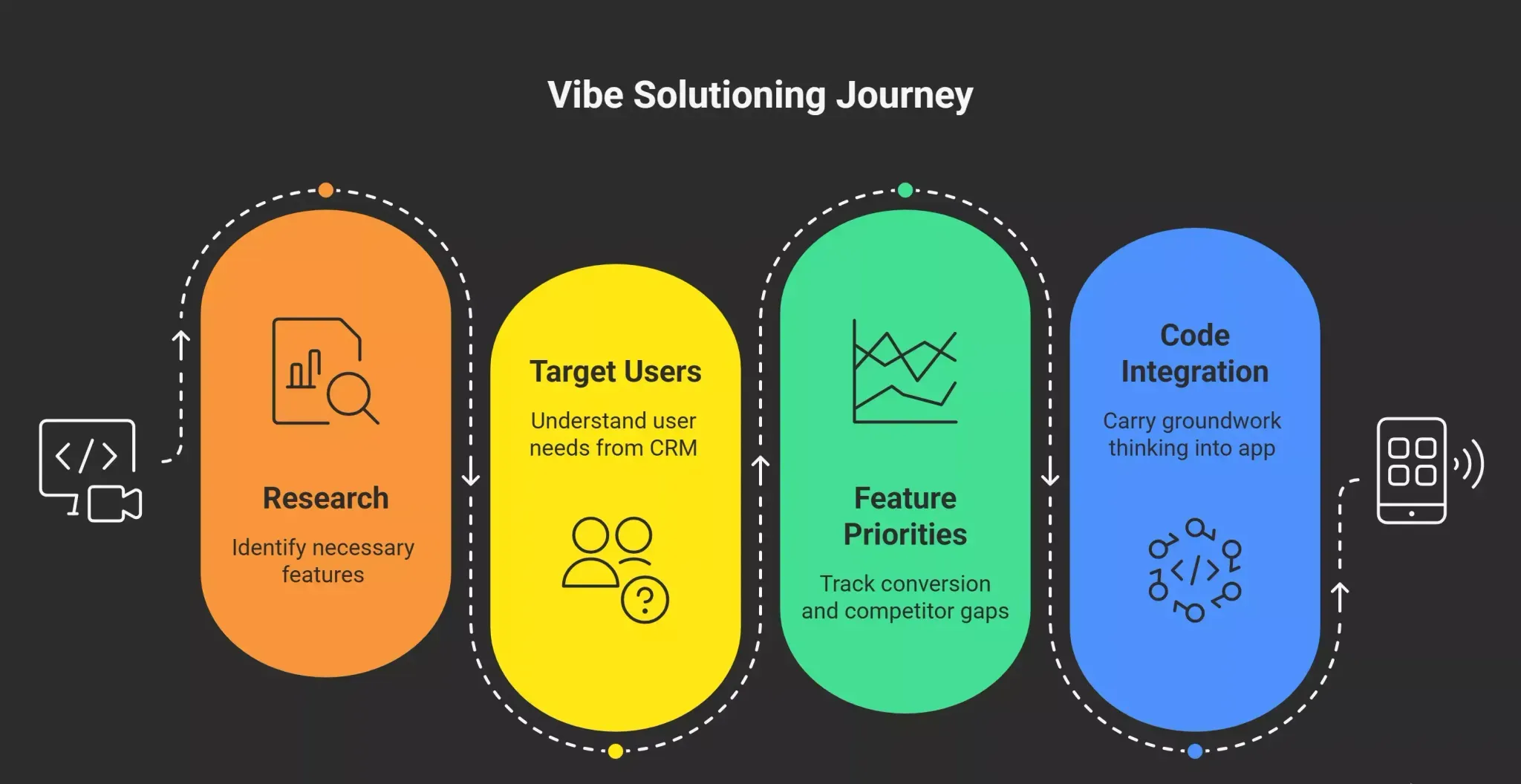 It answers "what and why" before "how." That shift sounds minor on paper, and it changes the whole downstream process of how apps get built:
-
Research prevents building unnecessary features, ensuring that the development focuses only on what is necessary. It runs before any generated code appears on screen.
-
Target users come from CRM signals, not guesses about an average persona.
-
Feature priorities track conversion history and competitor gaps, not the model's best pattern match.
-
The code carries the thinking from the groundwork straight into the app.
-
Every task in the project compounds the intelligence for the next one.
Vibe coding asked, "can AI write this?" Vibe solutioning asks, "is this worth building?"
Both questions matter, and one without the other produces demos that look great in a five-minute test and fail under real customers. The aim of a build matters more than the speed of the first generation, and that direction is what an empty brief cannot give you.
What People Are Saying About Vibe Coding Today
The conversation shifted quickly in the last year. Developers who celebrated single-prompt builds in early 2025 now talk openly about the ceiling that approach hits in production, and the community's focus has moved from raw output to structured thinking before the build. Karpathy himself framed the original idea directly on X when he introduced the term:
"There's a new kind of coding I call 'vibe coding,' where you fully give in to the vibes, embrace exponentials, and forget that the code even exists." - Source: Andrej Karpathy on X
That frame was honest about what it was: throwaway weekend projects where forgetting the code was acceptable. Serious apps need a different frame, and teams now focus on the research, the user signals, and the regulatory background that no single prompt can carry.
The community arrived at a clear answer: vibe coding works when the answers already live in your head, and when they do not, the tools hand back a polished version of the wrong app. So the next category of tools stopped at the door of the build itself and asks what the evidence says before any code starts.
How Rocket.new Handles Research-First Builds
A Platform Built on Accumulated Intelligence
Rocket.new is the hero of this workflow. It is the world's first vibe solutioning platform, built so each build runs on accumulated intelligence, not a blank slate. The thinking feeds the build. The build feeds the intelligence.
Every task sharpens the next, and that is why teams say intelligence compounds inside a Rocket project. This "think-validate-build" structure allows users to move from an idea to a fully functioning application with integrated backend logic more efficiently.
How Context Gets Converted Into Build Decisions
Rocket converts your documents into build decisions before code generation starts. Each task draws on project memory and runs thousands of background queries across external sources: competitor sites, job listings, pricing pages, and product changelogs.
That information feeds the build directly, so the system can generate an app aligned to the current market and not a guess about it.
Because the build starts from a strategic brief, the output includes production-grade features such as SEO optimization and accessibility compliance by default. Rocket surfaces the decisions that matter for this specific app and project.
What Gets Aligned Before a Line of Code Ships
Target personas come from your CRM data and market research. Core user journeys are prioritized by historical conversion benchmarks.
Data models line up with your existing systems and schemas, while permission schemes match your compliance requirements, and deployment choices stay compatible with your infrastructure.
Why Specificity Upfront Pays Off
Two minutes of specificity on the right inputs prevents two hours of error cleanup later, and the whole development loop gets tighter with every pass.
Here is the contrast on a single dimension at a time.
| Dimension | Blank Slate Approach | Research First on Rocket |
|---|---|---|
| Input | One sentence | Strategy docs, CRM signals, competitor information |
| Target users | AI pattern guess | Segments validated against real conversion numbers |
| Feature priorities | Whatever the prompt implies | Ranked by benchmarks and competitor gaps |
| Error and rework rate | High, context resets each session | Low, thinking compounds across tasks |
| Token cost | High from re-prompting | Up to 80% lower with shared memory and templates |
| Time to viable product | Weeks of patching | Hours with accumulated intelligence |
Rocket.new Key Capabilities
What makes Rocket structurally different from every other AI app builder:
-
Vibe solutioning platform: research, build, and competitor monitoring live in one platform with shared context that compounds over time
-
25,000+ templates library, free to use: each template adapts to your brand, stack, and project inputs, so you never have to create a layout from scratch or build one without a test cycle to back it up
-
Supports Flutter for mobile apps and Next.js for web apps: production-grade output, not prototypes, so you can create web apps and mobile apps that ship to stores and production URLs
-
Collaboration features built in: workspace, project, and task-level access, inline comments, version history, a shareable deploy link for every task
-
Three products, one platform: Solve answers business questions, Build ships the app, and Intelligence tracks competitors
Rocket builds differ from a blank-slate tool because the inputs differ. You load your strategy decks, customer research, competitive analyses, and connected sources once. Rocket reads files structurally, so every formula in a spreadsheet, every cross-sheet dependency, and every claim in a brief is understood the way your team works with it.
The platform then uses that shared knowledge to build web apps, create dashboards, and generate mobile experiences that match the team's existing decisions, not a generic pattern.
Competitive intelligence runs continuously in the background for the call to action section on every new feature. Rocket's system watches competitor websites, social feeds, product changelogs, and job postings at once.
Every morning, a structured brief arrives: what moved, what it means for your business, and what to do about it. That brief feeds the next build task, so nobody ships last year's product dressed up in this year's UI.
Rocket.new Use Cases
Specific use cases where Rocket changes the outcome for serious products:
-
A fintech lending dashboard factors current APR rules, competitor feature sets, and your 2024 default information before Rocket generates eligibility logic and UI disclaimers
-
A B2B SaaS retention feature starts from your churn analysis and past A/B test logs, so the fresh build targets users most likely to convert
-
A sprint planning portal uses your internal roadmap, engineering capacity, and recent velocity numbers to structure the backlog, not a generic template
-
An e-commerce returns flow incorporates best practices competitors rolled out in the last 12 months, guided by Rocket's continuous briefs
Every build ships with SEO, WCAG accessibility, GDPR compliance, and performance optimization built in. Backend development scaffolding lines up with your data models from the start, so the frontend and the server speak the same schema from day one.
Staging and production deployment is one click, and the share link for a build lands in a stakeholder's inbox in minutes, with a second link for internal test cycles. When the AI hits its edge, on a novel legal flow or an ambiguous strategic call, Rocket brings in a real person with the full project background, not a ticket handoff. The loop between the AI and the human team stays tight, and both sides work from one shared source of truth.
When you open a build task on Rocket, you do not start from scratch. You start from everything the project already knows about the market you sell into, and Rocket builds compound over time as the project takes in more evidence.
Building From Everything Your Team Already Knows
Research is not a step before the build. It is the substrate the build runs on. Teams skip the "explain it again" cycle, cut error rework, and create apps that match the market on day one. Bring your world in once, and every task, every new feature, and every sprint planning decision gets sharper than the last.
That is what research-first development looks like in practice, and it is how serious products earn their place in front of real users.
Stop guessing your product direction, build smarter with Rocket.new’s research-first AI approach.
Table of contents
- -Why Blank Prompts Fail Before The First Line of Code
- -The Gap a Blank Slate Can't Fill
- -The Speed Trap
- -Recurring Failure Patterns
- -A Context Problem, Not a Code Problem
- -The Hidden Cost of Rework
- -Vibe Coding Solved Execution. Vibe Solutioning Solves Direction.
- -Vibe Coding - Code Generation
- -Vibe Solutioning - The Step Beyond Code Generation
- -What People Are Saying About Vibe Coding Today
- -How Rocket.new Handles Research-First Builds
- -A Platform Built on Accumulated Intelligence
- -How Context Gets Converted Into Build Decisions
- -What Gets Aligned Before a Line of Code Ships
- -Why Specificity Upfront Pays Off
- -Rocket.new Key Capabilities
- -Rocket.new Use Cases
- -Building From Everything Your Team Already Knows