Rocket monitors Glassdoor under People and Hiring and Capterra under Reviews and Community because review and hiring shifts reveal competitor strategy weeks before public announcements. Nine signal pillars connect these inputs into Intel cards.
Rocket monitors Glassdoor and Capterra as competitive intelligence inputs, not review aggregators, because review and employee-sentiment shifts reveal competitor strategy weeks before public announcements. Glassdoor signals live in the People and Hiring pillar; Capterra signals live in the Reviews and Community pillar. Together, they form two of nine signal sources Rocket reads continuously.
What Makes a Review Platform a Competitive Intelligence Input?
A competitive intelligence input watches directional change, not current state. A review aggregator shows you a score; a competitive intelligence input tracks what that score is doing, how fast it is moving, and what the shifting themes signal about a competitor's product direction, pricing strategy, or internal health.
When a competitor's Capterra rating drops after a product update, that is not just customer dissatisfaction. It is a market reaction signal. When Glassdoor reviews start clustering around new enterprise focus or leadership restructuring, that signals a strategic direction the competitor has not yet announced.
The change is the data point. The current score is just context. A single review is noise; a directional shift across multiple reviews, arriving in a specific window, is intelligence. Sentiment velocity matters as much as sentiment state.
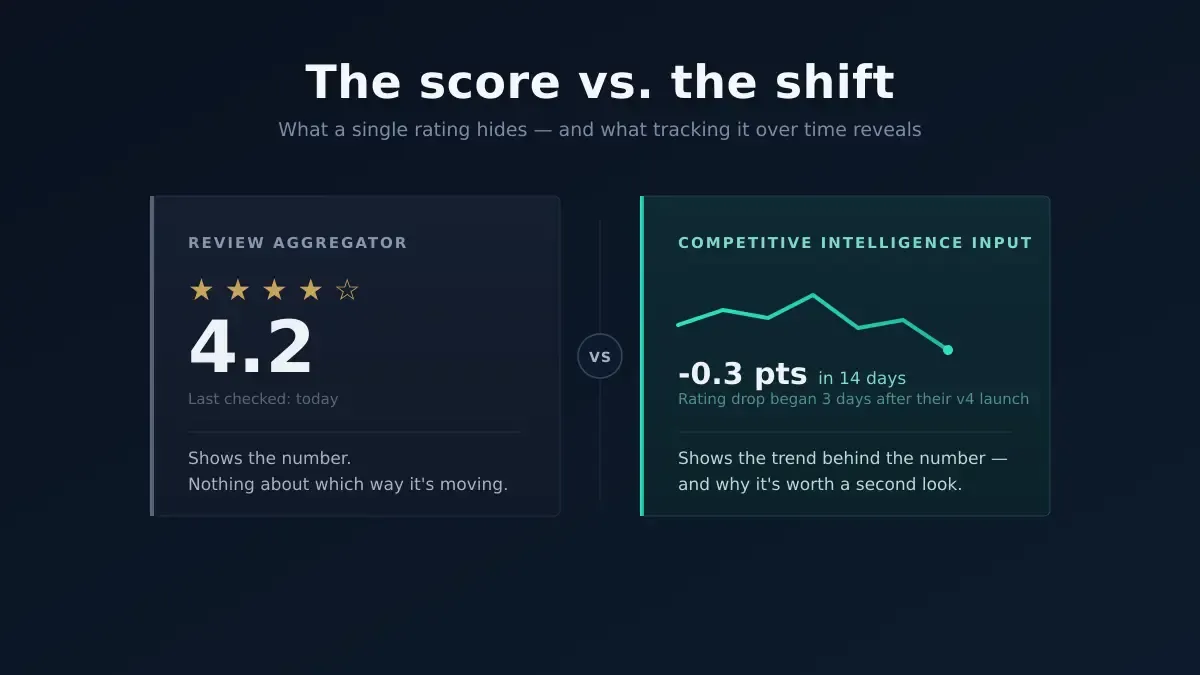
A review aggregator answers what is the score. A competitive intelligence input answers what is the score doing and why.
Review Aggregator vs. Intelligence Input
| Approach | Question It Answers | What It Misses |
|---|---|---|
| Review aggregator | What is the current score? | Directional shifts, sentiment velocity, theme clusters |
| CI input | What is the score doing, and why? | Nothing, reads the full picture |
| Rocket Intelligence | What does this signal mean for my business? | None, cross-pillar interpretation included |
Understanding this distinction is the foundation of competitive intelligence software done right.
What Does Glassdoor Actually Reveal About Your Competitors?
Glassdoor sits inside Rocket's People and Hiring pillar, not the Reviews and Community pillar. Glassdoor employee reviews carry workforce and strategic direction data, not customer product feedback. Employee Glassdoor reviews belong in People and Hiring per the pillar documentation.
The Employee Sentiment sub-tab shows Glassdoor ratings, CEO approval scores, recommendation rates, review volume, and burnout signals compared to industry averages. A cluster of reviews mentioning new AI features in development is a product roadmap signal.
Combined with the Active Hiring sub-tab, Glassdoor reviews form a picture of where a competitor is building. Hiring concentration in enterprise sales roles signals a market segment shift that typically shows up in pricing and product pages weeks later.
According to BrightLocal's 2026 Local Consumer Review Survey, 97% of consumers read reviews to guide their decisions. Glassdoor data is authentic, timestamped, and impossible for a company to spin.
What Does Capterra Reveal Past the Star Rating?
Capterra lives inside Rocket's Reviews and Community pillar, alongside G2, Trustpilot, Reddit, Hacker News, Product Hunt, and app store ratings. The Review Platforms sub-tab shows ratings with trend analysis.
A Capterra rating drop after a product update reveals immediate market reaction. Recurring complaints about a specific workflow signal where a competitor's product development is falling behind.
By August 2019, Capterra had already delivered over 1 million verified software reviews. When Capterra sentiment drops and reviews cluster around a specific complaint theme, that pattern often appears days to weeks before the competitor addresses the issue publicly.
The Reviews and Community pillar also watches Reddit threads, Hacker News discussions, and Product Hunt launches. Reddit threads often surface unfiltered user frustrations weeks before they appear in formal reviews.
Why Signal Clusters Beat Individual Data Points
The value of Glassdoor and Capterra as competitive intelligence inputs only materializes when read alongside other signals. A single data point is noise. A cluster of aligned signals across multiple pillars is strategy. This is the core of how signal cluster detection works inside Rocket.
Here is what a signal cluster looks like in practice:
- Reviews and Community: Capterra reviews begin mentioning too expensive for small teams, a pricing pushback signal
- People and Hiring: Glassdoor reviews mention big push toward enterprise clients, a strategic pivot signal
- People and Hiring: Active hiring shows new enterprise account executive roles, an execution signal
- Website Intelligence: Pricing page adds an Enterprise tier, public confirmation
By the time step four happens, a team running Rocket Intelligence already has context from steps one through three, typically weeks earlier.
| Signal Source | Pillar | What It Reveals | Lead Time |
|---|---|---|---|
| Glassdoor employee reviews | People and Hiring | Culture shifts, product focus, team investment areas | Weeks to months early |
| Capterra customer sentiment | Reviews and Community | Product pain points, pricing reception, feature gaps | Days to weeks after changes |
| Reddit and HN discussions | Reviews and Community | Unfiltered user frustrations, developer sentiment | Often before formal reviews |
| Active job postings | People and Hiring | Where a competitor is building | Often before any announcement |
| Website changes | Website Intelligence | Confirmed strategic direction | When the competitor is ready to go public |
This is also why predictive competitive intelligence outperforms reactive monitoring: the signal cluster is the forecast, not the confirmation.
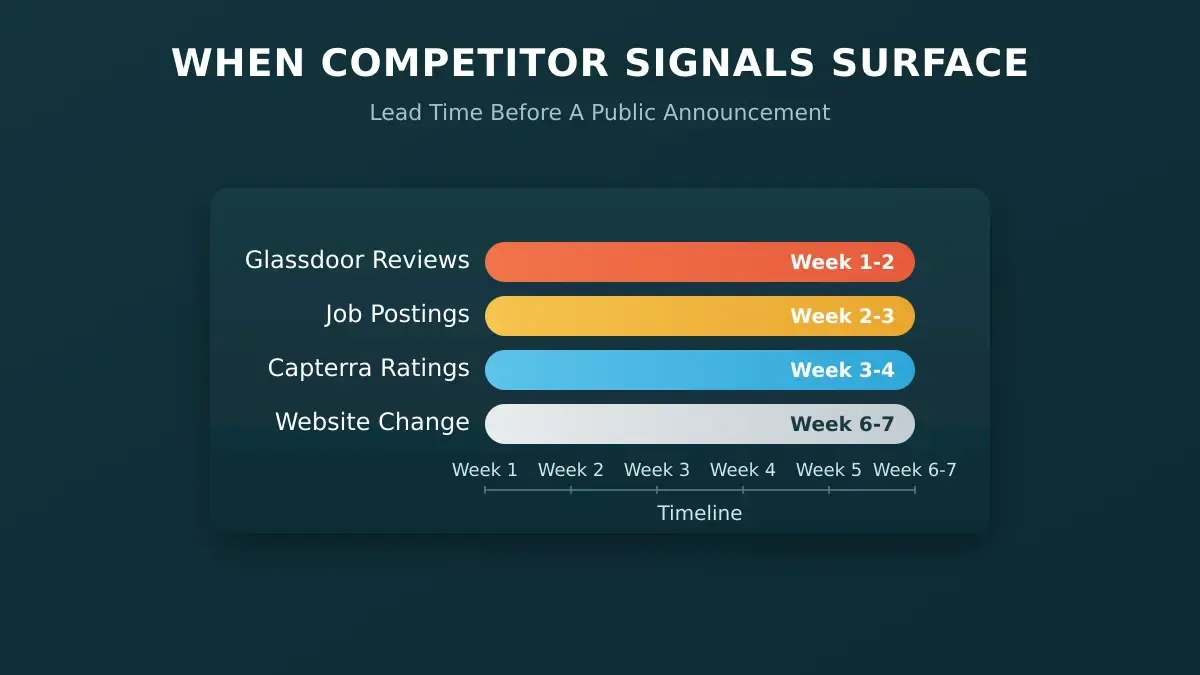
Glassdoor and hiring signals consistently surface weeks before a competitor's website confirms the strategic shift.
How Rocket Turns Review Data Into Competitive Intelligence
Rocket's Intelligence feature monitors every public platform a competitor operates on, continuously, from a single setup, using AI agents to connect signals across nine pillars. Those nine pillars are: Website Intelligence, Social Media, News and Media, GTM, Product and Technology, People and Hiring, Business and Finance, Reviews and Community, and a cross-pillar Intel feed.
- Sentiment trend tracking: Rating drops are flagged with impact markers. A 0.3-point Capterra drop in two weeks reads differently from the same drop over two months.
- Cross-pillar pattern detection: When Glassdoor reviews in People and Hiring mention a product direction change and Capterra reviews in Reviews and Community flag feature gaps in the same window, Rocket connects them into a single Intel card.
- Intel cards: Each day, Rocket surfaces structured Intel cards for each competitor, covering what changed, why it matters, and what your business should do.
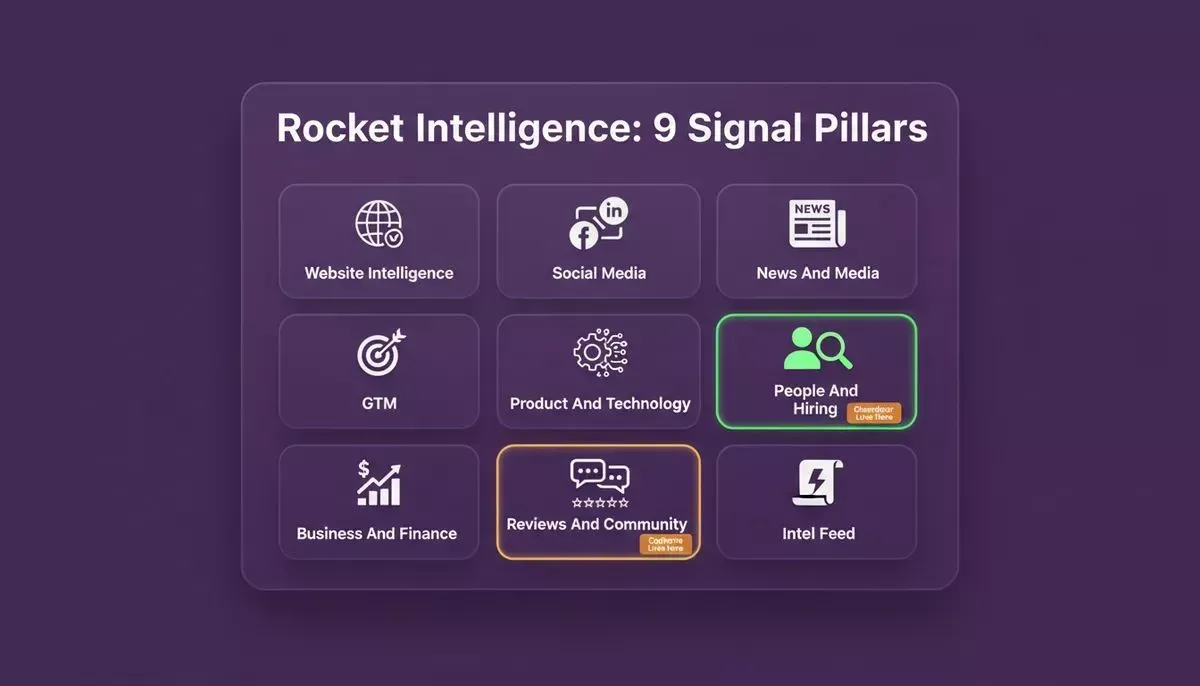
Glassdoor lives in People and Hiring. Capterra lives in Reviews and Community. Both feed into Intel cards that connect signals across all nine pillars.
For sales teams specifically, this kind of pre-deal competitive intelligence changes how reps enter high-stakes conversations.
Why Other Competitive Tools Often Stop Short
Traditional competitive intelligence tools surface signals and present them as alerts. The signal arrives, and you become the system: you decide what three signals from three platforms mean together, you carry context between sessions, and you coordinate what the marketing team should know versus what the sales team needs.
This is the fundamental gap between alerting systems and interpretation systems. Rocket is built on a different architecture. Intelligence runs alongside Solve (strategic research) and Build (product development) in one shared workspace.
The intelligence does not stop at a brief; it becomes the shared context that shapes what your team builds and decides. According to research on competitive intelligence practices, 82% of companies with revenues over $10 billion have organized intelligence systems.
Understanding how Rocket compares to dedicated CI tools like Crayon and Klue helps clarify why the interpretation layer matters more than the monitoring layer alone.
97% of consumers still lean on reviews to guide their decisions. The human need for peer recommendation is now a permanent fixture of how we buy. - Myles Anderson, Co-founder and CEO, BrightLocal
How to Set Up Glassdoor and Capterra Monitoring in Rocket
Setting up competitor monitoring in Rocket takes under five minutes.
- Open Intelligence from the sidebar and click + Add competitors
- Enter a competitor's homepage URL. Rocket automatically covers all nine pillars
- Set your signal priorities during the setup wizard. These control which signals surface first in your Intel cards
- Choose your notification channel (Push or Email) and brief frequency (Daily, Weekly, or Monthly)
- Wait 1-3 hours for initial data collection. After that, Rocket monitors continuously
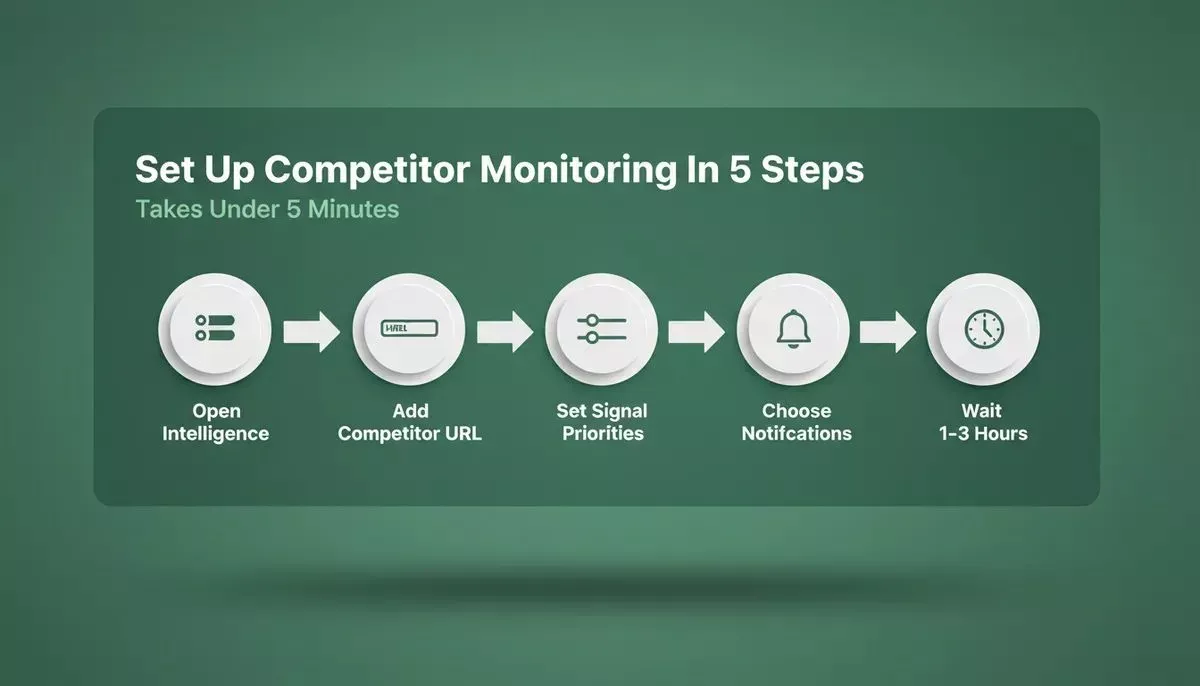
The entire setup takes under five minutes. After that, Rocket monitors Glassdoor, Capterra, and seven other signal pillars automatically.
For the full walkthrough, see the Intelligence quick start in the docs. If you are building a formal program around this, the guide on how to build a competitive intelligence program covers the broader framework.
Stop reacting to competitor moves after they happen. Rocket monitors Glassdoor, Capterra, G2, hiring data, website changes, social signals, and more simultaneously, and delivers structured Intel cards that tell you what it all means before your first meeting.
Start monitoring your competitors on Rocket.new and turn review platforms into the early-warning system they were always meant to be.
Table of contents
- -What Makes a Review Platform a Competitive Intelligence Input?
- -Review Aggregator vs. Intelligence Input
- -What Does Glassdoor Actually Reveal About Your Competitors?
- -What Does Capterra Reveal Past the Star Rating?
- -Why Signal Clusters Beat Individual Data Points
- -How Rocket Turns Review Data Into Competitive Intelligence
- -Why Other Competitive Tools Often Stop Short
- -How to Set Up Glassdoor and Capterra Monitoring in Rocket