
Most startups fail not from poor execution, but from building the wrong thing. An ai business idea validator tests your concept against real market data before you commit time, money, or code to it.
Why do 42% of startups fail?
Because founders skip validation. An AI business idea validator uses live market data, competitor analysis, and viability scoring to test how feasible your startup idea really is before you invest serious time or money.
For founders, product managers, and startup teams, that means a faster path to real demand and fewer months spent building something nobody wants.
Why Most Startup Ideas Fail Before Launch
The startup world celebrates building fast. But speed without validation is how founders burn through savings before realising their business idea had no market.
That statistic from Failory's analysis of startup failure sits at the core of a problem every entrepreneur faces. Founders fall in love with a business idea, skip the hard questions, and pour months into products the market never wanted.
- 42% of startups fail because they build products nobody wanted, according to data from multiple post-mortem analyses
- The Wilbur Labs 2026 founder survey found that 54% of founders realised too late they needed to validate business ideas against product-market fit
- 81% of founders pivoted from their original startup idea at least once, and 42% wished they had done it sooner
- First-time entrepreneurs have only an 18% success rate, partly because they trust theory over real data
The community of failed startups keeps growing. Founders do not fail because they lack talent. They fail because they skip the step that tells them whether their startup idea has real market demand. Startup idea testing and concept validation are not optional. They are the difference between a product that ships and one that stalls.
What Is an AI Business Idea Validator?
An AI business idea validator is a tool that evaluates the commercial viability of a startup concept using live data, algorithmic scoring, and structured analysis. Unlike a spreadsheet or a gut-check conversation, a good validator pulls real signals: search volume trends, competitor pricing, community sentiment, market size estimates, and revenue model fit.
It synthesises those signals into a structured report a founder can act on. That report can be presented to investors or used directly to scope a build. The key difference from traditional market research is speed and depth. AI validation tools generate structured findings in hours, not weeks.
Validation vs. Market Research: What Is the Difference?
Many founders confuse idea validation with market research. They are related, but they serve different purposes.
Market research answers: "How big is this space, and who are the players?" It is broad, descriptive, and often backward-looking.
Idea validation answers: "Will people pay for this specific thing, from me, right now?" It is narrow, predictive, and action-oriented.
Together, a good ai business idea validator does both in one pass. It sizes the market, maps competitors, and scores your specific concept's viability against real demand signals. The output is not a report to file away. It is a decision to make.
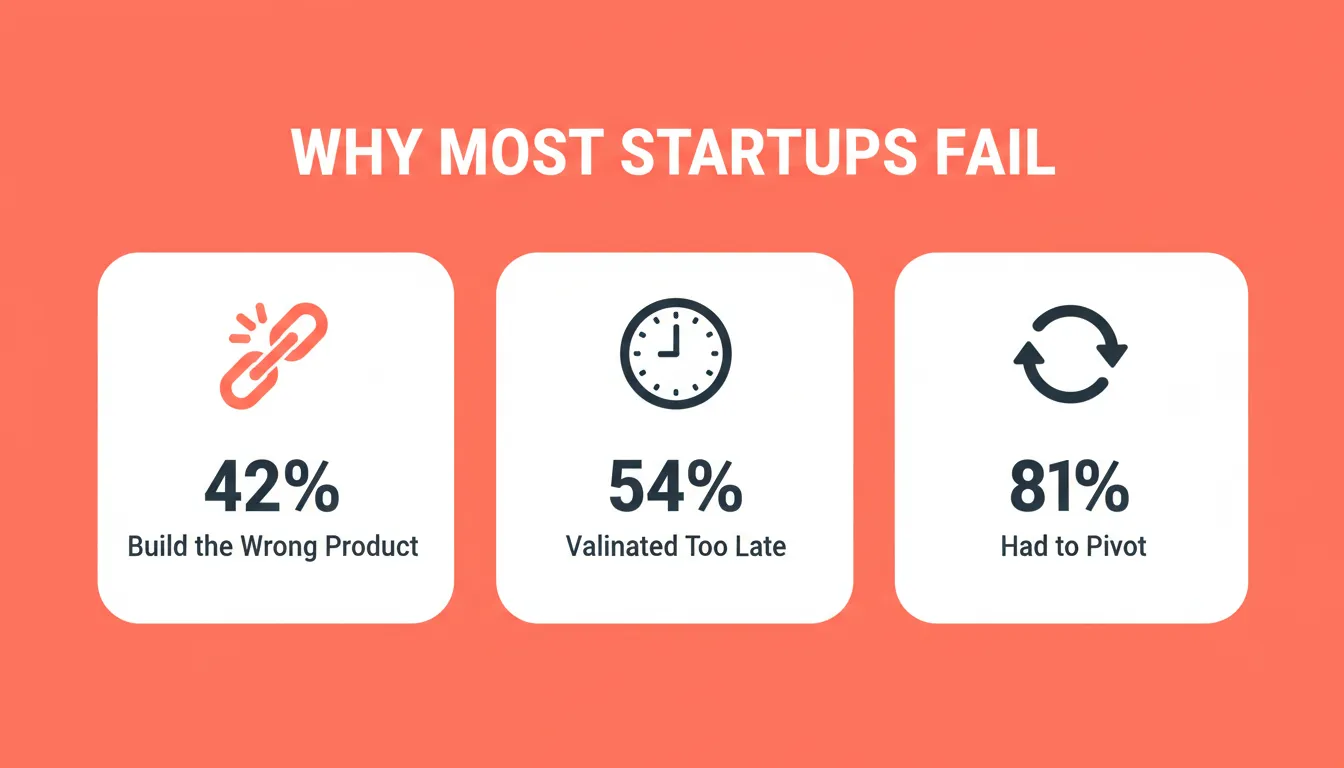 The numbers behind startup failure: skipping validation is the most common and most avoidable cause
How Does AI-Powered Idea Validation Work?
Traditional market research meant weeks of surveys and guesswork. AI-powered business idea validation compresses that cycle into hours by helping founders evaluate multiple data points at once.
Here is what a good AI tool does when you submit your startup idea:
- Market analysis pulls search volume, Google Trends data, and spending patterns to score whether people actively seek solutions to the problem
- Competitor mapping identifies existing players, pricing gaps, and blind spots in positioning
- Target audience identification uses data from LinkedIn ads, Reddit community discussions, and review sites to find who needs this solution
- Viability scoring evaluates TAM, market size estimation, revenue models, and business model fit
- Risk flagging highlights competition, saturation signals, and weaknesses in your value proposition
AI-powered idea validation: five parallel analysis layers feed into a structured report, then route to build or pivot
The output is not guesswork. A good validation tool returns evidence-backed analysis with confidence scores. This is how founders decide whether a business idea is ready to build, or whether they need to pivot first.
Teams using practical market research methods alongside AI idea validation report faster time-to-market and fewer wasted development cycles.
What Features Should a Good Validation Tool Have?
Not every AI tool claiming "business idea validation" delivers the same depth. Some generate surface-level analysis, while others run market analysis with viability scoring across multiple dimensions.
| Feature | Basic Free Tools | Advanced AI Validators |
|---|---|---|
| Market size estimation | Template-based, rough numbers | Live data with source citations |
| Competitor analysis | Manual list, no insights | Automated mapping, blind spots identified |
| Target audience research | Survey templates | AI-driven community and forum analysis |
| Viability scoring | Simple checklist | Multi-factor scoring with revenue models |
| Speed | Days to weeks | Minutes to hours |
| Business plan connection | None | Investor-ready plans with financial projections |
| Context continuity | Starts from zero each session | Shared memory carries insights into the build phase |
Understanding your market size through calculating TAM, SAM, and SOM is a strong starting point. However, the best validators go further by helping you create actionable next steps from that data.
Informly is one example of in-depth analysis, with validation reports averaging 75+ pages.
According to Startup Genome's research, the majority of AI funding concentrates in just a handful of cities globally. As a result, founders outside those hubs need better validation tools to compete for investors and funding.
- Check whether the tool validates startup ideas with real data, not just theory
- Look for free trials or free tiers that let you test the system before paying
- Prioritise tools that generate structured reports ready for investors
- Choose tools where validation output connects directly to your next build step
IdeaProof is one of the services trusted by 10,000+ entrepreneurs. It evaluates startup concepts using 50+ authoritative sources.
Common Idea Validation Mistakes Founders Make
Even founders who know they should validate often do it wrong. Here are the patterns that produce false confidence.
Asking friends and family. People who care about you will not tell you your idea is bad. Validation requires strangers with the problem you are solving, not supporters.
Confusing interest with intent. "That sounds cool" is not the same as "I would pay for that." Real validation measures willingness to pay, not enthusiasm.
Validating the category, not the concept. Confirming that "people want productivity tools" does not validate your specific productivity tool. Validation must be specific to your positioning, pricing, and target customer.
Stopping at one data source. A single Reddit thread or one survey is not validation. A good ai business idea validator cross-references multiple live data sources simultaneously to surface conflicting signals and produce a confidence score. For a structured, multi-source approach, see how to validate startup ideas with AI.
Skipping competitor analysis. If a well-funded competitor already owns the space, that changes your go-to-market entirely. Competitor mapping is not optional.
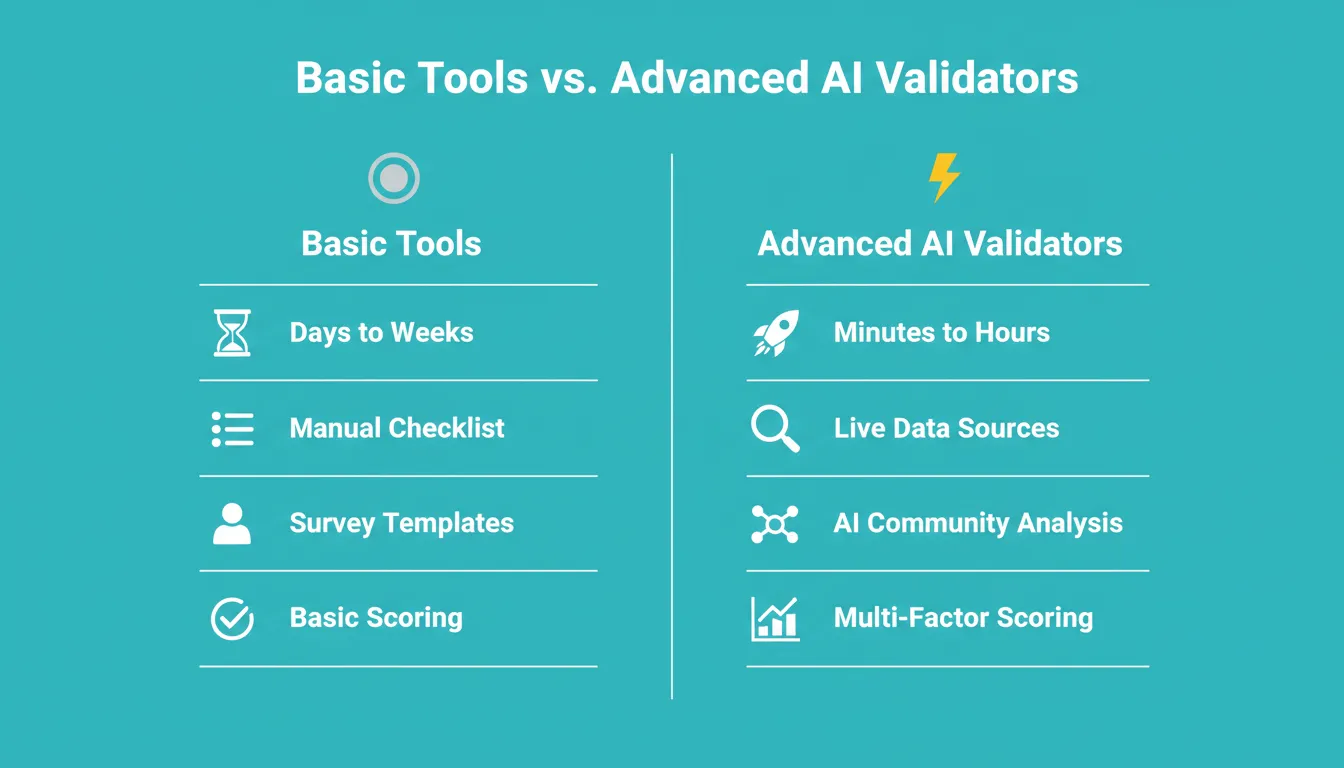 Basic tools give you a checklist. Advanced AI validators give you a decision backed by live data across multiple sources
From Validated Idea to Live Product on Rocket
Most validation tools end where the real work begins. You get a report, then you are stuck switching to a different tool to build. Rocket closes that gap.
1.5 million people have tried Rocket across 180 countries, from solopreneurs validating their first idea to enterprise teams running strategy and execution in the same platform. Rocket is the world's first Vibe Solutioning platform: validate ideas, build production-ready products, and monitor competitors, all in one place, all sharing the same context.
Here is how each pillar supports the validation-to-launch journey.
Solve: Structured Research Before You Build
Solve takes any business question and delivers a complete, structured solution. You describe your startup idea in plain language. Solve breaks it into component dimensions, runs parallel agent research across 150+ sources simultaneously, and synthesises findings into a structured report. That report covers market sizing, competitive landscape, target audience, revenue models, and risk matrix, typically within 60 to 90 minutes.
The output spans 8 to 12 sections. Each finding is tagged by signal strength (HIGH, MEDIUM, or LOW), and conflicting signals are called out explicitly rather than smoothed over. You can export as a PDF or generate a full presentation deck.
What makes Solve different from a chatbot or search engine: those tools give you a conversational answer. Solve gives you a structured, multi-source report built from live data, with an executive summary, supporting evidence, and actionable recommendations.
Build: From Validated Idea to Production-Ready Product
Once Solve has validated your direction, Build generates production-ready web apps (Next.js), mobile apps (Flutter), landing pages, and SaaS products from natural language. Every build starts from the accumulated intelligence of the project. The Solve research, competitive findings, and brand context are already in place, so nothing needs to be re-explained.
Every product ships with SEO-ready structure, WCAG accessibility compliance, GDPR coverage, and performance optimisation by default. These are the baseline, not optional extras.
Intelligence: Keep Validation Current After Launch
Markets move. Intelligence monitors every public platform a competitor operates on, continuously, and delivers daily and weekly briefs with pricing change alerts, hiring signals, and trend shifts. What other tools call monitoring, Rocket calls the minimum. Intelligence interprets what signals mean for your business, not just what changed.
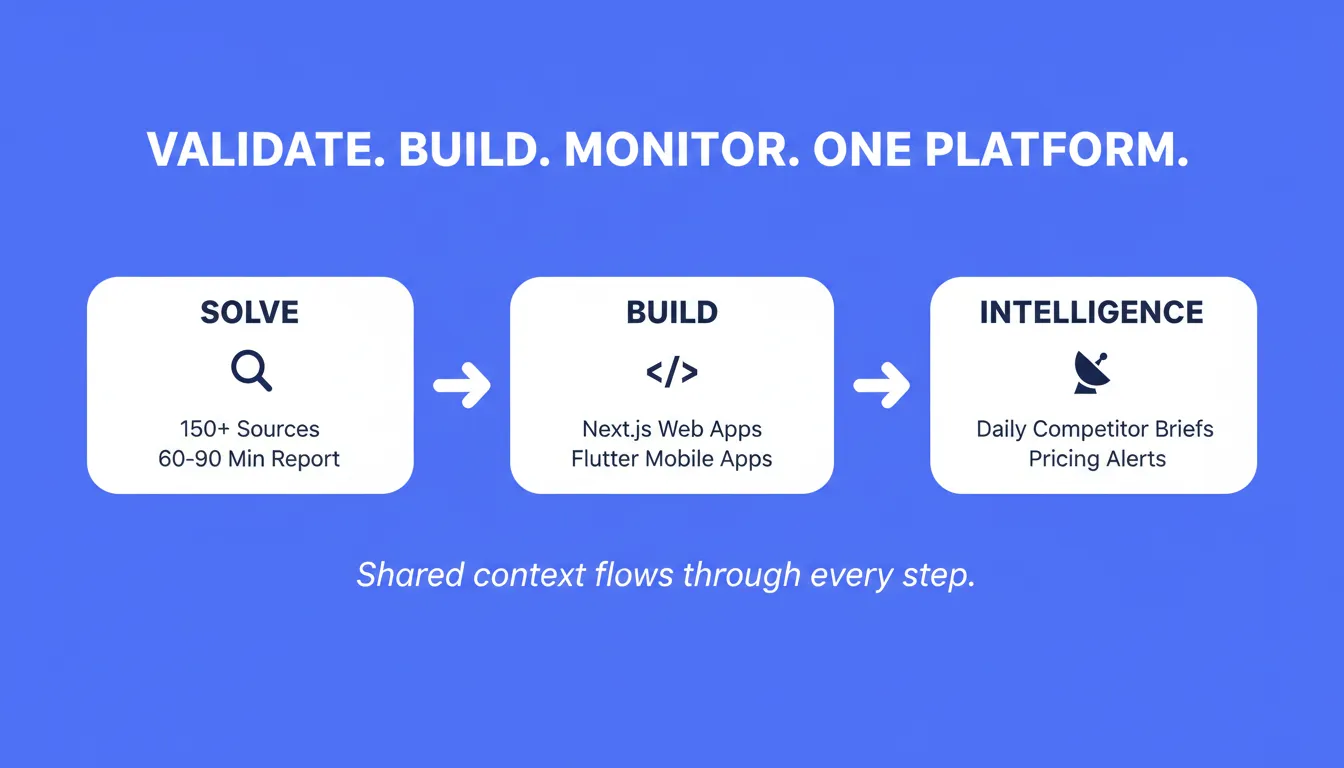 Rocket's three pillars share context: the research from Solve flows directly into Build, and Intelligence keeps both current
Context: No Handoffs, No Lost Research
Every task inside a Rocket project inherits the full context of every prior task. The Solve report that validated your direction is present when you open the Build task. The competitive brief is present when the landing page is written. The handoff is not improved. It is eliminated.
Other AI builders start from a blank prompt. They build what you tell them. Rocket figures out what is worth building first, then builds it.
Step-by-Step Process to Validate Startup Ideas
Knowing validation matters is one thing. Having a repeatable process is what separates founders who succeed from those stuck in research mode.
Six-step startup idea validation process: from concept definition through product-market fit confirmation
- Step 1: Define the initial concept in one sentence. If you cannot articulate what you sell and who needs it, the market will not understand either.
- Step 2: Identify your target audience and whether they currently spend money on imperfect solutions.
- Step 3: Run AI market analysis to validate demand, evaluate competition, and score viability with real data.
- Step 4: Generate a business plan based on your findings. Include financial projections, revenue models, market size, and marketing strategy.
- Step 5: Build a product fast, then test demand through customer interviews or a conversion-optimised landing page before scaling.
- Step 6: Gather real user feedback from paying customers or active trial users. Iterate on positioning, pricing, or features based on what the data shows, not what you hoped.
For founders exploring the best AI MVP builders for startups, this process compresses the typical validation journey from months to days.
Each step builds on the last. Skip one, and you are guessing again.
What to Do After Validation
Validation is not the finish line. It is the starting gun. Here is what comes next, depending on what the data shows.
If validation confirms demand: Move to scoping your MVP. Define the smallest version of the product that delivers the core value proposition. Use the validation report to prioritise features, not personal preferences.
If validation reveals a gap: Do not abandon the idea. Instead, identify whether the gap is in the problem definition, the target customer, the pricing model, or the competitive positioning. Pivot one variable at a time, then re-validate.
If validation is inconclusive: That is data too. Inconclusive results usually mean the market is early, the problem is not painful enough to drive spending, or the positioning needs sharpening. Run a second pass with a more specific prompt and a narrower customer segment.
The founders who succeed are not the ones who get perfect validation scores. They are the ones who treat validation as a continuous loop, not a one-time gate.
Build on Thinking, Not Guessing: The Future of AI Idea Validation
The most expensive mistake in any business is not a bad execution. It is a good execution of the wrong thing. AI-powered idea validation is changing that by giving any founder access to the kind of structured market intelligence that used to require a research team or a strategy consultant.
As AI validation tools get more precise, the gap between founders who validate and those who skip it will only widen. The next generation of successful startups will not be the ones who moved fastest. They will be the ones who thought clearly before they moved at all.
Your next business idea deserves a real foundation. Type it into Rocket, run a Solve analysis, and know what you are building before you build it. No credit card required.
Table of contents
- -Why Most Startup Ideas Fail Before Launch
- -What Is an AI Business Idea Validator?
- -Validation vs. Market Research: What Is the Difference?
- -How Does AI-Powered Idea Validation Work?
- -What Features Should a Good Validation Tool Have?
- -Common Idea Validation Mistakes Founders Make
- -From Validated Idea to Live Product on Rocket
- -Solve: Structured Research Before You Build
- -Build: From Validated Idea to Production-Ready Product
- -Intelligence: Keep Validation Current After Launch
- -Context: No Handoffs, No Lost Research
- -Step-by-Step Process to Validate Startup Ideas
- -What to Do After Validation
- -Build on Thinking, Not Guessing: The Future of AI Idea Validation