
Most founders build the wrong thing. AI validation fixes that before you write a line of code. This blog covers the full process: market research, competitor analysis, sentiment analysis, landing page testing, and viability scoring. Use it to validate any startup idea in days, not months.
Can AI really validate a startup idea before you build it?
Yes. Founders who run AI-powered validation before building are far more likely to ship something the market wants.
This blog walks through the complete process step by step. You will go from defining your idea to making a data-backed build decision, moving forward with evidence instead of assumptions.
Why Most Startups Fail Before They Begin?
According to Failory, 90% of startups fail. The leading cause is not poor execution. It is building something nobody wanted in the first place.
Most founders skip validation entirely. They fall in love with an idea, assume the market exists, and start building. Months later, they discover the problem was not painful enough, the market was too small, or a competitor already solved it.
The fix is not better execution. It is better thinking before the build begins.
The Cost of Skipping Validation
According to Exploding Topics, 34% of small businesses fail due to poor product-market fit. That is more than one in three.
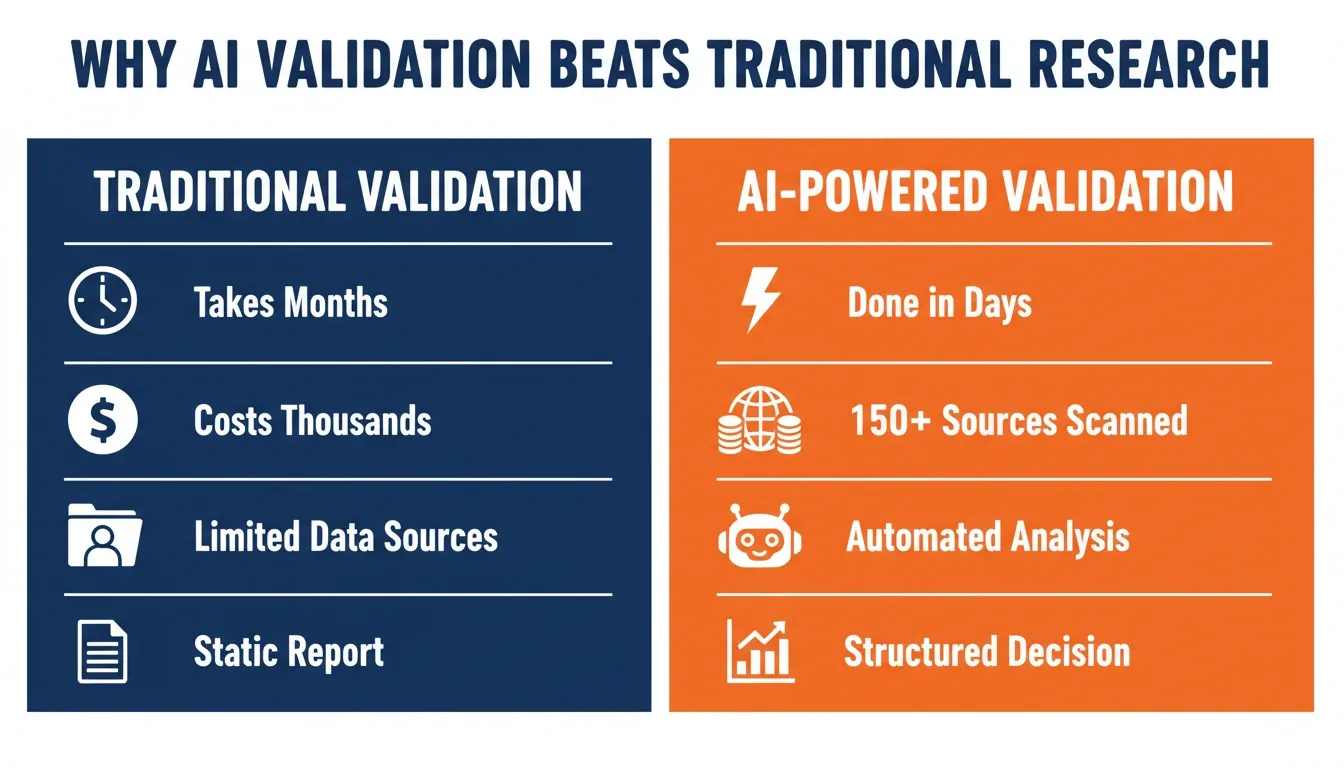
The traditional fix was expensive: surveys, focus groups, consultants, and months of manual research. Most early-stage founders could not afford it.
AI has changed the economics completely. A founder with a clear idea and the right tools can now complete a full validation cycle in three to seven days.
What AI-Powered Validation Actually Does
AI validation tools are research accelerators. They scan large volumes of data across forums, review sites, social media, and search trends. They surface patterns that a human researcher would take weeks to find manually.
Here is what a good AI validation process covers:
- Market research across dozens of sources at once
- Sentiment analysis on customer reviews and community discussions
- Competitor mapping across pricing, features, and positioning
- Viability scoring based on market size, competition, and demand signals
- Concept testing through landing page analysis
The output is structured intelligence, not a gut feeling. You get a clear picture of whether the problem is real, whether people will pay, and where the gaps are.
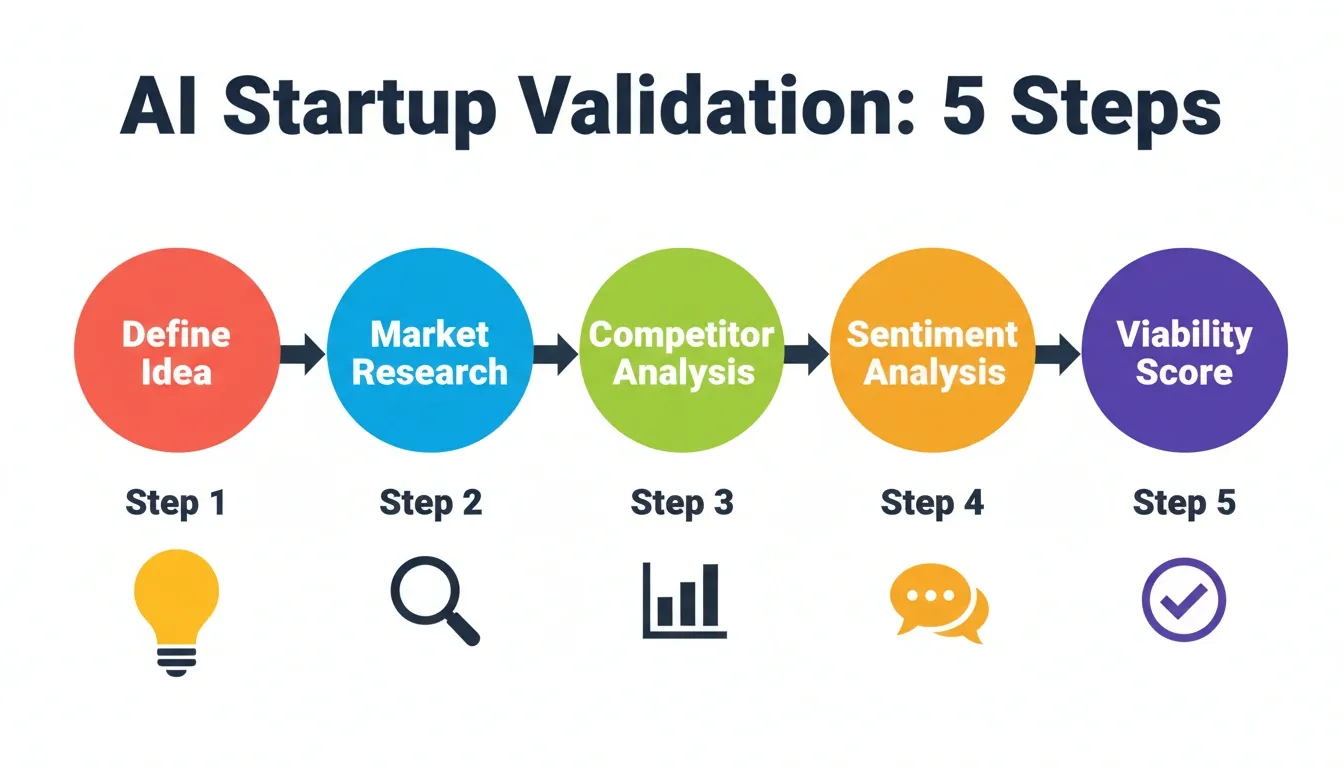
Step-by-Step: How to Validate Startup Ideas with AI
Step 1: Define Your Business Idea with Precision
Before any AI tool can help, you need a specific, plain-language description of your idea. Not a pitch. A clear paragraph covering the problem, the solution, the target customer, and the revenue model.
A weak prompt produces weak output. "An app for productivity" returns generic results. "A project management tool for freelance designers who struggle to track client feedback across revision rounds, priced at $29/month" returns focused, useful intelligence.
Write this description first. It becomes your prompt for every step that follows.
Common mistake: Founders describe their solution instead of the problem. Start with the problem. The solution can evolve. The problem is what you are validating.
Step 2: Run AI-Powered Market Research
Market research is where most founders either overspend or skip entirely. AI tools let you do it properly without either problem.
A good AI research tool scans search trends, social media, review platforms, and industry reports. It surfaces whether your idea addresses a real and growing need. You want answers to three questions:
- Is there proven demand for this type of solution?
- Is that demand growing, stable, or shrinking?
- What exact language do potential users use to describe the problem?
That language is your marketing copy. AI tools surface it through natural language processing. They pull real conversations and turn them into structured insights.
Market sizing is also part of this step. A business idea with 500 potential customers worldwide is a very different project than one with 5 million. Rough estimates of total addressable market (TAM) and serviceable market (SAM) give you a framework for the financial viability conversation.
For a deeper look at how AI market research connects to build decisions, the process is more integrated than most founders expect.
Step 3: Perform Competitor Analysis
No business idea exists in a vacuum. There are almost always competitors. Understanding them is a core part of validation.
AI tools scan competitor websites, pricing pages, app store reviews, and ad activity. They build a detailed picture of what already exists. The goal is not to get discouraged. A strong competitor is a sign of a real market. The goal is to find the gap.
| Analysis Area | What to Look For | Why It Matters |
|---|---|---|
| Pricing | Price points, tiers, free plans | Tells you what customers will pay |
| Reviews | Complaints, praise, feature requests | Shows gaps you can fill |
| Marketing | Messaging, channels, target audience | Reveals positioning opportunities |
| Features | Core functionality, missing features | Defines your differentiation |
| User base | Company size, customer type, geography | Confirms your target user |
If every competitor has the same weakness in their reviews, that weakness is your opportunity. Build your positioning around the gap, not around matching what already exists.
Step 4: Run Sentiment Analysis on Real Customer Data
Sentiment analysis measures how urgently people feel the problem you are targeting. It goes beyond counting mentions and captures emotional intensity.
AI tools use natural language processing to scan review sites, forums, Reddit, and social media. The output tells you whether people are frustrated, resigned, or actively searching for a solution.
High negative sentiment around a specific pain point is a strong validation signal. It means the problem is real, painful, and unsolved. Low or neutral sentiment suggests the problem may not drive purchasing decisions.
Sentiment analysis also surfaces what customers value in existing solutions. That tells you what you need to match or beat to win market share. Understanding how sentiment signals connect to product strategy is a step most founders skip entirely.
Step 5: Test Your Concept with a Landing Page
After AI research, you have a clear picture of the market, the competition, and the pain points. Now test your concept with real people who have no reason to be polite.
Build a simple landing page. State the problem clearly. Describe your solution in one or two sentences. Ask visitors to sign up for early access or pay a small deposit. You are not selling a finished product. You are testing whether people care enough to act.
Drive traffic through LinkedIn ads, Reddit posts, or a small Google Ads campaign targeting your primary keywords. Track sign-up rates, scroll depth, and any messages visitors send.
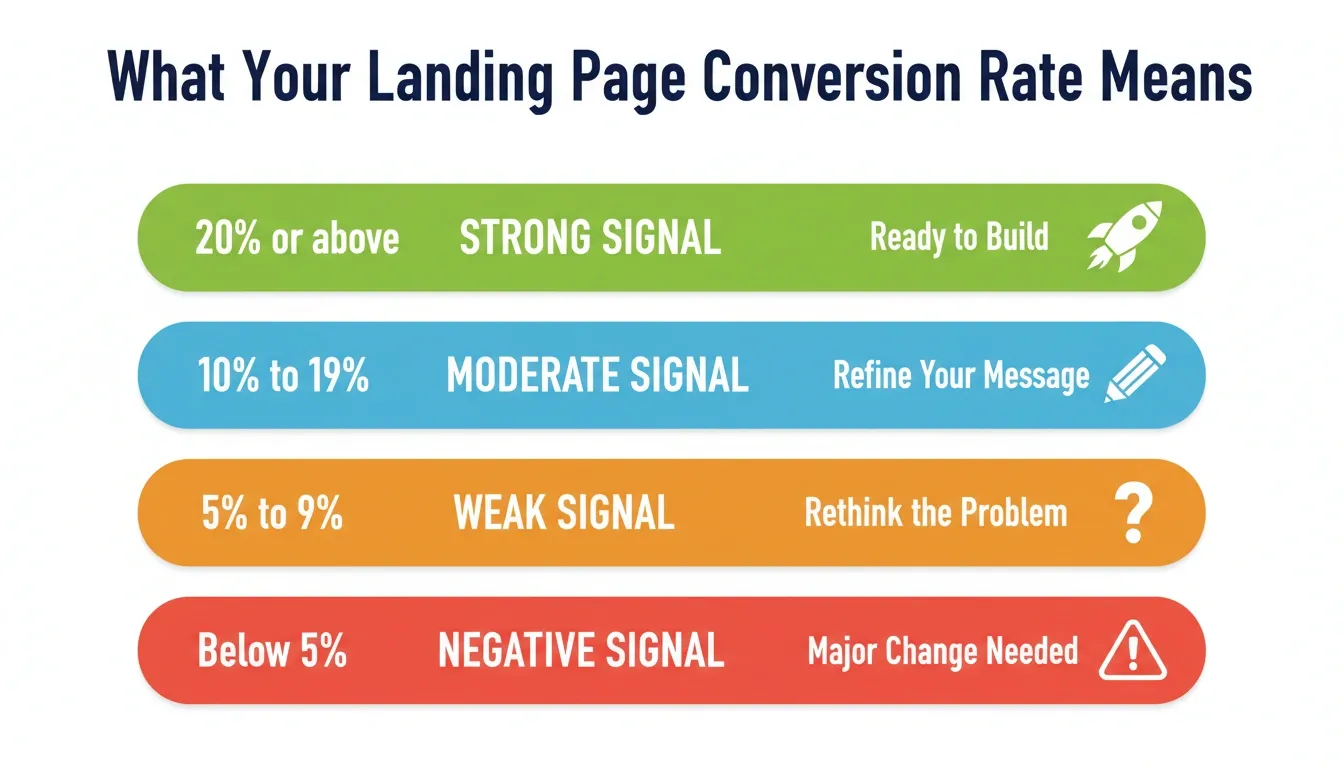
What the numbers tell you:
| Conversion Rate | Signal | Next Step |
|---|---|---|
| 20% or above | Strong | Move to build |
| 10 to 20% | Moderate | Refine messaging, retest |
| 5 to 10% | Weak | Revisit problem or solution |
| Under 5% | Negative | Major rethink needed |
The goal is not perfection. The goal is a signal from real users, not friends or co-founders.
Step 6: Review Your Viability Score and Decide
By this point, you have run market research, competitor analysis, sentiment analysis, and a landing page test. Now you make a decision: build, pivot, or stop.
AI tools that generate a viability score pull together all the signals from your research into a single composite rating. A high score means the signals are positive. A low score means something is off.
Use the viability score as the foundation for a structured conversation with your team or advisors. It does not decide for you. It gives you the evidence to make a well-informed decision.
Real-World Validation Use Cases
B2B SaaS: Finding the Right Niche
A founder building an HR onboarding tool uses AI to scan HR forums and review platforms. The research surfaces that onboarding documentation is consistently rated the most time-consuming HR task. It also shows that existing tools are built for large enterprises.
She runs a landing page test targeting HR managers at companies with 50 to 200 employees. 23% sign up for early access. She builds.
Consumer App: Discovering a Pivot
A founder building a generic meditation app finds a saturated market with strong incumbents. Sentiment analysis reveals an underserved segment: professionals who want meditation but find traditional apps too slow and spiritual.
The pivot is a five-minute, science-backed stress reduction app for professionals. A new landing page test achieves 31% conversion. The pivot saves six months of building the wrong thing.
Marketplace: Validating Both Sides
A founder building a freelance design marketplace uses AI to confirm that both designers and clients are actively searching for each other on informal platforms. The research surfaces a clear pricing gap at the mid-market level.
Pre-orders from a landing page test confirm willingness to pay before any development begins.
Common Validation Mistakes Founders Make
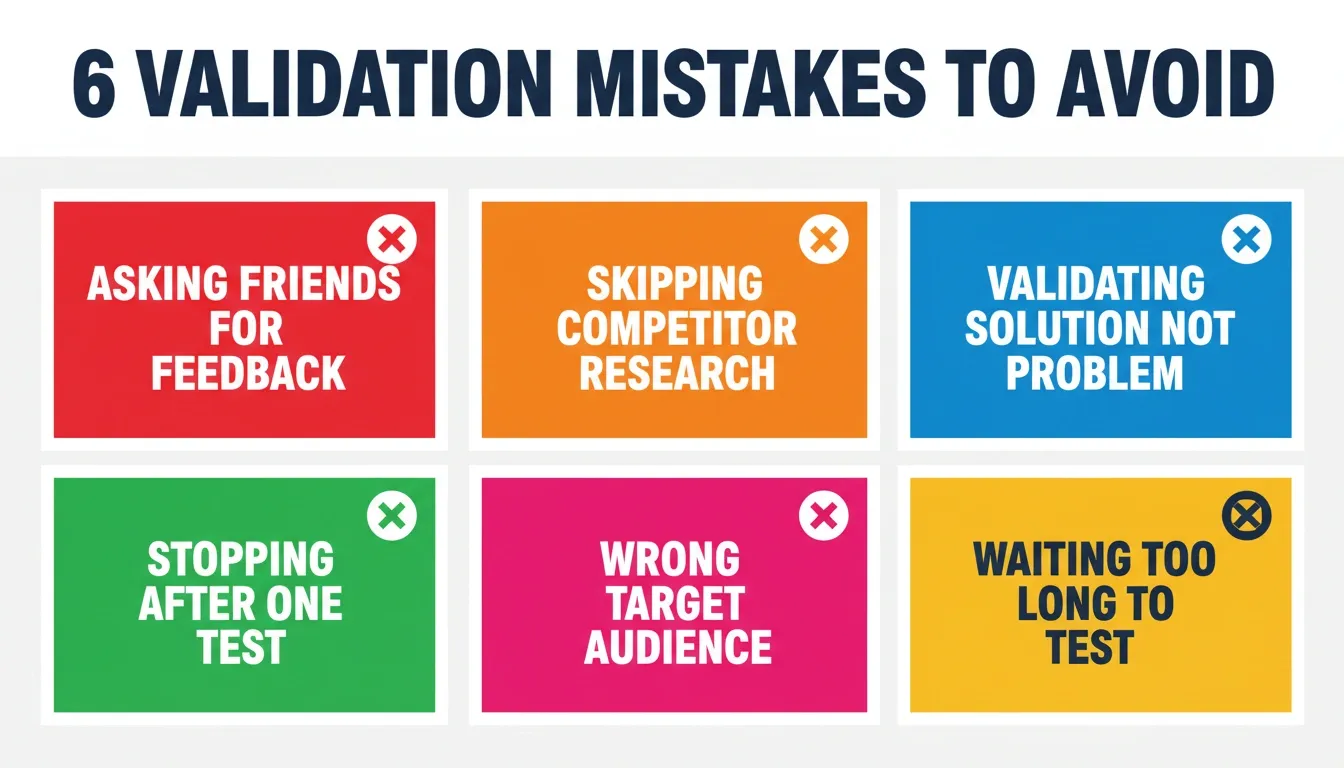 Even with great AI tools, founders make predictable mistakes. Here are the most expensive ones:
1. Asking friends and family for feedback. They will tell you what you want to hear. You need feedback from strangers who match your target user profile.
2. Validating the solution instead of the problem. Confirm the problem is real and painful before testing your solution. If people are not actively searching for a fix, your idea may not have enough pull.
3. Skipping competitor analysis. Founders often assume their idea is unique. It seldom is. Skipping this step means missing the most valuable positioning signals.
4. Treating a viability score as a final answer. The score is a guide, not a verdict. Use it alongside qualitative feedback and your own judgment.
5. Stopping after one test. A single landing page test is a data point, not a conclusion. Run multiple tests with different messaging and audiences before deciding.
6. Waiting too long to start. With AI tools, you can run a full cycle in a week. Founders who wait for a "more complete" idea are delaying the most valuable feedback they can get.
What Makes a Business Idea Worth Building?
| Question | What to Look For |
|---|---|
| Is the problem real? | Evidence of people actively searching for or paying for solutions |
| Is the market big enough? | Enough potential users to build a sustainable business at your target price |
| Can you win? | A realistic path to capturing market share given the competitive landscape |
| Will people pay? | Paying customers, not just interested sign-ups |
| Can you build it? | Skills, team, and resources to develop and ship |
| Is the timing right? | Market conditions and technology availability aligned |
Validation for Different Startup Types
B2B SaaS
B2B validation requires evidence that businesses will pay, not just that individuals are interested. Look for job postings that mention the problem you are solving. Look for active practitioner communities discussing the issue. Look for existing enterprise solutions with complaints from smaller companies.
Consumer Apps
Consumer validation requires evidence of habitual behavior and willingness to pay in a crowded market. Look at app store reviews of existing solutions for unmet needs. Test whether people will pay rather than just sign up for free.
Marketplaces
Marketplace validation requires evidence of both supply and demand. Look for informal solutions like Facebook groups or Craigslist listings that signal demand without a good product. Test willingness from both sides before building.
Hardware and Physical Products
Physical product validation requires evidence of willingness to pay before manufacturing. Crowdfunding campaigns and pre-order conversion rates from landing page tests are the most reliable signals available.
The Role of Timing in Startup Validation
Market timing is one of the most underappreciated dimensions of validation. A great idea in the wrong window fails just as reliably as a bad idea.
AI tools help you assess timing by analyzing search trend trajectory, technology availability, regulatory environment, and competitive maturity. A startup idea that fails validation today might pass in 18 months when the market matures.
Timing signals to check:
- Is interest in this problem growing or declining over the past 24 months?
- Has a new enabling technology recently made your solution possible or affordable?
- Are new regulations creating demand for compliance solutions in your space?
- Is the market early with room to enter, or late and consolidating?
For founders thinking about how to build an MVP after validation, timing analysis often determines whether to move fast or wait for a better window.
AI Tools for Startup Validation: A Comparison
| Tool | Best For | Key Limitation |
|---|---|---|
| ChatGPT | Brainstorming, quick analysis | No real-time data, general purpose |
| Perplexity | Research summaries with sources | Not startup-specific, no build connection |
| Google Trends | Search demand signals | Surface-level only, no competitive analysis |
| Product Hunt | Gauging community interest | Manual effort, limited data depth |
| Rocket (Solve) | Full validation to build pipeline | Best for founders ready to act on research |
The right choice depends on your stage. For early brainstorming, general tools work fine. For making a real build decision and then executing it, you need a platform that connects research to development.
Building a Business Plan After Validation
Once your idea passes validation, you need a lean business plan. Not a 40-page document. A focused framework covering your target audience, revenue model, competitive positioning, go-to-market strategy, and key milestones.
AI tools can generate this structure from your validation data in minutes. Feed in your market research, competitive analysis, viability score, and landing page results. Ask the AI to generate a structured outline. Then fill in the details with your own knowledge.
This business plan becomes your north star as you build. It keeps you anchored to the market signals that validated your idea in the first place.
According to CB Insights, 43% of VC-backed startup failures cite poor product-market fit as a primary cause. A business plan grounded in real validation data is your best defense against that statistic.
How Rocket Connects Validation to Building
Most AI tools stop at the research stage. You get a report and a list of insights. Then you are on your own to figure out what to build and how to build it. That gap between research and development is where a lot of good startup ideas die.
Rocket is the world's first Vibe Solutioning platform, where business thinking and building happen in the same place. 1.5 million people have tried Rocket across 180 countries, from solopreneurs validating their first idea to enterprise teams running strategy and execution on the same platform.
Solve: Research Before You Build
Rocket's Solve feature takes any business question and delivers a complete, structured solution. Describe your idea in plain language. Rocket identifies every relevant dimension, then runs thousands of queries across 150+ sources simultaneously.
Within 60 to 90 minutes, what would have taken a research team days is complete. The output covers 8 to 12 sections. Each finding is tagged by signal strength (HIGH / MEDIUM / LOW). Conflicting signals are called out explicitly, not smoothed over.
The Solve output does not disappear after export. It becomes the foundation of everything that follows in the project. The competitive brief is present when the landing page is written. The market research informs every product decision.
For a detailed look at how Solve handles business research differently from general AI tools, the structural difference is significant.
From Validation to Production in One Platform
Once your idea passes validation, Rocket lets you start building immediately without losing any research context. The platform generates production-ready Next.js and Flutter code. It handles authentication, databases, and deployment. It keeps your strategic context connected to every build decision.
Every build ships with SEO-ready structure, WCAG accessibility compliance, GDPR coverage, and performance optimization by default. You can see how this validation-to-build loop works in practice and why it produces better first versions.
Intelligence: Continuous Competitive Monitoring
Rocket's Intelligence feature tracks competitor signals continuously across websites, social media, reviews, ads, and hiring activity. If a competitor changes their pricing or shifts their messaging, Rocket surfaces that signal and connects it to your product strategy.
Traditional tools give you a snapshot. Rocket gives you a continuously updated picture of your competitive landscape. For founders who want to understand how competitive intelligence compounds over time, this is the feature that keeps your validation current after launch.
Stop Guessing. Validate Startup Ideas with AI Before You Build
The founders who succeed are not always the ones with the best ideas. They are the ones who find out fastest whether their ideas are worth building, and then build with evidence behind them.
Validating startup ideas with AI is the standard operating procedure for any founder who wants to move fast without wasting time on the wrong thing. The tools exist. The process is proven. The only question is whether you use it before or after you build.
The future of startup validation is moving toward real-time market intelligence, predictive viability scoring, and platforms where research flows directly into the build. Founders who build validation into their process now will have a structural advantage over those who still build first and ask questions later.
You have a startup idea. Before you write a line of code, find out if anyone actually needs it.
Start validating your startup idea on Rocket and build from a foundation of real market intelligence.
Table of contents
- -Why Most Startups Fail Before They Begin?
- -The Cost of Skipping Validation
- -What AI-Powered Validation Actually Does
- -Step-by-Step: How to Validate Startup Ideas with AI
- -Step 1: Define Your Business Idea with Precision
- -Step 2: Run AI-Powered Market Research
- -Step 3: Perform Competitor Analysis
- -Step 4: Run Sentiment Analysis on Real Customer Data
- -Step 5: Test Your Concept with a Landing Page
- -Step 6: Review Your Viability Score and Decide
- -Real-World Validation Use Cases
- -B2B SaaS: Finding the Right Niche
- -Consumer App: Discovering a Pivot
- -Marketplace: Validating Both Sides
- -Common Validation Mistakes Founders Make
- -What Makes a Business Idea Worth Building?
- -Validation for Different Startup Types
- -B2B SaaS
- -Consumer Apps
- -Marketplaces
- -Hardware and Physical Products
- -The Role of Timing in Startup Validation
- -AI Tools for Startup Validation: A Comparison
- -Building a Business Plan After Validation
- -How Rocket Connects Validation to Building
- -Solve: Research Before You Build
- -From Validation to Production in One Platform
- -Intelligence: Continuous Competitive Monitoring
- -Stop Guessing. Validate Startup Ideas with AI Before You Build