
An AI startup research tool replaces weeks of manual market research with structured intelligence in hours. This blog covers key features, top tools, step-by-step workflows, and how to choose the right platform for your stage.
Does your startup idea have a real market?
That question used to take weeks to answer. Today, an AI startup research tool answers it in hours.
An AI startup research tool is a software platform that uses artificial intelligence to automate market research, competitive analysis, and business idea validation. Rather than relying on manual surveys, spreadsheets, and fragmented data sources, these tools consolidate everything into one platform.
These tools serve founders who need to move fast, investors tracking startup trends, and marketing teams refining a strategy. The core advantage is speed and depth: enterprise-grade research at startup cost and timeline.
The best AI startup research tools do not stop at the report. They connect research context directly to product development. When your market analysis, competitive brief, and customer insights live in the same workspace as your build environment, the first version of your product reflects genuine market thinking.
Why Traditional Research Falls Short for Startups
Traditional research was designed for enterprises with large budgets and long timelines. For startups, however, it creates three problems that slow growth and waste resources.
-
Speed: Manual research takes weeks. Startups need answers in hours to stay competitive and avoid missing market windows.
-
Cost: Hiring analysts or running surveys is expensive. AI tools now provide comparable depth at a fraction of the cost, making market research accessible to every team regardless of budget.
-
Fragmentation: Data lives across spreadsheets, CRM systems, social media, and reports. Pulling it together manually wastes time and introduces errors.
As a result, AI-powered tools solve all three problems by automating data collection, analysis, and reporting on a single platform. The result is faster, cheaper, and more accurate research that scales with your team.
According to CB Insights, 43% of VC-backed startup failures cite poor product-market fit as a primary cause. Choosing the right best AI tools for startups early in the process is one of the most consequential decisions a founder makes.
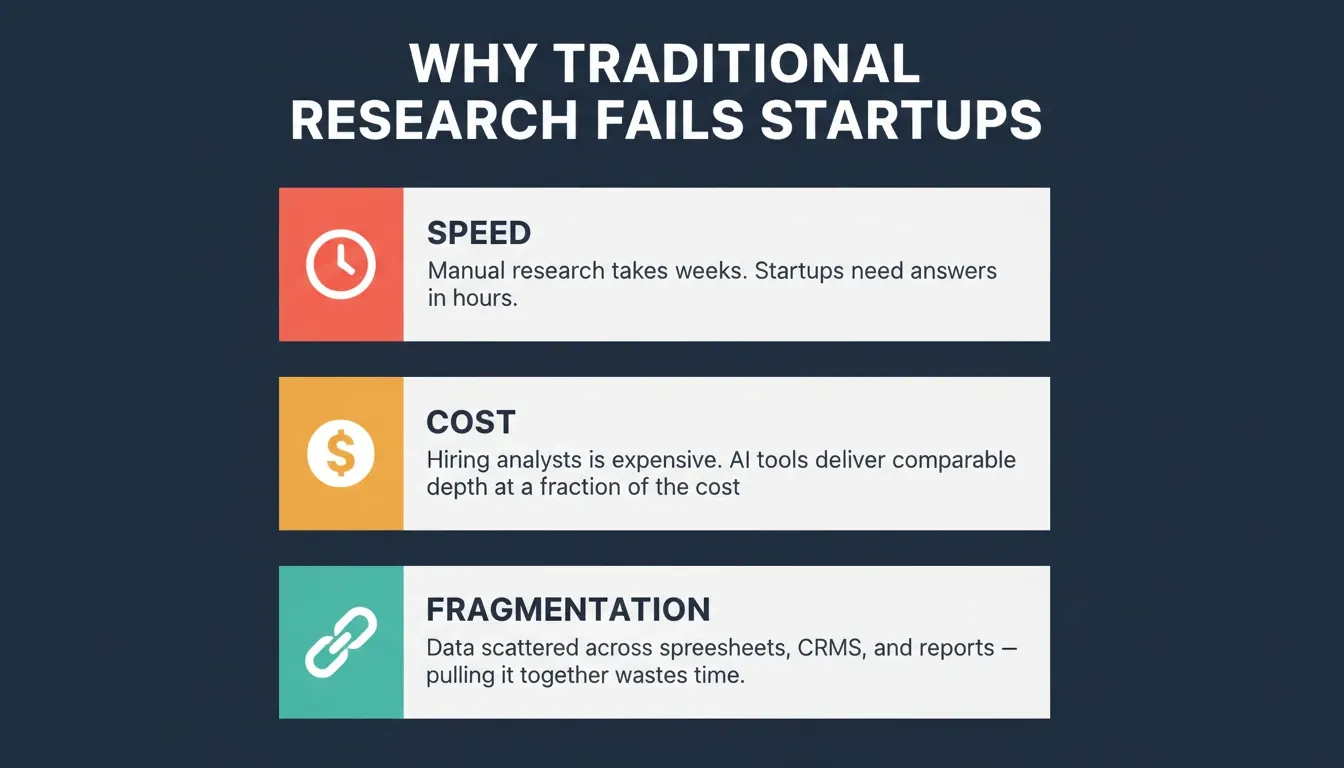
The three core problems traditional research creates for startups: speed, cost, and fragmentation.
Key Features to Look for in an AI Startup Research Tool
Not every research tool is built the same. When evaluating options, focus on the features that separate the best platforms from basic software.
Real-Time Data and Market Intelligence
The best AI startup research tools pull real-time data from live sources. They track competitor pricing, market size shifts, public sentiment, and industry trends as they happen. Static reports go stale fast. Real-time market data keeps your team ahead of the curve.
AI-Powered Market Analysis
Look for platforms that go beyond data collection and actually analyze data using AI-powered market analysis. This means identifying patterns across multiple markets, generating SWOT analyses, mapping key competitors, and surfacing valuable insights without requiring a data science background.
Strong platforms run queries across 150 or more sources simultaneously, tagging each finding by signal strength so you know which insights to act on first and which to treat as supporting evidence.
Audience Insights and Customer Data
Understanding your target audience is the foundation of any viable business idea. Strong AI tools analyze customer data from social media, surveys, interviews, and other sources. They deliver demographics, geography, and behavioral signals in plain language.
Competitor Pricing and Positioning
Knowing your key competitors is not enough. You also need to understand their pricing, positioning, and weaknesses. AI-powered tools automatically track competitor pricing changes and surface insights into how your business ideas compare across the market.
The most advanced platforms monitor competitors continuously across every public surface: website, social media, news, hiring activity, product changes, and reviews.
Generative AI for Content and Reports
Modern AI startup research tools use generative AI to draft reports, generate marketing strategy documents, and create content assets from your research data. Look for platforms that export in multiple formats: PDF for investors, PPT for board presentations, HTML for internal sharing, and PRD for engineering handoffs.
Natural Language Queries
The best platforms let you describe research needs in plain language. No code is required. You type your question, and the AI generates comprehensive feedback, market maps, and analysis in seconds. This makes the tools accessible to non-technical founders and marketing teams alike.
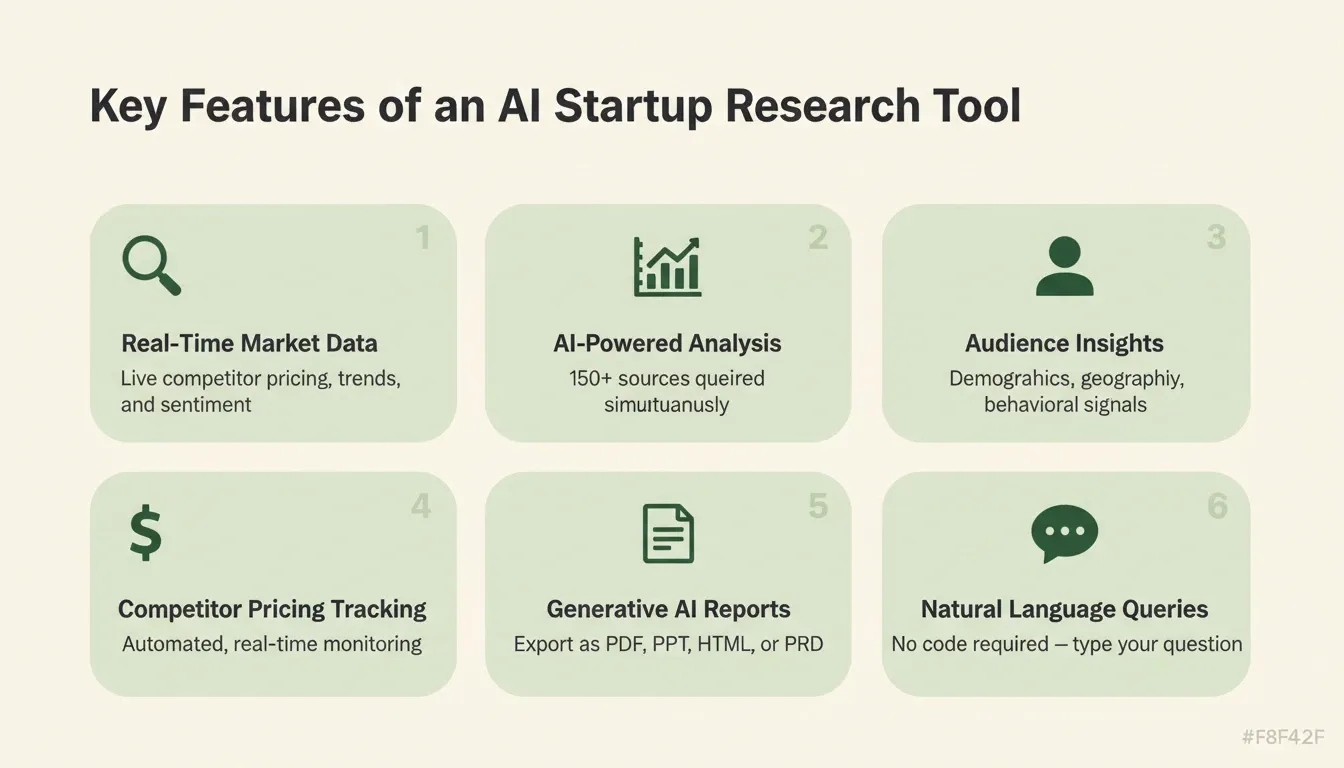
Six key features that define a capable AI startup research tool.
Top AI Tools for Startup Research
The market for AI startup research tools has grown rapidly. Here is a comparison of the best tools available, covering key features, pricing, and ideal use cases.
| Tool | Best For | Key Features | Free Plan |
|---|---|---|---|
| Rocket (Solve) | Founders and early stage startups | Full Solve research across 150+ sources, idea validation, real-time competitor monitoring, generative AI reports, Build and Intelligence in one platform | Yes (20 credits) |
| Crayon | Competitive intelligence teams | Competitor pricing tracking, market maps, real-time alerts, social media monitoring | No |
| Exploding Topics | Trend discovery | Trend analysis, market size data, early signals, industry research | Limited |
| Semrush Market Explorer | Marketing teams | Audience insights, competitor analysis, market data, traffic analysis | Limited |
| Perplexity AI | Quick research queries | Natural language queries, instant insights, source citations, web research | Yes |
| Otter.ai | Customer interviews | Interview transcription, analyzing customer data, feedback synthesis, integrations | Yes |
How AI Startup Research Tools Work: Step-by-Step
Understanding the workflow helps teams get started quickly and extract maximum value from their AI stack. The process follows a clear sequence from idea to validated decision.
AI startup research workflow: from idea definition to validated launch decision.
Step 1: Define Your Business Ideas
Start by describing your startup concept in plain language. The AI research tool takes your input and begins scanning relevant market data, industry reports, and competitor information across multiple markets.
A weak prompt produces weak output. "An app for productivity" returns generic results. "A project management tool for freelance designers who struggle to track client feedback across revision rounds, priced at $29/month" returns focused, useful intelligence.
Step 2: AI Scans and Aggregates Data
The platform automatically pulls data from web sources, social media, LinkedIn, news feeds, and other apps. It builds a comprehensive picture of the market landscape without manual effort. Real-time data collection ensures your analysis reflects current market conditions.
Advanced platforms decompose your question into component dimensions, run each as a parallel research stream, and synthesize findings into a structured report.
Step 3: Analyze Data and Surface Insights
Using AI-powered market analysis, the tool processes thousands of data points. It provides insights on market size, customer data patterns, competitor pricing, and target audience demographics. A well-structured market research report covers an executive summary, market sizing with TAM/SAM/SOM, competitive landscape, risk matrix, and actionable recommendations.
Step 4: Generate Reports and Validate Ideas
The AI generates comprehensive reports with visual elements, charts, market maps, and graphs. These help teams validate ideas quickly. You can share these reports with investors, marketing teams, or advisors to gather feedback before committing resources.
Step 5: Refine and Iterate
If the research reveals gaps or risks, the tool helps you refine your business ideas and run additional analysis. The ability to quickly refine and retest is one of the core advantages of AI-powered research over traditional methods.
AI Startup Research Tools vs. Traditional Research Methods
Understanding how AI tools compare to traditional methods helps founders make the right investment decision. The differences in speed, cost, and depth are significant.
| Factor | Traditional Research | AI Startup Research Tool |
|---|---|---|
| Speed | Weeks to months | Minutes to hours |
| Cost | High (analysts, agencies) | Low to accessible |
| Data Sources | Limited, manual | Multiple markets, real-time data |
| Depth of Analysis | Surface-level unless expensive | Deep AI-powered insights |
| Scalability | Scales poorly with team size | Scales easily across teams |
| Competitor Pricing Tracking | Manual, infrequent | Automated, real-time |
| Audience Insights | Surveys only | AI-powered, multi-source |
| Reports | Manual creation | AI generated in seconds |
| Research-to-Build Connection | Separate tools, context lost | Integrated platform, context preserved |
Rocket: The AI Startup Research Tool Built for Founders
Most AI tools stop at the report. You get a document and a list of insights. Then you are on your own to figure out what to build and how to build it. That gap between research and development is where a lot of good startup ideas die.
Rocket is the world's first Vibe Solutioning platform. It combines strategic research, AI app building, and competitive intelligence into a single product. 1.5 million people have tried Rocket across 180 countries, from solo founders validating their first idea to enterprise teams running strategy and execution on the same platform. Rocket is backed by Salesforce Ventures and Accel.
The platform is built on three connected pillars that share context and feed into each other.
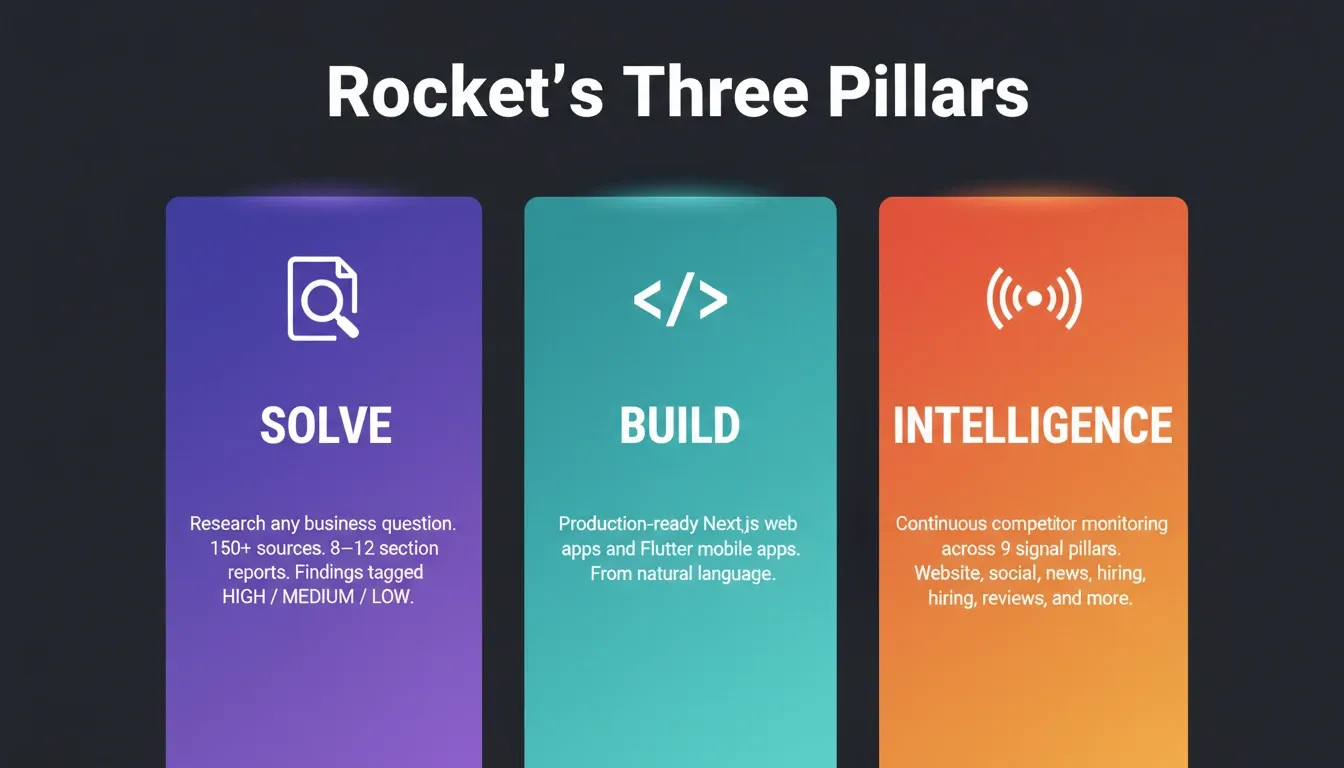
Rocket's three pillars: Solve (research), Build (production apps), and Intelligence (competitor monitoring), all sharing the same context.
Solve: Research Before You Build
Rocket's Solve feature is the AI startup research engine at the core of the platform. You describe your business question in plain language. Rocket then identifies every relevant dimension and runs queries across 150+ sources simultaneously.
Full Solve produces a comprehensive 8 to 12 section report. Each finding is tagged by signal strength (HIGH, MEDIUM, or LOW), and conflicting signals are called out explicitly. Light Solve delivers fast, structured answers for quick research and exploration. Both are available depending on your plan.
Solve covers the full range of startup research needs: market analysis with TAM/SAM/SOM estimates, competitive teardowns, pricing strategy, product direction with PRD generation, and investment analysis. The Solve output does not disappear after export. It becomes the foundation of everything that follows in the project.
Build: From Research to Production
Once your idea passes validation, Rocket's Build lets you start building immediately without losing any research context. You describe what you want in plain language, and Rocket generates production-ready code: Next.js for web apps and Flutter for iOS and Android mobile apps.
Every build ships with SEO-ready structure, WCAG accessibility compliance, GDPR coverage, and performance optimization by default. You can build web apps, SaaS dashboards, mobile apps, landing pages, e-commerce stores, and internal tools, all from the same platform where you ran your research.
Intelligence: Continuous Competitive Monitoring
Rocket's Intelligence watches competitors across nine signal pillars continuously: website, social media, news, GTM, traffic, product, people, business, and reviews. It tells you not just what changed, but what it means for your business specifically.
Traditional tools give you a snapshot. Rocket gives you a continuously updated picture of your competitive landscape. If a competitor changes their pricing, shifts their messaging, or spikes their hiring in a new area, Rocket surfaces that signal and connects it to your product strategy.
Rocket Pricing
| Plan | Price | Credits | What's Included |
|---|---|---|---|
| Free | $0 | 20 (one-time) | Build and Light Solve |
| Pro | $25/month | 100/month | Build and Light Solve |
| Rocket | $50/month | 250/month | Build, Full Solve (auto-routed), and Intelligence |
| Booster | $250/month | 1,500/month | Build, Full Solve (auto-routed), Intelligence, and premium support |
All paid plans include unlimited team members. Annual billing saves 20%.
Best AI Tools for Specific Startup Research Tasks
For Competitive Analysis
Tools that specialize in tracking key competitors, monitoring competitor pricing in real time, and generating AI-powered insights on competitive positioning provide instant visibility into what competitors are doing. Understanding competitive intelligence and how it connects to product strategy is a step most founders skip entirely.
In addition, market research and idea validation become significantly faster when AI handles competitor monitoring automatically.
For Audience Research and Customer Data
Platforms that specialize in analyzing customer data, including those integrating with Salesforce, CRM systems, and survey tools, help startups understand their target audience at a granular level. They analyze demographics, geography, and behavioral patterns to provide audience insights that drive marketing strategy decisions.
For Market Trend Analysis
Trend-focused AI tools scan public sentiment, social media, YouTube, and news sources to identify emerging trends before they peak. For early stage startups, catching trends early can mean the difference between market leadership and missed opportunities.
For Idea Validation and MVP Planning
AI startup research tools are especially powerful for validating startup ideas before investing in development. By analyzing market demand, competitive gaps, and customer willingness to pay, these tools help founders avoid building products nobody wants. When you are ready to move from validated research to building your MVP, the context you built during research should travel with you.
How to Build Your AI Research Stack
No single tool does everything perfectly. The most effective startup teams build an AI stack that combines specialized tools for different research functions. Here is how to structure your stack for maximum efficiency.
-
Market intelligence: Use an AI-powered market analysis tool for real-time competitor tracking and market size data. This forms the foundation of your research workflow.
-
Customer research: Deploy interview and survey tools to gather feedback from real people and validate ideas with actual customer data. Qualitative insights complement AI-generated quantitative analysis.
-
Content production: Use generative AI tools to draft reports, marketing strategy documents, and social media posts from your research findings.
-
Data organization: Connect your AI tools to Google Sheets, Notion, or CRM platforms to keep customer data and market data organized and accessible across your team.
-
Trend monitoring: Set up alerts on trend-tracking platforms to catch market shifts and public sentiment changes in real time.
The most efficient setup is a platform where research, building, and monitoring share the same context. When your Solve research informs your Build task and your Intelligence feed triggers new Solve questions, the entire workflow compounds rather than fragmenting across tools.
Common Mistakes Founders Make with AI Research Tools
Even with the best AI startup research tools, founders make predictable mistakes that reduce the value of their research. Here are the most common ones to avoid.
Asking the wrong questions. Vague prompts produce vague outputs. "Tell me about the SaaS market" returns generic results. "What is the market size for AI-powered documentation tools for mid-market companies? Include TAM, SAM, and SOM estimates with growth projections through 2027" returns focused, actionable intelligence.
Validating the solution instead of the problem. Confirm the problem is real and painful before testing your solution. If people are not actively searching for a fix, your idea may not have enough pull regardless of how well you execute.
Treating a single report as a final answer. AI research tools surface signals, not verdicts. Use findings alongside qualitative feedback from real users and your own judgment. Run multiple research cycles as your understanding deepens.
Stopping research after launch. Market conditions change. Competitors move. Customer needs evolve. The most valuable AI research tools are the ones you use continuously, not just at the start of a project.
Losing context between research and build. When your research lives in one tool and your product development lives in another, insights get lost at every handoff. Platforms that keep research and build in the same workspace eliminate this problem entirely.
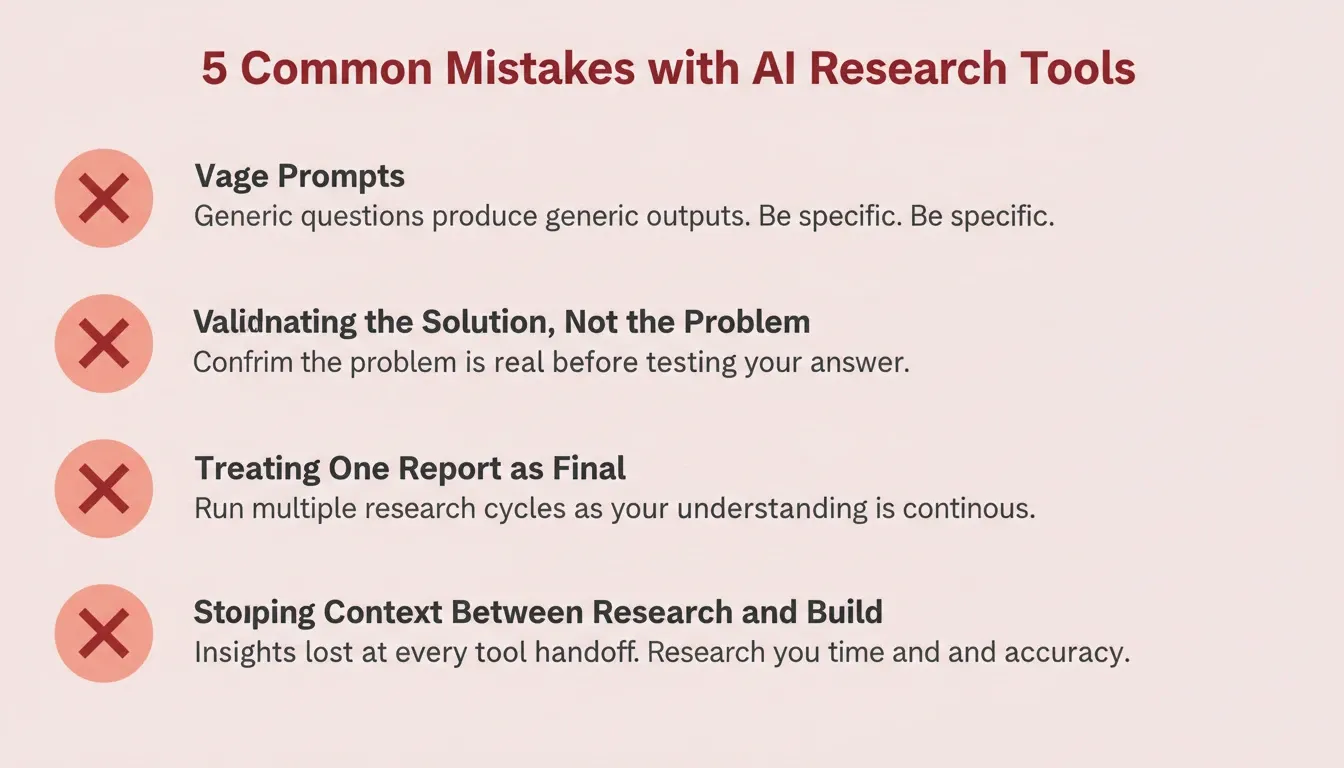
Five mistakes that reduce the value of AI startup research, and how to avoid them.
Get Started with AI-Powered Startup Research Today
The right AI startup research tool gives your team an unfair advantage. It delivers the depth of enterprise market research at startup speed and cost. Whether you need to validate ideas, track competitor pricing, analyze customer data, or generate investor-ready reports, AI tools make every step faster, cheaper, and more accurate than traditional methods.
According to Stanford's AI Index, AI adoption in business research has accelerated dramatically, with teams using AI tools reporting significantly faster decision cycles. Research from McKinsey confirms that companies using AI for market research reduce time-to-insight by up to 70 percent. And Exploding Topics data shows that AI startup research tools are among the fastest-growing software categories globally.
Start Researching Before You Build
The AI startup research tool you choose determines the quality of every decision that follows. As AI research platforms evolve, the gap between teams that validate before building and those that build first will only widen. Real-time market intelligence, predictive viability scoring, and research-to-build pipelines are becoming the standard operating procedure for founders who want to ship the right thing.
You have a startup idea. Type it. Rocket researches the market, maps the competition, and builds from that direction. Sign up on Rocket.new and start your first AI-powered market research project today.
Table of contents
- -Why Traditional Research Falls Short for Startups
- -Key Features to Look for in an AI Startup Research Tool
- -Real-Time Data and Market Intelligence
- -AI-Powered Market Analysis
- -Audience Insights and Customer Data
- -Competitor Pricing and Positioning
- -Generative AI for Content and Reports
- -Natural Language Queries
- -Top AI Tools for Startup Research
- -How AI Startup Research Tools Work: Step-by-Step
- -Step 1: Define Your Business Ideas
- -Step 2: AI Scans and Aggregates Data
- -Step 3: Analyze Data and Surface Insights
- -Step 4: Generate Reports and Validate Ideas
- -Step 5: Refine and Iterate
- -AI Startup Research Tools vs. Traditional Research Methods
- -Rocket: The AI Startup Research Tool Built for Founders
- -Solve: Research Before You Build
- -Build: From Research to Production
- -Intelligence: Continuous Competitive Monitoring
- -Rocket Pricing
- -Best AI Tools for Specific Startup Research Tasks
- -For Competitive Analysis
- -For Audience Research and Customer Data
- -For Market Trend Analysis
- -For Idea Validation and MVP Planning
- -How to Build Your AI Research Stack
- -Common Mistakes Founders Make with AI Research Tools
- -Get Started with AI-Powered Startup Research Today
- -Start Researching Before You Build