
This blog covers the five best AI tools for startups in 2026: Rocket, HubSpot AI, Jasper AI, Apollo.io, and Notion AI, evaluated on time-to-value, pricing, and how well each fits a connected startup stack.
Can a three-person startup compete with a funded team?
In 2026, the answer depends less on headcount and more on which AI software you use.
According to McKinsey's State of AI survey, 88% of organizations now use AI in at least one business function, up from 78% a year earlier.
For startups, the leverage is disproportionate. A connected stack of five tools compounds every week, while a disconnected one creates overhead that cancels out the speed gains.
This blog ranks the five best AI platforms across marketing, sales, and operations. Each tool is evaluated on time-to-value, pricing transparency, and how well it connects into a broader startup stack.
What Makes an AI Tool Startup-Ready?
Before the list, here is what separates startup-ready software from bloated enterprise platforms. These five criteria form the evaluation framework used throughout this guide.
| Criteria | Why It Matters | Red Flag |
|---|---|---|
| Time to value | Startups need results this week, not next quarter | Requires a dedicated setup team |
| Transparent pricing | Cash runway is finite; surprises kill planning | Hidden per-seat costs that spike at scale |
| Connection flexibility | Your stack changes monthly; tools must connect | Closed ecosystem with no API access |
| Learning curve | Founders wear many hats; steep UX wastes hours | Requires certification before basic use |
| Scalability | Today's team of 3 becomes 30 in a year | Caps on users, contacts, or data volume |
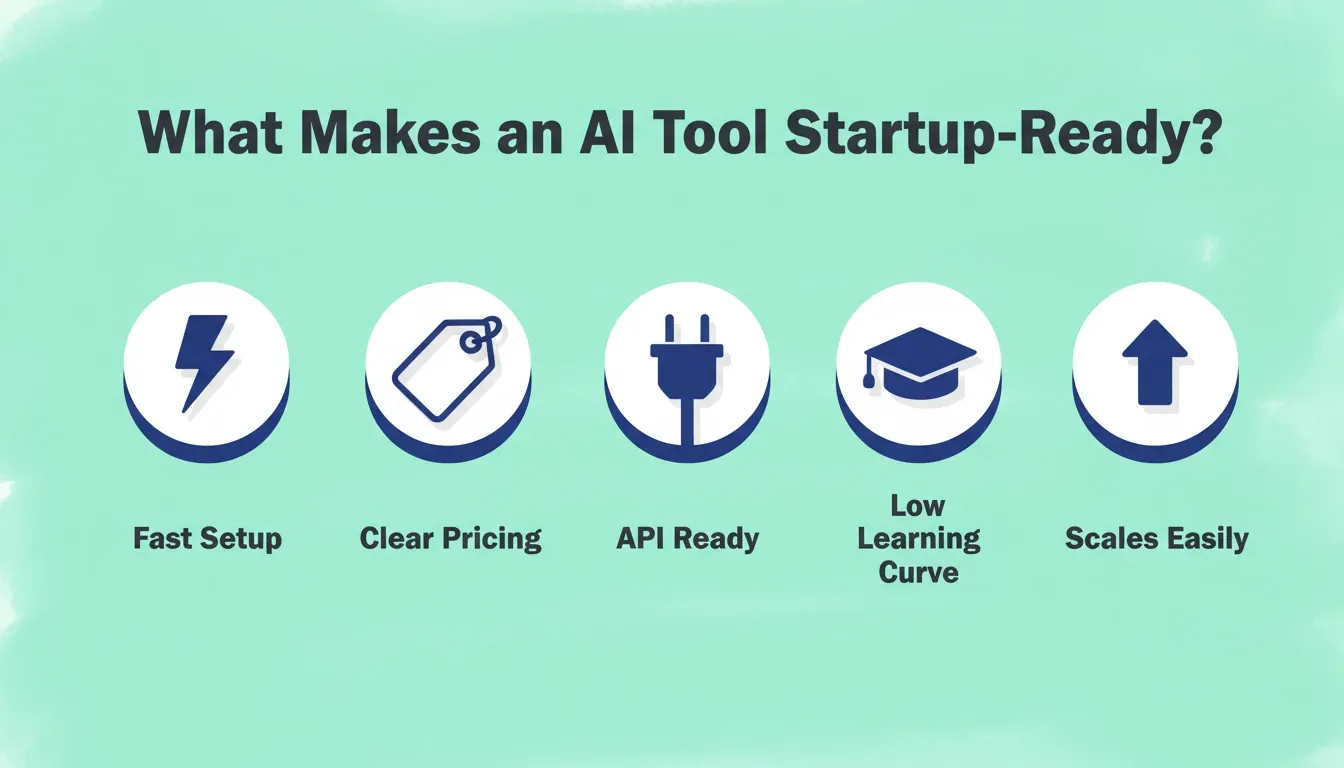
The platforms below pass every filter. Each connects to broader workflows through APIs or built-in connectors, which matters when you link no-code app building for startups with your growth tools.
Which AI Tool Fits Your Startup Stage?
Not every tool fits every stage. Here is how the five platforms map to where you are right now.
| Stage | Primary Need | Recommended First Tool |
|---|---|---|
| Pre-product (0 to 6 months) | Validate idea, build MVP | Rocket (Solve + Build) |
| Early traction (6 to 18 months) | Generate leads, build pipeline | Apollo.io + HubSpot AI |
| Growth (18 months and beyond) | Scale content, automate ops | Jasper AI + Notion AI |
| All stages | Competitive awareness | Rocket Intelligence |
1. Rocket — Research, Build, and Competitive Intelligence in One Platform
Most startups cobble together six or seven disconnected tools. One for research, another for building, a third for competitive tracking. Rocket collapses that fragmentation into one workspace where strategy flows directly into execution.
1.5 million people have tried Rocket across 180 countries, from solo founders validating ideas to enterprise teams running strategy and execution on the same platform. Salesforce Ventures and Accel back rocket.
The Seven Pillars
Rocket ships with seven capabilities. All are connected through a shared context architecture.
| Pillar | What It Does | Who Uses It |
|---|---|---|
| Solve | Any business question returns a structured, evidence-backed report | Founders, PMs, sales leaders, investors |
| Build | Generates production-grade web apps (Next.js), mobile apps (Flutter), and landing pages | Founders, developers, agencies |
| Intelligence | Monitors competitors continuously across websites, social, reviews, ads, and hiring | Founders, marketing leaders, strategy teams |
| Redesign | Eight slash commands reimagine any existing website | Growth teams, agencies |
| Context | Persistent shared memory carries files, research, and decisions into every task | All team members |
| Collaborate | Three-level role-based access (Admin, Creator, Viewer), inline comments, per-user credit allocation | Teams of all sizes |
| Support | Rocket's Success team steps in inside the platform when AI reaches its limit | Any user who gets stuck |
Key Features
-
Solve runs thousands of queries across 150+ sources simultaneously. It returns a structured report with an executive summary, supporting evidence, and actionable recommendations. Output exports as PDF or PPT.
-
Build generates production-grade apps with WCAG accessibility compliance, GDPR coverage, and SEO-ready structure by default. These are baselines, not optional extras.
-
Intelligence monitors every public platform a competitor operates on. It delivers daily briefs with recommended actions. Each competitor tracked costs \$100 per month (500 credits per month).
-
Context carries forward. Research from Solve informs what gets built. Builds inform what Intelligence monitors. The PRD generated by Solve is present when the developer opens the Build task. No handoff, no context loss.
-
25+ integrations include Stripe, Supabase, Google Analytics, Notion, Linear, Airtable, Mailchimp, Mixpanel, Typeform, Brevo, Calendly, MailerLite, SendGrid, Twilio, and Resend. Authenticate once and they flow into every build.
Pricing
| Plan | What Is Included |
|---|---|
| Free | 20 credits on signup |
| Build | Build-only tasks |
| Solve + Build | Research and Build |
| Solve + Build + Intelligence | Full platform |
| Intelligence add-on | $100 per month per competitor tracked (500 credits per month) |
Credits roll over month to month on monthly plans. On yearly plans, unused credits roll over within the 12-month term.
Best For
Startups that want to validate an idea, build the product, and monitor competitors from one place. Particularly strong for non-technical founders and teams of two to five people who cannot afford separate research, dev, and analytics tools.
Why It Stands Out
You type one question. Rocket researches the market, maps the competitors, builds the product, and deploys it. One input. One system.
According to AI startup statistics for 2026, AI-native companies reach $30M ARR in 20 months compared to 60+ months for traditional SaaS peers. The speed advantage compounds when research, build, and intelligence share the same context.
2. HubSpot AI — Marketing and Sales CRM With Built-In Automation
HubSpot has evolved from a basic CRM into an AI-powered growth platform. Its free tier gives startups a CRM, email marketing, and analytics dashboard at no cost. As a result, it is the default starting point for many early-stage teams managing both marketing automation and sales in one place.
Key Features
-
AI email writer generates campaign copy that adapts to audience segments and past engagement patterns.
-
Predictive lead scoring uses behavioral data to surface high-intent prospects before manual review.
-
Automated sequences nurture leads through personalized email flows triggered by user actions.
-
Content assistant drafts blog posts, landing page copy, and social captions from topic prompts.
-
Reporting dashboards track pipeline health, campaign ROI, and attribution across channels.
Pricing
| Plan | Monthly Cost | Best For |
|---|---|---|
| Free | $0 | Up to 1M contacts, basic CRM and email |
| Starter | $20 per month | Small teams starting outbound |
| Professional | $800 per month and up | Custom reporting, advanced automation |
| Enterprise | Custom | Large orgs with complex workflows |
Best For
Startups that need marketing automation and CRM in one platform. Works well for B2B teams running inbound campaigns alongside outbound sales motions.
Limitations
Advanced features lock behind expensive tiers. Custom reporting requires the Professional plan at $800 per month and up. The platform is broad but not deep in any single function compared to specialized tools. Per-contact pricing compounds quickly past the free tier limits.
3. Jasper AI — Content Marketing at Scale Without a Writing Team
Jasper focuses exclusively on content creation. Unlike generalist AI chatbots that produce generic copy, Jasper maintains brand voice across every piece. It learns your tone, audience, and style guidelines to produce consistent output.
Key Features
-
Brand voice training learns your company's tone, terminology, and messaging framework for consistent output.
-
Campaign workflows generate coordinated content across email, ads, social, and landing pages from one brief.
-
SEO mode integrates with Surfer SEO to produce content that matches search intent and NLP signals.
-
Template library covers 50+ content types from product descriptions to press releases.
-
Team collaboration allows multiple users to work within the same brand guidelines simultaneously.
Pricing
| Plan | Monthly Cost | Users |
|---|---|---|
| Creator | $49 per month | 1 user |
| Pro | $69 per month | Up to 5 users |
| Business | Custom | Unlimited users, custom brand voices |
| Free trial | 7 days | Not applicable |
Best For
Startups producing high volumes of content with a small marketing team or solo founder. Particularly effective when brand consistency matters across multiple channels and when content output needs to outpace human writing capacity.
Limitations
Jasper does not handle design, distribution, or analytics. Output still needs human editing for accuracy, especially with technical claims or data points. There is no permanent free tier, only a 7-day trial. Pricing scales with word count on some plans, which can surprise fast-growing content operations.
4. Apollo.io — AI Sales Outreach and Prospecting Engine
Apollo combines a B2B contact database with AI-powered outreach sequences. It eliminates the gap between finding prospects and reaching them. By handling the repetitive parts of sales, Apollo lets reps focus on relationships rather than data entry.
Key Features
-
275M+ contact database with verified emails, phone numbers, and firmographic data for targeting.
-
AI email personalization crafts outreach referencing prospect-specific signals like job changes, funding rounds, or tech stack.
-
Multi-channel sequences combine email, LinkedIn, and phone steps with automated follow-ups.
-
Intent signals identify accounts actively researching your category or competitors.
-
CRM sync pushes engagement data directly into HubSpot, Salesforce, or Pipedrive.
Pricing
| Plan | Monthly Cost | Credits |
|---|---|---|
| Free | $0 | 50 email credits, 5 phone credits per month |
| Basic | $59 per user per month | Unlimited email, 100 phone credits |
| Professional | $99 per user per month | Unlimited email and phone credits |
| Organization | $149 per user per month | Advanced features, custom limits |
Best For
B2B startups running outbound sales with a small team of one to five reps. Strong for companies selling to mid-market or enterprise accounts. Pairs well with competitive intelligence software to feed sales conversations with real-time market signals.
Limitations
Apollo works best when the startup already has a clear ideal customer profile. Without solid positioning, AI accelerates bad outreach at scale. Data accuracy varies by region; US contacts are strongest. The free tier's credit limits make it impractical for sustained outbound without upgrading.
5. Notion AI — Operations Hub for Team Documentation and Workflows
Notion AI transforms a popular workspace tool into an operational command center. It manages knowledge bases, project tracking, and team documentation with built-in AI that summarizes, generates, and connects information across your entire workspace.
Key Features
-
AI-powered writing summarizes meeting notes, generates action items, and drafts documentation from rough inputs.
-
Connected databases link projects, tasks, and team members with relational data that updates across views.
-
Q&A over workspace answers questions by searching through all your docs, wikis, and project pages.
-
Automated properties auto-fill database fields using AI based on page content.
-
Template system standardizes recurring processes like sprint planning, meeting notes, and onboarding.
Pricing
| Plan | Monthly Cost | AI Add-On |
|---|---|---|
| Free | $0 | Not available |
| Plus | $10 per user per month | +$10 per user per month |
| Business | $18 per user per month | +$10 per user per month |
| Enterprise | Custom | +$10 per user per month |
Best For
Startups that need a single source of truth for documentation, project management, and internal knowledge. Works well for teams of 3 to 20 people who outgrew scattered Google Docs but do not need heavyweight project management tools.
Limitations
Notion AI is not built for external-facing output such as websites, apps, or landing pages. The AI add-on at $10 per member per month adds up quickly as teams scale. Without deliberate structure, the workspace can become unwieldy as content volume grows.
According to recent AI adoption data, 40% of enterprise applications will include task-specific AI agents by end of 2026, up from less than 5% in 2025. Notion AI is positioning itself at the center of this shift for internal operations.
How to Connect These Tools Into One Stack
The Connected Stack Architecture
Choosing individual tools is the easy part. The real challenge is connecting them so each layer feeds the next. Here is how the five tools above map to a complete startup stack.
Stack Budget Guide by Team Size
| Team Size | Monthly Budget | Recommended Stack |
|---|---|---|
| Solo founder | $0 to $100 | Rocket (free) + Apollo free + Notion free |
| 2 to 5 person team | $100 to $400 | Rocket paid + HubSpot Starter + Notion Plus |
| 5 to 15 person team | $400 to $1,000 | Rocket + HubSpot Pro + Jasper Pro + Apollo Basic + Notion Business |
| 15 or more people | $1,000 and up | Full stack with enterprise tiers |
Start with the layer that matches your biggest bottleneck. If you cannot build fast enough, start with Rocket's Build layer. If leads are the problem, prioritize Apollo and HubSpot. The stack works best when each layer's output automatically becomes the next layer's input.
How to Avoid Tool Sprawl
The most common mistake startups make is adding tools reactively, one for each problem as it surfaces, without a connective architecture. The result is a stack that requires a human to be the integration layer: copying outputs from one tool into another, re-explaining context at every handoff.
The fix: choose platforms that connect natively or through APIs, limit yourself to one primary tool per function, and consolidate when possible. Review your stack every quarter and remove tools that are not generating measurable output.
Build the Stack That Compounds
The best AI tools for startups in 2026 are not the most feature-rich. They are the ones that connect. A research layer that informs your build, a build layer that feeds your marketing, and a competitive layer that sharpens every decision: that is the stack that compounds.
As AI adoption accelerates, the gap between connected and disconnected stacks will widen. The startups that win are the ones that chose their tools deliberately, connected them early, and iterated based on what the data told them.
You type the problem. Rocket researches it, recommends a direction, and builds from that direction. Start with Rocket.new — free to try, no setup required.
Table of contents
- -What Makes an AI Tool Startup-Ready?
- -Which AI Tool Fits Your Startup Stage?
- -1\. Rocket — Research, Build, and Competitive Intelligence in One Platform
- -The Seven Pillars
- -Key Features
- -Pricing
- -Best For
- -Why It Stands Out
- -2\. HubSpot AI — Marketing and Sales CRM With Built-In Automation
- -Key Features
- -Pricing
- -Best For
- -Limitations
- -3\. Jasper AI — Content Marketing at Scale Without a Writing Team
- -Key Features
- -Pricing
- -Best For
- -Limitations
- -4\. Apollo.io — AI Sales Outreach and Prospecting Engine
- -Key Features
- -Pricing
- -Best For
- -Limitations
- -5\. Notion AI — Operations Hub for Team Documentation and Workflows
- -Key Features
- -Pricing
- -Best For
- -Limitations
- -How to Connect These Tools Into One Stack
- -The Connected Stack Architecture
- -Stack Budget Guide by Team Size
- -How to Avoid Tool Sprawl
- -Build the Stack That Compounds