
An AI blog website builder generates a fully functional, SEO-ready blog from a plain-text description in minutes. This blog compares five leading platforms on design, SEO, code ownership, and deployment to help you pick the right one.
What is the best AI blog website builder in 2026?
The answer is a platform that generates a fully functional, SEO-optimized, responsive blog from a single plain-text description in minutes.
No templates to fight, no plugins to configure, no developer required. The AI blog website builder market has matured rapidly. Tools now handle architecture, design, structured data, and one-click deployment in a single pass.
This blog tests five leading platforms head-to-head, reveals what separates a production-ready tool from a demo toy, and shows you how to go from idea to live blog before your coffee gets cold.
Why Most Blogs Fail Before They Start
Starting a blog sounds deceptively simple. Pick a platform, choose a theme, install a few plugins, and write. But the reality for most creators is hours lost to configuration, generic-looking output, and a site that underperforms in search before a single post is published.
The Template Fatigue Problem
According to W3Techs, 70% of all websites now rely on a content management system, yet most blogs built on traditional platforms look identical because they share the same templates and manual configuration workflows. When thousands of blogs share the same layouts, readers struggle to tell one brand from another. Your content might be original, but the container it lives in sends a different signal.
The Performance and SEO Gap
Google's Core Web Vitals directly influence rankings. Most template-based sites ship with bloated code, unoptimized images, and third-party script chains that slow load times. Structured data, meta tags, XML sitemaps, and semantic HTML all need to work correctly from day one. Many traditional builders leave these tasks to you or lock them behind paid plugins.
The Design-Voice Mismatch
A photography blog and a developer newsletter need entirely different layouts, typography, and spacing. Templates rarely accommodate this without heavy customization that takes days, not minutes. The result is a blog that looks like everyone else's and performs like no one's.
AI blog website builders are designed to flip this ratio. You spend more time writing and less time configuring.
How AI Blog Website Builders Actually Work
The process looks almost too simple from the outside, but there is real engineering happening behind each prompt. Understanding the pipeline helps you write better prompts and choose the right platform.
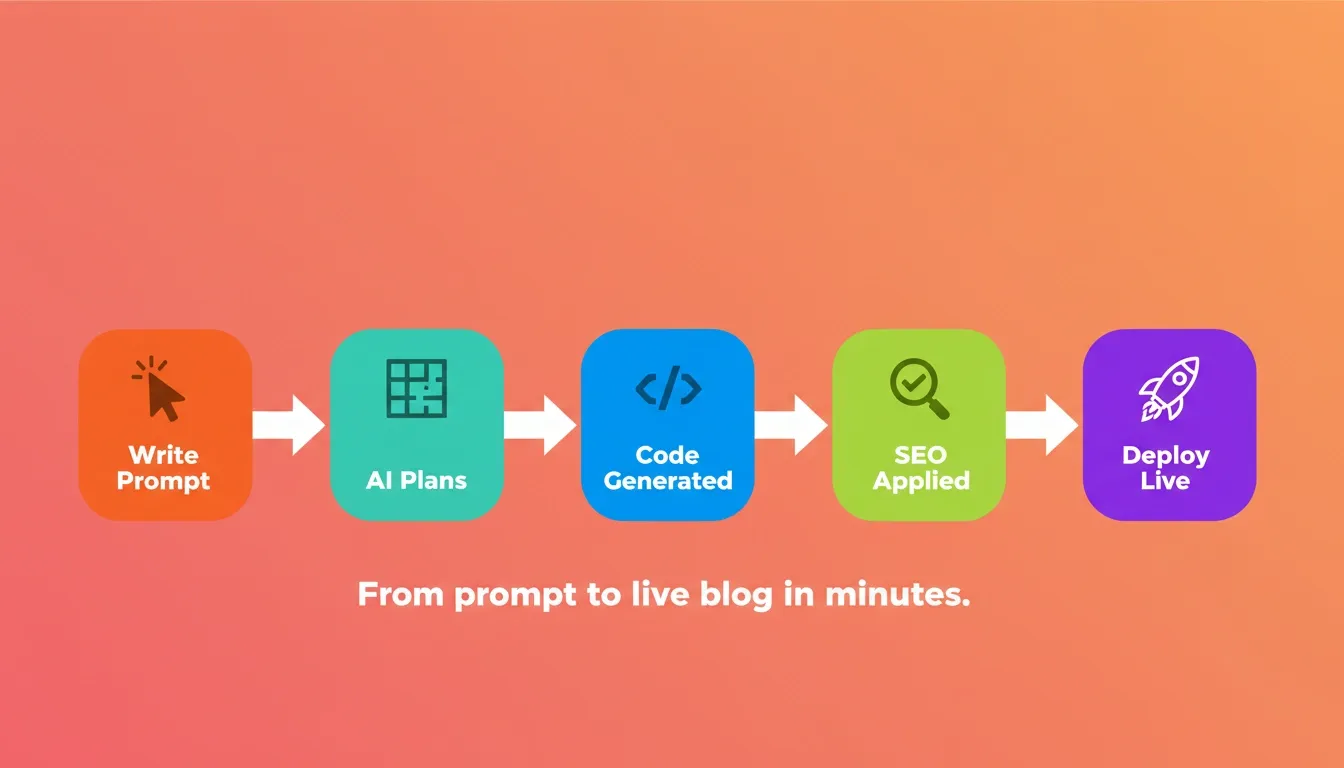
Step 1: Natural Language Parsing
Your description is broken into components: layout preferences, content type, color palette hints, tone, and feature requirements. The better your prompt, the more precise the output. Platforms that support iterative refinement let you course-correct without starting over.
Step 2: Architecture Planning
The AI selects the right framework, page structure, and data model before a single line of code is written. Some platforms use Next.js for web projects. This delivers server-side rendering, fast page loads, and strong SEO out of the box. Others rely on proprietary stacks that lock you in with no export path.
Step 3: Code Generation
The platform produces real, deployable files, not just a visual mockup. The best AI blog website builders deliver production-grade web applications with routing, responsive breakpoints, clean component architecture, and accessible markup. You get something you can actually ship.
Step 4: SEO and Performance Layers
Applied automatically: semantic HTML, meta tags, Open Graph data, JSON-LD structured data, image compression, and accessibility compliance. You get a site that performs well on day one without manual tuning. This is the layer where most platforms cut corners.
Step 5: Preview, Iterate, and Deploy
Change the color scheme, add a new page, or restructure navigation through conversation. No re-explaining your project each time. The best platforms remember your context and apply changes surgically.
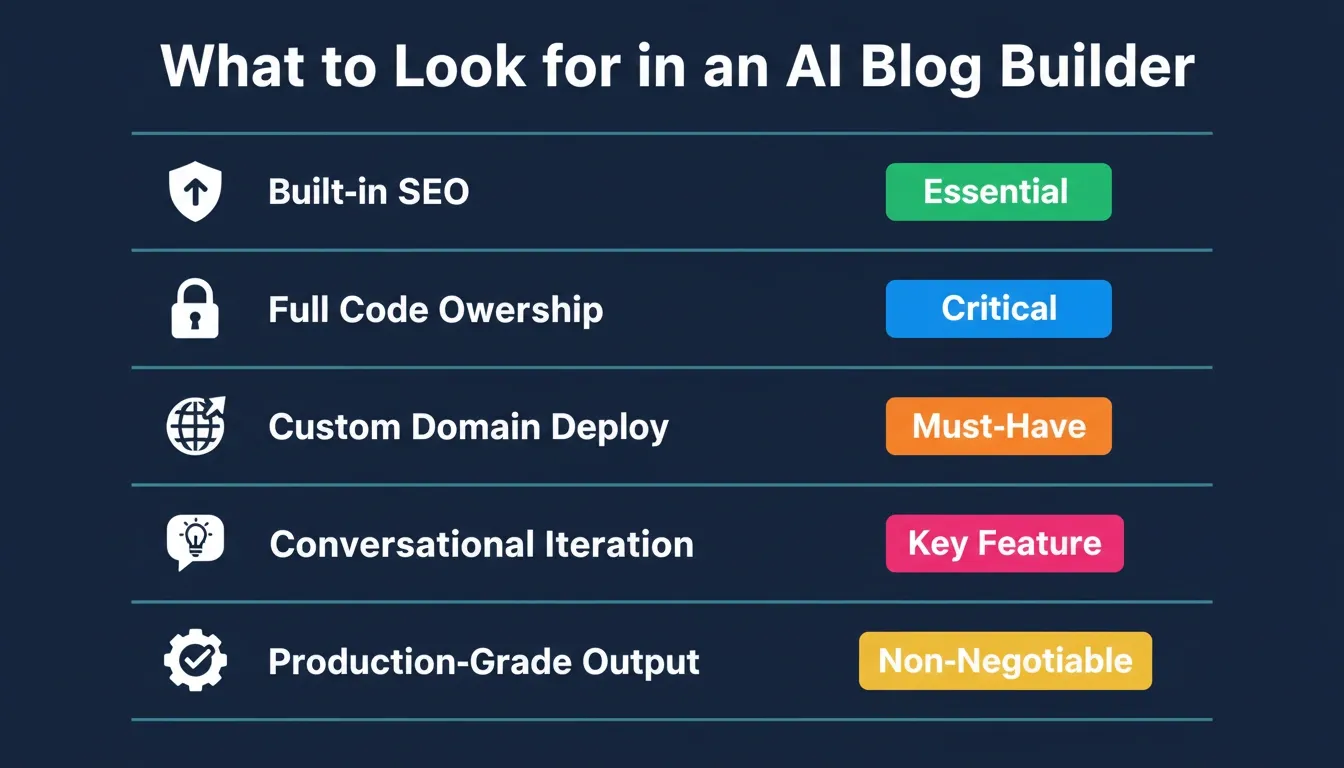
The 5 Non-Negotiable Features of a Great AI Blog Website Builder
With AI coding startups like Lovable raising at $12 billion valuations and crossing $400M in annual revenue, the space is intensely competitive. These five features separate tools worth using from tools worth skipping.
1. Built-In SEO From Generation Day One
Look for platforms that generate structured data, XML sitemaps, and semantic markup without requiring plugins or manual configuration. This means JSON-LD schema for articles, Open Graph tags for social sharing, canonical URLs, and auto-generated sitemaps. These details determine whether search engines can read and rank your content. Explore what SEO-ready by default looks like when it is baked into the generation process rather than bolted on afterward.
2. Custom-Grade Design Quality
The output should look like a designer touched it, not like a generic card-based page. Typography, spacing, color systems, and visual hierarchy need to feel intentional and distinct. If you can identify the platform from the design alone, the platform has failed.
3. Full Source Code Access and Ownership
If you cannot download, edit, or extend the source code, you are locked in with no exit. The best AI blog website builders give you complete ownership of what they generate. This matters when you need to add custom functionality, hand off to a developer, or migrate to a different host.
4. Conversational Iteration Without Limits
One generation is never the final version. You need conversational editing where you describe changes in plain language and the platform applies them instantly. Platforms that cap iterations or charge per change are not built for real publishing workflows.
5. One-Click Deployment With Custom Domains
Getting a site live should take seconds, not hours of DNS configuration. Staging environments, custom domains, automatic HTTPS, and version history should be part of the package, not upsells.
Real-World Use Cases: Who Uses AI Blog Website Builders and How
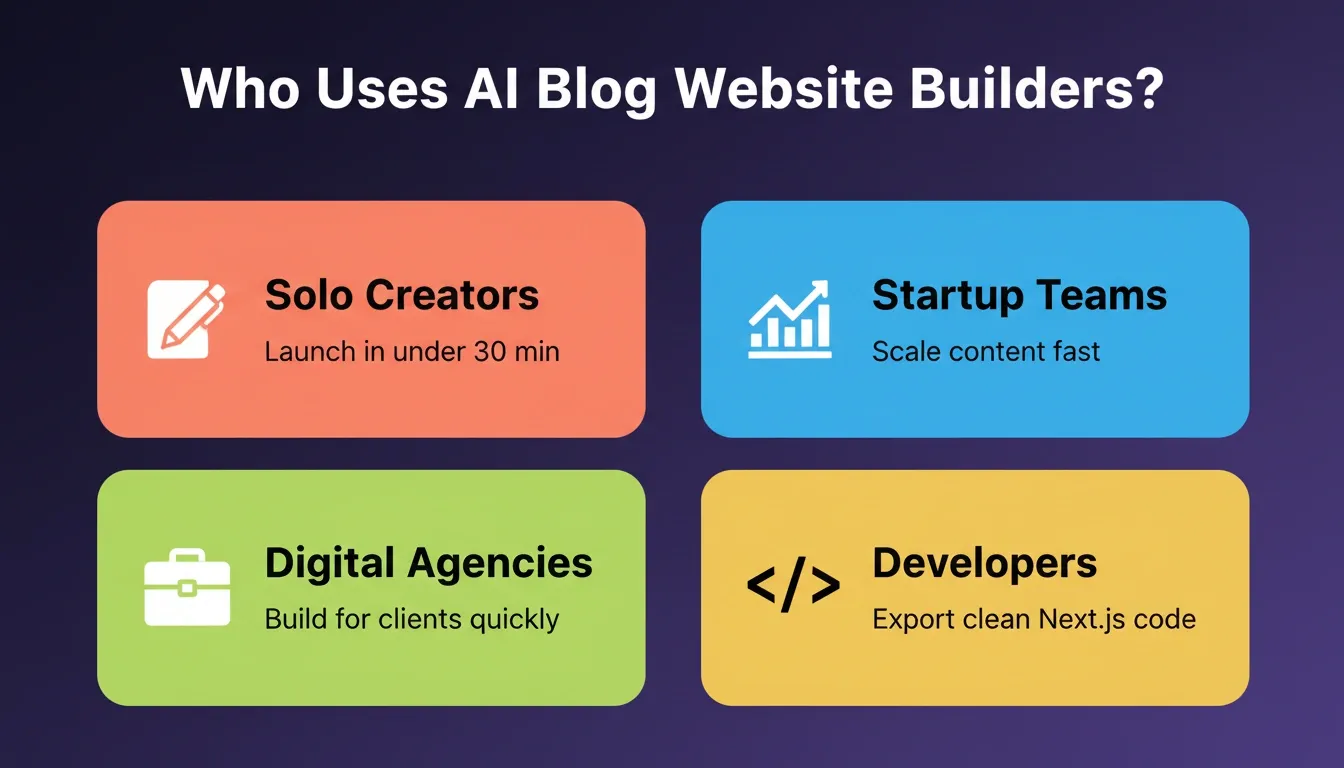
Understanding who benefits most from an AI blog website builder helps you assess fit before committing.
Solo Content Creators Launching a Newsletter Blog
A product designer wants to publish weekly essays on design systems. She has no coding background and a limited budget for developers. She needs fast setup, clean typography, email capture integration, and SEO-ready posts from day one.
With a good AI blog website builder, she describes her blog in one prompt. She gets a Next.js site with a homepage, article template, author page, and email integration in under three minutes. She iterates on the color palette through chat and deploys to a custom domain the same day. Her first post is indexed by Google within 48 hours because the site ships with a valid XML sitemap and JSON-LD article schema.
Startups Building a Content Marketing Engine
A B2B SaaS company needs a blog to drive organic traffic. They have a small team, no dedicated front-end developer, and need to publish consistently. They need code access for custom integrations, version history, and scalable architecture.
The team generates the initial blog architecture and downloads the source code. They hand it to their developer for custom CMS integration. They use the chat interface for ongoing design changes without touching code. The blog scales because the technical SEO foundation was correct from day one. For teams building at this scale, understanding how AI builders reduce development costs is worth reading before committing to a platform.
Agencies Delivering Blog Sites for Clients
A digital agency produces blog sites for clients across different industries. Manual builds take two weeks each. They need speed, white-label capability, and source code handoff. Build time and margin are the metrics that matter.
Each blog is generated from a client brief in minutes. The agency customizes through conversation, downloads the source code, and hands it off to the client. Build time drops significantly. Margin improves.
Developers Rebuilding Underperforming Blogs
A developer has a WordPress blog with poor Core Web Vitals scores, no structured data, and a dated design. A full rebuild would take weeks. With an AI blog website builder that supports redesign, the developer describes the new architecture, generates a Next.js replacement, migrates content, and redeploys. The new site scores significantly higher on Lighthouse. Organic traffic recovers within 60 days.
Platform Comparison: Five AI Blog Website Builders Tested
We tested five popular AI-powered platforms by giving each the same prompt: "Build a professional blog for a technology newsletter with a homepage, article pages, author profiles, and a dark/light theme toggle." Here is how they performed across every dimension that matters.
| Platform | Design Quality | Built-in SEO | Code Access | Speed to Launch | AI Iteration |
|---|---|---|---|---|---|
| Rocket | Custom-grade | Full: structured data, sitemaps, meta, OG | Complete source download | Under 3 minutes | Unlimited: chat, visual, code |
| Wix AI | Template-tier | Basic meta tags | None | 5-8 minutes | Limited prompts |
| Squarespace AI | Template-tier | Moderate structured data | None | 10-15 minutes | No AI iteration |
| Framer AI | Mid-tier | Basic | Export to code | 8-12 minutes | Limited prompts |
| Lovable | Mid-to-high | Minimal | Full code access | 2-4 minutes | Chat-based |
Rocket and Lovable stood out for speed and code access, but only Rocket delivered built-in SEO, accessibility compliance, and deployment as part of the same generation. The difference becomes clear when you move a site from "demo" to "production."
Developers on r/webdev frequently highlight this distinction: "The first AI generation is table stakes now. What separates a toy from a production tool is the iteration experience, the deployment pipeline, and whether you actually own the output." This matches what we observed in testing.
Each platform has a clear use case. Wix AI suits users who want a managed, no-maintenance blog and do not need SEO depth or code access. Squarespace AI works for design-conscious creators who prioritize visual polish. Framer AI fits designers comfortable with code export. Lovable is a strong choice for developers who want clean, exportable code fast. Rocket handles the full lifecycle: generate, iterate, SEO, deploy, and own.
How Rocket Builds Blog Sites From a Single Description
Describe and generate. Type a plain-language description of your blog. Rocket plans the architecture, selects Next.js as the framework, and produces a working site with pages, navigation, and responsive design in under three minutes. The output is not a mockup. It is deployable code. You can follow the quick-start walkthrough to go from blank canvas to live app in ten minutes.
Three ways to iterate. Chat with natural language instructions, click elements to edit visually, or open the source code directly. There is no limit on changes. Ask for a new page, adjust the color palette, restructure the navigation, or connect an integration.
SEO baked in by default. Every generated site ships with semantic HTML, meta tags, Open Graph data, JSON-LD structured data, and an XML sitemap. You can run /Generate SEO Report to audit and /Fix SEO Issues to apply corrections automatically. No plugin required.
Blog templates at zero cost. Rocket offers blog and editorial templates at zero credit cost. You can fully customize them through conversation afterward. Templates cover personal blogs, newsletter sites, portfolio blogs, and content marketing hubs. You only spend credits when you start customizing.
One-click deploy with custom domains. Hit Launch, connect your domain, and the blog is live with automatic HTTPS. Staging and production environments with full version history let you iterate without risk. You can roll back any change instantly.
Full source code download. Rocket gives you the complete source code at any point. Export it, host it anywhere, extend it with any developer. You own what you build. For teams evaluating the cost of building versus hiring, the AI builder vs. developer ROI breakdown is a useful reference.
1.5 million people have tried Rocket across 180 countries.
AI Blog Website Builder vs. Custom Development: When to Use Each
This is the question most technical founders ask before committing to any platform. The honest answer depends on what you need.
When an AI Blog Website Builder Wins
For content-focused blogs (newsletters, personal sites, portfolio blogs), AI builders deliver most of what a custom Next.js or Astro setup would, in a fraction of the time. You get responsive layouts, fast load times, and proper SEO without writing or maintaining code. The time-to-value ratio is unmatched for most use cases.
When Custom Development Still Makes Sense
For complex publishing platforms with multi-author workflows, paywalls, or deeply integrated CMS systems, you still need developer involvement. The complexity of the data model and custom business logic exceed what a prompt-driven tool can reliably handle in one pass.
The Hybrid Approach
Tools that offer full source code download mean you are never locked in. Start with AI generation for speed, then hand the codebase to your team when complexity demands it. This is the approach most startups and agencies are converging on.
For a deeper look at how AI is reshaping development decisions, how AI is changing product development covers the broader shift.
SEO Deep Dive: What Makes an AI-Generated Blog Rank
Technical SEO is where most AI blog website builders diverge most sharply. Here is what to look for and why each element matters for ranking.
Structured Data and Schema Markup
JSON-LD structured data tells search engines exactly what your content is: an article, a how-to guide, a FAQ, a product review. Without it, Google has to guess. With it, you qualify for rich results (article carousels, FAQ dropdowns) that improve click-through rates. Platforms that generate JSON-LD automatically save hours of manual configuration per post.
Core Web Vitals and Page Speed
Google's Core Web Vitals (Largest Contentful Paint, Cumulative Layout Shift, Interaction to Next Paint) are direct ranking signals. According to Google's Core Web Vitals documentation, a page passes when it meets the recommended thresholds at the 75th percentile of page loads. Platforms built on Next.js benefit from built-in code splitting, image optimization, and lazy loading, which directly improve these scores.
Semantic HTML and Accessibility
Semantic HTML helps search engines understand content hierarchy. It also ensures screen readers can navigate your blog. Accessibility and SEO are not separate concerns. They reinforce each other.
Open Graph and Social Metadata
Open Graph tags control how your posts appear when shared on LinkedIn, X, or WhatsApp. A well-configured OG image and title increases click-through from social shares. Platforms that generate OG metadata automatically remove one more manual step from your publishing workflow.
| SEO Element | Auto-Generated | Manual Setup Required |
|---|---|---|
| JSON-LD Structured Data | Best platforms | Most platforms |
| XML Sitemap | Most platforms | Some platforms |
| Open Graph Tags | Best platforms | Most platforms |
| Semantic HTML | Best platforms | Template-based platforms |
| Canonical URLs | Best platforms | Most platforms |
| Core Web Vitals Optimization | Next.js-based platforms | Template-based platforms |
Choosing the Right AI Blog Website Builder for Your Goals
The best platform depends on what you are building, how fast you need it, and whether you want to own the output long-term.
For Solo Creators and Personal Bloggers
Speed and design quality matter most. You need a tool that gets you live today, looks professional, and does not require ongoing maintenance. The right platform gets you from idea to published in under 30 minutes.
For Startups and Content Marketing Teams
You need code access, version history, multi-author support, and the ability to integrate with your CRM, email platform, and analytics stack. Platforms that lock you into proprietary systems become bottlenecks fast. Understanding the features of a capable AI website builder helps teams set the right evaluation criteria before committing.
For Agencies and Freelancers
The ability to remix, white-label, and hand off source code is non-negotiable. Build time and margin are the metrics that matter. A platform that compresses a two-week build into a two-day workflow changes the economics of client work.
For Developers and Technical Teams
Full source code access, Next.js output, GitHub sync, and the ability to extend with custom code make certain AI blog website builders credible tools for technical teams. You can open the code editor, make direct changes, and push to GitHub.
For Redesign Projects
If you already have a blog that underperforms, look for platforms with redesign capabilities. They read your existing structure and generate an improved version without starting from scratch. You keep your content, upgrade your architecture, and redeploy.
The Future of AI Blog Website Builders
Multimodal generation is the next wave. Future AI blog website builders will accept not just text prompts but sketches, screenshots, voice descriptions, and existing brand assets as inputs. You will be able to photograph a blog you admire and generate a similar structure with your own content and branding.
Autonomous SEO optimization will become standard. Platforms will monitor your blog's search performance in real time. They will suggest or automatically apply optimizations: updating meta descriptions, adding schema markup for new content types, improving internal linking, and flagging content gaps. The SEO layer will become self-maintaining.
Deeper CMS integration will close the gap between simple blogs and full publishing platforms. Future AI builders will generate not just the front end but the full CMS schema, content models, and editorial workflows. The transition from a simple blog to a full publishing platform will become seamless.
AI-assisted content workflows will merge the site builder and the content creation tool into one interface. Drafting, image generation, scheduling, and performance analytics will live in the same workspace as the site itself.
The AI Blog Website Builder Is the New Standard
The gap between "thinking about a blog" and "running a blog" has collapsed to minutes. AI blog website builders handle the technical complexity that used to require weeks of configuration, plugin research, and design iteration. The question is no longer whether to use one. It is which one to trust with your content.
The platforms that will define the next decade of blogging are those that give creators speed without sacrificing ownership, design without templates, and SEO without plugins. Traditional CMS platforms are losing ground to tools that treat the entire blog lifecycle as a single, AI-orchestrated workflow. As AI search engines like ChatGPT, Perplexity, and Gemini increasingly surface structured, authoritative content, the technical foundation of your blog matters more than ever.
Rocket is built for this shift. Describe your blog, generate production-grade code, iterate through chat or visual editing, and deploy to a custom domain with full SEO infrastructure in one flow. You own the output. You control the architecture. You ship when you are ready.
Sign up for free at Rocket.new and go from blog idea to live, SEO-ready, fully owned website in under three minutes.
Table of contents
- -Why Most Blogs Fail Before They Start
- -The Template Fatigue Problem
- -The Performance and SEO Gap
- -The Design-Voice Mismatch
- -How AI Blog Website Builders Actually Work
- -Step 1: Natural Language Parsing
- -Step 2: Architecture Planning
- -Step 3: Code Generation
- -Step 4: SEO and Performance Layers
- -Step 5: Preview, Iterate, and Deploy
- -The 5 Non-Negotiable Features of a Great AI Blog Website Builder
- -1. Built-In SEO From Generation Day One
- -2. Custom-Grade Design Quality
- -3. Full Source Code Access and Ownership
- -4. Conversational Iteration Without Limits
- -5. One-Click Deployment With Custom Domains
- -Real-World Use Cases: Who Uses AI Blog Website Builders and How
- -Solo Content Creators Launching a Newsletter Blog
- -Startups Building a Content Marketing Engine
- -Agencies Delivering Blog Sites for Clients
- -Developers Rebuilding Underperforming Blogs
- -Platform Comparison: Five AI Blog Website Builders Tested
- -How Rocket Builds Blog Sites From a Single Description
- -AI Blog Website Builder vs. Custom Development: When to Use Each
- -When an AI Blog Website Builder Wins
- -When Custom Development Still Makes Sense
- -The Hybrid Approach
- -SEO Deep Dive: What Makes an AI-Generated Blog Rank
- -Structured Data and Schema Markup
- -Core Web Vitals and Page Speed
- -Semantic HTML and Accessibility
- -Open Graph and Social Metadata
- -Choosing the Right AI Blog Website Builder for Your Goals
- -For Solo Creators and Personal Bloggers
- -For Startups and Content Marketing Teams
- -For Agencies and Freelancers
- -For Developers and Technical Teams
- -For Redesign Projects
- -The Future of AI Blog Website Builders
- -The AI Blog Website Builder Is the New Standard