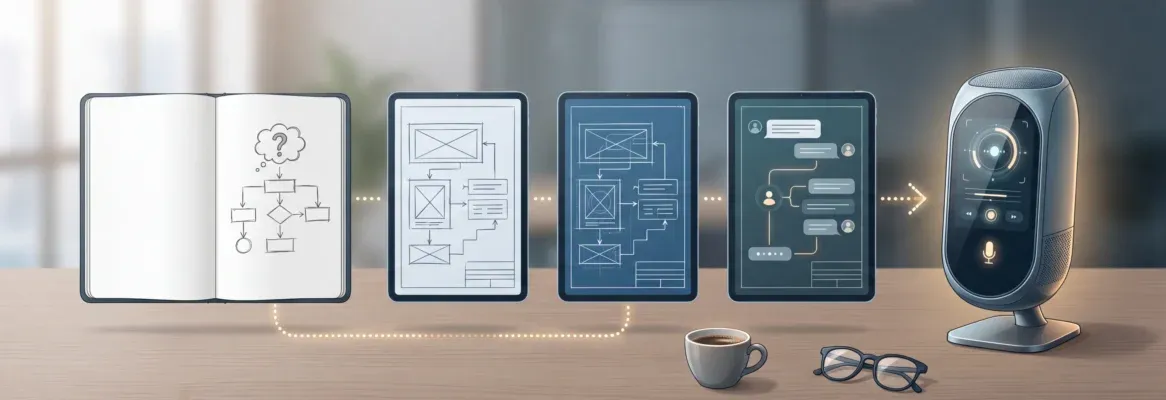
Use these 20 AI prompts to build a project management app covering planning, scheduling, resource allocation, budgets, risk tracking, and reporting. No coding required. Production-ready output in minutes.
Can AI Prompts Replace Months of PM App Development?
They can, when written with the right structure.
PMI's 2025 Pulse of the Profession report found that 66% of project professionals still operate with moderate proficiency gaps in core business execution. That gap between knowing what to build and actually building it is exactly where AI prompts shine.
A project manager no longer needs to write a specification document, hire a developer, and wait months for delivery. With the right AI prompts to build a project management app, you can produce structured project plans, resource allocation views, budget tracking systems, and full risk assessment dashboards from plain language descriptions.
How Do AI Prompts Speed Up PM App Development?
AI prompts act as a bridge between what an experienced project manager knows and what a software application does. Instead of translating project management knowledge into code, you describe the outcome you want in natural language. The AI interprets that context and generates a structured plan with screens, logic, and data models.
Here is why this approach works so well:
-
Structured plan generation: A good prompt includes the project description, constraints, and expected outputs. The AI builds everything connected, with no handoff gaps between designers, developers, and project managers.
-
Faster iteration cycles: Traditional development takes weeks per feature. A well-written prompt generates working project workflows in minutes. You then refine through conversation.
-
Built-in best practices: AI tools trained on thousands of project templates already understand how PMOs and project managers organize work. Your prompt activates that knowledge.
The process follows a clear path. Describe your app features, let AI generate the architecture, review the output, and then iterate until it matches your needs.
This AI-powered project management approach means you spend time thinking about what your project team actually needs, not writing code to make it happen.
Before You Write Your First Prompt
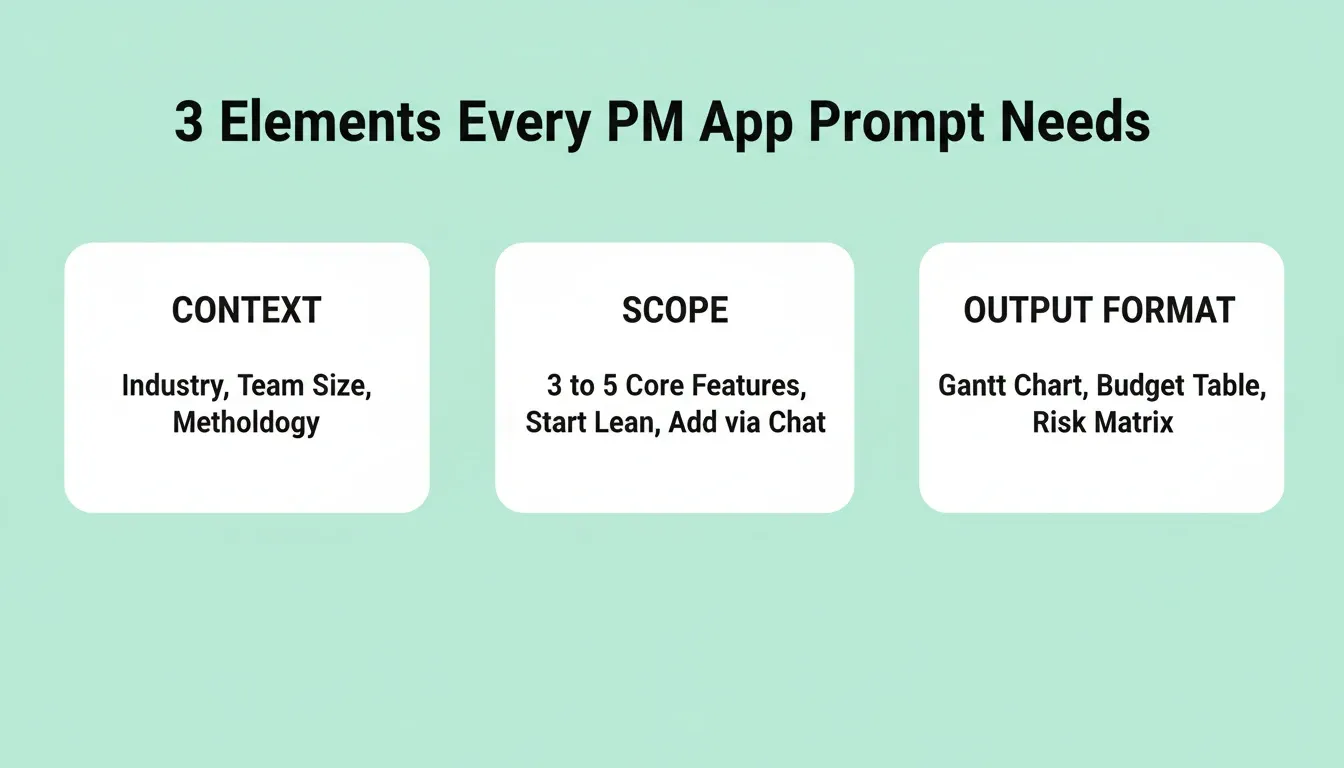
The quality of your AI-generated app depends almost entirely on the quality of your prompt. Before diving into the 20 prompts, understand the three elements every strong PM app prompt needs.
Context tells the AI who uses this app and what the project type is. A construction PM app has different data models than a software sprint tracker. Name your industry, team size, and project methodology. Scope defines the three to five most important features. List the core first, then add more through conversation after generation. Output format specifies what the app should produce: Gantt charts, Kanban boards, budget tables, risk matrices, or PDF reports.
For a deeper look at how to write prompts that produce working apps, see prompt engineering best practices for accurate AI results.
Prompt quality checklist — use this before every generation:
| Element | Weak Prompt | Strong Prompt |
|---|---|---|
| Purpose | "Build a PM app" | "Build a project tracking app for a 10-person software team using agile sprints" |
| Features | "Add tasks and deadlines" | "Include sprint boards, task dependencies, burndown charts, and deadline alerts" |
| Output | "Show progress" | "Generate a weekly status report with completion percentage and blocker list" |
| Users | (not mentioned) | "Used by project managers and team leads; team members view only" |
| Data | (not mentioned) | "Include sample data: 3 projects, 15 tasks, 2 team members" |
A prompt that answers all five elements generates a first version you can actually use. A prompt that answers two generates a prototype you have to rebuild.
Which Prompts Work Best for Planning and Scheduling?
Planning and scheduling form the backbone of any project management app. These prompts generate the features a project manager uses every day to create a detailed project plan, set key milestones, and track progress across project stages.
Here are the five prompts that produce the best planning and scheduling modules:
| # | Prompt | What It Generates |
|---|---|---|
| 1 | "Create a detailed project plan builder with phases, task dependencies, estimated durations, start and end dates, and a Gantt chart view for a [project type] involving [team size] members." | Full planning module with dependency mapping and timeline visualization |
| 2 | "Build a scheduling dashboard that shows project schedules across multiple concurrent projects, highlights conflicts, and lets a project manager drag tasks between dates." | Multi-project scheduling with conflict detection |
| 3 | "Generate a milestone tracking system where a senior project manager can set key milestones, attach deliverables to each milestone, and receive alerts when deadlines approach." | Milestone-based tracking with automated notifications |
| 4 | "Design a project timeline optimizer that accepts task list, durations, dependencies, and resource availability, then generates an optimized timeline with a critical path highlighted." | Timeline optimization with critical path analysis |
| 5 | "Build a work breakdown structure generator that takes a high-level project description and produces a hierarchical task list with estimated durations, owners, and dependencies." | WBS generator with automatic task decomposition |
Tips for better results with these prompts:
-
Include your specific project type in brackets to get tailored output
-
Mention team size and project stages for more accurate project schedules
-
Specify whether you need agile sprint views or waterfall phases
-
Add "include task dependencies and estimated durations" for complete scheduling logic
-
Add "include sample data with three projects and ten tasks" to get a populated, testable first version
The more context you provide about project scope and constraints, the more accurate your generated project plans will be. For related reading on building PM tools with AI, see best prompts for app building.
Ready to turn Prompts 1–5 into a live planning app? Paste any of these prompts into Rocket and get a working Gantt chart, milestone tracker, and WBS module in under 3 minutes. Start building on Rocket
What About Resource Allocation and Team Management?
Resource allocation is a constant balancing act. Project managers spend hours matching skills to tasks, checking resource availability, and trying to balance workloads across the project team. Fortunately, these prompts generate features that handle those challenges automatically.
-
Prompt 6: "Build a resource allocation dashboard that shows each team member's current workload, skills, resource availability, and upcoming assignments. Include a drag-and-drop interface to allocate resources effectively across projects."
-
Prompt 7: "Create a capacity planning view that analyzes resource utilization across all active projects, flags overallocated team members, and suggests ways to optimize resource allocation based on skills and deadlines."
-
Prompt 8: "Generate a team composition planner where an experienced project manager can define roles required for each project phase, match them against available team members by skill, and identify resource gaps before they cause delays."
-
Prompt 9: "Design a workload balancing tool that monitors project tasks assigned to each person, alerts when someone exceeds capacity, and recommends reallocation options to balance workloads across the project team."
-
Prompt 10: "Build a resource management module that tracks time spent versus estimated effort for each task, identifies resource utilization patterns, and produces a weekly resource report for stakeholders."
According to Wrike's research on AI resource management, organizations using AI for resource allocation report fewer missed deadlines and healthier team workloads during delivery. The difference between manual spreadsheet tracking and AI-driven allocation is significant.
These prompts work best when you specify your team size, the types of projects you manage, and whether you need cross-project visibility at the portfolio level. For a broader look at what goes into product management app development, that guide covers the full feature set to consider.
Want a resource allocation dashboard without writing a line of code? Describe your team size and project types, and Rocket generates a drag-and-drop workload view with capacity alerts built in. Try it on Rocket
Can AI Handle Budget Tracking and Cost Management?
Project budget management is where many apps fall short. A project manager needs to track actual costs against planned expenses, manage unexpected costs, and provide total estimated costs at any point during execution. These prompts for project financial features generate exactly that.
-
Prompt 11: "Create a project budget tracker with a structured budget table showing categories, planned costs, actual costs, variance, and percentage spent. Include alerts when any category exceeds its allocation and a detailed cost breakdown by project phase."
-
Prompt 12: "Build a budget tracking report generator that pulls spending data from all project tasks, compares it against the total budget, flags potential cost overruns, and produces financial reports for stakeholders in table format."
-
Prompt 13: "Design a cost estimation module that accepts a project description and scope, then generates a detailed budget with estimated costs per task, contingencies for unexpected costs, and total estimated costs for executive review."
-
Prompt 14: "Generate a budget variance analyzer that compares budget spent versus planned at each project stage, identifies root causes of overruns, and suggests corrective actions to keep the project budget on track."
What makes these prompts effective:
-
They specify the output format, such as structured budget tables, reports, and dashboards
-
They include alert logic for when costs deviate from the plan
-
They request both historical tracking and forward-looking projections
-
They mention stakeholder communication for real-world usefulness
When you combine budget prompts with scheduling prompts from the previous section, you get an integrated view. Changes to the project timeline then directly reflect in cost projections. That connection between modules is what separates a real PM app from a collection of isolated screens.
How Do You Prompt for Risk and Quality Features?
Every experienced project manager knows that identifying potential risks early saves projects from failure. Quality management ensures deliverables meet standards throughout execution. These prompts generate both.
-
Prompt 15: "Build a risk assessment module where a project manager can identify potential risks for each project phase, rate them by likelihood and impact, define mitigation strategies for each, and generate a risk mitigation plan with owners and due dates."
-
Prompt 16: "Create a risk monitoring dashboard that tracks all identified risks, shows their current status, suggests mitigation strategies when probability increases, and auto-generates a risk matrix visualization."
-
Prompt 17: "Design a quality management plan builder that lets a project manager define quality standards and quality objectives for each deliverable, set quality control measures and testing criteria, and track compliance throughout the project lifecycle."
-
Prompt 18: "Generate a project quality management tracker with key performance indicators for each project phase, automated scoring against quality objectives, corrective actions when metrics fall below threshold, and a summary view for stakeholders."
Structuring risk prompts for best results:
-
Always include "suggest mitigation strategies" so the AI generates actionable plans
-
Specify the number of risk categories relevant to your industry
-
Ask for both qualitative assessment and quantitative scoring
-
Include "key performance indicators" to connect risk to measurable outcomes
The pattern here is specificity. A prompt that names your project type, project stages, and quality standards generates a risk assessment framework tailored to your domain. For product managers building these tools, vibe coding for product managers covers how this workflow fits into modern PM practice.
Prompts 11–15 cover budgets and risk — two modules most PM apps get wrong. Rocket generates both with real alert logic and stakeholder-ready reports from a single description. Build yours on Rocket
What About Communication, Reporting, and Post-Project Review?
Project updates, stakeholder communication, and post-project review processes often consume more time than the actual project work. These final prompts automate the communication layer.
-
Prompt 16: "Create a risk monitoring dashboard that tracks all identified risks, shows their current status, suggests mitigation strategies when probability increases, and auto-generates a risk matrix visualization."
-
Prompt 17: "Design a quality management plan builder that lets a project manager define quality standards and quality objectives for each deliverable, set quality control measures and testing criteria, and track compliance throughout the project lifecycle."
-
Prompt 18: "Generate a project quality management tracker with key performance indicators for each project phase, automated scoring against quality objectives, corrective actions when metrics fall below threshold, and a summary view for stakeholders."
-
Prompt 19: "Build a project reporting system that auto-generates a concise project update email from current project status data, including completed tasks, project progress percentage, upcoming steps, blockers, and next steps. Format with clear updates for non-technical stakeholders."
-
Prompt 20: "Create a post-project review template system that captures lessons learned, challenges faced, key achievements, budget performance, project timeline accuracy, and recommendations for future projects. Include a project closure report generator and a format for presenting findings to leadership."
Why these prompts matter:
-
Project progress tracking and reporting consume 20 to 30 percent of a project manager's time, according to industry benchmarks
-
A good post-project review system captures lessons learned that improve future projects
-
Automated project updates reduce communication overhead without sacrificing clarity
-
Stakeholder reporting tools track progress and surface the right information at the right time
When you combine all 20 prompts, you get a comprehensive project management system. It covers planning, resource allocation, budget tracking, risk mitigation, quality management, communication, and post-project review. Each prompt generates a module, and together they form a complete app.
"I just one-shotted a prompt using @rocketdotnew and I can't put into words how astronomically better it is than any other no-code AI tool." — Mia Williams, @miatravls on X
All 20 prompts. One platform. Your full PM app — live in minutes. Rocket connects every module so your Gantt chart, budget tracker, risk register, and reports all work together. Start building on Rocket
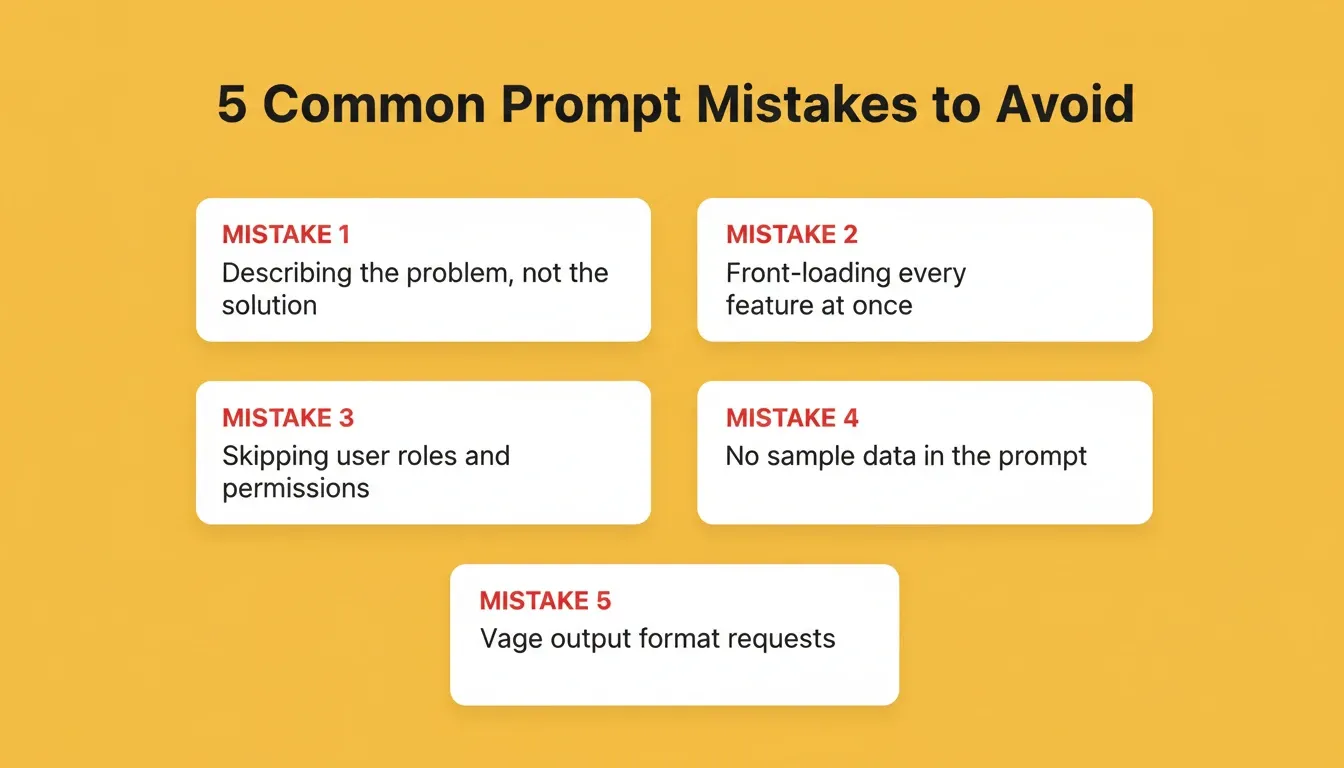
Common Prompt Mistakes That Produce Weak PM Apps
Even experienced project managers make these mistakes when writing their first AI app prompts. Knowing them in advance saves hours of iteration.
Mistake 1: Describing the problem instead of the solution. "My team struggles to track deadlines" tells the AI nothing about what to build. "Build a deadline tracking dashboard with color-coded status indicators and automated email reminders" tells it exactly what to generate.
Mistake 2: Front-loading every feature at once. Listing 20 features in a single prompt produces an app that handles none of them well. Use the 3 to 5 feature rule: list the most critical features first, then add the rest through conversation after the first generation.
Mistake 3: Skipping user roles. A PM app used by project managers, team members, and executives needs different views and permissions for each. Include "role-based access: project manager (full edit), team member (task update only), executive (read-only dashboard)" in your prompt.
Mistake 4: No sample data. An app generated without sample data looks empty and is hard to evaluate. Add "include sample data: 3 active projects, 12 tasks, 4 team members" to every prompt.
Mistake 5: Vague output requests. "Show project status" could mean a text field, a color indicator, or a full dashboard. Naming the exact output format produces exactly what you need.
How to Build a Complete PM App in One Prompt
If you want to generate a full project management app in a single prompt, combine the core elements from all 20 prompts into one structured description. Here is a template you can use directly:
"Build a project management web app for a [team size]-person [industry] team. Include: (1) a project dashboard with Gantt chart, task dependencies, and milestone tracking; (2) a resource allocation view showing team workload and availability; (3) a budget tracker with planned vs. actual costs and variance alerts; (4) a risk register with likelihood/impact scoring and mitigation plans; (5) automated weekly status report generation. Use role-based access: project manager (full edit), team member (task updates), stakeholder (read-only). Include sample data with 3 projects, 15 tasks, and 4 team members. Design for desktop with a clean, professional dashboard aesthetic."
This single prompt covers all five core PM app modules. The AI generates a connected application where the budget view reflects the same projects as the Gantt chart, and the risk register links to the same milestones as the timeline.
Why Rocket Turns These Prompts Into Working Apps
Most AI tools give you text output from prompts for project features. You still need to translate that output into a working application. Rocket is a full-stack AI app builder that generates production-ready code from natural language descriptions. The output is not a wireframe or mockup. It is a working, deployable product.
Here is exactly what Rocket produces when you use these prompts:
-
Next.js for web apps: Every project management web app Rocket generates is built in Next.js. It ships with WCAG accessibility compliance, GDPR coverage, and SEO-ready structure by default.
-
Flutter for mobile apps: Describe a mobile PM app and Rocket generates Flutter code for iOS and Android from a single codebase, with dark/light theming and fluid navigation.
-
Generated in 1 to 3 minutes: Most apps generate in under three minutes. You get a live, interactive preview you can click through and test immediately.
-
Three ways to iterate: After generation, refine through Build using Chat (natural language), Visual Edit (click any element to change it), or Code (edit the source directly). There is no change limit.
-
25+ integrations: Connect Supabase for your database, Stripe for payments, Notion or Airtable for data, Mixpanel for analytics, and Linear for issue tracking. Authenticate once and they flow into every build.
-
Full version history and one-click rollback: Every significant change creates a new version. If an iteration breaks something, you can restore any previous version instantly.
For a complete walkthrough of what is possible, see how to build project management software with Rocket.
How the approaches compare:
| Approach | Time to First Version | Code Quality | Ongoing Changes |
|---|---|---|---|
| Hire a developer | 4 to 12 weeks | High | Requires developer |
| No-code SaaS tools | Days (template-limited) | Template-limited | UI only, no custom logic |
| Rocket (AI app builder) | 1 to 3 minutes | Production-grade Next.js or Flutter | Chat, visual edit, or code |
1.5 million people have tried Rocket across 180 countries. They range from solo founders building internal tools to enterprise teams replacing their entire tool stack.
Rocket pricing:
| Plan | Price | Credits | What's Included |
|---|---|---|---|
| Free | $0 | 20 (one-time) | Build production-ready apps + Light Solve |
| Pro | $25/mo | 100/month | Build production-ready web apps, mobile apps, landing pages |
| Rocket | $50/mo | 250/month | Build + consultant-grade research on demand |
| Booster | $250/mo | 1,500/month | Build + research + SSO, data localisation, premium support |
All paid plans include unlimited team members. Annual billing saves 20%.
Start Building Your PM App Today
The 20 AI prompts to build a project management app in this guide cover every core module a real PM tool needs. Planning, scheduling, resource allocation, budgets, risk tracking, and reporting are all within reach of a well-structured prompt. As AI generation continues to improve, this approach will only become more powerful.
The gap between idea and working software has never been smaller. Describe what your project team needs, and your first working version will be ready before your next standup. Sign up for Rocket and start building now. Free to start, no credit card required.
Table of contents
- -How Do AI Prompts Speed Up PM App Development?
- -Before You Write Your First Prompt
- -Which Prompts Work Best for Planning and Scheduling?
- -What About Resource Allocation and Team Management?
- -Can AI Handle Budget Tracking and Cost Management?
- -How Do You Prompt for Risk and Quality Features?
- -What About Communication, Reporting, and Post-Project Review?
- -Common Prompt Mistakes That Produce Weak PM Apps
- -How to Build a Complete PM App in One Prompt
- -Why Rocket Turns These Prompts Into Working Apps
- -Start Building Your PM App Today