
Use structured AI prompts to design a warehouse management system and cut months of planning into focused sessions. This blog covers module-by-module frameworks, copy-paste templates, and how to deploy a working WMS without writing code.
Can AI replace months of WMS planning?
Yes, when the prompts are structured correctly.
A warehouse management system (WMS) is software that controls inventory tracking, order fulfillment, labor scheduling, receiving, put-away, picking, packing, shipping, and returns. Traditional WMS implementations take 6 to 12 months and cost between $50,000 and $500,000 depending on scale.
AI-designed WMS changes that equation. Instead of writing technical specifications for a development team, supply chain professionals write structured prompts. They describe their warehouse workflows, constraints, and data requirements.
The AI interprets those inputs and generates system architecture, database schemas, workflow logic, and user interfaces, ready to deploy as a working application.
Why Supply Chain Teams Need Smarter Prompting
According to ABI Research, 94% of supply chain companies plan to deploy AI or generative AI for operational decision support within two years (Open Sky Group, 2026). That signals a clear shift from theoretical interest to hands-on execution across the industry.
Teams that once spent months drafting requirements documents now feed structured AI prompts into tools. They receive functional system blueprints in return. The gap between a useful AI response and a useless one comes down to prompt quality and the context you provide.
Most supply chain professionals already interact with AI daily. The problem is that vague prompts produce generic outputs. These outputs fail to map onto real warehouse workflows, real inventory challenges, and real customer demand patterns.
- Generic prompts generate generic systems. Asking AI to "build a warehouse system" returns a vague overview, not an actionable architecture with picking logic, safety stock rules, and carrier routing.
- Operational decisions need operational context. AI tools perform best when prompts include specific data points: order volume, SKU count, storage types, peak demand periods, and compliance requirements.
- Teams waste cycles iterating without structure. Without a prompting framework, supply chain leaders spend hours refining outputs that should have been right on the first attempt.
- Decision making improves when prompts mirror real scenarios. Prompts that reference actual order patterns, supplier lead times, and customer expectations generate systems tuned to your operations.
Traditional WMS projects take 6 to 12 months of planning, vendor evaluation, and customization. Smarter prompting compresses that into days. It gives AI enough context to produce draft architectures, demand forecasting logic, and workflow rules from a single session.
Who This Guide Is For
This guide is written for three types of supply chain professionals:
- Operations managers and warehouse directors who need to design or upgrade a WMS without depending on a development team or a vendor's implementation timeline.
- Supply chain consultants and systems integrators who want to accelerate client WMS projects using AI-generated architecture and module blueprints.
- Founders and product teams building WMS software or logistics SaaS products who want to move from concept to working prototype in days rather than months.
No coding knowledge is required. The prompts and frameworks here are designed for people who understand warehouse operations, not software engineering.
What Makes a Good Prompt for Warehouse System Design?
The difference between AI prompts that work and prompts that waste cycles comes down to structure. AI systems respond to specificity, not vague instructions or broad tasks.
- Include operational constraints. State your warehouse size, number of employees per shift, daily order volume, and storage categories. This gives AI clear boundaries to plan within.
- Define the output format. Tell AI whether you want a database schema, a process flow, a feature list, or a requirements document. The format shapes response quality.
- Provide supply chain context. Mention your industry, customer types, shipping carriers, compliance needs, and technology systems already in place.
- Set the scope clearly. Specify which WMS module you need: inventory tracking, order fulfillment, labor scheduling, returns handling, or dock-to-stock time management.
- Use plain English with domain terms. AI performs better when you use real warehouse terminology like pick paths, wave planning, and slot assignment alongside simple terms that clarify intent.
Teams that follow prompt engineering best practices for accurate AI results consistently get deployable outputs on the first or second try. The knowledge gap is rarely about AI capability. It is about prompt specificity.
The Five-Part Prompt Framework for WMS Design
Every effective WMS prompt contains five components. Missing any one of them forces the AI to make assumptions that reduce output quality.
1. Facility profile — physical dimensions, storage type (racking, bulk, cold chain), number of dock doors, shift structure, headcount per shift.
2. Volume and SKU data — daily order volume, SKU count, average order lines, peak season multiplier, carrier mix.
3. Module scope — which WMS function this prompt addresses: inventory control, order fulfillment, receiving, put-away, labor scheduling, returns, or reporting.
4. Integration requirements — which systems the WMS must connect to: ERP, carrier APIs, barcode scanners, RFID readers, customer portals, or existing databases.
5. Output format — what you want back: database schema, API specification, user interface wireframe, workflow diagram, or a complete feature requirements list.
When all five components are present, the AI has everything it needs. It generates a system that reflects your actual operations rather than a generic warehouse template.
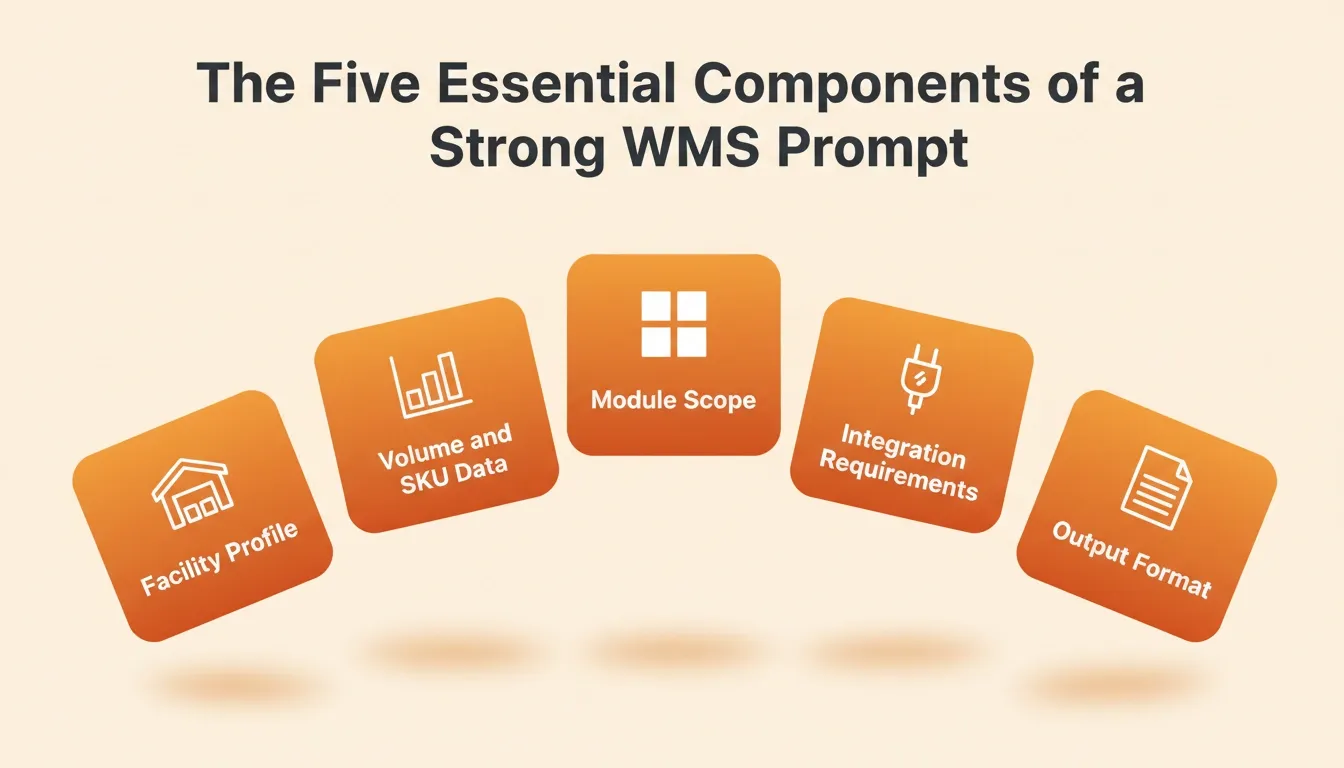 The five-part framework: include all five components in every WMS prompt to eliminate AI guesswork and get deployable outputs on the first attempt.
WMS Build vs. Buy: Cost Comparison
Before writing a single prompt, it helps to understand what you are replacing. The table below compares traditional WMS implementation options against an AI-designed approach.
| Approach | Typical Cost | Implementation Time | Customization |
|---|---|---|---|
| Enterprise WMS (e.g., Manhattan Associates, Blue Yonder) | $100,000 to $500,000+ | 6 to 18 months | High, but expensive |
| Mid-market WMS (e.g., HighJump, Infor) | $25,000 to $100,000 | 3 to 9 months | Moderate |
| Custom development (dev team) | $50,000 to $200,000 | 6 to 12 months | Full control |
| AI-designed WMS (prompt-to-app) | Fraction of above | Days to weeks | Full control, no code |
For logistics app development cost breakdowns across different regions, the gap between traditional and AI-designed approaches widens further outside the US.
Prompt Categories That Cover Every WMS Module
A complete warehouse management system has multiple modules working together. As a result, each module needs its own set of targeted AI prompts with specific inputs and expected outputs.
- Inventory control prompts focus on stock levels, reorder points, safety stock calculations, and ABC analysis. They should reference your own data: average lead time per supplier, demand variability by SKU category, and minimum order quantities.
- Order fulfillment prompts address pick paths, packing logic, shipping carrier selection, and order accuracy targets. Include daily order volume, peak shipping windows, and customer delivery preferences.
- Labor and scheduling prompts cover shift planning, task assignment, workload balancing, and productivity tracking. Feed in headcount data, shift patterns, and throughput targets per zone.
- Receiving and put-away prompts handle dock-to-stock time, inbound shipment scheduling, and storage slot assignment. Reference dock capacity, number of receiving bays, and product categories.
- Returns and reverse logistics prompts manage inspection workflows, restocking rules, financial risk allocation, and cost tracking for damaged items or customer returns.
- Reporting and analytics prompts ask AI to create dashboards that track inventory accuracy, order accuracy, packaging accuracy, transportation costs, and operational efficiency across all modules.
According to Omniful, by 2026 approximately 4.28 million commercial warehouse robots will be installed worldwide across over 50,000 facilities (Omniful, 2026). These automated systems need intelligent WMS software to coordinate operations. AI prompts are how teams now draft that coordination logic without relying on months of custom development.
Each category maps to a separate AI session. Giving AI one focused module at a time with clear data inputs produces higher quality outputs. Asking it to handle all tasks in a single prompt produces shallow results.
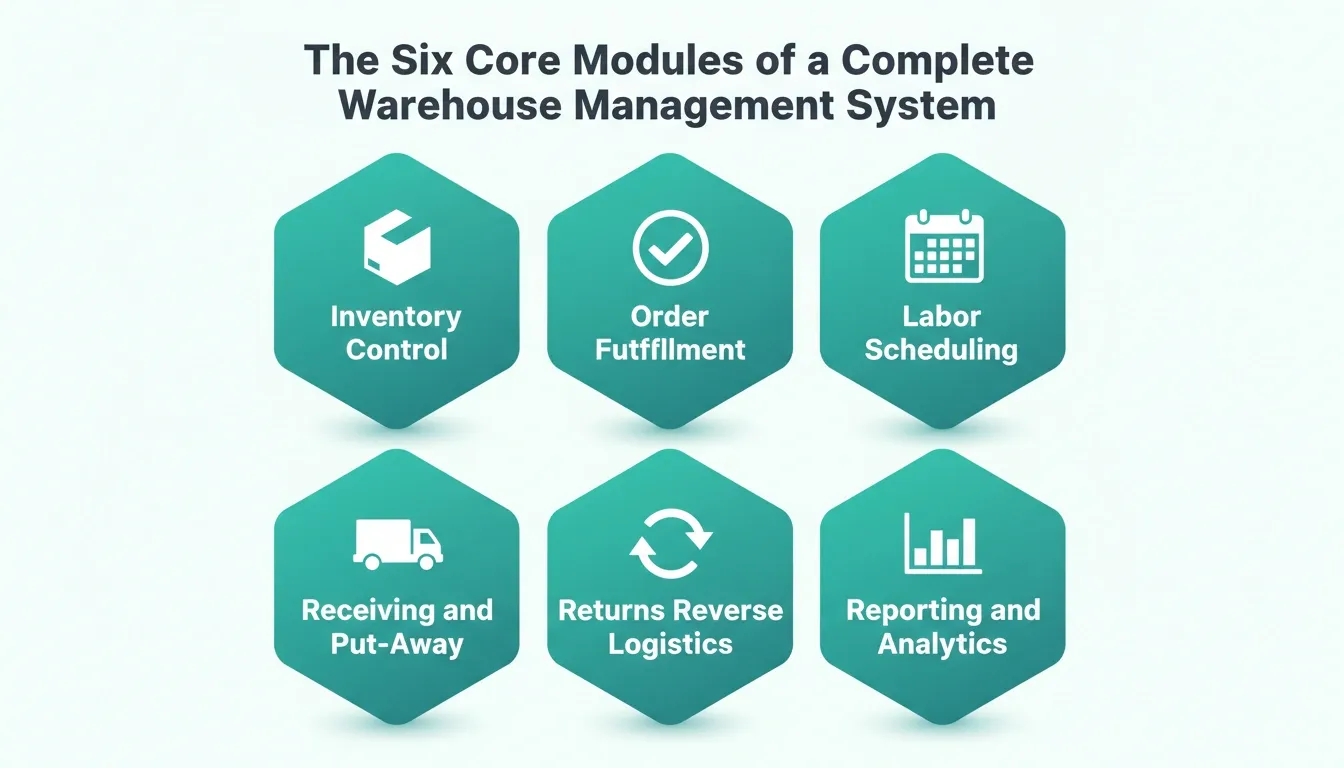
A complete WMS covers six interconnected modules. Each requires its own focused AI prompt with specific data inputs. Prompting all modules at once produces shallow, unusable outputs.
Ready-to-Use WMS Prompt Templates
Copy and adapt these templates for your warehouse. Replace the bracketed values with your actual operational data.
Inventory control module:
Design an inventory control module for a [X] sq ft warehouse managing [Y] SKUs across [Z] storage zones. Include: real-time stock level tracking with [barcode/RFID] scanning, automatic reorder triggers when stock falls below [N] days of supply, ABC classification with separate replenishment rules per tier, cycle count scheduling by zone, and a discrepancy reporting dashboard. The system must integrate with [ERP name] via REST API and update stock levels within [N] minutes of a scan event.
Order fulfillment module:
Build an order fulfillment workflow for [N] daily orders with an average of [X] lines per order. Include: wave planning that batches orders by carrier cutoff time, zone-based pick path optimization to reduce travel distance by at least 20%, packing station assignment based on order weight and dimensions, carrier label generation for [list carriers], and an order accuracy dashboard tracking pick errors by zone and shift. Peak volume is [N] orders per day during [season].
Receiving and put-away module:
Create a receiving and put-away workflow for a facility with [N] dock doors processing [X] inbound shipments per day. Include: advance shipment notice (ASN) matching against purchase orders, discrepancy flagging for quantity and condition variances, directed put-away logic that assigns storage locations based on velocity class and product dimensions, dock-to-stock time tracking with alerts when processing exceeds [N] hours, and a supplier performance dashboard tracking on-time delivery and accuracy rates.
For a deeper dive into how to build an inventory management system from scratch, including data models and screen-by-screen breakdowns, that guide covers the full build process.
Ready to test these prompts on a real WMS build?
Take any prompt from this guide and paste it directly into Rocket. In 1 to 3 minutes, you get a working, production-ready application — no code, no dev team, no waiting. Try it on Rocket.new and see your first WMS module live before you finish reading this guide.
How Can Prompts Handle Demand Forecasting and Safety Stock?
Demand forecasting and safety stock calculations sit at the core of every supply chain planning module. The right AI prompts turn historical sales data into forward-looking models that adapt to seasonal demand shifts and supply risk.
- Start with data context. Tell AI what historical data you have: "We track 3 years of weekly sales data across 4,000 SKUs, with seasonal peaks in Q4 and weather-related demand spikes during summer."
- Define the forecast horizon. Specify whether you need next quarter projections, monthly rolling forecasts, or weekly demand signals for high-velocity items.
- Include external factors. Mention promotional calendars, supplier constraints, weather patterns, and market trends that influence demand beyond historical data alone.
- Request safety stock formulas. Ask AI to calculate safety stock levels based on lead time variability, demand standard deviation, and your target service level.
- Build scenario analysis. Prompt AI to model risk scenarios: what happens if a key supplier increases lead time by 5 days, or if demand rises 30% next quarter due to a campaign launch.
Here is an example prompt that supply chain leaders use to plan inventory:
Using our historical sales data from the past 24 months, build a demand forecasting model for our top 200 SKUs. Factor in lead time variability (average 14 days, range 7-28 days from alternative suppliers), seasonal demand patterns, and a 96% target fill rate. Calculate recommended safety stock units for each SKU and flag items where real inventory levels fall below threshold. Output as a report table with columns: SKU, forecast demand next quarter, recommended safety stock, current stock, risk flag, and cost impact of stockout.
This kind of prompt gives AI everything: data scope, time horizon, assumptions, constraints, and output format. The response becomes specific, measurable, and ready to validate against real data from your warehouse operations.
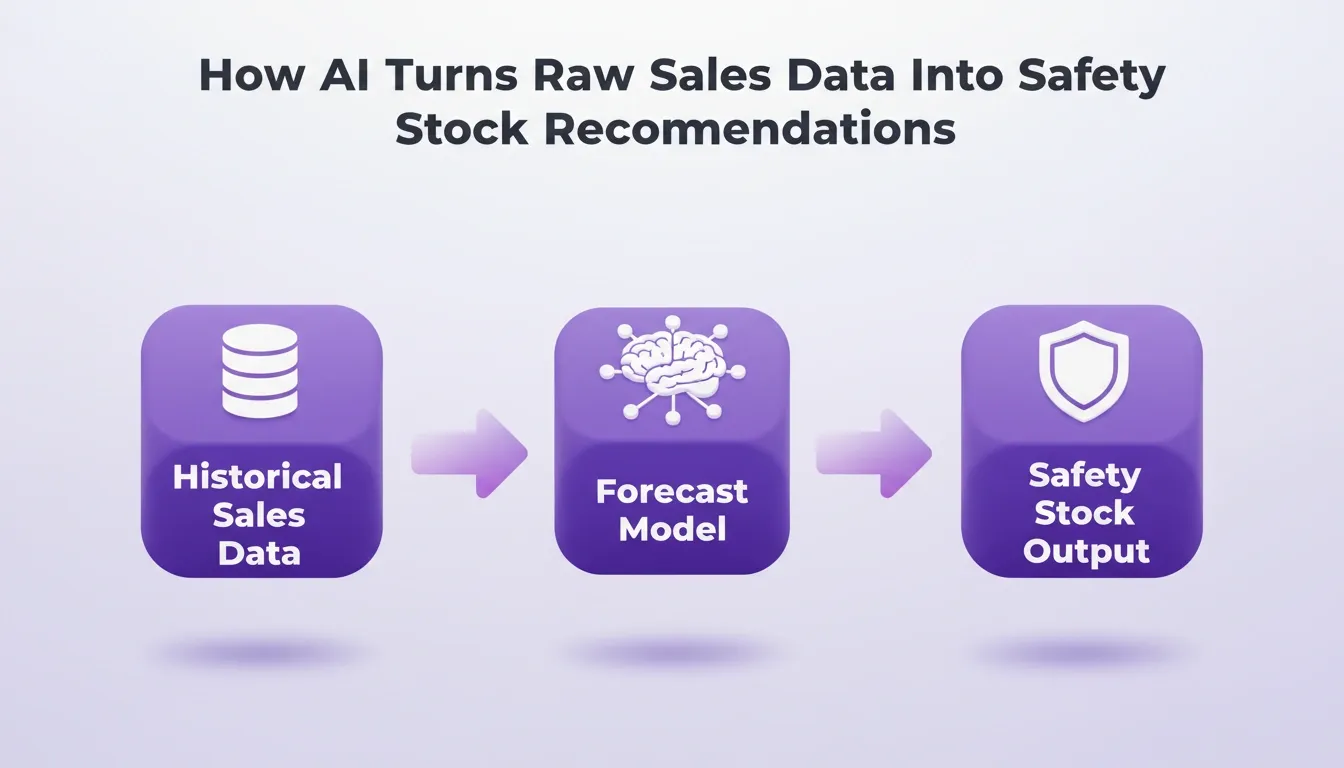
The demand forecasting pipeline: structured historical data feeds a model that accounts for lead time variability and seasonal patterns, producing per-SKU safety stock recommendations with risk flags.
Prompts for Predictive Maintenance and Quality Control
Warehouse operations depend on equipment uptime and product quality. AI prompts for predictive maintenance and quality control catch issues before they create costly disruptions to your supply chain work.
- Equipment maintenance prompts should include asset types (forklifts, conveyor systems, sortation lines), usage hours, historical breakdown data, and current maintenance schedules. Ask AI to analyze patterns and predict failure probability.
- Quality control prompts target inspection workflows, defect rate tracking, and compliance standards. Specify industry regulations, acceptable defect thresholds, and sample sizes for incoming goods inspection from suppliers.
- Cost-linked prompts produce better prioritization. Prompts that reference downtime cost per hour and financial risk of equipment failure help AI rank maintenance tasks by operational impact and urgency.
Predictive maintenance prompt template:
Analyze maintenance records for our [N] conveyor lines over [X] months. Identify patterns in belt wear, motor failures, and sensor malfunctions. Create a predictive maintenance schedule that targets [X]% reduction in unplanned downtime. Include cost estimates comparing proactive replacement versus emergency repair. Flag any line where failure risk exceeds [X]% in the next 30 days and recommend specific interventions to reduce that risk. Output as a prioritized maintenance calendar with estimated labor hours and parts cost per intervention.
Quality control prompt template:
Design a quality control inspection workflow for inbound goods at a [industry] warehouse receiving [N] shipments per day from [X] suppliers. Include: random sampling rules based on supplier risk tier, defect classification categories (cosmetic, functional, safety), inspection checklists by product category, automated hold and quarantine triggers when defect rates exceed [X]%, supplier scorecard generation, and a cost-per-defect tracking dashboard. The system must comply with [relevant standard, e.g., ISO 9001] documentation requirements.
How to Use Solve to Validate Your WMS Requirements Before Building
Before writing a single build prompt, supply chain teams can use Rocket's Solve pillar to validate WMS requirements. Solve maps the competitive landscape of WMS vendors and generates a structured product requirements document (PRD). That PRD becomes the foundation for every build prompt that follows.
Solve takes any business question in plain language and delivers a complete, structured analysis. It covers market data, competitive options, risk factors, and a clear recommendation. For WMS design, you can ask Solve to:
- Validate your WMS scope — "What are the essential modules for a WMS serving a 3PL with 50,000 sq ft of ambient storage and 1,500 daily orders? What do first-generation WMS implementations typically underestimate?"
- Generate a PRD — "Create a product requirements document for a warehouse management system for a mid-size e-commerce fulfillment center. Include functional requirements, integration requirements, user roles, and success metrics."
- Assess build vs. buy — "Compare building a custom WMS using AI tools versus purchasing an off-the-shelf platform for a 200,000 sq ft distribution center processing 10,000 orders per day."
- Map integration requirements — "What ERP, carrier, and barcode scanning integrations does a WMS need to support for a consumer goods distributor operating in North America and Europe?"
The Solve output does not disappear after you read it. It becomes the persistent context for every Build task that follows in the same project. When you open a build prompt for your inventory control module, the PRD Solve generated is already present. No re-explaining, no context loss between research and execution.
How Rocket Turns WMS Prompts Into Production-Ready Applications
Writing great AI prompts to design a warehouse management system is one half of the equation. The other half is turning those outputs into working software that your teams can access and use in daily warehouse operations.
Rocket is a vibe solutioning platform that combines strategic research (Solve), AI app building (Build), and competitive monitoring (Intelligence) in a single workspace. For supply chain teams, this means the WMS you design through prompts can deploy as a production-ready web or mobile application without writing code.
How Rocket's Build works for WMS:
- Describe your WMS in plain language. Rocket plans the architecture, writes production-ready Next.js code for web or Flutter code for mobile, and shows a live preview in 1 to 3 minutes.
- Iterate through conversation. After the first generation, change the data model, add a new module, connect an integration, or adjust the user interface. All of this happens through chat, without re-explaining what already exists.
- Connect your data sources. Rocket integrates directly with Supabase (PostgreSQL database and authentication), Airtable (inventory and workflow data), Google Sheets (existing operational data), Notion (documentation and SOPs), and 25+ other services. Authenticate once and those connections flow into every build.
- Launch to staging and production. Deploy to a live URL with one action. Staging and production environments are separate. Full version history and one-click rollback mean you can iterate without risk.
- Build mobile WMS apps. Warehouse teams work on the floor with handheld devices. Rocket generates Flutter mobile apps for iOS and Android from the same prompt. These apps are ready for App Store and Google Play submission.
Starting from what you already have:
If your team already has WMS requirements in a Notion document, a Google Sheet with your SKU data, or an Airtable base with your inventory structure, Rocket's Launchpad feature lets you start a build directly from that source. Rocket reads the linked document, extracts the intent and data structure, and begins generation from your existing work. No prompt writing required.
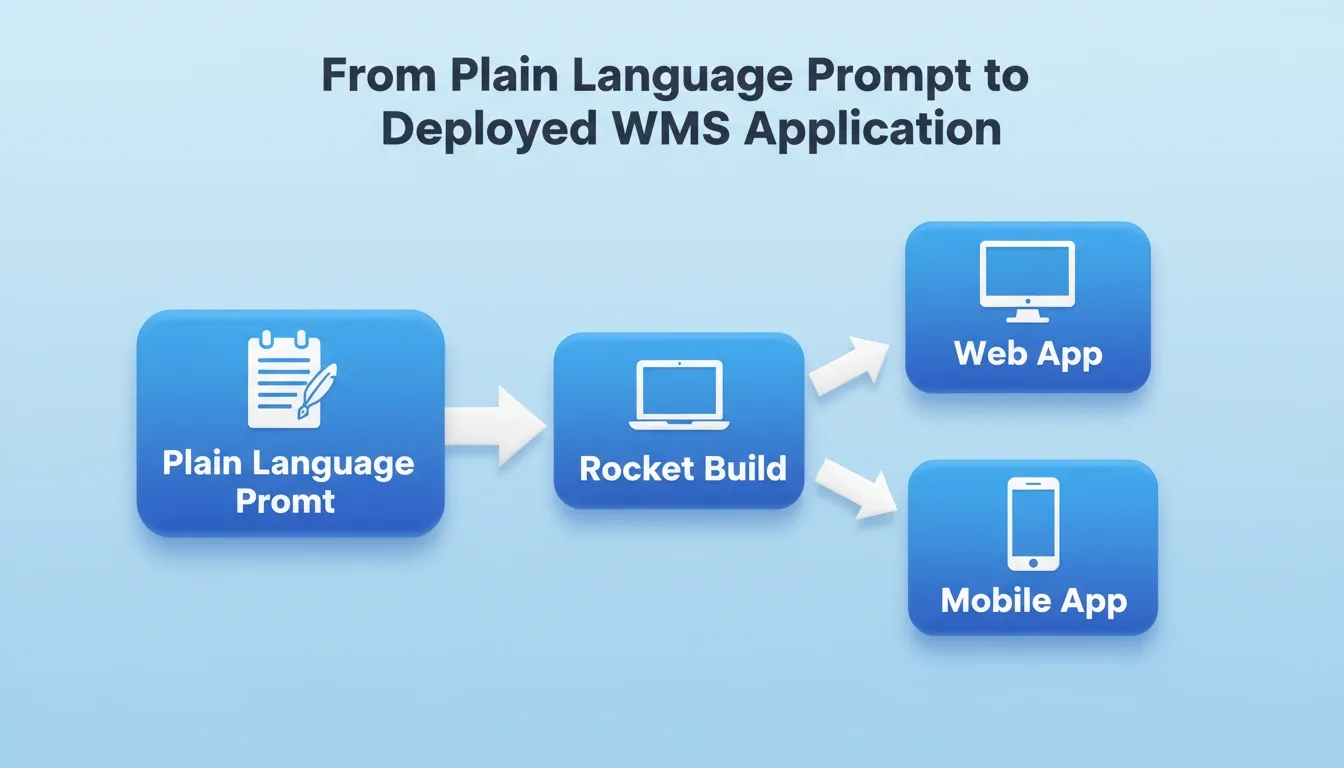
Rocket converts a plain language WMS prompt into production-ready code. Next.js powers the web app; Flutter powers the iOS and Android mobile app. A live preview appears in 1 to 3 minutes.
Teams building AI apps for operations teams on the platform report shipping their first working version within days. The shared context architecture means the market research, the requirements document, and the build task sit in the same project. Every step inherits the full context of every prior step.
Prompt Writing Mistakes That Waste Your Time
Even experienced supply chain professionals make predictable errors when prompting AI for warehouse system design. Recognizing these patterns helps you save time and reduce errors from the start.
- Too broad, no constraints. "Build a WMS" gives AI nothing useful. It generates a generic overview that applies to nobody's actual warehouse. Always include size, volume, process specifics, and customer requirements.
- Dumping sensitive data without labels. Feeding raw spreadsheets without explaining what the data represents leads to AI making wrong assumptions. Label your inputs clearly: "This column tracks supplier lead time in days; this column shows average daily demand in units."
- Ignoring the human layer. Prompts that focus only on technology miss the reality that people run warehouses. Include training needs, role-based access requirements, and communication workflows between departments and teams.
- Skipping the iteration cycle. The first prompt rarely produces a perfect result. Treat AI like a collaborator on your team: review the output, refine your prompt with more data, and iterate. Two focused rounds beat ten random attempts.
- Requesting features instead of outcomes. Prompts that describe process improvements ("reduce dock-to-stock time by 40%") outperform those requesting features ("add a barcode page"). Outcome-driven prompts give AI room to recommend approaches you might not have considered.
- Designing all modules in one prompt. A complete WMS has six to ten distinct modules. Prompting for all of them at once produces shallow coverage of each. Design one module per session with full context, then connect them.
McKinsey's research found that AI-enabled distribution operations achieve 20 to 30% inventory reduction and 5 to 20% logistics cost savings when properly embedded into supply chain workflows (McKinsey, 2024). Those results require thoughtful prompt design paired with the right execution platform that can turn plans into running systems.
The complete WMS design-to-deployment workflow: Solve validates requirements, Build generates each module, integrations connect your data, and one-click deployment pushes to web and mobile.
The Thinking Before the Build is What Separates Good WMS from Wasted Budget
The supply chain teams pulling ahead right now share one thing: they ask better questions before they build anything.
Structured AI prompts to design a warehouse management system replace months of requirements gathering, stakeholder interviews, and vendor evaluations. They produce working system designs in focused sessions that take days, not months.
Every warehouse runs differently. Your prompts should reflect your specific order volume, supplier network, labor model, and growth targets. When the prompt is sharp and loaded with real data and context, the system it produces delivers real value from day one.
Type your warehouse requirements into Rocket.new and go from structured prompt to deployed WMS application — web and mobile — without writing a line of code. Start with Solve to validate your requirements, then use Build to generate each module from your prompts.
Table of contents
- -Why Supply Chain Teams Need Smarter Prompting
- -Who This Guide Is For
- -What Makes a Good Prompt for Warehouse System Design?
- -The Five-Part Prompt Framework for WMS Design
- -WMS Build vs. Buy: Cost Comparison
- -Prompt Categories That Cover Every WMS Module
- -Ready-to-Use WMS Prompt Templates
- -How Can Prompts Handle Demand Forecasting and Safety Stock?
- -Prompts for Predictive Maintenance and Quality Control
- -How to Use Solve to Validate Your WMS Requirements Before Building
- -How Rocket Turns WMS Prompts Into Production-Ready Applications
- -Prompt Writing Mistakes That Waste Your Time
- -The Thinking Before the Build is What Separates Good WMS from Wasted Budget