
The best sales prospecting tools help B2B teams find, qualify, and reach buyers faster. This guide covers evaluation criteria, four tool categories, eight platform comparisons, build-vs-buy decisions, and where Rocket Intelligence fits in your stack.
What if the reason your pipeline looks thin has nothing to do with your pitch?
The best prospecting tools help sales teams find, qualify, and reach potential customers faster, cutting out manual research so reps spend time on the right contacts. Most teams that struggle to fill their pipeline are not bad at selling. They are using the wrong tools, or no tools at all.
Data quality at the start of the sales prospecting process means fewer bounced emails, better response rates, and a pipeline that actually moves. Pipedrive's State of Sales report found that 82% of sales pros who are very satisfied with their tools are more likely to hit quota.
Which prospecting tool actually deserves a seat in your B2B sales stack? This blog breaks it down.
What Makes a Prospecting Tool Worth Using?
Picking a prospecting tool without a checklist is how teams end up paying for software they barely open. Before comparing names and pricing tiers, get clear on the criteria that actually matter when you are evaluating your options.
Does It Surface Accurate Contact Data?
A tool is only as good as the contact data it gives you. Stale email addresses, outdated phone numbers, and missing titles put reps one step behind before a single message goes out.
What to look for:
-
Verified emails and phone numbers sourced from multiple data sources, not a single periodic crawl
-
Regular refreshes that keep contact records current as people change jobs and companies restructure
-
A stated data accuracy rate backed by third-party reviews, not just a homepage claim
-
Geographic coverage for the industries and target market where your team actually sells
Accurate contact data is the single biggest difference between a sales prospecting process that works and one that just looks busy. Bad data burns sender reputation, tanks deliverability, and wastes rep hours that could go toward real conversations.
How Well Does It Fit Your CRM and Existing Tools?
Even the best data tool creates friction if it does not talk to your CRM. Native CRM connectivity should be table stakes, not a premium add-on.
Look for:
-
Native connectors to major CRM systems including Salesforce, HubSpot, Pipedrive, and Microsoft Dynamics
-
Bidirectional sync so contact records stay consistent and updated across platforms
-
A Chrome extension for capturing contacts from LinkedIn profiles and company websites without switching tabs
-
API access and webhook support for connecting the tool into your existing prospecting workflow
Tools that sit in isolation from your CRM become data silos fast. The more friction between finding a contact and logging them into your pipeline, the less likely reps are to follow through consistently.
Can It Handle Outreach Automation?
Good contact data paired with automated workflows means reps spend their time on conversations, not copy-paste tasks.
What to check:
-
Multi-channel sequences covering email outreach, phone calls, and LinkedIn in a single workflow
-
Automated follow-ups that trigger on engagement signals rather than fixed time delays
-
Personalization tokens that pull from contact records automatically so each message feels specific
-
Sequence-level analytics tracking response rates, open rates, and reply activity at each step
Automated workflows are not about sending more emails. They are about removing the repetitive tasks that eat into selling time so sales reps can focus on the calls and conversations that actually move deals forward.
What Does Pricing Look Like at Scale?
A free plan gets you started, but pricing tiers matter when your sales teams grow past the point where the basics are enough.
Questions worth asking:
-
Does the free plan include enough to genuinely test the tool, or does it cut off at limited credits with gated key features?
-
Do paid plans price per user, per credit, or per feature tier and which model fits your team size?
-
Are contact enrichment and data enrichment features included in base plans or priced as separate add-ons?
-
What is the total cost once you factor in CRM connectivity fees, API access, and training time?
Tools that look affordable at five seats can get expensive fast at fifty. Run the math at your projected headcount, not your current one.
How Easy Is It for Your Team to Adopt?
A tool that never gets used delivers zero value. Team adoption is one of the most underrated factors when selecting prospecting software.
Watch for:
-
Simple setup that gets reps productive with minimal training time
-
A clean interface reps actually want to open every morning, not one they avoid because it is clunky
-
Mobile access for field sales and distributed teams
-
Good documentation, onboarding support, and an active user community
If reps find the tool hard to navigate, they revert to spreadsheets inside a week. Ease of adoption determines whether you see value from day one or spend three months in a rollout that never fully takes hold.
Does It Cover Data Privacy and Compliance?
This one gets skipped more than it should. If you sell into the EU or California, GDPR-compliant data collection and CCPA-compliant data collection are not optional.
Key checks:
-
Clear statements confirming the tool is GDPR compliant and ethically sources its contact data
-
Published data governance documentation, not just a checkbox on the pricing page
-
Regular compliance audits and certifications from recognized bodies
-
A vendor that actively updates its practices as data privacy regulations shift
Compliance protects your sender reputation, keeps your company clear of fines, and shows prospects that their contact information was handled with care. It is not a nice-to-have.
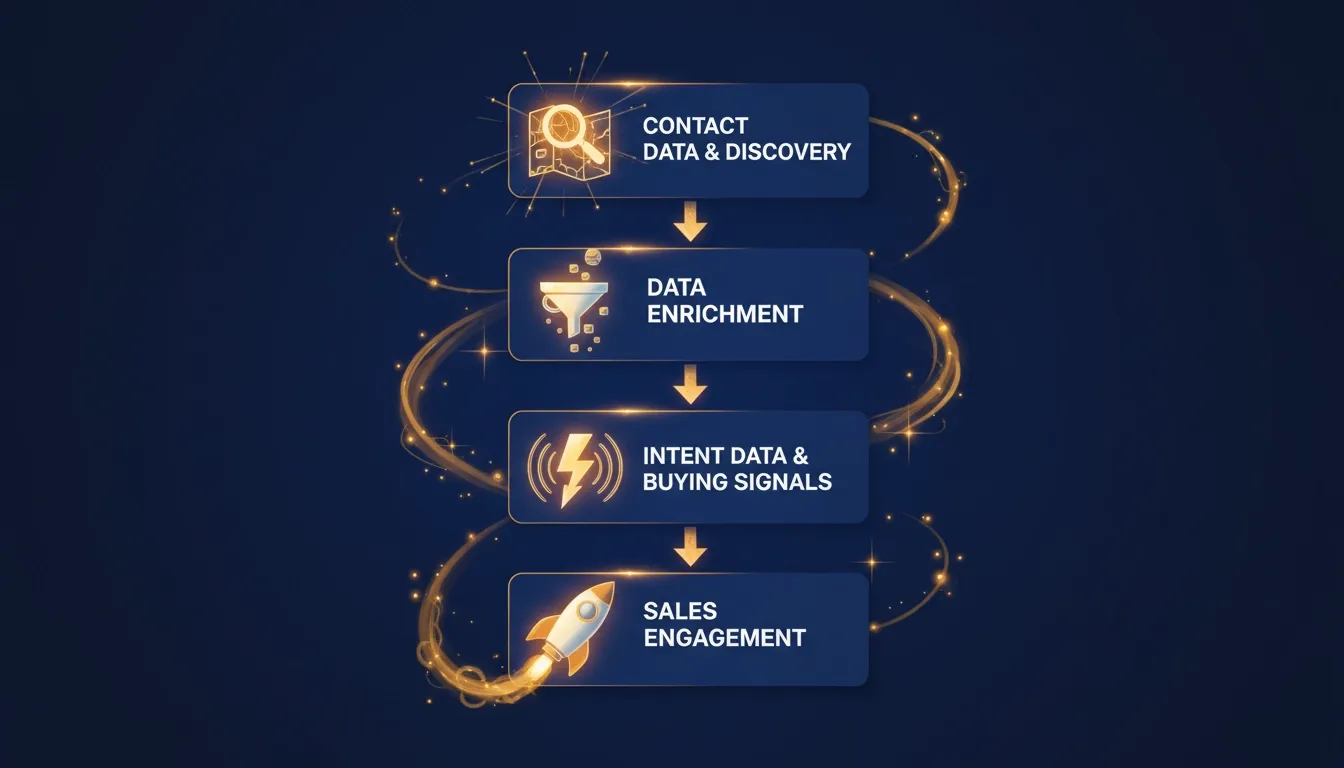 The four prospecting categories work as a connected system, each layer feeds the next.
The Four Categories Every Prospecting Stack Should Cover
Most prospecting discussions jump straight to tool names. That is the wrong starting point. Get clear on the four categories first, then match tools to your specific gaps.
Contact Data and Discovery
Contact data tools help sales teams identify potential customers and build lists that match your ideal customer profile. These platforms supply names, job titles, email addresses, phone numbers, and company data for your target accounts.
What this category covers:
-
Builds contact lists filtered by company size, industry, geography, and seniority level
-
Surfaces decision makers at target accounts by role and department
-
Provides verified emails and direct dials so reps reach the right person, not a generic inbox
-
Uses advanced search filters to narrow contact discovery to accounts most likely to convert
Without a strong contact data foundation, every other category in your prospecting stack is pointing at the wrong people. A well-maintained B2B sales database is the starting point for everything else.
Sales Engagement and Outreach Automation
A sales engagement platform helps sales teams run multi-channel outreach, automate follow-ups, and coordinate contact at scale. These tools sit between your contact database and your CRM, connecting data to actual conversations.
What a sales engagement platform delivers:
-
Multi-channel sequences spanning email outreach, phone calls, and LinkedIn in one place
-
Automated follow-up messages triggered by a contact's behavioral signals and engagement activity
-
Response rates, open rates, and click tracking at the sequence level
-
Full sync back to CRM records so every touchpoint is logged and visible across the team
This is the layer where pipeline actually gets built. Contact discovery finds who to reach. Sales engagement tools do the reaching.
Understanding how business workflow automation connects these layers is key to reducing rep overhead.
Intent Data and Buying Signal Tools
Intent data tools track behavioral signals that suggest an account is actively researching solutions like yours. They answer not just who to reach, but when.
What intent data adds to the stack:
-
Monitors website visitor activity and identifies companies browsing key pages on your site
-
Tracks topic-level research signals showing what content target accounts are consuming
-
Surfaces buying signals like funding rounds, hiring surges, and leadership changes at target accounts
-
Scores accounts by intent level so sales teams identify which ones are in an active buying cycle right now
Buyer intent data shifts prospecting from volume-based outreach to timed, targeted contact. The difference between a call that lands and one that gets ignored is often just timing.
Data Enrichment Tools
Data enrichment tools fill gaps in your existing contact records. They take a partial record and layer in verified email addresses, phone numbers, tech stacks, and company data.
What data enrichment adds:
-
Fills missing fields in CRM records automatically as new contacts come in
-
Keeps contact data fresh as people change jobs and company structures shift
-
Adds firmographic and technographic data to accounts for sharper segmentation
-
Cuts manual data entry so reps spend less time copy-pasting and more time selling
Enrichment tools are often treated as optional, but they are what stop a contact database from going stale. A solid data enrichment strategy is what keeps your pipeline targeting accurate over time.
How the Four Categories Work Together
No single tool covers all four categories equally well. The strongest prospecting stacks layer them in sequence, discovery feeds engagement, intent data tells you when to trigger outreach, and enrichment keeps all of it accurate as contacts move around.
How the flow typically works in practice:
-
Discovery surfaces target accounts and decision makers that match your ideal customer profile
-
Enrichment fills in missing contact details and keeps records current over time
-
Intent flags which accounts are in an active buying cycle and worth prioritizing right now
-
Engagement runs the actual multi-channel outreach to those prioritized accounts
The goal is not the most tools. It is clean coverage across these four layers without building a stack that nobody actually uses.
How Do the Top Prospecting Tools Actually Stack Up?
Here is a practical comparison of eight widely used platforms, what each does well, where it falls short, and which use case it fits.
| Tool | Best For | Contact Database | Engagement | Free Plan | Starting Price |
|---|---|---|---|---|---|
| LinkedIn Sales Navigator | Social selling and relationship-led outreach | LinkedIn network | InMail + alerts | No | ~$99/user/month |
| Apollo.io | All-in-one data and outreach for growing teams | 275M+ contacts | Sequences + dialer | Yes | $49/user/month |
| ZoomInfo | Enterprise contact data and intent | 300M+ contacts | Conversation intelligence | No | Custom |
| HubSpot Sales Hub | CRM-native prospecting on HubSpot | CRM-native | Email, calls, sequences | Yes (CRM) | $15/user/month |
| Salesforce Sales Cloud | Enterprise CRM and pipeline management | CRM-native | Workflow automation | No | $25/user/month |
| Outreach | High-volume multi-channel outbound | 3rd party data | Sequences + coaching | No | Custom |
| Salesloft | Revenue teams running complex cadences | 3rd party data | Conversation intelligence | No | Custom |
| Clay | Custom enrichment and list building for ops teams | 75+ data sources | Waterfall enrichment | Yes (limited) | $149/month |
LinkedIn Sales Navigator
LinkedIn Sales Navigator is the top choice for sales reps who lead with relationship-based selling. Its core advantage is the LinkedIn professional network, a live, continuously updated graph of 1 billion+ profiles.
Key features of LinkedIn Sales Navigator:
-
Advanced LinkedIn search filters for finding decision makers by title, company, seniority, and geography
-
Lead and account recommendations based on saved prospects and target accounts
-
InMail credits for reaching contacts outside your existing LinkedIn connections
-
Alerts for job changes, company news, and engagement signals so you reach contacts at the right moment
Sales Navigator excels at LinkedIn-native signals and connection-based outreach but does not surface verified emails or direct dials natively. Most sales teams pair it with a contact data tool to fill that gap. Best for teams running social selling motions where LinkedIn is already central to daily prospecting workflow.
Apollo.io
Apollo.io is one of the most capable all-in-one platforms for growing B2B sales teams. The free plan is genuinely usable for smaller teams testing the waters before committing to paid plans.
Key features of Apollo:
-
Contact database of 275M+ contacts with verified emails, phone numbers, and email addresses
-
Built-in email sequencing, multi-channel sequences, and a dialer for phone calls
-
Chrome extension for capturing contact details directly from LinkedIn profiles and company websites
-
Buyer intent data add-on for tracking accounts actively researching relevant topics
-
CRM connection with Salesforce, HubSpot, and Pipedrive out of the box
Apollo's all-in-one model cuts context switching between tools significantly. Data accuracy in niche industries can be inconsistent, but for most B2B sales teams it ranks among the best sales prospecting tools at its price point. Best for growing teams that want contact discovery, email outreach, and basic intent data without managing multiple separate platforms.
ZoomInfo
ZoomInfo holds the leading position in enterprise-grade contact data and company intelligence. The contact database is one of the largest on the market, and data accuracy in enterprise verticals is consistently strong.
What ZoomInfo brings to enterprise sales teams:
-
300M+ contact records with direct dials, mobile numbers, and verified contact details
-
Buyer intent data tracking which accounts are actively researching competitor solutions
-
Conversation intelligence for analyzing call recordings and coaching reps at scale
-
Advanced filtering across technographic, firmographic, and behavioral signals
-
Deep CRM connection with Salesforce Sales Cloud, HubSpot, and Microsoft Dynamics
The trade-off is cost. Pricing scales with contacts, features, and seats, enterprise sales teams get full value, while smaller teams often pay for coverage they do not need. Best for large organizations that need the broadest contact database with the deepest company data and intent signals.
HubSpot Sales Hub
HubSpot Sales Hub is built for teams already running on the HubSpot CRM. The prospecting experience lives natively inside the platform, contact records, deal tracking, and outreach all in one place.
Key features of HubSpot Sales Hub:
-
Built-in email sequences, calling, and meeting scheduling tied directly to CRM contact records
-
A prospecting workspace inside Sales Hub that lets reps manage their entire daily prospecting workflow in one view
-
HubSpot Breeze Intelligence for data enrichment and buyer intent signals as a paid add-on
-
Free plan for teams starting with basic features before stepping into paid plans
-
Sales Hub reporting on open rates, response rates, call outcomes, and pipeline health
Where HubSpot Sales Hub falls short is contact discovery, there is no native contact database for building lists from scratch. Teams that already have contacts do well. Teams building from zero need a contact data tool like Apollo alongside it. Best for teams already on HubSpot CRM that want a connected prospecting workflow without managing separate platforms.
Salesforce Sales Cloud
Salesforce Sales Cloud is the CRM backbone for most large enterprise sales organizations. It functions less as a prospecting tool and more as prospecting infrastructure, the system of record that every other tool feeds into.
What Salesforce Sales Cloud provides:
-
Pipeline management, forecast tracking, and territory management at enterprise scale
-
Workflow automation for routing leads, triggering follow-up tasks, and updating contact records
-
Einstein AI for lead scoring and next-best-action recommendations
-
Native connection to Salesforce's full product suite including marketing automation and service
-
Deep custom connections through the AppExchange marketplace for hundreds of third-party tools
Salesforce carries a steep learning curve and setup cost. For smaller teams, the overhead is hard to justify. For enterprise teams running complex multi-stage sales cycles, it is often the platform everything else is built around. Best for large organizations that need a configurable, scalable CRM.
Outreach
Outreach is one of the leading sales engagement platforms for high-volume outbound. Its strength is the depth of its multi-channel sequence builder and the analytics layer sitting on top of it.
Key Outreach capabilities:
-
Multi-channel sequences spanning email, phone calls, LinkedIn, and SMS in a single sequence builder
-
Conversation intelligence for analyzing call recordings and coaching reps at scale
-
Real-time intent signals and buyer behavior tracking within active outreach sequences
-
AI-powered recommendations for improving message timing and outreach sequence structure
-
Strong CRM connection with Salesforce and other major platforms
Outreach is not a contact database, you bring verified contact details from a separate data source. For teams with existing contact lists, it is one of the most capable outreach platforms on the market. Best for mid-market to enterprise sales teams running high-volume multi-channel outbound where sequence depth and analytics are the priority.
Salesloft
Salesloft competes directly with Outreach in the sales engagement space. Its cadence builder and conversation intelligence tools are strong, and the platform has expanded into revenue intelligence with pipeline management and deal forecasting features.
Salesloft's core capabilities:
-
Cadence builder for multi-channel outreach across email, phone, LinkedIn, and direct mail
-
Conversation intelligence for recording, transcribing, and analyzing sales calls
-
Revenue intelligence features covering pipeline health, deal risk, and forecast accuracy
-
Email sequencing with A/B testing and send-time recommendations
-
CRM connection with Salesforce, Microsoft Dynamics, and HubSpot
Salesloft's strength is the breadth of the revenue stack it covers, further into the funnel than most pure outreach tools. Its starting price and setup complexity can be a barrier for smaller teams. Best for revenue teams that want an engagement platform stretching into deal management and forecasting.
Clay
Clay is not a traditional prospecting tool. It is a data enrichment and workflow-building platform that lets operations teams pull from 75+ data providers simultaneously through a waterfall enrichment model.
Key features of Clay:
-
Waterfall enrichment that tries multiple data providers in order until it finds a verified email or phone number
-
AI-powered research agents that pull from company websites, news sources, and LinkedIn profiles to build custom contact lists
-
Direct connectors to outreach platforms like Outreach, Salesloft, and email sequencing tools
-
A flexible table interface that functions closer to a spreadsheet than a CRM
-
Free tier for testing, with paid plans scaling by credit usage
Clay is not the right starting point for most sales teams. It is the right tool for operations-heavy teams building custom enrichment pipelines that no off-the-shelf tool supports. Best for revenue operations teams building high-precision prospect lists at scale using custom data workflows.
Build vs. Buy: When to Stop Assembling and Start Consolidating
At some point, adding another prospecting tool to the stack stops improving pipeline and starts creating new problems. The build-vs-buy question is less about features and more about whether your team is actually getting value from what it already has.
Signs Your Current Stack Is Working Against You
Tool sprawl is one of the most common reasons prospecting workflows break down, and it is rarely talked about directly until pipeline stalls.
Warning signs your stack is working against you:
-
Reps are doing manual data entry because tools do not sync contact records automatically
-
Data silos between the contact database, CRM, and outreach platform mean no one has the full picture
-
Context switching between multiple tools per prospecting task adds errors and kills momentum
-
The sales process is slowing down because there are too many steps between finding a contact and sending the first outreach
-
Total cost of the stack has crept up, but pipeline output has not moved with it
"AI will replace fragmented GTM tech stacks. The problem is not the number of tools, it is that none of them talk to each other." — David Zhu, CEO of Reevo, via GTMnow
If two or more of those feel familiar, the stack is working against the sales process, not with it.
When an All-in-One Platform Makes More Sense
Not every team needs a modular, best-of-breed stack. For smaller teams and growing sales teams, a single platform handling contact discovery, outreach, and pipeline management often outperforms a multi-tool approach.
Signals that an all-in-one fits better:
-
Team size is under 20 reps and training capacity is limited
-
Reps need to get productive fast, with minimal setup time
-
Marketing automation and sales prospecting need to stay aligned under one data model
-
Budget cannot support separate seats, contracts, and renewals across four or five separate tools
-
You want a single source of truth for contact data, outreach activity, and pipeline health
Platforms like Apollo.io and HubSpot Sales Hub cover most of what growing sales teams need without the overhead of stitching together a multi-tool prospecting stack from scratch.
What a Healthy Consolidated Stack Looks Like
The goal is not one tool for everything. It is the fewest tools needed to cover the four prospecting categories without gaps or duplication.
The key principle: each layer hands off cleanly to the next. When workflow automation connects these layers, reps spend their time on selling, not on moving data between systems manually.
Where Does Rocket Intelligence Fit in Your Prospecting Stack?
Most prospecting tools solve the "who" problem well. They find contacts, verify emails, and run outreach sequences. What they do not solve is the "when and why" problem, knowing which accounts are actually ready to act right now, and what just changed at those companies.
That is what Rocket Intelligence is built for.
According to McKinsey, companies that invest in AI for sales are seeing a revenue uplift of 3 to 15 percent and a sales ROI uplift of 10 to 20 percent. The teams capturing that uplift are not just running better sequences. They are using real-time signals to find the right moment to reach out, and they are acting on those signals before the competition does.
What Rocket Intelligence Actually Tracks
Rocket Intelligence is a continuous monitoring platform that tracks company-level signals across multiple data sources in real time. It is not a contact database. It is the intelligence layer that tells you when an account is worth prioritizing and gives you the context to know why.
What Rocket monitors across your target accounts:
-
GTM signals: Paid campaigns, creator partnerships, and content shifts on target company websites, tracked through the GTM Intelligence pillar
-
Hiring signals: Job postings and headcount changes that signal growth stage and available budget
-
Website intelligence: Changes to company websites, new pages, pricing updates, and product launches
-
Social media signals: Organic and paid content shifts showing where a company is actively investing attention
-
News and media: Press coverage, funding rounds, and leadership changes at target accounts
-
Traffic and visitor data: Website visitor identification showing which companies are landing on key pages
When an account in your target market starts hiring SDRs, updates its pricing page, and launches a new paid campaign in the same week, that is a cluster of buying signals. Rocket surfaces that combination before your reps find it on their own.
How Rocket Compares to Traditional Contact Databases
Traditional contact databases are snapshots. They tell you who works at a company and what their contact details were when the database last refreshed. Rocket Intelligence is a live feed of what your target accounts are doing right now.
| Traditional Contact Database | Rocket Intelligence | |
|---|---|---|
| Core function | Store and serve verified contact details | Monitor and surface real-time buying signals |
| Data type | Static: name, title, phone numbers, email addresses | Active: GTM moves, hiring, funding, site changes |
| Update frequency | Periodic, weekly or monthly refresh | Continuous, real-time monitoring |
| Primary output | Contact lists for outreach | AI-powered insights on account readiness |
| Best use in stack | Contact discovery and list building | Signal-based prioritization and timing |
Rocket does not replace tools like Apollo or ZoomInfo. It tells your B2B sales teams which accounts in the CRM or contact list are worth calling this week and gives reps the context to make that first conversation land.
Getting Rocket Into Your Prospecting Workflow
Adding Rocket to an existing prospecting stack is straightforward. It sits as an intelligence layer on top of what you already have, no need to replace your CRM or contact data tool.
A practical setup for sales teams:
-
Use your existing contact data tool (Apollo, ZoomInfo, or LinkedIn Sales Navigator) to build your target account list
-
Monitor those accounts in Rocket Intelligence for hiring, GTM, website, and news signals
-
When Rocket surfaces a signal cluster on a high-priority account, trigger outreach through your existing sales engagement platform
-
Log the signal context in CRM records so follow-up conversations already have the right background in place
This is signal-led prospecting. Instead of working through a contact list in sequence, the AI agents in Rocket do the monitoring work and flag the accounts that are actually warm right now. Sales reps spend their time on conversations that already have a reason to start.
Start building your lead gen pipeline with Rocket at docs.rocket.new/learn/recipes/lead-gen.
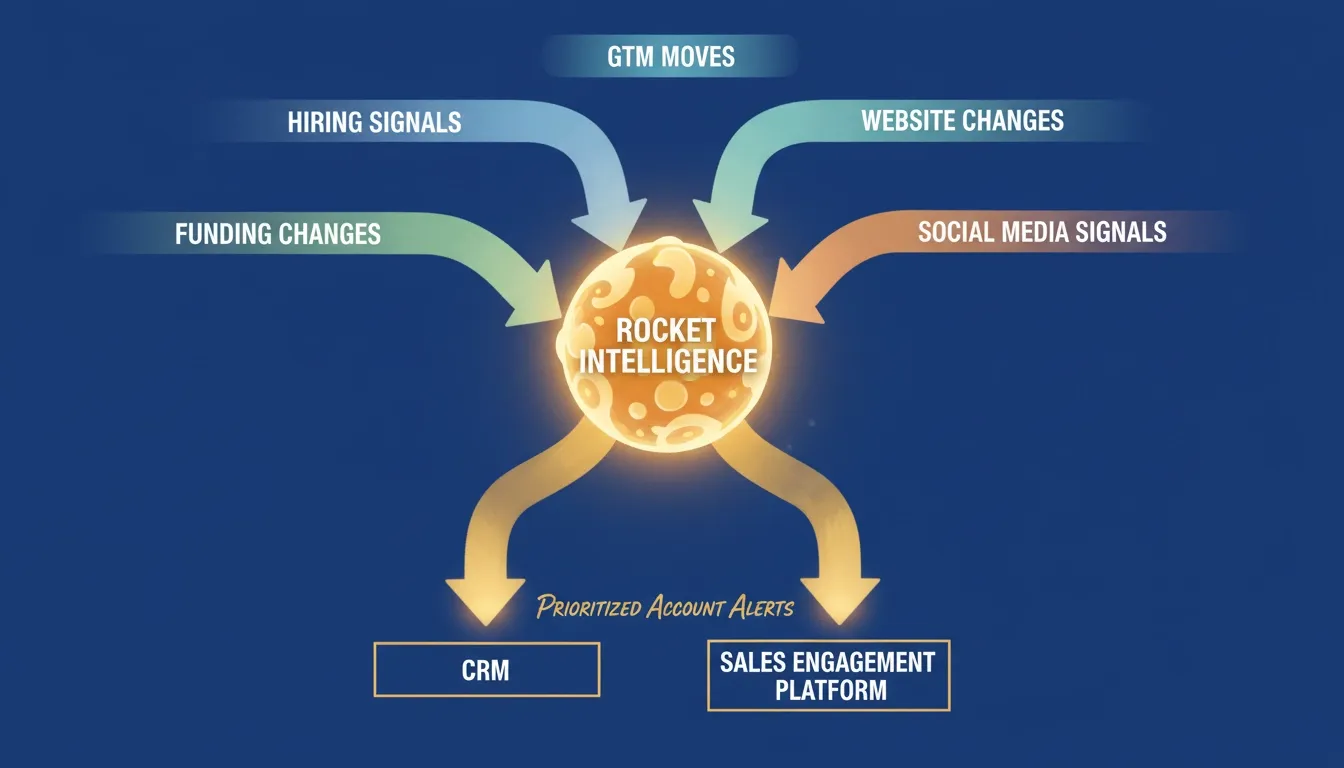 Rocket Intelligence monitors target accounts continuously and surfaces signal clusters so reps know exactly when to reach out.
Picking the Right Sales Prospecting Tool for Your Team
The right choice depends on where your team's biggest bottleneck actually sits. If the problem is finding the right contacts, start with a strong contact data platform. If the problem is running consistent outreach at scale, a sales engagement tool is what moves the needle. If the problem is knowing which accounts to prioritize right now, layering in intent data and real-time signals is what changes the game for your prospecting workflow.
No single tool covers all of this at the same level. The best prospecting stacks are built with intentional coverage across discovery, enrichment, intent, and engagement, not by stacking every tool that promises to solve everything at once.
Understanding your ideal customer profile before you build your stack is the step most teams skip, and it is the one that determines whether your prospecting tools actually produce pipeline.
Start Filling Your Pipeline With the Right Tools
The difference between a pipeline that stalls and one that moves is rarely about effort. It is about working from accurate data, reaching accounts at the right moment, and having the intelligence to know which conversations are worth starting.
Rocket gives your sales team the real-time signal layer that traditional prospecting tools cannot, continuous monitoring of your target accounts so every outreach starts with context, not just a contact record.
Table of contents
- -What Makes a Prospecting Tool Worth Using?
- -Does It Surface Accurate Contact Data?
- -How Well Does It Fit Your CRM and Existing Tools?
- -Can It Handle Outreach Automation?
- -What Does Pricing Look Like at Scale?
- -How Easy Is It for Your Team to Adopt?
- -Does It Cover Data Privacy and Compliance?
- -The Four Categories Every Prospecting Stack Should Cover
- -Contact Data and Discovery
- -Sales Engagement and Outreach Automation
- -Intent Data and Buying Signal Tools
- -Data Enrichment Tools
- -How the Four Categories Work Together
- -How Do the Top Prospecting Tools Actually Stack Up?
- -LinkedIn Sales Navigator
- -Apollo.io
- -ZoomInfo
- -HubSpot Sales Hub
- -Salesforce Sales Cloud
- -Outreach
- -Salesloft
- -Clay
- -Build vs. Buy: When to Stop Assembling and Start Consolidating
- -Signs Your Current Stack Is Working Against You
- -When an All-in-One Platform Makes More Sense
- -What a Healthy Consolidated Stack Looks Like
- -Where Does Rocket Intelligence Fit in Your Prospecting Stack?
- -What Rocket Intelligence Actually Tracks
- -How Rocket Compares to Traditional Contact Databases
- -Getting Rocket Into Your Prospecting Workflow
- -Picking the Right Sales Prospecting Tool for Your Team
- -Start Filling Your Pipeline With the Right Tools