
B2B data covers contact details, company profiles, intent signals, and buying triggers. Choose a verified, compliant provider, maintain freshness through regular data cleansing, and use live intelligence to track what your target accounts are doing right now.
What does your sales team do when the contact data in their CRM stops working?
Most reps discover the problem mid-sequence: bounced emails, disconnected direct dials, and messages landing with someone who moved on months ago. Business data is the foundation every revenue team builds on structured, verified information about companies and the professionals who work in them.
Ninety percent of sales teams now use AI agents or plan to within two years, according to Salesforce's State of Sales report and those teams need accurate business data to get any value from that investment.
Without fresh, verified records underneath it, even the most capable sales intelligence platform hits a wall fast. This blog covers data types, provider selection, quality maintenance, and how lead generation, outbound sales, and compliance all connect.
What Types of Business Data Do Sales and Marketing Teams Actually Use?
Most revenue teams draw from several data categories, each serving a distinct purpose at different stages of the sales cycle. Knowing what each type covers prevents wasted budget and misdirected outreach.
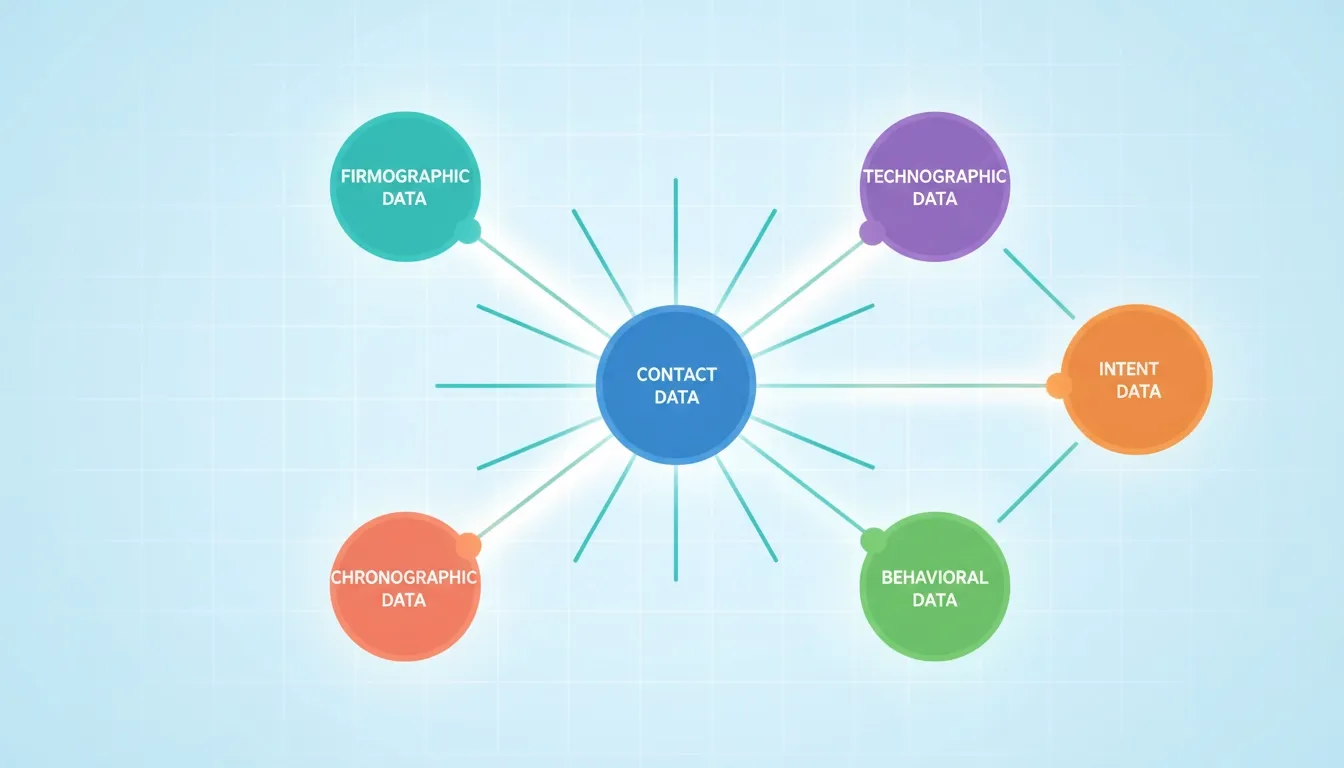 The six core B2B data types and how they connect across the sales and marketing stack.
Contact Data
Contact data is the operational core of any outreach program. It tells reps exactly who to contact and the fastest verified route to reach them directly.
-
Names, email addresses, phone numbers, and direct dials for contacts at target companies
-
Job title and seniority level to confirm you are reaching the right decision maker
-
Contact enrichment processes to catch role changes and prevent list decay
Data decay is the persistent risk - records accurate twelve months ago may be riddled with errors today as professionals change roles, get promoted, or leave companies.
Firmographic Data
Firmographic data answers whether a company fits your ideal customer profile before a single email is sent. It covers company-level attributes that determine whether an account is worth pursuing at all.
-
Company size, headcount, and revenue range to qualify against your target market
-
Industry classification and location for vertical and geographic targeting
-
Public records, regulatory filings, and industry databases as primary data sources
Firmographic data and technographic data together form the baseline of any structured account qualification process.
Technographic Data
Technographic data reveals what tools a company already runs in its technology stack. For anyone selling into or alongside existing software, this is one of the most targeted data sources available.
-
Current CRM, marketing platform, analytics suite, and productivity tools already in use
-
Identification of companies running complementary or competing products
-
Technology stack signals to filter outreach lists with precision
That specificity sharpens lead generation rates significantly and improves reply rates compared to untargeted list outreach.
Intent Data and Intent Signals
Intent data captures whether a company is actively researching topics related to your product right now. These intent signals surface accounts that are already in-market before they raise their hand.
-
Content consumption patterns and search behavior tracked across third party publisher networks
-
Website visitor tracking to identify companies researching relevant topics
-
Buyer intent data aggregated at scale from third party data providers alongside your first-party signals
Intent data is especially valuable for enterprise sales teams on long sales cycles surfacing accounts showing active research weeks before a formal inquiry arrives.
Chronographic and Behavioral Data
Chronographic data captures time-based company events that signal new budget or shifting priorities. Behavioral data adds engagement context from your own channels.
-
Funding rounds, leadership changes, and headcount shifts that flag accounts with new budget authority
-
Organizational changes and growth events as trigger-based outbound signals
-
Email engagement, page views, and product interactions from your own systems as behavioral data
Together, chronographic data and behavioral data provide timing context - the layer that firmographic data and contact data alone cannot supply. Teams running sales automation workflows benefit most when these signals feed directly into their sequences.
| Data Type | What It Covers | Primary Use Case |
|---|---|---|
| Contact data | Names, email addresses, phone numbers, direct dials, job title | Outreach and sales prospecting |
| Firmographic data | Company size, industry, revenue, location | Account qualification |
| Technographic data | Company technology stack, software in use | Targeted product-led selling |
| Intent data and intent signals | Research signals, content consumption, behavioral signals | Timing outreach to in-market buyers |
| Chronographic data | Funding rounds, leadership changes, organizational growth events | Trigger-based outbound sales |
| Behavioral data | Email engagement, site visits, content interaction | Personalization and lead scoring |
What Should You Look for in a Business Data Provider?
The market for B2B data providers is crowded. What actually matters when you evaluate a data provider is narrower than most vendor pitches suggest.
Coverage and Database Size
Coverage quality matters far more than database size. A provider with hundreds of millions of records but thin European coverage is less useful to a team targeting Germany than one with accurate, current local records.
-
Geographic coverage depth for your specific target market and regions
-
Multiple data sources: public records, company websites, job postings, and web crawling
-
B2B database update frequency - not just the total record count
Test sample data against your actual target companies before committing budget. The gap between advertised coverage and real-world accuracy is often significant.
Data Freshness and Verification
Data freshness is the single most underrated criterion when evaluating any data provider. An annual refresh cycle is near-useless for a team running daily outbound sequences.
-
Phone verified mobile numbers and phone verified data on decision-maker contacts
-
Real-time or near-real-time verification schedules for email addresses and direct dials
-
Automated contact enrichment to keep existing CRM data current between purchases
Verified contact data cuts bounce rates and protects email deliverability - both of which directly affect outbound campaign performance.
How to Evaluate Data Accuracy
Data accuracy is a claim every provider makes and few prove with real evidence. The right questions expose which vendors can actually back their numbers.
-
Stated accuracy rate supported by methodology documentation or an independent audit
-
Bounce rate guarantee terms and what they cover for B2B contact data specifically
-
Sample data matching your actual target accounts to test before any purchase
Specialist B2B data providers often outperform larger platforms on accuracy for specific verticals or European data. Database size does not equal data quality.
Compliance Documentation
GDPR compliant sourcing is non-negotiable for any team with European contacts. Skipping this check creates legal exposure, not just data quality risk.
-
Lawful basis documentation for how the provider sourced each contact recorCCPA compliant processes for California-based accounts within your target market
-
Data breach protocols and response timelines disclosed in compliance documentation
Non-compliant data from any third party data provider creates direct liability. Always request compliance documentation before purchasing external data.
Data Delivery and CRM Fit
Data delivery options and CRM compatibility determine how much friction sits between purchase and action. The best data in the world is useless if it does not reach your team's workflow.
-
Bulk CSV exports in standard data formats for list-based outbound campaigns
-
Real-time API calls for on-demand record enrichment within existing sales tools
-
Chrome browser extension availability for lightweight contact enrichment from company websites
LinkedIn Sales Navigator delivers strong contact intelligence but keeps the data layer inside its own platform, limiting its use in broader sales automation workflows.
| Evaluation Criterion | What to Ask |
|---|---|
| Coverage | Does the provider cover my target companies and geographies? |
| Data freshness | How often are records updated and verified? |
| Data accuracy | What is the verified accuracy rate? Is there a bounce guarantee? |
| Compliance | Is the provider GDPR compliant and CCPA compliant? |
| CRM Fit | Does it connect to my CRM or sales engagement tools? |
| Pricing | Per record, per seat, or subscription? |
How Do You Know If Your Business Data Is Actually Good?
Poor data quality is one of the most expensive hidden costs in sales and marketing. The damage shows up in wasted calls, failed campaigns, and compliance fines before most teams recognize the root cause.
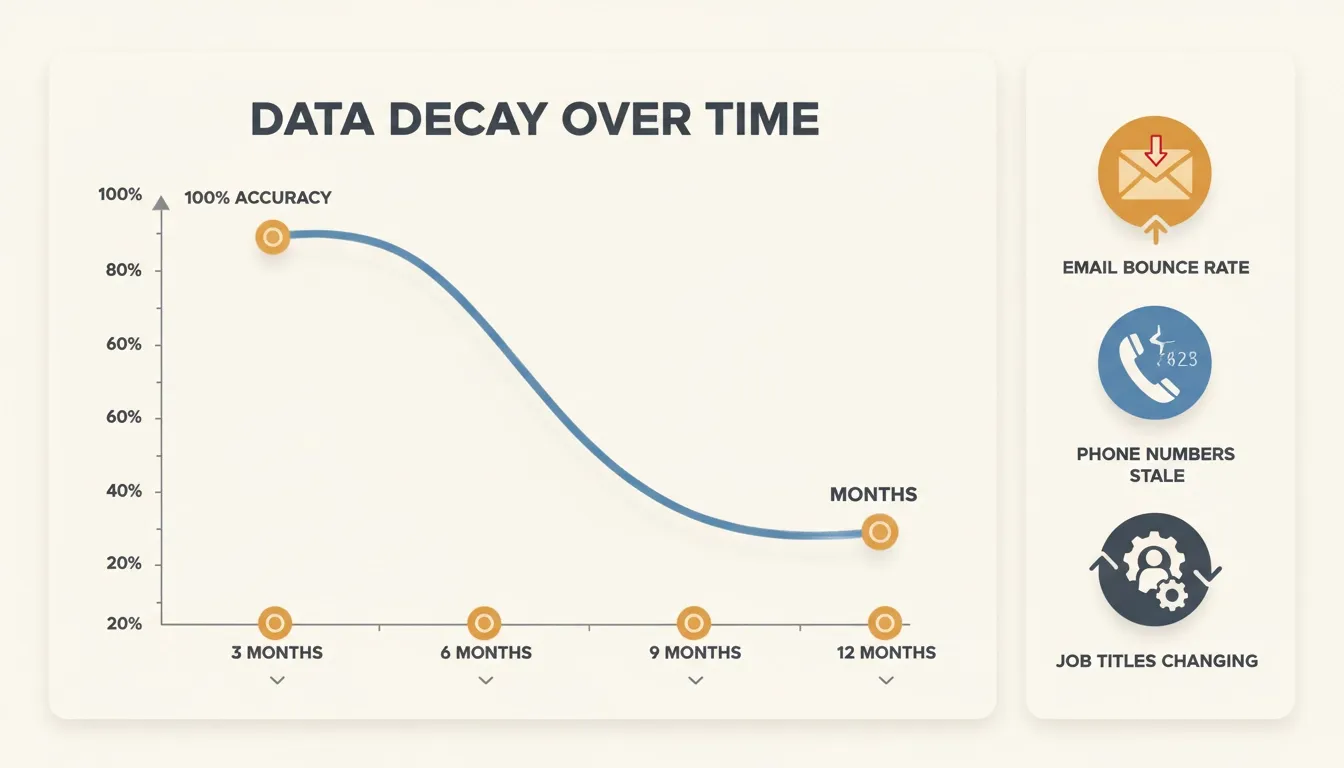 Contact data accuracy drops significantly over twelve months without ongoing cleansing and enrichment.
What Good Data Quality Means for Sales Teams
According to Dataversity, data quality describes the degree of confidence that data meets agreed business requirements across accuracy, completeness, consistency, and validity. For sales teams, that definition translates directly into whether campaigns work.
-
Email addresses that do not bounce and reach the intended recipient
-
Phone numbers that connect to the right person at the right company
-
Job titles that reflect the contact's current role, not their position from a year ago
-
Company details that match real-world records with no stale or duplicate entries
Clean, validated data is a competitive advantage. Teams that maintain it consistently outperform those that treat data quality as a one-time project.
Why Data Decays and What Data Cleansing Fixes
Business data decays naturally and continuously. A contact database sitting uncleaned for six months almost certainly contains significant data accuracy issues.
-
People change jobs, earn promotions, and leave companies throughout the year
-
Fast-growing sectors see organizational changes that make contact records go stale faster
-
Data cleansing removes duplicates, flags outdated records, and standardizes data formats across systems
Marketing strategies built on verified, cleansed lists consistently outperform those built on raw exports. Poor data quality compounds silently until it fails visibly.
Compliance: GDPR, CCPA, and the Risk of Data Breaches
Compliance is not a checkbox exercise. For any team handling contact data on EU or California residents, the legal and financial stakes are concrete.
-
The General Data Protection Regulation sets fines up to 20 million euros or 4% of global revenue for violations
-
CCPA compliant practices apply equivalent rights and obligations for California residents
-
Data breaches from non-compliant third party data sources carry legal consequences, reputation damage, and direct financial cost
GDPR compliant and CCPA compliant certifications from your data provider are non-negotiable when purchasing contact data in 2026.
The decision flowchart below shows how to handle new records from any external data source before they enter your CRM:
How Rocket Intelligence Gives Revenue Teams a Live Company Data Edge
Most B2B data providers sell snapshots. The moment a static database is downloaded, it starts aging and every day that passes makes it less useful to the sales team relying on it.
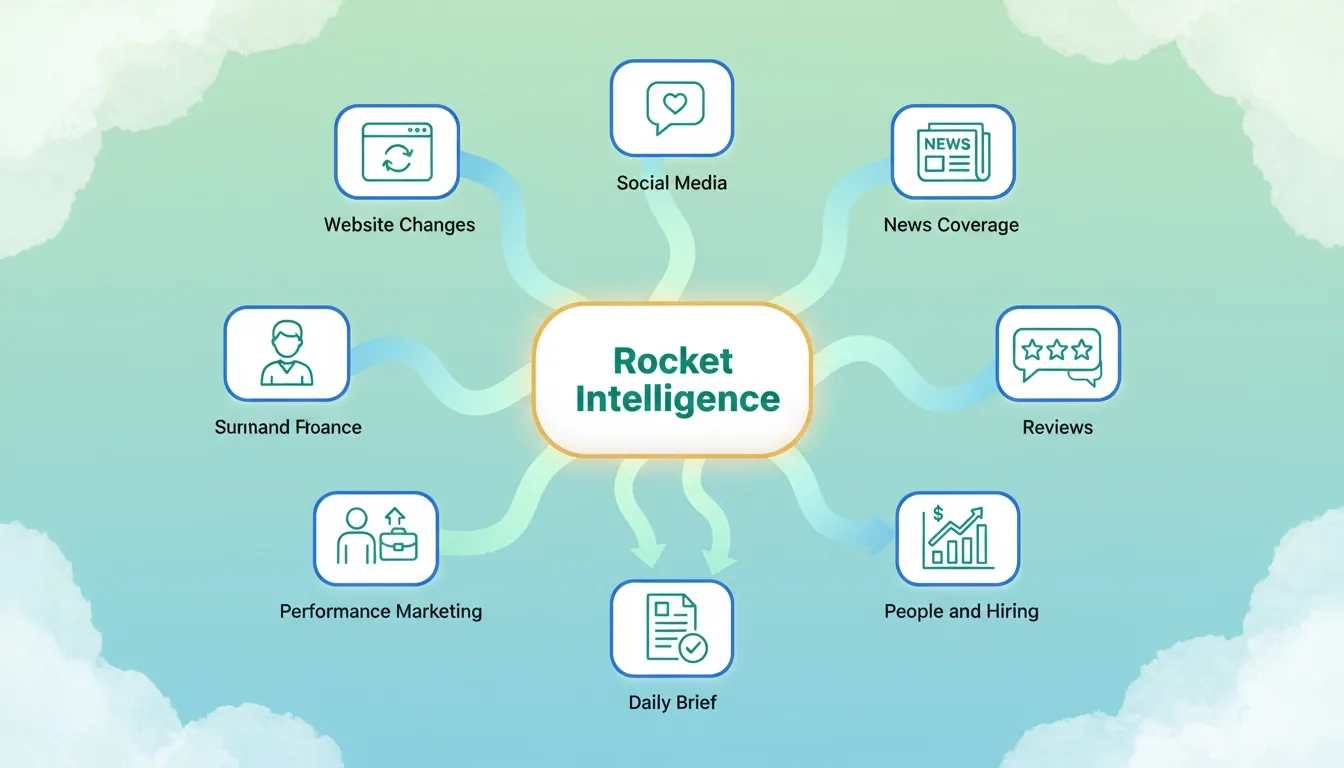 Rocket Intelligence monitors six signal categories continuously and delivers daily actionable briefs - not static exports.
-
Rocket Intelligence monitors every public platform a target company operates on: website changes, social media monitoring, news coverage, job postings, review platforms, and funding signals
-
Revenue teams get live insight into organizational changes, leadership shifts, product moves, and competitive signals as they happen
-
For enterprise sales teams and marketing and sales teams running account-based programs, this is a fundamentally different category from a downloaded contact list
As thegtmauditguy noted in a Hacker News discussion on AI-Led Growth (news.ycombinator.com/item?id=47052345):
"The technical requirements are different from traditional sales tooling. Real-time enrichment waterfalls. Event-driven automation from intent signals. Confidence scoring on every contact record. Multi-provider data validation before any outreach fires."
Revenue teams acting on live signals close faster than those working from last quarter's export.
Where Traditional Providers Fall Short
The limitations of established providers are well-documented by teams that use them daily. The core problem is that most providers are optimized for data volume rather than data currency.
-
ZoomInfo offers an extensive database with phone verified mobile numbers and direct dials, but its enterprise pricing puts it out of reach for many sales teams and data freshness on lower pricing tiers carries known accuracy concerns
-
LinkedIn Sales Navigator gives strong contact intelligence but requires manual monitoring and lacks the automated intent signals and competitive intelligence that lead generation workflows need at scale
-
Crunchbase focuses on firmographic data - funding rounds, headcount, investor relationships - but does not provide contact enrichment, outbound sales workflows, or real-time company data
Rocket Intelligence replaces the patchwork of static sources with a single continuous monitoring layer, covering six signal categories and delivering daily actionable insights without manual downloads. For teams building a B2B SaaS product or running account-based programs, the competitive intelligence layer it provides is a structural advantage over teams relying on periodic data exports.
Bringing It Together: A Practical Sales Data Strategy
The gap between strong and poor data quality is not about which provider you choose. It comes down to having a system for keeping records fresh, verified, and compliant over time. Start with contact data and firmographic data as the baseline for any outbound motion, then layer in intent signals or technographic data based on your sales cycle.
Build data cleansing and data enrichment into regular revenue operations workflows, not one-off projects. The winning teams are not the ones with the biggest database - they are the ones whose data is current, compliant, and tied to live signals that tell them exactly when to act.
Stop relying on stale exports. Rocket gives revenue teams live signals across every public platform their target accounts operate on - website changes, hiring moves, funding rounds, competitive shifts, and more - delivered as daily actionable intelligence.
Start building your live intelligence layer on Rocket and move from last quarter's data to what is happening right now.
Table of contents
- -What Types of Business Data Do Sales and Marketing Teams Actually Use?
- -Contact Data
- -Firmographic Data
- -Technographic Data
- -Intent Data and Intent Signals
- -Chronographic and Behavioral Data
- -What Should You Look for in a Business Data Provider?
- -Coverage and Database Size
- -Data Freshness and Verification
- -How to Evaluate Data Accuracy
- -Compliance Documentation
- -Data Delivery and CRM Fit
- -How Do You Know If Your Business Data Is Actually Good?
- -What Good Data Quality Means for Sales Teams
- -Why Data Decays and What Data Cleansing Fixes
- -Compliance: GDPR, CCPA, and the Risk of Data Breaches
- -How Rocket Intelligence Gives Revenue Teams a Live Company Data Edge
- -Where Traditional Providers Fall Short
- -Bringing It Together: A Practical Sales Data Strategy