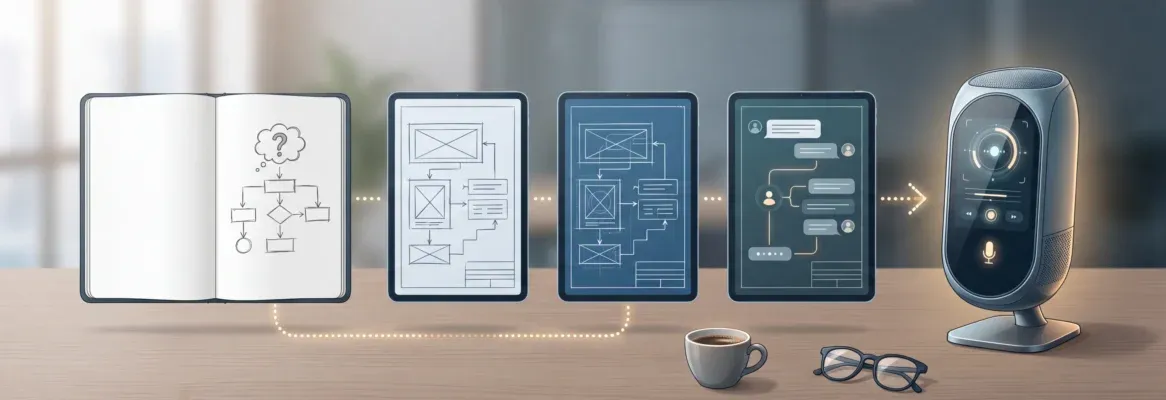
The best AI prompts to build an eCommerce store cover product descriptions, email campaigns, pricing strategy, and full storefront generation, cutting weeks of manual work down to minutes for any online business.
What if you could describe your entire online store and have it live before the end of the day?
According to Statista's 2026 eCommerce report, global eCommerce sales will surpass $7.4 trillion this year. That means more competition, more customers expecting personalized experiences, and more demand for speed.
AI prompts give small business owners and eCommerce teams a way to generate content, analyze customer data, write product descriptions, craft email campaigns, and improve the overall customer experience in minutes rather than hours.
The prompts in this guide are grouped by business function. Find the section that matches your biggest gap and start there.
Why AI Prompts Work for eCommerce Businesses
Here is a brief explanation of why this approach produces results before jumping into the prompts.
-
Product descriptions — AI tools generate compelling product descriptions that highlight unique features, address customer pain points, and drive sales
-
Customer data analysis — Prompts help you analyze customer browsing behavior, purchase history, and preferences to personalize customer experiences
-
Email marketing — Write personalized emails, subject lines, and email sequences that increase conversions and customer engagement
-
Inventory management — Use AI to identify trends in sales data, forecast consumer demand, and optimize stock levels
-
Customer service — Generate response templates, handle customer inquiries, and improve customer satisfaction scores
-
Business strategy — AI prompts help identify market trends, evaluate pricing strategy options, and support growth planning
Using AI this way represents a shift in how online business is done, moving from manual, repetitive effort to focused, strategic work.
The complete map of AI prompt categories for building and running an eCommerce store
Prompts to Build Your eCommerce Store from Scratch
Most AI prompt guides skip the most important part: building the actual store. These prompts cover storefront architecture, product catalog structure, checkout flows, and payment integration. Together, they form the foundation everything else sits on.
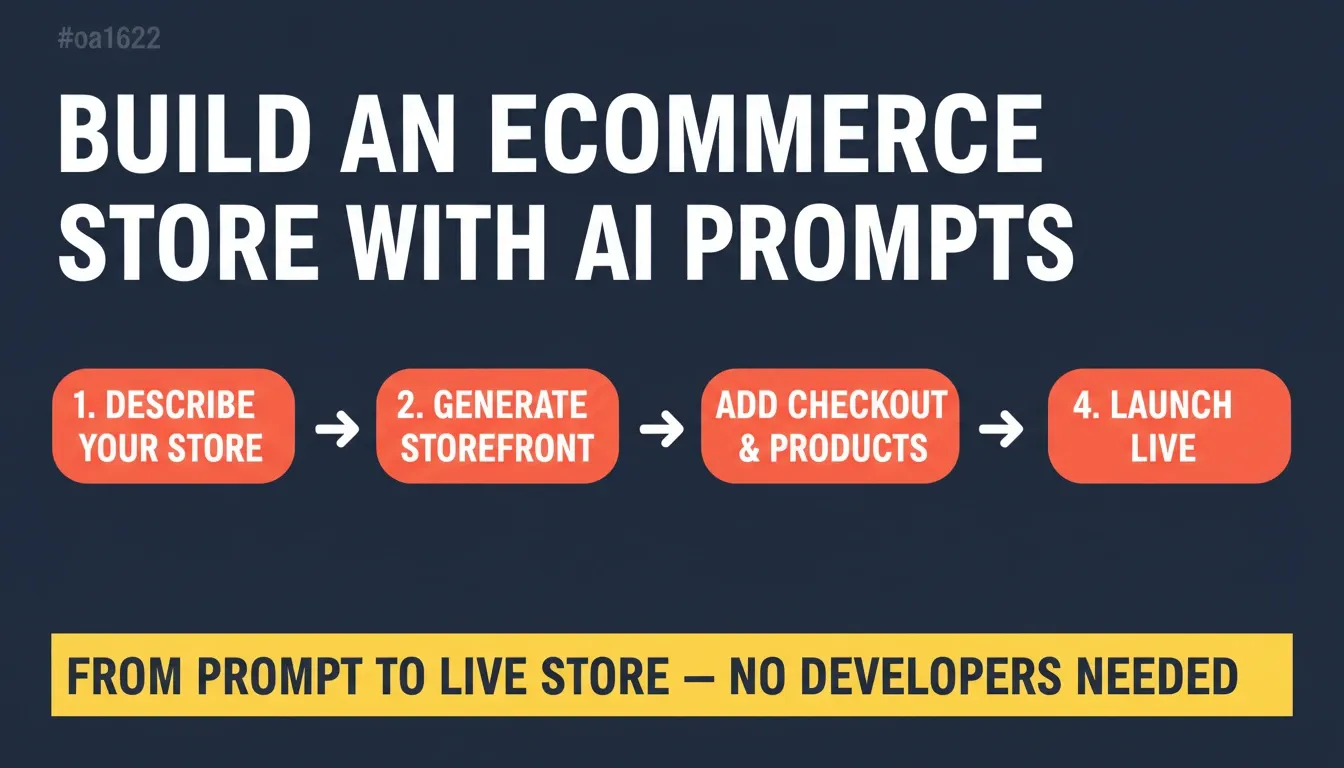
The 4-step flow for building a complete eCommerce store from a single AI prompt
Prompt 1: Full Storefront Generation
"Build a complete eCommerce store for a [product category] brand. Include: a homepage with hero section and featured products, a product catalog with filtering by [category/price/rating], individual product pages with image gallery, description, reviews, and add-to-cart, a shopping cart with quantity controls, a checkout flow with shipping address and payment fields, and an order confirmation page. Brand style: [describe colors, tone, visual direction]. Target customer: [describe demographics and preferences]."
The more specific your product category and brand direction, the more the output reflects your actual business rather than a generic template. Describe your customer's problem in the hero section, not just your product name.
Prompt 2: Product Catalog Architecture
"Design a product catalog structure for an online store selling [product types]. Create a category hierarchy with [number] main categories and subcategories. Include filtering options by [price range, size, color, material, rating]. Write category page descriptions that explain what each section contains and why a customer would shop there. Suggest a featured products logic for the homepage based on [bestsellers / new arrivals / seasonal trends]. Output the full sitemap structure."
A well-structured catalog is the difference between a store customers browse and one they abandon. This prompt produces the architecture before you build a single page. For a deeper look at catalog design, see how to build a digital product catalog website.
Prompt 3: Checkout Flow and Payment Integration
"Write the complete user flow for a checkout process on a [product type] eCommerce store. Include: guest checkout and account creation options, address entry with validation, shipping method selection with estimated delivery dates, order summary with itemized pricing and discount code field, payment method selection [credit card, PayPal, Stripe], and order confirmation with next steps. Flag any friction points that typically cause cart abandonment and suggest copy for each step that reduces hesitation."
Checkout is where revenue is lost. This prompt treats the checkout flow as a conversion problem, not just a technical one.
Prompt 4: Mobile-First Product Page
"Write a mobile-first product page for [product name] in the [product category]. The page should load with the product image above the fold, followed by the product name, price, key benefit in one sentence, size/variant selector, add-to-cart button, and a 3-point trust signal row [free shipping / easy returns / secure checkout]. Below the fold: full product description, specifications table, customer reviews section, and related products. Write all copy. Specify image placement and button hierarchy."
Mobile accounts for the majority of eCommerce traffic. A product page designed for desktop first loses customers before they read the description.
Ready to turn these prompts into a real store? Rocket takes your description and generates a fully functional eCommerce store with product pages, checkout, and Stripe integration built in. Start building for free on Rocket.
AI Prompts to Write Product Descriptions That Sell
Product descriptions make or break conversions. These prompts produce compelling product descriptions that speak to your target audience and drive sales, without spending hours on each one.
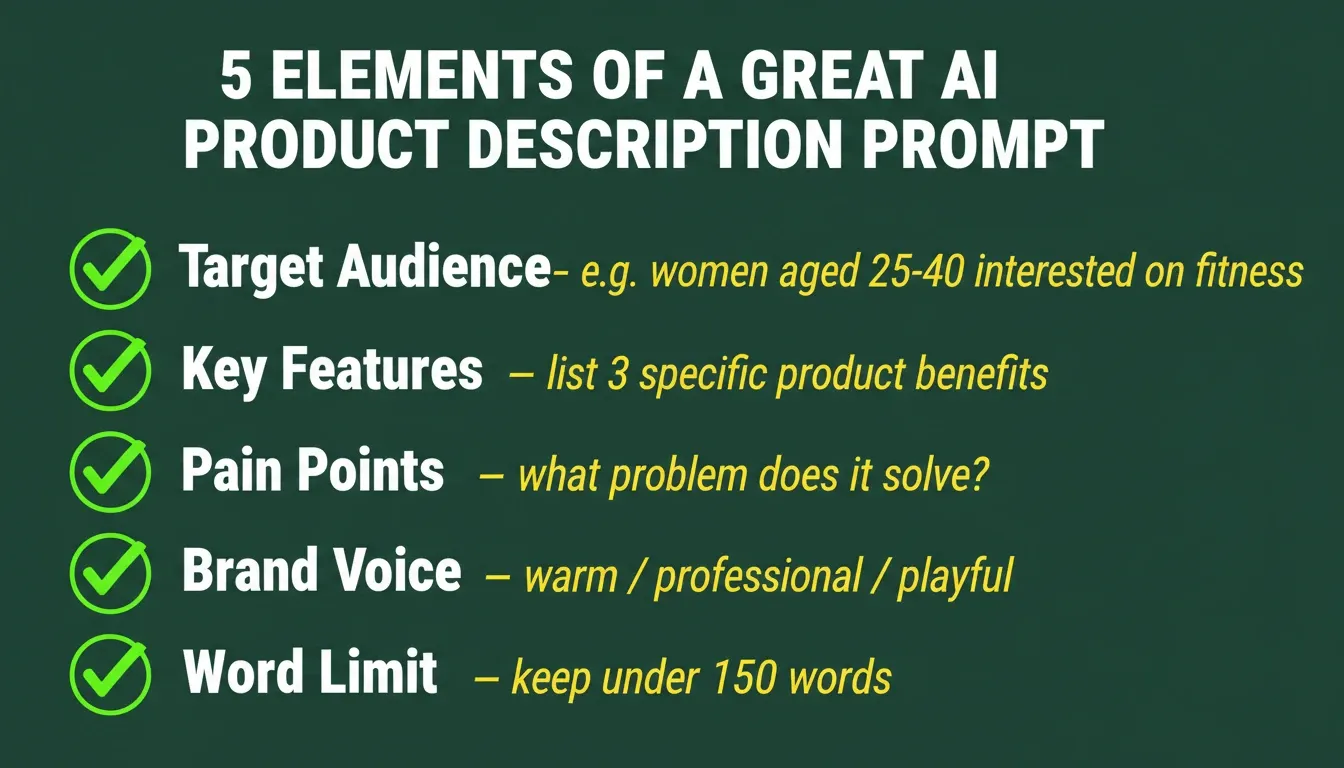
Five elements every strong AI product description prompt must include
Prompt 5: Feature-Focused Product Description
"Act as a marketing expert for a [product category] brand. Write a product description for [product name] that highlights its key features, addresses common customer pain points, and uses a conversational tone. Include specific examples of how this product improves daily life. Target audience: [specific demographic]. Keep it under 150 words."
This prompt provides clear instructions and context that guide the AI toward something your ideal customer actually wants to read. The more detail you provide, the better the output.
Prompt 6: SEO-Optimized Product Listings
"Generate an SEO-optimized product listing for [product name] in the [product category]. Include a compelling title with relevant keywords, a product description highlighting unique features and benefits, five bullet points covering specifications, and a call to action. Write in a brand voice that is [warm/professional/playful]. Avoid keyword stuffing."
This prompt helps your product listings rank in search results while still reading naturally for shoppers. It addresses both search visibility and customer engagement in a format that works across your catalog.
Prompt 7: Comparison-Based Descriptions
"Write a product description for [product name] that positions it against competitors without naming them directly. Highlight what makes this product different. Mention key features like [feature 1, feature 2, feature 3]. Use social proof language. Include a brief explanation of who this product is a good fit for."
Good prompts for product copy always include constraints and specific details. Prompts like this one produce results that feel authentic rather than generic AI-generated marketing copy.
Prompt 8: Product Description for a Specific Industry
"Create product descriptions for a [specific industry] online store selling [product type]. Write in plain English. Mention materials, specifications, and unique features. The target market is [demographics/interests]. Include how this product solves an unmet need. Brand voice is [style]. Generate three variations."
Using these prompts consistently helps eCommerce businesses build a catalog of compelling product descriptions that drive more clicks and conversions. The best results come from providing more detail upfront rather than asking the AI to guess what you need.
Your product descriptions are ready. Now put them on real product pages. Rocket builds the full store around your content, with product pages, image galleries, and a checkout flow that works from day one. See what Rocket builds from a single prompt.
Prompts for eCommerce Email Marketing Campaigns
Email marketing remains one of the highest-ROI channels for any online business. According to Litmus research, most companies see between $10 and $36 in return for every $1 spent on email marketing. These prompts help you draft personalized emails, craft subject lines, and build email sequences that bring customers back to your store.
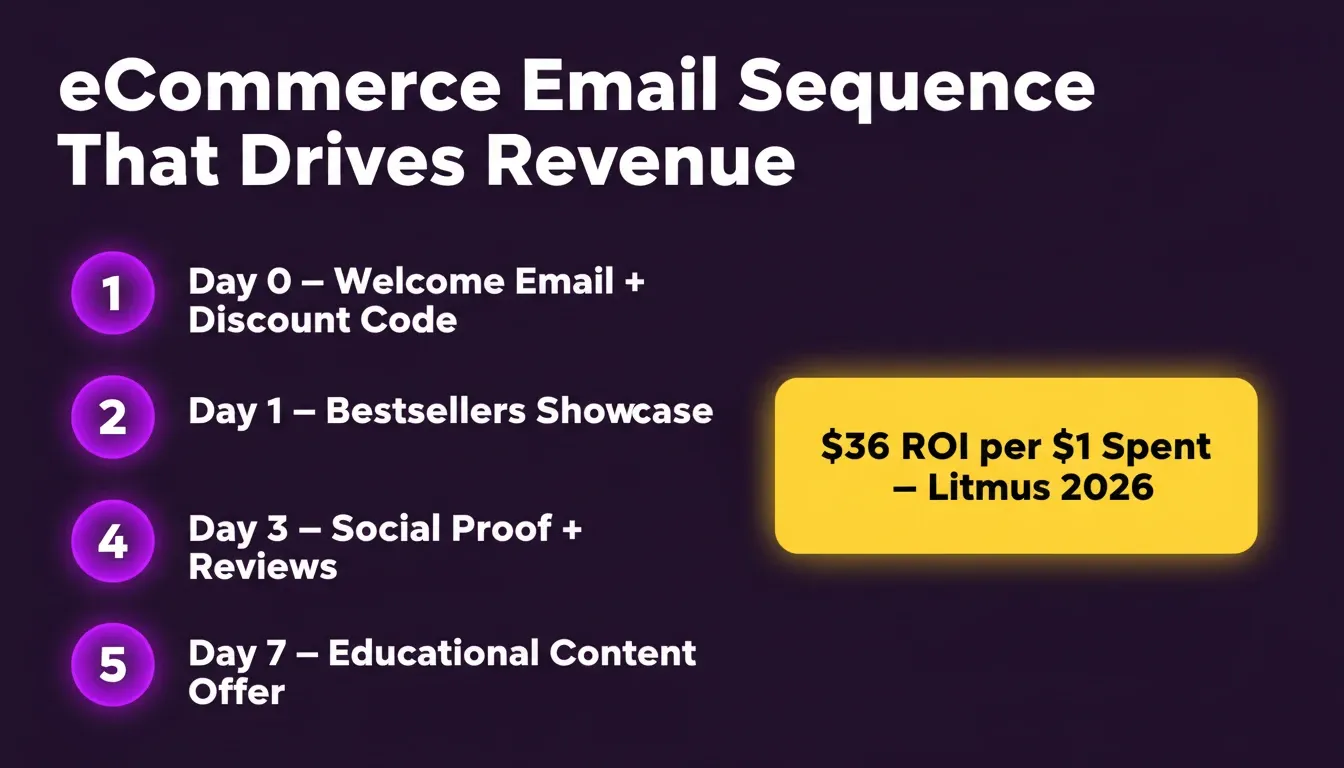
The five-email welcome sequence structure: timing, purpose, and why each step matters
Prompt 9: Welcome Email Sequence
"Write a five-email welcome sequence for new subscribers to a [product category] eCommerce business. Email 1: warm welcome with brand story and a discount code for first purchase. Email 2: showcase bestsellers based on popular items. Email 3: customer testimonials and social proof. Email 4: educational content about [topic]. Email 5: urgency-based offer. Use a conversational tone. Each email should have an engaging subject line."
Prompt 10: Abandoned Cart Recovery
"Draft three abandoned cart recovery emails for an online store selling [products]. Email 1 (sent one hour after): friendly reminder with product image. Email 2 (sent 24 hours after): address common objections like shipping costs or security concerns. Email 3 (sent 48 hours after): offer a limited discount code. Each email needs an engaging subject line that drives more clicks."
Prompt 11: Post-Purchase Upsell Sequence
"Write a three-email post-purchase sequence for a customer who just bought [product] from a [product category] store. Email 1 (day 1): order confirmation with shipping timeline and what to expect. Email 2 (day 3): tips for getting the most from the product, with a soft recommendation for a complementary item. Email 3 (day 7): request a review with a direct link, and introduce a loyalty reward for their next purchase. Keep each email under 200 words."
Post-purchase emails have the highest open rates of any eCommerce email type. Most stores send one confirmation and stop. This sequence turns a completed transaction into a repeat customer relationship.
Prompt 12: Customer Feedback Request
"Write a post-purchase email requesting customer feedback for a small business that sells [products]. The tone should be warm and empathetic. Ask about their customer experience, product quality, and delivery. Offer a small incentive for leaving a review. Include clear instructions on how to submit feedback. Keep it concise."
Email marketing prompts work best when you include the brand voice, target audience, and specific business goals. The AI's response improves when you supply context about your customers and what makes your online business unique.
Great emails need a great store to send customers back to. Rocket builds eCommerce stores with email capture, discount code systems, and customer accounts built in from the start. Build the store your email campaigns deserve.
AI Prompts for Customer Service and Customer Satisfaction
Customer inquiries and complaints take up a significant portion of business operations. Fortunately, these AI prompts help you generate response templates that improve customer satisfaction without sacrificing a human touch.
Prompt 13: Customer Complaint Response Templates
"Act as a customer service representative for a [product category] eCommerce business. Write response templates for these common scenarios: 1) delayed shipping, 2) wrong item received, 3) product quality complaint, 4) refund request. Each response should acknowledge the issue, show empathy, provide a clear resolution, and turn the customer into a repeat buyer. Keep the tone professional but warm."
Prompt 14: FAQ Content Generation
"Analyze common questions customers ask about [product type] in the [specific industry] eCommerce space. Generate FAQ content covering: product specifications, shipping times, return policy, payment security, and product care. Write answers in plain English that a non-technical person would understand. Make each answer concise and helpful."
Prompt 15: Personalized Customer Interactions
"Create a framework for personalized customer interactions at different points in the customer journey: first-time visitor, repeat customer, valued customer with five or more purchases, and customer who left negative feedback. For each segment, suggest ways to personalize the messaging, what kind of offers to provide, and what tone to use. Factor in purchase history and individual preferences."
These prompts help eCommerce teams maintain high customer satisfaction scores without manual intervention for every interaction. The AI handles the initial draft, and your team refines before sending.
How AI Prompts Help with Pricing Strategy and Sales Data
Pricing decisions can make or break an eCommerce business. These prompts help you analyze historical sales data, identify trends in market conditions, and develop a pricing strategy that balances profitability with customer satisfaction. For more on AI-assisted pricing, see best AI prompts for pricing pages.
Prompt 16: Competitive Pricing Analysis
"Act as a business strategy consultant. Analyze pricing strategy options for a small business selling [products] in a competitive eCommerce market. Consider these factors: current market trends, competitor pricing for similar items, target market willingness to pay, and seasonal trends. Suggest three pricing strategies with specific examples. Explain which strategy leads to higher customer satisfaction and repeat customers."
Prompt 17: Discount and Promotion Planning
"Help me develop a promotional calendar for my online store for the next quarter. Product categories include [list]. Analyze which discount code structures work best: percentage off, buy-one-get-one, free shipping thresholds, or early access for loyal customers. Consider sales trends from past purchase data and suggest ways to increase average order value while maintaining profitability."
Prompt 18: Dynamic Pricing with Sales Data
"Using historical sales data patterns for [product category], suggest a dynamic pricing model that adjusts based on consumer demand, seasonal trends, market conditions, and stock levels. Provide specific examples of when to raise prices and when to offer promotions. Include key performance indicators to track the success of each adjustment."
Using AI for pricing decisions helps eCommerce businesses respond to market shifts faster than competitors who rely on intuition alone.
Pricing strategy is only half the equation. The other half is a store that converts. Rocket builds eCommerce stores with built-in analytics so you can track what pricing and promotions actually drive revenue. Start building with Rocket.
AI Prompts for Social Media and Content Marketing
Content drives traffic, and traffic drives sales. These prompts help you create content, plan social media posts, and build visibility for your eCommerce business across channels where your target audience spends time.
Prompt 19: Social Media Post Generator
"Generate a week of social media posts for a [product category] eCommerce brand. Include: two product highlight posts with engaging copy, one customer testimonial post with social proof, one behind-the-scenes post, one educational blog post promotion, one user-generated content prompt, and one LinkedIn post about industry trends. Each post needs platform-specific formatting, relevant hashtags, and a call to action."
Prompt 20: Blog Post Ideas for eCommerce SEO
"Suggest ten blog post ideas for a [product type] online store targeting [target audience]. Each idea should address a specific question or pain point that potential customers search for. Include the primary keyword and a meta description for each. Aim for topics that build organic traffic and search visibility while positioning the brand as an expert in the space."
Prompt 21: Ad Copy and Landing Pages
"Write ad copy for a [product category] eCommerce business running ads on Google and social media. Create three headline variants and two body copy options for each platform. The target audience is [specific demographic] with interests in [topics]. Include a strong call to action and highlight the competitive edge. Also draft landing page copy that matches each ad variant."
The key is providing enough context about your brand, audience, and business goals so the AI-generated output feels authentic rather than generic.
Your content is driving traffic. Make sure the destination converts. Rocket generates conversion-focused landing pages and product pages built from your actual brand context, not a template. Turn your traffic into sales with Rocket.
Prompts to Analyze Customer Data and Identify Trends
Customer data is where the real growth opportunities are. These AI prompts help you analyze large amounts of customer data, spot patterns in browsing behavior, and make smarter decisions about inventory management, product recommendations, and marketing.
Prompt 22: Customer Behavior Analysis
"Analyze customer data patterns for an eCommerce store in [specific industry]. Identify trends in: purchase history frequency, average order value changes over time, product category preferences by demographic, and seasonal trends in customer browsing behavior. Based on these patterns, suggest personalized product recommendations and targeted marketing messages for each customer segment. Reference past purchases and individual preferences."
Prompt 23: Customer Feedback Synthesis
"Review the following customer feedback samples from our online store: [paste feedback]. Identify trends in: positive reviews, common complaints, unmet needs, and feature requests. Categorize findings by product category. Suggest specific ways to improve customer satisfaction based on this analysis. Include a brief explanation of how to turn negative feedback into positive improvements."
| Prompt Category | What It Helps With | Business Impact |
|---|---|---|
| Store Architecture | Storefront, catalog, checkout, mobile pages | Live store from a single prompt |
| Product Descriptions | SEO-ready, feature-focused, comparison-based listings | More clicks, higher conversions |
| Email Marketing | Welcome sequences, abandoned cart, post-purchase upsell | Better engagement, repeat customers |
| Customer Service | Response templates, FAQ content, personalization | Improved customer satisfaction |
| Pricing Strategy | Competitive analysis, promotions, dynamic pricing | Higher profitability, competitive edge |
| Content Marketing | Social posts, blog ideas, ad copy | Organic traffic, search visibility |
| Data Analysis | Customer behavior, trends, feedback synthesis | Smarter business decisions |
| Operations | Demand forecasting, workflow optimization | Reduced manual work, faster fulfillment |
AI Prompts for Inventory Management and Business Operations
Running a successful eCommerce business is not just about marketing. These prompts help you handle the operational side: inventory decisions, supply chain planning, and business workflows that usually require manual intervention.
Prompt 24: Demand Forecasting and Inventory
"Based on our sales trends for [product category], help me forecast inventory needs for the next quarter. Consider: seasonal trends, historical sales data showing [data points], current market trends in the industry, and upcoming promotions. Suggest optimal stock levels for each product type. Include a growth strategy that accounts for increasing consumer demand without overcommitting on inventory. Identify where operational efficiency can improve."
Prompt 25: Operational Workflow Optimization
"Act as a business operations consultant for a small business eCommerce store. Our current workflows include: order processing, shipping label generation, customer inquiries handling, inventory management, and returns processing. Suggest ways AI tools and automation can handle each area. Provide specific examples of how AI can reduce repetitive tasks and improve operational efficiency. Estimate time savings per week."
eCommerce businesses that integrate AI across all operations gain a competitive edge that compounds over time, not just in marketing, but in every function that touches the customer.
You have the prompts. Now build the store. Rocket generates a fully functional eCommerce store from your description, with product pages, Stripe checkout, inventory tracking, and built-in analytics ready from the first build. Go from prompt to live store on Rocket.
How Rocket Takes AI Prompts from Text to a Live eCommerce Store
Most AI tools like ChatGPT help you generate text: product descriptions, marketing content, and business strategy documents. However, they cannot build the actual store. The gap between generating great content and having a working eCommerce business still requires developers, designers, and weeks of development.
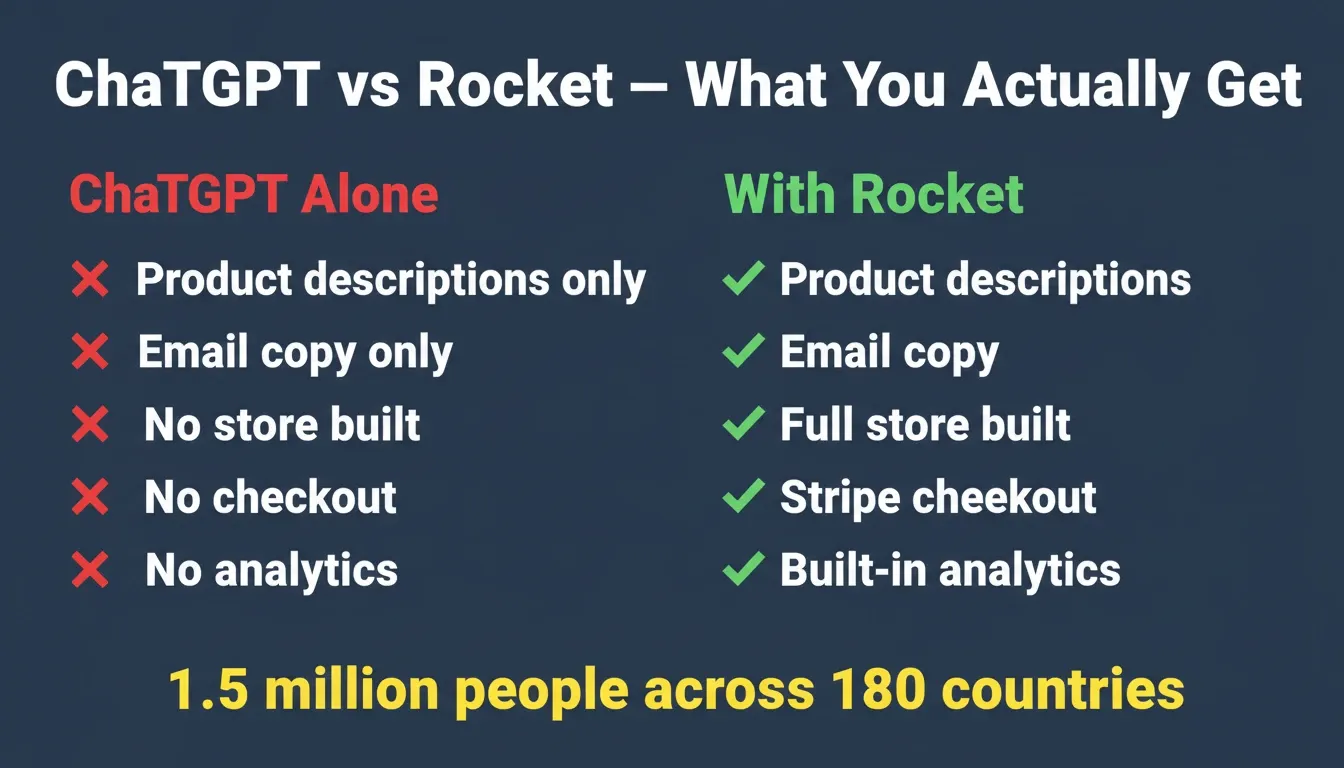
ChatGPT generates text. Rocket generates the store, including checkout, analytics, and everything in between.
You describe your online store: product categories, checkout flow, payment systems, design direction. Rocket then generates a fully functional eCommerce application with working code, responsive layouts, and Stripe integration. Not a mockup. A working store.
Here is what that looks like in practice:
-
Store architecture in one prompt. Product catalog, checkout flow, payment integration, customer accounts, and order tracking are all generated from a single description. 1.5 million people have tried Rocket across 180 countries, from solo founders shipping their first product to enterprise teams rebuilding their entire digital stack.
-
AI-generated product pages that ship in minutes. Your product descriptions, category structures, and customer experience flows become real pages with real functionality. Inventory management and order tracking are built in.
-
Customer data and analytics from day one. Every Rocket build includes built-in analytics for tracking customer interactions, conversions, and key performance indicators. No additional tools or setup required.
-
Context that carries forward. After your initial build, customize through conversation. Add personalized product recommendations, customer feedback forms, email capture, and discount code systems, all through follow-up prompts. Rocket remembers everything from the session before.
"Went from a ChatGPT product description prompt to a fully live store with Stripe checkout and customer accounts in 90 minutes on Rocket. The integrated approach saves time that used to take my team weeks." — Reddit r/ecommerce user, 2026
For a complete walkthrough of the build process, see how to build an eCommerce app with AI for modern businesses and build an eCommerce store app with Rocket: a complete guide. If you are evaluating platform options, best Shopify alternatives for eCommerce businesses of all sizes covers the landscape. For payment setup specifically, AI app builder with Stripe payment integration walks through the full flow. And if conversion is the goal, how to build an online store that converts more visitors fast is worth reading alongside this guide.
Tips for Writing Effective Prompts That Produce Best Results
Here is what separates prompts that produce useful output from ones that produce generic filler. These tips apply to all ChatGPT prompts and AI tools for eCommerce.
-
Include your target audience. Tell the AI who you sell to with specific demographics, interests, and preferences
-
Provide specific examples. Show the AI what good output looks like using few-shot prompting when possible
-
Set constraints. Word count limits, brand voice guidelines, and format rules prevent rambling
-
Give context. Mention your specific industry, product type, and business goals
-
Request variations. Ask for three or more options so you can test what resonates with your customer base
-
Use clear instructions. Tell the AI what role to play, what to include, and what to avoid
Well-crafted prompts consistently produce better results than vague ones. The difference is saving time versus wasting it on back-and-forth refinement. For a deeper dive into prompt craft, see prompt engineering best practices for accurate AI results.
The Future of AI-Powered eCommerce
AI technologies continue to reshape how eCommerce businesses operate. The emerging patterns worth watching include the following:
-
Personalized product recommendations that analyze customer browsing behavior in real time
-
AI-powered customer service that handles complex customer inquiries without human intervention
-
Predictive analytics using sales data and market trends to anticipate consumer demand before it peaks
-
AI-generated content at scale across product descriptions, email marketing, social posts, and ad copy
-
Continuous improvement loops where AI algorithms learn from customer interactions and feedback to refine the customer experience automatically
eCommerce businesses that start using AI today are building the foundation for a smarter, faster online business tomorrow.
Your eCommerce Store Starts with the Right Prompt
The best AI prompts to build an eCommerce store do not just generate text. They generate the store itself. From product catalog architecture to checkout flows, email sequences to pricing strategy, every section of this guide maps to a real business function.
AI-powered eCommerce is only getting more capable: smarter personalization, faster iteration, and stores that adapt to customer behavior in real time. The businesses building on this foundation today will be the ones that compound that advantage tomorrow.
You have the prompts. Build your store on Rocket and go from prompt to live eCommerce business, with product pages, checkout, analytics, and customer management all included.
Table of contents
- -Why AI Prompts Work for eCommerce Businesses
- -Prompts to Build Your eCommerce Store from Scratch
- -Prompt 1: Full Storefront Generation
- -Prompt 2: Product Catalog Architecture
- -Prompt 3: Checkout Flow and Payment Integration
- -Prompt 4: Mobile-First Product Page
- -AI Prompts to Write Product Descriptions That Sell
- -Prompt 5: Feature-Focused Product Description
- -Prompt 6: SEO-Optimized Product Listings
- -Prompt 7: Comparison-Based Descriptions
- -Prompt 8: Product Description for a Specific Industry
- -Prompts for eCommerce Email Marketing Campaigns
- -Prompt 9: Welcome Email Sequence
- -Prompt 10: Abandoned Cart Recovery
- -Prompt 11: Post-Purchase Upsell Sequence
- -Prompt 12: Customer Feedback Request
- -AI Prompts for Customer Service and Customer Satisfaction
- -Prompt 13: Customer Complaint Response Templates
- -Prompt 14: FAQ Content Generation
- -Prompt 15: Personalized Customer Interactions
- -How AI Prompts Help with Pricing Strategy and Sales Data
- -Prompt 16: Competitive Pricing Analysis
- -Prompt 17: Discount and Promotion Planning
- -Prompt 18: Dynamic Pricing with Sales Data
- -AI Prompts for Social Media and Content Marketing
- -Prompt 19: Social Media Post Generator
- -Prompt 20: Blog Post Ideas for eCommerce SEO
- -Prompt 21: Ad Copy and Landing Pages
- -Prompts to Analyze Customer Data and Identify Trends
- -Prompt 22: Customer Behavior Analysis
- -Prompt 23: Customer Feedback Synthesis
- -AI Prompts for Inventory Management and Business Operations
- -Prompt 24: Demand Forecasting and Inventory
- -Prompt 25: Operational Workflow Optimization
- -How Rocket Takes AI Prompts from Text to a Live eCommerce Store
- -Tips for Writing Effective Prompts That Produce Best Results
- -The Future of AI-Powered eCommerce
- -Your eCommerce Store Starts with the Right Prompt