
Most platforms treat SEO as a post-launch task. Rocket builds it into the product from the first generation, with clean semantic HTML, structured data, meta tags, and AI search visibility included before you ever hit deploy.
Why Most Apps Launch Without SEO and Pay for It Later?
You ship the product. Traffic is flat. You go back and add meta tags, fix heading structure, generate a sitemap, and realize the content was never written with search intent in mind.
That sequence is the standard. It is also expensive.
According to a June 2025 BrightEdge survey of over 750 marketing professionals, 68% of organizations are actively changing their strategies in response to AI search, and more than half have tasked their SEO teams to lead those efforts. Building without SEO from day one means every visitor who could have found you organically had to be paid for instead.
Rocket was built to close that gap. Every product it generates ships with SEO-ready structure, WCAG accessibility compliance, and performance optimization as the baseline, not as an upgrade.
What "SEO-Optimized Applications" Actually Means
The phrase gets used loosely. Here is what it means in practice for any application:
Technical foundation: Clean semantic HTML (nav, main, section, article), a proper heading hierarchy (H1 through H6), mobile-responsive layouts, and fast load times. These are Google ranking signals, not optional extras.
Discoverability signals: Optimized meta titles and descriptions, Open Graph tags for social sharing, Twitter card markup, and XML sitemaps paired with a robots.txt file that tells crawlers what to index.
Structured data: JSON-LD schemas including Organization, Product, Article, FAQ, and Breadcrumb that help search engines and AI answer engines understand what your content is about, not just what it says.
AI search readiness: Content structured with clear, quotable statements, entity clarification, and FAQ formatting that AI platforms like ChatGPT, Perplexity, Gemini, and Claude can extract and cite directly.
Rocket generates all of this at the build stage. You do not configure it afterward.
The Problem with Traditional SEO Workflows
The standard content workflow looks like this: write in one tool, optimize in another, research keywords on a third platform, and track performance somewhere else entirely.
Each tool serves a purpose. The switching between them is where the cost accumulates.
What that fragmentation produces:
- Keyword insights that arrive after content is already written
- SEO fixes applied after deployment, not before
- Performance data that cannot connect back to content decisions
- Teams spending more time coordinating tools than building
Tools like Surfer SEO and SE Ranking are genuinely useful for content scoring and keyword research. Using them in a separate workflow from where you build, however, adds friction at every step.
The real issue is not the tools. It is the architecture. When research, building, and optimization happen in disconnected systems, context gets lost between each handoff. The SEO insight from your keyword tool never quite makes it into the product the way it should.
Why AI Search Changes the Stakes
Search is no longer a single channel. Google AI Overviews, ChatGPT browsing, Perplexity citations, and Gemini responses now surface content directly inside the answer, before a user ever clicks a link.
Getting cited in an AI answer requires different signals than ranking on page one:
- Content structured around clear, quotable statements
- FAQ sections formatted with JSON-LD schema
- Strong entity signals about who created this, what it covers, and why it is authoritative
- Source credibility signals that AI platforms use to decide what to cite
This is Generative Engine Optimization (GEO) and Answer Engine Optimization (AEO). Both require the same structural decisions that good SEO has always required, applied earlier and more deliberately.
Rocket's Build feature generates products with GEO and AEO signals built in. You can also run /Generate GEO And AEO Report inside any project to audit and improve AI search readiness after the initial build.
How Rocket Builds SEO-Optimized Applications: The Full Stack
The Baseline Every Build Ships With
Every product Rocket generates includes the following by default, with no commands required:
- Semantic HTML structure: Proper use of
nav,main,section,article, and heading tags that search engines read as content hierarchy - Page titles from content: Titles derived from actual content, not placeholder text
- Basic meta descriptions: Generated from page content at build time
- Mobile-responsive layouts: A direct Google ranking factor, included automatically
- Core Web Vitals optimization: LCP under 2.5 seconds, INP under 200 milliseconds, and CLS under 0.1, matching the thresholds Google uses to assess page quality
This is the floor. Most platforms treat it as the ceiling.
What You Can Add Through Chat
Beyond the baseline, you ask Rocket to add specific SEO layers during the build:
- Optimized meta tags (title, description, OG tags, Twitter cards)
- Structured data and JSON-LD schemas (Organization, Product, Article, FAQ, Breadcrumb)
- XML sitemap and
robots.txt - Internal linking structure
- GEO and AEO optimization for AI search platforms
The slash commands /Generate SEO Report and /Fix SEO Issues run a full audit and apply fixes without requiring you to touch the code.
Performance Monitoring After Launch
After deployment, Rocket's built-in analytics tracks visitors, conversions, and Core Web Vitals across both staging and production environments. You see exactly which pages have performance issues and what fixing them would save, without needing a separate analytics tool.
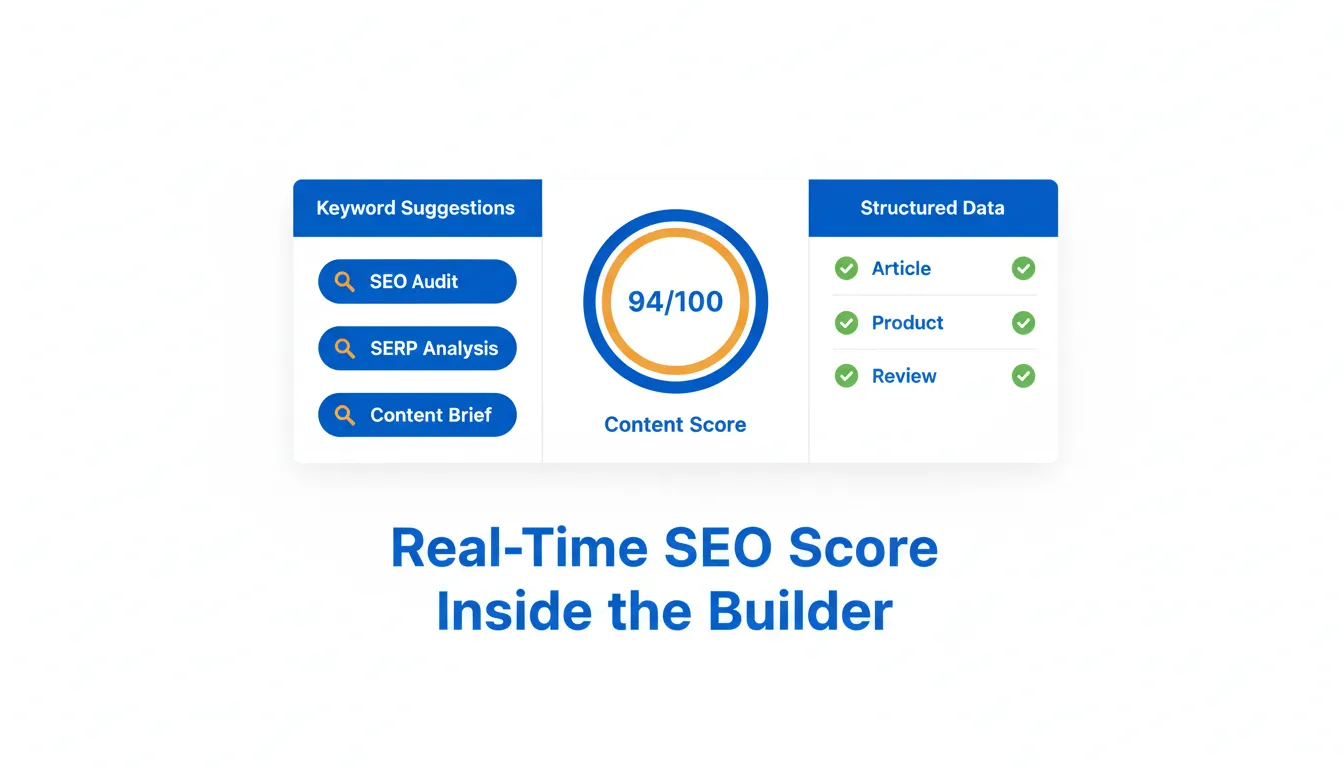
Rocket's built-in content scoring and structured data status indicators surface SEO issues during the build, not after the product is already live.
Practical Use Cases: Who This Matters For
Founders Shipping MVPs
You have a product idea. You validate it with Solve, build it with Build, and deploy it, all inside the same platform. The SEO structure that makes the product findable is already there when it goes live. You are not going back three months later to add meta tags to a product that has been live and unindexed the whole time.
Marketing Teams Building Landing Pages
A conversion-focused landing page built in Rocket ships with hero copy derived from your project context, proper heading hierarchy, OG tags for social sharing, and performance optimization. The page is ready to run ads against and rank organically from day one.
Agencies Delivering Client Work
Client sites built in Rocket pass technical SEO audits without additional configuration. WCAG 2.1 AA compliance, GDPR cookie consent, and structured data are included, which matters when clients have enterprise procurement requirements or accessibility obligations.
Teams Replacing Tool Sprawl
If your current workflow involves a CMS, a separate SEO tool, a keyword research platform, an analytics dashboard, and a performance monitoring service, Rocket consolidates the build, the SEO baseline, the analytics, and the performance monitoring into one workspace. The research from Solve and the competitive intelligence from Intelligence flow directly into what gets built, without re-explaining context at each step.
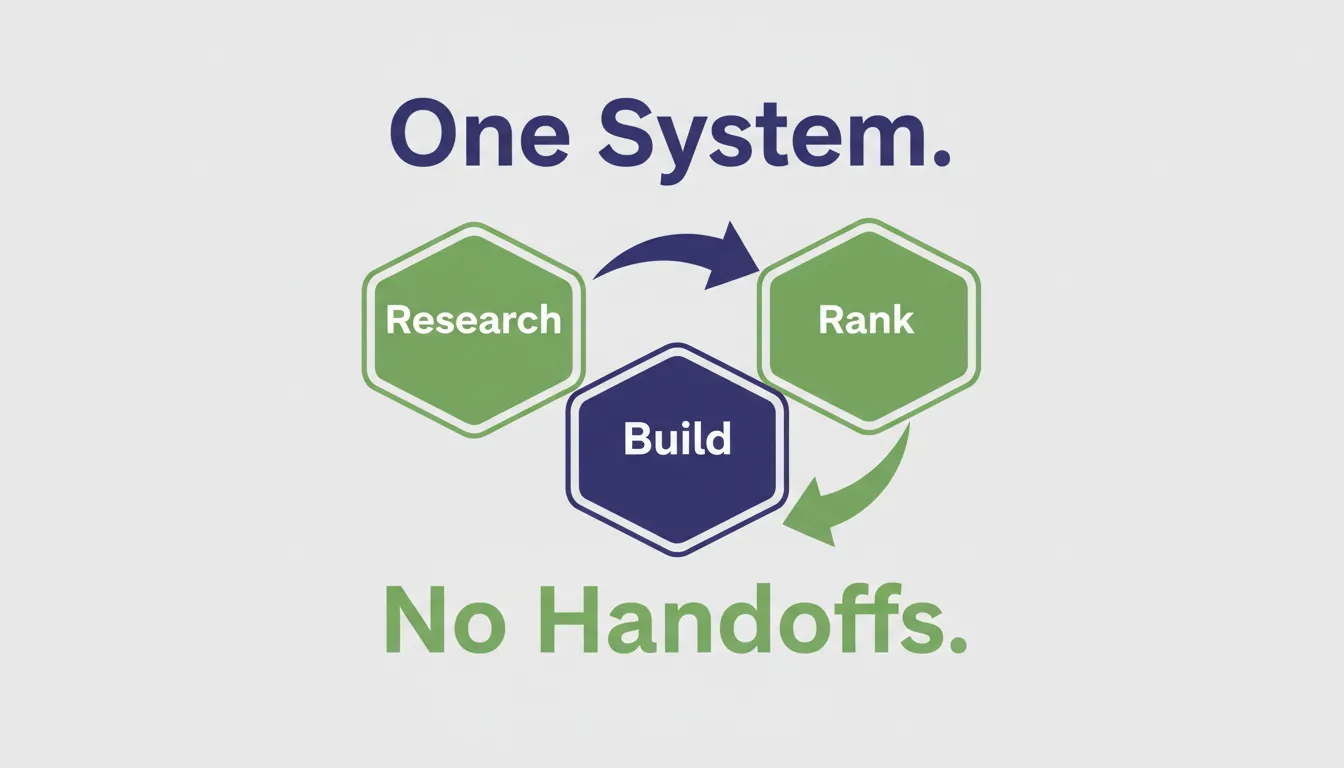
Research, build, and rank in a single connected workflow. No context lost between steps, no tools to coordinate.
SEO Workflow: Fragmented vs. Integrated
| Capability | Fragmented Workflow | Rocket |
|---|---|---|
| Semantic HTML | Manual or CMS-dependent | Generated automatically |
| Meta tags | Added post-launch via plugin | Built at generation time |
| Structured data / JSON-LD | Requires separate schema tool | Added via chat command |
| XML sitemap | Separate plugin or service | Generated on request |
| Core Web Vitals | External tool (PageSpeed Insights) | Built-in performance tab |
| Content score | External tool (Surfer SEO, etc.) | Available inside the platform |
| AI search optimization (GEO/AEO) | Manual content restructuring | /Generate GEO And AEO Report |
| Analytics | Google Analytics setup required | Built-in from first deployment |
| WCAG compliance | Separate accessibility audit | Baseline at generation |
The difference is not a feature list. It is where in the process each capability shows up. Fragmented workflows apply SEO after the product exists. Rocket applies it while the product is being built.
The AI Search Visibility Layer
ChatGPT, Perplexity, Gemini, and Claude now answer questions by pulling from indexed web content. Getting cited in those answers requires the same structural signals as traditional SEO, plus a few additional ones.
What AI platforms look for when deciding what to cite:
- Clear, quotable statements: Specific claims that can be extracted and attributed
- FAQ structure with schema markup: Questions and answers formatted in JSON-LD that AI parsers can read directly
- Entity clarity: Explicit signals about who created the content, what organization it represents, and what the page is about
- Source credibility: Consistent domain signals, internal linking, and structured data that establish authority
Rocket's GEO optimization addresses all four. You run /Generate GEO And AEO Report inside any project, and Rocket audits the content against these criteria and applies fixes.
As Ankit Kumar noted on LinkedIn, "SEO brings traffic. AEO delivers answers. GEO builds presence inside AI outputs... the shift is from ranking pages to being selected in answers." The products that get cited in AI answers are the ones built with this structure from the start, not retrofitted after the fact.
What Rocket Builds vs. What It Does Not
Accurate expectations matter. Here is what the SEO capabilities in Rocket actually cover:
Rocket handles:
- Technical SEO baseline (semantic HTML, meta tags, sitemaps, structured data)
- Performance optimization (Core Web Vitals, lazy loading, cache headers)
- WCAG 2.1 AA accessibility compliance
- GEO/AEO optimization for AI search platforms
- Built-in analytics for products deployed on Rocket
Rocket does not replace:
- Dedicated keyword research platforms for deep SERP analysis
- Content strategy and editorial planning
- Link building and off-page SEO
- Analytics for products not built on Rocket
The SEO layer in Rocket is the structural foundation. The content strategy, keyword targeting, and link acquisition that build on top of that foundation are still your work.
The Case for Building SEO-Optimized Applications From the Start
Why It Compounds
SEO is not a one-time task. It is a compounding asset. A product that launches with correct technical structure starts accumulating crawl data, indexing signals, and ranking history from day one. A product that launches without it starts that clock weeks or months later, after the retrofit.
The gap between the two is not just the time spent fixing the issues. It is every organic visit that did not happen during that window.
1.5 million people have tried Rocket across 180 countries. The pattern across those projects is consistent: products built with SEO structure from the start perform better in search than products where SEO was added later, because the structural signals compound from the first crawl.
Research from the Rocket WCAG and compliance blog confirms that integrating accessibility and SEO into the build lifecycle reduces remediation costs by roughly 30 times compared to fixing issues after launch.
Why AI Search Makes This More Urgent
The shift toward AI-generated answers means the window for establishing authority is narrowing. AI platforms cite sources that already have structured, authoritative content. Getting into that citation pool requires the structural signals to be in place before those platforms crawl and index your content.
Building SEO-optimized applications from day one is not a best practice. It is the only approach that positions a product to be found in both traditional search and AI-generated answers from the moment it goes live.
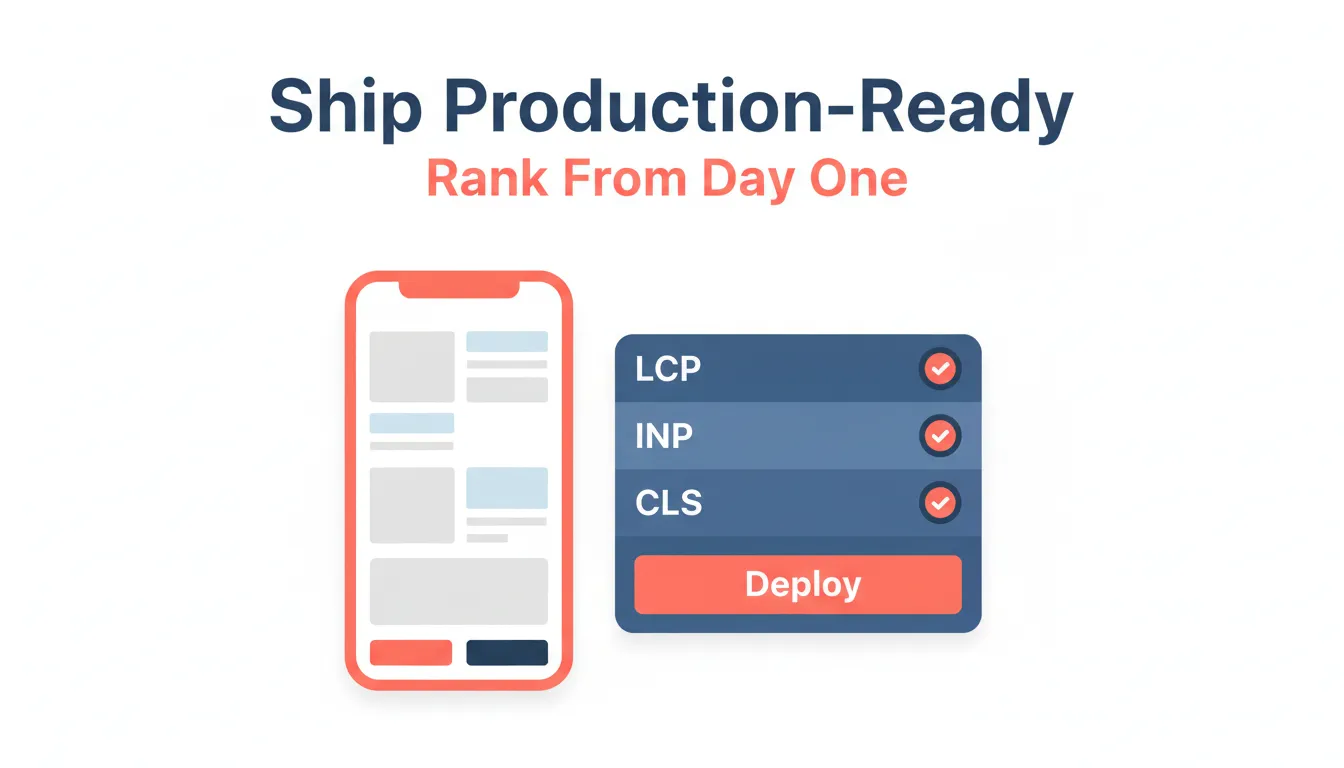
Deploy with confidence. Every Rocket build ships with Core Web Vitals optimization, WCAG compliance, and structured data already in place.
Build Smarter: Start With Structure, Not Retrofits
You type the product you want to build. Rocket generates it with the SEO foundation already in place: semantic HTML, meta tags, structured data, Core Web Vitals optimization, and AI search readiness included before you deploy.
The research from Solve that validated your direction flows into the build. The competitive intelligence that shaped your positioning informs the content. The SEO-ready structure ships with the first generation. The compliance defaults covering WCAG, GDPR, and SEO are baked in from day one.
That is not a feature list. It is a different answer to how a product should be built.
As AI search platforms become the primary discovery layer for a growing share of queries, the products that get cited are the ones built with this structure from the start. The retrofit path is getting more expensive, not less.
Start building on Rocket.new and ship the first version that is already ready to rank.
Table of contents
- -What "SEO-Optimized Applications" Actually Means
- -The Problem with Traditional SEO Workflows
- -Why AI Search Changes the Stakes
- -How Rocket Builds SEO-Optimized Applications: The Full Stack
- -The Baseline Every Build Ships With
- -What You Can Add Through Chat
- -Performance Monitoring After Launch
- -Practical Use Cases: Who This Matters For
- -Founders Shipping MVPs
- -Marketing Teams Building Landing Pages
- -Agencies Delivering Client Work
- -Teams Replacing Tool Sprawl
- -SEO Workflow: Fragmented vs. Integrated
- -The AI Search Visibility Layer
- -What Rocket Builds vs. What It Does Not
- -The Case for Building SEO-Optimized Applications From the Start
- -Why It Compounds
- -Why AI Search Makes This More Urgent
- -Build Smarter: Start With Structure, Not Retrofits