
Build an agentic accounts receivable app that detects overdue invoices, scores collection priority with AI, and sends automated SMS reminders, giving solo founders the same cash flow gains that enterprise AR platforms charge six figures to deliver.
What is agentic accounts receivable? An agentic AR system is an AI-powered application that autonomously detects overdue invoices, scores each account by collection risk, selects the right outreach channel and timing, and reconciles payments without manual intervention. Unlike rule-based automation, it reasons about context and adapts its strategy per customer.
Why Small Finance Teams Struggle with Invoice Collection
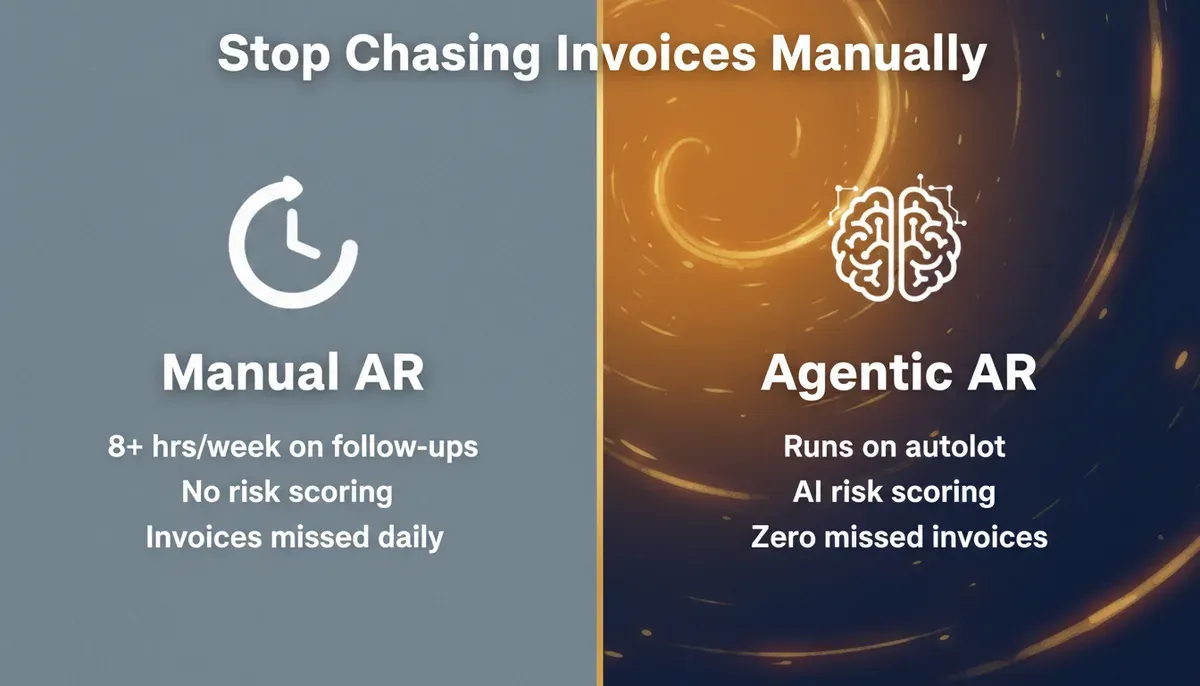
Most AR teams at small companies still rely on spreadsheets, email threads, and memory to track who owes what. The result is predictable: missed follow-ups, inconsistent data, and cash flow gaps that compound week after week.
Finance teams spend hours each week on manual processes like checking aging reports, copying invoice details into emails, and deciding who to chase first based on gut feeling rather than payment data.
AR managers juggle dozens of open invoices across multiple customers without real-time visibility into which accounts pose the highest risk of becoming bad debt. Manual follow-ups happen on no fixed schedule, so a reliable customer who simply forgot gets the same reactive treatment as a high-value account with a history of short payments.
The frustration is real: there is no prioritization, no payment behavior analysis, and no way to accelerate cash flow without adding headcount. The problem is that traditional accounts receivable automation tools only handle rules-based tasks like sending a reminder on day 30. They cannot reason about context, adapt to customer behavior, or make autonomous decisions about which collection strategies will actually work for each account.
*“How do you handle overdue invoices? Do you follow up with customers every other day—sending multiple emails or calling to remind them about unpaid bills? Or do you have someone managing this hassle for you? What is the longest you’ve ever waited for a payment?" - *Small business CFO, Reddit r/smallbusiness
How an Agentic AR System Differs from Basic Automation
The difference between traditional AR automation and an agentic AI system is the difference between a timer and a brain. Traditional automation follows if-then rules. Agentic AI reads context, reasons about outcomes, and chooses actions without human intervention.
Traditional automation fires a pre-written email when an invoice hits 30 days past due, regardless of customer relationships, dispute history, or payment patterns. Agentic AI evaluates invoice status, payment history, credit limits, customer risk profiles, and outstanding balances before deciding what action to take, when to take it, and through which channel. Agentic systems use machine learning algorithms and large language models to predict which customers will pay late based on historical patterns, then proactively adjust collection strategies before invoices become overdue.
AI agents operate with continuous learning: each payment outcome, each customer response, and each dispute resolution feeds back into the system's decision-making, improving accuracy over time. Agentic AI vs traditional AI agents represent a fundamental shift from reactive to proactive financial operations.
As Oracle's Chris Leone described in TechCrunch, agentic applications "understand the operational state of the business, identify available actions within a process, and proactively move work forward to achieve real business outcomes."
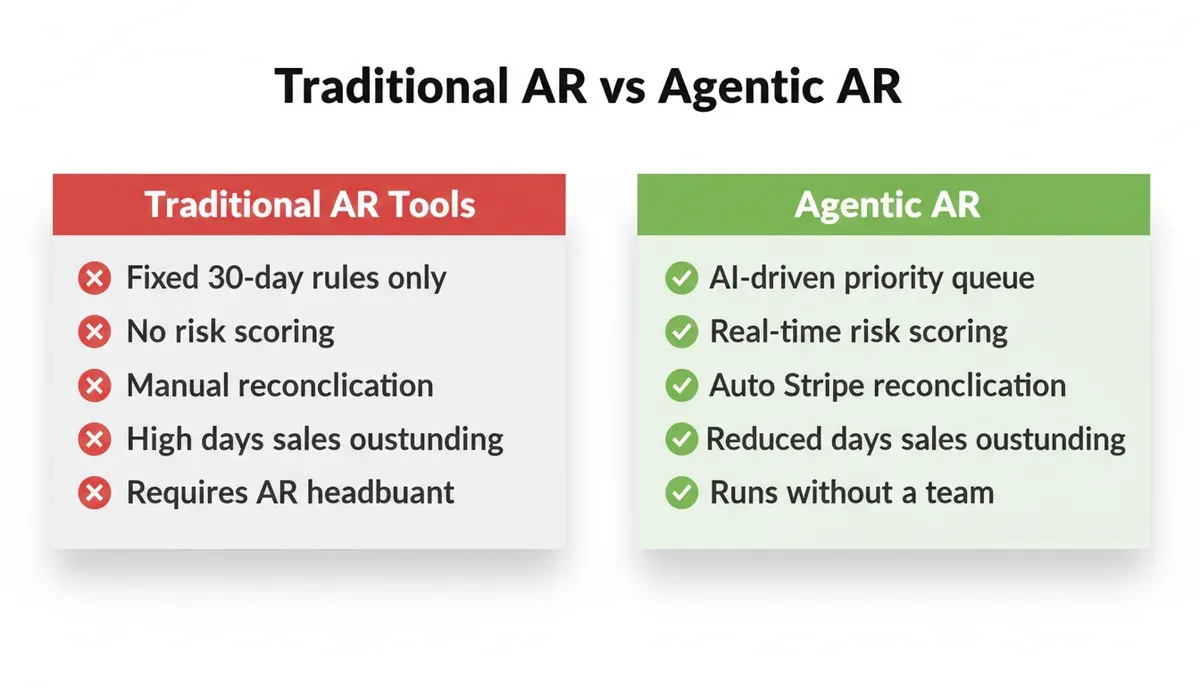
| Capability | Traditional AR Automation | Agentic AI AR System |
|---|---|---|
| Trigger logic | Fixed rules (day 30, day 60) | Contextual reasoning per account |
| Prioritization | First-in, first-out | Risk-weighted scoring with predictive models |
| Communication | One template fits all | Personalized tone and channel per customer |
| Learning | Static rules, manual updates | Continuous learning from payment data |
| Human intervention | Required for exceptions | Only for high-value decisions |
| Cash flow forecasting | Not included | Predictive cash flow forecasting built in |
The challenge is that enterprise organizations get this capability bundled into six-figure ERP systems. Solo founders and small AR teams get left behind, still relying on point solutions and spreadsheets.
How to Prioritize Your AI-Powered Collection Queue
Not all overdue invoices deserve the same level of attention. An agentic collections agent needs a scoring system that weighs multiple data signals to decide which accounts to chase first and how aggressively to pursue them.
The five signals your AI should weigh:
-
Invoice age and amount: A $50,000 invoice at 45 days past due demands faster action than a $500 invoice at 15 days. Dollar value multiplied by aging days gives a raw urgency score.
-
Customer payment history: Does this customer pay consistently on day 35, or do they have a record of short payments and disputes? Historical pattern is the single strongest predictor of future behavior.
-
Credit scores and credit limits: A customer approaching their credit limit with declining credit scores signals higher risk of bad debt. Flag these accounts before they become write-offs.
-
Dispute history: Accounts with active customer disputes should route to dispute resolution workflows, not aggressive collection outreach. Contacting a disputed account with a payment demand escalates friction.
-
Payment behavior clustering: Group customers by how they pay. Some need a gentle reminder, others need escalation to a collections agent or a credit agent review.
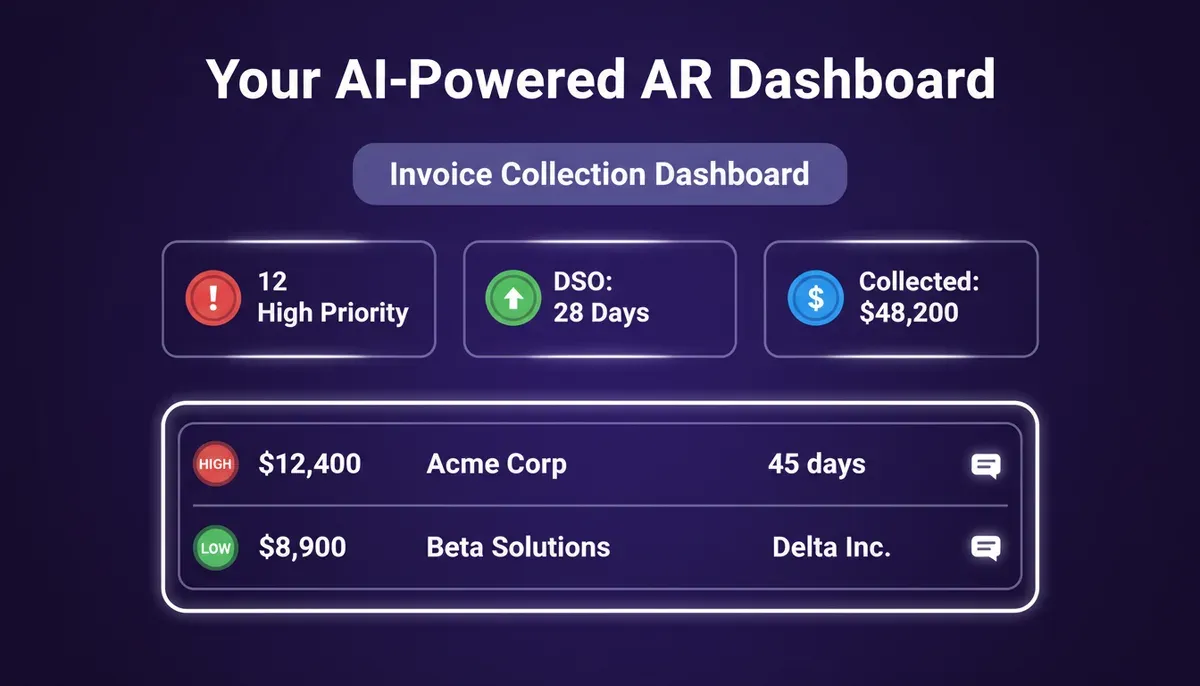
Agentic AR collection routing: AI assigns every overdue invoice to the right action in seconds.
Your AI engine should never treat AR work as a single-line queue. It should run predictive analytics on every account, calculate collection efficiency scores, and route each invoice to the right action at the right time. This is what implementing agentic AI in accounts receivable actually looks like in practice.
Step-by-Step: Building Your AR App on Rocket
Oracle charges enterprise organizations tens of thousands for their Collectors Workspace. HighRadius starts pricing conversations at similar levels. Rocket gives you the same intelligence in a single session, with no developers and no six-month deployment.
Here is the exact build sequence:
Step 1: Use Solve to validate the workflow before you build.
Open Rocket's Solve pillar and ask: "What are the most common accounts receivable automation workflows for a B2B company with 50 to 200 invoices per month?" Solve returns a structured research report with workflow patterns, risk scoring approaches, and integration options. This grounds your build in real AR practice, not guesswork.
Step 2: Describe your AR app in plain language.
In Rocket Build, type: "Build an accounts receivable dashboard. Show all open invoices, flag any invoice over 30 days past due in red, sort by risk score, and let me mark invoices as paid or disputed." Rocket's coding agent generates the full-stack app, including Next.js frontend, Supabase Postgres backend, and authentication, in a single session.
Step 3: Connect Supabase for your invoice database.
Type: "Connect Supabase and create an invoices table with fields: customer name, invoice amount, due date, payment status, days overdue, and risk score." Rocket scaffolds the schema, sets up row-level security, and wires the table to your dashboard automatically.
Step 4: Add the AI prioritization engine.
Type: "Add a risk score column. Calculate it as invoice amount multiplied by days overdue, divided by 1000. Flag any invoice with a risk score above 50 as high priority and display it at the top of the queue." The Advisor Agent, Rocket's built-in senior architect sub-agent running on the most capable model available, resolves any architectural decisions automatically if the coding agent encounters a complex trade-off, so you never get stuck in an error loop.
Step 5: Connect Twilio for SMS payment reminders.
Type: "Connect Twilio and send an SMS reminder to the customer's phone number when their invoice passes 15 days overdue. Include the invoice number, amount due, and a payment link." Rocket's native Twilio connector handles SMS delivery, including phone verification codes, order alerts, appointment reminders, and outbound notifications, all supported out of the box.
Step 6: Connect Stripe for payment confirmation.
Type: "Connect Stripe. When a payment webhook fires, find the matching open invoice in Supabase, mark it as paid, update the customer's risk profile, and remove it from the active collection queue." Rocket's Stripe connector handles checkout sessions, webhooks, and subscriptions natively.
Step 7: Deploy.
Click Launch. Rocket publishes your app to a live URL with HTTPS. The entire build, from first prompt to deployed app, typically completes in a single working session.
Note on multi-channel outreach:* Rocket's native Twilio connector sends SMS. If your AR workflow requires WhatsApp Business API delivery, that requires a custom Twilio WhatsApp integration built on top of the SMS connector and is not available as a native Rocket connector out of the box. For most small AR teams, SMS achieves strong read rates and is the fastest path to production.*
Automating Payment Reminders via SMS with Twilio
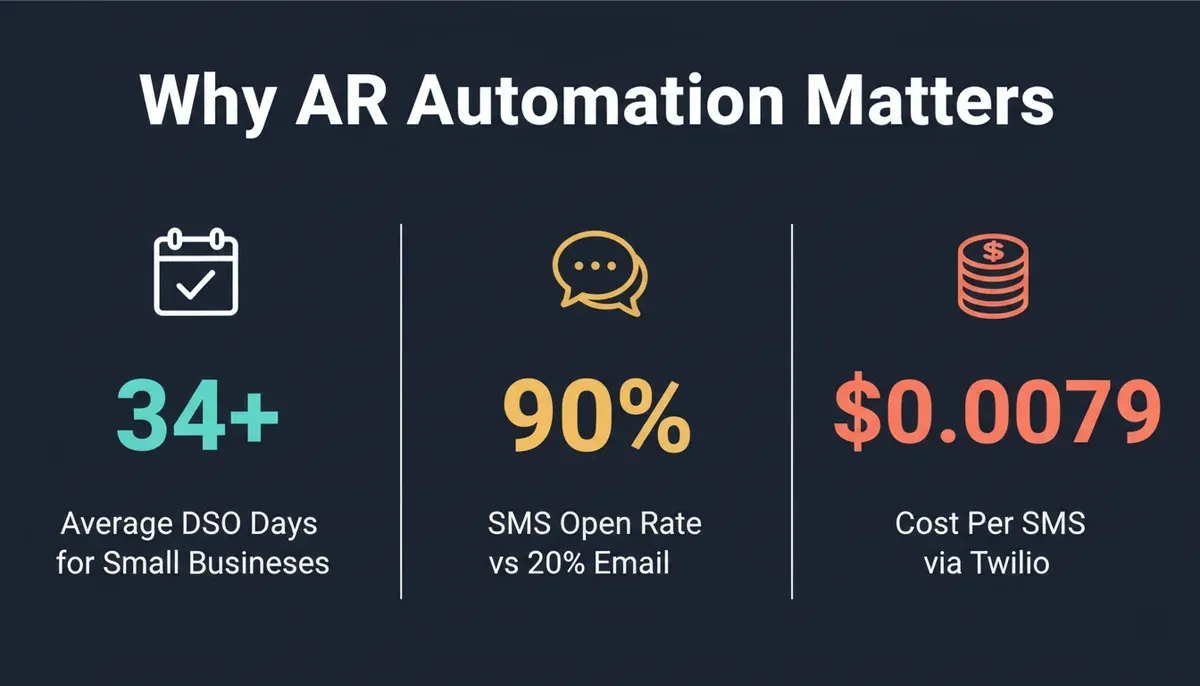
SMS read rates for time-sensitive messages exceed 90%, compared to roughly 20% for email. According to Twilio's SMS pricing page, domestic US messages cost $0.0079 per message, making automated payment reminders affordable even for small AR teams sending hundreds of nudges per month.
Your agentic system decides when to send each reminder based on payment patterns: a customer who always pays after one nudge gets a single SMS on day 7, while a customer with a history of delays gets escalating outreach on days 3, 7, and 14. The AI drafts context-aware messages that reference the specific invoice, amount, and due date, so reminders feel personal without requiring human effort.
Rocket's Twilio connector wires directly into your app's AI workflow automation solutions, so the entire SMS flow runs without manual intervention. Customers can reply "paid" or "need extension" directly in the SMS thread, and your app routes that response to the appropriate next step in the collection queue. The combination of agentic AI reasoning plus SMS delivery creates a cash collection system that works around the clock.
Confirming Payments and Closing the Loop with Stripe
The final piece of any accounts receivable automation system is knowing when money actually arrives. Without straight-through processing from payment to reconciliation, your AR team ends up with unapplied cash, messy records, and no confidence in their aging report.
Stripe webhooks fire events the moment a customer pays: your app receives the payment data in real time, matches it to the open invoice, and marks the account as reconciled. Cash application happens automatically. The AI matches remittance data to invoices, handles partial payments and short payments, and flags pricing errors or deductions for human approval. If a payment fails or a dispute is opened, the app instantly routes that account back into the agentic collection workflow with updated context.
Rocket's AI app builder with Stripe payment integration covers checkout sessions, webhooks, and subscriptions natively. You can follow Rocket's own "Add payments to your app" tutorial to wire the full Stripe flow in a single prompt. The end result: real-time visibility into your cash position, accurate predictive cash flow forecasting, and zero manual work for routine transactions.
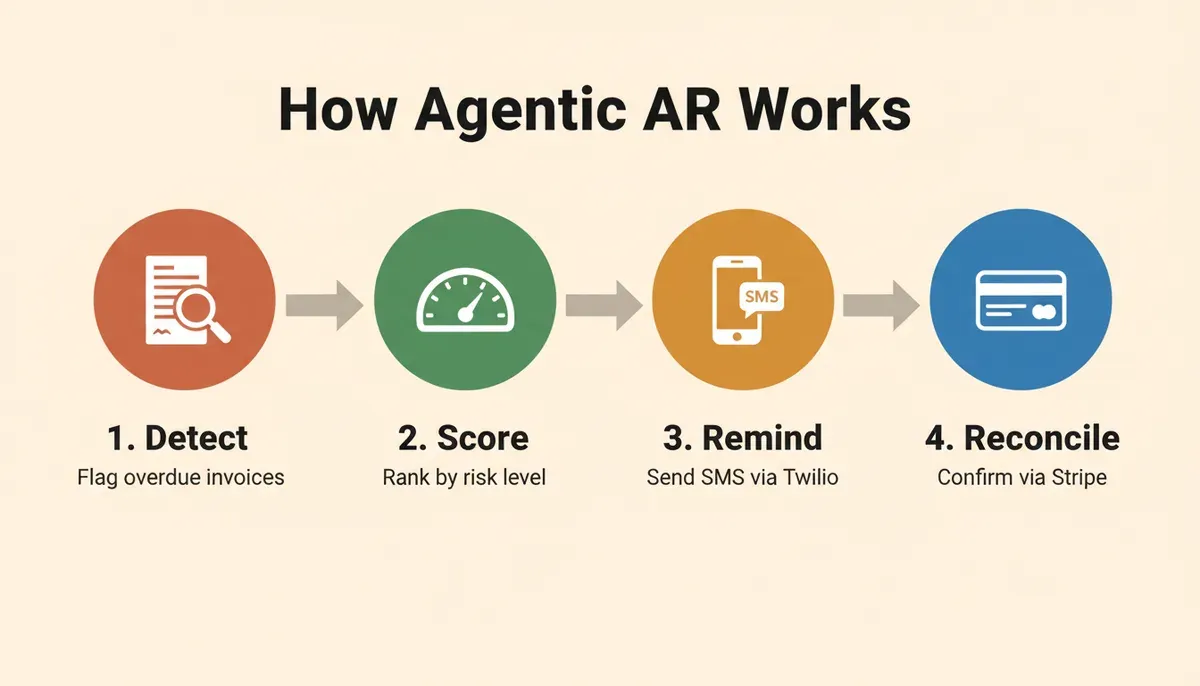
This closes the full loop. Your agentic AR system detects overdue invoices, prioritizes collections with AI-driven automation, sends personalized SMS reminders, confirms payments through Stripe, and feeds every outcome back into its decision-making. Financial operations that previously required a full AR team now run on autopilot with human oversight only for exceptions.
The Enterprise AR Gap and the SMB Opportunity
Oracle launched 22 Fusion Agentic Applications in March 2026, including a Collectors Workspace that autonomously prioritizes collections and moves cash faster. According to PYMNTS' annual B2B payments research, the average days sales outstanding for small businesses still exceeds 34 days, and late payments remain the top reason working capital dries up.
That gap between what enterprises have and what small finance teams struggle with is exactly what an agentic accounts receivable automation system can close. The shift from reactive, manual AR processes to proactive, AI-powered receivables management is happening at every scale.
Rocket is a three-pillar vibe solutioning platform: Solve for market and workflow research, Build for generating production-ready apps, and Intelligence for tracking competitors and market signals.
For an AR use case, this means you can use Solve to validate your collection workflow before writing a single line of code, Build to ship the app in a single session, and Intelligence to track how competing AR platforms are evolving, all from one workspace. Enterprise organizations have their Oracle and SAP deployments. Now, with Rocket, every founder and small finance team can deploy the same intelligence.
Rocket also makes it easy to build a financial reporting dashboard alongside your AR app, so your team gets real-time cash position visibility, not just collection automation. And if you want to understand how AI app builders compare on ROI before committing to a build, Solve can run that analysis for you in minutes.
Stop Chasing Invoices Manually, Describe it on Rocket.new
Cash flow problems rarely announce themselves politely. They compound quietly while invoices sit in aging reports and reminders go unsent. An agentic accounts receivable system handles the repetitive financial decisions, the follow-ups, and the reconciliation so that finance leaders can focus on strategy, customer relationships, and growth.
Stop chasing invoices manually. Describe your AR workflow in plain language on Rocket.new, connect Stripe and Twilio, and let AI handle the chasing while you focus on building your business.
Table of contents
- -Why Small Finance Teams Struggle with Invoice Collection
- -How an Agentic AR System Differs from Basic Automation
- -How to Prioritize Your AI-Powered Collection Queue
- -Step-by-Step: Building Your AR App on Rocket
- -Automating Payment Reminders via SMS with Twilio
- -Confirming Payments and Closing the Loop with Stripe
- -The Enterprise AR Gap and the SMB Opportunity
- -Stop Chasing Invoices Manually, Describe it on Rocket.new