Most commission tracking breaks because of process gaps, not bad math. Rocket.new lets sales teams describe their exact commission logic and get a working tracker with automated calculations, rep dashboards, and CRM connections, all in minutes instead of months.
Why does every growing sales team eventually hit the same wall with commission tracking?
The deal closes. The data sits in the CRM. And someone opens a spreadsheet built by a person who left two quarters ago. The formulas are fragile, the column labels are vague, and somewhere between "deal closed" and "rep gets paid," numbers go wrong.
According to Gartner's 2024 benchmarks, spreadsheet-based commission processes carry a 3-8% error rate, which means a team with $2.4M in variable compensation could be losing up to $192,000 in incorrect payments every year.
This is not a math problem. It is a process problem. And it gets worse as your sales team grows, your commission plans get more complex, and your finance teams spend hours reconciling payouts instead of closing the books.
Why Do Spreadsheet Commission Systems Break Down?
Most companies start tracking sales commissions in a spreadsheet. That works fine when you have three reps and one commission structure, but the problems start quietly as the organization scales.
-
Formula fragility is the first crack. A single misplaced decimal in your commission calculations can cascade across dozens of rows. Complex spreadsheets with nested IF statements and VLOOKUP chains are prone to breaking the moment anyone outside the original builder makes edits. Google Sheets and Excel do not flag logical errors in commission calculations the way dedicated software does.
-
Version control disappears fast. Manual data entry across multiple tabs and files means there is no audit trail showing who changed what, or when. Finance teams end up with three different versions of the same payout file, with no clear way to turn those spreadsheets into something reliable.
-
Human error compounds at scale. When you have five reps, one person can review every calculation by hand. At twenty reps with complex commission structures and split deals, manual processes become time consuming, error prone, and nearly impossible to verify. Missing data entry for new deals and incorrect formula references are the most common sources of incorrect payments.
The real cost is not just wrong numbers. It is the trust that erodes every time a rep opens their commission statement and finds something that does not match what they expected.
What Should a Commission Tracking System Actually Do?
Before picking any commission tracking software or building your own solution, it helps to map out what a proper commission management system actually needs to handle. The requirements vary depending on your sales commission plan, but some elements are universal.
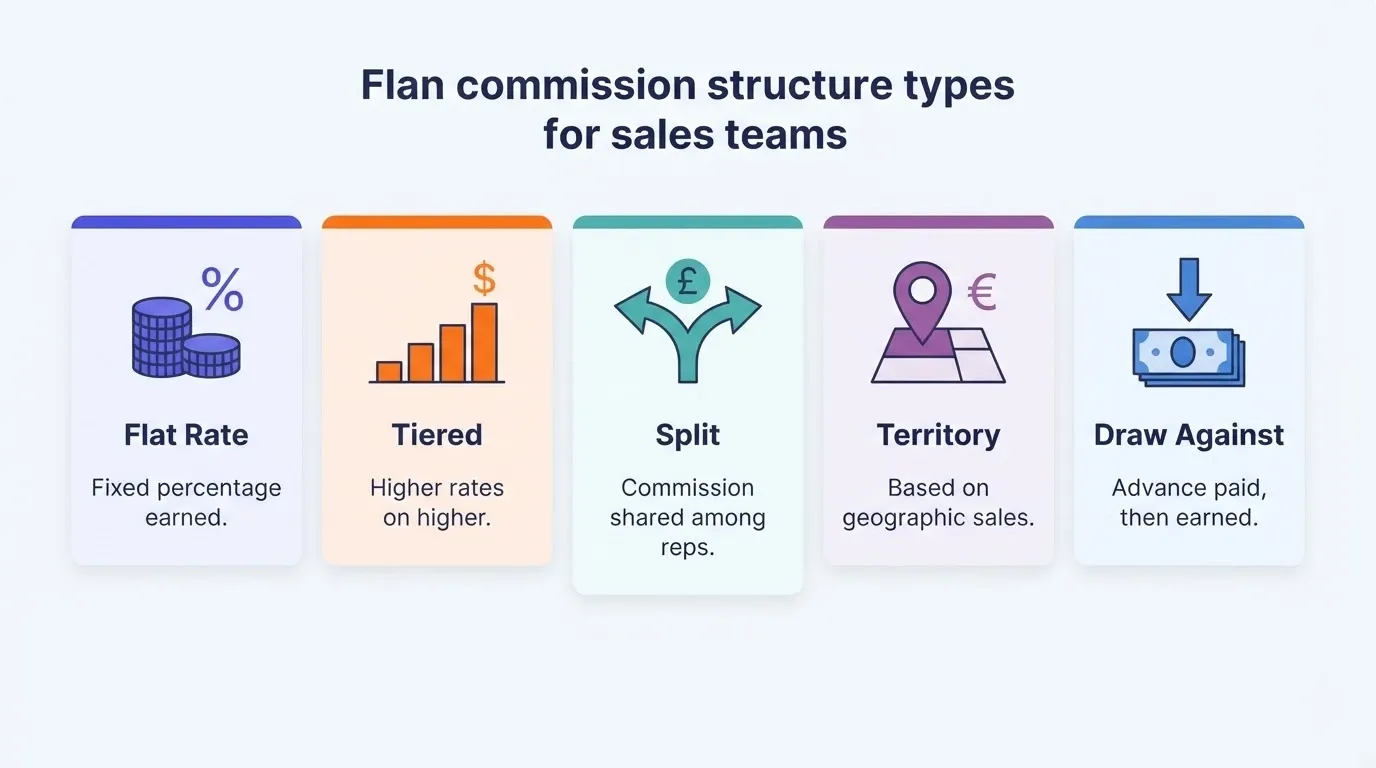
Here is a quick comparison of the most common commission structures and what each demands from your tracking software:
| Commission Structure | When to Use | Complexity | Tracking Requirement |
|---|---|---|---|
| Flat commission rate | Simple product, short sales cycle | Low | Track total sales per rep, apply fixed percentage |
| Tiered commission | Teams with quota targets | Medium | Track cumulative revenue against tier thresholds |
| Split commissions | Multiple reps on one deal | High | Attribution rules, deal role mapping, split ratios |
| Territory volume | Regional sales teams | Medium | Aggregate territory revenue, divide by headcount |
| Draw against commission | New reps or volatile markets | High | Track advances, reconcile against earned commission |
-
Your system needs to handle commission rules that change. Commission plans are not static. Rates shift quarterly, new product lines get added, and accelerators kick in when reps pass quota. Your commission management tool needs to apply the right commission rates to the right time period without manual intervention.
-
Real time visibility matters more than monthly statements. Sales reps who can see their earnings update as deals close are more motivated than reps who wait until payroll day. Commission tracking software should show each rep their progress against quota, projected payouts, and pending deals.
-
Audit trail is non-negotiable. When a rep disputes a payout, you need to build a system that shows exactly how every number was calculated. Every commission management platform worth using maintains a log of commission rules applied, sales data pulled, and final commission payments made.
A good commission tracking system does not just calculate numbers. It removes the ambiguity that causes disputes, saves time for finance teams, and gives sales reps the transparency they need to stay focused on closing deals.
How Do You Connect Deal Data to Automatic Payouts?
The gap between a closed deal and an accurate commission payment is where most commission tracking systems fail. Connecting sales data from your CRM to your commission calculations is the step that separates automated systems from manual processes.
Here is how the flow should work from deal to payout:
-
Start by mapping every deal field that affects sales commissions. Deal amount, product type, close date, deal owner, and any co-sellers need to flow from your CRM into the commission calculations. Most commission automation failures happen because critical details like product category or contract term are not captured at the deal level.
-
Build commission rules as configurable logic, not hardcoded formulas. According to Salesforce's commission structure guide, the most common commission types - base salary plus commission, tiered commission, territory volume, and draw against commission - each require different calculation approaches. Your system should let you define these as rules that finance teams can adjust without rewriting formulas.
-
Automate the handoff from calculation to payout. Once commission payments are calculated, the result should flow into a review queue where finance or sales operations can approve, flag exceptions, and push to payroll. Commission scheduling should match your payment schedule, whether that is monthly, quarterly, or on deal close.
-
Keep a full record of every calculation. Commission data should include the original deal value, the commission plan applied, the rate used, any split attribution, and the final payout. This creates the audit trail that eliminates disputes and supports compliance reviews.
The goal is a closed loop: deal closes, data flows, commission calculates, rep sees it, finance approves it, and nobody sends a "where is my commission" email.
What Are the Most Common Commission Calculation Mistakes?
Even well-intentioned commission management systems break down at predictable points. Knowing where mistakes happen helps you design a tracker that prevents them.
That frustration is common, and it points to real process failures:
-
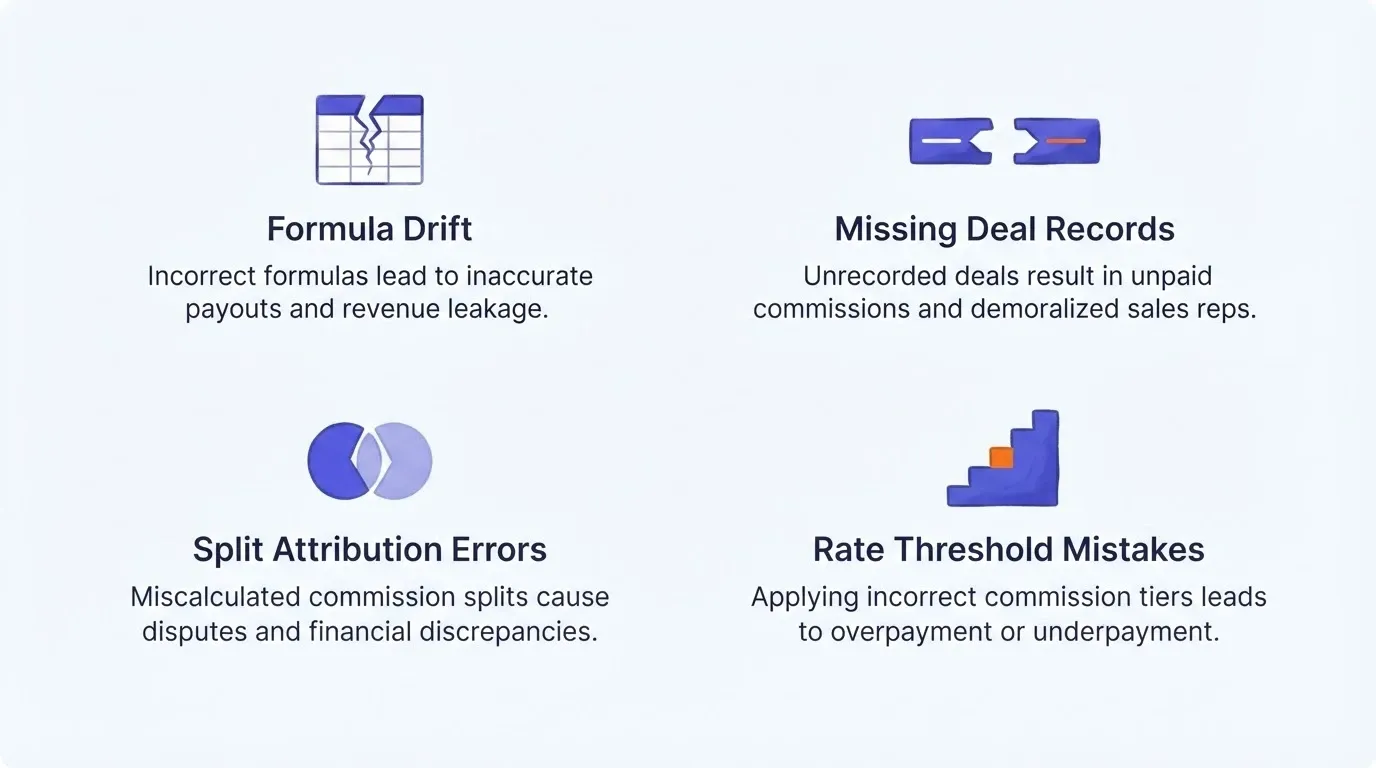
Formula drift is the silent killer. When the person who originally built the commission spreadsheet leaves, the formulas they created become a black box. New team members patch calculations without understanding the original logic, and over time the spreadsheet produces wrong numbers that nobody catches until a rep complains. Manual calculations in complex spreadsheets are time consuming and error prone.
-
Split attribution gets messy fast. When two sales reps work the same deal, split commissions require clear rules about who gets what percentage. Without a custom CRM platform that handles attribution automatically, these splits are calculated manually, and manual errors on split commissions are responsible for some of the most contentious disputes between reps and sales operations.
-
Rate thresholds are applied incorrectly. Tiered commission plans are popular because they reward top performers, but they create complex calculations. A rep who crosses from a 5% tier to an 8% tier mid-month needs the rates applied to the correct revenue brackets. A single misplaced decimal or wrong threshold value means some reps get overpayments while others get underpaid.
-
Stale sales data creates wrong payouts. If your commission tracking pulls deal data once per month instead of in real time, deals that are modified, cancelled, or reassigned after the snapshot will produce incorrect commission payments. Commission data needs to stay synced with the source of truth.
The pattern across all these mistakes is the same: manual processes that worked at small scale become error factories at growth stage.
How Do You Give Sales Reps Real Time Earnings Visibility?
One of the clearest signs that your commission tracking is working is when reps stop asking "how much am I getting paid this month?" If your sales reps can see their earnings in real time, they close with more confidence and fewer disputes reach your finance teams.
-
Personalized dashboards change rep behavior. When each team member can log in and see their own commission tracking dashboard showing closed deals, pending deals, quota attainment progress, and projected payouts, they spend less time calculating their own numbers in side spreadsheets and more time selling. Sales performance goes up when transparency goes up.
-
Commission trends over time tell a bigger story. Showing reps their earnings trajectory across months helps them spot patterns. Top performers can see what drove their best quarters. Sales leaders can use the same data for performance analysis and to identify who needs coaching.
-
The market is moving toward real time visibility. The global sales commission software market is projected to grow from $5.41 billion in 2025 to $9.99 billion by 2034, driven by the shift away from manual processes toward commission automation. Growing companies that adopt commission tracking software now are positioning themselves ahead of competitors still running on spreadsheets.
-
Giving reps access builds trust. When sales representatives can see exactly how their payouts were calculated, down to the deal, the commission plan rule, and the rate applied, commission disputes drop. Transparency does not just save time. It tells reps their hard work is being tracked accurately, and that goes a long way for motivation and retention.
Real time visibility is not a nice-to-have feature. It is the single fastest way to reduce commission disputes, build trust across your entire team, and keep your best sellers from looking elsewhere.
Why Growing Sales Teams Choose Rocket.new for Commission Trackers
Most sales teams that have outgrown spreadsheets face an uncomfortable gap. Dedicated incentive compensation management software like Xactly or CaptivateIQ can cost $15-30 per rep per month, require months of onboarding, and come with rigid workflows that do not fit every company's commission logic. That is overkill for a 15-person sales team with a nuanced commission plan.
Rocket.new fills that gap. Instead of buying a dedicated platform and adapting your process to its constraints, you describe your exact commission structure in plain language and Rocket generates a production-ready commission tracking app.
-
Describe your commission rules once, and Rocket builds the system. Tell Rocket your base salary structure, tiered commission rates, split rules, quota thresholds, and payout timing. It generates a working web app with the dashboard your sales team actually needs, not a generic template you spend weeks customizing.
-
CRM and data connections are built in. Rocket connects to Supabase for your backend, which means your commission management app can pull deal data directly from your existing systems. Sales data flows in, commission automation handles the math, and reps see payouts update as deals close.
-
Iterate through conversation, not configuration menus. When your commission plans change next quarter, and they will, you update the tracker by describing what changed. Add a new product line, adjust a tiered rate, create an accelerator for Q4, all through chat. No dedicated software consultant needed.
-
Version history and one-click rollback protect you. Every change Rocket makes is tracked. If a commission rule update produces unexpected results, roll back to the previous version instantly. This gives finance teams the version control and audit trail that spreadsheets never could.
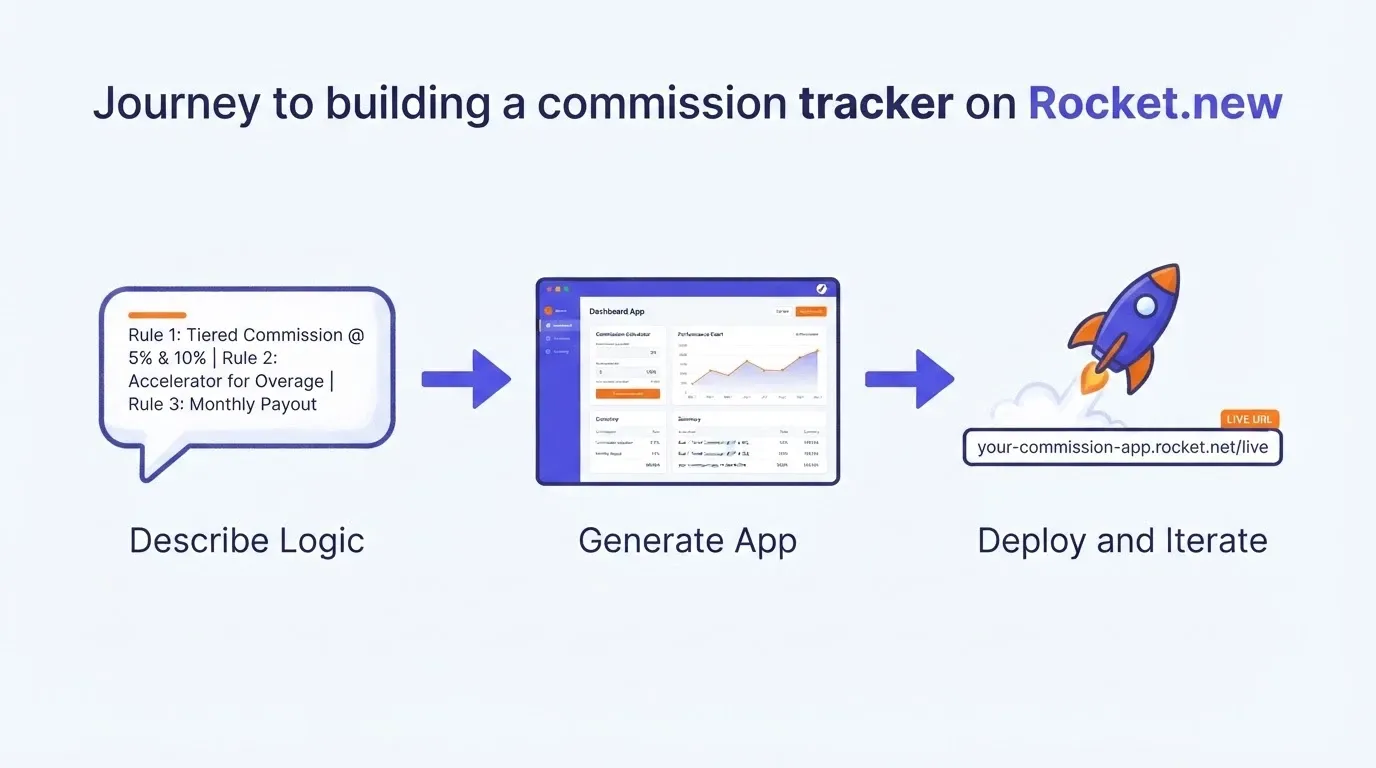
Best commission tracking software solves the calculation problem. Rocket.new solves the building problem, giving growing companies a commission management system shaped to their exact logic, deployed in minutes, and adjustable through conversation.
How Should You Structure Commission Plans That Scale?
The commission tracking system is only as good as the commission plans it runs. As your sales team grows, the plans themselves need structure that holds up under complexity.
-
Start with clear, simple tiers before adding exceptions. The most common mistake in sales commission plan design is building in too many edge cases from day one. Start with a base salary plus commission structure, add tiered commission rates at natural quota milestones, and layer in accelerators or bonuses as the team matures.
-
Document every rule as an "if/then" statement. Sales leaders who can write their commission plans as logic statements like "if quarterly revenue exceeds $200K, then commission rates increase to 12%" will find it much easier to build these into any commission software or tracking system on Rocket.new. Comp plan clarity saves hours of commission processing time.
-
Plan for incentive programs and multi-product structures early. As your organization scales, you will add product lines, territories, and team roles. Each of these introduces new commission rates, split rules, and quota attainment targets. Building your sales commission plan with expansion in mind, even if you start simple, prevents the painful rebuild that catches growing companies off guard.
-
Review and adjust quarterly, not annually. The best sales compensation programs treat commission plans as living documents. Sales operations should review quota attainment rates, total sales numbers, and payout data every quarter to check if the incentive plans are still driving the right behavior. Commission trends across the team tell you if plans are working or if reps are sandbagging deals to hit the next tier.
A commission plan that scales is one your sales team understands without a decoder ring, your finance teams can verify without forensic accounting, and your sales leaders can adjust without calling a developer.
When Payroll Day Stops Being a Fire Drill
Commission tracking does not need to be the monthly headache that drains your sales operations team and frustrates every rep on the floor. The companies that get this right are not the ones with the most expensive commission software. They are the ones that matched their commission management system to how their sales team actually works.
The tools exist now to build exactly the tracker you need, with the commission rules you run, connected to the data your team already captures. Whether you start from a spreadsheet, a CRM export, or a plain-language description of your sales commission plan, the gap between "we need a better system" and "we have one" has never been smaller.
Ready to stop reconciling commission payments by hand? Describe your commission logic to Rocket.new and ship a tracker your sales team will actually trust.
Table of contents
- -Why Do Spreadsheet Commission Systems Break Down?
- -What Should a Commission Tracking System Actually Do?
- -How Do You Connect Deal Data to Automatic Payouts?
- -What Are the Most Common Commission Calculation Mistakes?
- -How Do You Give Sales Reps Real Time Earnings Visibility?
- -Why Growing Sales Teams Choose Rocket.new for Commission Trackers
- -How Should You Structure Commission Plans That Scale?
- -When Payroll Day Stops Being a Fire Drill