
Automated competitor price tracking catches pricing changes faster than any spreadsheet. Track list prices, discounts, and stock status. Set pricing rules before a change hits. Tools like Rocket Intelligence add context to raw alerts so your team knows what to act on.
What if your competitor just cut their prices?
That single move can shift a purchasing decision before your team even knows it happened. McKinsey research shows that a 1% improvement in realized prices drives an 8% lift in operating profit, making price intelligence a revenue lever, not a background task.
Whether you manage a retail catalog with thousands of SKUs or a SaaS product with three pricing tiers, the challenge is the same. Most teams start with a spreadsheet and move to automated price monitoring when the manual effort breaks.
This blog covers what to watch on competitor pricing pages, how manual and automated approaches compare, and how to act on price changes without losing margin.
Why Tracking Competitor Prices Is Good for Business
Competitor prices shape buyer expectations before a deal reaches your sales team. Here is why regular price monitoring pays off.
The Direct Line Between Prices and Profits
-
A 1% price improvement generates an 8% lift in operating profit for a typical S&P company, making pricing one of the highest-leverage business decisions available.
-
Tracking competitor prices gives your team a live market reference, not to match blindly, but to understand where your product sits versus what buyers compare right now.
-
Teams with regular price monitoring catch margin threats early, before a competitor's quiet discount shows up as an unexplained drop in win rate.
What Happens When You Miss a Price Change?
-
Shoppers across e-commerce channels compare prices before completing a purchase. If your price drifts above the market without a clear value reason, conversion data will show the problem before your pricing team knows why.
-
B2B SaaS buyers run the same comparison. A new entry-level tier or a feature moved to a lower plan reframes their expectations before you get on a demo call.
-
The first signal that a competitor price change has hurt you is often a lost deal, not a pricing report.
Are Your Buyers More Price-Sensitive Now?
-
43% of consumers now list rising prices as their top concern when shopping, according to Shopify's 2025 global eCommerce data.
-
That level of price sensitivity pushes competitor monitoring from a background task to a front-line sales input.
-
Brands that track competitor prices and catch pricing shifts early make faster, better-supported decisions.
Price intelligence is not about reacting to every change. It is about having the context to know which changes actually matter.
Manual vs. Automated Price Tracking: Which Approach Wins?
Both approaches work at the right scale. The question is whether the time cost of manual tracking is worth it for your catalog and team.
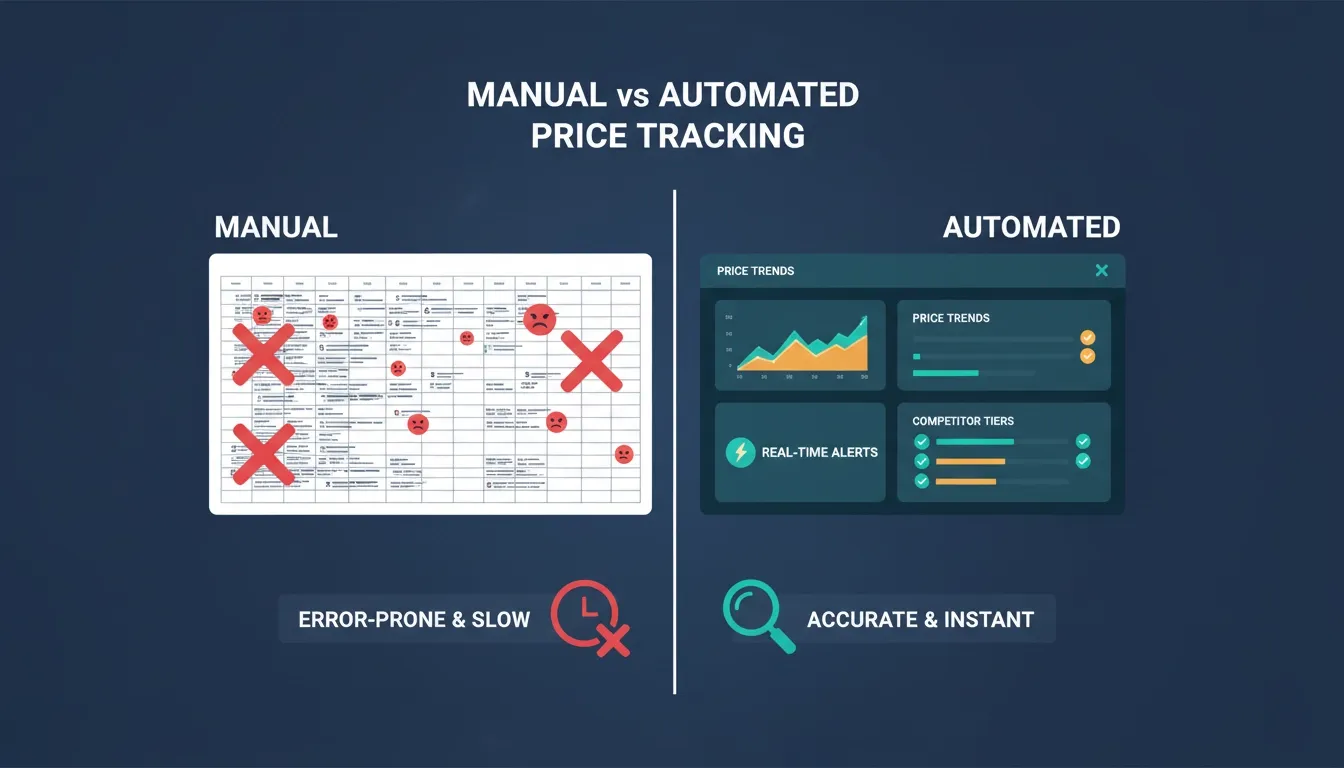 Manual tracking works for small catalogs. Automated price monitoring scales to thousands of SKUs with consistent accuracy.
What Manual Price Tracking Actually Looks Like
-
Manual tracking means visiting competitor websites, logging prices in a spreadsheet, and comparing changes week to week.
-
For small catalogs, a few products across two or three competitors, this is a workable starting point with no software cost and direct visibility into competitor websites and specific page elements.
-
The limits show up fast. Checking 50 products across 10 competitors takes hours, and by the time the spreadsheet is complete, some prices may have already changed.
The Case for Price Monitoring Software
-
Price monitoring software automates data collection from competitor websites on a schedule, detects changes, and fires alerts without manual effort.
-
Tools range from simple website change detection setups to full price intelligence platforms covering stock availability data, shipping costs, MAP monitoring, and AI-powered repricing rules across multiple channels.
-
According to Mordor Intelligence, the pricing software market was valued at USD 1.68 billion in 2025 and is set to reach USD 4.17 billion by 2031, a 16.06% CAGR driven by AI-powered dynamic pricing and automated repricing adoption.
When Does Automation Start Making Sense?
| Factor | Manual Approach | Automated Price Monitoring |
|---|---|---|
| Speed | Hours or days for a full catalog check | Near real-time or scheduled crawls |
| Scale | Works for fewer than 20 SKUs | Handles tens of thousands of products |
| Data Quality | Prone to copy errors and missed changes | Consistent, system-driven accuracy |
| Team Cost | Free in tools; expensive in time | Paid software; saves significant hours |
Even teams tracking a handful of competitor products find that automated price monitoring pays for itself in time saved and faster pricing decisions.
For teams building or scaling their competitive strategy, business workflow automation using AI can extend these gains well beyond pricing alone.
What to Watch on Competitor Pricing Pages
List price is just the opening signal. The data that shapes competitive position goes well past the headline number on a competitor's pricing page.
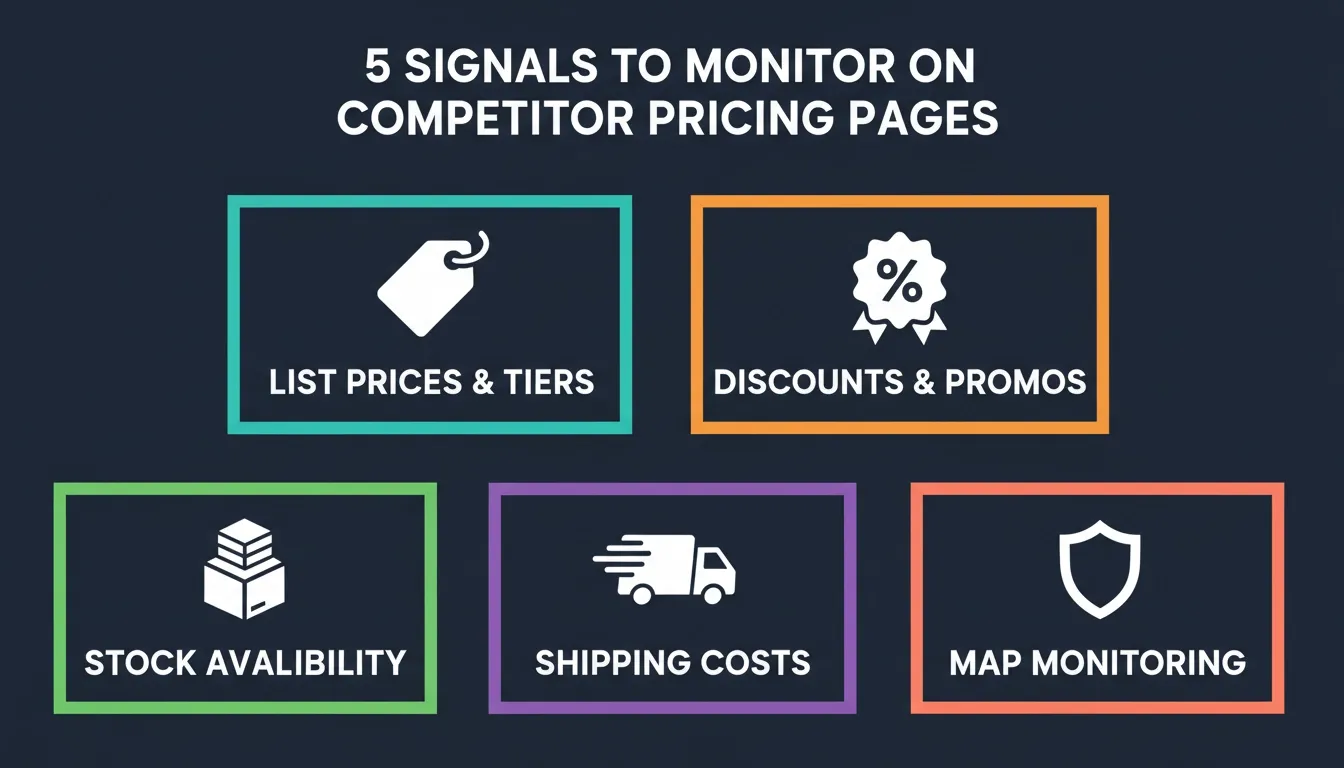 Five key signals to monitor: list prices and tiers, discounts and promotions, stock availability, shipping costs, and MAP compliance.
List Prices and Published Tiers
-
The base price is the most visible data point on any competitor's pricing page.
-
For SaaS products, tier structure often reveals more than the price itself, showing which features land at which plan, how wide the gap between tiers runs, and where a competitor places their recommended label.
-
Tracking price points over time builds a price history that shows how a competitor's pricing strategy shifts across quarters.
Discounts, Bundles, Promotions and Flash Sales
-
Promotional pricing is where competitor pricing data gets most actionable. Flash sales, bundle deals, extended free trials, and seasonal discounts all signal something about a competitor's market position.
-
A heavy discount on a product category often means a competitor is clearing stock. A SaaS brand bundling features that were previously paid add-ons is usually responding to pressure from a lower-priced rival.
-
Track discounts separately from list prices, as promotions tend to move before list prices do and often serve as early indicators of a deeper pricing shift ahead.
Stock Availability, Shipping Costs and MAP Monitoring
-
For physical product sellers, stock status adds context that price data alone cannot. A competitor running low on stock creates a pricing window for sellers who are still in supply and positioned well.
-
Shipping costs are part of the effective price a buyer actually pays. A competitor dropping its free-shipping threshold is cutting real cost without touching any number on their pricing page.
-
For brands selling through resellers on multiple channels, MAP monitoring catches below-floor pricing before customers see it.
Building a Sustainable Monitoring Workflow
-
Identify which competitor pricing pages to watch and how often each needs a check.
-
Classify detected changes by type: price drop, new tier, discount, restock, or packaging shift.
-
Route each signal type to the right person: pricing team for list price changes, product team for tier shifts, sales for competitive deal context.
Teams that build a repeatable price monitoring routine end up with a steady stream of competitor pricing data to act on, rather than a pile of ad hoc spreadsheets.
Understanding omnichannel best practices helps retail and digital teams coordinate these signals across every channel they operate.
How to Act on Competitor Price Changes Without Losing Margin
Collecting pricing data creates value only when the team knows how to use it without starting a margin-destroying price war.
Setting Your Pricing Rules in Advance
-
The worst time to decide how to respond to a competitor price drop is the moment it happens.
-
Pricing rules defined in advance, including floor prices, match thresholds, and categories where you will not compete on price, turn a reactive scramble into a structured pricing decision.
-
A short list of rules covers most competitor price change scenarios: match on hero SKUs if a competitor drops more than 5%, hold on thin-margin categories.
Beating Alert Fatigue with Smarter Signals
-
In categories where price changes happen many times a day, a price monitoring setup that fires real-time alerts on every minor move will train your team to ignore them. That is alert fatigue.
-
Better pricing intelligence filters by size and context. A 1% movement on a low-volume SKU is noise. A 15% drop on a flagship product before a major sales event deserves fast alerts.
-
Set thresholds so your team gets instant alerts on changes that matter, while routine pricing data rolls up in scheduled reports.
Protecting Profit Margins While Staying Competitive
-
Not every competitor price drop deserves a response. Before matching, ask whether the competitor has genuinely lower cost structure or is buying market share at the expense of their own profit margins.
-
A competitor cutting prices unsustainably often strengthens your competitive position if you hold steady while they absorb the hit.
-
A long-term pricing strategy built on real competitor pricing data will almost always outperform reactions to individual price changes.
Good pricing decisions come from recognizing patterns across time, not from reacting to a single alert. Teams that want a deeper view into competitor strategy can explore how Rocket Intelligence predicts competitor intent before positioning shifts become visible to the market.
How Rocket Intelligence Watches Competitor Pricing Around the Clock
Most price monitoring software logs what changed. Rocket Intelligence tells you what it means and what to do about it.
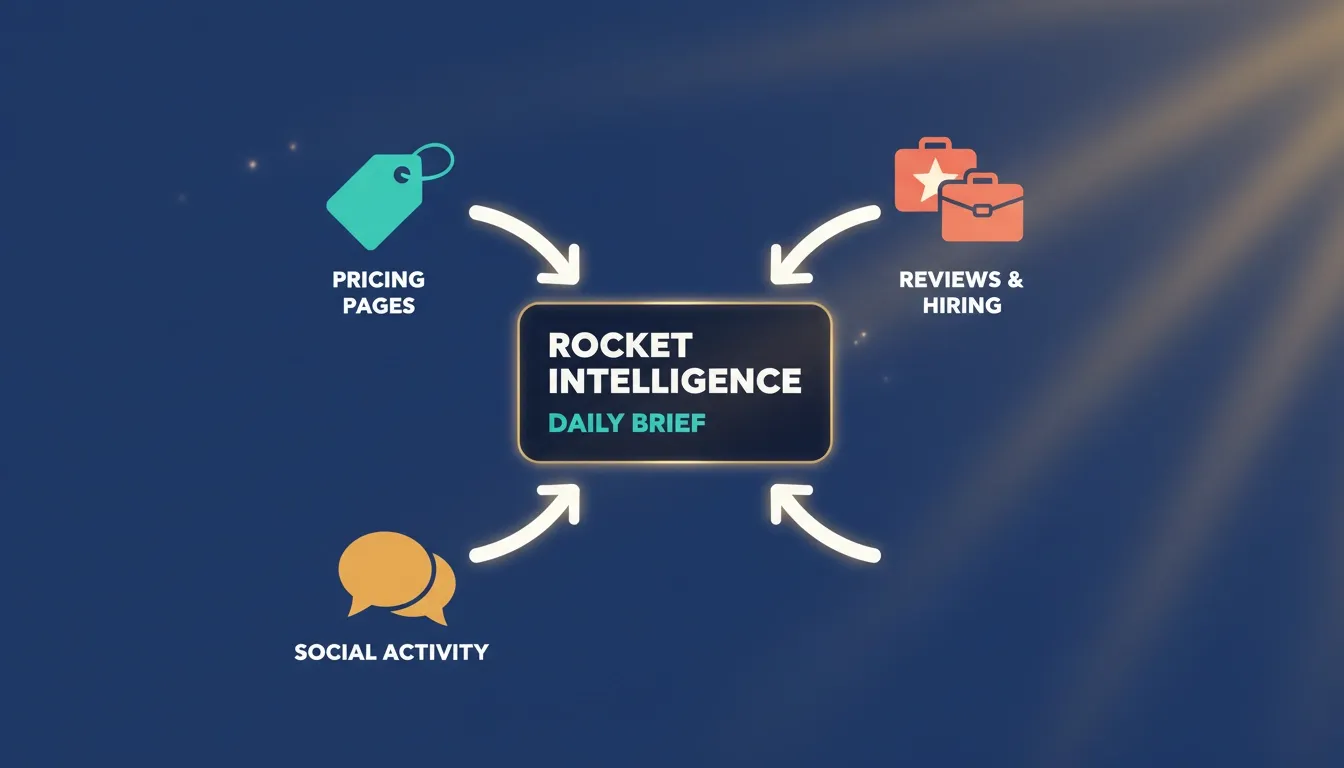
Rocket Intelligence vs. Standalone Price Alert Tools
-
Traditional competitor monitoring platforms such as Crayon, Klue, and Kompyte surface website changes in a feed and leave analysis to an analyst. They log what changed. They do not tell you what it means.
-
Rocket Intelligence is built as an interpretation system, not a standard change monitoring tool. It uses AI-powered product matching and signal clustering to connect data from competitor pricing pages, social activity, job postings, and customer reviews.
-
The output is a daily brief with key highlights, a clear "so what," and recommended actions so your pricing team has context before the first meeting of the day.
Real-Time Signals from Pricing Pages to Social Activity
-
Rocket Intelligence monitors every public platform a competitor operates on: pricing pages, product pages, feature announcements, social media posts, job listings, and review platforms, continuously, from a single setup.
-
When a competitor's pricing page changes, Rocket reads that alongside everything else that competitor has done in the same window: new enterprise-focused social posts, a spike in sales hiring, defensive G2 responses.
-
That cluster of signals gives your pricing team something a raw price alert cannot: an interpretation of what a pricing move signals about a competitor's strategy.
From Raw Pricing Data to Strategic Action
-
The platform covers website change detection, competitor pricing pages, stock status monitoring, and multiple channels in one view, going well past what standalone price tracking software offers.
-
It replaces separate tools for change detection, analysis, and reporting without requiring a dedicated analyst to make sense of the data.
-
Teams using Rocket Intelligence also benefit from its competitive intelligence roadmap planning capability, which connects live pricing signals directly to product and GTM decisions.
Rocket Intelligence is built as a pricing intelligence layer, not just an alert system. It reads signal clusters so your team acts on strategy, not noise.
From Data to Competitive Edge
Tracking competitor prices is not about matching every move a rival makes. It is about having enough visibility to make confident pricing decisions and catching the changes that actually matter before they affect your revenue. Start with the signals that move your category: list prices, promotional activity, stock status, and packaging shifts.
Build a price monitoring process that filters noise and surfaces the pricing data worth acting on. The businesses that win on pricing are not always the fastest to respond. They are the ones with enough context to know when to move and when to hold.
Rocket gives you that context automatically. Start your first competitive pricing brief no credit card required, ready in under 30 minutes.
Table of contents
- -Why Tracking Competitor Prices Is Good for Business
- -The Direct Line Between Prices and Profits
- -What Happens When You Miss a Price Change?
- -Are Your Buyers More Price-Sensitive Now?
- -Manual vs. Automated Price Tracking: Which Approach Wins?
- -What Manual Price Tracking Actually Looks Like
- -The Case for Price Monitoring Software
- -When Does Automation Start Making Sense?
- -What to Watch on Competitor Pricing Pages
- -List Prices and Published Tiers
- -Discounts, Bundles, Promotions and Flash Sales
- -Stock Availability, Shipping Costs and MAP Monitoring
- -Building a Sustainable Monitoring Workflow
- -How to Act on Competitor Price Changes Without Losing Margin
- -Setting Your Pricing Rules in Advance
- -Beating Alert Fatigue with Smarter Signals
- -Protecting Profit Margins While Staying Competitive
- -How Rocket Intelligence Watches Competitor Pricing Around the Clock
- -Rocket Intelligence vs. Standalone Price Alert Tools
- -Real-Time Signals from Pricing Pages to Social Activity
- -From Raw Pricing Data to Strategic Action
- -From Data to Competitive Edge