Most vendor contract renewals fail not because teams are careless, but because contract data is scattered, ownership is unclear, and no system exists to surface deadlines before they pass.
Why do so many teams discover a vendor renewal only after the auto-renewal kicks in? The answer is rarely negligence. It is almost always a visibility gap.
According to World Commerce and Contracting, organizations lose an average of 9.2% of annual revenue to poor contract management (Procurement Tactics, 2026). For a company doing $10 million in revenue, that is nearly a million dollars leaking through missed terms and forgotten renewals.
The real problem is not that people forget. Contract data simply lives in too many places, owned by too many people, with no single system pulling it together before the deadline arrives.
What is Vendor Contract Renewal Management?
Vendor contract renewal management is the process of tracking expiration dates, reviewing vendor performance, and coordinating stakeholder approvals. Teams act before auto-renewal clauses activate, not after.
Without a structured process, teams face three costly outcomes. First, unwanted auto-renewals lock them into unfavorable terms. Second, missed negotiation windows remove any chance to renegotiate. Third, compliance gaps appear when vendor certifications lapse unnoticed.
For teams managing more than a handful of vendors, ad hoc approaches break down quickly. Email reminders, spreadsheet tabs, and calendar alerts simply cannot scale. A structured system with automated alerts and defined ownership at every stage is the only reliable solution.
Why Do Vendor Contract Deadlines Get Missed So Often?
Contract renewal failures rarely happen because someone was careless. They happen because the system around the contract was never designed to support timely decisions. Understanding the root causes helps teams build a process that actually works.
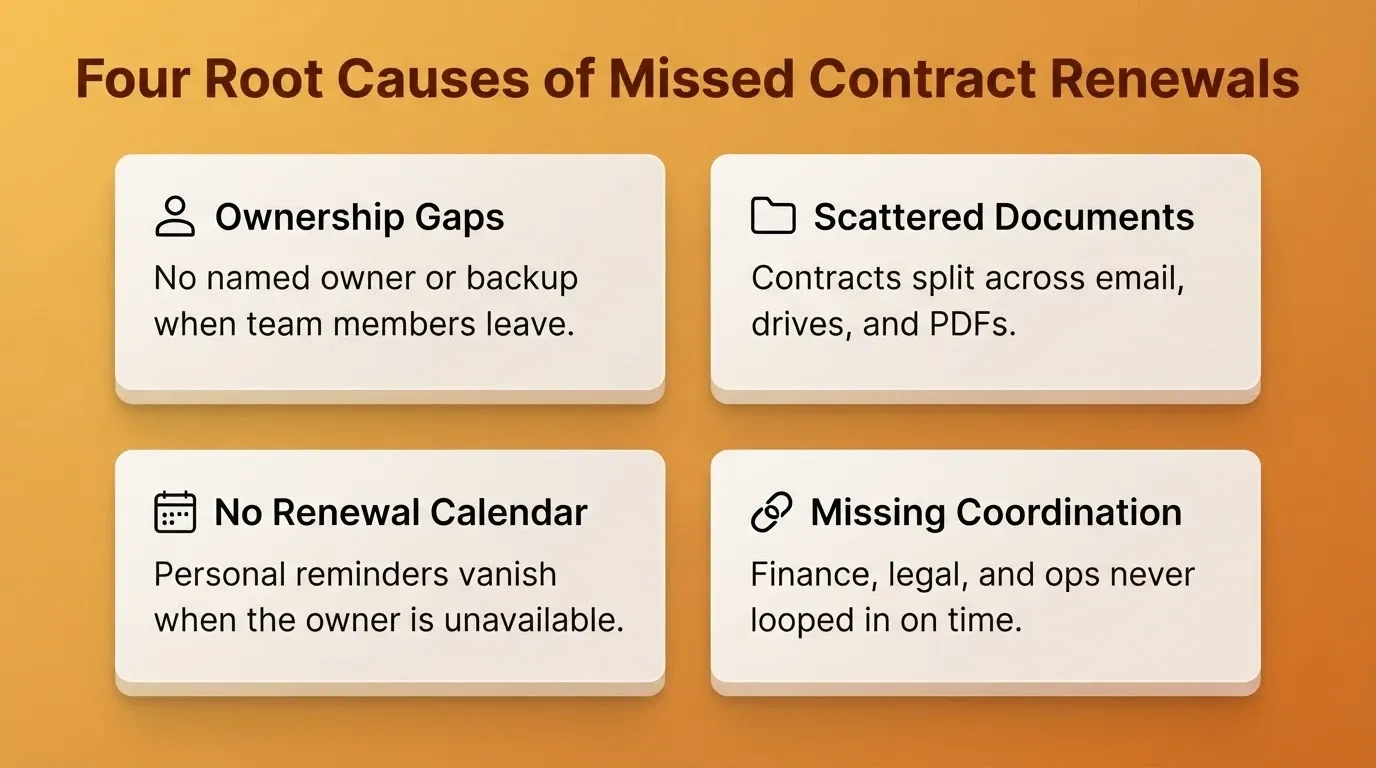
Here is what typically goes wrong in practice:
-
Ownership changes without handoff. When an employee who managed a vendor relationship leaves, the contract gets orphaned. No one inherits the responsibility, so the renewal date passes silently.
-
Contract documents are scattered. The original agreement sits in someone's inbox. The amendment lives on a shared drive, and the pricing addendum is a PDF that was never indexed. 71% of companies cannot locate at least 10% of their active contracts, according to a 2026 WorldCC study.
-
No centralized renewal calendar. Teams rely on personal reminders and spreadsheet tabs that no one else can access. When the person who set the reminder is unavailable, the deadline passes.
-
Cross-department coordination is missing. Renewing a vendor contract requires input from finance, legal, and the team using the service. Without a process to loop them in early, decisions get compressed into the final days.
The pattern is consistent: 80% of organizations lack clarity on contract ownership, according to WorldCC. When nobody owns the process, nobody catches the deadline. Teams that automate business workflows around these stages catch issues months before they become crises.
Which Approach Is Right for Your Team?
Before building a system, teams need to understand the trade-offs between their options. The right choice depends on contract volume, team size, and the level of customization required.
| Approach | Best For | Key Limitation |
|---|---|---|
| Spreadsheet (Excel / Google Sheets) | 1-10 contracts, solo owner | No automated alerts; breaks at scale; no audit trail |
| Shared calendar and email reminders | Small teams, simple renewals | No document storage; reminders get ignored; no stakeholder routing |
| Off-the-shelf CLM software | Large legal teams, complex contracts | High cost; months to implement; feature bloat |
| Custom-built internal tracker | Ops teams with specific workflows | Historically required developers and weeks to build |
For most operations and procurement teams managing 10 to 200 vendor contracts, a custom-built internal tracker hits the right balance. It offers tailored workflows, automated alerts, document storage, and stakeholder routing without enterprise overhead.
What Should You Track at Each Stage of a Vendor Contract?
A vendor contract is not a single event. It is a lifecycle with distinct stages, and each stage demands different information. Tracking the right details at the right time separates teams that stay ahead from those that scramble.
| Contract Stage | What to Track | Who Owns It |
|---|---|---|
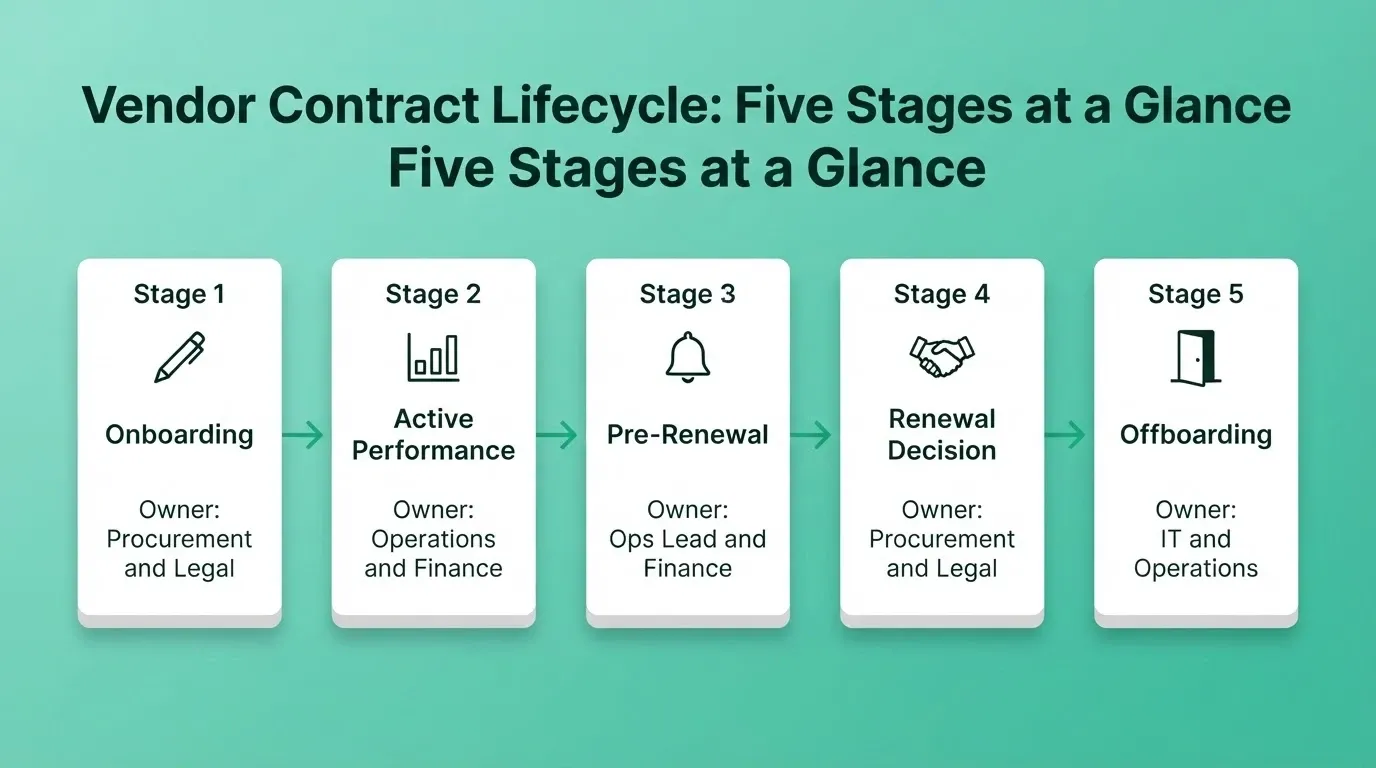
| Onboarding | Signed agreement, payment terms, SLA benchmarks, primary contact | Procurement / Legal |
| Active Performance | Service delivery metrics, invoice accuracy, compliance status | Operations / Finance |
| Pre-Renewal (90 days out) | Usage data, satisfaction scores, market alternatives, budget approval | Ops Lead / Finance |
| Renewal Decision | Negotiation notes, revised terms, stakeholder sign-off | Procurement / Legal |
| Offboarding (if not renewed) | Data migration plan, final invoices, access revocation | IT / Operations |
-
During onboarding, capture the full contract document, key dates, and the names of everyone who needs to be involved in future decisions.
-
During active performance, log any deviations from SLAs, track invoice discrepancies, and note vendor responsiveness.
-
During pre-renewal, pull usage reports and satisfaction feedback so the renewal conversation is grounded in data, not assumptions.
The goal is not to track everything. It is to track the right things at the right time so decisions stay informed rather than reactive.
Vendor Contract Renewal Checklist: The 90/60/30-Day Framework
The most effective way to manage vendor contract renewals is to build lead time into the process. Starting 90 days out gives enough room to evaluate, negotiate, and decide without pressure.
Vendor contract renewal decision workflow: a structured 90-day process from initial performance review through final sign-off.
At 90 days out, trigger the first alert. Pull performance data and share it with the team that uses the vendor's service. Confirm the auto-renewal date and the opt-out window. This is the window for honest evaluation.
At 60 days out, loop in finance. Confirm budget availability and review pricing against current market rates. Flag any cost concerns and identify volume discounts or renegotiation opportunities.
At 30 days out, legal reviews the terms. Flag risky clauses such as unlimited liability, unfavorable termination windows, and price escalation. Finalize any negotiation here, with enough buffer for back-and-forth.
On decision day, if no decision has been made by the contractual notice period, escalate immediately. Building lead time into the process is the single most effective way to avoid unwanted auto-renewals. A central purchase approval system can route renewal notifications to each stakeholder group automatically.
Which Stakeholders Need to Weigh In Before a Renewal?
One of the most common reasons vendor renewals go sideways is that too few people are involved in the decision. Renewal is not just a procurement task. It touches budgets, compliance, and daily operations.
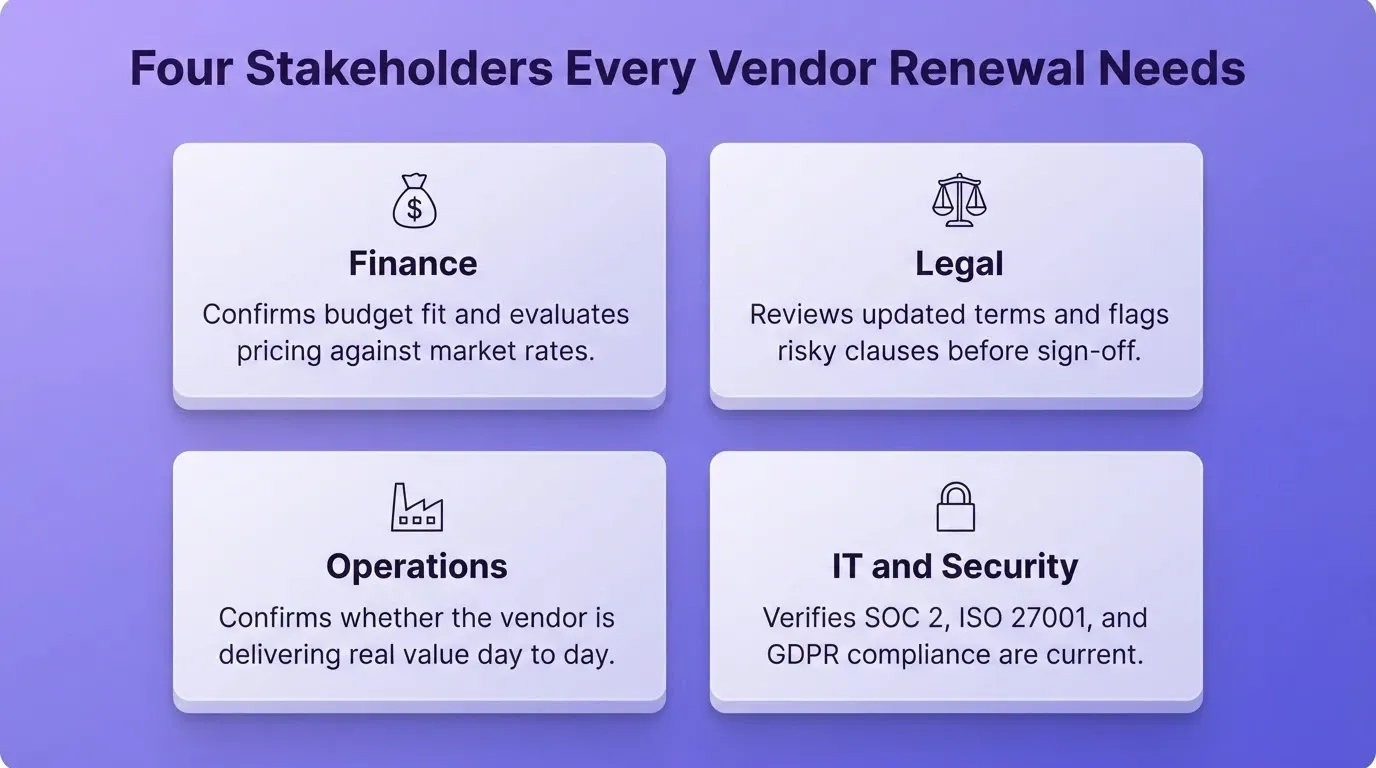
Here is what each group contributes to the renewal decision:
-
Finance confirms whether the contract still fits the budget and whether better pricing is available.
-
Legal reviews updated terms, checks for regulatory changes, and flags risky clauses like unlimited liability or unfavorable termination windows.
-
Operations or the end-user team knows whether the vendor is actually delivering value. Their input is the difference between renewing out of inertia and renewing because the service works.
-
IT or Security (for technology vendors) verifies that the vendor still meets security and compliance requirements, including SOC 2, ISO 27001, or GDPR data processing agreements.
A Concord analysis of more than 10,000 contracts found that 38% of contracts contain volume discounts that companies fail to use. That is money left on the table simply because the right people were not reviewing the right terms before renewal.
Getting stakeholders involved early is not about adding bureaucracy. It is about making sure the right people are part of the conversation before the deadline removes their ability to act. Teams that are building internal tools without a developer can set up automated stakeholder routing in hours rather than weeks.
How to Build a Vendor Contract Renewal Tracker
You describe the tracker in plain language. Rocket then generates a production-ready web application, typically in one to three minutes. The output is not a template or a mockup. It is a working, deployable app built in Next.js, with real UI, navigation, data logic, and integrations.
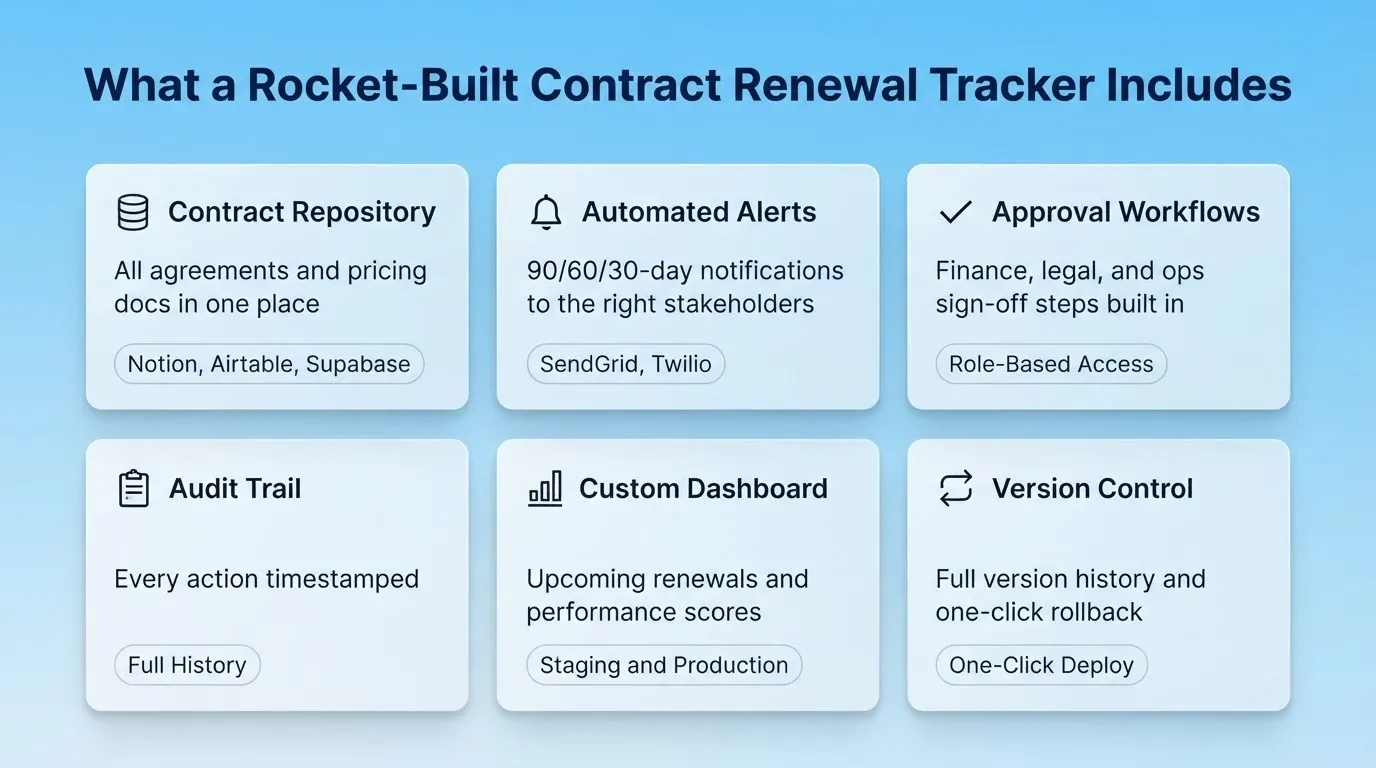
A vendor contract renewal tracker built on Rocket can include the following features:
-
Centralized contract repository. Store every vendor agreement, amendment, and pricing document in one place. Connect it to tools your team already uses, such as Notion, Airtable, or Supabase for the backend data layer.
-
Automated renewal alerts. Set up 90/60/30-day notification sequences routed to the right stakeholders. Customize alerts by vendor tier, contract value, or department. Use SendGrid for email or Twilio for SMS, as both are available as direct integrations.
-
Stakeholder approval workflows. Route renewal decisions through finance, legal, and operations with built-in approval steps. Everyone sees the same data in the same place.
-
Full audit trail. Every action is logged with timestamps. Document uploads, stakeholder approvals, and negotiation notes all become part of a searchable history that makes future renewals faster.
-
Custom dashboards. See all upcoming renewals, contract values, vendor performance scores, and budget impact on a single screen. Staging and production environments let you test before going live.
Rocket ships every build with full version history, one-click rollback, and 25+ integrations that authenticate once and flow into every build. Deploy to a live URL with one click. No code, no IT backlog, no waiting.
| Plan | Price | Credits Per Month | What Is Included |
|---|---|---|---|
| Free | USD 0 | 20 (one-time) | Build production-ready apps + Light Solve |
| Pro | USD 25/mo | 100 | Build web apps, mobile apps, landing pages + Light Solve |
| Rocket | USD 50/mo | 250 | Build + Full Solve on demand + Competitive Intelligence |
| Booster | USD 250/mo | 1,500 | Build + Full Solve on demand + Competitive Intelligence |
What are the Biggest Contract Renewal Pitfalls to Watch For?
Even teams with good intentions fall into predictable traps. Knowing these pitfalls ahead of time can save significant time and money. Here are the most common ones to avoid.
-
Auto-renewal clauses that go unnoticed. Many vendor contracts include automatic renewal provisions with short opt-out windows, sometimes as narrow as 30 days. Miss that window and you are locked in for another term at whatever price the vendor sets.
-
Single-owner dependency. When one person holds all the vendor knowledge and then leaves, the institutional memory leaves with them. Contracts without a backup owner are the ones most likely to slip.
-
No SLA review before renewal. Renewing a contract without reviewing whether the vendor met its service commitments is like signing a new lease without checking if the landlord fixed the leaky roof.
-
Missing audit trail. Without a record of past negotiations, pricing history, or performance issues, every renewal starts from zero. Teams lose leverage they already earned.
-
Treating all contracts equally. A \$500-per-year SaaS subscription and a \$200,000 annual infrastructure contract should not go through the same review process. Tier your vendor contracts by value and risk so high-stakes renewals get proportionally more attention.
-
Skipping the compliance check. For technology vendors, a renewal is the right moment to re-verify that security certifications and data processing agreements are current. Renewing without this check creates compliance exposure.
These pitfalls are preventable. The common thread is a lack of systems, not a lack of effort. Choosing the right platform for internal tools is often the difference between catching a renewal early and discovering it on the invoice.
Build the System Before the Next Deadline Arrives
Vendor contract renewals will keep slipping as long as the process depends on memory, scattered documents, and last-minute coordination. The fix is structure: a single source of truth with automated alerts, stakeholder workflows, and a clear audit trail for every vendor relationship.
As vendor portfolios grow and compliance requirements tighten, teams that manage vendor contract renewals systematically will consistently outperform those that react to surprises. Building that capability now means you will not be scrambling when the next renewal window opens.
You describe the tracker. Rocket builds it. Start building today.
Table of contents
- -What is Vendor Contract Renewal Management?
- -Why Do Vendor Contract Deadlines Get Missed So Often?
- -Which Approach Is Right for Your Team?
- -What Should You Track at Each Stage of a Vendor Contract?
- -Vendor Contract Renewal Checklist: The 90/60/30-Day Framework
- -Which Stakeholders Need to Weigh In Before a Renewal?
- -How to Build a Vendor Contract Renewal Tracker
- -What are the Biggest Contract Renewal Pitfalls to Watch For?
- -Build the System Before the Next Deadline Arrives