
Porter's three generic strategies, cost leadership, differentiation, and focus, are the foundation of modern competitive strategy. The right choice depends on your industry, resources, and available positions. Companies that sustain a competitive advantage track rivals continuously, not just once a year.
What if the right competitive position was already visible to you, but you kept looking at the wrong rivals? A strong business strategy is a plan for how a company wins, which customers to serve, what advantage to build, and how to hold that position against competitors. Firms that commit to a clear path consistently outperform those that drift.
IKEA reported 45 billion euros in revenue in 2024, built on a strategy of standardized production that lets it respond to demand faster than any rival. Research from the Kellogg School of Management found that firms using this kind of standardization scaled dramatically faster when demand increased, while competitors struggled to keep up (Kellogg Insight, 2025).
That finding points to something most planning sessions overlook: execution matters, but so does knowing which position to execute from. The companies that get this right don't just pick a better direction; they stay in it long enough for it to compound.
What Defines a Strong Business Strategy?
A business's plan for winning inside that environment, the decisions it makes about who to serve, what to offer, and how to set itself apart, gives the business a defensible strategic position.
Every company operates inside a competitive environment where customers have choices, rivals are actively chasing market share, and new entrants can show up without warning.
Many managers assume strategy means having a vision statement or a long-term growth plan. In practice, it means something more specific: choosing competitive positions deliberately, accepting the trade-offs those choices create, and building organizational discipline to hold them when things get difficult.
When strategy theorists and corporate strategy consultants discuss why companies fail, the answer often comes back to a lack of a clear competitive position.
-
A defined position: A clear approach places a company in specific competitive positions relative to rivals, choosing which customers to serve and at what price point. That specificity is what makes a business strategy actionable rather than aspirational.
-
A set of trade-offs: Picking one path means giving something else up. Trying to be all things to all buyers is one of the most common ways firms end up stuck, with no real competitive advantage and no clear reason for customers to choose them.
-
An ongoing commitment: Corporate strategy only works when the whole organization moves in the same direction. Resources, hiring, pricing, and product decisions all need to point toward the same outcome.
-
A response to industry forces: Markets shift. The competitive environment changes as new entrants arrive, supplier power shifts, and customer needs evolve. A strategy that worked last year may need rethinking today.
Sustainable competitive advantage comes from making those choices deliberately, and having the discipline to hold the line when short-term pressures push back.
| Strategy Path | Core Logic | Key Risk |
|---|---|---|
| Cost leadership | Be the lowest-cost producer in your industry | Rivals copy your cost structure; margins compress |
| Differentiation | Offer something buyers value enough to pay a premium | Uniqueness erodes if rivals catch up |
| Focus | Serve a narrow segment better than broad competitors | Segment may shrink or be targeted by larger rivals |
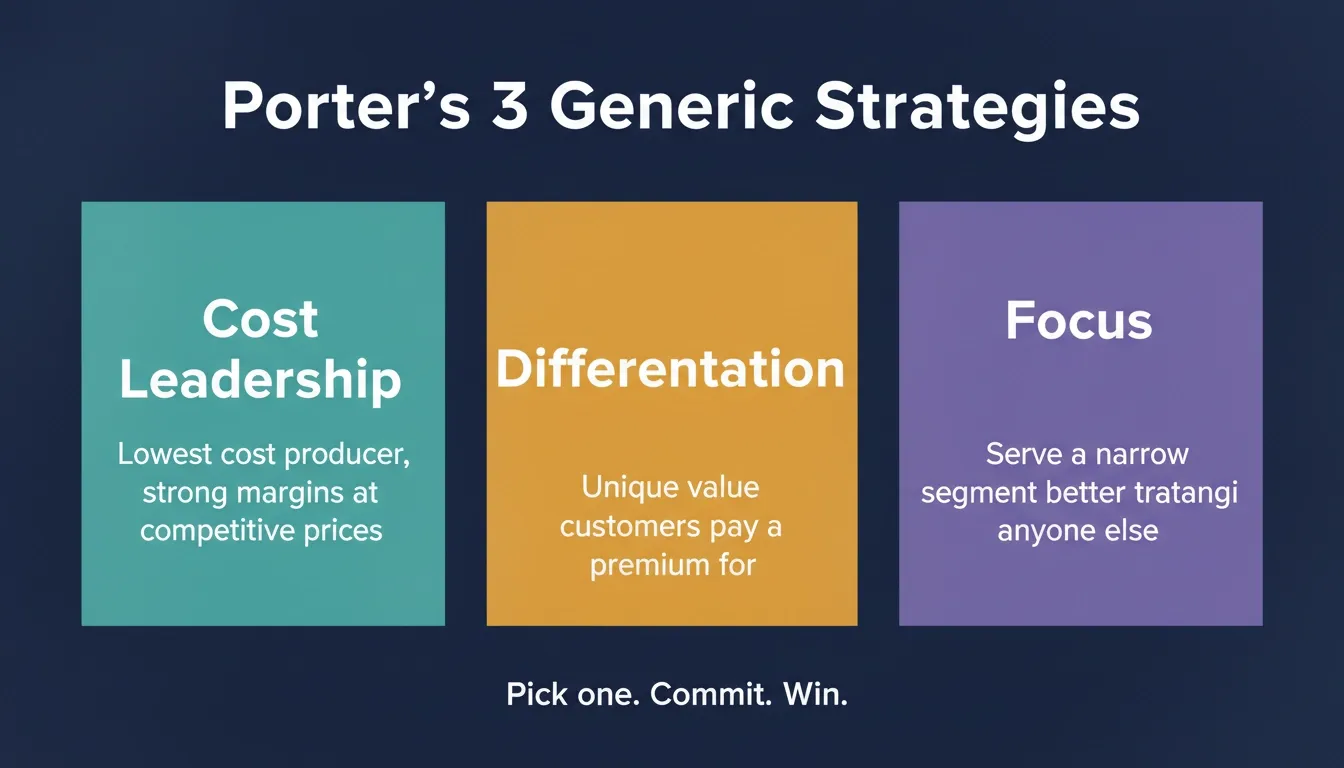 The three generic strategies every business must choose between.
Porter's Generic Strategies: The Original Playbook
Michael E. Porter introduced three generic strategies in his 1980 book published by the Free Press, and much of the business thinking that followed in classrooms and boardrooms was built directly on those ideas.
The Harvard Business School professor spent decades analyzing industries and found that firms achieve superior profitability when they commit to one clear route, rather than trying to occupy every position at once. Porter's strategy thinking has been internalized by millions of managers globally and shaped how consultants, investment analysts, and students approach corporate strategy.
Michael Porter's framework starts with two dimensions: the type of competitive advantage a firm is chasing, low cost or distinctiveness, and the competitive scope it targets, broad market or narrow segment. Those two dimensions produce four strategic positions and one critical trap.
His ideas, now foundational in the Strategic Management Journal and published across the Harvard Business School curriculum, remain the most-used reference in analyzing industry structure and corporate positioning.
What Are Porter's Three Generic Strategies?
The cost leadership strategy aims to produce at the lowest cost in the industry. This isn't the same as charging the lowest price, a firm pursuing cost leadership uses its cost advantage to earn strong margins even at competitive prices.
Walmart, Amazon's retail core, and Ryanair all operate from this position. The cost leadership strategy requires relentless attention to the value chain: procurement, operations, distribution channels, and overhead all become sources of advantage or vulnerability.
Differentiation strategy builds something customers value enough to pay more for. Brand loyalty forms naturally when buyers feel they can't get the same result elsewhere. Apple's hardware and software approach creates switching costs that keep users in its ecosystem for years. The differentiation strategy requires proprietary knowledge, continuous product investment, and a precise understanding of what buyers actually value.
Focus strategies narrow the competitive scope. Rather than competing across a whole market, the company zeroes in on a particular market segment and wins there through either a cost focus strategy or a differentiation focus strategy. Whole Foods pursues a differentiation focus strategy, serving premium-oriented buyers better than any broad retailer. Dollar General runs a cost-focused strategy, owning a price-sensitive, rural market segment that larger chains leave underserved.
Porter's rich frameworks also include his famous five forces model, an approach for industry analysis that identifies five underlying forces shaping structural attractiveness: the threat of new entrants, bargaining power of buyers, bargaining power of suppliers, the threat of substitute products, and competitive rivalry among existing players. Michael E.
Porter's article on the five forces in the Harvard Business Review is among the most-cited pieces in management thinking (Harvard Business Review, 2008). It sits alongside his core Harvard Business School course materials as foundational reading for anyone taking corporate strategy seriously.
His warning about being "stuck in the middle", pursuing cost leadership and differentiation simultaneously without excelling at either, still applies. The result of that trap is typically low profits and a brand identity that customers can't read clearly. For a deeper look at how competitive positioning connects to product decisions, see how competitive intelligence shapes product strategy.
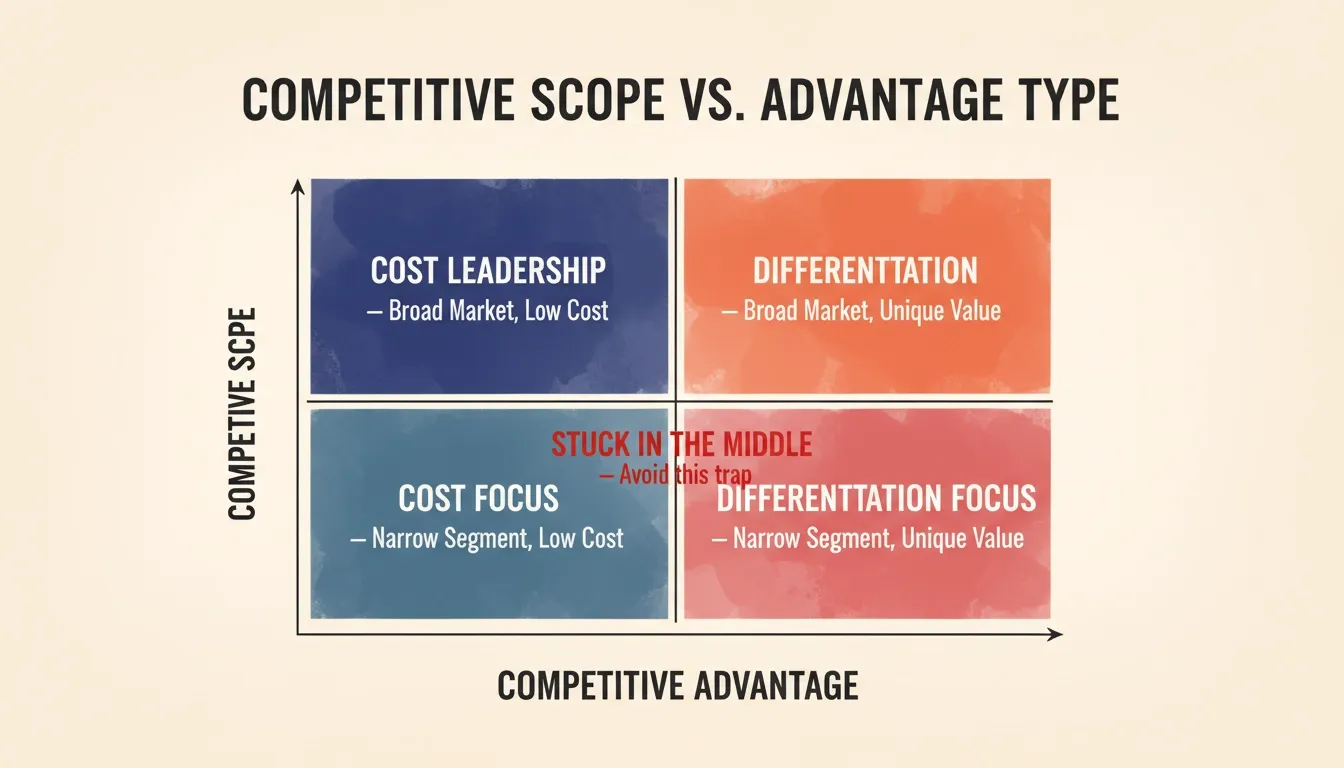 The four quadrants of Porter's framework, and the trap at the center.
Real-World Competitive Strategy Examples from Leading Companies
Each of the three strategy types has well-known competitive strategy examples, and most stumbles trace back to a loss of strategic discipline rather than a bad initial choice of direction.
Frameworks make more sense when you can see them working, and when you can see what happens when a company drifts from its original path.
Which Companies Use These Strategies Well?
-
Cost leadership at scale: Walmart built its market position by treating every step of the value chain as a source of savings. Low switching costs for customers mean it can never stop improving its cost structure. IKEA follows the same logic: standardize production, build supplier relationships around volume, and keep price points so low that differentiation becomes irrelevant to most buyers in its chosen segment.
-
Differentiation that earns a premium: Apple charges more in nearly every category it enters. Brand loyalty runs deep, buyers upgrade on a regular cycle, and rarely leave the ecosystem. The firm's proprietary knowledge about how its hardware and software work together creates switching costs that are partly financial and partly habitual.
-
Focus strategies in narrow markets: Whole Foods targets a particular market segment, health-conscious, premium-willing shoppers, and prices accordingly. Ferrari sits at an even narrower market position: pure differentiation focus, where exclusivity is the core product. Dollar General takes the opposite side of focus strategies, running a cost focus model that owns a price-sensitive rural segment where scale retailers can't operate profitably.
| Company | Strategy Type | Core Advantage |
|---|---|---|
| Walmart | Cost leadership | Value chain management, margin discipline |
| Apple | Differentiation | Ecosystem lock-in, brand loyalty |
| Whole Foods | Differentiation focus | Premium segment, health-conscious target market |
| Ryanair | Cost leadership | No-frills model, the lowest cost structure in European aviation |
| Ferrari | Differentiation focus | Exclusivity, heritage, performance |
| Dollar General | Cost focus | Hyper-local, price-sensitive rural segment |
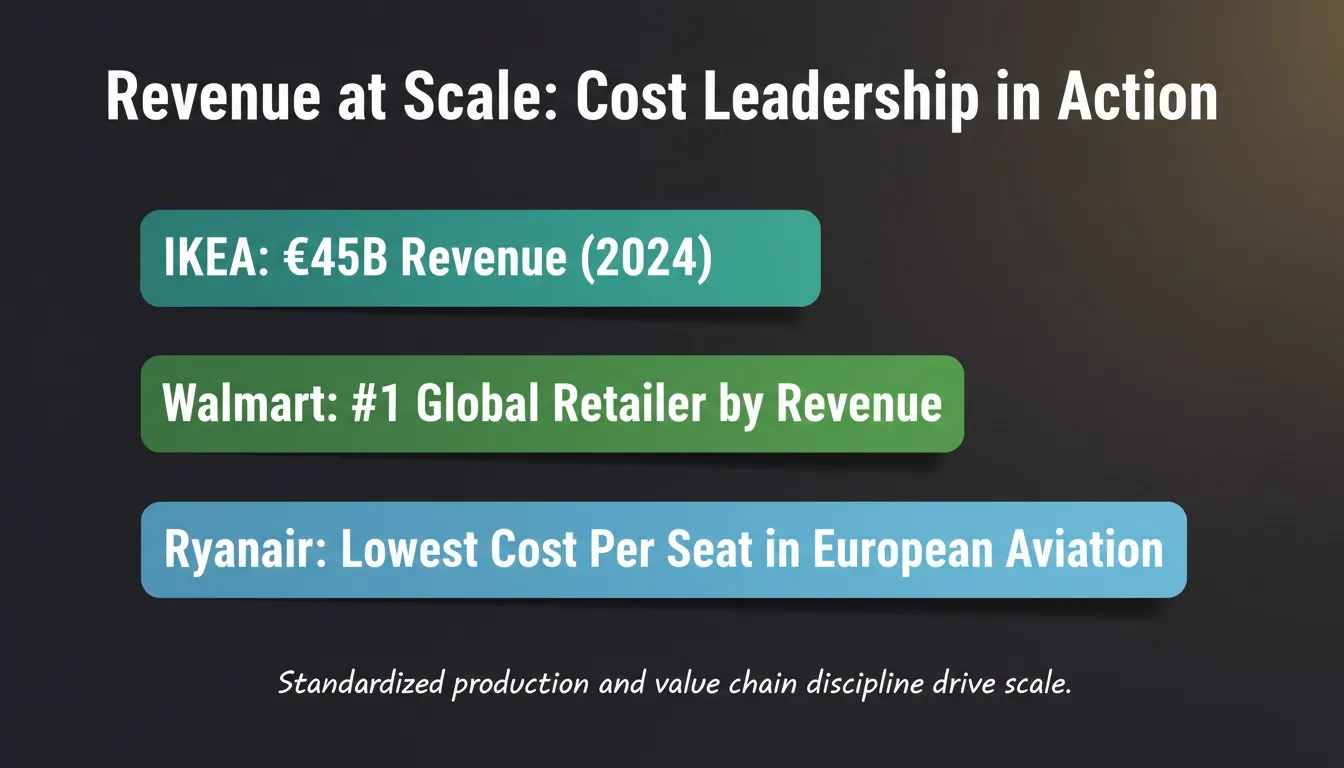 Cost leadership at scale: revenue and structural discipline across three benchmark companies.
Roger Martin, ranked the #1 management thinker in the world in 2017 and former dean of the Rotman School, wrote on his Medium strategy blog:
"In strategy, strategists can't analyze their way to great strategy, because analysis simply affirms the past." (Roger Martin, "Fixing Strategy," Medium, Feb 2026)
Understanding how to read and respond to competitor moves is a core part of executing any strategy well. Teams that want to build this capability can start with how to build a competitive intelligence program.
How Do You Choose the Right Competitive Position?
Company analysis and competitor assessment feed the strategy formulation process; neither alone is sufficient.
Choosing a path sounds simple at the framework level. In practice, it requires a clear-eyed look at what your company does well, what your rivals are doing right now, and how your industry competition is likely to shift over the next few years.
-
Start with core competencies: What does your organization know how to do that rivals genuinely can't replicate quickly? Core competencies, the great skills and capabilities that define how a firm creates value, are the most stable foundation for any competitive position.
-
Run a competitive analysis: Map your direct competitors and existing competitors, and understand their cost structures, pricing approaches, and customer segments. Strategic analysis without real competitor data is closer to guesswork than planning.
-
Do a thorough industry analysis: Assess the five underlying forces, bargaining power of buyers, bargaining power of suppliers, threat from new entrants, substitute products, and competitive rivalry. A clear industry analysis tells you which positions are defensible and which ones quietly lose market share over time.
-
Think about switching costs: If customers can walk away easily, a differentiation approach or a cost leadership position becomes much more important. High switching costs build a moat; low ones mean you compete on value every single day.
-
Watch for slow industry growth: When markets experience slow industry growth, industry competition intensifies as rivals fight for a static pool of buyers. Analyzing industries through periods of contraction reveals which players have genuine intelligence about rivals.
-
Build in an ongoing process: A competitive position isn't set once. Research on strategy under uncertainty shows that even well-chosen positions need revisiting as new information becomes available. (McKinsey Quarterly)
Strategy formulation isn't a one-time event. The teams that consistently find strong competitive positions share one habit: they run a regular competitor assessment alongside every planning cycle, not just before the annual review.
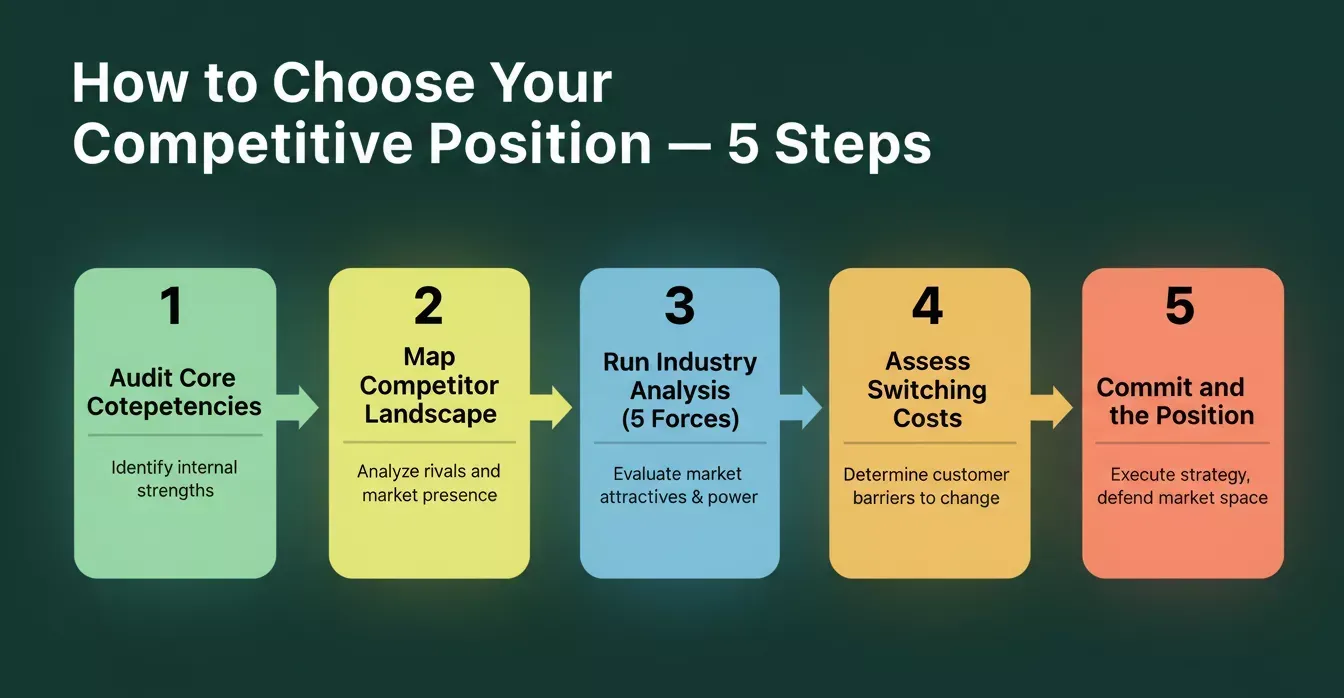 Five steps to selecting and committing to a defensible competitive position.
How Should You Adapt Your Strategy Over Time?
A firm shouldn't abandon cost leadership simply because a rival launched a premium line — that move might mean the rival is chasing a segment too small to matter. The better response is to understand what's actually shifting in the industry structure, not just what's visible from the outside.
Speed matters too. A firm that waits for a full, comprehensive analysis cycle before responding will always be reacting, not leading. Distribution channels, supply chain decisions, and market position all flow downstream from competitive position. Getting the position wrong compounds every decision that follows.
Tracking how competitors respond to market shifts is itself a strategic capability. Tools like predictive competitive intelligence help teams spot those shifts before they become obvious. For product teams specifically, using competitive intelligence before roadmap planning is one of the highest-leverage habits to build.
Why Live Competitor Data Changes Everything
What they can't provide is real-time information on what rivals are planning next week.
Porter's frameworks are powerful. They help map competitive positions, identify where core competencies give you an edge, and spot vulnerabilities in your industry structure.
Most competitive intelligence today follows a familiar pattern: a team member compiles a quarterly report from public sources, a few investment analysts add perspective, a deck goes to leadership, and by the time anything reaches a decision-maker, the data is already three months old. That's not a discipline problem, it's a data freshness problem.
-
What Rocket Intelligence tracks: Rocket's Intelligence feature is an always-on interpretation layer, not an alert tool. It monitors rivals across ten pillars: website, social, news, GTM, traffic, product, people, business, reviews, and a cross-pillar overview. Strategy teams receive personalized Intel ranked by relevance to their role, surfaced continuously rather than on a quarterly schedule.
-
Competitive positions need current inputs: Choosing where to compete requires knowing where competitors actually sit today, not where they were six months ago. Live competitive intelligence means your competitor analysis reflects current reality, not last quarter's snapshot.
-
Absence is also a signal: Rocket Intelligence detects not just what competitors do, but when they go quiet, a slowdown in hiring, a pause in content, a pricing page that stops changing. Absence detection and cross-pillar pattern recognition reveal a strategy that activity alone can never show.
-
Available to every team: Sophisticated competitive intelligence used to require dedicated research teams and significant budget. Rocket makes those most powerful competitive tools available to any team, founders, product leaders, sales, and marketing, without the overhead of a large competitive analysis function.
Traditional research methods require teams to manually pull data, structure it, and cross-reference multiple reports. Rocket cuts the gap between signal and decision to near-zero, so the next strategic call is based on what's happening now, not what happened last quarter. Sales teams can also use this capability to prepare for high-stakes enterprise deals before the first call.
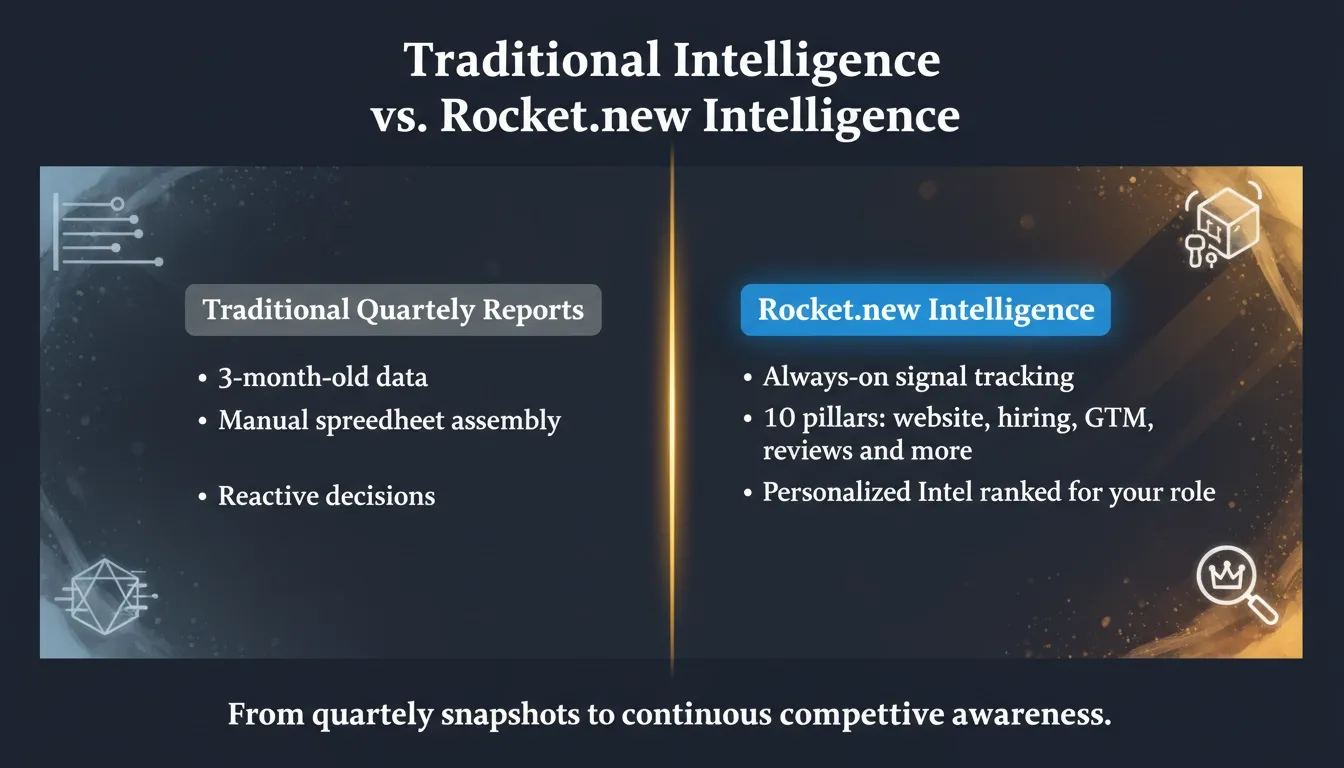 From reactive quarterly reports to always-on competitive awareness across ten pillars.
Winning Is a Choice You Keep Making
The three generic strategy types, cost leadership, differentiation, and focus, give you a map, but the map needs reading again as the territory moves.
Picking a strategic path isn't a one-time decision you make in a planning offsite and file away. Markets shift, rivals adjust, and the conditions that made one approach right can change without much warning.
The companies that hold their competitive advantage longest share one habit: they treat their strategy as a living position, not a historical document. They revisit it with real data, make deliberate trade-offs, and know where they stand relative to rivals on any given day.
Strategy teams that act on live data outperform those working from quarterly snapshots. Rocket gives you always-on competitive intelligence, ranked, personalized, and ready before your next strategic decision. Start building smarter with Rocket.new.
Table of contents
- -What Defines a Strong Business Strategy?
- -Porter's Generic Strategies: The Original Playbook
- -What Are Porter's Three Generic Strategies?
- -Real-World Competitive Strategy Examples from Leading Companies
- -Which Companies Use These Strategies Well?
- -How Do You Choose the Right Competitive Position?
- -How Should You Adapt Your Strategy Over Time?
- -Why Live Competitor Data Changes Everything
- -Winning Is a Choice You Keep Making