
A structured market monitoring program covers prices, competitor conduct, regulatory signals, and consumer feedback. Match your sources to your sector, set a cadence your team can maintain, and build an internal classification process. Rocket Intelligence automates continuous collection and interpretation, delivering daily briefs your team can act on.
How does your market shift before you notice?
Prices change. Competitors update their positioning. Regulators publish new conduct guidelines that reach most teams weeks too late.
Consumer feedback shifts in tone before formal reports catch up. By the time informal channels surface these changes, the window to respond has often closed.
The global market research industry reached $150 billion by the end of 2025, growing at 8.4% per year (Wikipedia). That growth reflects one reality: businesses that track signals early adapt before the market forces their hand. Collecting data is only part of the job.
The other part is turning those signals into decisions your teams can act on. This blog covers what to track, which sources to use, how to build an internal classification process, and how Rocket Intelligence automates the work.
What Does a Market Monitoring Program Actually Cover?
Tracking programs differ by sector, but several signal categories apply across most markets. Getting the scope right before building the process saves significant time and effort later.
-
Prices, conduct, and competitor moves
-
Regulatory signals and market violations
-
Consumer feedback and sentiment data
The sections below break each category down in detail.
Prices, Conduct, and Competitor Moves
Prices, competitor conduct, and market violations form the core layer most market monitoring programs start with. Together they tell you where your market is heading before the shift becomes visible to everyone.
-
Price changes signal strategy, not just cost. A competitor dropping their price may reflect capacity gaps, demand shifts, or a repositioning into a new segment. Teams that monitor prices consistently identify these patterns before they become market-wide shifts.
-
Conduct monitoring tracks how market participants behave. Whether established players are engaging in practices that restrict competition, whether new actors are entering, or whether market design flaws are creating unfair conditions for other market participants.
-
Market violations surface through consistent tracking. Pricing irregularities, preferential contracts, and exclusionary practices show up in conduct data when teams monitor through established channels, including ISO standards documentation and regulatory filings.
-
Competitor analysis covers the full activity stack: website changes, product updates, job postings, social content, and news. A burst of enterprise-focused job openings often signals a strategic shift months before any public announcement confirms it.
-
Commodity-heavy sectors need an extra layer: raw material prices, supply chain indicators, and trade data that affect margins across the whole sector. Monitoring these alongside competitor activity gives a more complete picture of market conditions.
A pricing page update alongside a shift in ad copy and defensive review responses tells a far clearer story than any single data point could. Getting these signals connected is where a continuous market tracking program generates its real value.
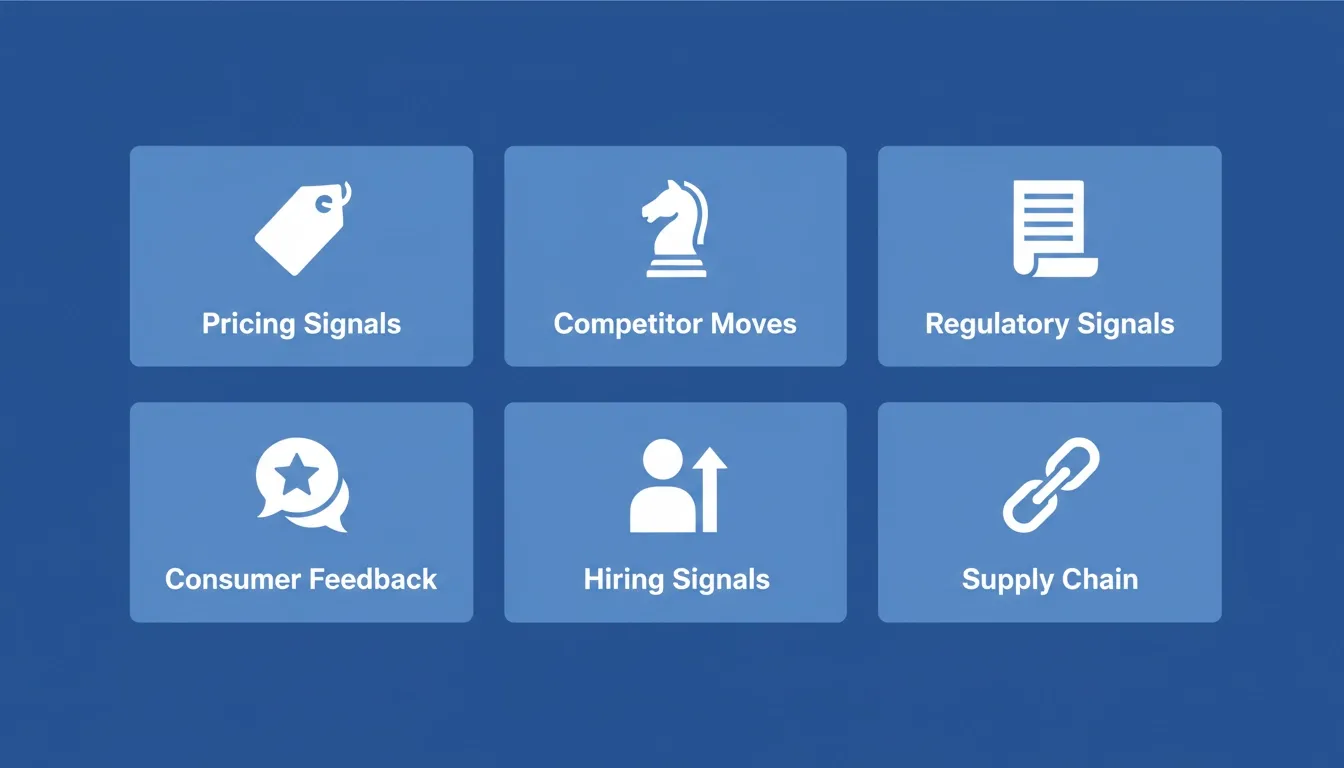
Regulatory Signals, Market Violations, and Consumer Feedback
Regulatory signals and consumer feedback round out the core monitoring scope. These categories surface what internal data alone cannot.
-
Regulatory signals affect every capital-intensive sector. When regulators update rules or launch investigations, businesses already tracking those signals can respond faster and with less disruption.
-
The SBA provides guidance on competitive analysis covering how to identify practices that could harm your position (SBA). In regulated sectors, market power abuses are tracked and reported through formal channels.
-
ISO standards provide a reference framework. ISO 20252 governs market, opinion, and social research. ISO 9001, ISO 14001, and ISO 31000 address conduct monitoring and risk management relevant to competitive tracking programs.
-
Consumer feedback is often the fastest-moving signal. Reviews, complaints, and survey data reflect changes before formal reports document them. When consumers of a competitor raise complaints about response times, that is a visible window.
-
Your own review data is a warning system. When your reviews shift in tone, that shift happened before internal data captured it. Tracking consumer feedback continuously gives context that periodic reports never quite provide.
Consumers signal change before formal reports ever document it. That speed advantage only exists for teams with an active market tracking process in place.
Which Sources and Which Cadence Work Best for Your Industry?
Once you know what to track, the question is where to look and how often. Matching your cadence to the pace of your specific market prevents the two most common tracking failures - missing signals by checking too infrequently, and burning out on noise by checking too often.
-
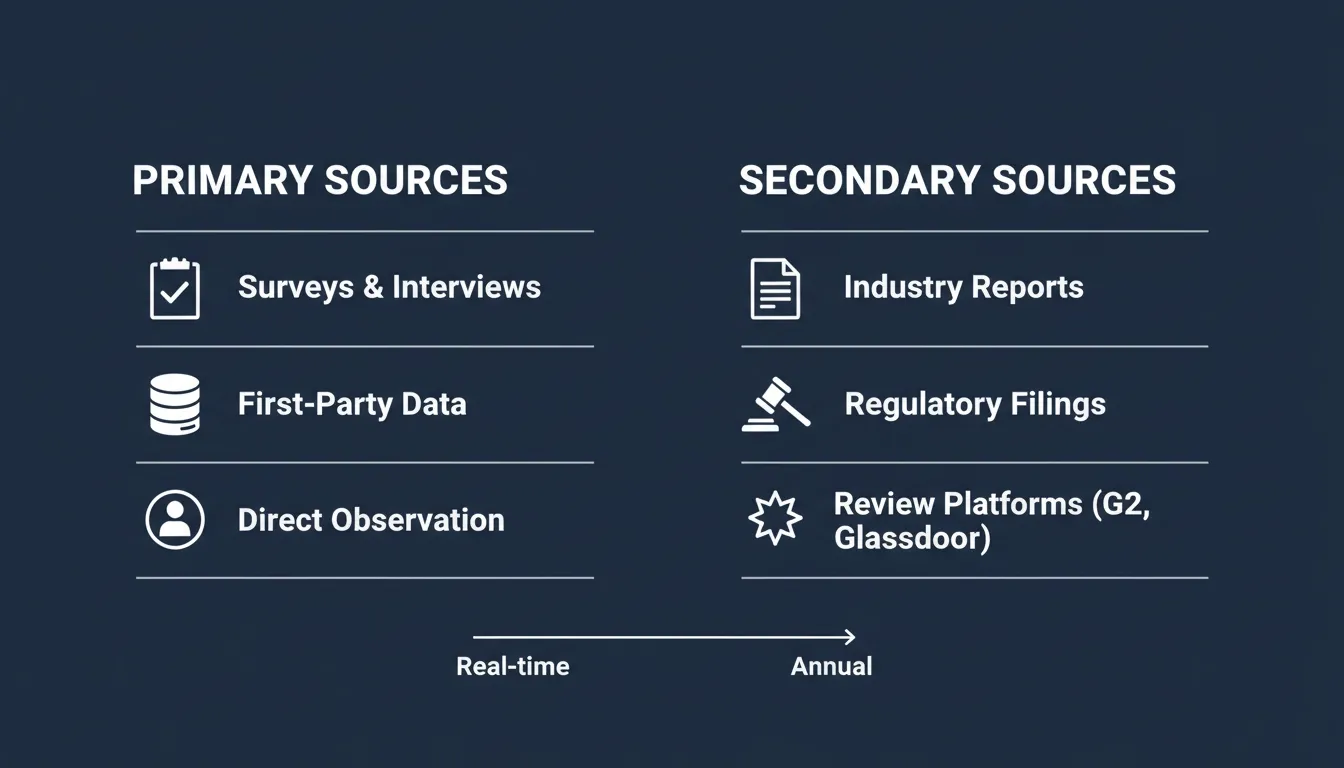
Primary sources: direct collection through surveys, interviews, and first-party data
-
Secondary sources: reports, filings, PDF publications, and review platforms
-
Cadence: daily, weekly, monthly, or quarterly depending on market pace
The sections below cover sources and cadence in detail.
Primary vs. Secondary Sources
Primary and secondary sources serve different questions at different cadences. A well-structured program draws from both.
| Source Type | What It Tells You | Refresh Rate | Best For |
|---|---|---|---|
| Competitor website changes | Messaging, pricing, product direction | Real-time to weekly | Competitive positioning |
| Industry reports and PDF publications | Sector trends, benchmarks, market size | Quarterly or annual | Strategic planning |
| Review platforms (G2, Glassdoor) | Consumer and employee sentiment | Weekly | Reputation and product gaps |
| Regulatory filings and ISO documentation | Conduct requirements, compliance shifts | As published | Regulated industries |
| Social media and news feeds | Brand activity, public sentiment | Daily | PR and competitive moves |
| Trade and commodity data | Price benchmarks, supply chain indicators | Daily or weekly | Manufacturing, energy, retail |
-
PDF publications are secondary source mainstays. Most industry associations and regulatory bodies publish findings in PDF format. ISO standards documentation, conduct rules, and annual state-of-market reports are key resources for compliance-focused teams.
-
Independent System Operators (ISOs) in energy markets are established bodies responsible for monitoring wholesale power markets. An ISO's reports do not necessarily reflect the views of any single market participant - they represent an independent assessment across the full range of actors.
-
ISO 27001 and ISO 9001 serve software and services sectors in compliance monitoring functions distinct from energy market ISO conduct reports.
The right source combination matches the pace of your market. A fast-moving software sector runs on daily social and review data; a regulated commodities team refers heavily to ISO filings and conduct PDFs.
For teams building omnichannel customer experiences, layering review data with social listening is especially critical.
Setting a Cadence That Matches Your Market's Pace
Cadence is where most market monitoring programs fall apart. Teams either check everything once a quarter and miss real-time signals, or try to monitor daily and burn out.
-
Daily cadence makes sense for social media, news, and review activity in fast-moving sectors. A product launch or viral consumer complaint can shift response options within hours.
-
Weekly cadence suits competitive website tracking, job posting analysis, and industry news review. Most competitors do not shift their positioning overnight.
-
Monthly cadence works for deeper analysis: report review, competitive benchmarking, and internal feedback loops. This is where teams review patterns and adapt strategy.
-
Quarterly or annual cadence is appropriate for stable markets or strategic planning cycles. ISO standards updates and major regulatory changes typically happen at this pace.
A comprehensive program that nobody runs is less valuable than a focused one that works every week. Start with the cadence your team can actually maintain, then build from there.
From Monitoring to Decisions: What Happens After You Spot a Signal?
Tracking signals is only useful if your teams know what to do with them. The signal-to-decision flow works best when it follows a clear classification path.
-
Informational signals get logged and continue to be monitored. No immediate action required.
-
Signals requiring action get routed to the relevant team contact. A pricing signal goes to sales; a regulatory update goes to legal or compliance.
-
Pattern-level signals get escalated to leadership. These indicate a larger strategic shift happening across multiple data points.
-
The feedback loop matters as much as the initial response. Information from teams that act on signals tells you which categories are actually driving decisions.
Over time, this feedback tightens monitoring priorities and makes each review cycle more useful. Teams that invest in business workflow automation can route these signals automatically, reducing manual triage time significantly.
Building an Internal Monitoring Unit
The most mature organizations build a dedicated market monitoring unit. It does not have to be large - two or three people supported by the right tools can run an effective function.
-
Signal collection: Pull data from established sources across all monitoring categories - website tracking, review platforms, regulatory filings, and news feeds.
-
Signal classification: Identify which signals are informational, which require a response, and which indicate a pattern worth escalating to the relevant contact within leadership.
-
Distribution: Route intelligence to the teams that can act on it. Building clear contact routes for each signal type is what makes a monitoring unit work in practice.
-
Feedback loop: Collect responses from internal stakeholders to calibrate what matters. This is how the unit gets smarter over time.
-
ISO-compliant data collection practices are worth adopting for teams in regulated sectors where conduct reporting requirements refer to specific ISO standards.
-
In regulated markets, an independent market monitor may be formally established by a regulatory body to assist with oversight. These independent monitors evaluate market conduct and submit findings to the relevant regulatory contact.
"You can imagine my relief when we were able to hook up the API and just automatically see so many answers come pouring in. That was the biggest sanity-saving thing we've created." - Logan Hart, Competitive Intelligence Lead at ZoomInfo (Crayon blog, October 2025)
The structural logic applies whether you operate in a regulated market or not: a defined function, responsible for clear activities, with established contact routes to the people who act on the intelligence.
When Market Design Flaws and Abuses Surface
Not every market operates as intended. Market design flaws allow certain market participants to gain advantages that harm others - and these patterns are rarely visible until teams are actively watching.
-
Market power abuses occur when a dominant player restricts competition through predatory pricing, exclusionary contracts, or information asymmetries.
-
According to Crayon's 2025 State of Competitive Intelligence, sellers compete against rivals in 68% of deals, yet most teams rate their competitive preparedness at just 3.8 out of 10 (Crayon). That gap reflects what happens when competitive conduct goes untracked.
-
ISO conduct reports filed by Independent System Operators are a useful structural model. ISOs monitor conduct across all market participants, identify patterns consistent with market power abuses, and submit findings to regulators.
-
An ISO's reports do not necessarily reflect the views of any single stakeholder. They represent an independent assessment of what is happening across the full range of actors in the market.
-
Once a market shift or violation has fully played out, most response options are gone. Early detection is where this work pays off.
The organizations that catch these signals early can respond before real harm has occurred. This is where continuous conduct tracking justifies the investment.
How Rocket Intelligence Watches Every Signal So You Don't Have To
For most teams, the monitoring work above is spread across too many tools and too many people. Rocket Intelligence is built to close that gap, monitoring every public platform a competitor operates on, continuously, and interpreting what signals mean for your specific business context.
-
Website changes: Every pricing page update, product announcement, messaging shift, and positioning change across competitor sites.
-
Social and news signals: Posts, campaigns, press coverage, and executive statements across LinkedIn, X, Instagram, Facebook, YouTube, TikTok, and Reddit.
-
Reviews and reputation: Sentiment shifts on G2, Glassdoor, Capterra, and app stores. Tracks how consumers respond to competitor changes over time.
-
People and hiring: Headcount, job posting velocity, key exits, and new hires. A burst of enterprise sales openings is a signal. A wave of AI-focused hires is a signal. Rocket connects these dots automatically.
-
Performance marketing: Ad activity and messaging across Meta, LinkedIn, and TikTok.
-
The daily brief: Every day, Rocket delivers a structured brief covering what changed, what patterns are forming, and what your business should do. This is not a list of alerts - it is an interpretation layer.
-
A pricing update in isolation is noise. That same update alongside defensive review responses, new enterprise job openings, and a shift in social content tells a clear strategic story. Rocket reads signal clusters, not individual changes.
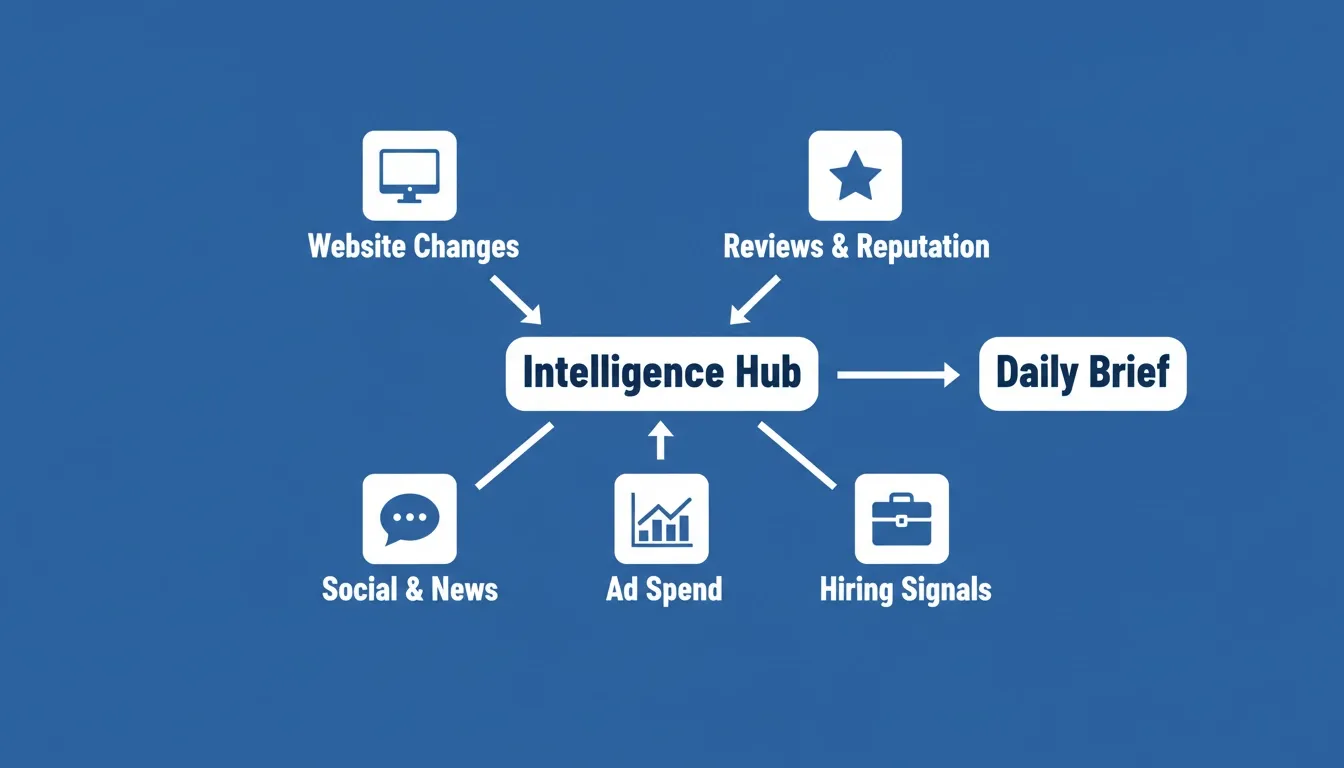 Rocket Intelligence consolidates collection, interpretation, and delivery in one continuous system
Tools like Google Alerts send you articles but do not tell you what they mean. Other competitive platforms track specific signal types but require you to do the interpretation work yourself. Rocket handles collection, interpretation, and delivery in one place, framed relative to your own business context. If you are interested in seeing how this works on your actual competitors, Rocket Intelligence lets you start free and follow your first company in under 30 seconds.
Understanding how competitor repositioning gets detected early is one of the clearest illustrations of why automated market monitoring outperforms manual processes. Teams that rely on social media monitoring software as a standalone tool often miss the cross-platform signal clusters that reveal true strategic intent.
Staying Sharp in Markets That Never Stand Still
Industry conditions do not stay fixed: prices shift, consumer preferences change, and new market participants enter. The organizations that build a continuous process for tracking these signals, and turning them into decisions, are the ones that stay ahead of changes that reactive teams catch only after the fact.
You need a clear scope of what you are tracking, a reliable set of sources, a consistent cadence, and a process for routing signals to the right contact points. Start with the categories that matter most for your sector.
If you want to skip the manual setup entirely, Rocket.new gives you continuous competitive intelligence from day one start free and follow your first competitor in under 30 seconds.
Table of contents
- -What Does a Market Monitoring Program Actually Cover?
- -Prices, Conduct, and Competitor Moves
- -Regulatory Signals, Market Violations, and Consumer Feedback
- -Which Sources and Which Cadence Work Best for Your Industry?
- -Primary vs. Secondary Sources
- -Setting a Cadence That Matches Your Market's Pace
- -From Monitoring to Decisions: What Happens After You Spot a Signal?
- -Building an Internal Monitoring Unit
- -When Market Design Flaws and Abuses Surface
- -How Rocket Intelligence Watches Every Signal So You Don't Have To
- -Staying Sharp in Markets That Never Stand Still