
Building an MVP in 2026 costs $10K–$150K+ the traditional way and takes months. Rocket.new lets founders build real, deployable apps in days for a fraction of the mvp cost breakdown, no code required.
Building an MVP is one of the biggest challenges founders face. Many startups struggle to balance cost, speed, and quality while trying to launch their product.
In 2026, traditional MVP development can cost anywhere from $10,000 to over $150,000, making it difficult for early-stage founders and non-technical teams to move forward without spending heavily. Knowing where costs come from and avoiding common mistakes can save both time and money.
Tools like Rocket.new are changing the process by helping founders build faster and at lower costs. This blog explores MVP expenses, founder challenges, and smarter ways to launch products.
What Does It Really Cost to Build an MVP?
Let us start with the numbers most founders do not see coming. The actual mvp development cost is not just the developer's hourly rate. It is a stack of expenses that adds up fast. Understanding the full mvp cost breakdown before you commit is the difference between a lean launch and a burned runway.
| Cost Category | Traditional Dev Agency | Rocket.new |
|---|---|---|
| Design & Wireframes | $3,000 – $10,000 | Included in build |
| Frontend Development | $8,000 – $40,000 | Prompt-driven, hours not weeks |
| Backend & Database | $10,000 – $50,000 | Built-in infrastructure |
| Quality Assurance | $3,000 – $15,000 | AI-assisted testing |
| Deployment & Hosting | $2,000 – $5,000 | One-click deploy |
| Revisions & Iterations | $5,000 – $30,000 | Unlimited prompts |
| Total Estimate | $31,000 – $150,000+ | Fraction of the cost |
Here is what each of those line items really means for your budget:
-
Design and wireframes: Before a single line of code is written, most agencies bill separately for mockups and design. With Rocket.new, you describe the interface in plain language and it builds it.
-
Frontend development: This is where traditional costs balloon. Component-by-component builds take weeks. Rocket.new generates the entire interface from a prompt in hours.
-
Backend and database: The plumbing most non-technical founders do not see is often the most expensive part. Rocket.new builds this alongside your frontend automatically.
-
Quality assurance: Manual testing cycles add cost and delay. Rocket.new's AI-assisted build catches logic errors during generation, not after deployment.
-
Revisions and iterations: Every change request to an agency costs money. On Rocket.new you prompt, refine, and update without additional billing per change.
The gap between traditional development and AI-powered builders is not small, and neither is the timeline. A traditional MVP takes 3 to 9 months. With Rocket.new, founders are shipping working code in days.
Key Factors That Drive MVP Development Cost Higher
Understanding what drives mvp development costs up is essential for any founder trying to build an MVP on a realistic budget. The core factors are feature complexity, technology stack choices, team structure, and development approach. Each one can significantly increase mvp cost if not managed from the start.
-
Feature complexity: The more complex the feature set, the higher the development cost. Prioritize core features that validate your core value proposition. Nice-to-haves can wait.
-
Technology stack: Custom development using specialized tech stacks requires skilled developers at higher hourly rates. Rocket.new's built-in infrastructure removes this variable entirely.
-
Team structure: An in-house team carries salaries, equipment, and ongoing expenses. Outsourcing to a development agency or freelancers adds coordination overhead and scope creep risk.
-
Development approach: Agile development with short sprints and continuous iteration is faster and cheaper than waterfall. AI-assisted development is faster still.
Hidden Costs Most Founders Overlook
Beyond the obvious line items, there are hidden costs that consistently catch founders off guard. Post-development costs including ongoing maintenance, server costs, security patches, and bug fixing can add 15–20% of the initial build cost every year. Infrastructure costs for cloud hosting scale with traffic, and third-party API and payment processing integrations carry their own fees.
These post-launch expenses are rarely included in agency quotes. Rocket.new's one-click deployment and built-in infrastructure significantly reduce these hidden expenses from day one. Every build ships with SEO-ready structure, WCAG accessibility compliance, GDPR coverage, and performance optimization included, not bolted on later.
The Trap Most Founders Fall Into
Most founders start with conviction. They believe in their idea, and they go straight into build mode. Months of work later, they have a polished product that real users have never touched.
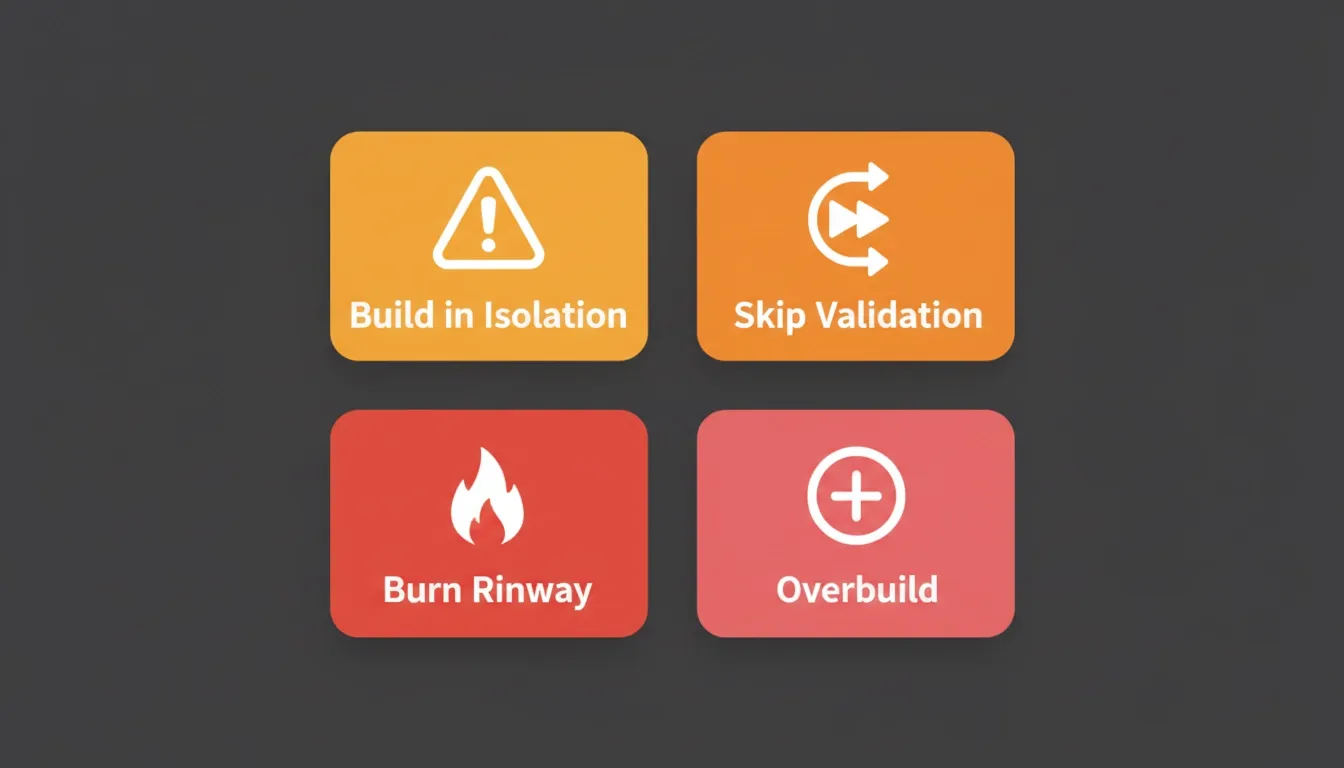 Here is why that pattern keeps repeating, and why it keeps failing:
-
Building in isolation: Spending months developing a product without external feedback means you are optimizing for assumptions, not real user needs.
-
Skipping proper validation: Many founding teams mistake enthusiasm from friends and colleagues for market demand. These are very different signals.
-
Burning runway before launch: Initial costs pile up fast during long development cycles. By the time a product is ready to test, there is often little budget left to iterate.
-
Overbuilding the first version: The temptation to add features before launch is strong, but every added feature increases cost, extends the timeline, and delays real user feedback.
Startups fail at alarming rates. 90% of startups do not survive, and the leading cause is not bad execution. It is building something the market does not want. (Source: Exploding Topics)
The smarter path is to build a small, fast version first. Get it in front of real users. Collect real user feedback. Then invest in growth.
Scope Creep: The Silent Budget Killer
Scope creep is one of the most consistent cost drivers in traditional MVP development. It happens when requirements expand beyond the original plan, usually because there is no fast, low-cost way to test assumptions before building. Every added feature requires additional development time, additional testing, and additional project management.
With Rocket.new, scope creep loses its teeth. You can build, test, and iterate in hours rather than weeks, which means you validate demand before committing resources. Before writing a single prompt, the Rocket.new Solve capability helps founders research the market and get a clear, evidence-backed recommendation on exactly what to build.
What the Market Research Actually Shows
Good market research does not just tell you whether people like your idea. It tells you whether they will pay for it, use it consistently, and tell others about it. That is a very different bar to clear.
Here is what proper market research actually involves, and where most founders cut corners:
-
Talking to strangers, not friends: Friends give encouraging feedback. Strangers give honest feedback. Your user base will be made up of strangers.
-
Watching behavior, not asking opinions: What people say they will do and what they actually do are rarely the same. Behavioral data from a live product is far more reliable.
-
Building a waiting list early: A sign-up form tells you far more about real demand than a survey. If people will not give you their email, they will not give you their money.
-
Testing core assumptions fast: Every product rests on a set of core assumptions about the user, the problem, and the solution. Validating these early is the whole point of an MVP.
-
Using working software to validate demand: The fastest way to do proper market research is to put a real, working product in front of people within days, not months.
The difference between startups that find product market fit and those that do not almost always comes down to the speed of this loop. With 1.5 million people across 180 countries already using Rocket.new, the platform has proven it can compress months of traditional development into days. Learn how the Rocket.new validation loop works in practice before you commit to building.
Build an MVP Without Writing Code: A Win for Non-Technical Founders
For most of startup history, non-technical founders without a co-founder who could write code had one option: hire out. That meant agencies, freelancers, or months of searching for the right technical partner.
Here is what Rocket.new changes for founders who do not write code:
-
No dependency on a developer: You can build, test, and update your product on your own timeline, without waiting for a sprint cycle or a freelancer's availability.
-
Describe your product in plain language: Rocket.new takes your description and generates working code, including front-end interface, back-end logic, and database structure.
-
Test an idea this week: What used to take months to assemble now takes days. That changes the entire calculus of when and how much to invest.
-
Iterate on real user feedback immediately: When users point out issues or request changes, you can act on them the same day. No ticket queue, no billing cycle.
-
Own your code from day one: Rocket.new outputs real, exportable code with full 2-way GitHub sync. You are not locked into a proprietary system.
"I've been able to build a complex app front and back end which otherwise would have cost me upwards of £60k." — Tracy Trew, verified Rocket.new user (Trustpilot, May 2026)
That quote captures the shift perfectly. Not a simple landing page, but a complex app, front and back end, at a fraction of the traditional cost.
No-Code Tools vs. Custom Development: A Development Approach Comparison
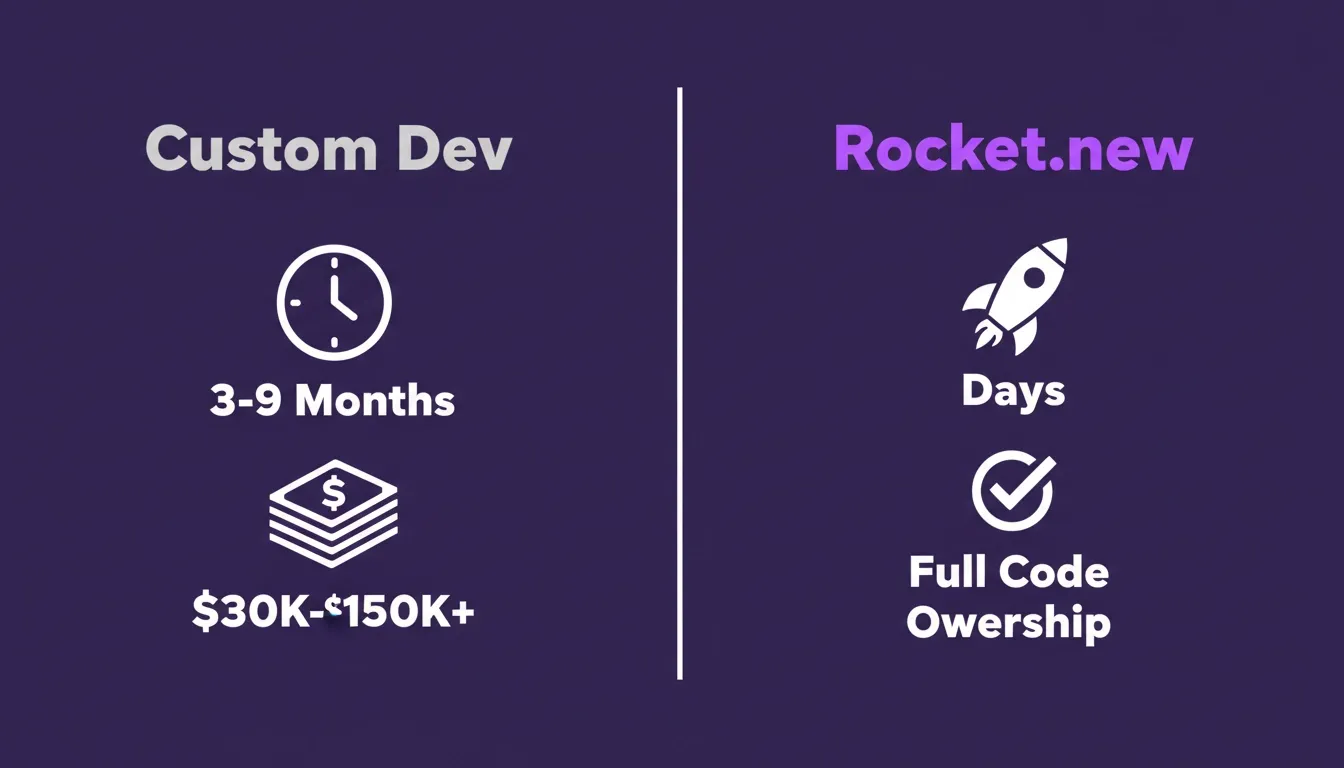 The rise of AI-assisted development has fundamentally changed the cost structure for early-stage MVPs. Where custom development once required a full development team, a defined technology stack, and months of development time, Rocket.new now lets founders ship a production-ready product in days.
Unlike traditional no-code platforms that hit a ceiling, Rocket.new outputs real, exportable code that scales with your product.
You can start from a natural language prompt, a Figma file, an existing Next.js codebase, or choose from 25,000+ free templates, all carrying your brand, stack, and goals already in. Every build includes staging and production environment separation, version control, and one-click deploy on a custom domain.
| Development Approach | Timeline | MVP Budget Range | Code Ownership | Scalability |
|---|---|---|---|---|
| In-House Team | 4–9 months | $80,000–$200,000+ | Full | Full |
| Development Agency | 3–6 months | $30,000–$150,000 | Partial | Depends on contract |
| Freelancers | 2–4 months | $15,000–$60,000 | Partial | Variable |
| No-Code Platforms | 2–6 weeks | $500–$5,000 | None | Limited |
| Rocket.new | Days to weeks | Fraction of above | Full | Full |
How Rocket.new Fits Into Your MVP Cost Breakdown
Rocket.new is the world's first Vibe Solutioning platform, covering the full arc from market research to a live product to continuous competitive intelligence, in one system with one shared context. There are three paths most founders take when they decide to build an MVP, and understanding the difference changes how you budget from the start.
-
Hire a developer or agency: High initial cost ($30,000 to $150,000+), long timelines (3–9 months), limited control after handoff, and expensive change requests.
-
Older no-code platforms: Faster to start, but most hit a ceiling. When you need to add features, integrate APIs, or grow your user base, you often have to rebuild from scratch.
-
Rocket.new: Generates real working code. No vendor lock-in. Deployable and scalable from day one. Built for founders who want to move fast without paying for a full development team.
What You Can Build on Rocket.new
Rocket.new's Build capability supports a full range of product types, all production-ready from the first prompt:
-
Web apps and Flutter mobile apps with database, authentication, and logic in one build
-
SaaS products with pricing pages, dashboards, user accounts, and payment flows
-
Internal tools like client portals, admin panels, and data management systems
-
Online stores with cart, checkout, and payment processing built in
-
Multi-page websites and customer portals, responsive by default
Where Rocket.new Pulls Ahead of the Competition
| Platform | Trustpilot Score | Code Ownership | AI-Powered Build | Scalable Output |
|---|---|---|---|---|
| Rocket.new | 4.1 / 5 (105 reviews) | Yes, full GitHub sync | Yes | Yes |
| Bolt.new | 1.4 / 5 (178 reviews) | Partial | Yes | Limited |
| Replit | 3.2 / 5 (1K reviews) | Yes | Partial | Yes |
| Base44 | 2.4 / 5 (595 reviews) | No | Yes | Limited |
Trustpilot data confirmed May 2026. The support difference is striking. Rocket.new users consistently cite the team stepping in on complex issues in real time, a pattern not seen with competitors.
"The platform enabled me to build a professional SaaS with zero SEO errors and 96% site health straight out of the build no developer required. PostRight now has live customers and real revenue."— Joshua Coley, founder (Trustpilot, April 2026)
Real customers, real revenue, no developer required. That is the outcome Rocket.new is built around. See a full comparison of Rocket.new vs Bolt.new to understand exactly where the gap lies.
Quality Assurance Without a QA Team
Quality assurance is one of the most consistently underestimated line items in any MVP budget. It takes time, it takes people, and it still misses bugs that users find on day one.
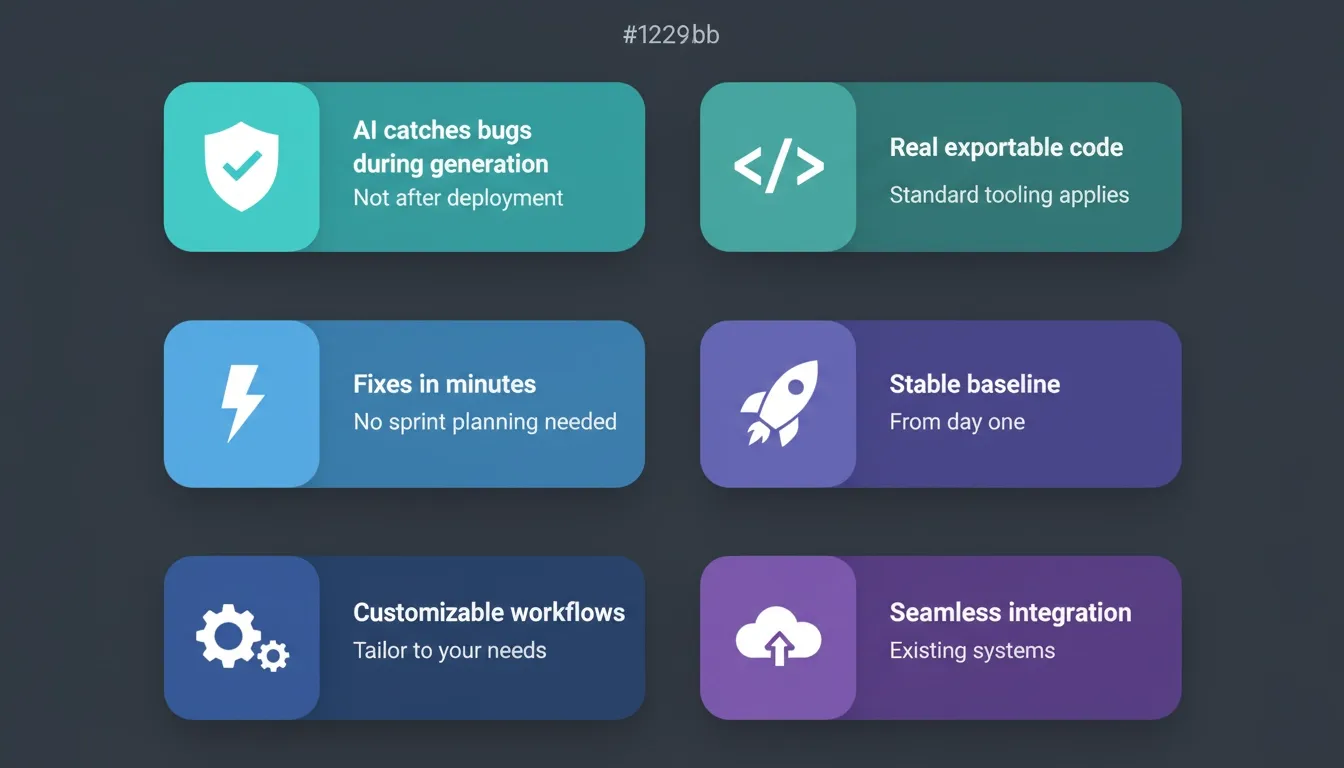 Here is how Rocket.new approaches this differently:
-
AI-assisted build process catches errors during generation: Logic issues are flagged before the app is deployed, not after users report them.
-
Real code means standard tooling applies: Because Rocket.new outputs actual code, developers can run standard quality assurance testing processes and review tools if needed.
-
Faster iteration means faster fixes: When issues do surface, changes are a prompt away. No sprint planning, no change request fees.
-
More stable baseline than a rushed agency build: Time-pressured agency builds often cut quality assurance to meet deadlines. Rocket.new's generation process does not have that trade-off.
Starting from a stable, tested baseline at a tenth of the traditional cost is not just a budget win. It is a better product launch. Every Rocket.new build also ships with built-in analytics and performance monitoring, so you catch issues before they become problems.
The Right Way to Think About MVP Costs
The real question is not "how much does an MVP cost?" It is "what is the minimum I need to spend to validate demand?" Those are very different questions with very different answers.
Here is how to reframe the cost conversation:
-
Separate validation spend from build spend: Before committing to a full product, spend the minimum needed to prove someone will pay for it. A basic sign-up page can do this for almost nothing.
-
Use cost-per-learning as your metric: Instead of tracking how much the MVP costs in total, track how much each round of user feedback costs. Lower is better.
-
Short iterations beat long builds: Multiple fast cycles based on real user feedback will always produce a better product than one long build cycle based on assumptions.
-
Gartner backs the shift to AI-powered builders: 70% of new applications will use low-code or no-code platforms as the primary development method, driven by speed and budget pressure. (Source: Kissflow citing Gartner)
-
Free plan means zero risk to start: Rocket.new's free plan gives you 20 credits with no credit card required, enough to build 1–2 websites or 5–6 landing pages. That removes the biggest barrier for most early-stage founders.
The founders who validate demand fast and iterate based on real feedback are the ones who survive. The ones who spend six months in stealth building a perfect product are the ones who make up that 90% failure rate.
Cost-Saving Strategies That Actually Work
Founders on tight budgets can significantly reduce development costs without sacrificing quality by following a few proven cost-saving strategies:
-
Prioritize core features only: Define the minimum viable feature set that proves your core idea. Cut everything else.
-
Use pre-built solutions: Leverage open-source tools, third-party APIs, and existing infrastructure rather than building from scratch.
-
Avoid over-engineering: Technical debt from unnecessary complexity is expensive to fix later. Keep the architecture simple at the MVP stage.
-
Choose AI-assisted development: Rocket.new can reduce development time from months to days, which directly reduces your total mvp budget.
-
Solve before you build: Use Rocket.new's Solve capability to research the market and validate demand before writing a single prompt. This eliminates the most expensive mistake founders make: building the wrong thing.
Stop Overpaying to Learn: The Smarter MVP Approach
The minimum viable product was never meant to be a polished launch. It was designed to be the smallest, cheapest version of an idea that could prove whether the idea is worth pursuing.
The problem is that "minimal" in traditional development still costs tens of thousands of dollars and takes months to deliver. Rocket.new closes that gap. For a fraction of the traditional mvp development cost, non-technical founders can build working apps, ship them fast, and start collecting real user feedback before committing to a full build.
With competitive intelligence built in, Rocket.new also watches what your competitors do after you launch, so you are never flying blind. The platform's AI app builder for non-technical founders has helped over 1.5 million people across 180 countries ship faster.
Ready to cut your MVP development cost and ship faster? Start building on Rocket.new today.
Table of contents
- -What Does It Really Cost to Build an MVP?
- -Key Factors That Drive MVP Development Cost Higher
- -Hidden Costs Most Founders Overlook
- -The Trap Most Founders Fall Into
- -Scope Creep: The Silent Budget Killer
- -What the Market Research Actually Shows
- -Build an MVP Without Writing Code: A Win for Non-Technical Founders
- -No-Code Tools vs. Custom Development: A Development Approach Comparison
- -How Rocket.new Fits Into Your MVP Cost Breakdown
- -What You Can Build on Rocket.new
- -Where Rocket.new Pulls Ahead of the Competition
- -Quality Assurance Without a QA Team
- -The Right Way to Think About MVP Costs
- -Cost-Saving Strategies That Actually Work
- -Stop Overpaying to Learn: The Smarter MVP Approach