Consultants who package their expertise into a digital client system stop losing value at the engagement close. Clients get structured access to frameworks and progress tracking. The methodology stays alive between calls.
What happens to your consulting frameworks the moment a project ends?
Most of them disappear into a slide deck nobody opens again. The methodology that took years to develop reaches clients once, during a live engagement, then goes quiet. A digital client system changes that. It gives clients structured, ongoing access to your frameworks, templates, and progress tracking between engagements.
This blog covers what a digital client system includes, how it shifts the consulting relationship, and how to build one without a development team.
Why Consulting Knowledge Disappears After the Engagement
What makes consulting knowledge so hard to preserve after a project closes? The frameworks get buried in slide decks. The strategies collect dust in shared drives that nobody opens again.
According to ConsultingSuccess research, high-performing consulting firms earn 70% of their revenue from existing clients. Yet most consulting services end with a final report and a handoff call, leaving customers to apply what they learned on their own.
The gap between what consultants know and what clients can actually use is the core problem a digital client system solves. A digital consulting approach lets you package your methodology into a structured system that customers access on their own time. That shift from project delivery to a persistent digital model is what separates practices that scale from those that stall.
Professionals already making this move are turning consultant playbooks into paid digital services and rethinking how their consulting services reach clients altogether.
What Happens to Consulting Knowledge After the Last Deliverable?
Most consulting firms follow a familiar arc: diagnose, advise, deliver, move on. The quality of the work is rarely the issue. The issue is that clients lose access to it almost immediately. Here is how that plays out in practice.
-
Slide decks go unread. Clients receive a final presentation and reference it once, maybe twice. Within three months, the document is buried somewhere in their inbox. The pain points that prompted the engagement start resurfacing.
-
Frameworks lose context without the consultant. A pricing model or go-to-market framework only works when someone explains the logic behind it. Without that support, clients revert to old business processes. Digital consulting services exist to fix this problem, yet most consultants still default to PDFs and one-off workshops.
-
Repeat questions create repeat work. A consultant working on three or four accounts at once spends hours re-explaining concepts that already shipped. Customer expectations for ongoing access keep rising.
-
Knowledge stays locked in one person. Independent consultants carry decades of experience, but that knowledge only reaches clients during live calls. The methodology behind a successful engagement never makes it past the conversation.
What Does a Digital Client System Actually Look Like?
A digital client system is not a course platform or a shared Google Drive folder. Instead, it is a structured digital environment built around your own methodology. Customers follow a process, access relevant content, and track their own progress between engagements.
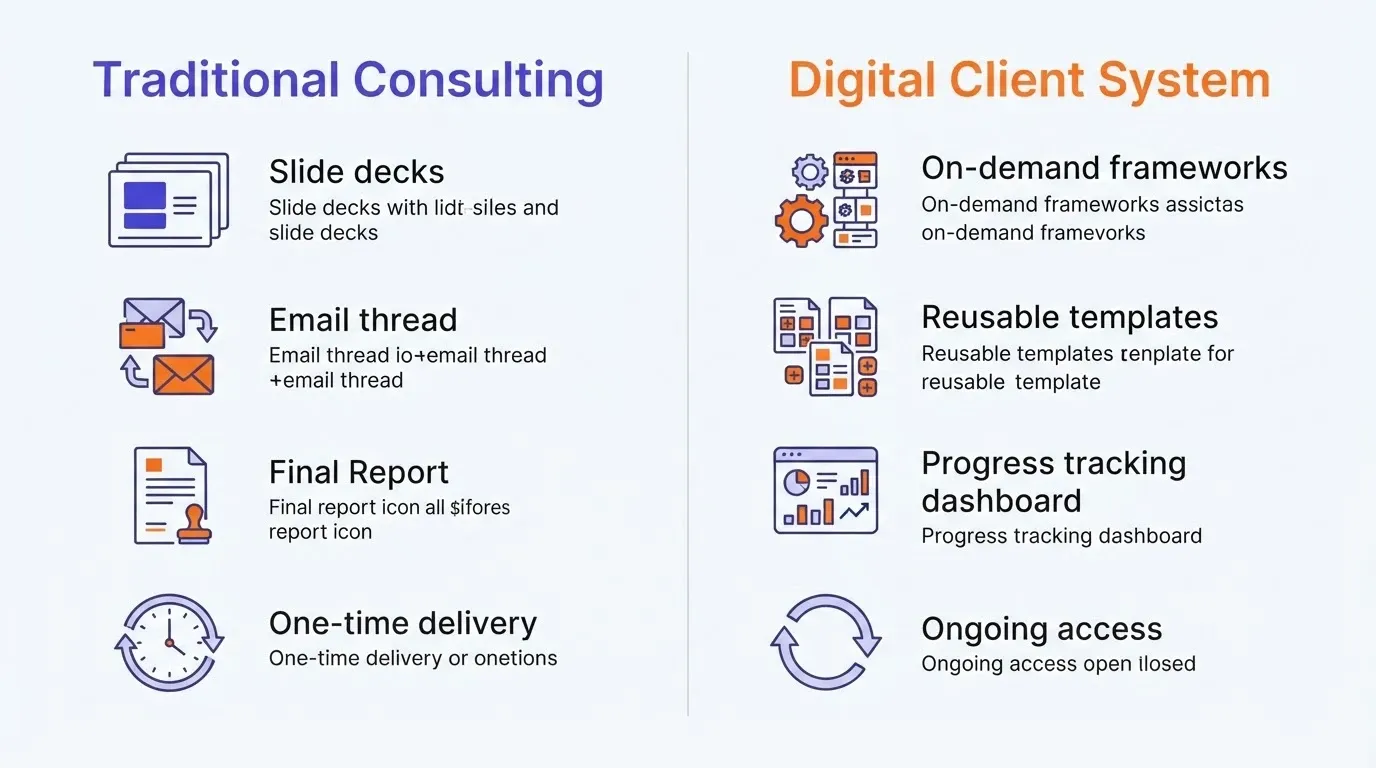
The difference between traditional delivery and a digital consulting system comes down to what clients can do on their own.
| Feature | Traditional Consulting | Digital Client System |
|---|---|---|
| Framework access | Slide deck sent once | On-demand inside the portal |
| Template availability | Attached to final email | Ready to use at any stage |
| Progress tracking | None after engagement | Built-in dashboards |
| Client communication | Scheduled calls only | Async access between sessions |
| Knowledge retention | Declines within weeks | Persistent and updated |
| Revenue model | Project-based fees | Subscription or retainer |
| Scalability | Capped by consultant hours | Concurrent clients, same system |
Three things make this a structural shift, not just a technology upgrade.
Methodology becomes a product. The business processes you guide clients through get codified into steps, templates, and data checkpoints. Your approach stops living in your head and starts living in a system.
Clients self-serve between calls. Most customers want to keep moving forward while you work with other accounts. A structured digital environment lets them do that on their own schedule, without waiting for the next session.
Data drives the next conversation. Instead of guessing where clients are stuck, you check analytics inside the system. As a result, every follow-up becomes targeted rather than a catch-up call.
For advisory firms already building toward this model, turning consulting knowledge into a subscription-based platform shows how the revenue model evolves once the system is in place.
How This Shifts the Consulting Relationship
When consultants move from project-based delivery to a persistent digital model, the relationship with clients fundamentally changes. Instead of being the person who shows up, fixes something, and leaves, you become the person whose methodology is present between engagements.
That distinction changes how clients perceive value. When the methodology is accessible around the clock, perceived value goes up. Meeting client expectations becomes easier when the system delivers answers between calls. Retention improves because the experience is continuous, not episodic.
According to McKinsey's Global Institute, knowledge workers spend about 20% of their time, roughly one full day per week, just searching for and gathering information they already have. A digital consulting system eliminates that friction for your clients entirely.
Progress becomes visible through data, not something discussed only in a quarterly call. Frameworks get applied more consistently because the journey is structured, not improvised.
Common Mistakes Consultants Make When Packaging Their Expertise
Before building the system, it is worth naming what goes wrong when consultants try this without the right approach. These patterns are easy to fall into and costly to undo.
Building a course instead of a system. A course is passive consumption. A digital client system is active application. Clients enter their own data, track their own progress, and apply frameworks to their specific situation.
Recreating the slide deck in digital form. Uploading PDFs to a portal is not a digital client system. The value is in structured workflows, input fields, progress dashboards, and decision trees, not static documents with a login screen in front of them.
Skipping role-based access. Every client should see only their own data, their own progress, and their own next steps. A system where clients can accidentally see each other's information is not a professional client portal.
Launching without a retention mechanism. The system needs a reason for clients to return weekly, not just when they remember. Progress tracking, milestone notifications, and updated resources are what create the habit.
How to Build Your Digital Client System With Rocket
You have the frameworks, the templates, and the methodology. The next question is how to build the system without hiring a development team or spending months on configuration.
Rocket is a Vibe Solutioning platform. Its Build capability generates production-ready web applications in Next.js and mobile apps in Flutter from natural language descriptions. You describe what your consulting methodology looks like, and Rocket builds a working, deployable product in one to three minutes.
Here is what Rocket builds for consulting practices specifically:
-
Role-based client portals. Each client logs in and sees only their own frameworks, their own progress, and their own next steps. No shared logins. No workarounds.
-
Framework and template libraries. Structured, interactive versions of your methodology that clients work through step by step, with input fields and decision logic rather than static PDFs.
-
Progress tracking dashboards. Built-in analytics show which templates clients actually use, where they stall, and when to reach out with targeted guidance.
-
Onboarding workflows. Automated sequences walk new clients through your system from day one, reducing setup time on both sides.
-
Subscription and payment integration. Stripe connects directly into the build so retainer billing, access control, and subscription management are handled automatically.
Every Rocket build ships with GDPR coverage, WCAG accessibility compliance, SOC 2 certification, ISO 27001 compliance, and SEO-ready structure by default. With 25+ integrations, including Stripe, Supabase, Airtable, Notion, Mailchimp, and Mixpanel, you authenticate once and they flow into every build.
According to HubSpot's State of Marketing Report, 61% of marketing leaders say AI represents the biggest disruption in 20 years. Consultants who build their systems now will be well-positioned as clients come to expect digital experiences from every service provider they work with.
Explore what Rocket builds for client-facing systems to see the full range of what is possible.
Step-by-Step: Building Your Consulting Client Portal
Step 1: Describe your system. Go to rocket.new and describe your consulting methodology in plain language. Include the key frameworks clients use, the data you want to track, and how clients should move through the process. Specific prompts produce better first generations.
Step 2: Review and refine. Rocket generates a working, deployable product in one to three minutes. Review the live preview, then refine through chat. Change the data model, adjust the layout, add features, and connect integrations, all in context.
Step 3: Connect your integrations. Authenticate Stripe for subscription billing, Supabase for your database, and Airtable or Notion if you manage client data there. Authenticate once and they flow into every build.
Step 4: Configure role-based access. Each client account sees only its own data. Rocket handles the access control architecture. You define the rules in plain language.
Step 5: Launch. Click Launch. Your system goes live instantly with a shareable URL. Connect a custom domain from the same panel. No external hosting setup is required.
Rocket plans are structured around how much you build and research. Here is how they compare:
| Plan | Price | Monthly Credits | What Is Included |
|---|---|---|---|
| Free | $0 | 20 (one-time) | Build production-ready apps + Light Solve |
| Pro | $25/month | 100 | Build production-ready apps + Light Solve |
| Rocket | $50/month | 250 | Build + Full Solve + Competitive Intelligence |
| Booster | $250/month | 1,500 | Build + Full Solve + Competitive Intelligence + premium support |
What Keeps Clients Connected After the Engagement Ends?
The real test of a digital client system is what happens after the initial project closes. Does the client log in again? Do they apply the frameworks? Do they come back for more? The answer depends on how well the system is designed to keep them engaged.
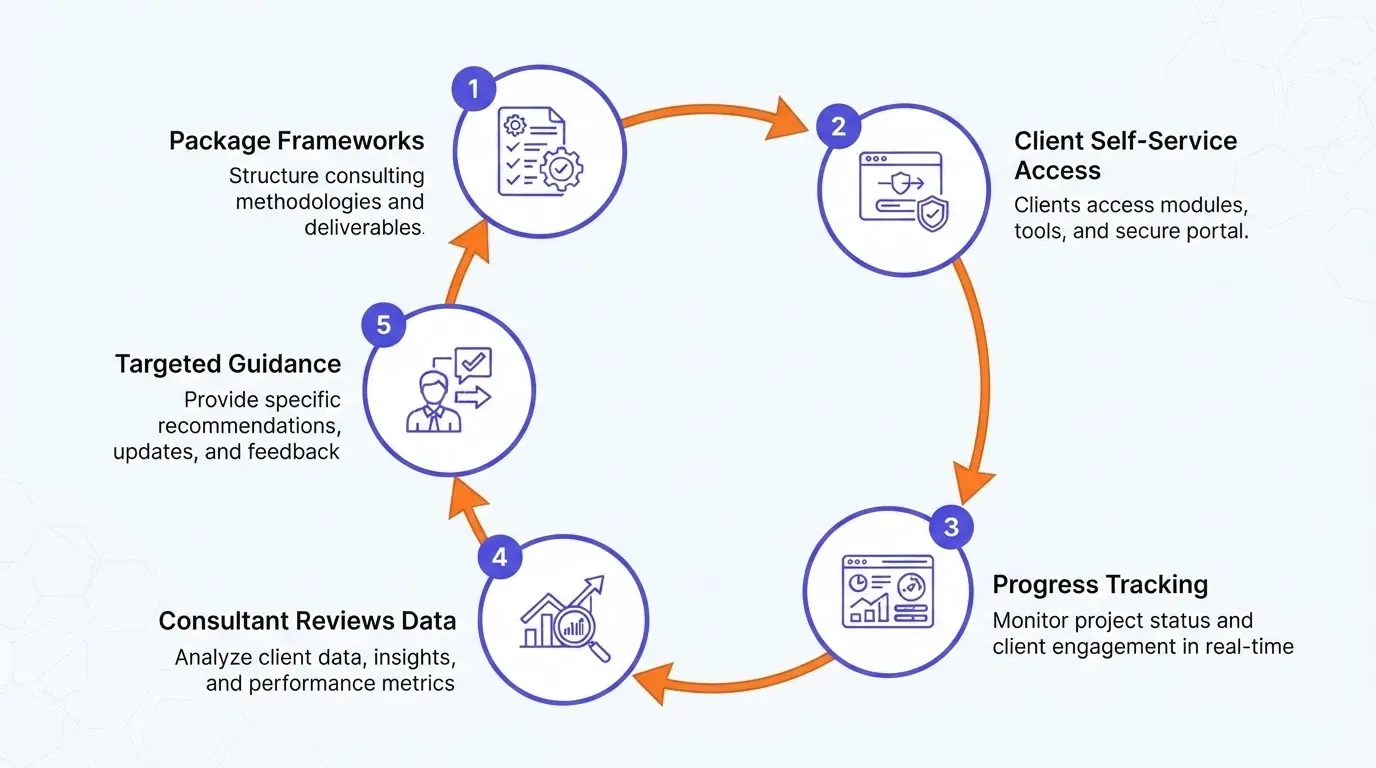
Progress tracking turns passive clients into active users. When customers can see their own milestones, completion rates, and dashboards, the system stops being a reference library and starts being a working tool. Visible momentum keeps clients engaged between sessions.
Key indicators signal when to step in. The system shows when a client stalls, so you can reach out with specific guidance at the right moment rather than on a fixed calendar schedule.
Templates and resources stay current. As your methodology evolves, so does the system. Update once, and every client benefits. No re-sending PDFs and no version confusion.
Ongoing access creates ongoing revenue. When clients stay connected to the system, the business model shifts from project invoices to subscription or retainer revenue. That shift is what separates a consulting practice that scales from one that stays capped by available hours.
The diagram below shows how the continuous engagement loop works once the system is live.
For more on how professional services firms are making this transition, see how professional services workflows become digital products.
Your Consulting Expertise Deserves a System That Outlasts the Project
The consulting practices that scale in the years ahead will treat their methodology as a product, not just a service. A digital client system built around your consulting expertise turns your frameworks into something clients return to, build on, and recommend to others, long after the original engagement closes.
As client expectations continue to rise, the gap between consultants who deliver once and those who deliver continuously will only grow wider. The tools to make that shift are available today.
Describe your methodology to Rocket and see the first version of your client system before your next engagement begins.
Table of contents
- -Why Consulting Knowledge Disappears After the Engagement
- -What Happens to Consulting Knowledge After the Last Deliverable?
- -What Does a Digital Client System Actually Look Like?
- -How This Shifts the Consulting Relationship
- -Common Mistakes Consultants Make When Packaging Their Expertise
- -How to Build Your Digital Client System With Rocket
- -Step-by-Step: Building Your Consulting Client Portal
- -What Keeps Clients Connected After the Engagement Ends?
- -Your Consulting Expertise Deserves a System That Outlasts the Project