
Traditional market research relies too heavily on assumptions, reports, and theoretical TAM/SAM estimates. Rocket.new helps founders validate real demand by building, measuring, and iterating with actual users in days instead of months. Faster experimentation leads to sharper market sizing, stronger competitive intelligence, and better product-market fit.
What if your market research could give you a clear, actionable answer in days, not months?
That’s exactly what the build, measure, iterate approach to market research makes possible. Instead of stacking assumptions on top of industry reports, which often fail to define the real market or customer needs you put something real in front of real people and watch what happens.
According to Exploding Topics, 34% of startup failures come down to poor product-market fit, while 42% of startups collapse simply from misreading what the market actually wants. The guesswork is expensive and avoidable, especially when this approach helps uncover the real problems customers face, not just theoretical issues.
Why Traditional Market Research Gets Founders in Trouble
Most founders treat market sizing like a research project. You pull some industry reports, build a spreadsheet with total addressable market (TAM) and serviceable addressable market (SAM) figures, often based on the number of companies that could theoretically use your product, write a deck, and move on. Founders try to figure out their market size using these estimates.
The problem is that none of that gets tested against real customer behavior.
Your target segment exists on paper. Your assumptions about what your target customer will pay, prefer, or even notice have never seen daylight. And your SAM estimate is based on who could theoretically use your product, not who will actually buy it.
That’s not market analysis. That’s structured guesswork, and you have to ask whether this approach makes sense for your business.
Most AI tools that promise faster market research fall into the same trap. They surface data quickly. But they’re reporting on what has already happened in a market, not what your specific target customer will do when your product lands in front of them. Aligning your market analysis with actual business outcomes is crucial.
The Build, Measure, Iterate Loop for Market Sizing
The build, measure, iterate approach flips the market research process on its head. You don’t research first and build second. You start by building something small, watch how the market responds, and let real behavior sharpen your assumptions. At each cycle, it's crucial to focus on the most critical assumptions or market segments to maximize learning and impact.
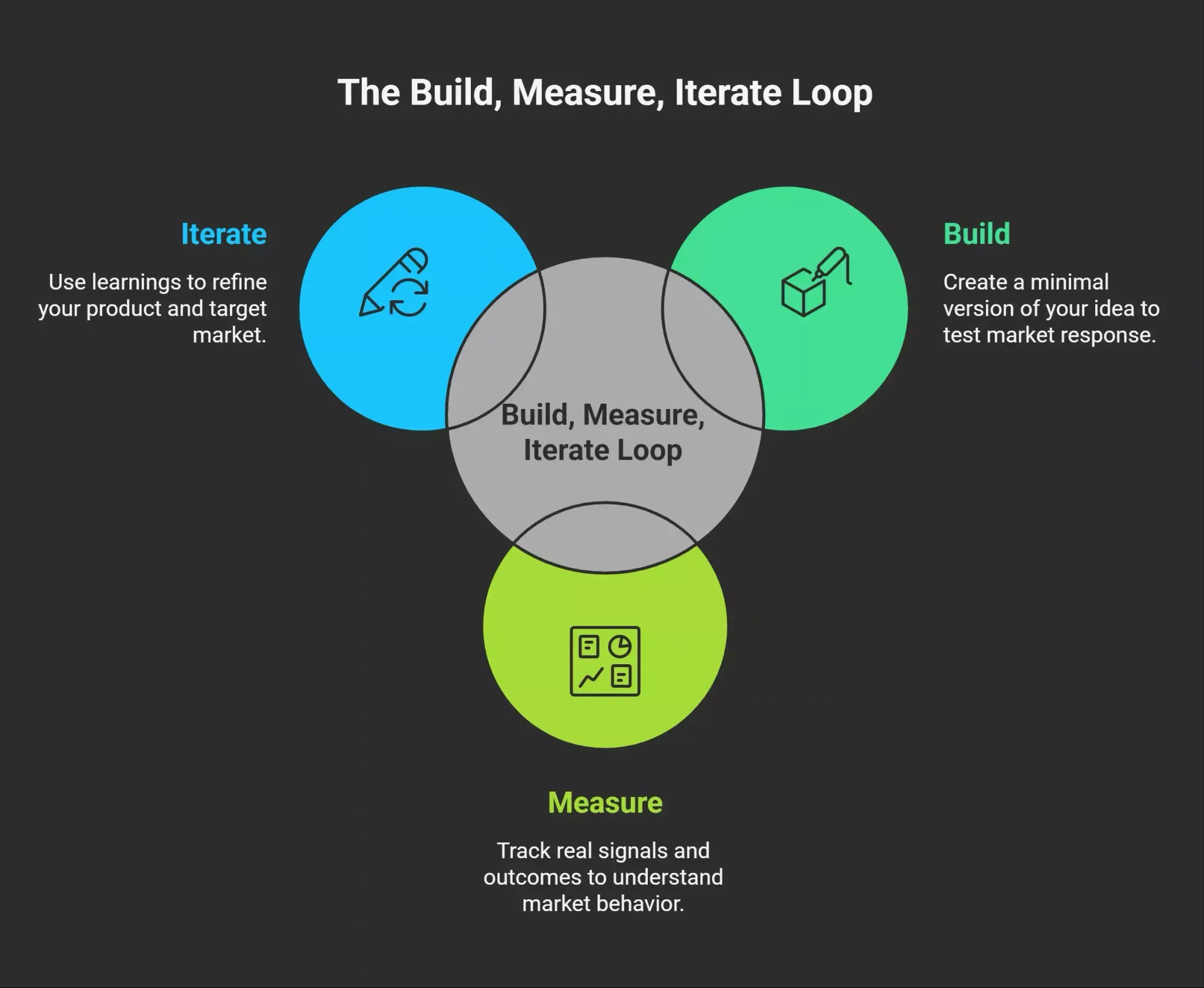 Here’s each step in the loop:
-
Build: Create a minimal version of your idea. A landing page, a single-feature app, or a simple prototype aimed at a narrow target segment.
-
Measure: Track real signals. Sign-ups, drop-offs, click-through rates, time on page. Go beyond surface-level metrics by evaluating outcomes such as adoption, retention, and user engagement to truly understand the impact of your changes.
-
Iterate: Use what you learned to refine your product, your pricing, your target customer definition, or your market segment. Then run the loop again, ensuring you have a clear plan for each iteration to guide structured learning and improvement.
Each time you run this cycle, your market sizing gets sharper. Your SAM narrows to reflect actual demand. Your competitive intelligence shifts from theory to evidence. And your product differentiation gets validated by real customers instead of being assumed by a persona doc.
The key is not skipping steps. Run each step deliberately, build something ready to test, measure what real people do, focus on outcomes, and act on what you find with a solid plan for the next iteration. That’s the whole exercise.
What Good Market Research Actually Looks Like
Good market research today isn’t about reading 80-page industry reports and hoping they apply to your specific niche. The global market research services market reached $93.37 billion in 2025, and a growing share of that spend is shifting toward real-time, AI-driven research methods.
The strongest market analysis combines fast qualitative signals with structured quantitative data:
| Research Method | What It Tells You | Speed |
|---|---|---|
| Landing page test | Early demand signals, willingness to click (for example, running ads to a landing page to see if your target market signs up) | Hours |
| Customer interviews | Pain points, language, priorities (for example, interviewing different groups within your target market to understand their specific needs) | Days |
| Competitor teardown | Gaps in the competitive landscape | Days |
| Prototype testing | Feature validation, drop-off analysis | Weeks |
| Industry reports | Macro SAM and TAM sizing | Weeks |
Starting with landing pages and customer conversations gives you fast, actionable signals and helps you identify and refine your target market. Industry reports help you frame the bigger picture. The mistake most founders make is using only one or the other.
The Community Already Knows This
The startup community is increasingly clear about the right approach. In a recent thread on Reddit’s r/startups (July 2025), a founder building an AI infrastructure product shared exactly this instinct:
“I have a mocked-up MVP, demo, and deck, but I am working on this solo… I want to get started with some outreach to this target customer profile and hopefully get some calls set up.”
That impulse, to get in front of your target customer before claiming to know the market, is the right one. The most actionable market research happens in motion, not in a slide deck. Early feedback from these conversations can help a founder decide when to expand into adjacent or new segments, and real-time feedback can prompt a strategic shift in product or market approach as customer preferences or the competitive landscape evolve.
The Most Common Mistake: Skipping the Middle Step
Most people build something and then jump straight to scale - without actually measuring what worked.
When that happens, the target segment turns out to be wrong. Or the product differentiation isn’t landing the way they thought. Or the SAM estimate was off because they counted everyone who could theoretically use the product instead of the segment willing to pay for it today.
Validate before you scale. That’s not a detour from market research. That is market research.
How You Can Solve on Rocket.new: Vibe Solutioning for Real Market Data
This is where Rocket changes how founders and teams approach market sizing and market analysis.
Rocket is a vibe solutioning platform that takes you from idea to working app in minutes, no code required. Rocket supports your go-to-market strategy by enabling rapid iteration and validation, allowing you to quickly test and refine your approach. The platform covers the full scope of tasks, from initial concept to deployment, streamlining the entire process.
Most AI tools stop at analysis. Rocket helps you build a functioning app you can actually put in front of customers, without needing months of development time or a full engineering team.
Plus, Rocket can present investor-ready reports or presentations quickly, so you’re always prepared for investor meetings. The value Rocket provides lies in refining your product-market fit and competitive positioning, helping you sharpen your value proposition and respond strategically to market shifts.
What Solve Build Looks Like on Rocket.new
The vibe solutioning approach on Rocket.new helps founders and teams at every step of the research cycle with its Solve feature:
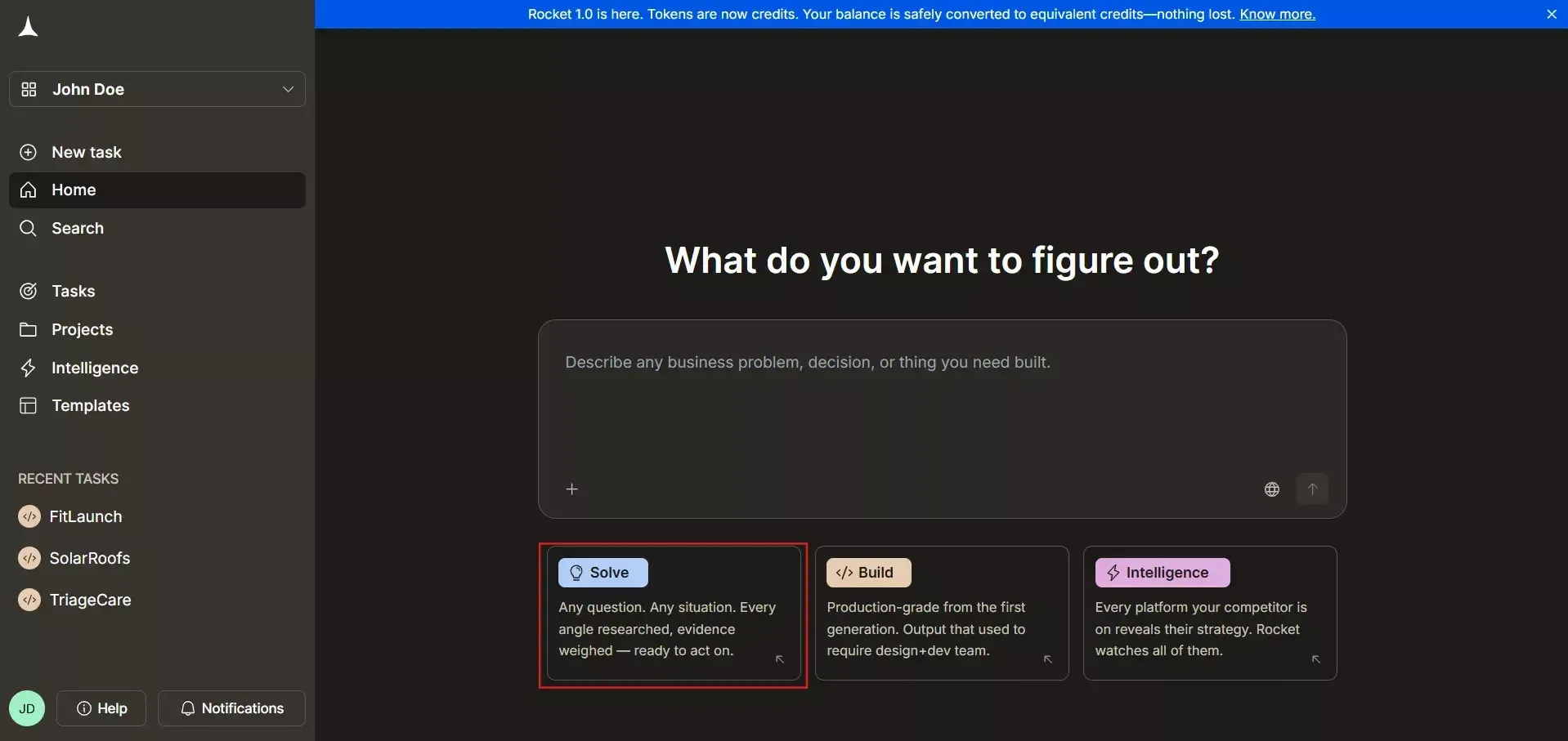 One platform for Flutter mobile and Next.js web. Most AI app development tools lock you into a single tech stack, needing separate tools for front-end, back-end, and deployment.
Rocket.new covers Flutter mobile, Next.js web, and full backend in one place. Less switching means faster iteration without needing to coordinate multiple tools or teams across your workflows. Teams can access real-time insights and data within Rocket.new, ensuring everyone stays aligned and informed.
Real apps, not mockups. Ship a functional product to a narrow market segment and measure actual behavior, not survey responses. This is competitive intelligence you can act on.
It helps you determine which target segment is ready to convert and which needs more work before you scale. Having background information on customer interactions or market segments is crucial for effective iteration, allowing you to make informed decisions at every stage.
Landing pages as market probes. Use quick-launch landing pages to test demand signals before committing to a full product build. It’s one of the fastest ways to validate a target segment and sharpen your SAM estimate, without needing an expensive research agency or weeks of setup time to run the process.
AI agents that handle code changes. Rocket.new’s AI agents work in context, so when you iterate based on what you learned, the technical changes happen fast. You stay focused on the insights, not the code. Start a new iteration in minutes, without needing to write a single line.
Where Most AI Tools Fall Short
Most AI tools in the market analysis space either generate static reports or produce code that’s hard to deploy and harder to iterate on. They close neither the research loop nor the build loop. The level of competition among AI app tools is high, with many solutions saturating the market, but Rocket.new stands out by addressing both research and deployment seamlessly.
Some vibe solutioning tools produce prototypes but don’t give you a real, deployable app. Others produce apps but don’t help you think through the market segment you’re targeting or how to read the signals you collect.
The competitive landscape for AI app tools is crowded, but most of them treat building and researching as separate activities. Rocket.new treats them as one continuous process, which is exactly what the build, measure, iterate approach requires. That’s the core difference, and teams quickly realize the benefits of integrating research and building in one process, making it a meaningful advantage for any team needing to validate fast.
Building Competitive Intelligence Through Iteration
When you ship something real and watch how the market responds, you also gather competitive intelligence passively.
You see which competitors your early users mention. You see which features they compare you against. You see where they drop off, which often reveals a gap in the competitive landscape that no industry report would have flagged.
A brief case study: One SaaS team iterated on their onboarding flow based on user feedback, and as an outcome, they discovered a unique pain point that competitors overlooked. Over two or three iteration cycles, their competitive positioning sharpened from “we’re better than X” to “we’re the only product that solves this problem for this specific target segment.” That’s a meaningful difference when you’re pitching, pricing, or trying to capture market share.
What This Means for Your Market Sizing
When you run build, measure, iterate cycles consistently, your market sizing stops being a one-time estimate and becomes a living picture of real demand:
-
Your SAM narrows to reflect verified demand, not assumed demand
-
Your target segment gets defined by who converts, not who you hoped would
-
Your market analysis gains depth from real behavioral data
-
Your competitive landscape view moves from theoretical to evidential
-
Your competitive intelligence helps you find market share opportunities others miss
The global research industry is shifting in this direction. According to McKinsey’s State of AI 2025, 64% of organizations say AI is enabling their innovation - but most are still in the experimentation phase. The teams that close the loop between research, building, and measuring will capture the most market share going forward.
Stop Researching. Start Building. Then, Research Again.
The old model of market research, static, slow, and disconnected from customers, leaves you with estimates. The Rocket.new approach to market research and market sizing leaves you with evidence.
Every product release is a research exercise. Every iteration adds signal to your SAM. Every real user interaction helps you understand your target customer more than any industry report could.
Most AI tools will tell you what a market looks like from the outside. Rocket.new puts you inside the market, helping you build, measure, and get smarter with every cycle. Start your first iteration today and share what you find with your team at the end of each run. The data picture gets clearer every time.
Ready to implement the build, measure, iterate approach?
Use Rocket.new to launch your first market entry experiment. Begin with a phased implementation plan: define your initial hypothesis, build a minimum viable product, measure real user feedback, and iterate based on insights. Share your findings with your team and refine your strategy with each cycle for continuous improvement.
Table of contents
- -Why Traditional Market Research Gets Founders in Trouble
- -The Build, Measure, Iterate Loop for Market Sizing
- -What Good Market Research Actually Looks Like
- -The Community Already Knows This
- -The Most Common Mistake: Skipping the Middle Step
- -How You Can Solve on Rocket.new: Vibe Solutioning for Real Market Data
- -What Solve Build Looks Like on Rocket.new
- -Where Most AI Tools Fall Short
- -Building Competitive Intelligence Through Iteration
- -What This Means for Your Market Sizing
- -Stop Researching. Start Building. Then, Research Again.