
Rocket Intelligence, built into Rocket.new's paid plans, monitors G2, Glassdoor, and 13 other competitor data sources across 6 signal categories. It clusters signals into a daily strategic brief so your team acts before competitors announce their next move.
Rocket.new transforms G2 and Glassdoor reviews into strategic assets, extracting insights to boost credibility, guide product improvements, and sharpen competitive positioning through consistent, data-driven feedback loops and smarter marketing decisions.
What makes G2 and Glassdoor reviews more than just feedback? They can directly help you win deals. When used the right way, reviews become strong signals for sales. They don't just sit there. They guide messaging, highlight gaps, and shape better decisions. Buyers today trust what other people say more than what brands claim.
So, the real question is simple. Are you using that same data better than your competitors, or are you reacting too late? This blog will show you how to turn everyday reviews into clear sales insights and smarter decisions.
Why Reviews Matter More Than You Think
Reviews are more than opinions. They reflect repeated patterns in what people experience, expect, and talk about when they interact with a company.
What reviews actually reveal:
- What customers like and value the most
- Common frustrations and recurring complaints
- Expectations buyers bring into conversations
- Gaps where competitors fall short
- Early signals that influence buying decisions
Sales teams often rely on pitch decks and scripts. But buyers trust reviews more than sales talk. A quick scroll through Glassdoor reviews or product feedback platforms can shape how people think about a company even before the first call.
The real shift happens when you stop reading reviews one by one and start seeing the bigger patterns they create.
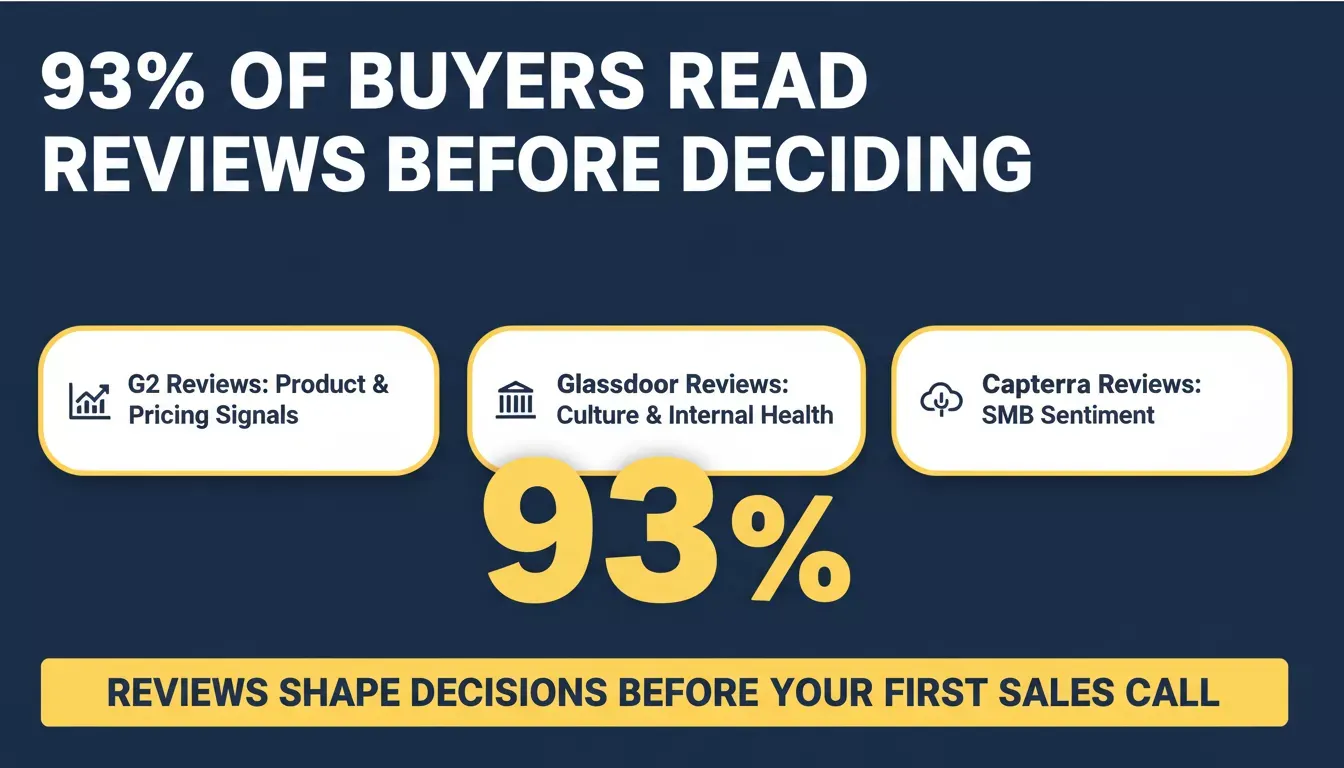
Reviews shape buying decisions well before your first sales conversation starts
The Hidden Value Inside Glassdoor and G2
Reviews on platforms like G2 and Glassdoor are full of signals. But they are messy. One person writes about culture. Another talks about features. Someone else complains about jobs or internal processes.
| Source | What You Learn | Why It Matters |
|---|---|---|
| G2 Reviews | Product features, usability, pricing feedback | Helps sales position the product |
| Glassdoor Reviews | Culture, internal issues, leadership signals | Reveals competitor weaknesses |
| Capterra Reviews | SMB user sentiment, feature comparisons | Surface gaps in competitor positioning |
| LinkedIn Posts | Real-time opinions and discussions | Shows what people are currently thinking |
| Hiring Boards | Open roles, team growth signals | Predicts upcoming product and market moves |
Now imagine trying to go through Glassdoor reviews every day manually. It takes time. It is repetitive. And things get missed.
The Real Problem Sales Teams Face
Here is what usually happens:
- Sales reps don't have time to analyze reviews
- Insights are scattered across tools
- Decisions are based on partial information
- Teams react late instead of early
A competitor changes pricing. Someone complains about support. A new feature gets praise. These signals matter, but by the time most teams notice, it has already happened.
Insights from User
Here is a relevant insight from a LinkedIn discussion that directly connects with how reviews impact sales:
"Reviews on G2 are social proof... organized and activated are a sales weapon." - LinkedIn
This highlights something simple but powerful. Reviews are not just feedback sitting on a page. When teams organize and use them properly, they become a real advantage in sales conversations.
Introducing Rocket Intelligence
Rocket Intelligence is a core pillar of Rocket.new, the world's first Vibe Solutioning platform. It is not a third-party integration. It monitors every public platform a competitor operates on and interprets what those signals mean for your business specifically.
The keyword is interpret. Most competitive intelligence software tools alert you to changes. Rocket Intelligence tells you what those changes mean and what to do about them.
Every day, Intelligence produces a structured brief for every competitor you track:
- Signals and insight: a synthesized paragraph connecting everything that moved
- What to watch: emerging patterns not yet obvious
- Recommendation: what your business should do next
This brief lands before your first meeting of the day. No manual research required.
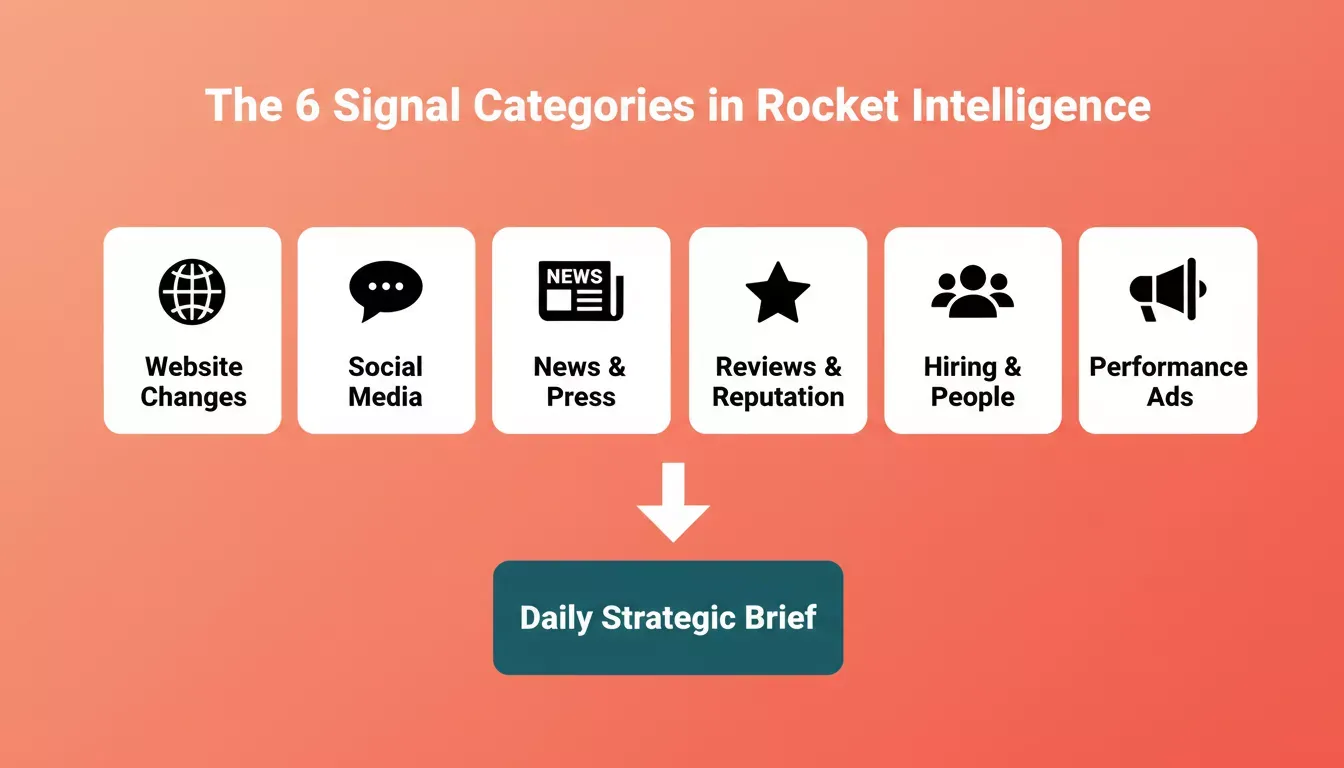
Rocket Intelligence organizes competitor monitoring into six structured categories that converge into one daily brief
The Six Signal Categories
Rocket Intelligence organizes monitoring into six structured categories. Reviews are one. Together, all six tell a complete story.
1. Website: every page change, messaging shift, pricing page changes, new feature announcement, and positioning pivot with full before/after interpretation.
2. Social Media: every post, campaign, and engagement pattern across LinkedIn, X, Instagram, Facebook, YouTube, TikTok, and Reddit.
3. News and Web Presence: press coverage, blog posts, partnership announcements, executive interviews, and media mentions tracked over time.
4. Reviews and Reputation: G2, Glassdoor, Capterra, and other review platforms. Sentiment shifts over time with impact tags.
5. People: employee count, new hires, exits, hiring velocity, Glassdoor rating, and open position breakdown by department. Hiring concentration reveals where competitors are investing before any product announcement confirms it.
6. Performance Marketing: ad activity across LinkedIn, Meta, and TikTok.
Why Signal Clusters Beat Individual Reviews
This is the most important concept in competitive intelligence, and the one most teams miss entirely.
A single G2 review complaining about slow onboarding is noise. That same complaint appearing in 23 reviews over 60 days, combined with Glassdoor reviews mentioning "engineering understaffed" and new engineering job postings, is a signal cluster. And a signal cluster tells a story.
Rocket Intelligence reads signal clusters, not individual changes. A pricing page update in isolation is noise. That same update alongside enterprise-focused social posts, defensive G2 responses about security, and new enterprise sales job openings is a single clear strategic signal: this competitor is moving upmarket.
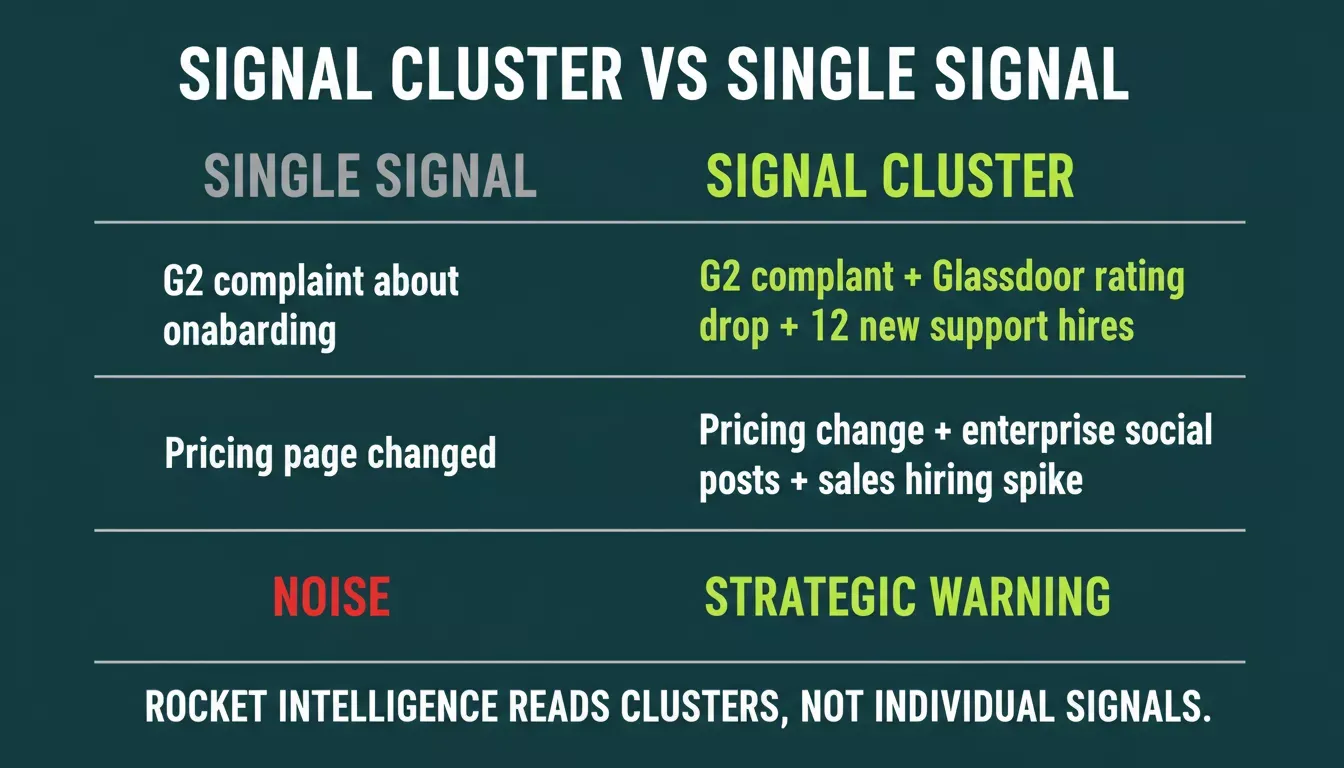
Clusters of signals reveal strategic intent that individual data points never could
| Signal Cluster | What It Means | Your Move |
|---|---|---|
| G2 sentiment drops + Glassdoor rating falls + hiring slows | Competitor in internal distress | Accelerate competitive deals, emphasize stability |
| Pricing change + enterprise social posts + enterprise sales hiring | Competitor moving upmarket | Lock in SMB positioning, adjust messaging |
| Feature reviews spike on G2 + product blog posts increase | Competitor in an aggressive product cycle | Accelerate your roadmap, monitor feature gaps |
| Executive LinkedIn activity rises + press mentions surge | Expansion or acquisition signal | Prepare for new market entry |
Real-World Use Cases
Sales Team Before a High-Stakes Deal
A sales rep is about to enter a deal where the prospect is also evaluating a direct competitor. Instead of manually searching G2 the night before, they open Rocket Intelligence and see the competitor's G2 score dropped, the most common complaint is "poor customer support after onboarding," and Glassdoor reviews mention "customer success team understaffed."
The sales rep now has a specific, evidence-backed angle before the call. See exactly what Rocket Intelligence shows a sales team before a high-stakes deal to understand how this plays out in practice.
Product Team Prioritizing the Roadmap
A product manager looks at the Reviews and Reputation tab for their top three competitors. Competitor A has 40+ recent G2 reviews praising dashboard customization. Competitor B has 15+ reviews complaining about lack of API flexibility. The market already voted on what to build next. No user research sprint required.
Marketing Team Responding to a Competitor Move
A competitor just announced a new pricing tier. Rocket Intelligence shows the website change was detected 48 hours before the press release, their social media shifted to "affordable" messaging three weeks ago, and their job postings show no new product engineers, only sales hires. The counter-message writes itself: depth over discount.
The Intelligence to Solve to Build Pipeline
Rocket.new is the world's first Vibe Solutioning platform. That means Intelligence is not the end of the workflow. It is step one.
When Rocket Intelligence surfaces a signal cluster, the natural next question is: "What should we do about it?"
That is where Solve comes in. Solve takes any business question and delivers a complete, structured analytical output in 60 to 90 minutes.
Then Build takes that recommendation and ships it. A new comparison page. An updated pricing page. A competitive battle card portal. All in the same platform, with the full context already embedded.
This is the structural difference versus standalone tools like Klue or Crayon. Those tools stop at the insight. Rocket turns the insight into a shipped product.
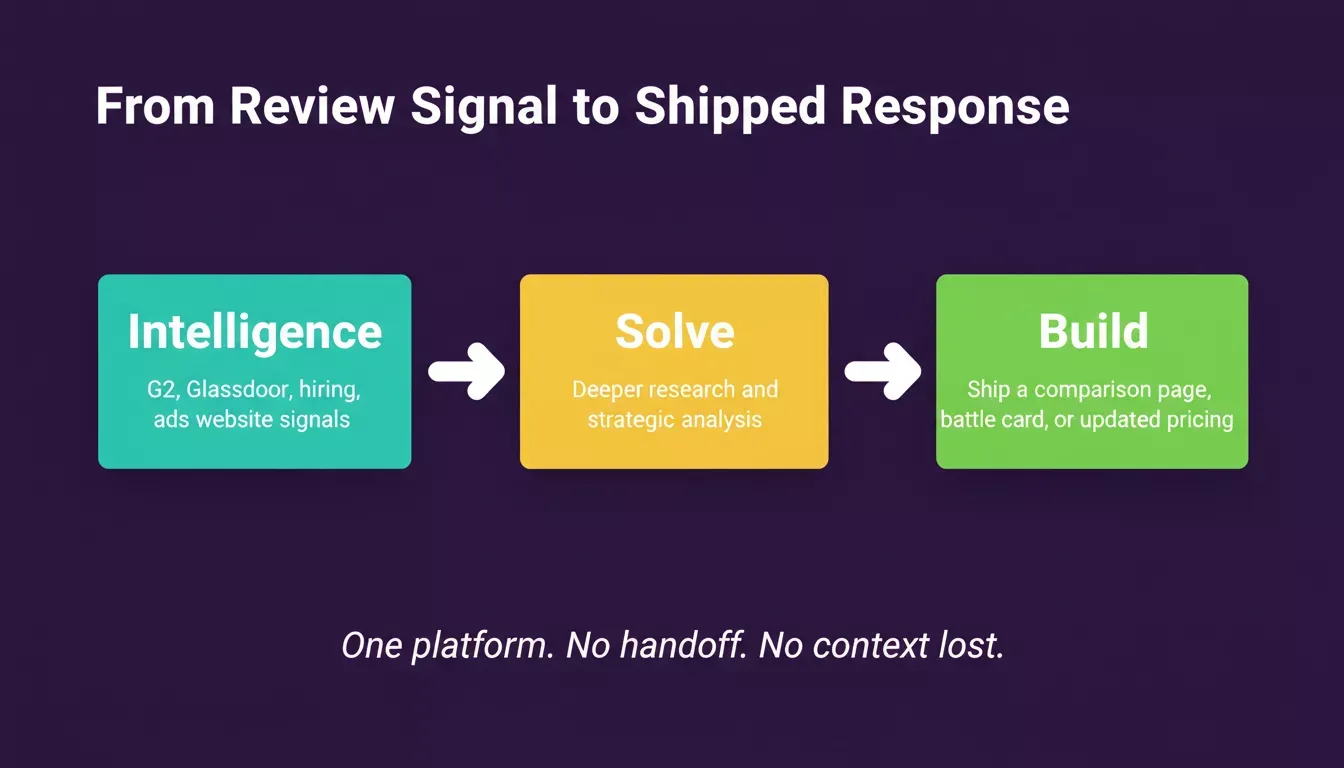 Rocket.new connects the insight directly to execution — no handoff, no context lost
Rocket Intelligence vs Manual Research
| Task | Manual Approach | With Rocket Intelligence |
|---|---|---|
| Monitor G2 for sentiment shifts | Weekly manual check, easy to miss trends | Continuous, automatic, with trend alerts |
| Track Glassdoor for internal signals | Quarterly check at best | Daily, with impact tags |
| Detect competitor pricing page changes | Only if someone notices | Automatic, with before/after comparison |
| Identify competitor hiring patterns | LinkedIn searches, incomplete | Full headcount tracking, velocity, department breakdown |
| Connect signals to strategic action | Manual synthesis, days of work | Daily brief with interpretation and recommendation |
Rocket Intelligence also helps you predict competitor moves weeks before formal announcements, using early signals from hiring, website changes, and social messaging shifts.
Why Intelligence Compounds Over Time
Most intelligence tools give you a snapshot. Rocket Intelligence builds a history.
Because Intelligence runs continuously inside a Rocket project, every signal it captures becomes part of the project's accumulated context. The competitor signal from Monday's brief is present when a PM opens Solve on Wednesday. The G2 sentiment shift from last month is present when the sales team prepares for a competitive deal next month.
This compounding architecture is the structural moat. Competitors cannot replicate accumulated context.
Ready to stop reacting to competitors and start outmaneuvering them?
Sign up for Rocket and let Rocket Intelligence turn every G2 review, Glassdoor signal, and competitor move into your next strategic advantage.
Table of contents
- -Why Reviews Matter More Than You Think
- -The Hidden Value Inside Glassdoor and G2
- -The Real Problem Sales Teams Face
- -Insights from User
- -Introducing Rocket Intelligence
- -The Six Signal Categories
- -Why Signal Clusters Beat Individual Reviews
- -Real-World Use Cases
- -Sales Team Before a High-Stakes Deal
- -Product Team Prioritizing the Roadmap
- -Marketing Team Responding to a Competitor Move
- -The Intelligence to Solve to Build Pipeline
- -Rocket Intelligence vs Manual Research
- -Why Intelligence Compounds Over Time