
Rocket.new is the better choice for enterprise product teams, offering fast, full-stack app generation with real code, mobile support, and long-term scalability. It’s built for teams that need to move quickly without sacrificing flexibility or ownership. Base44 works well for simple web apps and non-technical users, but falls short for complex, scalable, and multi-platform applications.
Trying to pick between two popular vibe coding platforms for your enterprise team?
Rocket.new is the stronger choice. It's a vibe solutioning platform that builds full-stack apps with real code, real deployment flexibility, and real long-term growth in mind.
According to market research, the global no-code and low-code market is projected to reach $65.5 billion by 2027, and companies already report up to 90% reduction in development time when using these platforms. That's a serious shift. So let's break down exactly which platform deserves a spot in your team's workflow.
What is Vibe Coding and Why It Matters
Vibe coding means building apps using natural language instead of manual coding. You describe your idea, and AI generates the frontend, backend, and logic, ready to refine.
For enterprise teams, this is a major shift:
-
Turns weeks of development into hours or days
-
Works across web apps, mobile apps, dashboards, and internal tools
-
Speeds up rapid prototyping and validation
The real value: it handles repetitive development work, so teams can focus on complex architecture and core business logic that truly differentiates their product.
Why Vibe Coding is Gaining Ground Fast
If you think vibe coding tools are useful for rapid prototyping, but they may not handle highly specialized, intricate business logic effectively, then check out this:
-
Around 70% of new business applications are expected to be built on low-code or no-code platforms by 2025
-
A 2024 GitHub report found 70% of developers believe AI coding tools give them a clear advantage
-
Rocket raised $15 million in a seed round from Salesforce Ventures and Accel in September 2025, reaching 1 million-plus creators in 180 countries
-
Teams at Meta, PayPal, KPMG, and PwC already use Rocket.new for internal and side projects
Vibe coding isn't a shortcut for hobbyists anymore. It's a serious approach to app building for teams that need to move fast.
What Makes an AI App Builder Enterprise-Ready?
Not all app builders are designed for enterprise work. Many handle simple use cases fine but fall apart when teams need depth, flexibility, and ownership.
Enterprise product teams need more than a live app from a prompt. They need tools that generate full-stack apps with real code, support version control, connect to existing systems through enterprise integrations, and let teams scale without hitting walls.
Not all platforms get this right.
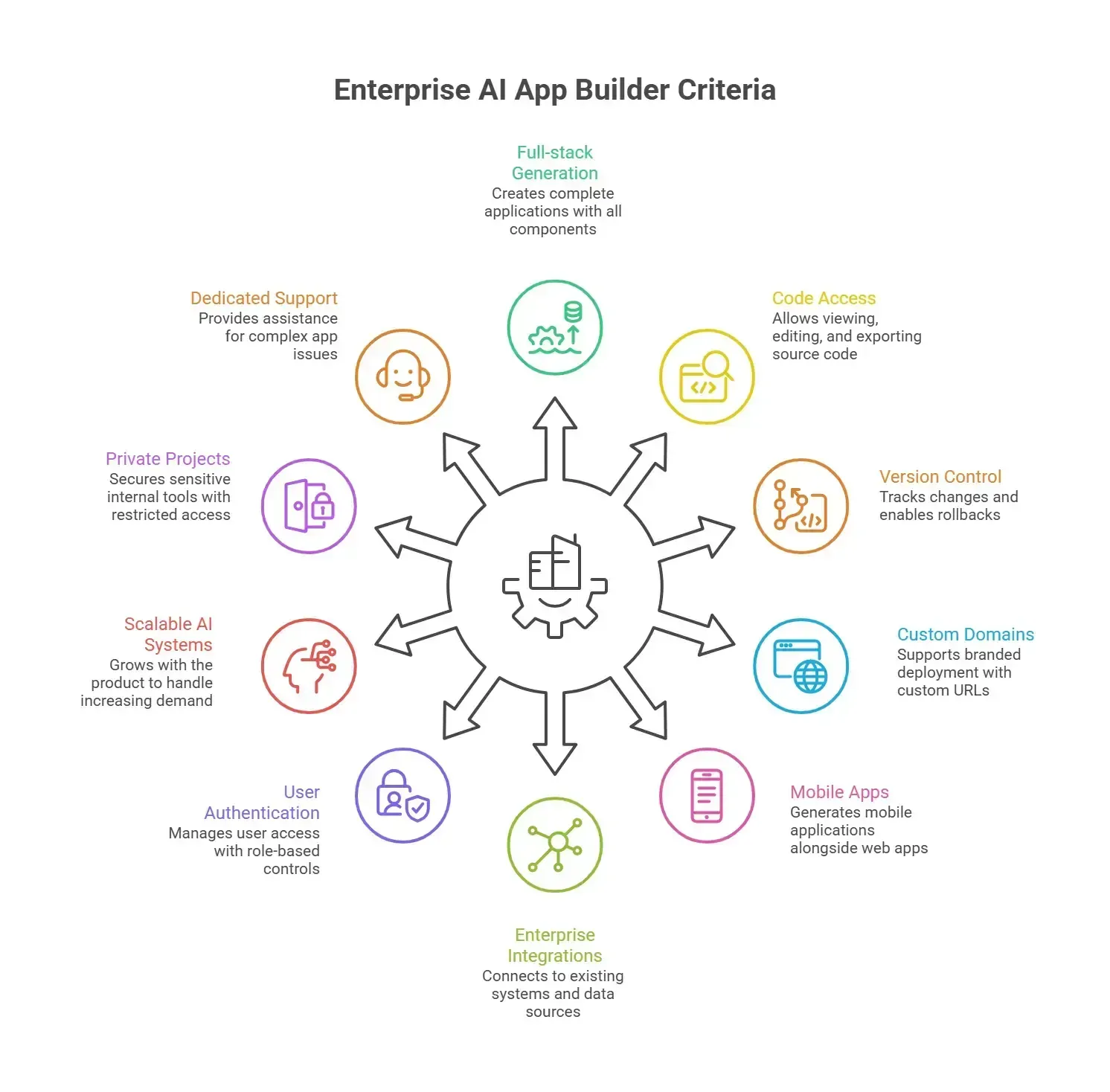
Key Criteria Enterprise Teams Look For
Here's what separates tools that just impress demos from tools that carry production weight:
-
Full-stack generation covering frontend, backend logic, database, and APIs
-
Code access to view, edit, and export source files freely
-
Version control for safe rollbacks and change tracking
-
Custom domains for branded deployment
-
Mobile apps support alongside web apps
-
Enterprise integrations with existing APIs, tools, and data sources
-
User authentication with role-based controls
-
Scalable AI systems that grow with the product
-
Private projects for sensitive internal tools
-
Dedicated support when complex apps run into real issues
Rocket.new: The Vibe Solutioning Platform Enterprise Teams Have Been Waiting for
Rocket.new is a vibe solutioning platform built for teams that want speed without sacrificing code quality or ownership. It's not just an AI app builder that generates throwaway mockups.
Rocket generates full-stack web and mobile apps from natural language, gives you the real code, and lets your team ship, refine, and scale from there.
How Rocket.new Works
Rocket.new is built around a four-step process: describe, build, refine, and ship, making it user-friendly for rapid prototyping.
You start with a plain language description of what you need. Rocket's AI runs a multi-stage workflow covering market research, UX design planning, and full-stack generation in a single pass.
After that, you refine using natural language prompts throughout the build. When you're ready, you deploy instantly to custom domains or external platforms.
The output isn't a prototype to throw away later. It's production-ready apps built in frameworks like React, Next.js, and Flutter for mobile apps, with source files you own. Rocket.new is optimized for generating functional apps quickly but may require manual refinement for deeper architectural reasoning.
Top Features of Rocket.new
Rocket.new brings a powerful feature set to enterprise product teams:
-
25,000-plus templates library: Curated design templates covering landing pages, dashboards, mobile applications, internal tools, and full-stack web apps. Reduces token consumption by up to 80%
-
Flutter and Next.js support: Build full-stack web apps and mobile apps using modern, widely-supported frameworks
-
Figma integration: Import Figma designs via plugin and generate matching code directly
-
Full code access and code export: Download source files, do code editing inside or outside the platform, and own everything you build
-
Team collaboration: Multiple team members can work on the same project with no engineering bottlenecks
-
Custom domains: Deploy apps on branded custom domains at the click of a button
-
Version control: Roll back to any previous build in seconds, with GitHub sync available
-
AI agents: Use AI agents for research, code generation, feature planning, and rapid iteration
-
Browser-based development: No local setup required at all
-
Unlimited users: No per-seat caps for team collaboration on enterprise plans
-
User authentication: Database schemas, authentication, APIs, and data storage configured on the go
-
Free plan: Start building with 1 million free tokens, no credit card needed
Rocket.new Use Cases for Enterprise Product Teams
Rocket connects to what enterprise product teams actually need to build:
-
Internal tools and internal business apps: Build CRM dashboards, ops portals, and team reporting tools through natural language, no writing code required
-
Landing pages: Generate SEO-optimized landing pages from a plain language prompt in minutes, using any of the 25k-plus design templates
-
MVP development: Rocket.new allows users to generate functional web apps and MVPs quickly from prompts. Its features include preview and deployment workflows within its ecosystem, making it suitable for MVP launches.
-
Full-stack web apps: Go from description to a working full-stack web app with database, APIs, and user authentication in one session
-
Mobile apps: Build and deploy mobile applications alongside web apps using Flutter support
-
Business apps: Create workflow automation tools, client portals, finance trackers, and HR systems without a dev team
-
Rapid prototyping: Validate multiple product directions before a weekly stakeholder review
-
Structured project files: Rocket.new generates structured project files automatically and allows edits within its environment, optimized for fast iteration.
-
Figma import: Rocket.new allows for importing Figma files and editing code directly.
-
Scalable AI systems: Build apps that connect to external APIs and grow with your user base over time
Who Should Use Rocket.new?
Rocket.new is the fastest way to go from idea to a working, production-ready app — and it fits a wide range of builders at every skill level. For early-stage teams, it compresses validation cycles from weeks to hours.
For enterprise teams tackling complex systems, it delivers a real, exportable codebase from day one, so even when projects evolve toward traditional stacks.
-
Enterprise product teams that need speed and code ownership together
-
Non-technical builders who need to ship real apps, not just wireframes
-
Designers and PMs who want to build web apps without waiting in engineering queues
-
Agencies that need rapid iteration across multiple client projects at once
-
Non-technical founders building web and mobile apps from day one
-
Advanced builders who want full-stack generation with real code to hand off later
One Trustpilot user said it well:
"Rocket is an amazing platform to handle extremely complicated tasks in minutes. I created a very complex webapp in under one week."
What is Base44?
Base44 is an AI-powered no-code builder acquired by Wix in mid-2025. It focuses on structured, AI-guided app creation from natural language prompts.
It's designed to be an all-in-one platform. You describe your idea, and Base44 automatically handles hosting, databases, user authentication, and deployment.
The platform targets non-technical users and non-technical founders who want to launch business apps without any technical knowledge involved.
Key Features of Base44
-
All-in-one environment with built-in database, hosting, and authentication
-
Natural language to app generation with structured workflow framing
-
Pre-built connectors for Google Sheets, Slack, Notion, and Trello
-
OAuth, magic link, and password-based user authentication
-
Workflow automation and guided app logic
-
Visual data model creation without SQL
-
Version rollback with single-click restore
-
Team collaboration tools and project tracking
Base44 Enterprise Capabilities
Base44 has specific enterprise features worth acknowledging:
-
Enterprise SSO via SAML and OAuth
-
Granular role-based permissions
-
IP allowlists for access control
-
Centralized user management panel
-
Private projects hosted on secure Wix infrastructure
-
Draft-to-production workflow staging
Base44 is better equipped for compliance-heavy environments in certain specific contexts. The Wix acquisition has given it added credibility and a path toward professional and enterprise markets.
That said, Base44's backend stays within the Wix ecosystem. Teams that need deployment flexibility or code ownership will run into limitations quickly.
Rocket.new vs Base44: Feature Comparison at a Glance
Here's a direct side-by-side view of both platforms across the categories that matter for enterprise teams:
| Feature | Rocket.new | Base44 |
|---|---|---|
| App Building Type | Full stack (web and mobile apps) | Web-focused no-code |
| Natural Language Prompts | Yes, multi-stage AI workflow | Yes, structured framing |
| Mobile Apps | Yes (Flutter) | Limited |
| Code Access | Full source file export | Limited |
| Custom Domains | Yes, all paid plans | Yes, paid plans |
| Version Control | Yes, with GitHub sync | Yes, within platform |
| AI Agents | Yes | Partial |
| Enterprise Integrations | APIs, Stripe, Firebase, and more | Google Sheets, Slack, Notion |
| User Authentication | Configured on-the-go | Built-in, automatic |
| Free Plan | Yes (1M tokens) | Yes (limited credits) |
| Figma Import | Yes | No |
| Vibe Coding Experience | Strong, with real code output | Moderate, no-code only |
| Templates Library | 25,000-plus | Limited |
| Mobile Applications | Yes (Flutter) | No native support |
| Best For | Enterprise, agencies, founders | MVPs, non-technical founders |
Rocket.new wins more categories here, especially the ones enterprise teams care about most.
App Building Speed and Setup
-
Both platforms start quickly with natural language prompts
-
Rocket.new: Build full-stack, production-ready apps in minutes
-
Base44: Can build simple web apps in minutes
-
Rocket = more complete output,
-
Base44 = faster for basic tools
-
Both are browser-based (no setup required)
Full-Stack Generation Capabilities
-
Rocket.new:
◦ Full-stack (frontend + backend + DB + APIs + deployment)
◦ Generates production-ready apps
◦ Uses advanced AI (Claude + Gemini)
-
Base44:
◦ Full-stack but limited to Wix ecosystem
Rocket.new = more flexibility + ownership
Code Access, Export, and Editing
-
Rocket.new:
◦ Full code access on all plans
◦ Export, edit, deploy anywhere
◦ GitHub support
-
Base44:
◦ Limited code export
◦ Backend tied to the platform
Rocket.new = better for long-term growth
Natural Language Workflow
-
Rocket.new:
◦ Multi-step AI (planning + UX + code)
◦ Handles complex full-stack apps
-
Base44:
◦ More guided and structured workflow
Rocket.new = more powerful and flexible
Mobile App Support
-
Rocket.new:
◦ Native mobile apps with Flutter (iOS + Android)
◦ Shared backend with web apps
-
Base44:
◦ Web-only (no mobile support)
Internal Tools and Business Apps
-
Rocket.new:
◦ Supports complex tools + enterprise integrations
◦ Used by large teams (Meta, PayPal, etc.)
-
Base44:
◦ Good for simple internal tools
Rocket.new = better for scalable business apps
Version Control and Collaboration
-
Rocket.new:
◦ Built-in version control + GitHub sync
◦ Real-time team collaboration
-
Base44:
◦ Basic collaboration + rollback
Rocket.new = better for dev workflows
Enterprise Integrations
-
Rocket.new:
◦ Connects to Stripe, Firebase, APIs via prompts
◦ High flexibility
-
Base44:
◦ Pre-built integrations + SSO & security features
Base44 = slightly stronger in enterprise security
Rocket.new = more flexible integrations
Deployment Capabilities
-
Rocket.new:
◦ Deploy to custom domains, Netlify, Firebase
◦ Full control over hosting
-
Base44:
◦ Deploys on Wix infrastructure
Rocket.new = more deployment flexibility
Final Snapshot: • Rocket.new → Best for full-stack apps, mobile, flexibility, and scaling • Base44 → Best for simple web apps and quick internal tools
Pricing: Rocket.new vs Base44
Both tools offer a free plan. Here's how the paid plans break down:
Rocket.new Paid Plans
-
Free: 1 million tokens, limited project scope, browser-based development available
-
Personal: Around $25/month for 5 million tokens, private projects included
-
Rocket Plan: Around $50/month for 10.5 million tokens, agencies, and client projects
-
Agency/Teams: Around $100/month for agencies and teams handling multiple concurrent projects
-
Enterprise: Custom pricing with dedicated support, higher token allocation, and enterprise-level access
Rocket.new's token model rewards efficiency. With up to 80% token savings from its template library, paid plans go further than the numbers suggest. Rocket.new's top-tier enterprise pricing is custom and based on volume usage. Token consumption varies by complexity, with landing pages using far fewer tokens than full-stack web apps.
Base44 Paid Plans
-
Free: Limited AI credits, basic app generation
-
Starter: Around $16 to $20/month with expanded credits
-
Mid-tier: Around $40/month with higher AI credits and integration options
-
Advanced: Around $80/month for high-credit users
-
Elite: Around $160/month with maximum credits and priority support
Base44 scales billing by message and integration credits. Costs climb with the number of AI interactions and enterprise integrations your team needs.
For enterprise product teams doing heavy iteration on full-stack apps, Rocket.new's token model tends to offer better output per dollar because each build produces a more complete, production-grade result.
Community Feedback: What Builders Are Saying
The builder community has been vocal about both tools.
On Reddit, users describe Rocket.new as "a powerful prototype engine" with intuitive onboarding and clean, generated UI. Community feedback praises its speed at going from a natural language prompt to a live app in a single session.
A developer shared on LinkedIn:
"Using AI assistance for multi-file management changed how our team collaborates. Less friction, more iteration." - Source
That captures exactly what enterprise product teams report when they switch to a strong vibe coding workflow.
Early adopters of Rocket.new position it as far more than an MVP tool. Multiple users have compared the vibe coding experience to discovering Figma, noting the output quality and clean code tech stack.
Base44 gets positive community feedback for its structured AI-guided workflow and the credibility the Wix acquisition adds. That said, community feedback also reflects open questions around scalability and ecosystem lock-in.
Other AI App Builders Worth Considering
Many AI app builders have entered the vibe coding space. Here are a few others worth a look:
CodeConductor.ai
CodeConductor.ai is a leading no-code AI platform for teams who want to build, deploy, and scale production-ready apps as scalable AI systems.
Vitara.ai
Vitara.ai creates full-stack web and mobile apps from simple prompts, handling both frontend and backend in one place. A strong pick for non-technical builders who want an all-in-one approach.
Lovable
Lovable is popular with non-technical founders who want to move fast. It handles web apps, landing pages, and internal tools through chat-based building.
Bolt.new
Bolt.new focuses on browser-based development with full code access. No local setup needed. Solid for rapid prototyping and fast code generation.
Emergent
Emergent uses AI agents to design, code, and deploy full-stack apps from start to finish, supporting both web and mobile experiences.
Which Tool Wins for Enterprise Product Teams?
Let's be direct.
| Category | Winner | Why Rocket.new Wins |
|---|---|---|
| Full-Stack Generation | Rocket.new | Generates complete web and mobile apps with fully exportable code in one go |
| Code Access | Rocket.new | Full ownership of source code across all plans—no lock-in |
| Mobile App Support | Rocket.new | Native mobile app generation using Flutter (iOS & Android) |
| Vibe Coding Experience | Rocket.new | True vibe coding platform with real, production-ready code output |
| Templates Library | Rocket.new | 25,000+ templates, including landing pages, dashboards, and internal tools |
| Deployment Flexibility | Rocket.new | Supports custom domains, Netlify, Firebase, or any custom infrastructure |
| Long-Term Growth | Rocket.new | Exportable code enables scaling, migration, and full customization |
Base44 holds its own in a few areas. Its compliance features (Enterprise SSO, IP allowlists) are strong for regulated industries. For non-technical users building simple apps, its guided workflow and low learning curve are genuinely useful.
But for enterprise product teams building real projects that need to scale, Rocket.new's combination of full-stack generation, real code, and flexible deployment is the right pick.
Making the Smart Call for Enterprise Product Teams
Rocket.new vs Base44, which tool is better for enterprise product teams question has a clear answer: Rocket.new wins.
-
Rocket.new is the stronger choice for enterprise teams needing more than basic no-code tools
-
Delivers full-stack apps (web + mobile) with real, exportable code
-
Includes 25,000+ templates, GitHub sync, and scalable token-based pricing
-
Built for production-ready apps, not just prototypes
Base44
-
Best for simple apps and non-technical users
-
Offers a guided, easy-to-use environment
-
Limited for scaling, mobile apps, and code ownership
Final Take:
Choose Rocket.new if you need flexibility, scalability, and long-term growth. Use Base44 for quick, simple web prototypes.
Table of contents
- -What is Vibe Coding and Why It Matters
- -Why Vibe Coding is Gaining Ground Fast
- -What Makes an AI App Builder Enterprise-Ready?
- -Key Criteria Enterprise Teams Look For
- -Rocket.new: The Vibe Solutioning Platform Enterprise Teams Have Been Waiting for
- -How Rocket.new Works
- -Top Features of Rocket.new
- -Rocket.new Use Cases for Enterprise Product Teams
- -Who Should Use Rocket.new?
- -What is Base44?
- -Key Features of Base44
- -Base44 Enterprise Capabilities
- -Rocket.new vs Base44: Feature Comparison at a Glance
- -App Building Speed and Setup
- -Full-Stack Generation Capabilities
- -Code Access, Export, and Editing
- -Natural Language Workflow
- -Mobile App Support
- -Internal Tools and Business Apps
- -Version Control and Collaboration
- -Enterprise Integrations
- -Deployment Capabilities
- -Pricing: Rocket.new vs Base44
- -Rocket.new Paid Plans
- -Base44 Paid Plans
- -Community Feedback: What Builders Are Saying
- -Other AI App Builders Worth Considering
- -CodeConductor.ai
- -Vitara.ai
- -Lovable
- -Bolt.new
- -Emergent
- -Which Tool Wins for Enterprise Product Teams?
- -Making the Smart Call for Enterprise Product Teams