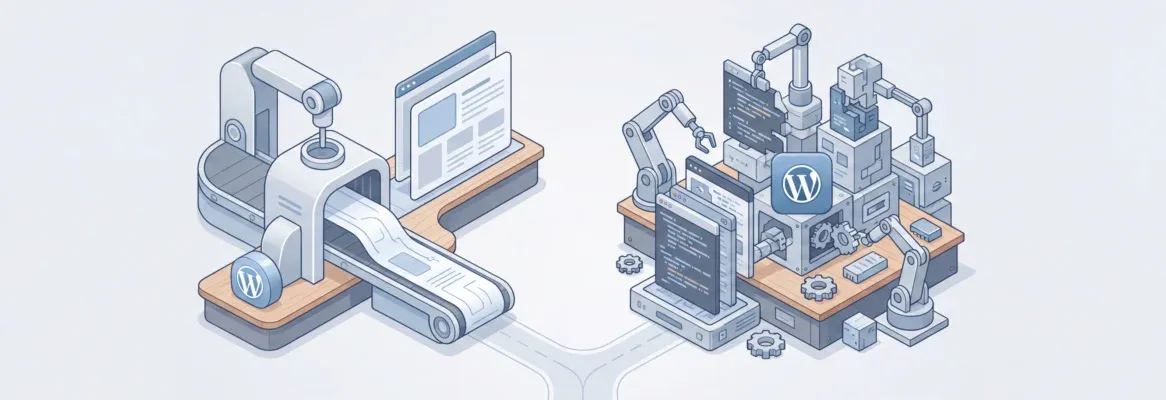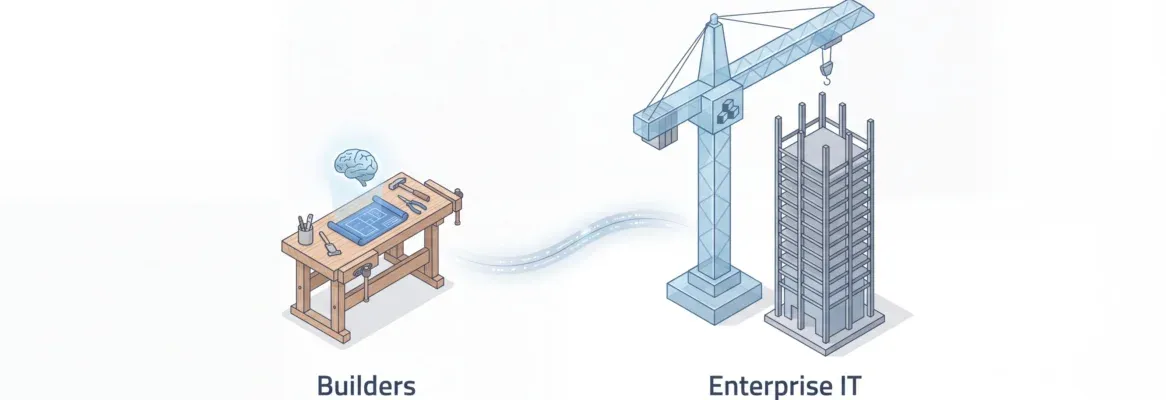
Betty Blocks governs enterprise IT with EU sovereignty and compliance. Rocket.new ships full-stack web and mobile apps from one prompt in minutes. Same category, completely different audiences. Choose by your stage and budget.
Rocket.new vs Betty Blocks puts two radically different philosophies head-to-head. Betty Blocks governs enterprise IT with sovereignty-first software architecture. Rocket generates full-stack web and mobile apps from a single prompt and deploys them in minutes.
Why do two platforms in the same category feel like they were built for different planets? Betty Blocks rebranded as a sovereign AI Application Generation Platform in June 2026, doubling down on DTAP pipelines, ISO 27001 compliance, and EU data governance for enterprises.
Rocket ships full-stack products from a single typed sentence, and 1.5 million people across 180 countries have used it to do exactly that.
The low-code and no-code software market is now valued at $65 billion in 2026, growing at 26.1% CAGR. This blog breaks down who each platform actually serves, what each one costs over a full year, and how to pick the one that matches how your team works.
Same Category, Different Universe
Betty Blocks and Rocket both call themselves AI application generation platforms. That is where the overlap ends.
Betty Blocks DNA is enterprise governance: Its June 2026 rebrand doubled down on DTAP pipelines, citizen-developer and IT fusion teams, ISO 27001 compliance, and EU data sovereignty. The Dutch National Police, the Province of South Holland, and Forvis Mazars are among its named customers.
Rocket DNA is builder speed: It generates a complete full-stack application: a web app in Next.js, a mobile app in Flutter for iOS and Android, a backend, a database, and deployment, all from a single natural-language prompt. Most apps are generated in one to three minutes.
The honest framing: if you work in a regulated European enterprise with an IT department and a compliance mandate, Betty Blocks is built for you. If you need a working app by Friday and want to spend nothing to find out if it works, Rocket is built for you.
What Does the Low-Code Market Look Like in September 2026?
Low-code and no-code platforms are not a niche technology category anymore. $65 billion in global market size in 2026, with 26.1% CAGR through 2028. Enterprise low-code spending grew 31% year-over-year in 2025, outpacing overall IT spending growth by nearly four times.
75% of new enterprise applications will be built on low-code platforms by 2026, according to Gartner. 77% of enterprises now use at least one low-code or no-code tool, with companies above 5,000 employees running an average of 6.8 platforms simultaneously.
Platforms like Betty Blocks, Bubble, OutSystems, and Mendix primarily serve enterprise buyers. Builders who want production-ready applications from natural language use tools like Rocket.
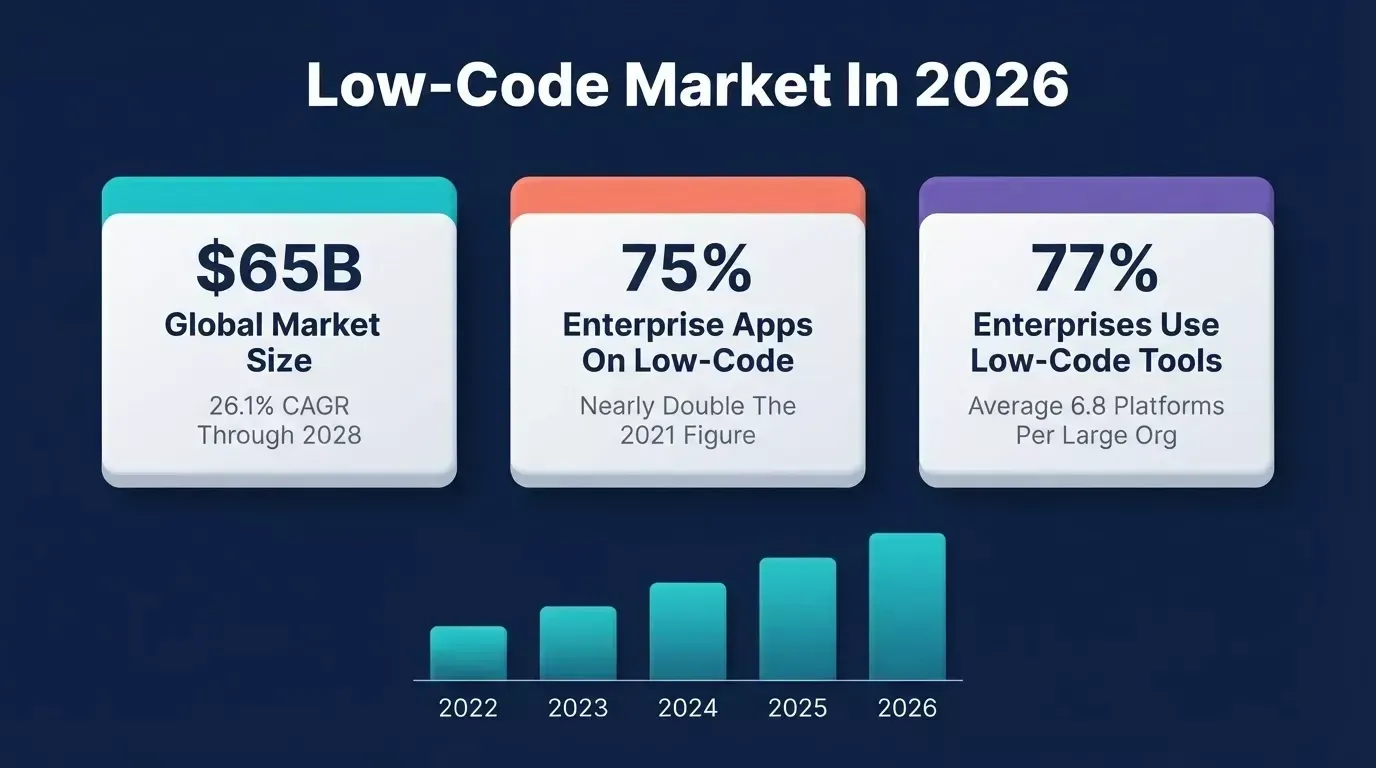
The low-code market reached $65B in 2026. Enterprise adoption is accelerating across every industry.
How Does Betty Blocks Serve Enterprise IT Teams?
Betty Blocks positions itself as the only sovereign AI Application Generation Platform, and the claim is specific.
Code ownership from day one. Every Betty Blocks application compiles to standard React (frontend) and WebAssembly (backend). You can export the code and run it anywhere, no rebuild required. This directly addresses the vendor lock-in concern that affects 37% of organizations adopting low-code software.
Choose your AI model. Betty Blocks connects any large language model through MCP servers. If token pricing changes or a provider raises costs, enterprises switch without rewriting their applications or workflows.
Deploy anywhere. Public cloud, private cloud, on-premises, or hybrid. EU enterprises can keep data within EU borders and meet regulatory requirements across industries like healthcare and financial services.
DTAP governance. Development, Testing, Acceptance, Production pipelines with role-based access, SSO/SAML, audit logging, and automatic security patches.
ISO 27001, SOC 2 Type 2, GDPR, and NEN 7510 compliance come standard across all tiers.
Betty Blocks hit every mark we needed for a low-code platform: database, connectivity, and a clean UX. Other platforms did not come close. - Jeremy Oddo, Global Director of Technology
Betty Blocks serves regulated enterprises where data sovereignty is not optional. Betty Blocks offers a 4-week guarantee to the first production app.
Betty Blocks Pricing And Governance Layers
| Plan | Monthly Cost | Annual Cost | Key Features |
|---|---|---|---|
| Create | 1500 EUR/month | 18000 EUR + 7500 EUR onboarding | Unlimited users, small app bundle, standard LLM, basic roles |
| Scale | 3500 EUR/month | 42000 EUR + 7500 EUR onboarding | Developer sandbox, multiple MCP servers, Block Store, no-license guarantee |
| Enterprise | Custom | Custom | Enterprise governance, flexible LLMs, on-premises hosting, custom brand toolkits |
Onboarding runs 7500 EUR for Create and Scale tiers (included with Enterprise). The no-license guarantee means you pay for development capacity, not per-user access.
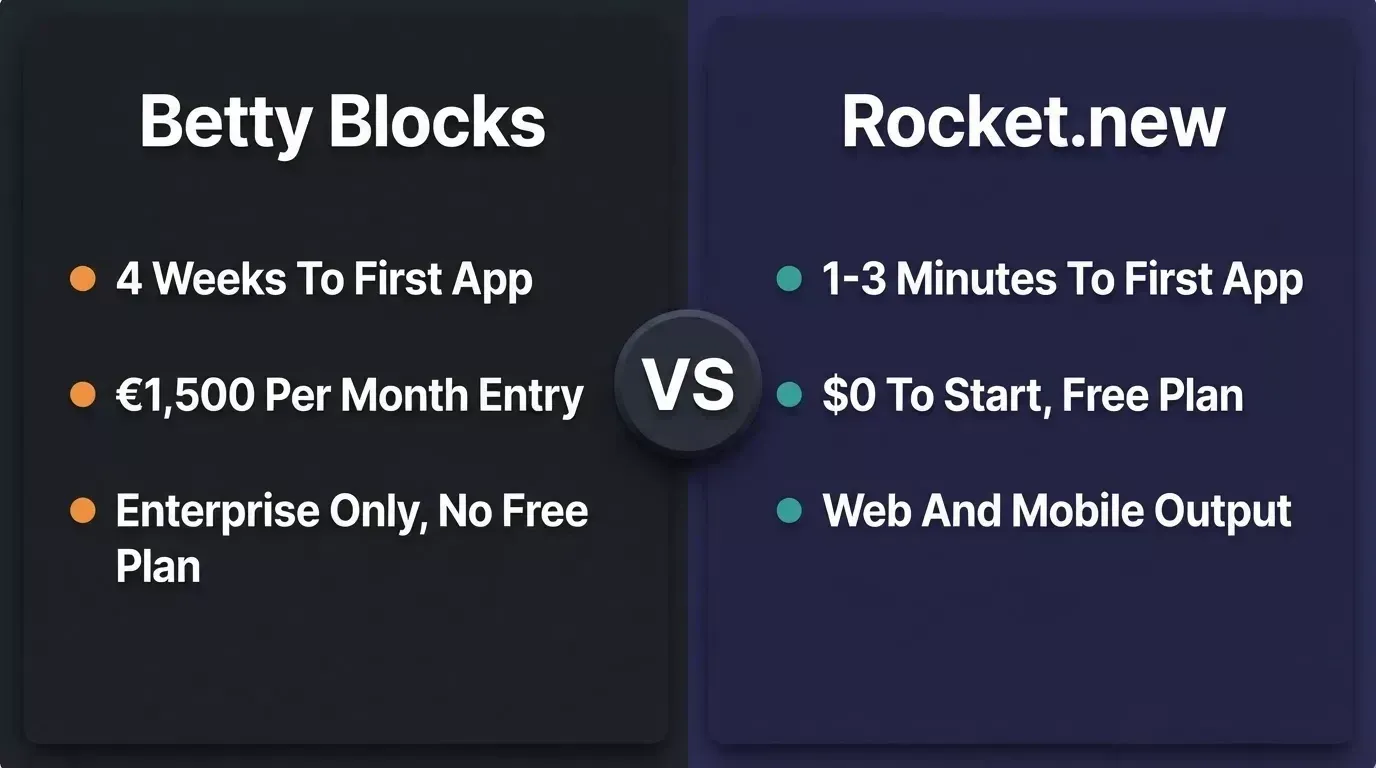
Betty Blocks and Rocket.new serve fundamentally different audiences with fundamentally different timelines and price points.
Where Does Rocket Fit For Product Builders?
If Betty Blocks is built for the enterprise IT room, Rocket is built for the serious person or team who wants to build an app with an idea that needs to be working by Friday. Rocket is the world's first Vibe Solutioning platform where you research what to build, build it, and monitor what matters, all in one place.
Full-stack from a single prompt. Describe what you want in plain language. Rocket generates a complete web app (Next.js), mobile app (Flutter for iOS and Android), or landing page with frontend, backend, database, and deployment. No code required. No setup.
Free plan to start. Twenty free credits, no credit card needed. Paid plans scale from there without per-seat pricing.
Ship in one to three minutes. Most apps generate in one to three minutes. Click Launch and get a live URL. Connect a custom domain. Download the full source code. Sync with GitHub and keep building. No lock-in.
25+ connectors for Stripe, Supabase, Figma, OpenAI, Google Analytics, Mixpanel, and more. Authenticate once, and every build inherits the connection.
Decision intelligence before the build. Rocket Solve answers any business question with a structured, evidence-backed report before you write a single line of code.
Continuous competitive monitoring. Rocket Intelligence monitors every public platform a competitor operates on and surfaces what signals mean for your business. No equivalent exists in Betty Blocks.
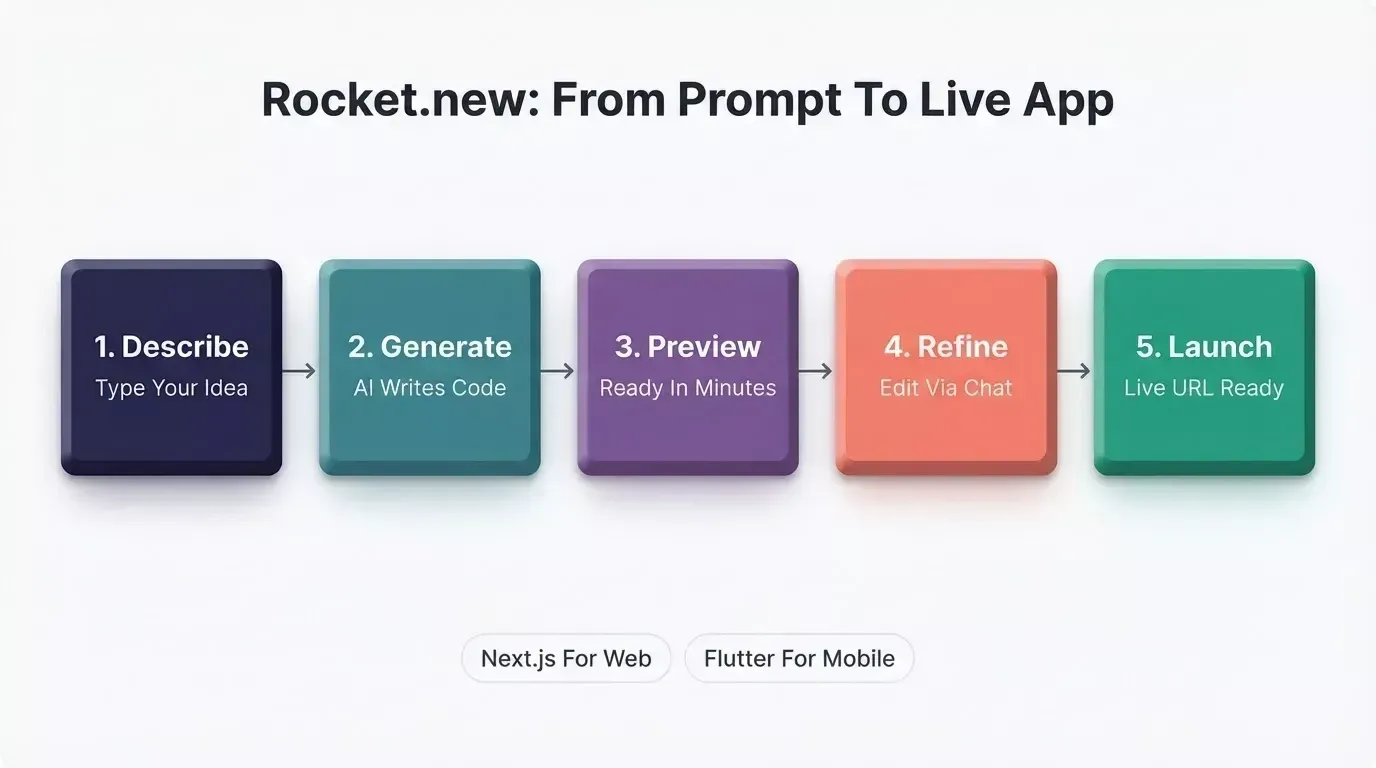
Rocket.new turns a plain-language description into a deployed, production-ready app in one to three minutes.
Rocket Pricing: What Does It Actually Cost?
Rocket pricing is structured around credits, a single balance that covers Solve research, Build generation, and Intelligence monitoring. There is no per-seat pricing on any plan.
| Plan | Monthly Cost | Annual Cost | Monthly Credits |
|---|---|---|---|
| Free | $0 | $0 | 20 one-time credits |
| Pro | $25 | $300 | 100 credits/month |
| Rocket | $50 | $600 | 250 credits/month |
| Booster | $250 | $3,000 | 1,500 credits/month |
| Intelligence add-on | $100/competitor | $1,200/competitor/year | 500 credits/competitor |
Unused credits roll over month-to-month on all monthly plans. The annual cost difference between Betty Blocks Create tier and Rocket Pro is over 24,000 EUR in year one.
How Do These Platforms Compare Side By Side?
| Feature | Betty Blocks | Rocket.new |
|---|---|---|
| Primary audience | Enterprise IT, regulated industries | Founders, product teams, solo builders |
| AI generation | Prompt-to-app with governed workflows | Prompt-to-production, full-stack output |
| Frontend | React (exported) | Next.js (web), Flutter (mobile) |
| Backend | WebAssembly (exported) | Supabase, auto-generated schemas |
| Mobile apps | Web-only, no native mobile | Native iOS and Android from Flutter |
| Speed to first app | 4-week guarantee | 1-3 minutes |
| Free tier | None | 20 free credits, no credit card |
| Entry price | 1500 EUR/month + 7500 EUR onboarding | $0 (free) |
| Year-one cost | ~25,500 EUR | $0 |
| Deployment | Public, private, on-premises, hybrid | Rocket hosting, custom domain, GitHub sync |
| Compliance | ISO 27001, SOC 2 Type 2, GDPR, NEN 7510 | SOC 2, GDPR, CCPA, ISO 27001 |
| Code ownership | Export React + WASM | Download full source, push to GitHub |
| Research layer | None | Rocket Solve, structured business intelligence |
| Competitive monitoring | None | Rocket Intelligence, continuous and automated |
| User base | Regulated European enterprises | 1.5M users across 180 countries |
Betty Blocks is a strong choice for large organizations that need governed environments, EU data sovereignty, and citizen-developer-IT fusion teams. Rocket is a strong choice for anyone who needs to build apps fast, ship them to real users, and iterate without a procurement cycle.
For readers comparing across a wider range of alternatives, many builders also look at Bubble alternatives before choosing Rocket for its full-stack speed and native mobile output.
If you have been comparing enterprise-grade low-code alternatives, the pattern holds. Governance-first platforms trade speed for control. Builder-first platforms trade governance depth for velocity.
The Rocket.new Platform: Seven Pillars In One Place
What separates Rocket from every other AI app builder is the full arc it covers. Most platforms solve one part of the journey. Rocket covers the entire thing from the business question that validates what to build, to the build itself, to the monitoring that tells you what to do next.
Rocket ships with seven pillars: Solve (decision intelligence), Build (web and mobile app generation), Intelligence (competitive monitoring), Redesign (website reimagination), Context (shared memory), Collaborate (team workspaces), and Support (human help when AI reaches its limit). All seven are connected through a shared context architecture. Nothing is re-explained, and everything compounds.
If you want to see how this compares to a traditional development approach, the no-code vs traditional development breakdown covers the full picture.
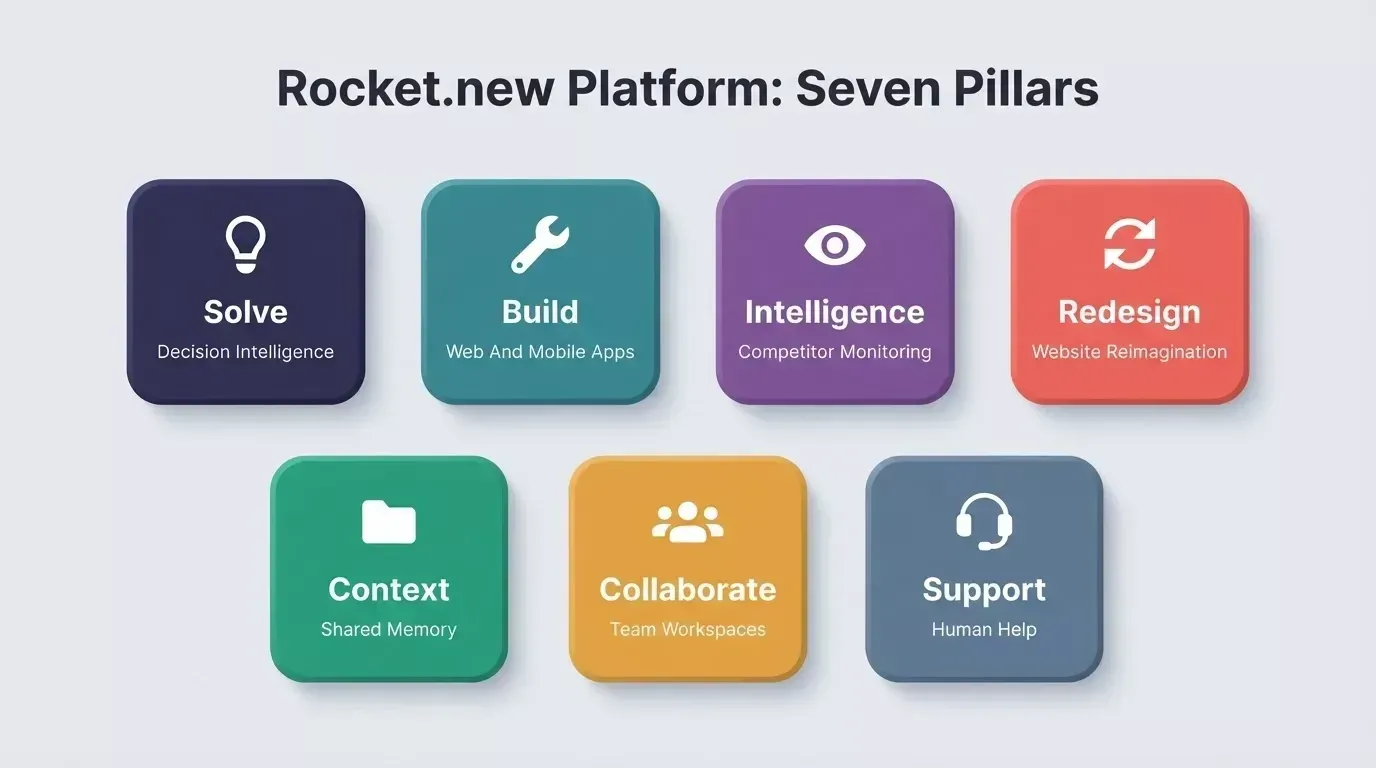
Rocket.new seven pillars cover the complete arc from business intelligence to app generation to ongoing monitoring.
When To Choose Betty Blocks
Betty Blocks earns its pricing for a specific type of organization. Choose Betty Blocks when:
-
Your organization operates in a regulated industry where EU data residency and ISO 27001 compliance are non-negotiable.
-
You have a dedicated IT department and a citizen-developer program that needs governed workflows and DTAP pipelines.
-
Your annual software budget exceeds 25,000 EUR, and you need a platform that scales across multiple complex internal applications.
-
You need on-premises or private cloud deployment and cannot accept any public cloud dependency.
-
Your team has already evaluated Mendix or OutSystems and needs comparable governance depth with more modern AI generation.
Betty Blocks is not the right choice for startups, solo founders, or product teams that need to move fast.
When To Choose Rocket
Rocket is built for a different moment entirely. Choose Rocket when:
-
You need to go from idea to live, deployed app in hours rather than weeks.
-
You are building a customer-facing product and want web app or native iOS and Android output from a single codebase.
-
You want to validate a product idea before committing budget. The free tier gives you enough to build and test one to two complete applications at zero cost.
-
You need research and competitive intelligence alongside your build.
-
Your team needs a platform that works from a browser without enterprise procurement.
-
You are a freelancer, agency, or product team that needs to ship fast and hand clients a live URL.
The ideal path for founders and small businesses: build fast, validate with real users, and add enterprise governance later when the business requires it. Rocket is designed for exactly that room in the market where speed matters more than process.
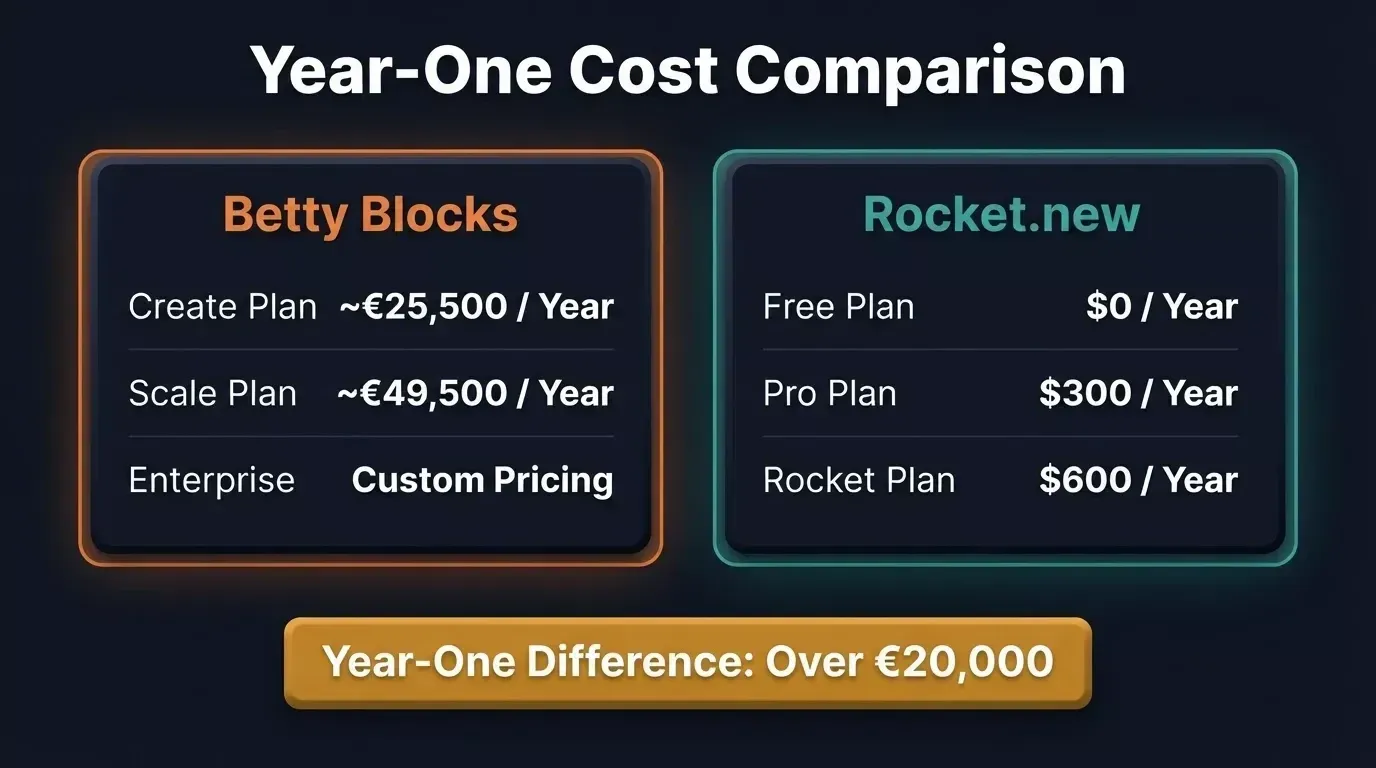
Year-one cost comparison: Betty Blocks Create tier starts at 25,500 EUR. Rocket.new starts at $0.
The Platform Question Is Really An Audience Question
Betty Blocks and Rocket both build software with AI, but they build it for different people with different timelines. Betty Blocks is designed for enterprises that measure success in compliance audits, governance frameworks, and multi-year technology platform decisions. It earns its pricing by keeping regulated teams safe while they ship internal tools and business workflows.
Rocket is built for builders who wake up with an idea and want it live by lunch. The platform turns a typed description into a deployed product with production-grade code, and it costs nothing to try.
If you are exploring the broader no-code and low-code landscape, the guide to choosing low-code platforms for scale is a useful next read.
Rocket.new has helped 1.5 million builders across 180 countries ship without writing a line of code, with full-stack web and mobile apps from a single prompt, built-in research, competitive monitoring, and 25+ integrations. Start building for free, no credit card, no sales call, one prompt to production.
Table of contents
- -Same Category, Different Universe
- -What Does the Low-Code Market Look Like in September 2026?
- -How Does Betty Blocks Serve Enterprise IT Teams?
- -Betty Blocks Pricing And Governance Layers
- -Where Does Rocket Fit For Product Builders?
- -Rocket Pricing: What Does It Actually Cost?
- -How Do These Platforms Compare Side By Side?
- -The Rocket.new Platform: Seven Pillars In One Place
- -When To Choose Betty Blocks
- -When To Choose Rocket
- -The Platform Question Is Really An Audience Question