Oracle APEX is genuinely powerful if you're already on Oracle Database. For everyone else, the $47,500/processor license makes "free" one of enterprise software's most misleading labels. Rocket.new builds full-stack apps from natural language with no Oracle dependency.
Oracle APEX 26.1 was rebranded as the "Oracle APEX AI Application Generator" in May 2026, adding APEXlang, AI Agents, and AI Interactive Reports. But the Oracle Database it runs on still lists at $47,500 per processor for Enterprise Edition.
This guide compares Rocket.new vs Oracle APEX on real cost, developer experience, lock-in, and which platform fits your organization.
Oracle APEX 26.1: What's Actually New (The AI Rebranding Examined)
Oracle released APEX 26.1 on May 14, 2026, officially renaming the platform the "Oracle APEX AI Application Generator." Three genuine additions shipped with this release.
APEXlang introduces a structured .apx specification format. App definitions are written in a version-controlled, human-readable language that can be diffed, reviewed, and audited before execution. This is a real governance differentiator: AI-generated apps can be inspected and approved before they touch production data.
AI Agents give APEX developers the ability to define controlled tool execution with explicit capability boundaries. Agents can query Oracle data, trigger workflows, and surface results inside APEX pages, all within developer-defined constraints.
AI Interactive Reports translate natural language queries into declarative report settings rather than raw SQL. A business user can describe what they want to see; APEX generates the report configuration.
What the Rebranding Did Not Change
APEX still only runs on Oracle Database. Oracle Database Enterprise Edition still lists at $47,500 per processor. Hiring an APEX developer still requires finding someone who combines Oracle Database architecture knowledge, PL/SQL fluency, and APEX framework experience.
Moving off Oracle after building in APEX still costs €15,000 to €80,000 in database migration alone, before a single line of APEX code is touched. The AI rebranding is partly genuine and partly a positioning response to AI-first builders entering the enterprise application space.
The Real Cost Of Free Oracle APEX
Oracle APEX is technically a no-cost feature of the Oracle Database. Oracle's own platform page confirms there are "no separate license fees for APEX" and no limits on the number of applications, developers, or end users. That part is accurate.
Oracle Database Enterprise Edition lists at $47,500 per processor, with annual support at 22% of the license cost, approximately $10,450 per processor per year. A single 4-core on-premises server carries a license cost of roughly $190,000 plus $41,800 per year in annual support.
The VMware trap: Oracle's soft-partitioning policy means running Oracle Database in a VMware cluster can multiply license exposure by 10 to 20 times compared to bare-metal or OCI-native deployment. Organizations running Oracle on VMware without careful license management face significant audit risk.
The AWS/Azure penalty: Oracle applies a 2:1 vCPU multiplication factor for licensing on AWS and Azure compared to OCI-native deployment. Running Oracle on non-Oracle cloud infrastructure costs more per core.
2026 pricing reality: Oracle average discounts fell from 57% to 44% between 2024 and 2026. The negotiating leverage organizations once had is narrowing.
The Oracle APEX low-code platform sits on top of a paid infrastructure stack that many organizations budget at six to seven figures annually. That is the gravity well. The software is free. The escape is not.
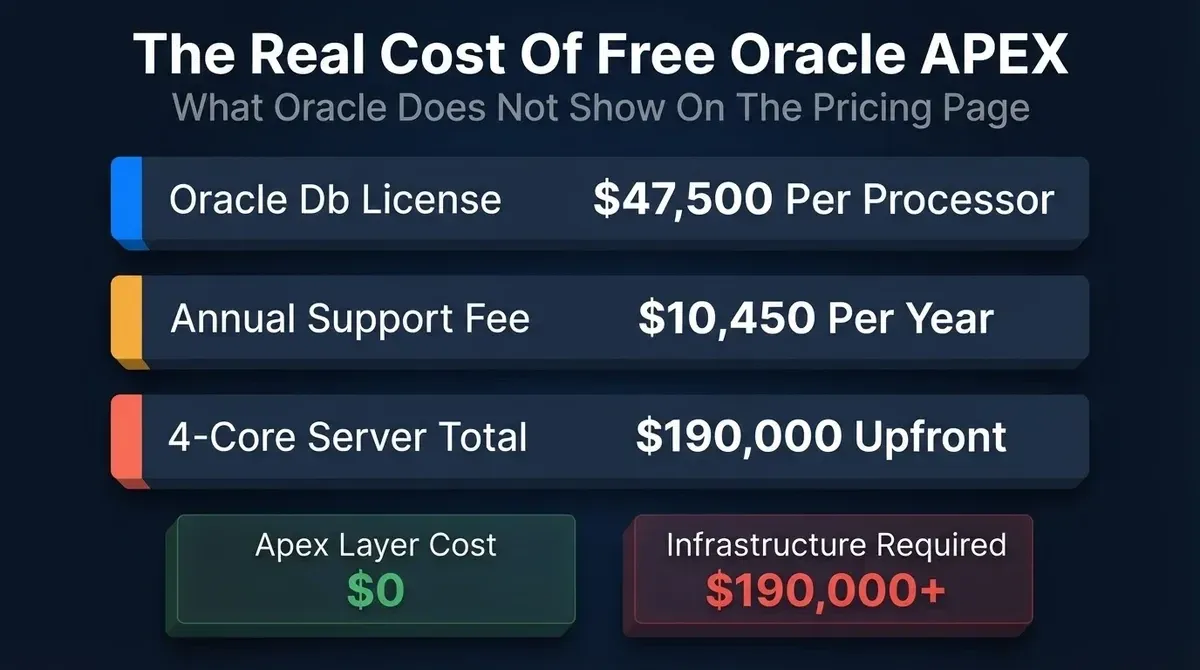
Oracle APEX's hidden cost stack: $47,500/processor license + 22% annual support = $190,000+ for a single 4-core server
Where Oracle APEX Is Genuinely Unmatched
Oracle APEX has real strengths that matter for specific enterprise contexts. Acknowledging them is what makes the comparison credible.
Zero-latency Oracle Database access: When application data lives in Oracle, APEX is native. The application and database share the same transaction boundary with no network calls between tiers. Sub-millisecond data access is a genuine architectural advantage, but only if you are already on Oracle.
Structural compliance inheritance: APEX inherits Oracle Database's compliance posture. Virtual Private Database, Transparent Data Encryption, fine-grained auditing, and Oracle Advanced Security are available without adding new audit surfaces. For organizations subject to DORA, SOX, or MiFID II, this structural inheritance is a meaningful differentiator.
No per-user pricing: Oracle APEX has no per-seat, per-developer, or per-workspace charges. For internal applications deployed to 500 or more users such as HR portals, government systems, and compliance dashboards, this is a genuine competitive advantage over platforms that charge per active user.
APEXlang AI governance: The structured .apx format introduced in 26.1 allows AI-generated applications to be version-controlled, diffed, reviewed, and approved before deployment. This is a governance capability that open-ended AI builders currently lack.
Enterprise deployment track record: TCU Brazil runs more than 500 APEX applications, including an internationally referenced anti-corruption system. Aster DM Healthcare uses APEX for multi-level approval workflows with high-volume parallel processing.
How Each Platform Builds An Enterprise App
Consider a concrete use case: a multi-level approval workflow with an audit trail for a 500-person financial services firm. The workflow requires role-based access, email notifications, a full audit log, and a mobile-accessible interface.
Top row: Oracle APEX path. Bottom row: Rocket path
The APEX path requires a developer who understands Oracle Database schema design, APEX Page Designer, PL/SQL for business logic, Oracle Workflow for process orchestration, and OCI deployment. The mobile interface is a PWA with no native binaries, no offline-first capability, and no native sensor access.
The Rocket path requires a description of the workflow. The platform generates a Next.js web application with a Supabase backend, role-based access control, email notifications, and a full audit log. The mobile app is native Flutter with iOS and Android binaries and offline capability.
The key difference is not just build speed. It is the skill requirement and the infrastructure dependency. APEX requires a specialist combination that takes 8 to 12 weeks to hire in the US market. Rocket requires any developer familiar with JavaScript, or no developer at all.
Building enterprise apps with AI tools means the platform handles the infrastructure work that used to require a dedicated DevOps team and weeks of service configuration.
The Lock-In Calculation
Oracle APEX applications cannot run on PostgreSQL, MySQL, Supabase, or any non-Oracle database. The application definitions, the business logic, and the data models are all tightly coupled to Oracle-specific constructs.
Migrating off APEX is two separate projects running in parallel: a UI layer rebuild and a database migration. The database migration alone carries a cost of €5,000 to €80,000 or more, depending on the volume of PL/SQL stored procedures and Oracle-specific SQL constructs.
Oracle SQL constructs with no direct PostgreSQL equivalent include ROWNUM, CONNECT BY hierarchical queries, NVL, DECODE, SYSDATE, and DUAL. Each one requires rewriting during migration. Moving away from Oracle is not trivial, and the cost compounds with every application added to the stack.
| Factor | Oracle APEX | Rocket |
|---|---|---|
| Database dependency | Requires Oracle Database | Supabase (PostgreSQL), open source and self-hostable |
| Starting cost | $0 APEX + $47,500/processor Oracle EE | $25 to $250/month flat |
| Per-user pricing | None | None |
| Mobile app | PWA only | Native Flutter (iOS + Android) |
| Code ownership | Oracle-runtime-bound app definitions | Full Next.js source + GitHub sync |
| AI features | APEXlang, AI Agents, AI Interactive Reports | Natural language to full-stack generation |
| Compliance | Structural Oracle DB inheritance | WCAG, GDPR, RBAC via Supabase RLS |
| Talent availability | Oracle DB + PL/SQL + APEX specialist | Any JavaScript/React developer |
| Learning curve | High, Oracle ecosystem knowledge required | Low, natural language or JavaScript |
| Lock-in exit cost | €15,000 to €80,000+ database migration | Standard Next.js, deploy anywhere |
Rocket generates standard Next.js output with GitHub sync. The Supabase backend is open-source and self-hostable. There is no proprietary runtime holding the application hostage. Choosing a low-code development platform for scale means weighing these portability constraints honestly before the first line of code is written.
The Oracle Forms Migration Decision
Oracle Forms 12c Premier Support is scheduled to end in late 2026. Organizations running Forms applications are facing a forced migration decision, and Oracle's recommended path is APEX.
The APEX path preserves existing PL/SQL business logic while modernizing the presentation layer. The migration risk is lower because the data model stays in Oracle and the business logic stays in PL/SQL. The tradeoff is that the organization remains Oracle-locked with the same licensing costs, the same talent dependency, and the same exit barriers.
The Rocket path requires higher initial migration effort. PL/SQL business logic must be rewritten in JavaScript and the Oracle data model must be migrated to PostgreSQL. The payoff is that the organization exits Oracle licensing entirely, opens the developer talent pool to any JavaScript developer, and owns portable code that can run on any infrastructure.
"Migrating from Forms to APEX is a UI layer replacement that still leaves the organization Oracle-locked." For organizations where the Oracle licensing cost is a strategic burden, the Forms end-of-support moment is the right time to evaluate whether staying in the Oracle ecosystem is the correct long-term decision.
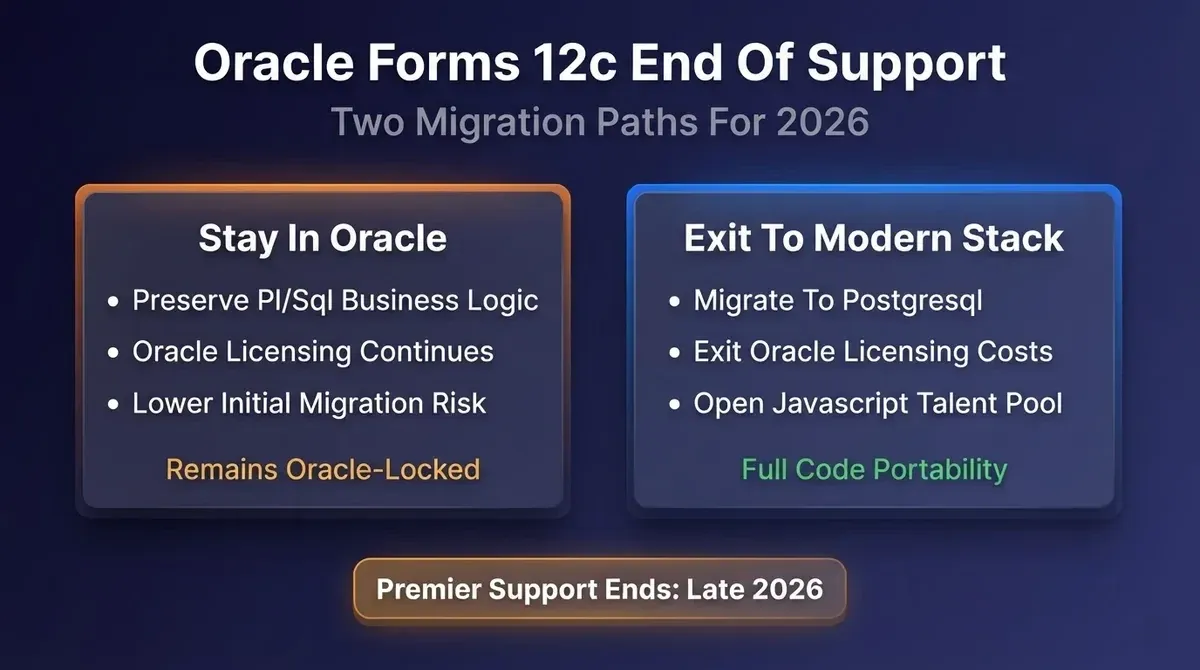
Oracle Forms 12c Premier Support ends late 2026. Organizations must choose between staying Oracle-locked or modernizing to a portable stack
The Talent Problem
Oracle APEX requires a developer who combines three distinct skill sets: Oracle Database architecture, PL/SQL programming, and the APEX framework itself. This combination is found in a substantially smaller talent pool than JavaScript developers.
The US hiring cycle for an APEX developer averages 8 to 12 weeks. React and JavaScript developers, by contrast, are typically hired within days from a pool that is orders of magnitude larger.
This talent dependency creates a business continuity risk that compounds over time. APEX applications become dependent on a specialized, aging talent pool. As Oracle Database expertise becomes less common among new developers entering the workforce, the cost and difficulty of maintaining APEX applications will increase.
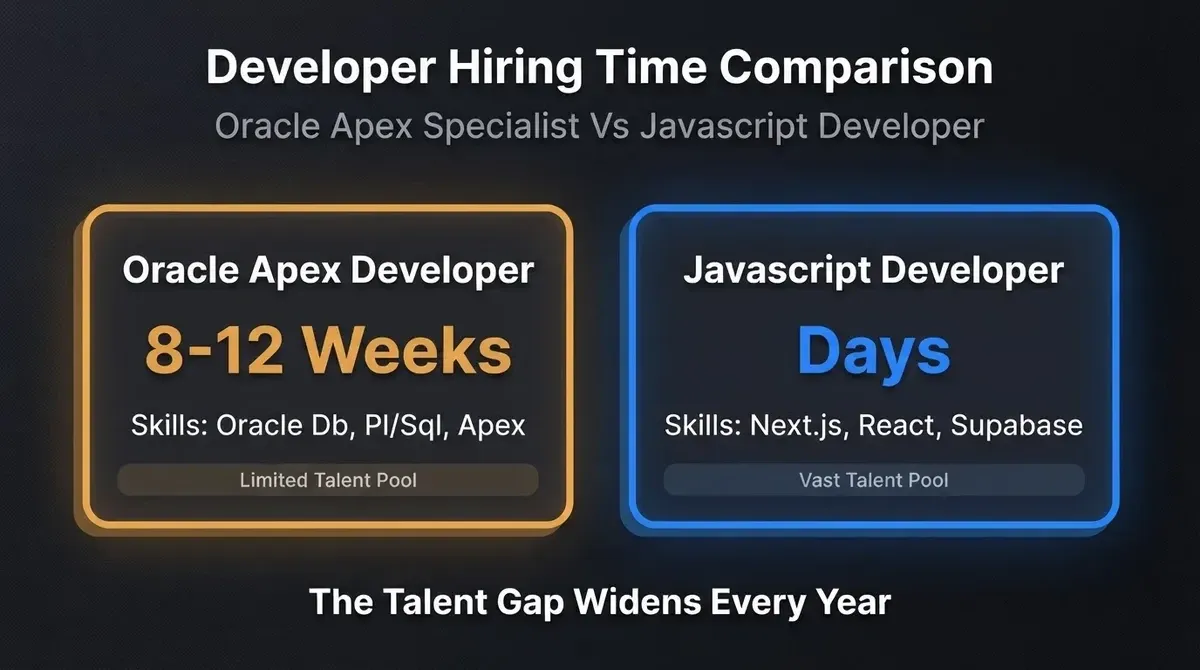
Hiring an Oracle APEX developer takes 8 to 12 weeks in the US market. JavaScript/React developers are available in days
Rocket generates Next.js output, the world's most widely used React framework. Any JavaScript developer can read, modify, and extend the generated code. The talent risk is the same as any modern web application, not a specialized Oracle ecosystem dependency.
Who Should Choose Oracle APEX
Oracle APEX is the right choice when:
-
Your organization is already on Oracle Database with an active support contract and the licensing cost is already absorbed
-
You are modernizing Oracle Forms 12c and want to preserve PL/SQL business logic with lower migration risk
-
Your primary application use case is Oracle data such as Oracle EBS, Oracle Fusion, or Oracle CRM where native data access matters
-
You need structural compliance inheritance for banking, government, or regulated industries without adding new audit surfaces
-
You are deploying to 500 or more users and need zero per-seat cost
For organizations in this category, APEX is a genuine enterprise-grade option. The benefits of low-code platforms for business process automation are real when the platform is matched to the right infrastructure context.
Who Should Choose Rocket
Rocket is the right choice when:
-
Your organization is not on Oracle Database, or is actively planning to exit Oracle
-
You want to build new enterprise applications without Oracle licensing complexity
-
You need a native mobile app alongside the web application, Flutter iOS and Android, not a PWA
-
You want to own portable Next.js code that runs on any infrastructure, not Oracle-runtime-bound app definitions
-
You need pre-build market validation (Solve) and competitive monitoring (Intelligence) in the same platform
-
You want to open your developer talent pool to any JavaScript developer rather than Oracle specialists
The Rocket internal tools playbook covers the full range of enterprise use cases Rocket handles, from approval workflows to customer portals to compliance dashboards.
Final Verdict
Oracle APEX is the right tool for Oracle-ecosystem enterprises. It is genuinely enterprise-grade, compliance-strong, and zero per-user cost for organizations already paying Oracle support fees. The AI features in 26.1 are real additions. The platform has a 25-year track record in government and regulated industries.
Rocket is the right tool for organizations building new enterprise applications without Oracle infrastructure. Full-stack generation from natural language, native mobile output, portable Next.js code, and no Oracle licensing dependency. The complexity Oracle APEX cannot remove is the Oracle Database it runs on. Rocket removes it entirely.
The question is not which platform is better in the abstract. The question is whether your organization's next application should deepen your Oracle investment or compound your team's intelligence on infrastructure you own and control.
Enterprise teams building new applications deserve a platform that ships production-grade software without Oracle's licensing complexity. Rocket generates full-stack Next.js web apps and native Flutter mobile apps from natural language with no PL/SQL, no Oracle licensing, and no infrastructure overhead. Start building your next enterprise application today!
Table of contents
- -Oracle APEX 26.1: What's Actually New (The AI Rebranding Examined)
- -*What the Rebranding Did Not Change*
- -The Real Cost Of Free Oracle APEX
- -Where Oracle APEX Is Genuinely Unmatched
- -How Each Platform Builds An Enterprise App
- -The Lock-In Calculation
- -The Oracle Forms Migration Decision
- -The Talent Problem
- -Who Should Choose Oracle APEX
- -Who Should Choose Rocket
- -Final Verdict