
Rocket.new vs Tabnine covers two distinct AI development tools. One builds full stack apps from a prompt; the other suggests code inside your IDE. This blog breaks down features, pricing, security, and use cases to help you decide.
Are you choosing between an AI code assistant and a full app builder?
Rocket.new vs Tabnine is one of the most searched comparisons in AI development tools today. Rocket is a Vibe Solutioning platform. It validates ideas, builds production-ready full stack apps, and monitors competitors from one workspace. Tabnine is an AI code assistant that provides code suggestions inside your IDE.
According to GitHub's developer survey, more than 97% of enterprise developers have used AI coding tools at work. That adoption rate signals a clear shift. However, the tools themselves serve very different purposes.
This blog breaks down features, pricing, security, and the best use cases for each.
What Does Each Tool Actually Do?
These two tools occupy fundamentally different categories in AI software development.
-
Tabnine is an AI code assistant. It sits inside your IDE and provides real-time code suggestions as you type. It offers code completion, function-level code generation, and AI chat for your codebase. Tabnine supports multiple programming languages and focuses on accelerating developers who already write code.
-
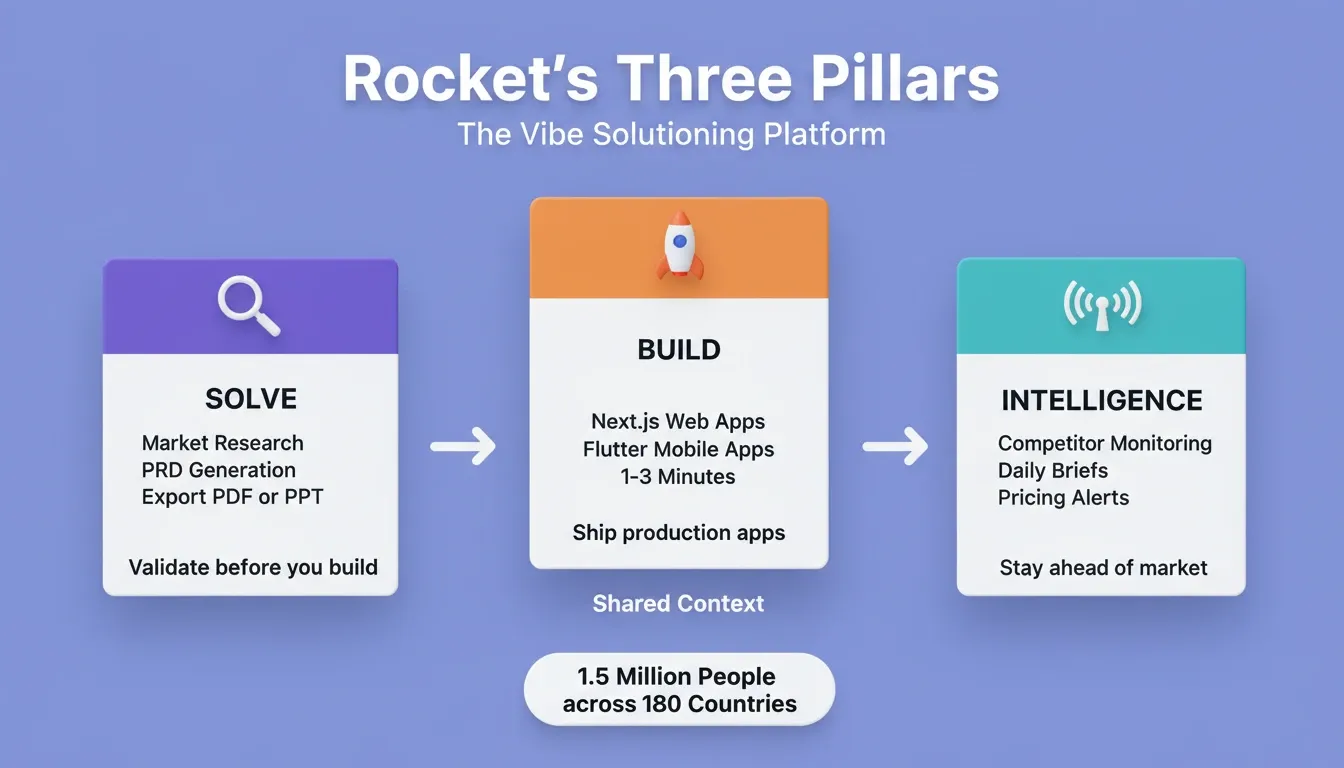
Rocket is an AI Vibe Solutioning platform. It combines three pillars in one workspace: Solve (validate ideas, run market research, generate PRDs), Build (generate full stack web and mobile apps from natural language), and Intelligence (monitor competitors continuously). Non-technical users and developers alike use it to go from idea to production-ready app in minutes.
-
The category difference is fundamental. Tabnine helps you write code faster. Rocket builds the entire app for you and helps you decide what to build first.
1.5 million people have tried Rocket across 180 countries, from solo founders validating their first idea to enterprise teams running strategy and execution on the same platform.
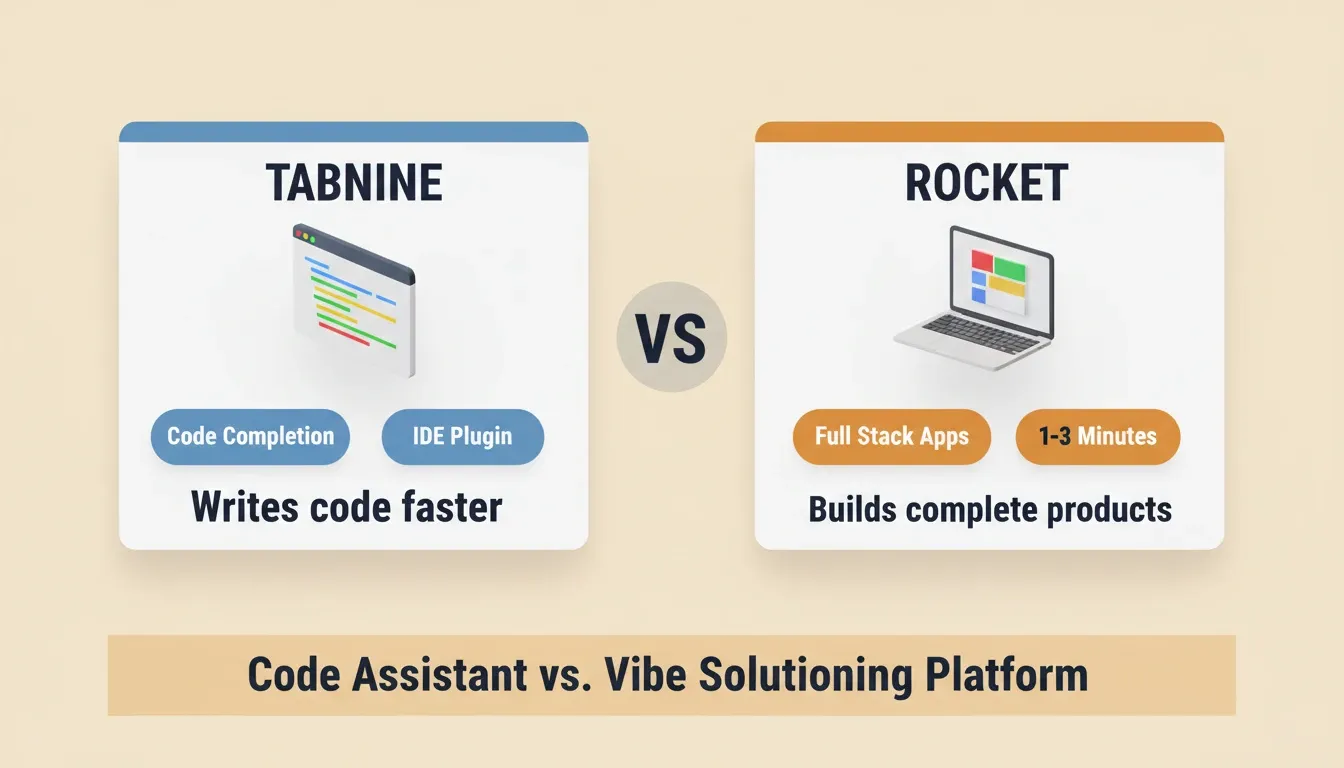
If you need an AI code assistant for line-by-line suggestions, Tabnine fits. If you need production-ready apps from natural language, check out these top AI app builders available today.
How Do Their Key Features Compare?
A feature comparison reveals just how different their approaches to AI-powered software development really are.
| Feature | Rocket | Tabnine |
|---|---|---|
| Code generation scope | Full stack apps (frontend, backend, database) | Line-level and function-level code completion |
| Natural language input | Describe your app, get a working product in 1 to 3 minutes | Chat-based code suggestions in IDE |
| Market research and PRDs | Built-in Solve pillar: validates ideas, generates PRDs, exports PDF/PPT | No research capability |
| Competitor monitoring | Built-in Intelligence pillar: continuous monitoring, daily briefs | No intelligence capability |
| Deployment | One-click cloud deployment with custom domains and automatic HTTPS | No deployment capability |
| GitHub sync | Built-in two-way GitHub sync and version control | GitHub Copilot-style IDE plugin |
| Visual editor | Drag-and-drop visual editor for UI | No visual editing |
| Backend logic | Auto-generated APIs, database schemas, and auth | No backend generation |
| Mobile apps | Native Flutter mobile apps from one prompt | No mobile app building |
| Code quality | Production-grade Next.js and Flutter, WCAG and GDPR by default | Code suggestions based on proprietary code context |
| Integrations | 25+ (Stripe, Supabase, Notion, Linear, and more) | IDE plugin integrations only |
| Built-in analytics | Visitors, conversions, Core Web Vitals after launch | No analytics |
| Starting methods | Prompt, Figma file, GitHub repo, attachment, or free template | IDE only |
-
GitHub Copilot and Tabnine overlap significantly. Both provide code suggestions inside IDEs. GitHub Copilot has broader model access and deeper GitHub connectivity. Tabnine differentiates with its privacy-first approach and model customization for enterprises.
-
Rocket generates production code in Next.js and Flutter, giving builders full ownership of clean, maintainable output. SEO-ready structure, WCAG accessibility compliance, and GDPR coverage ship as defaults.
The table makes one thing clear: code assistants accelerate code writing. Rocket replaces entire development workflows and adds the strategic layer before the build begins.
Where Does Tabnine Fall Short for App Building?
Tabnine excels at what it was designed for. However, it has notable gaps if your goal is generating apps from scratch.
-
Tabnine cannot generate full applications. It provides code suggestions line by line. You still need to architect, scaffold, connect databases, build UIs, and deploy manually.
-
It has no deployment, hosting, or app building capability. After Tabnine helps you write code, everything from version control to production infrastructure remains your responsibility.
-
Non-technical users cannot use Tabnine. It requires an existing IDE setup, coding knowledge, and a project already in progress.
-
Tabnine has no pre-build intelligence. There is no opinion on whether what you asked it to build was worth building. The quality of output depends entirely on what you brought to the tool.
For developers who want faster code completion inside their IDE, Tabnine delivers. For anyone building production apps without a full dev team, the tool was not built for that purpose.
How Does Pricing Break Down?
Pricing tells you not just what a tool costs, but what you get relative to what you would otherwise need to build or hire.
| Plan | Rocket | Tabnine |
|---|---|---|
| Free tier | Yes: 20 one-time credits, build production-ready apps | No free plan (deprecated 2024) |
| Starter | $25/month (Pro: 100 credits/month) | $39/user/month (Code Assistant) |
| Pro | $50/month (Rocket plan: 250 credits/month, includes Solve and Intelligence) | $59/user/month (Agentic Platform) |
| Power | $250/month (Booster: 1,500 credits/month, premium support) | Custom (on-premises available) |
| Enterprise | Custom pricing | Custom (on-premises available) |
| Per-user pricing | No per-seat charges: unlimited team members on all paid plans | Per-user per month |
| Unused credits | Roll over month to month | LLM token quota plus 5% handling fee |
-
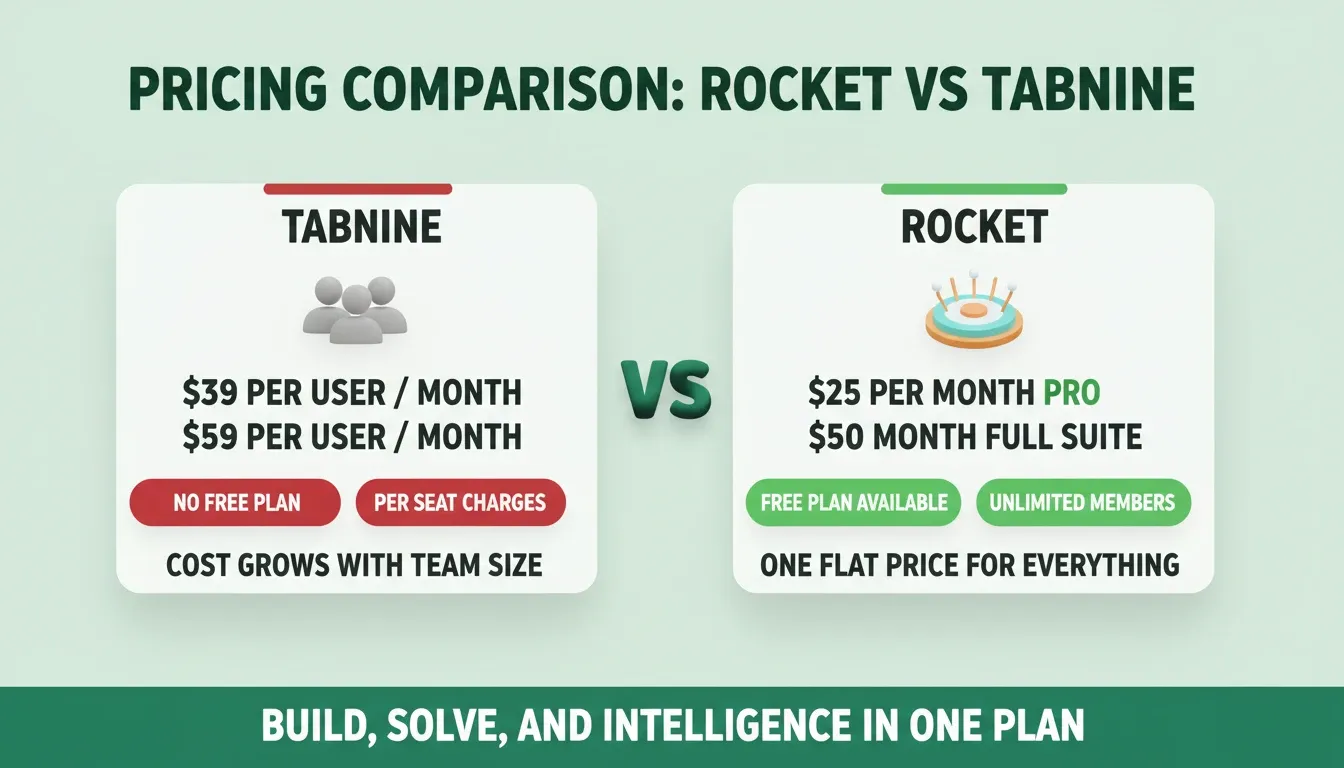
Tabnine's per-user pricing adds up fast for teams. At $39/user/month for basic code suggestions or $59/user/month for the agentic platform, a team of 10 pays $390 to $590/month just for IDE chat and code completion.
-
Rocket's flat pricing includes the entire stack. One subscription covers app generation, deployment, databases, authentication, hosting, custom domains, GitHub sync, market research (Solve), and competitor monitoring (Intelligence). According to Stack Overflow's annual developer survey, 62% of developers cite technical debt as their top frustration. Generating clean full stack code from the start helps avoid that accumulation.
-
The free tier difference matters. Rocket offers a free plan so you can test the full workflow before paying. Tabnine removed its free plan, meaning you pay before knowing if the code suggestions fit your workflow.
On a cost-per-outcome basis, Rocket delivers more value. You pay for one tool and get a complete product. See how AI app builders compare on development costs to understand the full picture.
Which Tool Handles Data Privacy and Security Better?
Data privacy and security concerns are not abstract for teams handling customer code, proprietary code, or sensitive business logic.
-
Tabnine built its reputation on enterprise security. It offers on-premises deployment, VPC hosting, fully air-gapped environments, and a zero data retention policy. No customer code is stored or used for training. It holds SOC 2, ISO 27001, and GDPR compliance certifications.
-
Rocket protects code through a different model. Your generated code lives in your own GitHub repo with full ownership and full control. Code is not shared, stored on third-party servers, or used to train models.
-
Enterprise compliance needs differ by use case. Tabnine serves organizations requiring on-premises AI where no data leaves the building. Rocket serves teams wanting production-ready code with full ownership stored in version control systems they already control.
-
Rocket ships WCAG accessibility, GDPR-ready data handling, and SEO compliance as defaults in every generated app. Environment variables are handled at the server level, so API keys and secrets are never exposed in client code.
If your primary concern is keeping AI inference completely on-premises, Tabnine fits that need. For most builders who want full code ownership with production-grade privacy defaults baked in from generation, Rocket covers the bases while delivering significantly more output.
Why Builders Pick Rocket for Full Stack AI Apps
When the goal shifts from "write code faster" to "ship a working product," the tool requirements change completely.
-
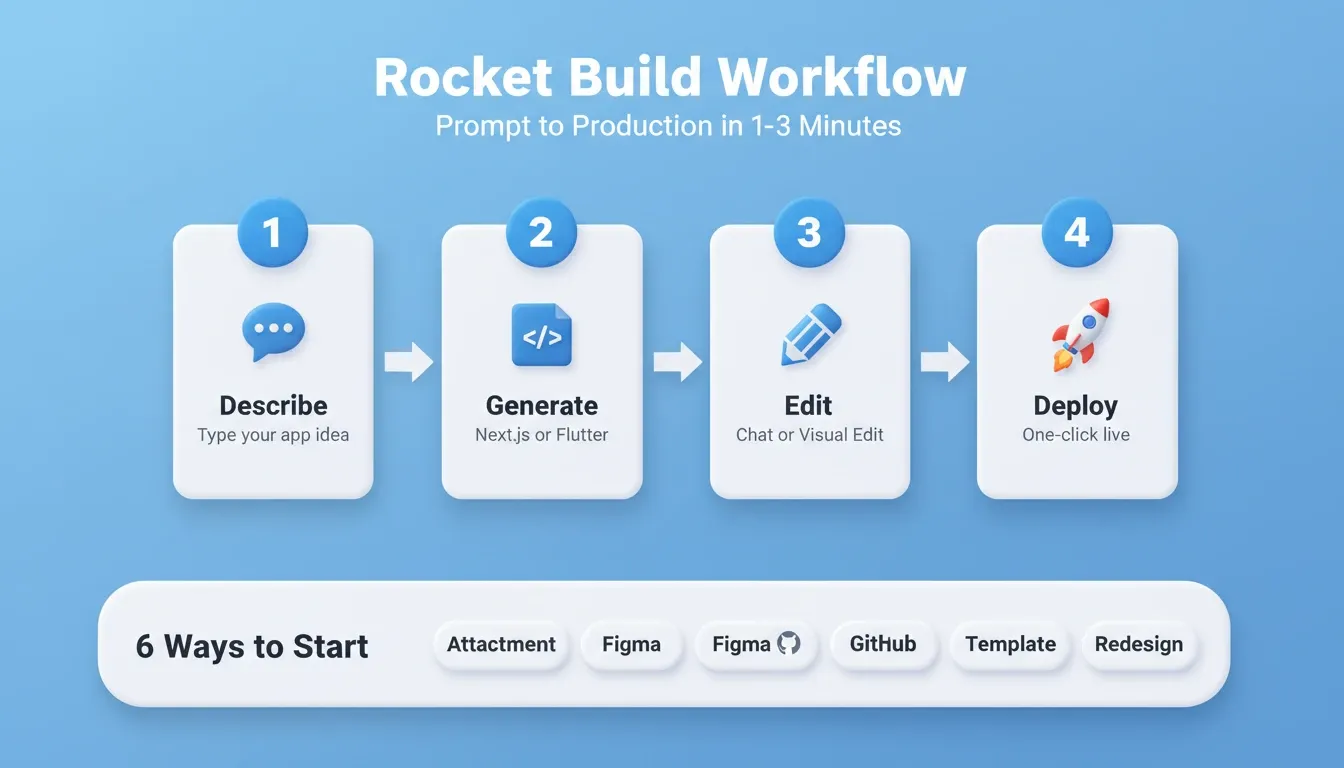
From prompt to production in 1 to 3 minutes. Describe your app idea in natural language, and Rocket generates the full stack: frontend, backend automation, database, authentication, and hosting. Other AI code assistants help you write code. Rocket builds the thing itself.
-
Six ways to start a build. You can start from a plain language prompt, a Figma file, an existing GitHub repository (Next.js and TypeScript), an attachment (screenshot, PDF, spreadsheet), a free template, or by pointing Rocket at a live URL to redesign it.
-
Solve before you build. The Solve pillar lets you validate your idea, run market research, create PRDs, and get structured reports with data, insights, and recommendations. Outputs export as PDF or PPT and flow directly into your Build task as shared context.
-
25+ integrations flow directly into generation. Stripe, Google Analytics, Supabase, Notion, Linear, Airtable, Mailchimp, Mixpanel, and more: authenticate once and they are available in every build.
-
GitHub sync and code ownership are built in. Every project syncs to GitHub automatically via a two-way sync. You get full ownership of every line. Export, modify, and host anywhere with no lock-in.
Tabnine helps developers write code marginally faster. Rocket helps builders ship a working app in minutes, with the research, the build, and the competitive intelligence all in one place.
Who Should Use Which Tool?
The right tool depends entirely on what you are trying to accomplish and where you sit in the development process.
| User Type | Best Tool | Why |
|---|---|---|
| Professional developer in an IDE | Tabnine | Context-aware code suggestions, enterprise privacy controls |
| Enterprise with on-premises AI requirement | Tabnine | Air-gapped deployment, SOC 2, zero data retention |
| Solo founder shipping an MVP | Rocket | Full stack app from one prompt, no dev team needed |
| Non-technical builder | Rocket | No coding required: describe the idea, get the product |
| Freelancer building client projects | Rocket | Fast iteration, production-ready output, GitHub export |
| Team needing market research and build | Rocket | Solve, Build, and Intelligence in one platform |
| Developer wanting both | Both | Tabnine for daily IDE work, Rocket for new projects and MVPs |
-
For non-technical users, the choice is straightforward. Tabnine requires coding knowledge. Rocket requires only an idea described in plain language.
-
Individual developers often use both. Tabnine works in the IDE for daily coding tasks. Rocket works for spinning up new projects, MVPs, internal tools, dashboards, and landing pages.
Learn how vibe coding workflows for modern teams are changing the speed of product development. Also explore the best AI tools for solo founders building without a full engineering team.
What Are Developers Saying About Both Tools?
Community sentiment shows how these tools perform in real workflows, not just in polished demos.
-
Tabnine's acquisition reshaped its trajectory. In July 2026, Tricentis acquired Tabnine to integrate its Enterprise Context Engine into quality engineering workflows. Per the Tricentis acquisition announcement, Tabnine customers reported "up to 2x improvement in AI accuracy" and "up to 80% reduction in token consumption." The product now focuses on enterprise quality engineering over general-purpose code assistance.
-
GitHub Copilot remains the comparison baseline. Most developers evaluating Tabnine compare it against GitHub Copilot. Both offer code suggestions in IDEs. However, GitHub Copilot has deeper GitHub connectivity while Tabnine differentiates on data privacy and model customization for enterprises.
-
A developer on LinkedIn noted: "The problem with AI code assistants is they help me write code faster, but I still spend 80% of my time on everything that is not writing code: architecture, deployment, testing, infrastructure." This is exactly the gap full stack AI app builders fill.
-
Software development professionals increasingly recognize that the bottleneck has shifted to system design, deployment speed, and iteration cycles rather than line-level code writing.
The developer community is splitting into two camps: those who want better code writing tools and those who want better product building tools. The question is which camp matches your goals.
The Right AI Tool Comes Down to Your Goal
The Rocket.new vs Tabnine decision is straightforward when you know what you are building toward. Tabnine serves professional developers who need faster, privacy-controlled code suggestions inside an existing IDE workflow. Rocket serves builders who need to go from idea to deployed product, with research, build, and competitive intelligence in one place.
As AI development tools mature, the gap between code assistance and full product generation will only widen. Rocket is already built for that future: validate the idea with Solve, ship the product with Build, and stay ahead with Intelligence. Start building at Rocket.new and ship your first app in minutes.
Table of contents
- -What Does Each Tool Actually Do?
- -How Do Their Key Features Compare?
- -Where Does Tabnine Fall Short for App Building?
- -How Does Pricing Break Down?
- -Which Tool Handles Data Privacy and Security Better?
- -Why Builders Pick Rocket for Full Stack AI Apps
- -Who Should Use Which Tool?
- -What Are Developers Saying About Both Tools?
- -The Right AI Tool Comes Down to Your Goal