
Account intelligence gives B2B reps real-time signals; funding rounds, leadership changes, technographic data, and trigger events; so they walk into every call with sharp, relevant context instead of guesswork.
How would your sales calls change if every rep had complete account context before reaching out?
That's the core of sales intelligence at the account level. Reps with structured, real-time briefs convert more prospects, land more relevant conversations, and spend less time on cold approaches that go nowhere.
According to Salesforce 2026 State of Sales, 73% of B2B buyers actively avoid sellers who send irrelevant outreach. The fix is not fewer emails. It is sharper ones, grounded in real signals about what an account actually needs today.
This blog walks through which signals move deals, how modern intelligence platforms process raw data, and how your sales teams can put all of it to work before every call.
What Makes an Account Brief Actually Useful?
Walk into most CRMs and you'll find account records untouched for weeks: stale contact data, notes from the previous rep, and a firmographic snapshot from six months ago. That's not pre-call prep. That's guesswork with a company logo attached.
Good account research draws from intelligence platforms that track live signals alongside static records. A proper brief answers a specific set of questions before you dial:
-
What changed at this account in the last 30 days?
-
Who are the key decision makers right now, and who just departed?
-
Which tools are they running, and what might they replace next?
-
Are there recent funding rounds or earnings calls that opened a budget cycle?
-
What trigger events, such as a new hire, an acquisition, or a product launch, just shifted their priorities?
The gap between sharp account research and basic sales intelligence comes down to data freshness. Most legacy tools stop at firmographic data: company size, industry, revenue band. That's a snapshot of who an account is. It says nothing about what the account is doing today, which is where decision making actually happens.
Account Intel vs. Basic Sales Intelligence
Sales intelligence is the broader practice of gathering signals about prospects to improve outreach and guide the buyer journey. Account-based intelligence goes deeper: it focuses on the company as a whole, not just individual prospects, and it tracks signals as they evolve over time.
The four data layers that matter most:
-
Firmographic data confirms whether an account fits your ideal customer profile. It doesn't confirm whether the timing is right.
-
Contact data shows who works at the company. It doesn't reveal who controls budget or who just took over a team.
-
Behavioral data from website visits, email engagement, and content interaction signals interest. It doesn't explain the reason.
-
Third-party data sources bridge what first-party data alone can't cover: market activity, external intent data, and public signals.
Good account research ties all four layers together so reps walk into calls with context rather than just coordinates.
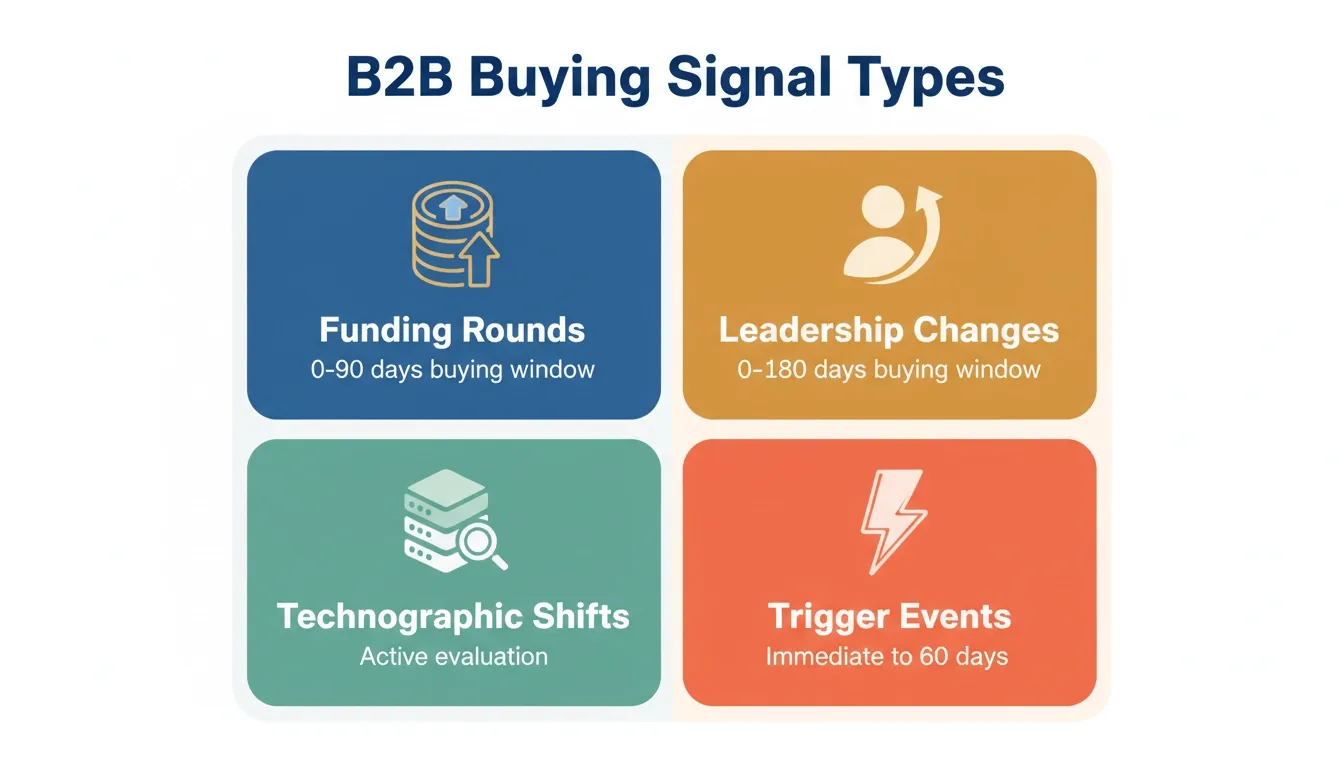
Four B2B buying signal types and their respective buying windows for sales teams
Why Static Data No Longer Cuts It
Gartner finds that 75% of B2B buyers now prefer a rep-free purchasing experience. That's not a rejection of sellers. It means buyers arrive at calls already informed, and they expect the rep to have done the same preparation.
When intelligence platforms only surface static data, reps face predictable problems:
-
They show up with information the buyer already knows
-
The pitch sounds generic, and experienced buyers notice immediately
-
The competitive intelligence advantage disappears before the conversation starts
Modern account research fixes the lag. A brief updated this morning is a fundamentally different tool from one refreshed three weeks ago, and that gap is often what separates a productive call from a polite pass.
Why Do Reps Walk Into Calls Without the Right Context?
Most reps aren't underprepared by choice. They're working against a system built for logging activity, not learning from it. Research scattered across five browser tabs, a dated CRM entry, and a last-minute LinkedIn check isn't a workflow. It's a collection of separate pain points that compound daily and quietly kill sales efficiency.
The Relevance Gap
Buyers arrive at sales conversations having already done their homework. By the time a rep dials in, the buyer has framed the problem, shortlisted options, and formed strong opinions.
The rep's job at that point isn't to introduce the product. It's to show up with a point of view grounded in account-specific context: what the buyer is worried about, what's changing inside their organization, and how far the buyer journey has already progressed on their side.
Without that context, reps fall back on generic messaging and a pitch that could have gone to any account on the list.
The Time Trap
Sales reps spend roughly 60% of their time on non-selling tasks, including manual account research, CRM updates, and internal coordination. Every hour spent building a brief from scratch is an hour not spent talking to target accounts.
Scale that across a week: ten accounts at 20 minutes of manual research each, and you've burned nearly a full day of selling time. Sales efficiency drops, deal velocity slows, and the sales organization misses targets not because of skill gaps but because of information gaps. Intelligence platforms that automate signal collection give that time back, and redirect it toward preparation that actually requires judgment.
The Signals That Move Deals
Not every data point is a buying signal. Most are noise. The signals that move deals consistently point to change: new pain points, new priorities, new budget. A company in motion is a company worth calling. Here's where to find those signals.
Funding Rounds and Earnings Calls
Fresh capital is one of the clearest B2B buying signals available. A Series B close or a strong earnings call signals a company in expansion mode: hiring, tooling up, and allocating budget across new initiatives. Sales teams that track funding rounds reach target accounts while the money is live and the mandate is active.
For public companies, earnings calls deliver forward-looking intent data at a strategic level. When a CFO mentions "significant investment in go-to-market infrastructure," that's a buying window, not a vague hint. Key intent signals to track from earnings calls:
-
New headcount commitments by department and function
-
Technology investment language from the CFO or CEO
-
Geographic expansion plans and new market entries
-
Acquisition and strategic partnership announcements
Reaching out in the weeks after an earnings call, with messaging tied to what the executive team just said publicly, puts reps in the conversation with a specific reason to be there.
| Signal Type | What It Tells You | Buying Window |
|---|---|---|
| Funding rounds | Live budget; growth mode active | 0-90 days post-close |
| Leadership changes | Vendor relationships reset | 0-180 days post-hire |
| Technographic shifts | Active evaluation in progress | Active |
| Trigger events and news | Strategic priorities just shifted | Immediate to 60 days |
Hiring and Leadership Changes
Hiring patterns are often the earliest indicator of strategic direction, appearing months before any public announcement. Signals worth tracking systematically:
-
A cluster of job changes in a department you sell into is a direct buying trigger
-
A new VP of Sales hired from an enterprise background signals a market-up move
-
Engineering headcount jumping from 5 to 19 open roles in two weeks points to major product investment
-
An unfilled C-suite role sitting open for weeks indicates organizational instability
Rocket's People and Hiring intelligence pillar tracks this in depth: open roles by department, executive arrivals and departures, headcount velocity, and what the patterns imply about the company's strategic direction.
Leadership changes at the C-suite level tend to reset vendor relationships entirely. A new CTO evaluates the technology stack with fresh eyes. A new CMO often replaces agency and martech vendors within the first six months. Job changes at senior levels are re-entry windows worth acting on quickly.
Technographic Data and Product Moves
Technographic data tells you what tools a target account is currently running. Third-party data providers aggregate this from multiple external data sources:
-
Job boards showing role requirements that reveal technology stack investments
-
Review platforms capturing recent product scores and switching activity
-
App usage data and public API patterns
-
Product release notes and changelog announcements
Combined with behavioral data from review patterns and hiring signals, technographic data gives sales teams a picture of where gaps are forming before the account starts actively shopping. Knowing the technology stack of a target account transforms reps from cold callers into informed advisors who arrive with a specific, grounded point of view.
Trigger Events and News
News signals capture moments of change that compress buying timelines. Classic trigger events include new funding announcements, leadership hires or departures, product launches or sunset announcements, mergers and acquisitions, geographic expansion, and regulatory changes affecting the company's industry.
A company that just announced a major acquisition is not the same organization you pitched eight months ago. Their pain points shifted. Their budget opened. Trigger events tell you not just that an account is interesting, but when to reach out and what specific angle to take.
Track these signals continuously. The difference between catching a buying window and missing one usually comes down to whether your sales teams are watching target accounts in real time.
How Does Modern Sales Intel Actually Work?
Sales intelligence at scale requires three layers: data collection from external data sources, an enrichment process that cleans and ranks raw signals, and a delivery layer that surfaces actionable insights to reps before they need them. Here's how each piece fits together.
First-Party vs. Third-Party Data Sources
First-party data is what your organization already owns: CRM history, email records, call transcripts, website visit logs, and support tickets. It's the richest behavioral data because it reflects your specific relationship with each account.
Third-party data comes from outside your organization. Third-party data sources include data brokers, review aggregators, job board APIs, financial data providers, news feeds, and social listening platforms. Each adds a layer of signal the first-party record can't provide on its own.
The limitation of first-party data alone is its blind spot: it shows what happened with you, not what's happening at the account right now. Third-party sources fill that gap. Both types work together: first-party data grounds the brief in your relationship history, while third-party data sources show the account's current trajectory and external activity.
From Raw Data to Ranked, Actionable Insights
Raw data is close to useless for a rep with 90 seconds before a call. Data collection alone doesn't solve the problem. What separates good intelligence platforms from plain aggregators is the data enrichment layer that processes incoming signals into something a rep can actually use.
Data enrichment works through four steps:
-
Filtering noise from genuine intent signals using pattern matching
-
Cross-referencing signals across multiple data types, such as checking whether a funding round aligns with the new hire pattern
-
Ranking outputs by relevance to the rep's specific accounts and deal stage
-
Packaging the result as a readable brief with interpretation, not just raw data points
The output is interpretation, not aggregation: what changed, why it matters, and what the rep should probably say next.
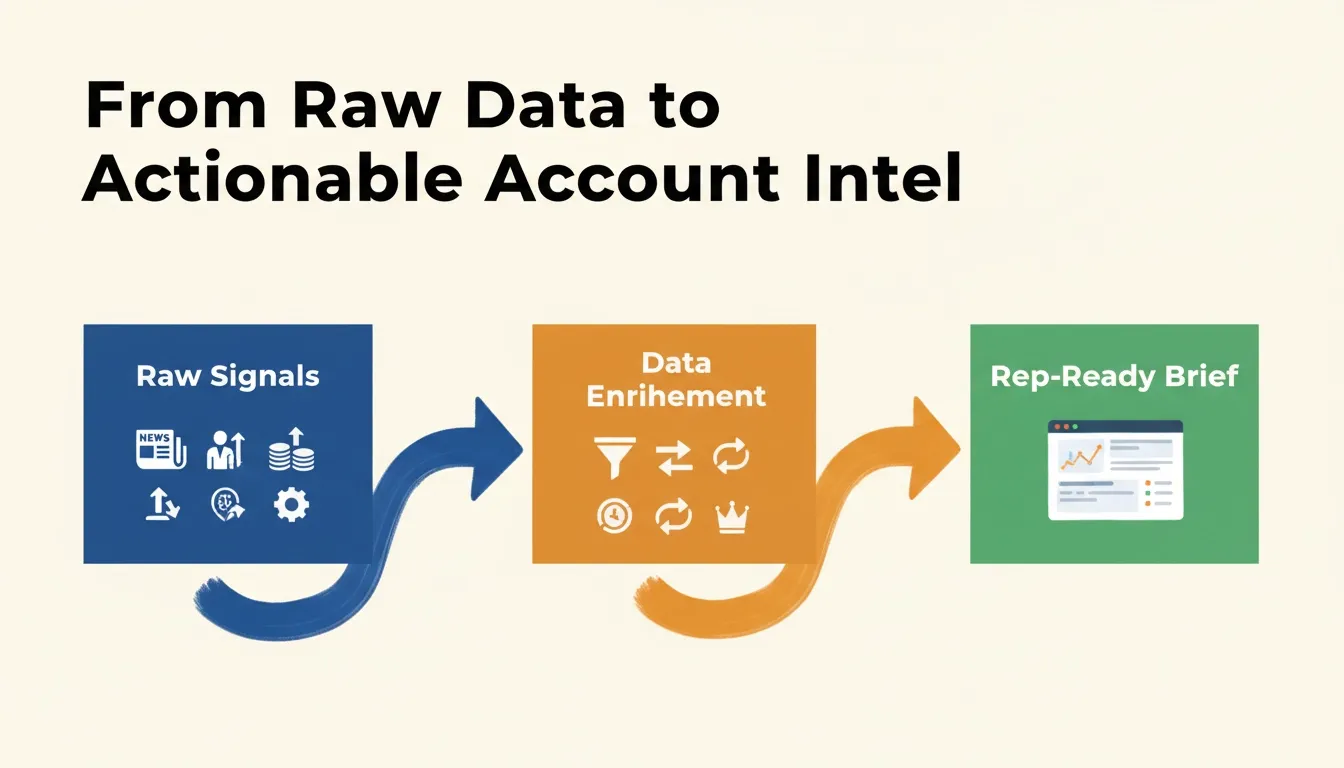 The account intelligence data pipeline: from raw external signals to a ranked, rep-ready brief
The Role of AI and Machine Learning
Artificial intelligence and machine learning are what make this pipeline run at the scale most sales teams need. Tracking ten accounts manually across multiple signal categories is manageable. Tracking five hundred target accounts is not.
Machine learning handles the heavy pattern-matching work:
-
Identifying which intent signals are leading indicators of a purchase decision for a given account type
-
Generating predictive analytics showing which accounts in similar stages converted vs. churned
-
Scoring and ranking intel by relevance to the current deal stage
-
Detecting anomalies: signals that break a company's established pattern and may point to a strategy shift
Predictive analytics from these models help sales teams prioritize their pipelines using data-driven decisions rather than instinct. Artificial intelligence surfaces what matters most, ranked, so reps spend prep time on strategy rather than manual data collection.
Data Freshness and Accuracy
A brief is only as good as the data behind it. Stale data accuracy issues create a failure mode that's hard to diagnose: the rep walked in with wrong context, built the wrong pitch, and couldn't understand why the call went sideways.
Good intelligence platforms address this through continuous collection:
-
Near-real-time data processing across external data sources, not weekly export cycles
-
Duplicate detection and resolution before the brief is assembled
-
Conflicting signal flagging when data accuracy is uncertain
-
Freshness indicators so the rep knows how current each piece of intel is
The result is a living system rather than a static snapshot that decays between exports. For a deeper look at how sales intelligence software platforms differ on this dimension, the comparison is worth reviewing before evaluating vendors.
Turning Data into Daily Sales Workflows
Knowing which signals matter is step one. Getting those signals into daily rep workflows is where most sales teams stall. The problem usually isn't data quality. It's operational structure.
Building Your Target Accounts List
Start with your ideal customer profile. Good intelligence platforms help identify high value accounts from large datasets by filtering across firmographic data, technographic, and intent data layers simultaneously, then ranking results by recent signal activity.
Account identification isn't just about finding accounts that fit your criteria. It's about finding the right accounts at the right time: companies in motion, with active pain points relevant to your product and intent signals pointing to live buying readiness.
A tiered approach to list-building works well for most sales and marketing teams:
-
Tier 1 (high value accounts): Active signals across multiple categories; follow in real time with personalized outreach
-
Tier 2 (target accounts): Strong ICP fit with one or two active signals; track and trigger on the next event
-
Tier 3 (more accounts): Good ICP match but quiet signal activity; monitor before investing outreach effort
This account-based approach to list-building improves conversion rates by focusing effort where intent data points to genuine buying readiness, not just firmographic fit. Every ideal customer profile match that lacks fresh signals belongs in a lower tier until the signals change.
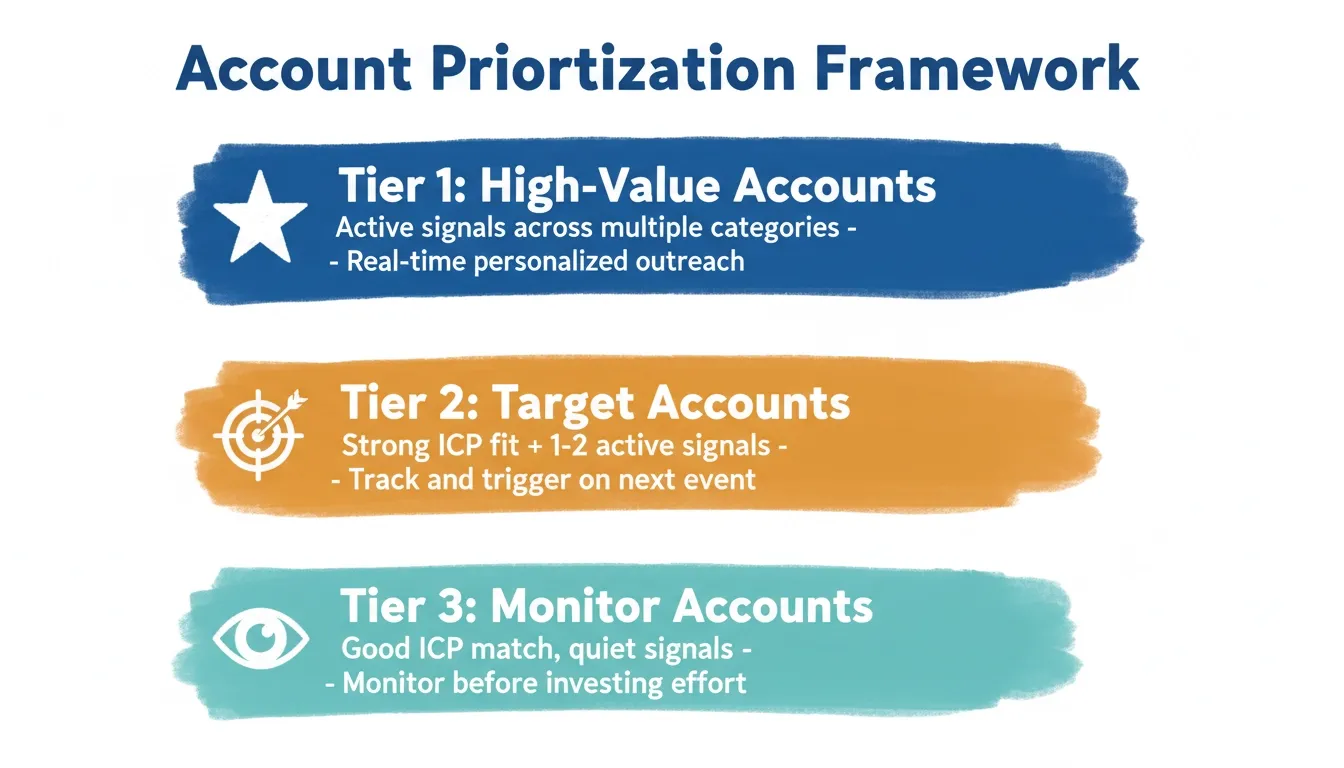 A tiered account prioritization framework based on signal activity and ICP fit
Personalizing Outreach with Intent Signals
Intent data bridges the gap between knowing something changed at an account and saying something relevant about it. When sales outreach references a specific signal tied to the prospect's current situation, it reads as informed rather than intrusive.
Personalized outreach built around intent signals follows a clear structure:
-
Reference the specific trigger event or signal
-
Connect it to a pain point the signal implies
-
Link it to an outcome your product produces for that problem type
Sales outreach built this way consistently drives higher open rates, faster decision making, and shorter sales cycles than generic sequencing. ABM campaigns apply this same intent data logic at scale. Sales and marketing teams align on account strategies for target accounts, running personalized campaigns triggered by what accounts are actively signaling. The result is account-based marketing that performs like a direct conversation and delivers measurably better conversion rates across the funnel.
Understanding how to build a clean B2B sales database is the foundation that makes this personalization possible at scale.
Connecting Intel to Your CRM
Customer relationship management systems are where account data should ultimately live, accessible to the full sales team. The challenge is keeping that data current. Contact data goes stale within months. Intent data rarely makes it into CRM records. The system drifts from reality between sales and marketing cycles.
Good intelligence platforms push enriched data directly into CRM records so sales teams always work from fresh context:
-
Updated contact data and firmographic details flow in automatically
-
Intent signals appear in account records without manual data entry
-
Data accuracy holds across the full pipeline
-
Reps see account changes in context rather than discovering them mid-call
The data enrichment loop between intelligence platforms and your CRM is what separates a living sales system from a historical log that requires constant manual correction.
Signal-Based Scoring and Resource Allocation
Not every account deserves the same level of attention at the same time. Signal-based scoring assigns priority to accounts based on recent signal volume and quality, helping sales managers make data-driven decisions about where to direct their team's effort.
An account that just closed a funding round, hired a new VP of Revenue, and is visiting your pricing page multiple times a week scores very differently from one quiet for two months. Sales strategies built around this scoring produce better deal velocity, stronger conversion rates, and more predictable revenue. Competitive advantage at the pipeline level comes from acting on intent data before the rest of the market notices the same signals.
Learning how to build a scoring model that sales reps trust is the practical next step after your signal collection is in place.
How Rocket Intelligence Builds Live Account Briefs
Most intelligence platforms fall into one of two failure modes: they either alert you to everything and create noise, or they only answer questions you already knew to ask and miss the signals you weren't watching for. Neither is what a sales rep needs 15 minutes before a call.
Rocket takes a different approach. Rocket Intelligence watches companies you care about across every public surface they operate on, interprets what changes mean for your business specifically, and surfaces findings as ranked Intel: personalized updates that arrive in your dashboard without any manual data hunting.
Ten Pillars of Always-On Coverage
Most data providers track one or two signal categories and call it coverage. Rocket Intelligence monitors ten pillars simultaneously: website, social media, news, GTM, traffic, product and technology, people and hiring, business and finance, reviews, and a cross-pillar overview that catches when several signals together imply a strategy.
Each pillar gives sales and marketing teams a different read on the account:
-
People and hiring tracks open roles, executive arrivals and departures, headcount velocity, and what hiring patterns imply about strategic direction. Hiring is often the earliest signal of a move.
-
Business and finance surfaces funding rounds, partnership signals, acquisition activity, and earnings calls disclosures.
-
Product and technology watches product releases, technology stack changes, and capability signals from hiring requirements.
-
News and media captures press releases, analyst coverage, executive commentary, and competitive positioning shifts in the market.
Cross-pillar patterns are where deeper insights live. When an account raises funding, hires an enterprise VP of Sales, and posts senior AE roles within the same 30-day window, Rocket Intelligence surfaces that as one ranked Intel item with context, not three disconnected alerts. Sales and marketing teams acting on that pattern-level insight reach the account before the buying window narrows.
Where Traditional Platforms Fall Short
Legacy sales intelligence tools were built around static databases. They tell you what a company looks like at the time of last update: size, location, revenue band, and technology stack. They don't show what the company is doing right now.
Three gaps appear consistently with traditional platforms:
-
Stale update cycles: Many platforms refresh records weekly or monthly. Buying windows open and close within those gaps.
-
No absence detection: Traditional tools flag what happened. They miss what stopped happening. A competitor gone quiet on hiring and social media might be reorganizing, which is itself a meaningful signal.
-
Single-source alerts with no interpretation: A ping every time a target account raises money, with no cross-referencing or ranking, generates more noise than insight.
Rocket Intelligence was built with absence detection as a core principle: silence or slowdown can be as informative as activity. The platform tracks what changed, what stopped, and what the pattern means in your specific context.
Structured Briefs That Change as the Account Changes
The output from Rocket Intelligence isn't a raw data export. It's a structured brief, personalized to your role and priorities, that updates continuously as the account changes.
Sales teams working from Rocket get:
-
The most promising prospects surfaced automatically, ranked by signal activity
-
Key decision makers flagged with recent activity context
-
Customer engagement patterns highlighted across all pillars
-
Expansion plans or new capabilities detected before they go public
The brief draws on account insights across all ten pillars, ranked by relevance to your current deal stage. Because the system runs continuously rather than on a weekly export cycle, the brief you pull on Monday reflects something that happened on Sunday. Context stays current, data accuracy holds, and reps walk into every call ready to talk about what's actually happening at the account today.
From Signal to Sale: Why Context Wins Every Call
Sales context has become a pre-call requirement. Buyers research independently, enter conversations informed, and expect reps to bring something to the table they didn't already know. The sales teams closing deals today aren't winning on outreach volume. They're winning on the sharpest context available on their target accounts before the call starts.
Signals are out there. Funding rounds, leadership changes, hiring patterns, technographic shifts, and trigger events: all of it is public. The question isn't whether your target accounts are generating signals. It's whether your revenue strategy is set up to catch them before the window closes.
Rocket gives your team a live account intelligence layer that watches every signal category, interprets what patterns mean, and delivers ranked briefs before every call. Stop building context from scratch. Start every conversation already ahead.
Table of contents
- -What Makes an Account Brief Actually Useful?
- -Account Intel vs. Basic Sales Intelligence
- -Why Static Data No Longer Cuts It
- -Why Do Reps Walk Into Calls Without the Right Context?
- -The Relevance Gap
- -The Time Trap
- -The Signals That Move Deals
- -Funding Rounds and Earnings Calls
- -Hiring and Leadership Changes
- -Technographic Data and Product Moves
- -Trigger Events and News
- -How Does Modern Sales Intel Actually Work?
- -First-Party vs. Third-Party Data Sources
- -From Raw Data to Ranked, Actionable Insights
- -The Role of AI and Machine Learning
- -Data Freshness and Accuracy
- -Turning Data into Daily Sales Workflows
- -Building Your Target Accounts List
- -Personalizing Outreach with Intent Signals
- -Connecting Intel to Your CRM
- -Signal-Based Scoring and Resource Allocation
- -How Rocket Intelligence Builds Live Account Briefs
- -Ten Pillars of Always-On Coverage
- -Where Traditional Platforms Fall Short
- -Structured Briefs That Change as the Account Changes
- -From Signal to Sale: Why Context Wins Every Call