Most website builders in 2026 trap you in templates, add-ons, and steep learning curves. Rocket generates a production-ready, SEO-optimized site from a single prompt, free, in minutes, no coding needed. Ship before Monday.
Can you build a professional website in a weekend for free?
Yes, and in 2026, you can do it without a drag and drop editor, a generic template, or three days of setup.
Rocket generates a production-ready, live site from a single prompt in minutes. And since website/blog/SEO is the number one ROI-generating channel for marketers (HubSpot State of Marketing, 2026), the gap between having a site and not having one has never been more expensive to ignore.
This blog walks through how to ship a site that actually performs, and why most popular website builders are quietly holding small business owners back in 2026.
Why Most Website Builders Are Holding You Back in 2026
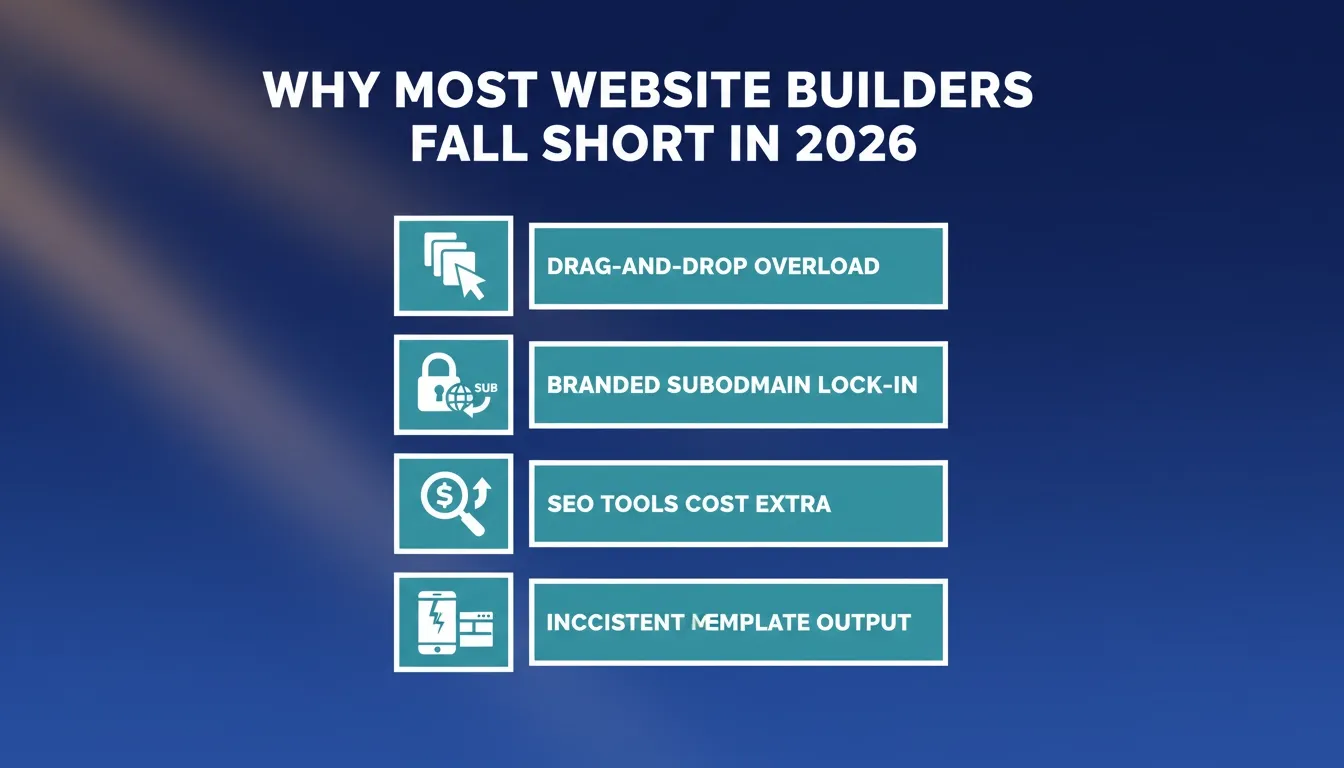
Most platforms were built around a drag and drop editor and a library of basic templates. That model made sense a decade ago. In 2026, it produces sites with a steep learning curve, a generic template look, and a growing list of add ons before you can do anything real.
Here is what that experience actually looks like for most small business owners:
-
You spend hours in a drag and drop editor that gives creative control in theory, but not in practice
-
The free plan locks your live site behind a branded subdomain with limited customization
-
Paid plans start at one price, but SEO tools, ecommerce features, and custom code all cost extra
-
Mobile responsiveness is inconsistent, even though more than 60% of all global web traffic comes from mobile (HubSpot, 2025)
-
The output looks like a generic template, because it started as one
The frustration is real. And it is exactly the gap that the new generation of AI website builders is designed to close. The most popular website builders were built to be easy. The best website builders in 2026 need to be effective, and those are not always the same thing.
What the Best Website Builders Actually Need to Do
Before picking any platform, it helps to get clear on what you actually need. The easiest website builder is not always the right one, especially for service-based businesses, small business owners, and product-based businesses who need a site that works, not just one that exists. If you want to build a website with AI effectively, the platform has to meet a higher bar than drag-and-drop alone.
The non-negotiables for a SEO friendly website builder in 2026:
-
Mobile responsiveness out of the box. 67% of mobile users say they are more likely to buy from a company if its website is mobile-friendly (HubSpot, 2023)
-
SEO tools built in. Meta titles, structured data, sitemaps, not add ons
-
Fast site speed. Google uses Core Web Vitals as a ranking signal
-
Contact forms and landing pages without needing third party tools
-
Design quality that does not look like a generic template
What separates good from great:
-
A free plan that lets you build and preview before paying
-
Custom code access for when you need precise control
-
Ecommerce features that do not require a separate subscription
-
Custom domains without a steep additional cost
-
An all-in-one platform that does not require piecing together extra tools
Most platforms check some of these boxes. Very few check all of them. And the ones that do not, Wix, Squarespace, WordPress, Framer, all have structural limitations that show up the moment your business grows.
Website Builder Comparison: Features at a Glance
| Feature | Wix | Squarespace | WordPress | Rocket |
|---|---|---|---|---|
| Free plan | Yes (branded domain) | Trial only | Yes (limited) | Yes |
| AI website builder | Basic | Basic | Plugin-based | Native, full-stack |
| Mobile responsiveness | Auto | Auto | Theme-dependent | Built-in default |
| Custom code | Limited | Limited | Full | Full |
| SEO tools | Good | Good | Plugin-required | Built-in |
| Ecommerce features | Paid plan | Paid plan | WooCommerce | Built-in |
| Design quality | Template-based | Template-based | Theme-based | AI-generated, unique |
| No coding skills required | Yes | Yes | No | Yes |
A Deep Dive Into the AI Website Builder Shift
The most popular website builders started adding AI capabilities, but most bolted AI onto an existing drag and drop editor. The result is a slightly smarter version of the same old tool. The real shift is happening with platforms built AI-first from the ground up.
Here is how the two approaches compare:
Traditional path: Pick a template, use the drag and drop editor, tweak for hours, and end up with a generic-looking live site.
Rocket path: Describe your site in plain language, AI generates production-ready code via a single prompt, preview and refine via chat, and launch a live site in minutes.
The numbers back this up. Generative AI-powered tools drove 693.4% more traffic to retail websites during the 2025 holiday season compared to the prior year (Digital Commerce 360, 2026). Businesses that adopted AI-powered web tools earlier are already seeing the gap widen. The question is not whether AI website builders are the future. The question is which one actually delivers.
AI-First vs. Template-First: How the Build Process Differs
How Rocket Works as an App Builder and Website Builder
Rocket is not just an AI website builder. It is the world's first Vibe Solutioning platform, where business thinking and building happen in the same workspace. Most platforms are tools. Rocket is a system.
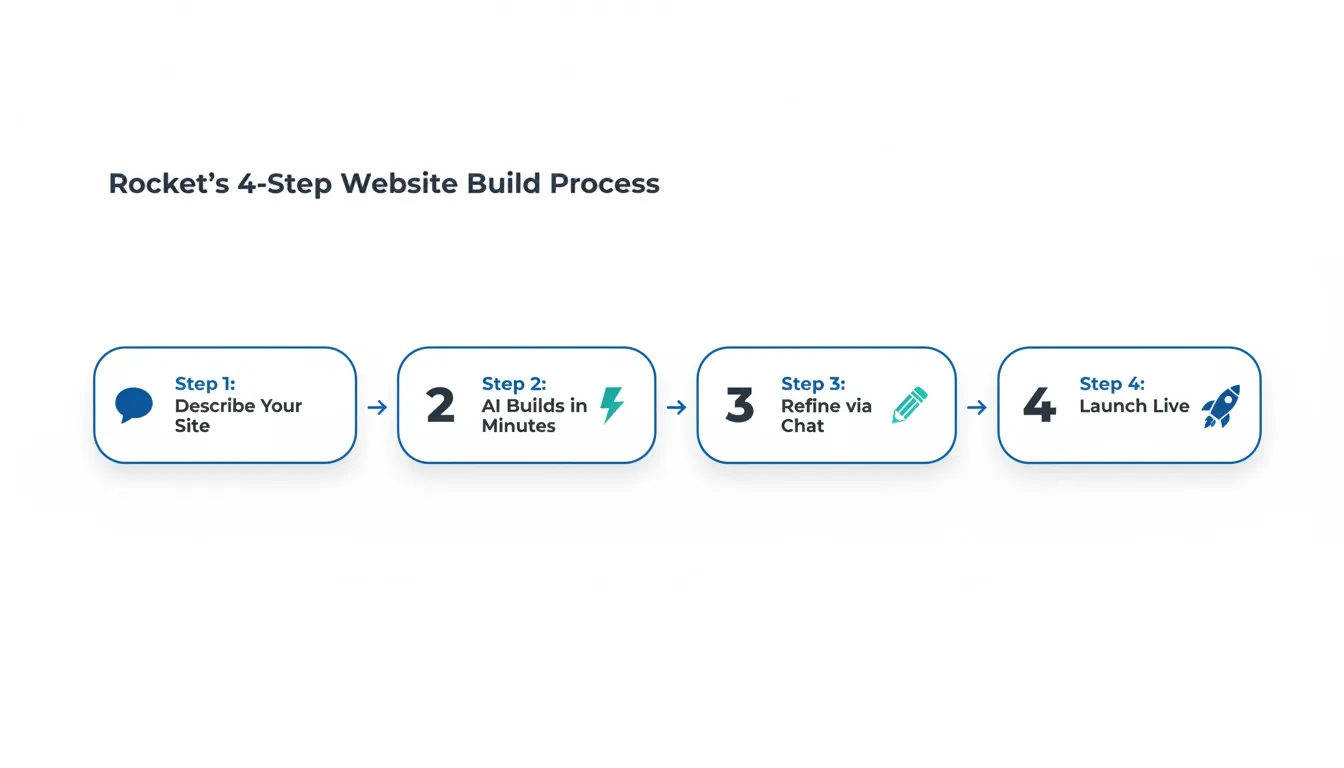
Here is how the build process works, step by step:
Step 1: Describe what you want
-
Go to Rocket, sign in, and describe your site in plain language
-
Use category tabs such as Landing page, Website, SaaS, or E-commerce, or type your own prompt directly
-
Example: "Build a professional website for a boutique accounting firm with a homepage, services page, contact form, and about section. Clean design, navy and white color palette."
-
Rocket scores the clarity of your prompt and asks clarifying questions if needed
Step 2: Watch it build
-
Most web apps and websites generate in 1 to 3 minutes
-
You can watch the code being written in real time
-
When done, you get a live preview you can interact with like a real user, click buttons, fill contact forms, navigate between pages
Step 3: Refine through chat
-
"Change the header to a dark background"
-
"Add a testimonials section after the services"
-
"Make the contact form more prominent on mobile"
-
No re-explaining context. No starting over. Rocket applies changes in context and updates the live site accordingly
Step 4: Launch
-
Click Launch and your site goes live instantly with a shareable URL
-
Connect a custom domain directly through the platform; Rocket handles DNS setup automatically
-
Buy a domain directly through the Launch panel without needing an external registrar
This is what shipping a SEO friendly website builder site looks like when the platform is built AI-first rather than template-first. Rocket also makes it easy to create high-converting landing pages for product launches, campaigns, and lead generation, all from the same workspace.
Rocket vs. The Most Popular Website Builders
The most popular website builders all do their jobs. Wix, Squarespace, WordPress, and Framer each have real strengths. But they also have structural limitations that matter for small business owners who need more than a basic site.
Wix and Wix Studio
Wix is one of the most popular website builders for good reason. The drag and drop editor is genuinely easy to use, and Wix Studio gives web designers more creative control. But the limitations are real:
-
Design quality is template-based, and most Wix sites look like Wix sites
-
The learning curve for Wix Studio is steep for non-designers
-
Ecommerce features and SEO tools require paid plans
-
No AI builder that generates from scratch; AI tools assist within the existing editor
For small business owners who want a site that looks distinct, Wix delivers a solid starting point but rarely delivers a result that feels custom-built.
Squarespace
Squarespace has a reputation for design quality, and it is deserved for certain use cases. But the limitations show quickly:
-
No free plan, only a trial period
-
Steep learning curve for anything beyond basic customization
-
Custom code is limited on lower paid plans
-
Not built for web apps or anything with real business logic
Squarespace is basic compared to what an AI-first builder can produce, especially for service-based businesses that need contact forms, landing pages, and real flexibility.
WordPress
WordPress powers a huge portion of the web. That flexibility is also its biggest problem for most business owners:
-
Requires coding skills or a developer for anything beyond basic themes
-
Ongoing maintenance, security updates, and plugin management
-
The learning curve is steep; it is not the easiest website builder
-
Design quality depends entirely on the theme and plugins you choose
Most small businesses end up rebuilding their WordPress sites every few years because the ongoing maintenance and plugin complexity compound over time.
Framer
Framer produces beautiful sites and gives designers real design freedom. But it is not built for business owners without design backgrounds:
-
Not accessible to non-tech-savvy users
-
No real ecommerce features
-
Paid plans start at a price point that does not make sense for most small businesses
-
No AI builder that generates from a plain language description
Rocket does not start with a template. It starts with your idea. The output is a site built from scratch for your specific use case, with intentional typography, real hierarchy, and a visual identity that does not read as AI-made.
Built-In Tools That Go Beyond a Basic Template
One of the biggest frustrations with most popular website builders is that the features you actually need are add ons. You pay for the base plan, then pay again for SEO tools, email marketing, ecommerce features, and contact forms. Rocket takes a different approach; the built-in tools are part of the platform, not bolt-on extras.
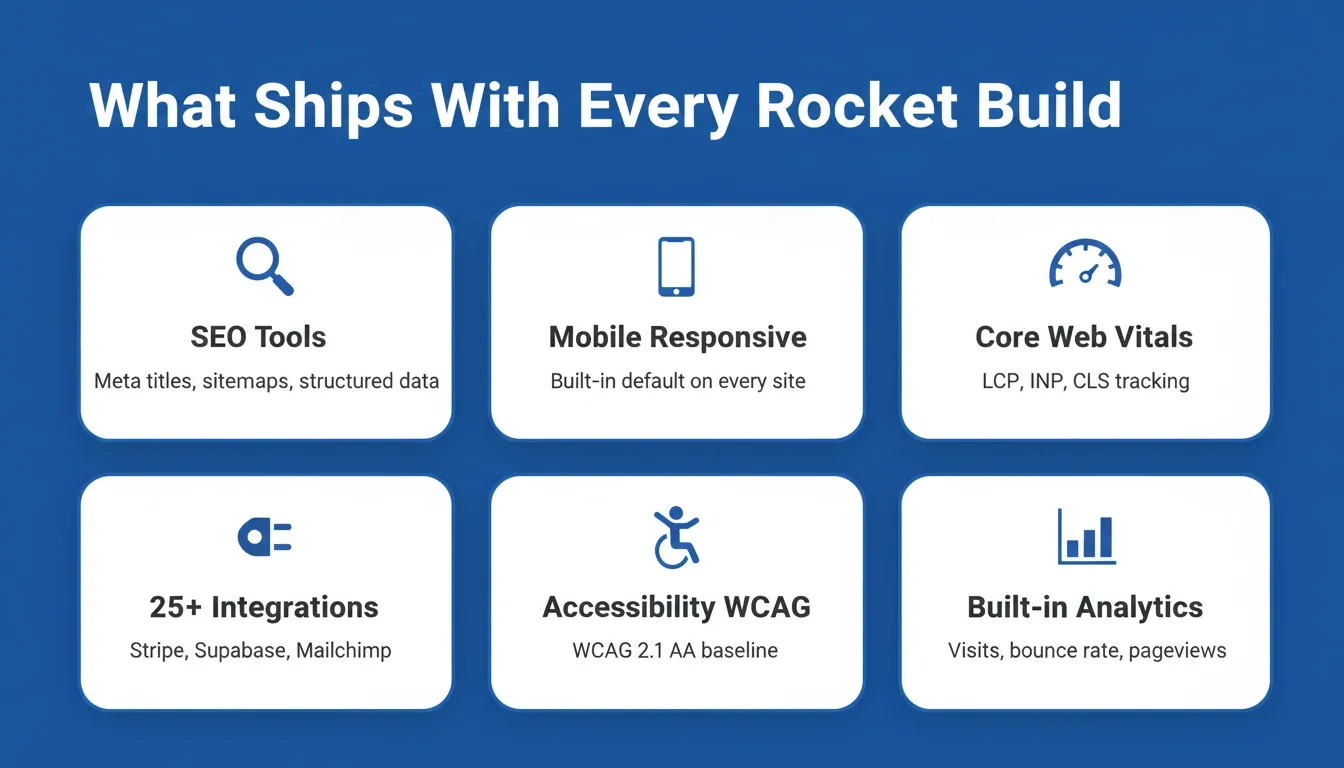
Every site Rocket ships is SEO-ready by default, which means the technical foundation search engines need is already in place before you launch. The built-in analytics dashboard gives you visits, pageviews, bounce rate, and visit duration, with no third-party tools required.
What ships with every build:
- SEO tools. Meta titles, meta descriptions, structured data, XML sitemaps, and robots.txt. Run
/Generate SEO Report and /Fix SEO Issues directly in the platform
-
Accessibility. WCAG 2.1 AA compliance as a baseline. A striking 95.9% of websites had detected WCAG failures in 2026 (WebAIM Million, 2026), and Rocket starts from a compliant baseline
-
Analytics. Built-in tracking for visits, unique visitors, pageviews, visit duration, and bounce rate
-
Performance monitoring. Core Web Vitals tracking for LCP, INP, and CLS. Google uses these as ranking signals. Rocket shows where you stand and offers one-click fixes
-
25+ integrations. Stripe, Google Analytics, Supabase, Mailchimp, Typeform, Calendly, and more. Authenticate once, and they flow into every build
The Redesign feature is one of Rocket's most powerful differentiators. If you already have a live site that is underperforming, you do not have to start from scratch. Point Rocket at any live website URL and use the Redesign commands to control the depth of change:
/Reimagine Website Design
— modern look, all existing content preserved
/Full Website Makeover
— completely new look, layout, and copy
/Mobile-First Redesign
— rebuilt for how most users actually arrive
/Fix Conversion Issues
— redesign to address bounce and drop-off problems
/Redesign Like Competitor
— apply a competitor's design style to your content
None of the most popular website builders can do this. Wix, Squarespace, and WordPress all generate from scratch or work within templates. Rocket reads your existing site structurally and rebuilds it with intelligence.
Business Owners Who Ship Sites This Weekend
Rocket works for a wider range of use cases than most people expect. Here is who benefits most from building this weekend:
Service-based businesses:
-
A clean site with a homepage, services page, contact form, and about section
-
No ecommerce features needed, no complex business logic
-
Rocket generates exactly what is needed, nothing more, nothing less
Small business owners launching online stores:
-
U.S. ecommerce sales totaled \$1.234 trillion in 2025 (Digital Commerce 360, 2026)
-
Ecommerce websites need product catalogs, checkout flows, and payment integrations
-
Rocket builds a no-code ecommerce store with Stripe integration out of the box, with no separate WooCommerce setup and no additional cost for ecommerce features
Founders and startups:
-
Landing pages for product launches, conversion-focused and built from project context
-
The hero section speaks to the specific customer problem, not a generic value proposition
-
Rocket's Context architecture means your research, brand guidelines, and customer insights carry into every build
Agencies and designers:
-
Start from a Figma design; import your file and Rocket converts it to working code, preserving typography, spacing, visual hierarchy, and color system
-
The developer handoff becomes unnecessary, as designers ship directly
-
The Remix feature lets you generate a shareable link that recipients can clone, with the full app, complete codebase, and integration config ready to customize
Launch Your Site on Rocket This Weekend
The most popular website builders, Wix, Squarespace, WordPress, and Framer, all do their jobs. They have free plans, drag and drop editors, and large template libraries. For certain use cases, they are fine choices.
But "fine" is not the same as "built for your business."
The problem with most platforms is structural. They start with a generic template and ask you to make it yours. The design quality reflects that starting point, the learning curve reflects it too, and the add ons, SEO tools, ecommerce features, and custom code, all reflect the business model underneath.
Rocket starts from the opposite direction. Describe what you want. Get a site built from scratch, with production-ready code, intentional design, and all the built-in tools you need to ship a SEO friendly website builder site on Rocket this weekend. The gap between a site that looks like everyone else's and a site that looks like yours has never been smaller, and the time it takes to ship has never been shorter.
If you are ready to stop fighting templates and start shipping a site that actually works for your business, Rocket is the fastest path from idea to live. Sign up free and build your first site today.
Table of contents
- -Why Most Website Builders Are Holding You Back in 2026
- -What the Best Website Builders Actually Need to Do
- -Website Builder Comparison: Features at a Glance
- -A Deep Dive Into the AI Website Builder Shift
- -AI-First vs. Template-First: How the Build Process Differs
- -How Rocket Works as an App Builder and Website Builder
- -Rocket vs. The Most Popular Website Builders
- -Wix and Wix Studio
- -Squarespace
- -WordPress
- -Framer
- -Built-In Tools That Go Beyond a Basic Template
- -Business Owners Who Ship Sites This Weekend
- -Launch Your Site on Rocket This Weekend