Rocket.new helps teams build internal tools and admin panels from natural language prompts instead of drag-and-drop builders. Unlike Retool, Rocket.new offers full code ownership, flat pricing, native mobile app generation, and faster deployment workflows. For teams tired of backlog delays, vendor lock-in, and per-user pricing, Rocket.new is a faster way to ship production-ready internal apps in 2026.
Still Waiting on Engineering to Ship That Admin Panel?
Your ops team is copy-pasting records into a spreadsheet. Your support lead is chasing approvals over Slack. And the admin panel that would fix all of this?
It's sitting in the backlog, third in line behind two feature requests.
This is the internal tools problem. It affects almost every company that builds software - and it's getting more expensive than most teams realize.
-
A 2025 survey found that 75% of developers lose 6 to 15 hours every week navigating disconnected tools to build applications, costing teams an estimated $1 million annually in lost productivity (byteiota.com).
-
Tools like Retool stepped in to help. They made building internal tools faster than writing everything from scratch. But in 2026, there's a meaningfully better way to ship custom internal tools, one that starts with a natural language prompt and ends with production-ready code that your team fully owns.
What Are Internal Tools (and Why They Keep Getting Deprioritized)
Internal tools are the software your team uses every day to do their jobs, software that customers never see. Admin panels, CRUD apps, approval workflows, data management dashboards, client portals, inventory trackers, onboarding systems, and compliance tools all fall into this category.
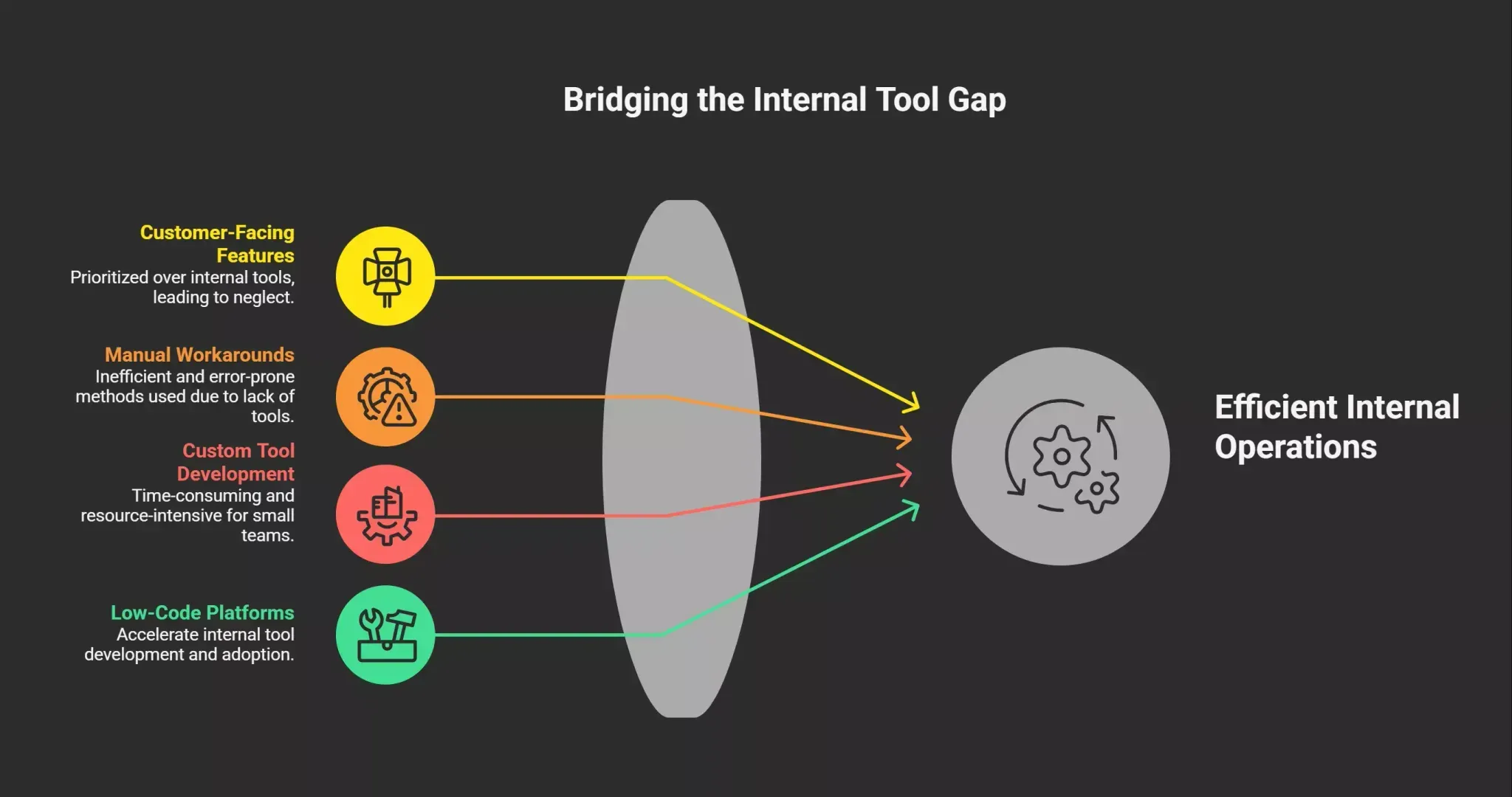 They're built for internal users. And because they're internal, they often get treated as lower priority than customer-facing features.
The problem compounds fast. Without proper internal tools, teams hack together workarounds using spreadsheets, manual exports, and a pile of Slack messages. The work still gets done, just slowly and with a lot of room for error.
Building custom internal tools from scratch takes weeks of engineering resources. You need a front end, backend, user authentication, access control, data source connections, and deployment. For most small teams, that's too much to justify when the product roadmap is already full.
That's exactly why low-code platforms for building internal apps became popular. And why tools like Retool, and now Rocket.new exist.
The Internal Tools Landscape in 2026
The market for building internal apps has grown significantly.
According to Mordor Intelligence, the low-code development platform market is valued at $31.59 billion in 2026 and is projected to reach $67.1 billion by 2030 at a CAGR of 20.6%. Gartner forecasts that 75% of new applications will be built on low-code platforms by 2026.
AI-generated internal tools are now part of that picture. The conversation has shifted from "how do we build faster?" to "why are we dragging and dropping at all when AI can generate the whole app?"
Here's a quick look at the types of internal apps teams are building most often in 2026:
-
Admin panels and data management dashboards
-
CRUD apps for records and database operations
-
Approval workflows and complex multi-step workflows
-
Client portals and partner portals
-
Reporting dashboards connected to multiple data sources
-
Onboarding tools, compliance trackers, and audit log viewers
The internal tool builder market now has clear tiers: open source retool alternatives like Appsmith and ToolJet, enterprise options like Microsoft Power Apps and Retool, and AI-native builders like Rocket.new.
Retool: The Category Leader With a Few Strings Attached
Retool is one of the best-known internal tool builders on the market. It offers a drag-and-drop interface with pre-built UI components, strong connectivity to external data sources, workflow automation, and enough JavaScript customization to handle complex logic.
For developers with technical expertise and organizations with a budget for enterprise software, it works. But the trade-offs have become harder to ignore.
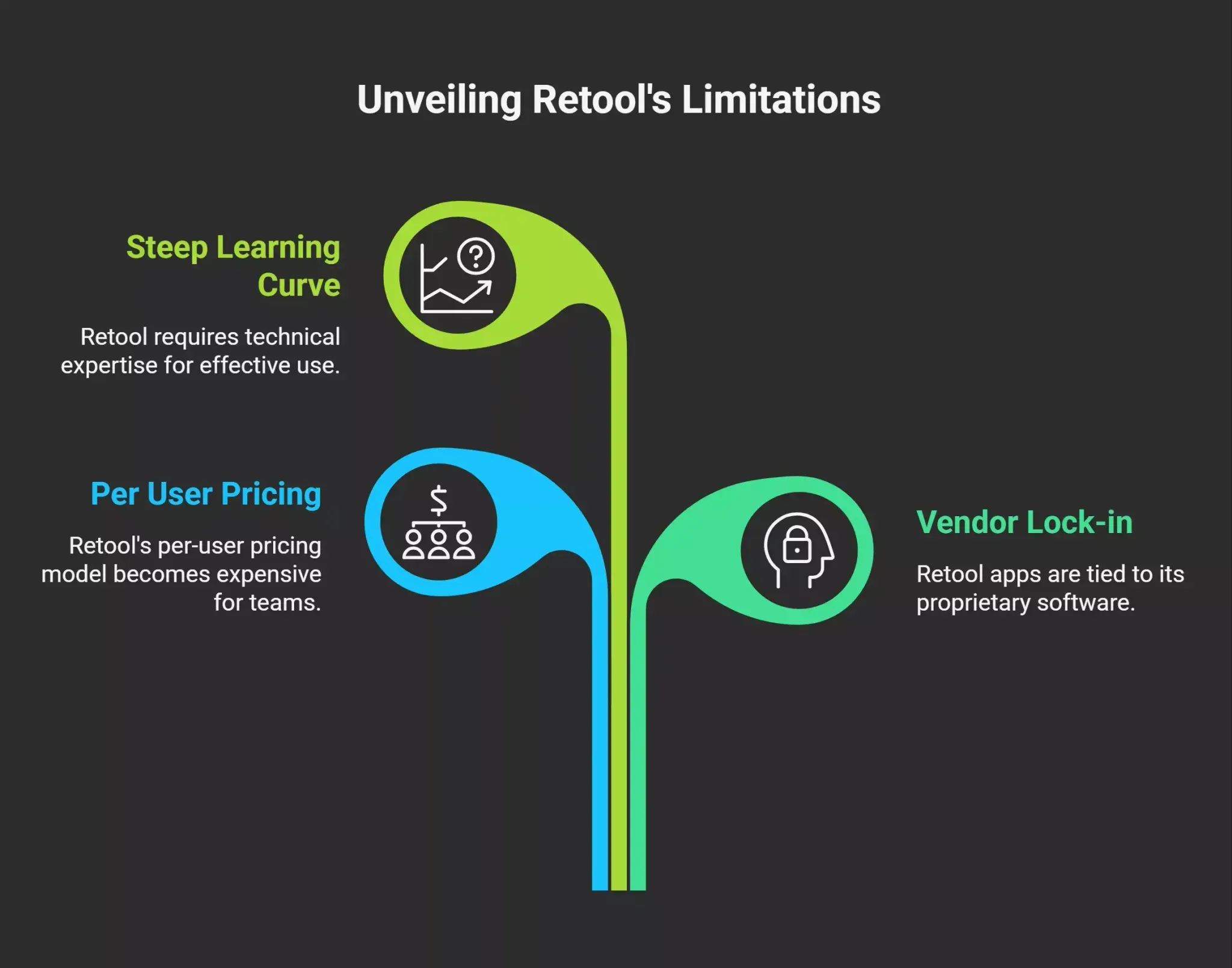
Per User Pricing That Compounds Quickly
Retool's pricing model is based on the number of users, and it scales linearly.
According to Adalo's 2026 review of Retool pricing, here's how the plans break down:
| Plan | Standard User | End User | External User |
|---|---|---|---|
| Free | Free (max 5 users) | Free | Not available |
| Team | $10/month | $5/month | Not available |
| Business | $50/month | $15/month | $8/month (up to 250) |
| Enterprise | Custom pricing | Custom pricing | Custom pricing |
For a team of 20 on the Business plan, you're looking at $1,000/month just for standard users, before end-user or external user charges. For small teams or startups, this per-user pricing model can make internal apps surprisingly expensive to operate.
Vendor Lock-in With No Exit Strategy
Retool apps are built inside Retool's proprietary software. You get no full code ownership, no code export, and no way to move your apps elsewhere without rebuilding them. If pricing changes, if the platform pivots, or if your needs evolve beyond what Retool supports, you lose everything you built.
This is the vendor lock-in problem that drives most teams to search for retool alternatives.
The situation got notably worse in early 2026. A community post on r/lowcode surfaced what many Retool users missed:
"Quick heads-up if you're using or looking at Retool self-hosted. Their docs recently updated to say 'Self-hosted Retool is available on an Enterprise plan only', with no announcements. Pricing page now only lists self-hosted under Enterprise, too."- r/lowcode, February 2026 (reddit.com)
Self-hosted Retool, previously available on lower-tier paid plans, was quietly moved to Enterprise-only with no announcement. Teams that chose Retool specifically because they could run it on their own infrastructure had that option removed without notice.
A Steep Learning Curve for Non-Developers
Retool requires technical expertise to use effectively. You need to understand SQL databases, REST APIs, JavaScript for custom logic, and how database schemas work. For non-technical users trying to build basic internal apps, the steep learning curve means engineering resources are still required.
That limits who can actually build internal tools, keeping the work on developers' plates.
Best Retool Alternatives for Building Internal Apps in 2026
The internal tool builder space has strong alternatives worth knowing.
Open Source Retool Alternatives
Appsmith
It is one of the most popular open source retool alternatives. It offers a drag-and-drop builder, connects to multiple data sources, including SQL databases, and gives teams free self-hosting on the community edition. Drawbacks: no native mobile apps, no server-side code execution, and limited AI features.
ToolJet
It is another open source option with better AI-native features. It supports JavaScript and Python for custom logic, connects to 75+ data sources, and has an AI app builder. The catch: the free tier is heavily limited, and the Team plan with real enterprise features costs $199/builder/month.
Microsoft Power Apps
For teams already in the Microsoft ecosystem, Microsoft Power Apps is a relevant option. It starts at $5/user/month and supports web and mobile apps with a drag-and-drop interface. But it comes with its own vendor lock - it's tightly coupled to Microsoft's infrastructure and Azure, and the pricing model still charges per user.
Rocket.new
Rocket.new takes a different approach entirely. Instead of a drag and drop builder, you assemble piece by piece, Rocket.new generates complete, production-grade apps from natural language descriptions. Web apps in Next.js. Mobile apps in Flutter. Real code that you own and can export.
Launch Your Internal Tools and Admin Panels at Rocket Speed
Here's where the story genuinely changes.
Rocket.new is an AI app builder that generates fully functional internal tools from a single prompt. You describe what you need in plain language, "build an admin panel to manage customer orders with status filters, user roles, and CSV export", and Rocket.new plans the architecture, writes production-ready code, and shows you a live preview in under three minutes.
This is what AI-powered app generation looks like when it's actually production-grade. Not a prototype. Not a wireframe. A working, deployable app with real design, real navigation, real logic, and real data connections.
Over 1.5 million people across 180 countries have used Rocket.new to build apps. That includes internal ops tools, admin dashboards, client portals, onboarding systems, and compliance trackers.
One developer shared their experience in the r/vibecoding community:
"It does a really solid job of analyzing everything, and then generates a to-do list where you can pick which screens to create." (reddit.com)
How Building an Admin Panel on Rocket.new Actually Works
Here's how the process compares when building internal tools:
The path on Rocket.new skips the platform-learning phase entirely. You go from idea to working app in the same time it takes Retool users to read the documentation.
Key Features That Make Rocket.new a Stronger Internal Tool Builder
Natural Language App Generation
The core of Rocket.new is its AI generation engine. You describe your internal app, in plain English, with as much or as little detail as you want, and it builds a working product. The generated app has real design hierarchy, real navigation flows, and real logic. It's not assembled from templates or pre-built widgets. It's written fresh for your use case.
This makes building internal apps accessible to ops leads, product managers, and business users, and not just developers.
Full Code Ownership and Code Export
Rocket.new generates web apps in Next.js and native mobile apps in Flutter. You can download the complete source code at any time and take it anywhere.
This is the opposite of the vendor lock-in problem. Your admin panel isn't stored in someone else's proprietary software. It's yours. You can host it on your own infrastructure, modify it in your own IDE, or hand it to another developer without starting from scratch.
Flat Pricing Model - No Per-User Charges
Rocket.new uses flat pricing plans. Your costs don't scale per user. A team of 50 pays the same plan rate as a team of 5.
Compare that to Retool's Business plan: 50 standard users cost $2,500/month before end-user charges are even counted.
For small teams and growing companies, this pricing model removes one of the biggest friction points in the retool alternatives decision.
Multiple Data Sources and 25+ Integrations
Rocket.new connects to external data sources through 25+ built-in integrations: Supabase for database and user authentication, Airtable or Google Sheets for spreadsheet data, Notion, Linear, Stripe, Mixpanel, Mailchimp, Twilio, and more. Authenticate once and those connections flow into every build.
This means your internal tools connect to your actual data from day one - not a sandboxed demo database.
Workflow Automation for Complex Apps
Rocket.new handles workflow automation and complex logic through the same natural language interface. Multi-step approval flows, notification triggers, conditional logic, and data transformations are all described conversationally and built into the generated app.
Teams can automate workflows that previously required dedicated engineering resources and weeks of development time.
Native Mobile Apps From the Same Platform
Most internal tool builders only build web apps. Rocket.new generates both web and mobile apps - native iOS and Android from a single Flutter codebase, ready for App Store and Google Play submission.
Field teams, support agents, and operations staff often need native mobile apps to do their jobs. Having one platform for web and mobile apps removes the need to build separately for each.
User Authentication and Role-Based Access Control
Rocket.new builds user authentication and access control into generated apps automatically. Role-based permissions, user management, and access levels for internal users and external users are part of every admin panel - no separate configuration required.
What You Can Build for Your Team With Rocket.new
Here's a quick reference of use cases that Rocket.new handles well for building internal apps:
| Use Case | Description |
|---|---|
| Admin panels | Manage records, filter data, trigger actions, track status |
| CRUD apps | Create, read, update, and delete records across existing databases |
| Approval workflows | Multi-step approval chains with notifications and audit logs |
| Client portals | External user login, request submission, and status tracking |
| Reporting dashboards | Pulls from multiple data sources, charts, filters, and CSV export |
| Onboarding systems | Step-by-step workflows for new users or clients |
| Compliance tools | GDPR data request management, audit-ready trackers |
All of these are built through natural language descriptions, refined through chat or the visual editor, and deployed to production with one click.
When Rocket.new Fits Better Than Retool
Rocket.new is the right choice when:
-
Your team doesn't want to pay per-user pricing that grows linearly with headcount
-
You want full code ownership and no vendor lock after the app is built
-
You need internal apps shipped quickly without a steep learning curve
-
You're building both web and mobile apps and want one platform for both
-
Your ops team or product team wants to build without developer bottlenecks
-
You want AI-generated internal tools, not manually assembled drag-and-drop components
If you're already deeply embedded in enterprise Retool workflows, have budget for per-user pricing at scale, and need features like advanced proprietary governance layers tied to an existing Microsoft ecosystem setup, those cases may still fit Retool. For the majority of teams building custom internal tools in 2026, though, the case for Rocket.new is clear.
The Faster Way to Ship Internal Tools in 2026
Internal tools and admin panels don't have to live in the backlog forever. The tools, time, and technical expertise required to build them have all dropped significantly, and the reason is AI-powered app generation.
Retool opened the category. It showed teams that building custom internal tools could be faster than writing everything from scratch. But the per-user pricing model, the vendor lock-in, and the removal of self-hosted access from lower-tier plans have pushed many teams to look for what comes next.
Rocket.new is that next step. Ship internal tools and admin panels on Rocket.new, from a natural language prompt to a production-ready app with full code ownership, faster than any low-code platform on the market today.
Sign up now, build your next admin panel or internal tool on Rocket.new and go from prompt to production-ready app in minutes.
Table of contents
- -Still Waiting on Engineering to Ship That Admin Panel?
- -What Are Internal Tools (and Why They Keep Getting Deprioritized)
- -The Internal Tools Landscape in 2026
- -Retool: The Category Leader With a Few Strings Attached
- -Per User Pricing That Compounds Quickly
- -Vendor Lock-in With No Exit Strategy
- -A Steep Learning Curve for Non-Developers
- -Best Retool Alternatives for Building Internal Apps in 2026
- -Open Source Retool Alternatives
- -Microsoft Power Apps
- -Rocket.new
- -Launch Your Internal Tools and Admin Panels at Rocket Speed
- -How Building an Admin Panel on Rocket.new Actually Works
- -Key Features That Make Rocket.new a Stronger Internal Tool Builder
- -Natural Language App Generation
- -Full Code Ownership and Code Export
- -Flat Pricing Model - No Per-User Charges
- -Multiple Data Sources and 25+ Integrations
- -Workflow Automation for Complex Apps
- -Native Mobile Apps From the Same Platform
- -User Authentication and Role-Based Access Control
- -What You Can Build for Your Team With Rocket.new
- -When Rocket.new Fits Better Than Retool
- -The Faster Way to Ship Internal Tools in 2026