
Technographic data reveals which tools a prospect uses, how mature their stack is, and when they are ready to buy. Combined with firmographic and intent signals, it helps sales teams prioritize the right accounts at the right moment.
Technographic data tells you which software and tools a prospect runs, how mature their technology stack is, and when they are likely to be in market for a change. That context is something firmographic or demographic signals alone simply cannot give you.
According to G2's ABM research, 91% of B2B technology marketers already use intent data alongside technographics to prioritize accounts and build their target account lists. The best sales and marketing teams today apply technographic segmentation to score, prioritize, and personalize outreach at scale.
Rocket Intelligence pulls this real-time signal feed into account research, so your team knows what is changing before your competitors do.
What is Technographic Information, and Why Does it Matter for Sales?
Technographic data is information about the technologies a company uses, including software, hardware, cloud infrastructure, and other tools in a company's technology stack. Software covers CRM platforms, ERP systems, marketing automation, accounting software, and security tools.
Hardware encompasses server types, network providers, employee devices, and storage infrastructure. Service providers include cloud hosts, internet service providers, and web hosting firms.
Every account in your database has a hidden layer. Underneath the basic firmographic facts, company size, revenue, location, and industry, sits a technology environment that tells you far more about fit and timing than most sellers ever see.
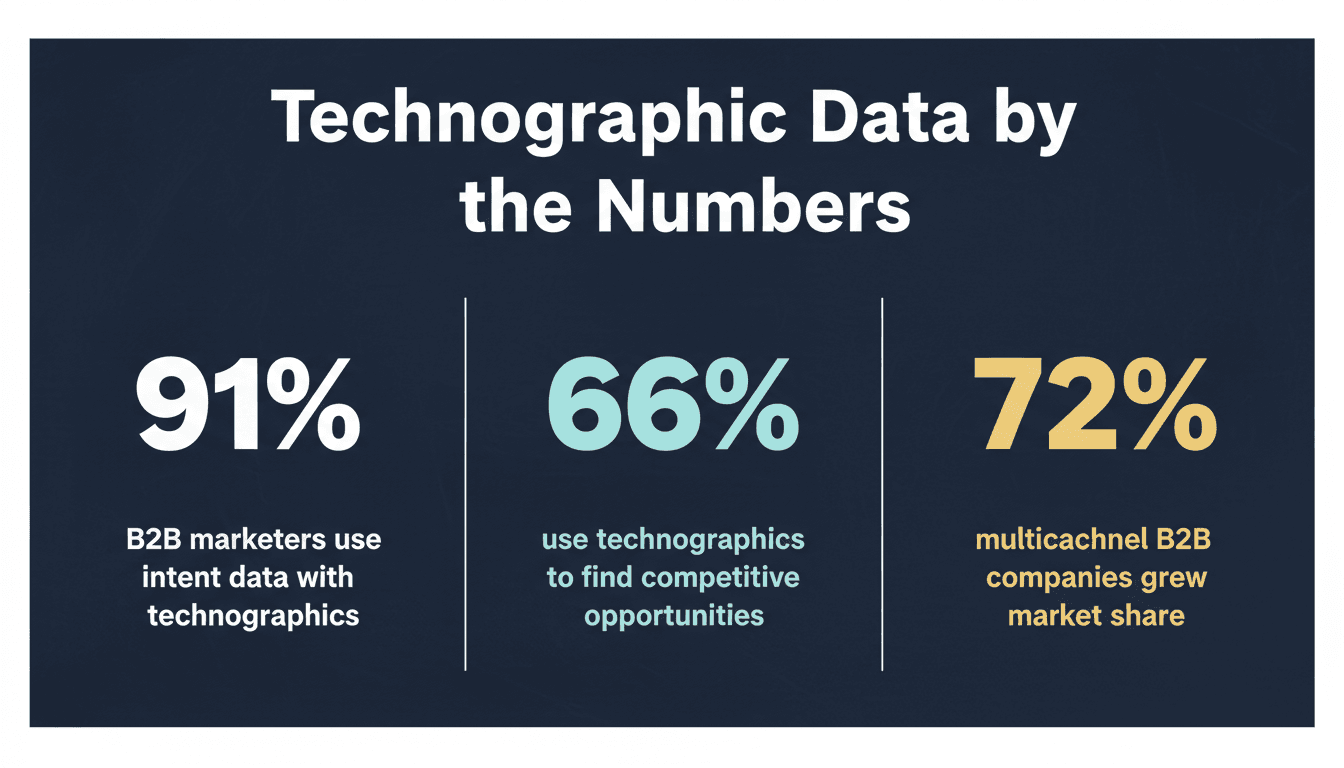
Key statistics showing how widely technographic data is used across B2B sales and marketing teams
| Data Type | What It Captures | Primary Sales Use |
|---|---|---|
| Firmographic | Industry, company size, revenue, location | Qualifying accounts by structural fit |
| Demographic | Job title, seniority, contact details | Reaching the right decision maker |
| Technographic | Software, hardware, cloud provider, installed tools | Assessing stack fit and purchase readiness |
| Intent Data | Content consumption, research behavior | Timing outreach to active buying cycles |
As B2B practitioner Manohar Devadiga noted in a LinkedIn Pulse article on technographic intelligence:
"A 200-person fintech company is one thing. A 200-person fintech company running HubSpot, Snowflake, and Stripe is a much clearer picture. You know their operational style, their likely budget range, and where your product might fit."
That specificity is what separates technographic intelligence from every other data type in your stack. The same company size looks completely different once you can see inside their tools.
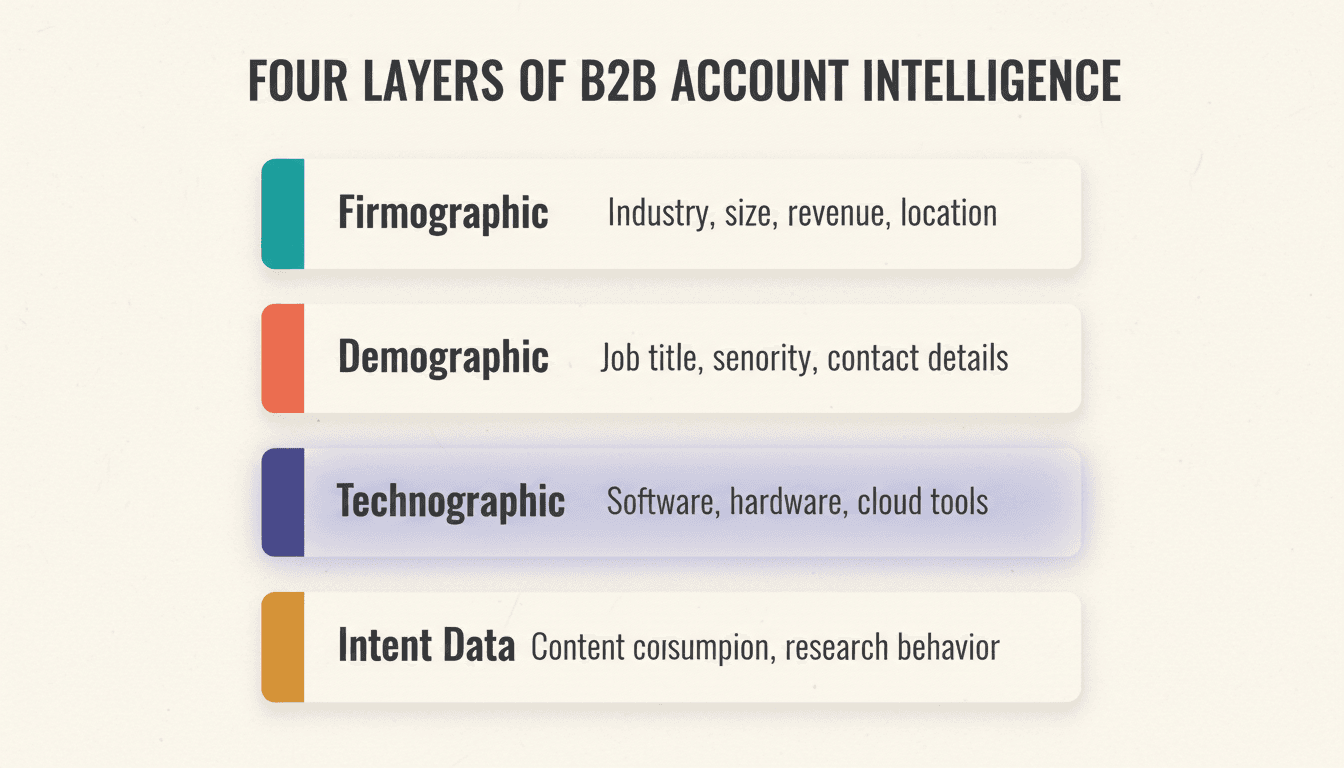
The four data layers that together give sales teams a complete picture of account fit and timing
The Difference Between Firmographic, Demographic, and Technographic Signals
Firmographic data tells you who a company is: their size, their industry, their location. Demographic data tells you who to call. Technographic signals tell you how the company operates: which software and hardware solutions they rely on every day, which cloud provider runs their infrastructure, and which tools they are actively using versus which ones sit idle.
Technographic data helps businesses understand whether their product fits into a company's operating environment. When you combine all three data types, you get a picture that is far more useful than any single layer alone. Combining technographic and firmographic data lets you build an ideal customer profile that filters for both who the company is and how they operate, isolating accounts with the exact technical environment needed for your software.
What Does a Company's Tech Stack Actually Tell You?
A prospect's technology stack is a window into their operational reality. The company's technology stack is not just a list of tools, it is a map of priorities, spending patterns, and procurement history that most sellers never look at.
-
Budget signals: Enterprise cloud infrastructure alongside premium SaaS tools signals meaningful IT spending.
-
Maturity signals: The ratio of legacy systems to modern SaaS reveals how ready a team is to adopt new technology.
-
Complementary tools: A company running Salesforce CRM is a natural candidate for any product that plugs directly into it.
-
Competitor installs: A competing product in the prospect's stack tells you whether this is a displacement play or a greenfield conversation.
-
Cross-sell and upsell signals: By analyzing a company's tech stack, sales teams can identify companies that may need complementary tools or services, a direct path to expansion revenue.
-
Disqualification signals: Sales teams can disqualify prospects lacking integration capabilities or compatibility with their product before wasting a single call.
Technographic intelligence also reveals gaps in a prospect's digital ecosystem, guiding marketers to design precise account-based marketing campaigns rather than broad outreach.
Why Sales Teams Miss High-Value Accounts Without Technographics
Sales teams running solely on firmographic data end up with a flat view of their target companies. Two companies can match perfectly on industry, headcount, and revenue while sitting in completely different places on the buying readiness curve.
66% of B2B marketers are already using technographics to identify competitive opportunities and target accounts that are not yet using their products or services. Without technology data, the remaining teams default to outreach that guesses at fit. With it, they can find the accounts where the product fits the stack, the timing matches a real change event, and the conversation opens with genuine context.
Technographic intelligence transforms a list of target companies into a prioritized, contextual view of which accounts are ready, why, and what they actually need right now.
How Do Stack Signals Reveal Account Fit and Buying Timing?
Knowing what tools an account runs is step one. Step two is reading those signals correctly.
Stack Signals That Point to Purchase Intent
Not all technology signals carry equal weight. The most valuable ones show movement or change, not just static presence.
-
Technology adoption events: A company migrating from on-premise infrastructure to cloud-based services almost always opens adjacent budget and creates new tool requirements.
-
Stack gaps: A company runs a CRM and a marketing automation platform but nothing for data enrichment in between. That gap is a direct sales opening.
-
Competitor product installs: A competing software product in the prospect's tech stack means the category is already validated. The conversation is about switching, not educating.
-
Real-time declining usage signals: Real-time visibility into a competitor's declining usage metrics signals an opportunity for sales teams to pitch a replacement solution before a competitor even knows the account is in play.
-
Contract renewal windows: Companies can monitor when a competitor's contract might be up for renewal to identify and time sales opportunities precisely.
-
Legacy systems still active: Older enterprise software often signals a pending modernization cycle and a procurement window approaching.
McKinsey's B2B Pulse research consistently shows that sales teams using richer, more layered signals to find and engage accounts significantly outperform teams relying on a single data source.
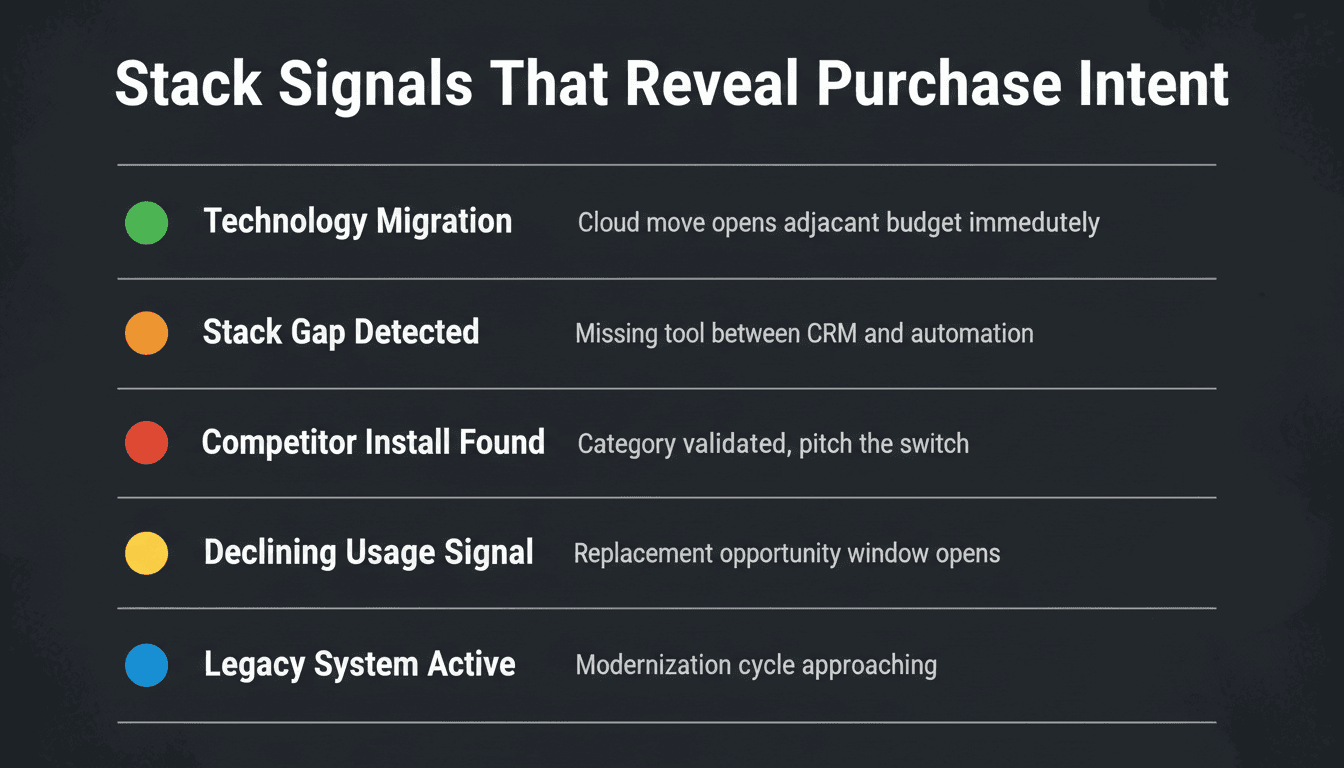
Five technology stack signals that indicate a prospect is approaching a buying decision
How Job Postings Amplify Technographic Intelligence
Job postings are one of the most underused technographic signals. They are public, updated frequently, and surprisingly specific about where a company is actively building.
-
New engineering roles mentioning specific tools, Snowflake, DBT, Terraform, show exactly which technologies a company is adopting right now.
-
Sales enablement job descriptions referencing specific revenue tech stacks tell you which vendors are embedded in their commercial motion.
-
Marketing operations roles listing marketing automation platforms show which demand gen tools are powering their funnel.
-
Job posting volume itself is a signal: aggressive hiring in a specific function often precedes budget spend in that same area.
Sales prospecting becomes far more effective when reps reference specific tools prospects use in outreach, demonstrating an understanding of their workflow that leads to more meaningful conversations. Job postings, read alongside live technology tracking, give sales teams a timing dimension that raw stack data alone simply cannot provide.
Timing the Outreach Window Using Tech Signals
The sales cycle shortens when outreach lands at the right moment. A company replacing its CRM is in active procurement mode for adjacent tools. A startup adding its first marketing automation platform is building out a RevOps stack and will need more tools soon.
A company whose buying signals show active research in your category, while their job postings call for someone to run exactly that function, is very close to a buying decision. Tracking shifts in a customer's technology stack can also anticipate friction and allow sales teams to propose integration solutions proactively, before a churn risk surfaces.
Stack signals alone move outreach from cold to warm. Stack signals combined with intent data move it from warm to ready.
1flowchart LR
2 A[Tech Signal Detected]:::input --> B{Signal Type}:::decision
3 B -->|Stack change| C[Adoption Event]:::change
4 B -->|Job posting| D[Hiring Signal]:::hiring
5 B -->|Intent data| E[Research Signal]:::intent
6 C & D & E --> F[Account Score Updated]:::score
7 F -->|Threshold met| G[Outreach Triggered]:::action
8 F -->|Below threshold| H[Continue Monitoring]:::monitor
9 classDef input fill:#EEF2FF,stroke:#4F46E5,color:#1e1b4b
10 classDef decision fill:#FFF7ED,stroke:#F97316,color:#431407
11 classDef change fill:#F0FDF4,stroke:#16A34A,color:#14532d
12 classDef hiring fill:#EFF6FF,stroke:#3B82F6,color:#1e3a5f
13 classDef intent fill:#FDF4FF,stroke:#A855F7,color:#3b0764
14 classDef score fill:#F8FAFC,stroke:#64748B,color:#0f172a
15 classDef action fill:#4F46E5,stroke:#4F46E5,color:#ffffff
16 classDef monitor fill:#F1F5F9,stroke:#94A3B8,color:#334155How raw technology signals flow through scoring to trigger the right outreach at the right moment
How Do Sales and Marketing Teams Collect Technographics?
The best ways to collect technographic data usually involve combining multiple sources, as no single source will provide complete information. Teams either collect too little of it or rely on stale data pulled from a single provider.
Web Scraping and Passive Signal Detection
Web scraping tools scan company websites for JavaScript tags, tracking pixels, analytics scripts, and CMS platforms, revealing the website technologies layer of a company's stack quickly and at scale. HTML source code often exposes front-end frameworks and hosting providers. However, web scraping misses tools that operate behind the firewall: internal systems, data warehouse software, CRM systems, and more.
Analyzing company websites can reveal many technologies in use, but it may not capture the full internal technology stack. That is why deeper technographic intelligence requires going further with multiple methods.
Third-Party Technographic Providers: What to Look For
Most sales and marketing teams access technographic intelligence through a third-party provider. Companies like HG Insights and BuiltWith track technology installs across millions of company profiles, including behind-the-firewall signals that web scraping cannot reach.
| Evaluation Criterion | Why It Matters |
|---|---|
| Coverage Depth | Surface web detection vs. behind-firewall and cloud infrastructure signals |
| Update Frequency | Monthly refreshes create stale data; weekly or daily is better for timing outreach |
| Data Compliance | GDPR, CCPA, and sourcing ethics matter when providers use passive sources |
| CRM Connectivity | Technology data needs to flow directly into Salesforce, HubSpot, or your CRM of choice |
| Confidence Scoring | A confidence score tells teams how reliable a given technographic signal actually is |
Reputable providers combine web scraping, job description analysis, survey data, and proprietary sensor networks to improve both depth and data quality.
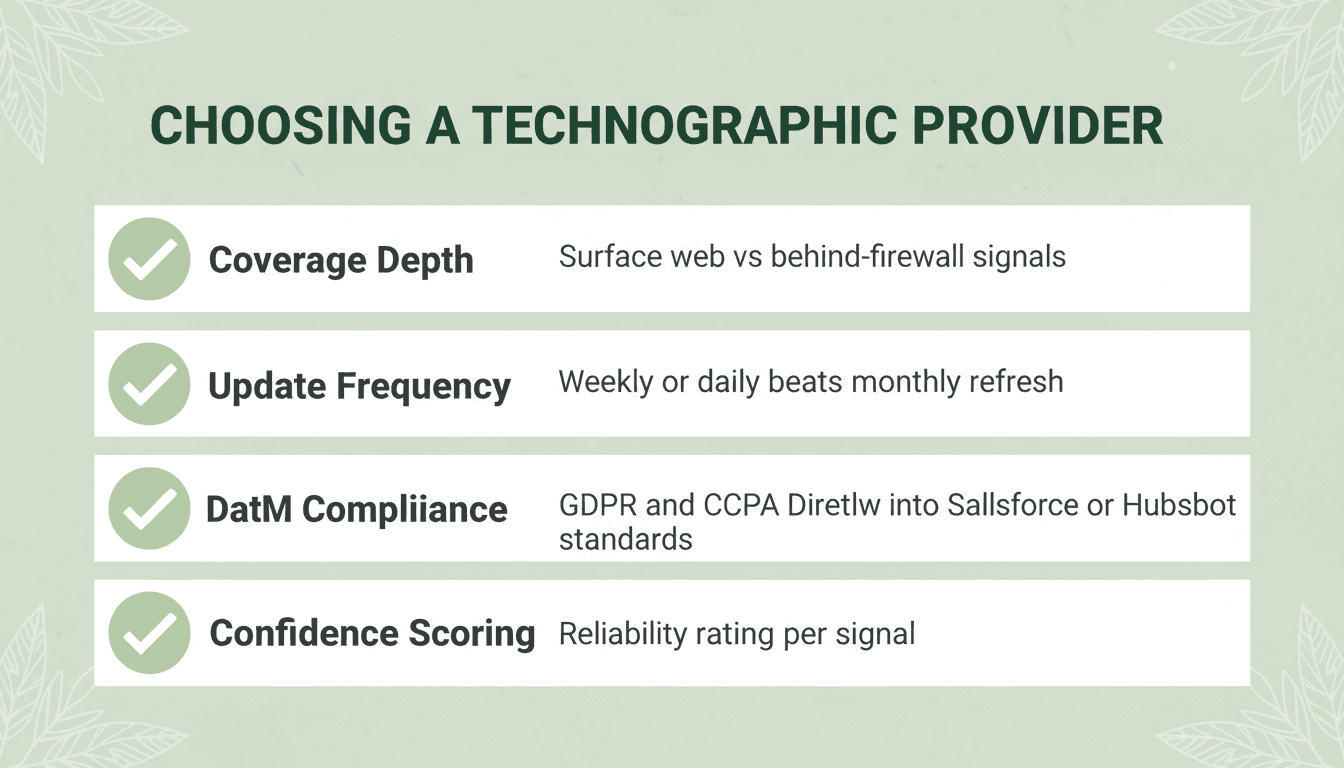
Five criteria to evaluate before choosing a technographic data provider for your sales team
What Is Technographic Segmentation, and How Do Teams Apply It?
Having a technology profile for every account is valuable. Actually using that data to segment, score, and activate your pipeline is where most teams stall out.
Segmenting Target Accounts by Stack Category
Technographic segmentation starts with sorting target accounts into groups based on their current technology adoption patterns:
-
By platform: All accounts running Salesforce, HubSpot, or Microsoft Dynamics, giving you the foundation for highly targeted campaigns built around specific tool narratives.
-
By stack maturity: Legacy-heavy companies are candidates for modernization pitches; cloud-native companies are candidates for expansion plays.
-
By stack gap: Segment accounts that have a core platform but are missing an adjacent tool your product fills.
-
By competitive presence: Isolate accounts running a competitor product for a focused displacement campaign.
Monitoring technographic trends also informs product roadmap decisions, aggregating data on which adjacent software your customers are adopting tells you exactly which integrations to build next. This kind of competitive intelligence is what separates reactive product teams from proactive ones.
Using Technology Adoption Signals for Account Scoring
Technology adoption behavior feeds directly into lead scoring models. Here is how to use it in practice:
-
Positive score signals: Recent migration to cloud-based services; new additions to a stack in your category; hiring in roles that actively use your tool.
-
Negative score signals: Competitor product deeply embedded; declining use signals; no meaningful technology changes in the past year.
-
Timing multipliers: Combine technology adoption signals with intent data to build a composite score. A company evaluating your category AND actively changing their stack ranks significantly higher.
According to McKinsey's B2B Pulse research, 72% of B2B companies that sold through seven or more channels grew their market share. Adding technographic segmentation to your scoring model is exactly that kind of signal layering, taking single-dimensional prospect lists and turning them into a multi-signal, prioritized view of who is actually in market right now.
Building Highly Targeted Campaigns from Stack Data
ABM is most effective when the account list is narrow enough to personalize and large enough to scale, and technographic data helps identify accounts where a product has a clear reason to exist. Once target accounts are grouped by their technology profiles:
-
Tailor messaging to the exact tools they run: "We replace X" or "We work alongside Y" opens conversations that generic pitches simply cannot.
-
Custom landing pages and ad targeting tailored to specific software users yield higher conversion rates compared to generic marketing.
-
Personalized outreach sequences reference their known stack rather than generic pain points.
-
Marketing automation workflows that trigger specific sequences when stack change signals are detected keep outreach timing sharp.
Using technographic data in ABM allows businesses to create personalized campaigns that resonate with the unique needs of targeted organizations, improving engagement and conversion rates. The result is a measurable lift in conversion rates, shorter sales cycles, and stronger customer retention rates because you started with accounts that were genuinely a good fit from day one.
How Rocket Intelligence Turns Stack Signals into Sales Briefs
Most sales intelligence tools give you a snapshot. Rocket Intelligence was built for a different use case: continuous, contextual monitoring that connects technology signals to everything else happening with an account, and delivers the whole picture as a daily brief.
What Rocket Tracks Beyond Standard Tech Detection
Rocket Intelligence monitors six signal categories per company simultaneously and connects them into a single account brief rather than a flat data export:
-
Website: Every page change, messaging shift, pricing update, new feature announcement, and positioning pivot, with full before-and-after and strategic interpretation.
-
Social Media: Every post, campaign, and engagement pattern across LinkedIn, X, Instagram, Facebook, YouTube, TikTok, and Reddit.
-
News and Web Presence: Press coverage, blog posts, partnership announcements, executive interviews, and media mentions with volume tracked over time.
-
Reviews and Reputation: G2, Glassdoor, Capterra, and other review platforms, sentiment shifts over time with impact tags.
-
People and Hiring: Employee count, new hires, exits, hiring velocity, and open position breakdown by department. Hiring concentration reveals where competitors are investing before any product announcement confirms it.
-
Performance Marketing: Ad activity across LinkedIn, Meta, and TikTok.
Each of these signals is read against your specific role and intent. Rocket already knows what questions matter to you, so it filters noise and surfaces what actually moves the needle for your pipeline.
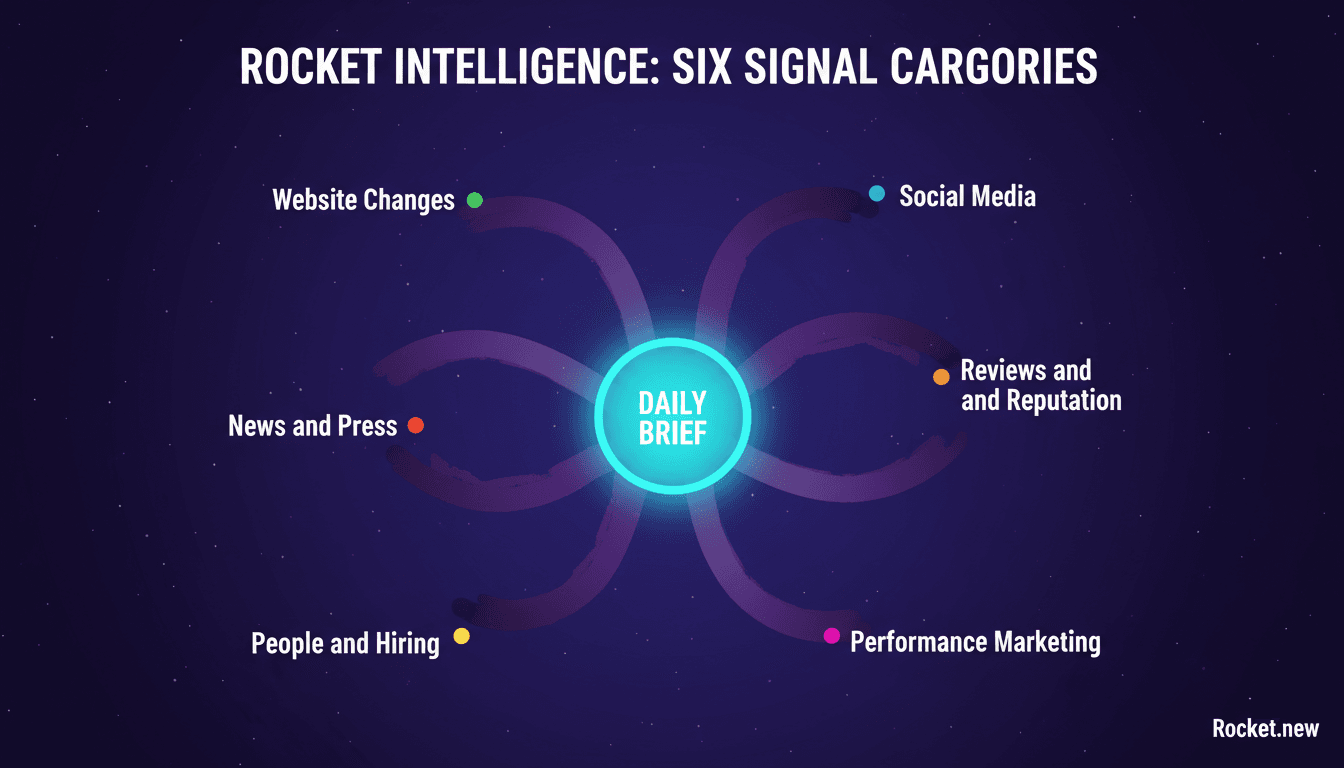
Rocket Intelligence monitors six signal categories simultaneously and delivers them as a structured daily brief
From Raw Signal to Ready-to-Use Sales Context
Where traditional technographic providers deliver a data export or a CRM field update, Rocket Intelligence delivers a brief. That difference matters for real-time sales teams.
A company's tech stack changes overnight. Rocket sees it, connects it to their recent job postings and product announcements, and delivers a brief explaining why this moment is worth acting on. A sales rep opens their morning update and sees two target accounts showing convergent intent signals and stack changes at the same time, that is a same-day outreach trigger, not a monthly data refresh.
The brief connects directly to Rocket Solve, where you can run market research on the opportunity, build a pitch framework, and move straight into execution no re-explaining context, no starting over.
Why Other Sales Intelligence Tools Leave Gaps
Standard technographic providers and sales intelligence tools each do one part of this well:
-
ZoomInfo covers firmographic data and some contact intelligence well, but its technology detection sits at the surface level.
-
Bombora delivers strong intent data but does not natively connect intent signals to live technology stack signals.
-
HG Insights goes deep on technographic coverage but operates as a data provider, not a signal-to-action platform.
The gap is the connection layer. Sales teams end up switching between providers to build a coherent picture of an account, then writing the outreach manually, a slow, error-prone enrichment workflow that misses timing windows every week.
Give Your Sales Team a Real Time Account Context
Rocket Intelligence is not just another technographic provider. It is the layer where technology signals, hiring signals, product signals, and intent signals converge, then get delivered as actionable briefs, every day, inside the same workspace where your team does the rest of their work.
Rocket.new Intelligence brings all of those signals together, tech stack changes, hiring signals, real-time competitor usage data, and contract renewal windows, into one daily brief your team can act on immediately.
Sign up now, and start using Rocket Intelligence today and give your sales team the real-time account context they need to win more deals.
Table of contents
- -What is Technographic Information, and Why Does it Matter for Sales?
- -The Difference Between Firmographic, Demographic, and Technographic Signals
- -What Does a Company's Tech Stack Actually Tell You?
- -Why Sales Teams Miss High-Value Accounts Without Technographics
- -How Do Stack Signals Reveal Account Fit and Buying Timing?
- -Stack Signals That Point to Purchase Intent
- -How Job Postings Amplify Technographic Intelligence
- -Timing the Outreach Window Using Tech Signals
- -How Do Sales and Marketing Teams Collect Technographics?
- -Web Scraping and Passive Signal Detection
- -Third-Party Technographic Providers: What to Look For
- -What Is Technographic Segmentation, and How Do Teams Apply It?
- -Segmenting Target Accounts by Stack Category
- -Using Technology Adoption Signals for Account Scoring
- -Building Highly Targeted Campaigns from Stack Data
- -How Rocket Intelligence Turns Stack Signals into Sales Briefs
- -What Rocket Tracks Beyond Standard Tech Detection
- -From Raw Signal to Ready-to-Use Sales Context
- -Why Other Sales Intelligence Tools Leave Gaps
- -Give Your Sales Team a Real Time Account Context