The 7S model maps seven organizational elements strategy, structure, systems, staff, skills, style, and shared values and checks whether they all work together. When one element falls out of sync, change programs stall and strategy misfires. Rocket helps teams benchmark the key elements against rivals for a sharper organizational diagnosis.*
How does a well-funded strategy still fall flat?
The answer usually comes down to organizational alignment. The seven moving parts of the organization are not pointing in the same direction. The McKinsey 7S framework was developed in 1980 by Tom Peters and Robert Waterman to diagnose this exact problem, mapping seven interconnected elements that together determine whether any plan actually gets executed.
The "Structure Is Not Organization" paper by Waterman, Peters, and Phillips, published in Business Horizons, showed that a company's org chart tells you almost nothing about whether it can deliver on its goals. Four decades later, business managers and consultants still use this model to run organizational analysis before major change initiatives. See the McKinsey 7S Framework history on Wikipedia.
This blog covers what each element means, how to apply the model step by step, and where competitive intelligence fits into the 7S diagnosis.
What Does the 7S Framework Actually Do?
The McKinsey 7S model is a diagnostic tool for organizational effectiveness. It is a structured way to check whether all parts of an organization are working toward the same objectives. Used across industries and company sizes, it gives leaders a shared language for diagnosing what is actually keeping a plan from landing.
Tom Peters and Robert Waterman developed the framework while consulting at McKinsey and Company. As Peters later admitted in Fast Company, there was "no carefully designed work plan" and "no theory" he was out to prove. It was just wide-ranging conversations with leaders about what makes organizations work. That honesty is part of why the model has stayed relevant for over four decades.
The seven elements of the framework are not a checklist. They form a constellation of interdependent elements, and a change in any one of them ripples through all the others. When organizations focus only on strategy and structure and leave staff, skills, style, and shared values unchanged, change initiatives routinely stall before they reach their intended outcome.
What Are the Hard Elements vs. Soft Elements?
The model divides its seven elements into two groups. This distinction is central to how it gets applied in change management and organizational design work.
-
Hard elements: Strategy, structure, and systems are tangible. They show up in strategy documents, organizational charts, and business systems records. They are relatively easy to identify and straightforward to change on paper.
-
Soft elements: Staff, skills, style, and shared values are intangible. They live in people, behavior, and leadership approach. They take longer to shift and resist top-down directives far more than hard elements do.
A common mistake in change management is pulling only on hard elements and assuming the soft ones will follow. Organizations that do this find that new structures collide with resistant culture, and training investments are wasted when management style does not change to reinforce them.
Why Does Every Element Depend on the Others?
The 7S model works like a web, not a list. Pull one element and the shape of every connection changes.
-
If strategy shifts toward new markets, skills requirements change and so do the training programs needed to close those gaps.
-
If systems are overhauled, the management style needed to support daily operations often needs to adapt alongside them.
-
If leadership style shifts from directive to collaborative, the organizational structure and reporting lines typically need to follow.
Key insight: Organizational alignment is not a one-time project. It is an ongoing diagnostic practice, and the McKinsey 7S model is the tool that makes that practice repeatable.
The Seven Elements Explained
Understanding exactly what each element covers is the foundation of any useful McKinsey 7S model analysis. The seven organizational elements work as a system. No single element operates in isolation from the others.
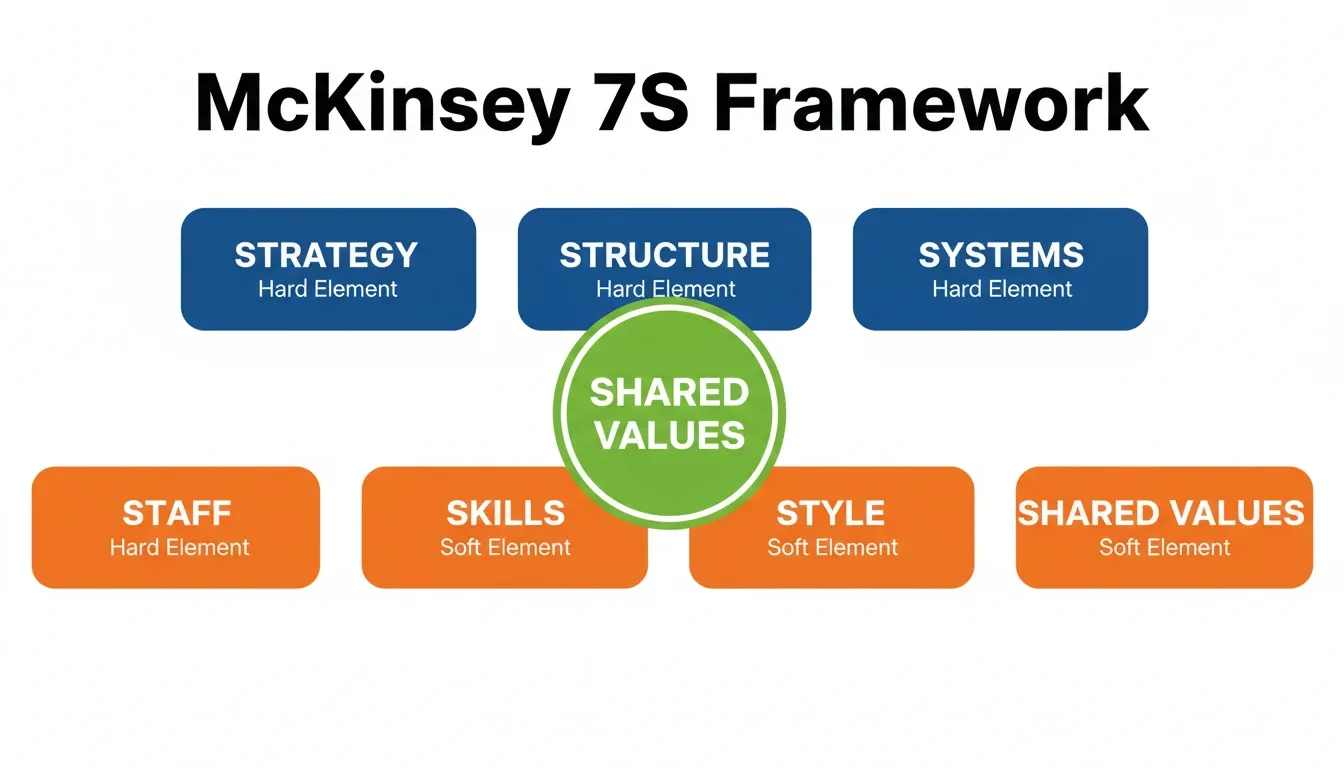
The McKinsey 7S Framework: Hard elements (Strategy, Structure, Systems) and Soft elements (Staff, Skills, Style) all anchored by Shared Values.
1graph TD
2 STR["Strategy (Hard)"]
3 STRUC["Structure (Hard)"]
4 SYS["Systems (Hard)"]
5 SV["Shared Values (Core)"]
6 STAFF["Staff (Soft)"]
7 SKILLS["Skills (Soft)"]
8 STYLE["Style (Soft)"]
9
10 STR --- SV
11 STRUC --- SV
12 SYS --- SV
13 STAFF --- SV
14 SKILLS --- SV
15 STYLE --- SV
16 STR --- STRUC
17 STRUC --- SYS
18 STAFF --- SKILLS
19 SKILLS --- STYLE
20 STYLE --- STAFF
21
22 classDef hard fill:#60A5FA,stroke-width:0,color:#FFFFFF
23 classDef soft fill:#FB7185,stroke-width:0,color:#FFFFFF
24 classDef center fill:#34D399,stroke-width:0,color:#FFFFFF
25
26 class STR,STRUC,SYS hard
27 class STAFF,SKILLS,STYLE soft
28 class SV center
The Three Hard S's
These three hard elements form the documented backbone of how an organization operates. They are the starting point in most 7S model applications because they are visible, measurable, and comparable across organizations.
-
Strategy: The direction the organization has chosen to achieve competitive advantage. This covers market focus, resource allocation priorities, and how it plans to respond to shifts in the business environment. Strategy is the element all others must ultimately support.
-
Structure: How the organization is divided and coordinated. This covers the organizational structure, hierarchy, reporting lines, division of responsibilities, and how departments and teams relate to each other.
-
Systems: The formal and informal procedures that govern daily operations. This includes performance management processes, financial reporting, human resources workflows, and the business systems that run day-to-day activities. Systems are, as the original model noted, "more powerful than they are given credit."
Consultants and business managers running organizational design work typically begin with these three, mapping the current state of each hard element before turning to the softer side of the model.
The Four Soft S's
These four soft elements are where the real organizational complexity lives. They change slowly, resist documentation, and shape how people actually behave regardless of what any strategy document or org chart says.
-
Staff: The people dimension of the organization. This covers human resources practices, how the company recruits, develops talent through training programs, and structures career paths. Staff training quality, onboarding rigor, and ongoing training investment all sit here and shape whether the workforce has the skills the current strategy demands.
-
Skills: The distinctive competencies the organization has actually built. What it genuinely does well, and what it does not. The original model's authors noted that old skills can act as a hindrance when new strategies call for capabilities not yet developed. This is why training in new skills often needs to run ahead of structural change.
-
Style: The management style and leadership approach that characterize how managers and senior leaders behave day to day. Style covers what leaders pay attention to, how decisions are made, and the norms governing how teams interact. Not what leaders say, but what they consistently do.
-
Shared Values: The element at the center of the model. Shared values are the core values and organization's culture. They are the guiding beliefs shaping behavior at every level. Shared values influence every other element, which is why the original diagram places them at the heart of the web. Without aligned shared values, training programs have little traction, strategy documents gather dust, and change initiatives lose their momentum.
Professional services firms and consulting teams work with all seven elements regularly. If you are building a client-facing advisory practice, Rocket's professional services templates provide a structured foundation for frameworks and client deliverables.
How Do You Apply the 7S Framework Step by Step?
Applying the McKinsey 7S model is less about filling in a diagram and more about asking structured questions at each element, comparing what exists today with what the strategy requires, and building a targeted action plan around every identified gap.
The model works as a four-step diagnostic sequence. Treating all seven elements with equal rigor matters. Skipping the soft elements because they feel harder to measure is precisely where most change management efforts go wrong.
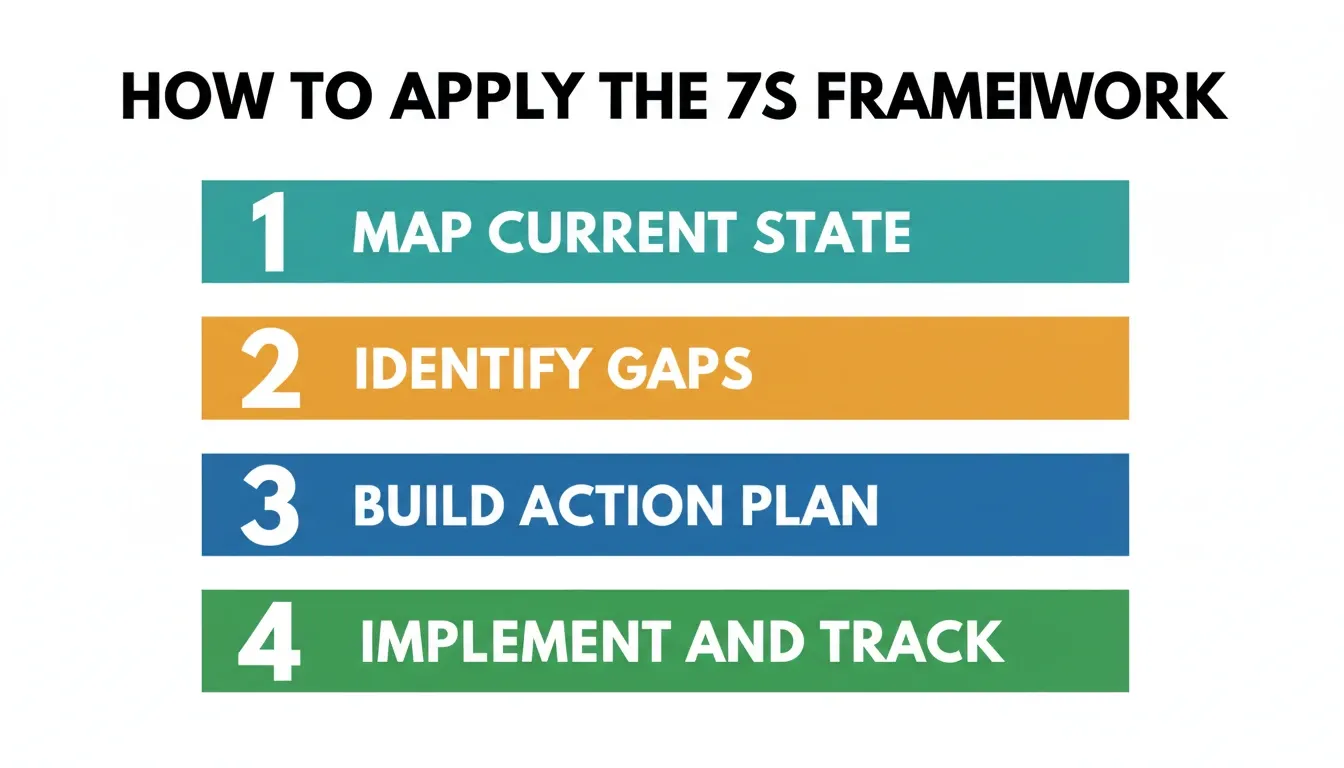
Four steps to apply the McKinsey 7S model: Map, Identify Gaps, Build Action Plan, Implement and Track.
Step 1: Map the Current State of Each Element
Start by documenting what actually exists. Not the ideal version, but the real current state of each organizational element. Accuracy here determines the quality of everything that follows.
-
Strategy: Is it clearly articulated? Do actual decisions reflect it, or is it only a document?
-
Structure: Map the real reporting lines alongside the official org chart. Where are the informal structures?
-
Systems: Which business systems support daily operations? Which create friction or workarounds?
-
Staff: What does the current workforce look like? What formal training programs are active, and where do training gaps sit?
-
Skills: What can this organization genuinely do? Where do current skills fall short of what the strategy requires?
-
Style: How do senior leaders actually behave? What management style characterizes everyday decision-making?
-
Shared Values: Which core values show up in daily decisions, not just in brand guidelines or annual reports?
Accuracy matters above everything at this stage. The McKinsey 7S model functions as a diagnostic tool only when its inputs reflect reality, not aspiration.
Step 2: Identify the Gaps Between Elements
This step is where misalignments between organizational elements become visible. Compare each element against the desired future state and identify gaps systematically.
-
Ask whether the current structure actually supports the strategy, then ask the same question for every other element pairing.
-
Look for inconsistencies where one element is actively working against another. A strategy built on speed inside a structure designed for lengthy sign-off chains is a gap that will cost the organization real progress.
-
Map where soft elements are misaligned with hard ones. A strategy calling for agility will stall when management style rewards caution, when training has not built the required skills, or when shared values prioritize stability over change.
The goal at this step is to identify gaps, not fix them. Rushing to solutions before the full picture is mapped is one of the most reliable predictors of failed organizational change.
The Diagnostic Model for Organizational Effectiveness, as Dagmar Recklies describes at TheManager.org, works precisely because it forces teams to compare current state to ideal state before committing to action.
Step 3: Build an Action Plan for Each Gap
Once gaps are visible, the work shifts to prioritizing and sequencing the changes needed.
-
Rank gaps by their strategic impact: which misalignment is blocking the most progress or carrying the highest cost?
-
Develop specific plans for each gap: A structural change, a new training program for staff, a shift in leadership approach, or a systems overhaul. Each action plan item should tie directly to a specific element and a specific gap.
-
Assign accountability: who owns this change, and what resources does it require?
-
Set training milestones as separate line items in the plan, since training programs in new skills typically require longer lead times than structural changes. Shifts in shared values and management style take the longest of all.
When you need to build the internal tools, dashboards, or workflows that will support this action plan, Rocket's digital modernization strategy guide helps teams move from plan to working product without heavy development overhead.
Step 4: Implement and Track Progress
Change management at this stage means maintaining momentum while keeping the model updated as conditions evolve.
-
Roll out changes in a coordinated sequence. Soft element changes like training, culture shifts, and management style typically take longer and should start earlier in the timeline.
-
Track progress using performance metrics at each of the seven elements. Not every gap closes at the same pace.
-
Revisit the 7S model at regular milestones to check whether new gaps are opening as the organization changes and the business environment shifts.
-
Adjust the action plan as change initiatives take hold and new information changes the picture.
The model is not a one-time report. Organizations that use it well return to it at every major strategic shift, treating it as a living organizational design tool rather than a one-off exercise.
The 7S Model in Action: A Real-World Example
Abstract frameworks become clearer through a real case. Consider a mid-size retailer navigating a failed digital change program. This is a scenario that business managers across many industries will recognize.
A Mid-Size Retailer Uses the 7S Model to Fix a Failed Rollout
The company had invested heavily in a new e-commerce platform. It was a clear systems upgrade with a solid strategic rationale. Eighteen months after launch, adoption was low, the sales staff were reverting to old processes, and customer experience was inconsistent across channels.
A McKinsey 7S model analysis revealed the problem had nothing to do with the technology.
-
Strategy declared "digital-first" in every presentation, but management style still rewarded in-store metrics and largely ignored online performance data.
-
Staff had not received adequate training for the new platform. The training provided at rollout was insufficient, no ongoing training process was built for new hires, and training gaps compounded as staff turnover continued.
-
Shared values remained anchored in face-to-face service excellence, creating persistent resistance to digital workflows at every level of the organization.
-
Structure kept digital and physical teams in separate silos, blocking the coordination needed to deliver a consistent customer experience.
The fix was not a better platform. It was realigning the soft elements: updating the shared values reflected in leadership communications, redesigning training programs so staff were genuinely prepared, shifting management style so senior leaders visibly championed digital-first behaviors, and restructuring teams to remove the silos.
"Hard is soft. Soft is hard... it's the people and shared values and skills which are truly 'hard' — the bedrock upon which the adaptive and enduring enterprise is built." — Tom Peters, TomPeters.com
For startups running a structured organizational review early in their growth, Rocket's competitive strategy frameworks guide offers ready frameworks for defining culture and operating model before scale creates inertia.
How Does the 7S Model Compare to Other Strategy Frameworks?
The McKinsey 7S model sits alongside several strategy tools practitioners use regularly. Understanding where it fits relative to SWOT analysis and Porter's Five Forces helps teams pick the right tool for each situation.
How Does 7S Compare to SWOT and Porter's Five Forces?
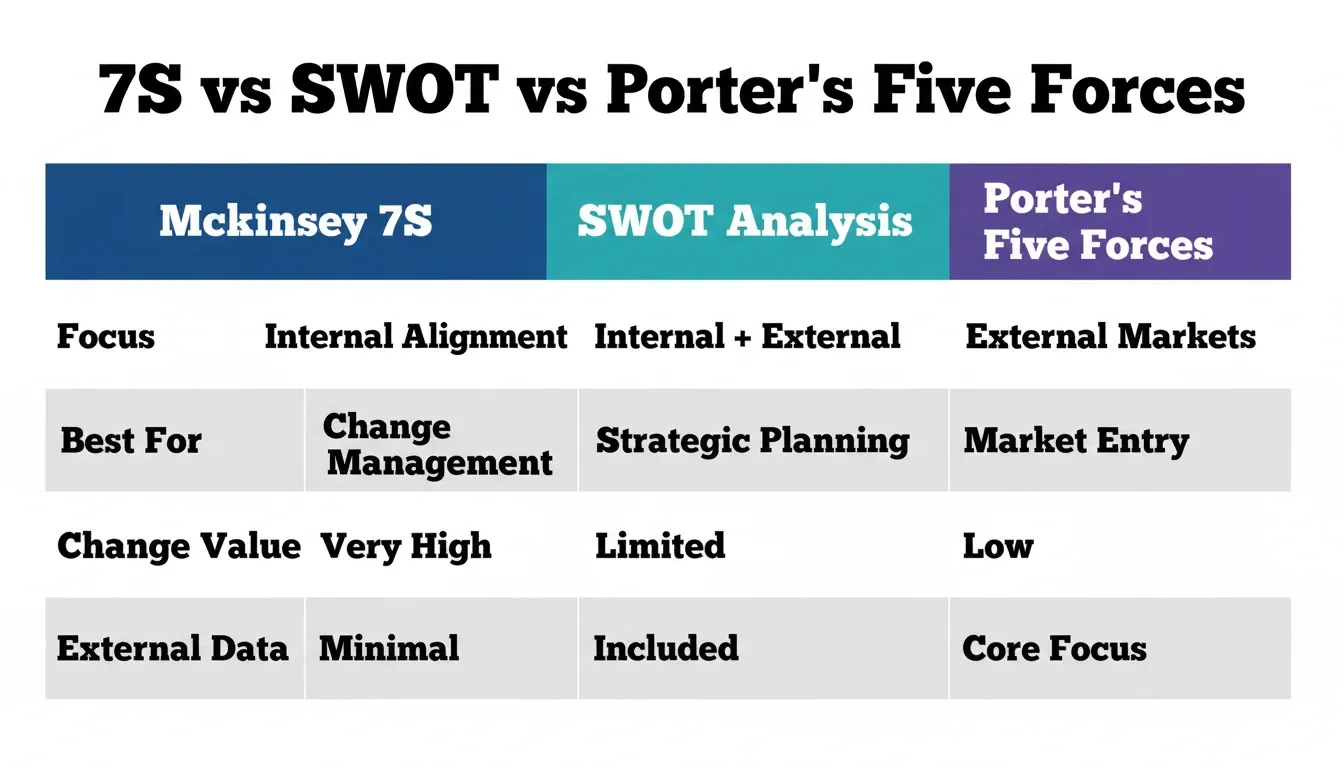
McKinsey 7S, SWOT Analysis, and Porter's Five Forces compared across four key dimensions.
| Dimension | McKinsey 7S Model | SWOT Analysis | Porter's Five Forces |
|---|---|---|---|
| Primary focus | Internal organizational alignment | Internal strengths/weaknesses + external factors | External competitive dynamics |
| Best used for | Change management, organizational design | Strategic planning, situation reviews | Market entry, competitive positioning |
| Unit of analysis | The organization's seven elements | Any strategic situation | Industry or market |
| External factors | Minimal, internally focused | Included | Core focus |
| Change management value | Very high | Limited | Low |
| Time orientation | Current state vs. desired future state | Point-in-time snapshot | Structural and long-term |
When Does the 7S Model Win?
The 7S framework is the right choice when the challenge is internal rather than external. When the question is not "what should we do?" but "can our organization actually execute it?"
-
When a new strategy needs to be rolled out and alignment gaps across the seven elements are suspected
-
During organizational change: mergers, restructuring, leadership transitions, or major systems overhauls
-
When change initiatives keep failing for unclear reasons. A 7S analysis consistently surfaces soft-element misalignments that drive invisible resistance
-
When assessing whether current staff, skills, management style, and shared values can actually support a new strategic direction
For external competitive analysis, SWOT and Porter's Five Forces remain stronger tools. The McKinsey 7S model's competitive advantage is its internal lens and its ability to show whether the organization has what it actually takes to execute.
Where Competitive Intelligence Fits Into Your 7S Diagnosis
The McKinsey 7S model is, by design, an internally focused diagnostic framework. That internal focus is its strength. But it also creates a gap: the model tells you whether your organization is aligned, but not whether that alignment is competitive relative to what rivals are doing.
Can Real-Time Competitor Data Sharpen a 7S Analysis?
Two elements of the 7S framework connect directly to external market signals: Strategy and Systems.
-
Strategy sets direction, but that direction only has value if you know how it compares to what rivals are doing. Are competitors entering new markets faster? Pricing differently? Building capabilities through hiring and training that your organization has not yet developed?
-
Systems govern how work gets done day to day, but market-facing systems like pricing workflows, customer service processes, and CRM tools can fall behind without an external reference point to compare against.
This is where competitive intelligence becomes an active part of the 7S diagnostic, not just a separate strategy exercise.
-
Follow your key competitors on Rocket Intelligence and get real-time signals on pricing changes, hiring activity, product updates, and market positioning shifts.
-
Map those signals directly onto your Strategy and Systems elements to calibrate whether your current state is competitive, not just internally aligned.
-
Use competitor hiring data to spot training needs and skill gaps in your Staff element before they become costly to close.
-
Let market dynamics shape the targets and timelines in your action plan, grounding internal alignment work in what the competitive environment actually demands.
Real-time competitor signals give your 7S diagnosis an external calibration layer. Without it, you are aligning the organization to a target you cannot clearly see.
Alignment Is the Strategy
The 7S model does one thing exceptionally well: it makes the invisible visible. Culture, leadership style, and shared values are not soft in the sense of unimportant. They are the elements that decide whether any hard strategy translates into real organizational change. Treating them as secondary is not a neutral choice. It is the most predictable path to a failed change initiative.
The framework has earned its place in serious organizational design work because it treats a company as a web of interconnected elements rather than a set of independent decisions. When you run a full 7S analysis, you are not just reviewing a plan. You are reviewing the organization's actual capacity to execute it.
Rocket brings competitive intelligence directly into your 7S workflow, so your diagnosis is grounded in real market signals and not just internal assumptions. Start your free organizational diagnosis on Rocket today.
Frequently Asked Questions
What Are the Seven Elements of the McKinsey 7S Model?
The McKinsey 7S model covers seven organizational elements: strategy, structure, systems, staff, skills, style, and shared values. Three, strategy, structure, and systems, are hard elements: tangible, documented, and visible in plans and org charts. The remaining four, staff, skills, style, and shared values, are soft elements: people-driven, cultural, and harder to directly measure or control. All seven are interdependent, meaning a change in any one element affects every other element in the model.
What Is the Difference Between Hard and Soft Elements in the 7S Framework?
Hard elements in the 7S framework are the tangible, documented parts of an organization: the strategy plan, the structural org chart, and the business systems governing daily operations. Soft elements are intangible: staff training practices, the skills built over time, the management style leaders display, and the shared values at the cultural core. Both categories matter equally. Underinvesting in training or values work is one of the clearest patterns in failed organizational change.
When Should I Use the 7S Model for Organizational Change?
The 7S model is most useful when an organization is planning significant change: a strategy rollout, a merger, a leadership transition, or a major systems overhaul. It is also the right tool when change initiatives keep stalling and the cause is unclear. A 7S analysis regularly surfaces soft-element misalignments blocking progress. Running it before committing to a change program gives teams a grounded action plan covering training needs, management style shifts, and shared values work alongside structural changes.
Is the McKinsey 7S Model Still Relevant Today?
Yes. The McKinsey 7S model remains among the most widely used tools in organizational design and change management, and its core logic that organizations succeed when all seven elements are aligned holds across industries and company sizes. Practitioners today often add competitive intelligence as an external data layer to complement the model's internal orientation. The seven-element diagnostic framework itself continues to guide how consultants and senior leaders identify organizational gaps and plan change initiatives.
Table of contents
- -What Does the 7S Framework Actually Do?
- -What Are the Hard Elements vs. Soft Elements?
- -Why Does Every Element Depend on the Others?
- -The Seven Elements Explained
- -The Three Hard S's
- -The Four Soft S's
- -How Do You Apply the 7S Framework Step by Step?
- -Step 1: Map the Current State of Each Element
- -Step 2: Identify the Gaps Between Elements
- -Step 3: Build an Action Plan for Each Gap
- -Step 4: Implement and Track Progress
- -The 7S Model in Action: A Real-World Example
- -A Mid-Size Retailer Uses the 7S Model to Fix a Failed Rollout
- -How Does the 7S Model Compare to Other Strategy Frameworks?
- -How Does 7S Compare to SWOT and Porter's Five Forces?
- -When Does the 7S Model Win?
- -Where Competitive Intelligence Fits Into Your 7S Diagnosis
- -Can Real-Time Competitor Data Sharpen a 7S Analysis?
- -Alignment Is the Strategy
- -Frequently Asked Questions
- -What Are the Seven Elements of the McKinsey 7S Model?
- -What Is the Difference Between Hard and Soft Elements in the 7S Framework?
- -When Should I Use the 7S Model for Organizational Change?
- -Is the McKinsey 7S Model Still Relevant Today?