
Developers and founders searching for Bolt alternatives want faster builds, cleaner code, and more flexibility than Bolt.new provides. This blog covers the top platforms, verified feature comparisons, real use cases, and a clear framework for choosing the right tool for your project.
If you're searching for the best bolt alternatives, you're not alone.
Developers, founders, and product teams are actively looking for tools that go beyond what Bolt.new offers, whether that means cleaner generated code, stronger full-stack capabilities, better team collaboration, or more reliable AI app development.
This blog covers the top bolt alternatives available today, with honest comparisons, real use cases, and everything you need to choose the right platform for your project.
What Are Bolt Alternatives and Why Do Developers Need Them?
Bolt.new gained rapid popularity as an AI-powered, browser-based development environment. Teams describe their apps in plain language and get a working prototype back quickly. But as projects grow more complex, many developers hit its ceiling.
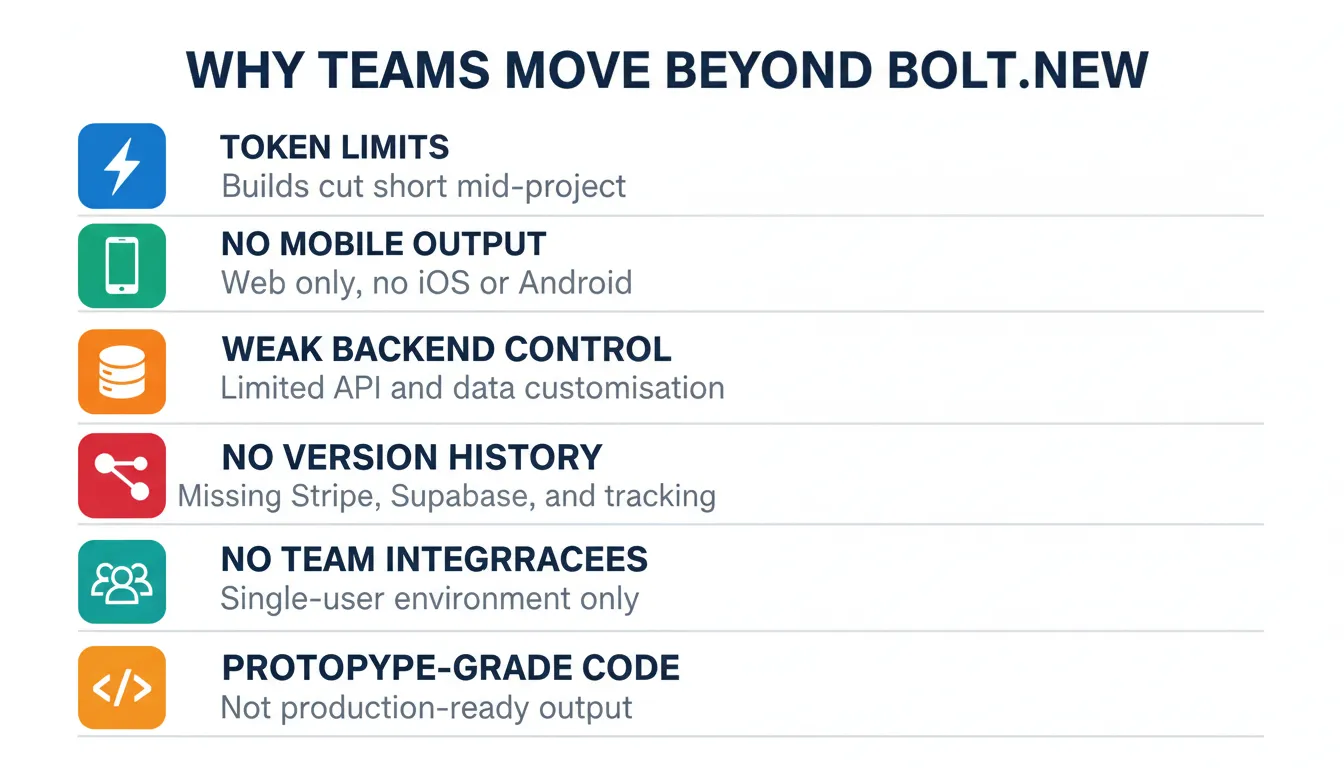
The most common friction points include: token constraints that cut builds short, no native mobile app output, limited backend customization, and gaps in enterprise-grade security. When these limits appear mid-project, teams start looking for bolt alternatives that can carry the full weight of production work.
Bolt alternatives are AI-powered app development platforms that offer similar or superior capabilities. These include generated code, full-stack web app support, internal tools, rapid prototyping, and workflow automation. The low-code and no-code market is one of the fastest-growing segments in enterprise software, with analysts tracking consistent double-digit annual growth across the category.
Whether you're a solo founder building an MVP, a developer needing custom code injection, or an enterprise team requiring role-based access control and audit logs, there is a Bolt alternative built for your exact situation.
Who Should Read This Guide?
- Developers frustrated by token limits or lack of backend flexibility
- Founders and product managers who need to ship full-stack apps without a large engineering team
- Enterprise teams looking for internal tools with security and scalability
- Non-technical builders who want AI-generated apps without writing a single line of code
Why Look for a Bolt Alternative?
Bolt.new is known for its no-code and low-code features, but some developers find it limiting. Maybe you need more flexibility, custom code injection, or advanced AI capabilities. That's where bolt alternatives shine. They bring AI powered app development, seamless integration, and internal tools that make web apps easier to manage.
These alternatives often come with full-stack capabilities, version control, and team collaboration features. So, your project isn't just faster, it's smarter.
According to Statista, the global low-code and no-code platform market is growing rapidly, with projections showing significant expansion in the coming years. Bolt alternatives have stepped in to help developers and teams create full-stack web applications without sweating over every line of code. They offer generated code, internal tools, and rapid prototyping features that make app building feel more like stacking Lego blocks than wrestling with a coding nightmare.
Common Reasons Developers Switch
| Pain Point | What Teams Need Instead |
|---|---|
| Token limits hit mid-project | Generous or unlimited AI generation budgets |
| No native mobile app output | Flutter or React Native code generation |
| Weak backend customization | Full-stack control with custom API routes |
| No version history | Git-based version control |
| Limited integrations | Stripe, Supabase, Airtable, OpenAI connectors |
| No team collaboration | Multi-developer workspaces with role-based access |
| Poor code quality | Clean, production-ready generated code |
Top Bolt Alternatives at a Glance
Each platform listed below offers unique features that make app building faster and more efficient. From AI-powered app development to full-stack web applications, these bolt alternatives cater to different project needs.
| Platform | Best For | AI Code Gen | Mobile Support | Free Tier |
|---|---|---|---|---|
| Rocket | Full-stack apps, MVPs, internal tools | Yes | Yes (Flutter) | Yes |
| Retool | Enterprise internal dashboards | Partial (AppGen) | Yes | Yes (up to 5 users) |
| Appsmith | Collaborative full-stack web apps | Partial | No | Yes |
| Draftbit | Mobile-first app development | Yes | Yes (React Native) | Yes |
| UI Bakery | Web apps with workflow automation | Yes | No | Yes |
Rocket: The Best Bolt Alternative for Full-Stack AI App Development
Rocket stands out as one of the most efficient bolt alternatives for fast web app development. While there are many options, Rocket brings together generated code, AI powered app development, and internal tools in a way that makes launching web apps fast and reliable. Teams can leverage AI agents, instant deployment, and robust collaboration features to move from idea to a functional app quickly.
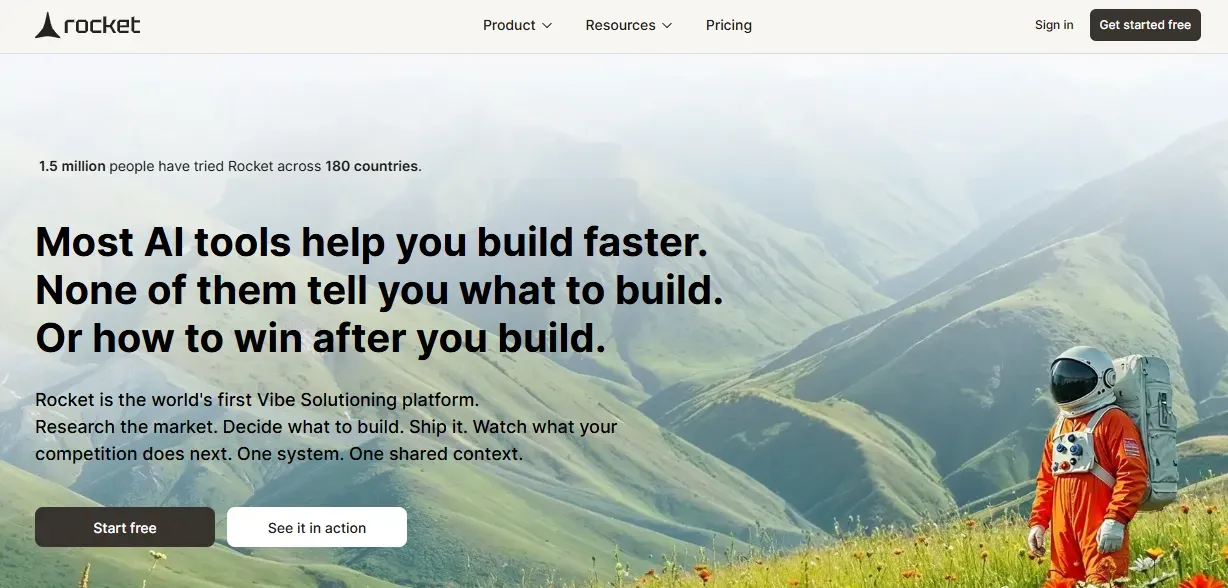 What sets Rocket apart is its architecture-first approach. Instead of generating throwaway prototype code, Rocket generates production-ready Next.js and Flutter applications with proper component structure, database schemas, and API routes from the first generation. 1.5 million people have tried Rocket across 180 countries, from solopreneurs shipping MVPs to enterprise teams rethinking their entire stack.
Rocket is also the world's first Vibe Solutioning platform, covering the complete arc from strategic research (Solve) to production-grade building (Build) to continuous competitive monitoring (Intelligence). You're not just getting a code generator. You're getting a system that thinks before it builds.
Why Rocket Outperforms Bolt.new
- Generated code quality: Rocket outputs clean, maintainable Next.js and Flutter code ready to ship and extend, not prototype scaffolding.
- Full-stack by default: Backend logic, database integration (Supabase, Airtable), and API routes are generated alongside the frontend.
- Mobile apps included: Generate iOS and Android apps from a single Flutter codebase. Bolt.new has no equivalent capability.
- Team workspaces: Multi-developer collaboration with shared project context, three-level role-based access (Admin, Creator, Viewer), and version control.
- 25+ integrations: Stripe, OpenAI, Anthropic, Gemini, Twilio, Mailchimp, Supabase, Airtable, Mixpanel, and more, all connectable in one click.
- Compliance by default: Every build ships with SEO-ready structure, WCAG accessibility compliance, and GDPR coverage as baseline outputs, not optional add-ons.
Rocket Feature Breakdown
- Generated code for full-stack apps that work out of the box
- AI app builders and AI assisted development to simplify coding
- Custom domain support and integrated hosting for professional deployment
- Version control and team collaboration features for multi-developer projects
- Internal tools for business and web applications to streamline operations
- Figma-to-code conversion that preserves every spacing and design decision
- Built-in SEO, WCAG accessibility, and GDPR compliance as defaults
Real Use Cases for Rocket
SaaS MVP in a Weekend: A two-person founding team describes their product in plain language. Rocket generates the full Next.js frontend, Supabase backend, Stripe payment integration, and user authentication. The team deploys to a live URL without writing a single line of code manually.
Internal Operations Dashboard: An operations team needs a custom dashboard to track logistics data across three databases. Using Rocket's internal tools builder, they connect Airtable, build a role-based access dashboard, and deploy to a custom domain in one afternoon.
Mobile App from Figma: A non-technical founder uploads a Figma design file. Rocket generates a Flutter mobile app that preserves every spacing decision and design token. The result is a production-ready iOS and Android app ready for app store submission.
Community Validation
While browsing this Reddit thread on alternatives to Bolt.new, one comment stood out:
"Hey! If you're looking for vibe coding tools like bolt, check these… Rocket just getting great feedback and 400k users in just 16 weeks."
Real builders share honest experiences. The organic adoption signal points to Rocket as a serious, production-grade bolt alternative worth evaluating before committing to any other platform.
How to Choose the Right Bolt Alternative
Choosing the right bolt alternative can save time, reduce errors, and make app development smoother. The single most important question is: what is your primary output? That one answer eliminates most wrong choices immediately.
Decision Framework
- Define your primary output. Do you need a full-stack web app, a mobile app, an internal dashboard, or UI components? This narrows the field fast.
- Assess your technical level. Non-technical founders should prioritize Rocket or UI Bakery. Developers comfortable with code will get more from Appsmith.
- Check integration requirements. List every third-party service your app needs. Verify the platform supports them natively before committing.
- Evaluate version control needs. If multiple developers will work on the project, confirm the platform supports Git integration or has its own version history.
- Consider deployment and hosting. Some platforms host your app for you (Rocket); others require you to bring your own infrastructure (Appsmith self-hosted).
- Test with a real project. Every platform on this list offers a free tier. Build a small prototype before committing to a paid plan.
Quick-Reference Decision Table
| If you need... | Choose... |
|---|---|
| Full-stack web and mobile app from one prompt | Rocket |
| Enterprise internal tools with governance | Retool |
| Open-source, self-hosted internal tools | Appsmith (SOC 2 Type II verified) |
| Mobile-only React Native app | Draftbit |
| Workflow-automated web apps | UI Bakery |
Retool: Enterprise-Ready Internal Tools Builder
Retool is recognized for simplifying the creation of internal dashboards and business applications. It's a powerful bolt alternative that seamlessly integrates with databases and APIs, making complex data management straightforward. Retool emphasizes security and role-based access controls, enabling teams to build reliable tools with confidence.
 Retool is the right choice when your primary need is internal tooling for an enterprise environment. Its AppGen feature uses AI to generate working apps from a prompt, connected to your own data. Mobile apps are supported on all plans, including the free tier.
Top Features:
- Strong database integration for seamless backend connections
- User authentication and role based access control for team security
- Drag-and-drop interface for quick dashboard creation
- Mobile app support on all plans (unlimited mobile apps per retool.com/pricing)
- Audit logging and SAML/SSO on Business and Enterprise tiers
Retool is ideal for enterprises that need secure, reliable internal tools without compromising speed or efficiency. Builder seat pricing starts at $10/month on the Team plan and $50/month on Business, which can scale quickly for larger teams.
Appsmith: Collaborative Full Stack Web Development
Appsmith focuses on web applications and full-stack development, making it a versatile bolt alternative. It allows teams to build both frontend interfaces and backend logic in one place, with collaborative tools that make teamwork efficient and manageable.
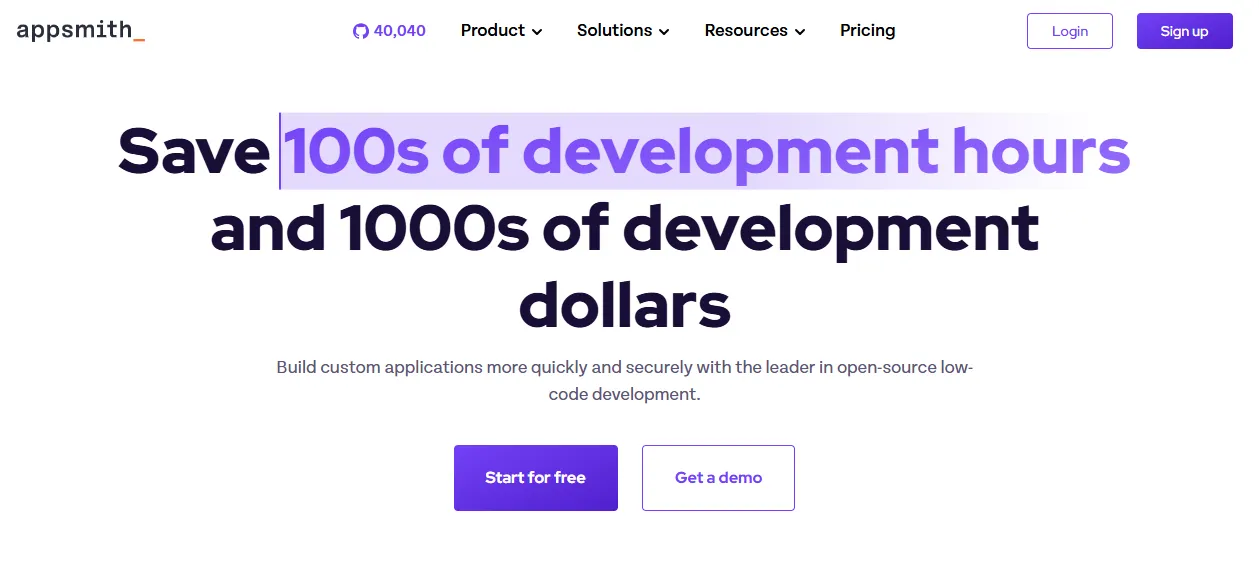 Appsmith is best for engineering teams that want an open-source, self-hostable platform for building internal tools and data-heavy web applications. It is fully maintained under the Apache 2.0 license with SOC 2 Type II certification, confirmed on appsmith.com.
Top Features:
- Full-stack app development, including frontend and backend management
- Collaborative features with Git-based version control
- API access and database integration
- Open-source under Apache 2.0 with self-hosting options
- SOC 2 Type II certified
Appsmith requires more manual configuration than Bolt.new but gives you far more control over data sources and deployment. It does not support mobile app generation.
Draftbit: Mobile App Development Made Fast
Draftbit is a top choice for mobile app development, focusing on AI-generated code and rapid prototyping. It allows developers and entrepreneurs to create mobile-first apps quickly while supporting team collaboration and streamlined app building.
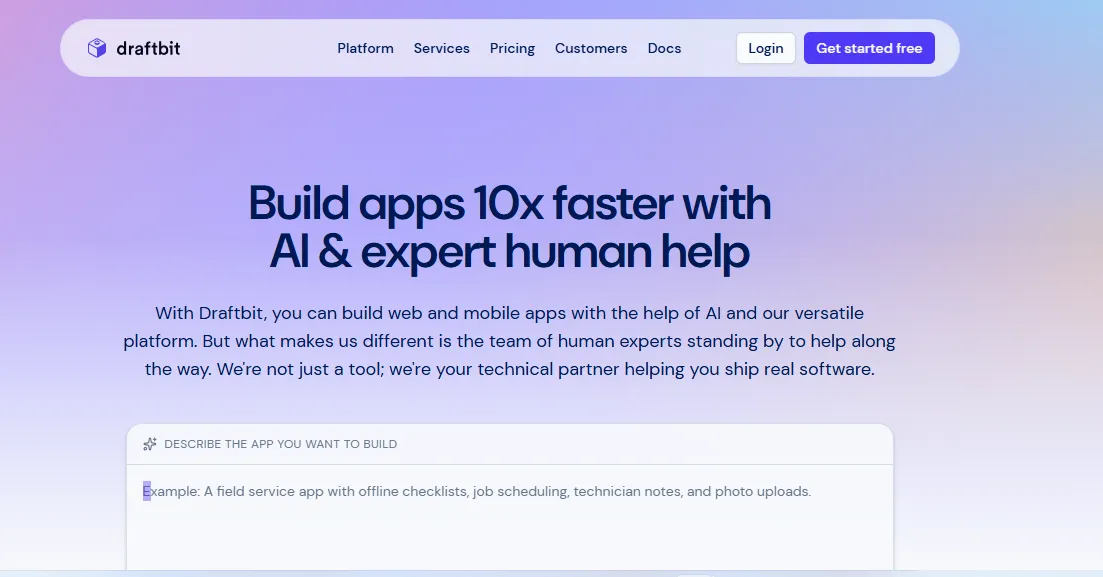 Draftbit is purpose-built for mobile. If your primary deliverable is a React Native app for iOS and Android, Draftbit's visual builder and code export capabilities make it a strong bolt alternative for mobile-first projects.
Top Features:
- AI app generation to reduce coding effort
- Drag-and-drop app builder for mobile apps
- Team collaboration tools for multi-developer projects
- Rapid prototyping for testing ideas fast
- React Native code export for developer handoff
Draftbit is an excellent choice for mobile-first projects where speed, AI assistance, and team collaboration are key. It is focused on mobile only and has a smaller integration ecosystem than full-stack platforms.
UI Bakery: Full Stack Web Apps and Automation
UI Bakery excels at creating full-stack web apps and internal tools with a focus on workflow automation. It's a reliable bolt alternative for teams that need to combine AI-generated code with project management features for smooth app development.
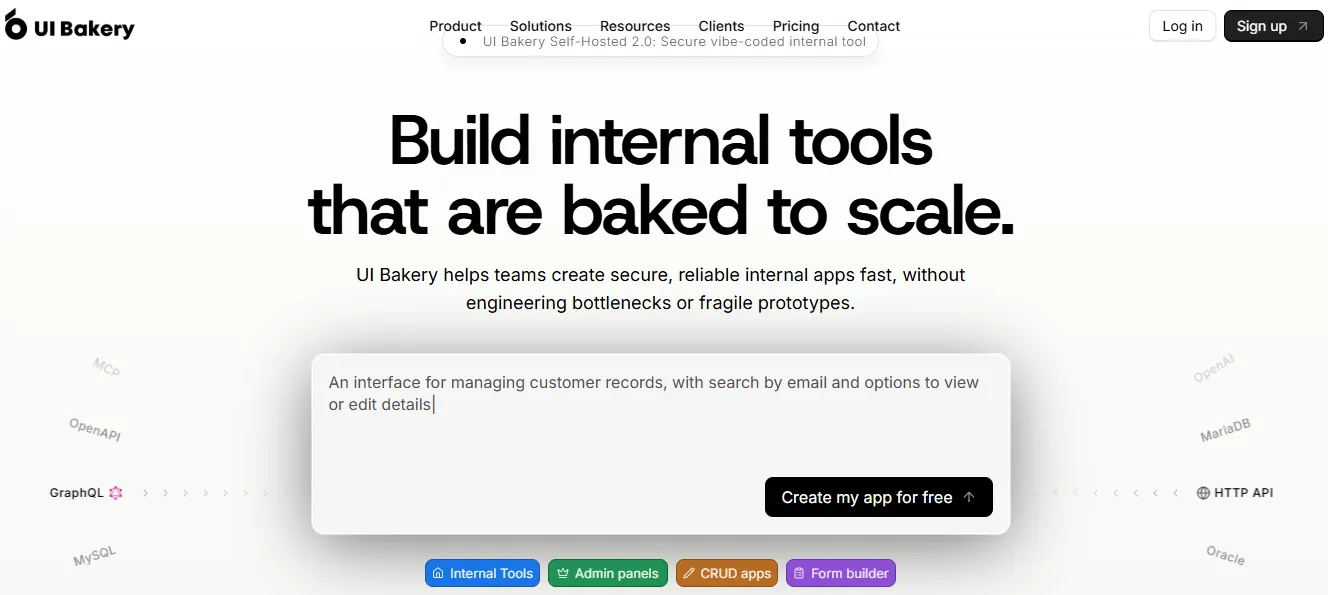 UI Bakery is a strong option for teams building internal portals, admin panels, and workflow-driven web applications. Its automation features and project management integrations make it particularly useful for operations and product teams.
Top Features:
- AI-generated code for full-stack web apps
- Workflow automation for improved efficiency
- Project management tools integrated with app development
- Collaborative environment for team projects
- Pre-built UI component library for faster design
UI Bakery offers a balance of automation and collaboration, making it perfect for teams building complex web applications efficiently.
How AI Tools Are Changing App Building
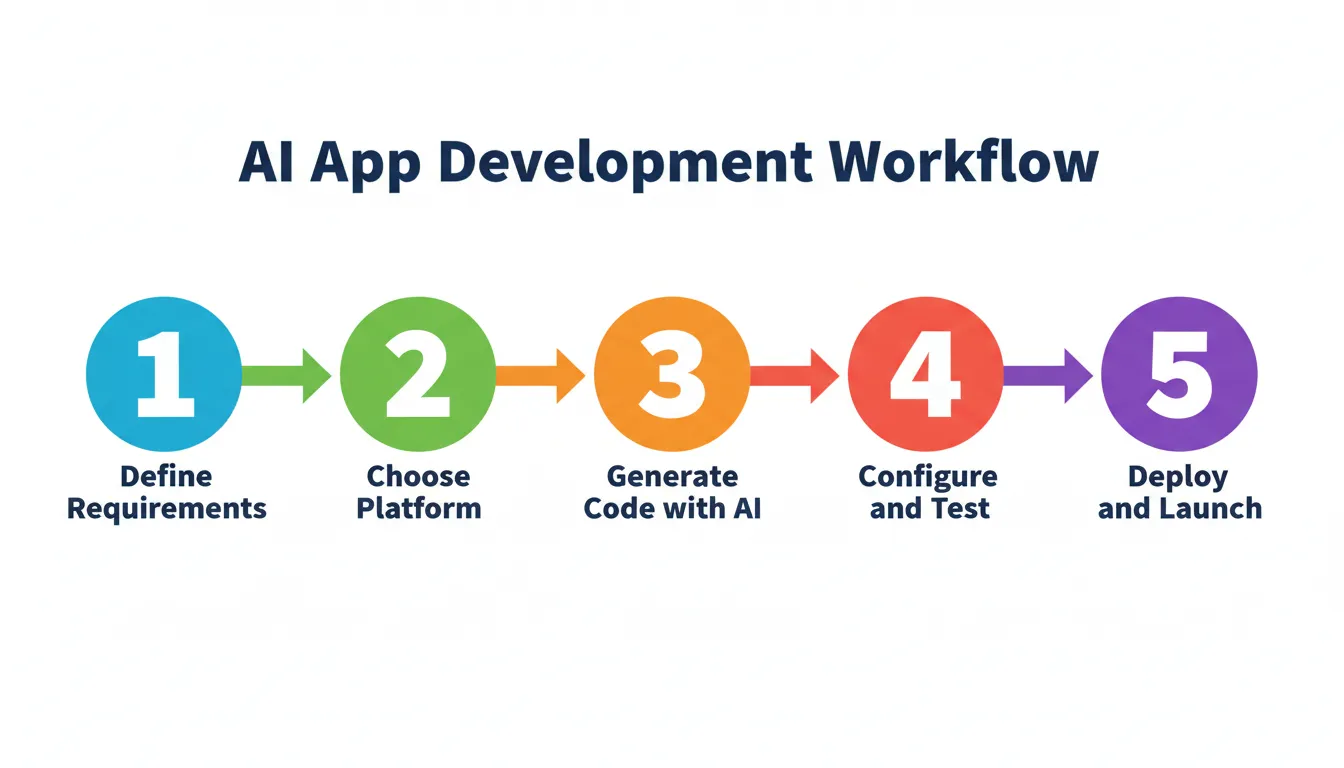
AI tools are transforming how web and mobile apps are built, making development faster, smarter, and more efficient. The shift is not just about speed. It is about fundamentally changing who can build software and what they can build.
The most significant transformation is the move from code-first to intent-first development. You describe what you want to build, and the platform handles architecture, code, and deployment. This removes the bottleneck of syntax knowledge and lets teams focus on product decisions rather than implementation details.
Key Capabilities AI Brings to App Development
- Natural language to code: AI tools interpret natural language descriptions to create functional app features, eliminating the need to know specific syntax or frameworks.
- AI coding assistant: Generate working code automatically by describing app functionality, reducing time from idea to implementation from weeks to hours.
- Rapid prototyping: Test and iterate app ideas quickly, validating product-market fit before investing in full development.
- Workflow automation: Automate repetitive tasks and backend logic, freeing developers to focus on complex, high-value problems.
- Compliance by default: Platforms like Rocket ship WCAG accessibility, GDPR coverage, and SEO-ready structure as baseline outputs, not optional add-ons.
Teams that build full-stack apps with AI consistently report faster iteration cycles and fewer handoff errors between design and development. The productivity gains are most pronounced when the AI platform handles both the thinking layer (what to build) and the execution layer (how to build it).
The AI App Development Workflow
Bolt Alternatives by Use Case: Which Platform Wins?
Different projects demand different tools. Here is a clear breakdown of which bolt alternative wins for each major use case.
Full-Stack SaaS Application
Winner: Rocket. Rocket generates complete Next.js applications with Supabase backends, Stripe payments, user authentication, and custom API routes. No other bolt alternative matches this level of full-stack completeness from a single prompt. Teams exploring how AI is changing product development consistently find Rocket the most complete starting point.
Enterprise Internal Dashboard
Winner: Retool. For secure, permission-controlled internal tools connected to enterprise databases, Retool's governance layer, SAML/SSO, and audit logging make it the safest choice for regulated industries.
Mobile App (iOS and Android)
Winner: Rocket or Draftbit. Rocket generates Flutter apps deployable to both iOS and Android from a single codebase. Draftbit specializes in React Native. Rocket wins if you also need a web version; Draftbit wins if mobile-only is the priority.
Open-Source Internal Tool
Winner: Appsmith. Appsmith's self-hostable, Apache 2.0 open-source architecture and SOC 2 Type II certification make it the top choice for teams with strict data residency requirements.
What Most Bolt Alternative Guides Skip
Most comparisons focus only on feature lists. Here are the questions that actually matter when choosing a platform.
Code Ownership and Export
This is critical and rarely discussed. Some platforms lock your app inside their environment. Others export clean, portable code you own entirely. Rocket generates standard Next.js and Flutter code you can export to GitHub and continue developing independently. Appsmith is open-source and self-hostable. Retool and UI Bakery are proprietary environments with limited export options.
Before choosing any platform, ask: Can you take your code and leave?
Pricing at Scale
Free tiers are generous for prototypes. Pricing changes significantly at team and enterprise scale. Retool's builder seat pricing starts at $10/month per builder on the Team plan, scaling to $50/month on Business. Appsmith and UI Bakery offer more predictable team pricing. Always test the pricing calculator with your actual team size and usage before committing.
AI Model Flexibility
Some platforms are locked to a single AI provider. Rocket supports AI provider flexibility, meaning you can switch providers without changing your setup. This matters when model capabilities evolve or when cost optimization becomes a priority.
Vibe Coding vs. Vibe Solutioning
This distinction is worth understanding. Vibe coding tools (including Bolt.new) start at line one. You describe what to build and the AI writes code. Vibe Solutioning, the category Rocket created, starts before line one. Rocket's Solve feature researches the market, maps competitors, and validates the direction before a single line of code is written.
Teams that start from research before building consistently ship products that better match actual market demand.
The difference is not a feature comparison. It is a different answer to the question of who runs the operation.
Bolt Alternatives That Actually Work: Key Takeaways
Developers and teams need to create web apps fast. Traditional coding slows things down and can be error-prone. Bolt.new is good, but not always enough. Bolt alternatives like Rocket, Retool, Appsmith, and others provide generated code, AI tools, internal tools, and full stack app capabilities. They allow rapid prototyping, instant deployment, and better team collaboration.
The best bolt alternative is not a single answer for everyone. It depends on your stack, your team, your timeline, and your end user. But for the broadest range of use cases, from SaaS MVPs to mobile apps to internal tools, Rocket delivers the most complete solution available today.
Teams that want to understand the full landscape before committing should also explore how vibe coding compares to low-code platforms and what the best AI app builders offer before making a final decision.
The Bolt Alternative Built for What Comes Next
The search for the best bolt alternatives reflects a broader shift in how software gets built. AI-powered app development is no longer a novelty. It is the new standard for teams that want to move fast without sacrificing code quality, scalability, or user experience.
Rocket is built for exactly this moment. With AI that generates production-ready full-stack applications, native mobile app output, 25+ one-click integrations, and team collaboration built in from day one, Rocket gives developers and founders everything needed to ship real products, not just demos. 1.5 million people have tried Rocket across 180 countries, from solopreneurs validating their first idea to enterprise teams running strategy and build in the same platform.
Whether you are replacing Bolt.new because of token limits, code quality concerns, or the need for mobile support, Rocket delivers a faster, more complete, and more reliable path from idea to deployed application. Start building for free on Rocket.new and ship your first production-ready app today.
Table of contents
- -What Are Bolt Alternatives and Why Do Developers Need Them?
- -Who Should Read This Guide?
- -Why Look for a Bolt Alternative?
- -Common Reasons Developers Switch
- -Top Bolt Alternatives at a Glance
- -Rocket: The Best Bolt Alternative for Full-Stack AI App Development
- -Why Rocket Outperforms Bolt.new
- -Rocket Feature Breakdown
- -Real Use Cases for Rocket
- -Community Validation
- -How to Choose the Right Bolt Alternative
- -Decision Framework
- -Quick-Reference Decision Table
- -Retool: Enterprise-Ready Internal Tools Builder
- -Appsmith: Collaborative Full Stack Web Development
- -Draftbit: Mobile App Development Made Fast
- -UI Bakery: Full Stack Web Apps and Automation
- -How AI Tools Are Changing App Building
- -Key Capabilities AI Brings to App Development
- -The AI App Development Workflow
- -Bolt Alternatives by Use Case: Which Platform Wins?
- -Full-Stack SaaS Application
- -Enterprise Internal Dashboard
- -Mobile App (iOS and Android)
- -Open-Source Internal Tool
- -What Most Bolt Alternative Guides Skip
- -Code Ownership and Export
- -Pricing at Scale
- -AI Model Flexibility
- -Vibe Coding vs. Vibe Solutioning
- -Bolt Alternatives That Actually Work: Key Takeaways
- -The Bolt Alternative Built for What Comes Next