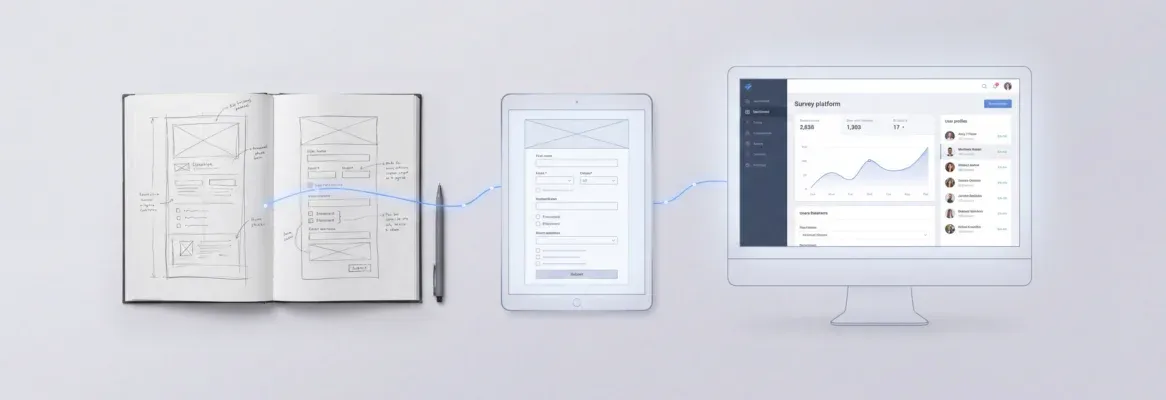
AI prompts for accounting platform workflows cut document analysis time in half, improve client conversion rates by 25%, and turn repeatable tasks into production-ready tools your entire firm can use today.
Are accounting firms still spending nearly half their billable hours on tasks AI can handle in seconds? According to a 2025 CPA.com report cited by the Journal of Accountancy, some firms have automated more than 80% of individual tax return preparation using AI-assisted tools.
The gap between effective AI users and manual-process firms grows wider each quarter. Well-crafted ChatGPT prompts can cut document analysis time in half. They also improve client conversion rates by 25%.
This blog covers the exact prompts for accountants that produce real results.
Why AI Prompts Are Changing the Accounting Industry
The accounting industry is shifting from batch processing to continuous, AI-assisted workflows. This transition affects every accounting practice, from solo practitioners to large firms.
-
AI adoption is accelerating across the profession. Most firms now recognize that AI tools replace repetitive work, not accountants. Machine learning models process financial data faster than any human team. They identify transaction patterns that would take days to spot manually.
-
Accounting software alone is not enough anymore. Traditional software handles data storage and basic calculations. AI prompts add a layer of intelligence. They let accountants ask specific questions and receive structured, actionable insights.
-
The shift favors prompt-literate professionals. Following prompt engineering best practices is becoming a core skill. Firms that build enterprise apps with AI see measurable gains in speed, accuracy, and client satisfaction.
The real value is not in having AI. It is in knowing what to ask it.
What Makes a Good Accounting Prompt?
Not all prompts are equal. A vague prompt like "analyze my finances" produces generic output. A well-structured prompt specifies the client name, business type, time period, output format, and the decision the analysis will inform.
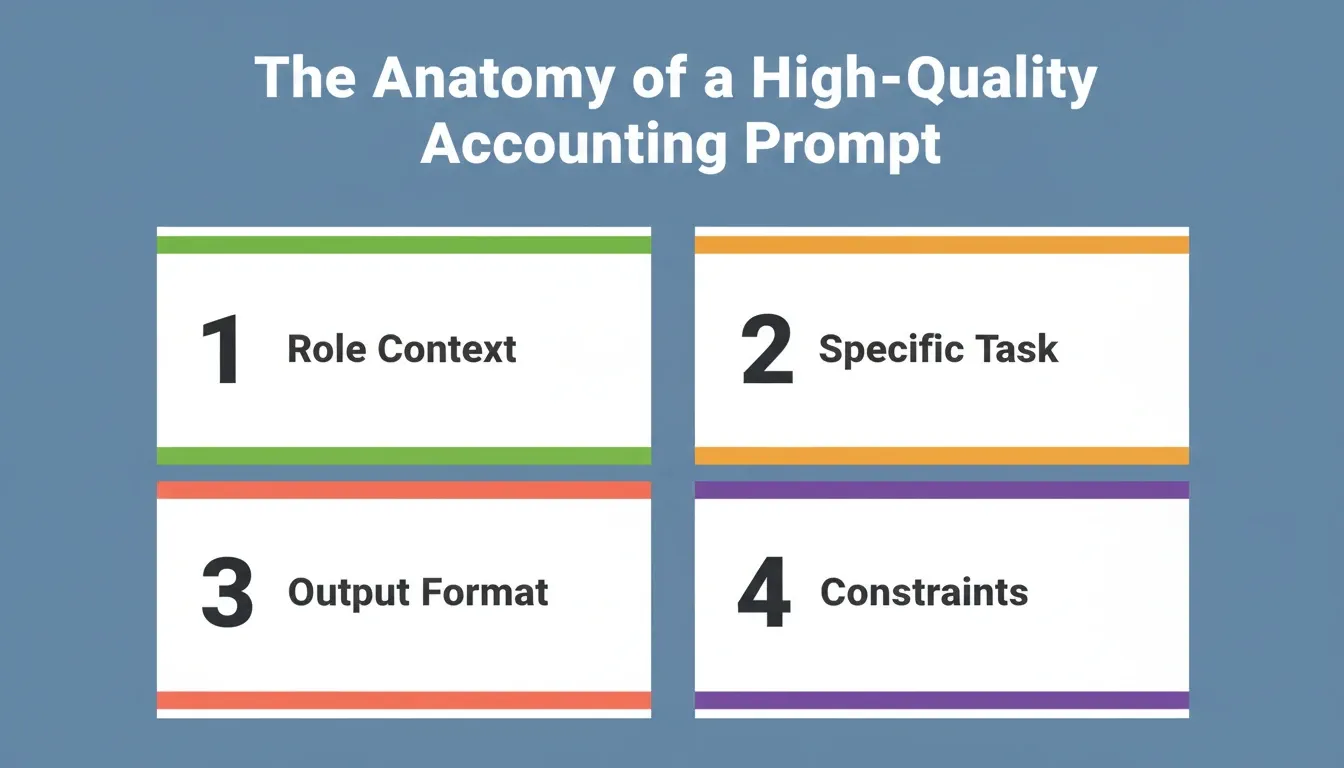
A high-quality accounting prompt follows four components: role context (who the AI is acting as), specific task (exactly what to analyze), output format (table, bullet list, or narrative), and constraints (thresholds, flags, and plain-language requirements). Learning how to write AI prompts that include all four components is the fastest way to improve output quality. Every prompt in this guide follows this structure.
How Do Prompts for Accountants Improve Daily Workflows?
Prompts for accountants work best when they target specific, repeatable tasks. The right ChatGPT prompts turn vague requests into structured outputs that match your accounting workflows.
-
Data entry and categorization become hands-off. A single prompt can categorize a month of transactions by account type, flag anomalies, and produce a summary. Instead of manual data entry across spreadsheets, the AI processes receipt text, invoice details, and bank feeds into clean, organized records.
-
Bookkeeping tasks run on autopilot. Prompts that specify output format, business type, and date ranges produce consistent results. For example: "Categorize the following transactions for a small business restaurant. Use chart of accounts structure. Flag anything over $500 as needing management review." That single prompt saves hours each week.
-
Routine tasks get batched and templated. Build a library of ChatGPT prompts for recurring tasks like bank reconciliations, month-end close checklists, and accounts payable aging reports. Each prompt becomes a reusable AI workflow your team can run without re-inventing the process.
-
Accounting clients get faster turnaround. When bookkeeping tasks take minutes instead of days, your clients notice. Faster delivery strengthens client relationships and opens space for advisory conversations.
Good prompts do not just save hours. They change how the entire accounting practice operates.
Tax Preparation and Compliance Prompts That Work
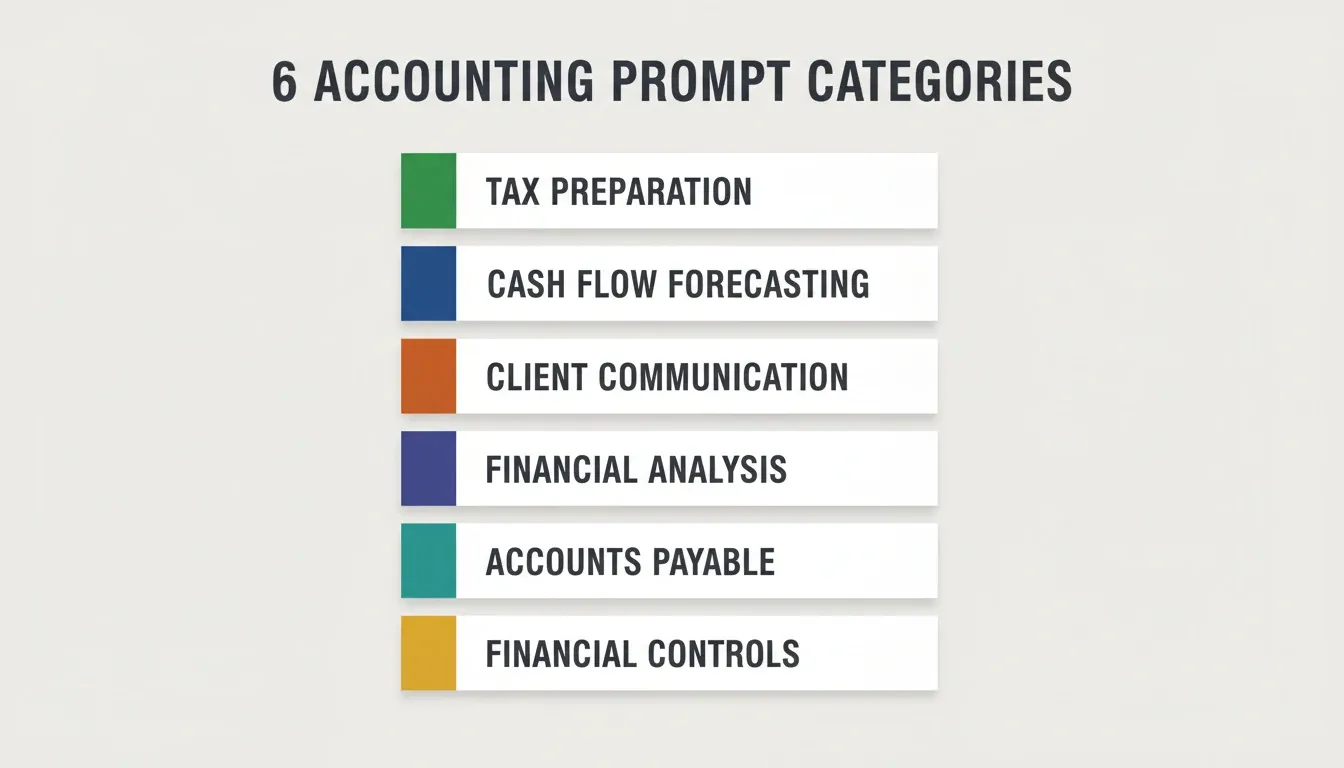
Tax season does not have to mean all-nighters. Here are ChatGPT prompts built for tax preparation workflows that accounting firms can start using today.
-
Sales tax classification prompts. "Review the following product list for [client name]. Determine which items are subject to sales tax under [state] tax law. Present results in a table with columns: Item, Taxable (Y/N), Applicable Rate, Citation." This prompt handles multi-state sales tax analysis without checking each jurisdiction manually.
-
Income statement and balance sheet review prompts. "Analyze the attached income statement and balance sheet for [client name]. Compare cash flow trends across the last four quarters. Identify any financial statements discrepancies that may indicate misclassification or timing errors."
-
Tax law research prompts. "Summarize the current tax law treatment for [specific situation] in [jurisdiction]. Include relevant code sections, recent regulatory updates, and any safe harbor provisions. Output in bullet points with citations." CPA Brian Davis from One Stop CPA told the Journal of Accountancy that using AI research tools this way cut complex tax planning work from days to roughly two hours.
-
Cash flow forecasting prompts. "Based on historical data from the past 12 months, project cash flow for the next quarter. Assume seasonality patterns hold. Flag any months where projected cash flow drops below [threshold]. Present as a monthly table with assumptions listed."
-
Estimated tax calculation prompts. "Calculate estimated quarterly tax payments for a sole proprietor with the following income and expense data. Apply current self-employment tax rates. Show the calculation breakdown and due dates for each payment."
-
Depreciation schedule prompts. "Generate a depreciation schedule for the following fixed assets using MACRS. Include asset name, purchase date, cost basis, useful life, annual depreciation, and accumulated depreciation through the current tax year."
Each of these ChatGPT prompts pairs tax expertise with structured AI output. The professional judgment still sits with the accountant, but the research and formatting happen in minutes rather than hours.
What Are the Best Prompts for Client Communication?
Client communication is where most accounting firms lose time without realizing it. The right AI prompts turn back-and-forth email chains into structured, professional touchpoints.
-
Client onboarding sequences. "Draft a welcome email for a new client named [client name] who runs a [business type] with [X] employees. Include next steps for document collection, introduce our team member who will be their primary contact, and set expectations for response times. Tone: professional but warm." Firms that build a client portal with AI can automate this entire onboarding sequence without manual follow-up.
-
Client emails for follow-up and reminders. "Write a friendly follow-up email to [client name] requesting their Q3 financial records. Mention the upcoming tax preparation deadline. Include a checklist of specific documents needed based on their client profile as a [business type]."
-
New client intake qualification. Sarah Harris, CPA and cofounder of Agate CPA, shared with the Journal of Accountancy that her firm used AI to build a smarter intake form. Their conversion rate rose 25% as a result. The prompt: "Create a web intake form for prospective accounting clients. Include qualifying questions about business type, employee count, revenue range, and reason for seeking new client service. Route responses to our CRM."
-
Client service update templates. "Generate a monthly progress report for [client name] summarizing completed bookkeeping tasks, upcoming deadlines, and recommendations for improving their financial health. Keep it under 200 words. Use plain language, no jargon."
-
Difficult conversation scripts. "Draft a professional email to [client name] explaining that their Q2 financials show a 15% decline in gross margin. Suggest three possible causes and request a call to discuss. Tone: direct but supportive, no alarming language."
-
Engagement letter templates. "Write an engagement letter for a new bookkeeping client. Include scope of services, fee schedule, client responsibilities, confidentiality terms, and a signature block. Format for a professional services firm."
Strong client communication prompts protect client relationships while reducing the time your team spends on follow-ups. When new client inquiries get qualified automatically, your firm's client base grows without proportional effort.
Financial Analysis and Risk Assessment Prompts
Financial analysis prompts require more context than simpler accounting tasks. The key is providing enough financial data for the AI to generate insights that matter for strategic decisions.
| Prompt Category | Example Prompt | Expected Output |
|---|---|---|
| Cash flow analysis | "Analyze cash flow patterns for [client name] over 12 months. Identify seasonality." | Monthly breakdown with trend flags |
| Risk assessment | "Review accounts receivable aging. Flag clients over 90 days. Calculate risk exposure." | Risk-scored client list with amounts |
| Revenue trend | "Compare revenue trend year-over-year by service line. Highlight growth areas." | Revenue trend table with % changes |
| Financial ratios | "Calculate key financial ratios from the attached balance sheet. Compare to industry benchmarks." | Ratio table with benchmark comparison |
| Scenario planning | "Model three scenarios for profit margin impact if costs increase 10%, 20%, 30%." | Scenario comparison table |
| Budget variance | "Compare actual vs. budgeted figures for each department this quarter. Flag variances over 10%." | Variance report with explanations |
| Working capital | "Analyze working capital trends for the past six quarters. Identify liquidity risk indicators." | Trend chart with risk flags |
Here is how a prompt engineering workflow looks for financial analysis:
Prompt engineering workflow for financial analysis: from identifying the need to delivering client-ready insights.
Financial analysis ChatGPT prompts work best when you provide specific context: the client name, time period, and the decisions that depend on the analysis. Risk assessment prompts should always reference actual financial records rather than generic templates. Scenario planning becomes practical when you feed real numbers and ask questions tied to current market conditions.
Firms that pair these prompts with a purpose-built dashboard for financial reporting get live data connections. As a result, the analysis stays current without manual updates.
Common Mistakes Accountants Make With AI Prompts
Understanding what not to do is as important as knowing the right prompts. Here are the most common failure patterns and how to fix them.
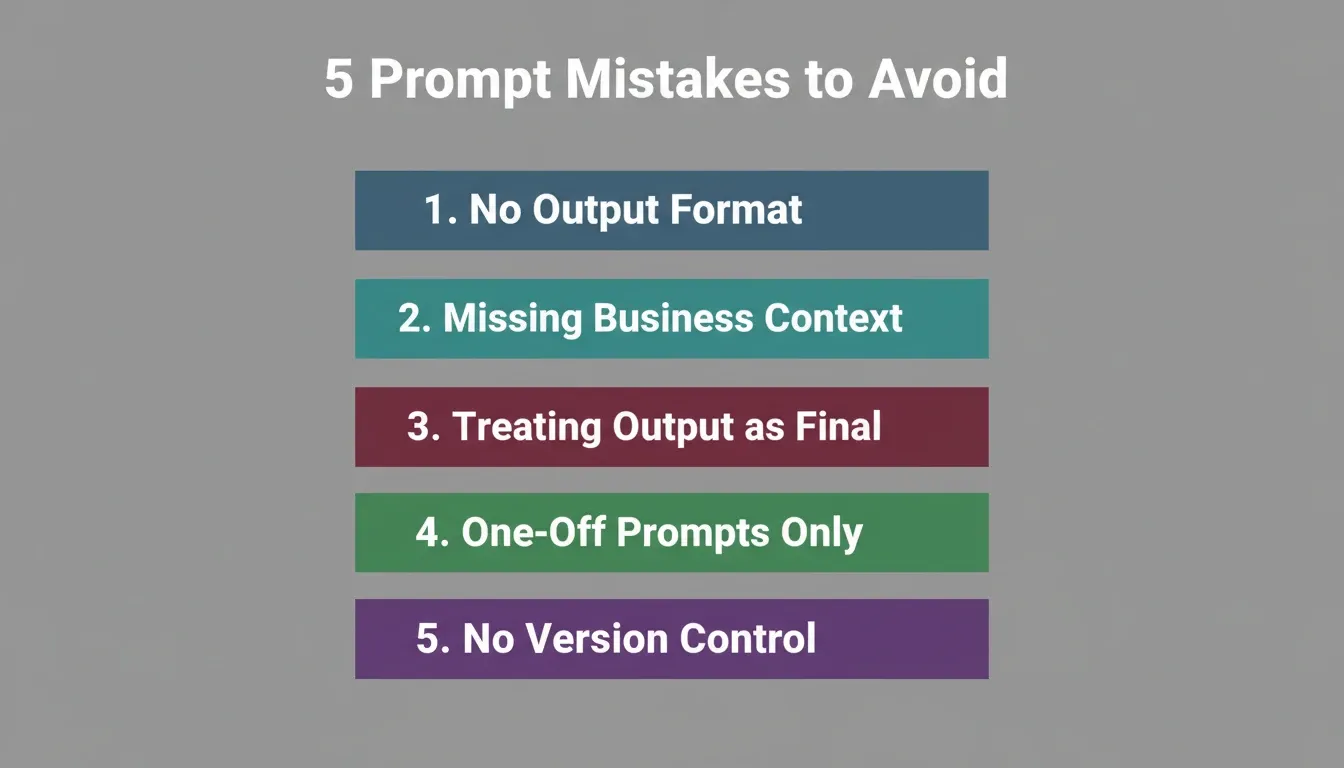
Mistake 1: Prompts without output format specifications. Asking "analyze this balance sheet" produces a paragraph. Asking for a "table with columns: Account, Balance, YoY Change, Flag" produces something you can paste directly into a client report.
Mistake 2: Missing business context. AI does not know your client is a seasonal restaurant versus a year-round SaaS company. Always include business type, revenue range, and the specific decision the analysis will inform.
Mistake 3: Treating AI output as final. ChatGPT prompts accelerate research and formatting. However, professional judgment remains with the accountant. AI tools surface patterns in financial data. The accountant interprets results, verifies accuracy, and makes strategic recommendations.
Mistake 4: One-off prompts instead of reusable workflows. The real leverage comes from building a prompt library. Eventually, you convert those prompts into permanent applications your entire team can access without re-writing them each time.
Mistake 5: No version control on prompts. As you refine prompts, track what changed and why. A prompt that works for a restaurant client may need adjustment for a professional services firm. Document the variations.
How Rocket Turns Accounting Prompts Into Production-Ready Apps
Here is the thing about ChatGPT prompts for accounting: they are powerful for one-off tasks, but they do not scale. Every time a team member needs to run the same analysis, they copy, paste, and hope the output format stays consistent. That is where Rocket changes the game for accounting firms.
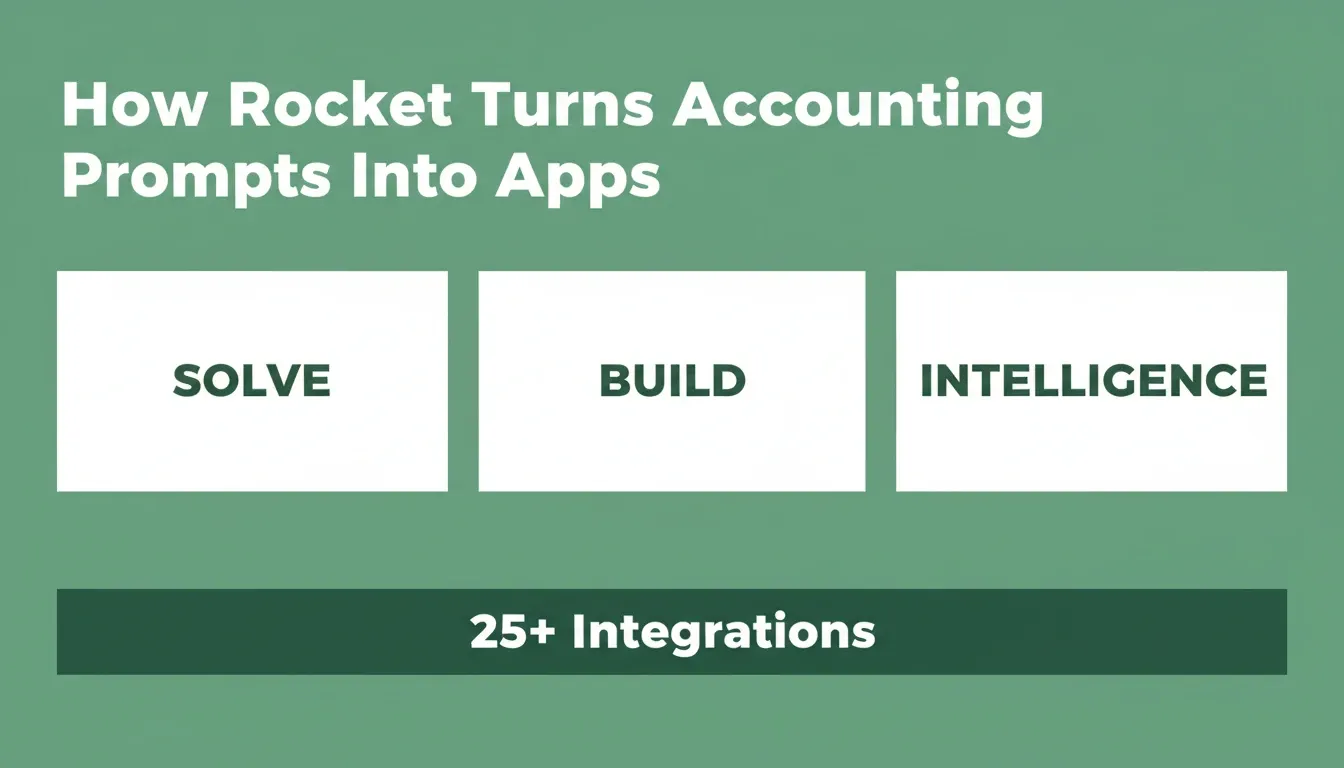
Rocket is a vibe solutioning platform that combines three capabilities in one place. Solve handles research and validation. Build creates production-ready apps from natural language. Intelligence monitors competitors and markets continuously. Accounting firms use all three.
Rocket takes the prompts for accountants you have already refined and turns them into fully functional applications. These applications include databases, user interfaces, and automated workflows. No coding background is needed.
What Rocket Builds for Accounting Firms
When you describe an accounting workflow to Rocket in plain language, it generates a complete, production-ready application. Specifically:
-
Web apps built on Next.js: client portals, financial reporting dashboards, and internal tools
-
Mobile apps built with Flutter: iOS and Android apps ready for App Store and Google Play submission
-
Integrations via 25+ connectors: connect Stripe for payments, Supabase for database and authentication, Airtable for client data management, HubSpot for CRM, and more
The workflow is straightforward. Describe what you want, watch Rocket generate it in real time, iterate with chat or visual editing, then launch with one click. Firms that have explored how to build AI accounting software for teams consistently find that Rocket compresses months of development into a single session.
-
From prompt to deployed app in one session. Describe your accounting workflow in plain language. Rocket generates the full stack: frontend, backend, database schema, and deployment. Your ChatGPT prompts become permanent tools rather than disposable conversations.
-
Built for accounting practice workflows. Unlike generic AI tools, Rocket builds the prompt logic directly into the app. Your team accesses a clean interface while the AI reasoning runs behind the scenes. This means error reduction across every accounting task the app handles.
-
Handles complex tasks that ChatGPT prompts alone cannot. Need a client onboarding portal that connects with your existing software? A financial analysis dashboard that pulls live data? An accounts payable tracker with automated reminders? Stand-alone ChatGPT prompts fall short because they cannot connect to your current systems or remember state. Rocket creates persistent applications that do.
-
Accounting firms ship faster than with traditional development. Most firms do not have engineering teams. Hiring developers for a custom accounting tool costs months of time and tens of thousands of dollars. Rocket compresses that timeline to hours.
"Small practitioners with little or no specialized technology background are using free or inexpensive programs to create solutions to practice problems." — Sarah Harris, CPA, Agate CPA (Journal of Accountancy, August 2026)
Prompt engineering skill matters. Turning those prompts into tools your entire accounting firm uses daily is where the real value sits.
Rocket Plans for Accounting Teams
| Plan | Price | Credits/Month | Best For |
|---|---|---|---|
| Free | $0 | 20 (one-time) | Testing Rocket before committing |
| Pro | $25/mo | 100 | Personal projects and side tools |
| Rocket | $50/mo | 250 | Firms needing research and competitive intelligence |
| Booster | $250/mo | 1,500 | Power users and fast-moving teams |
Annual billing saves 20%. All paid plans include unlimited team members.
Accounts Payable and Invoicing Prompts That Generate Insights
Accounts payable is where most accounting firms lose visibility into their clients' spending patterns. The right prompts surface patterns that humans miss.
-
Invoice categorization prompts. "Review the following invoice data for [client name]. Categorize each by vendor, amount, department, and payment terms. Flag any duplicate entries or amounts that deviate more than 20% from historical data." This generates insights about spending trends while catching errors before they compound.
-
Accounts payable aging analysis. "From the accounts payable ledger, create an aging report grouped by vendor. Highlight any vendor with outstanding balances over 60 days. Calculate the weighted average days payable and compare against industry benchmarks for [business type]."
-
Revenue growth tracking prompts. "Track monthly revenue growth for [client name] across all service lines. Compare against the same period last year. Identify which lines show declining revenue trend and suggest areas for deeper financial analysis."
-
Financial controls audit prompts. "Review the chart of accounts for [client name]. Identify any accounting treatment inconsistencies across similar transaction types. Flag entries that bypass normal approval workflows or lack supporting documentation."
-
Vendor payment optimization prompts. "Analyze the accounts payable schedule for [client name]. Identify vendors offering early payment discounts. Calculate the annualized return on taking each discount versus holding cash. Rank by ROI."
-
Three-way match verification prompts. "Compare the following purchase orders, receiving reports, and vendor invoices. Flag any discrepancies in quantity, price, or terms. Output a reconciliation table with status: Matched, Discrepancy, or Missing Document."
According to Sage's research on AI in accounting, accounting firms that apply AI to continuous monitoring of financial data catch anomalies in real time rather than during periodic reviews. The future belongs to firms that generate insights proactively rather than reactively.
Your Accounting Practice Deserves Smarter AI
The accounting firms winning right now are not the biggest or the most well-funded. They are the ones writing better AI prompts, applying professional judgment to AI outputs, and building tools that future-proof their client relationships.
Your next step does not need to be complicated. Pick one workflow that frustrates your team, write a prompt that solves it, and turn it into a tool your entire firm can use. Start building with Rocket and ship your first AI-powered accounting tool today.
Table of contents
- -Why AI Prompts Are Changing the Accounting Industry
- -What Makes a Good Accounting Prompt?
- -How Do Prompts for Accountants Improve Daily Workflows?
- -Tax Preparation and Compliance Prompts That Work
- -What Are the Best Prompts for Client Communication?
- -Financial Analysis and Risk Assessment Prompts
- -Common Mistakes Accountants Make With AI Prompts
- -How Rocket Turns Accounting Prompts Into Production-Ready Apps
- -What Rocket Builds for Accounting Firms
- -Rocket Plans for Accounting Teams
- -Accounts Payable and Invoicing Prompts That Generate Insights
- -Your Accounting Practice Deserves Smarter AI