
Rocket Intelligence is built for GTM teams, including sales leaders, marketing leaders, founders, product managers, and customer success teams, who need always-on competitive awareness. This post breaks down which six GTM team types get the most value, what each role uses it for, and why Rocket.new is the AI GTM platform revenue teams are choosing in 2026.
Who Is Rocket Intelligence For? The GTM Teams Using It in 2026
The 2026 B2B buyer is digital-first, completing the majority of their journey before engaging a sales representative. By the time a prospect books a demo, they have already researched your competitors, read your G2 reviews, and formed an opinion about your positioning. Static playbooks fail in this environment because buyer channels shift faster than any quarterly update cycle can track.
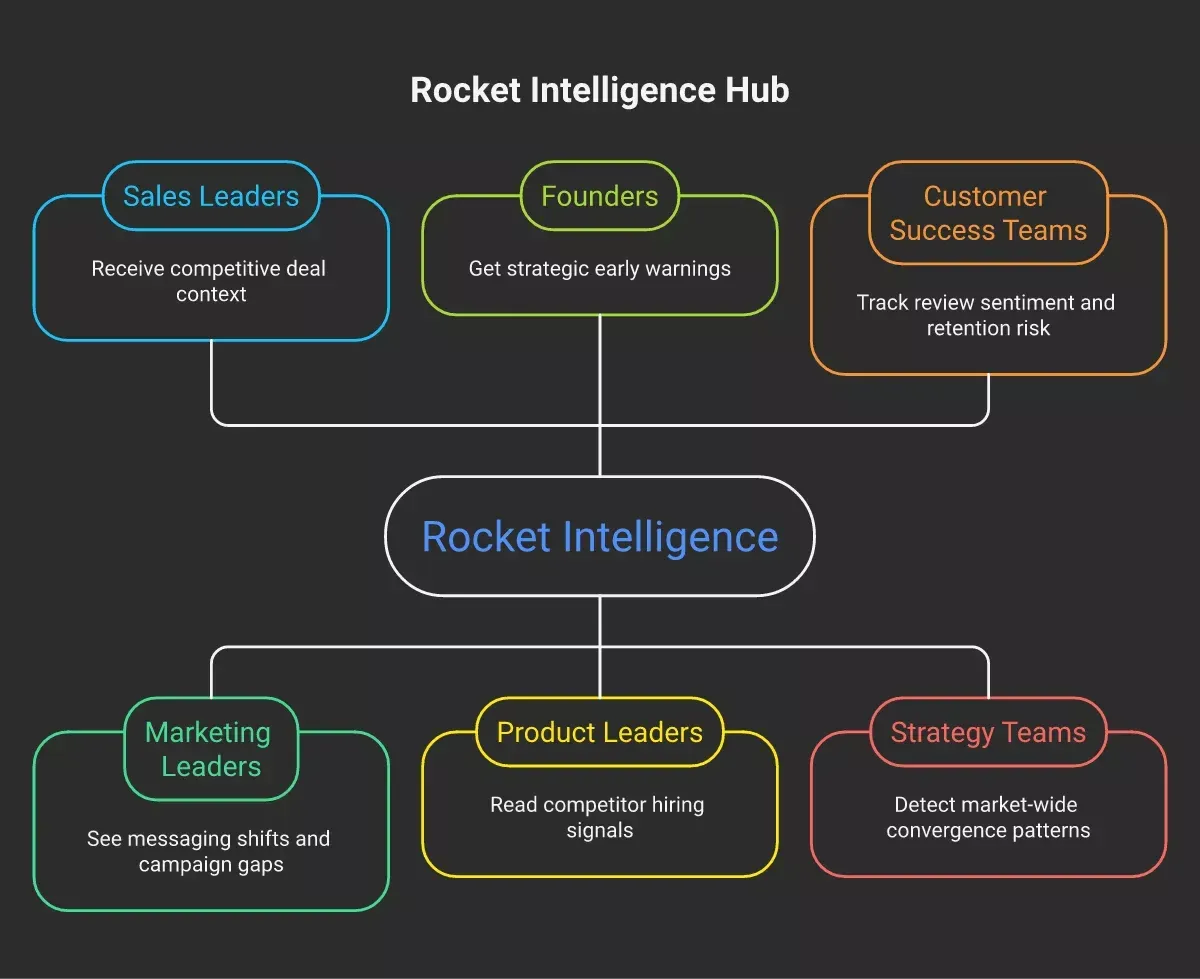
Rocket Intelligence is the always-on competitive layer that revenue teams have been building spreadsheets to replace. It watches companies across ten pillars simultaneously: website, social, news, GTM, traffic, product, people, business, reviews, and cross-pillar patterns. It surfaces what those signals mean for your work specifically. Not raw data. Interpreted Intel.
According to HubSpot's 2026 State of Marketing report, 80% of marketers now use AI for content creation, but far fewer are using AI agents to monitor the competitive moves that should be shaping that content in the first place. That gap is exactly where Rocket Intelligence lives.
The Problem With How GTM Teams Gather Intelligence Today
Most revenue teams still run on manual research. Someone opens five browser tabs before a sales call. Another person scans LinkedIn for competitor job posts. A marketing leader checks a competitor's website once a month and hopes nothing has changed.
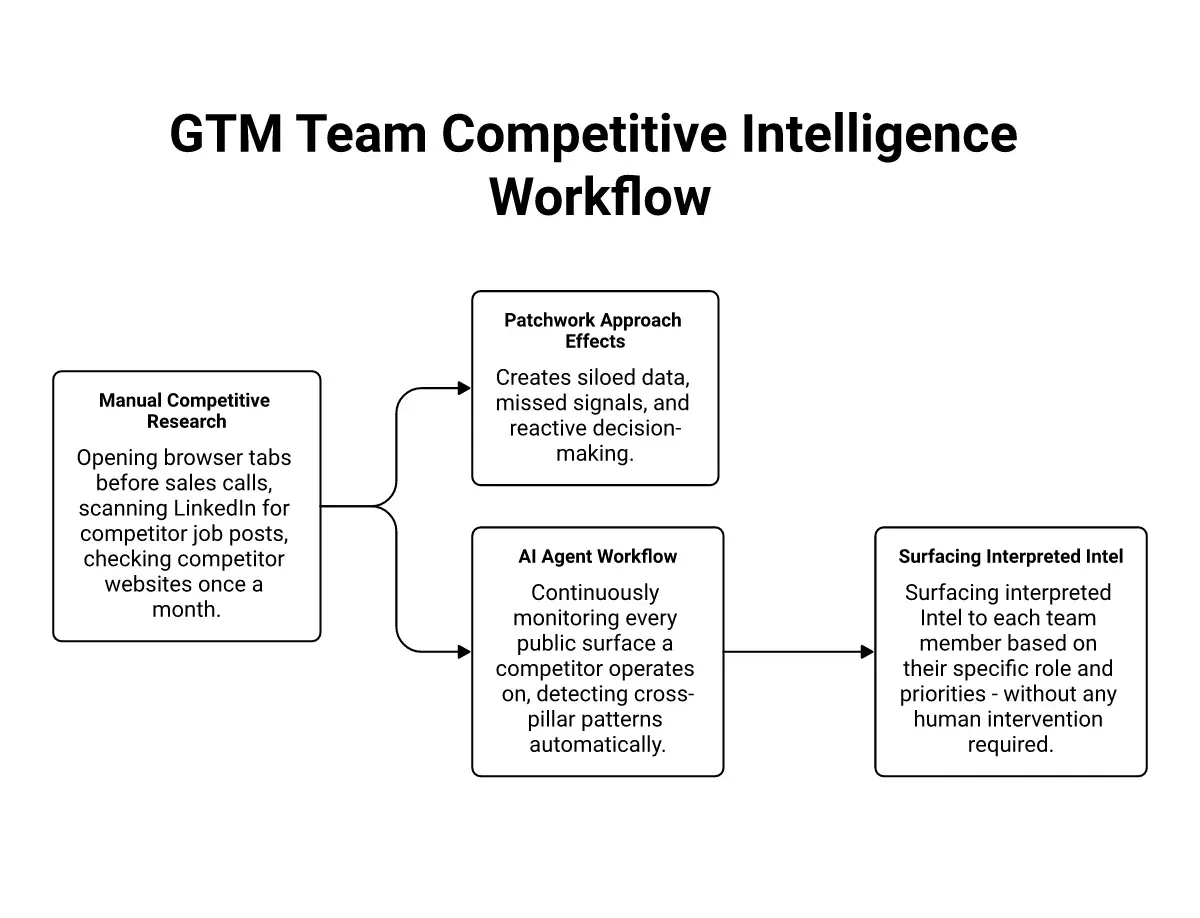
That approach has a name: guesswork dressed up as research. Manual analysis cannot keep pace with the speed at which competitors move in 2026. A pricing page can change overnight. An enterprise hiring push starts six weeks before any product announcement. A new paid campaign signals a market shift before the traffic numbers catch up.
Revenue leaders already feel this. A Gong study analyzing 1.8 million deals found that 81% of revenue leaders say their team's deals are more complex than ever. That complexity comes partly from the fact that buyers do their own research, and that means GTM teams need to know exactly what story those buyers are finding when they research your competitors.
The execution gap is real. In 2026, organizations are increasingly focused on closing the gap between strategy and action, as buyers continue to research and form opinions outside of easily trackable channels. Rocket Intelligence replaces the patchwork of manual research, scattered GTM data, and fragmented data that most teams live with. It watches competitors continuously, detects cross-pillar patterns, and delivers personalized Intel to each person in the revenue organization based on their role and priorities.
The uncomfortable truth: most revenue organizations have invested in AI systems for outreach, for CRM data hygiene, for workflow automation, but they are still researching competitors manually. That is a broken data foundation for any go-to-market strategy. AI-powered execution and automation only work when the data foundation is unified, accurate, and reliable, and that is precisely what a unified GTM data model enables.
Why AI GTM Agents Are Reshaping How Revenue Teams Operate
The rise of AI GTM agents has fundamentally changed what good competitive intelligence looks like. Legacy tools sent email alerts. Modern AI GTM agents continuously monitor, interpret, and surface what matters based on your role and context. They work autonomously, detecting signals across multiple surfaces simultaneously, without manual analysis or static rules.
AI agents are transforming GTM strategies by providing real-time insights into campaign performance, personalizing messages at scale, and automating repetitive tasks, which enhances operational efficiency across the entire revenue organization. Companies are already achieving 25 to 30% increases in revenue-generating activity time through intelligent automation, to reach 70 to 80% revenue-focused work compared to the traditional 20 to 30%. AI-powered tools are expected to deliver an average ROI of 340% within the first 18 months of deployment, significantly enhancing revenue generation capabilities.
Rocket Intelligence operates as an always-on AI GTM agent layer. When you follow a company, AI agents begin tracking every public surface: website, social, news, GTM campaigns, hiring activity, product releases, reviews, traffic patterns, and business signals.
The platform tracks over 150 real-time sources for competitor signals, pricing shifts, and digital footprints, delivering automated prescriptive actions. Each signal is evaluated in context. A pricing page update alone may not be significant. That same update alongside enterprise-focused social posts, five new sales leadership hires, and LinkedIn ads targeting IT decision-makers is a coordinated strategic move. AI agents surface it as a single connected Intel item, not four separate notifications.
The best AI GTM agents also detect absence. When a competitor that posted twice daily goes quiet for two weeks, that silence is a signal. When a regularly updated changelog stops getting entries, something is happening internally. Traditional GTM data tools only report activity. AI agents that watch for absence turn silence into intelligence.
Who is Rocket Intelligence For? The Six GTM Team Types
Rocket Intelligence is built for operators with skin in the game, specifically people whose work changes because of what they learn. The product is designed for six core GTM team types, each getting personalized Intel ranked for their specific context.
| GTM Role | Primary Value | First Signal to Track |
|---|---|---|
| Sales Leader / AE | Competitive deal prep, pricing and positioning awareness | Direct competitor pricing page and GTM campaigns |
| Marketing Leader | Campaign differentiation, messaging gap detection | Competitor homepage, social, and paid GTM |
| Founder / CEO | Strategic early warning, market-wide pattern detection | Top two to three direct competitors, cross-pillar overview |
| Product Leader | Hiring-based build signals, product release monitoring | Competitor People and hiring, Product pillar |
| Customer Success | Retention risk, Intel, competitor feature, and pricing shifts | Competitor reviews, product releases |
| Strategy / Corp Dev | M&A signals, market structure shifts, convergence patterns | Multiple competitors, Business and Finance pillar |
Sales Leaders and AEs: Winning Competitive Deals Before the Call
Sales intelligence is the difference between walking into a call prepared and walking in reactively. Sales leaders leverage real-time market signals to build data-backed rebuttals, handle objections, and prepare tailored playbooks before deals. Most sales teams are reactive today. They find out that a competitor shifted pricing when a prospect mentioned it on the call. They discover a competitor added a new security certification when the prospect asks why you do not have the same one.
HubSpot data shows that only 27% of sales reps consistently hit their quota. Gong's research on 1.8 million deals found that multi-threading boosts win rates by 130% in deals over $50K, but to thread deals effectively, sales teams need current intelligence on every buyer stakeholder's context.
Rocket Intelligence gives sales leaders and AEs a continuous feed of competitor signals: pricing page updates, new certifications, messaging shifts, enterprise hiring activity, all ranked and interpreted for a sales context. Sales teams use the platform to interpret changes in competitor activities, providing concrete talking points during deals. Before every sales call, the Intel is already there. No manual work needed.
"Intelligence is an interpretation layer, not an alerting system. A pricing update alone is data. That same update alongside enterprise hiring and new LinkedIn ads targeting IT leaders is a clear strategic signal." — Rocket.new Documentation
Marketing Leaders and Growth Teams: Campaign Differentiation at the Speed of Competitors
Marketing teams spend enormous resources building campaign messaging, content calendars, and positioning. Most of that work is based on outdated competitive research.
Marketing teams now utilize real-time market signals to generate competitive battlecards and shape messaging based on real-world movements. Real-time competitor tracking allows product marketing teams to continuously monitor competitor website alterations, social media presence, and review trends in one dashboard. When a competitor moves upmarket, adding an enterprise tier, shifting their homepage CTA to "Book a demo," running LinkedIn ads targeting IT decision-makers, marketing teams need to know immediately to protect their marketing spend.
According to HubSpot, 82% of sales professionals say AI helps them gain valuable insights from data, but AI GTM insight for marketing means knowing what competitors are doing in real time, not just what your own data shows.
Rocket Intelligence gives marketing leaders exactly that. The Website Intelligence pillar tracks every homepage change, pricing page update, and messaging pivot. The Social Media pillar monitors what competitors and their executives are posting publicly. The GTM pillar watches paid campaigns, creator partnerships, and SEO activity.
In 2026, the best GTM teams prioritize connection over mere attention, focusing on creating authentic experiences that resonate with buyers and yield better engagement signals. Rocket Intelligence makes that possible by grounding every campaign decision in live competitor data.
Founders and CEOs: Strategic Awareness Before Board Meetings and Key Decisions
Founders and CEOs need competitive awareness at a strategic level. Not every pricing change. Not every social post. The patterns and moves signal where the market is heading months before anyone announces it publicly.
The shift towards a unified go-to-market operating system is becoming essential, as AI reveals dysfunctions in fragmented departmental approaches, prompting leaders to rethink their GTM setup. The ability to unify internal operational data with external market intelligence is a defining characteristic that separates platform leaders from point solutions.
Rocket Intelligence delivers exactly that unified view, with data integration that becomes completely invisible to end users, allowing for seamless access to unified operational data and external market intelligence.
For founders, the People and Hiring pillar is a particularly powerful forward indicator. When a competitor's engineering headcount surges from five open roles to nineteen in two weeks, that signals a major product investment. When a competitor hires a first VP of Customer Success alongside a cluster of enterprise sales roles, that signals an imminent enterprise expansion.
Founders using Rocket Intelligence report arriving at board meetings with a current, cross-pillar competitive picture, not a summary built the night before from five different tools and outdated data sources.
Product Leaders: Knowing What Competitors Are Building Before They Ship It
Product teams have a specific and urgent need: they need to know what competitors are building before it lands in their customers' hands.
Hiring signals are the earliest indicator. A competitor hiring five ML engineers signals a product investment months before any public announcement confirms it. A cluster of new roles in a department that did not exist six months ago is a strategic bet made visible before the product team writes the first PRD.
Rocket Intelligence's People and Hiring pillar is built exactly for this. It tracks open roles by department, posting velocity, and hiring pattern signals. Combined with the Product and Technology pillar, which monitors product releases, changelogs, and technology stack changes, product leaders get a continuous picture of what competitors are building and how fast.
The absence detection capability adds another layer. When a competitor's changelog goes quiet for three weeks, that silence is a signal. AI agents that track absence give product leaders intelligence that pure activity monitoring cannot surface.
Customer Success Teams: Retention Intelligence Before Churn Risk
Customer success gets the shortest shrift in most competitive intelligence setups. Customer success teams find out about competitor moves when a customer mentions them during a QBR, by which point the deal is already at risk.
Rocket Intelligence changes this. Customer success leaders can follow direct competitors and receive Intel that maps directly to churn risk: new feature launches that close gaps your product has, pricing changes that make switching more attractive, and negative review patterns that reveal competitor weaknesses to highlight in renewal conversations.
The Reviews and Community pillar monitors G2, Glassdoor, Capterra, and other review platforms for sentiment shifts over time. When a competitor's G2 rating drops from 4.2 to 3.6 over three months, that is a conversation your CS team should be having with at-risk customers.
Strategy and Corp Dev Teams: Market-Wide Pattern Detection
Strategy leaders and corp dev teams have the most expansive scope. They are tracking multiple companies across an entire market to spot convergence moves, M&A signals, and structural shifts before they become public news.
The Business and Finance pillar tracks funding rounds, partnerships, and revenue signals at the company level. When combined with People and Hiring signals, strategy teams get early visibility into which companies are scaling and which are contracting, months before the press coverage arrives.
How Rocket Intelligence Works Across the GTM Stack
| Pillar | What It Tracks | Primary GTM Users |
|---|---|---|
| Website Intelligence | Homepage, pricing, messaging, blog, legal, tech stack | Marketing, Sales, Product |
| Social Media | Posts, campaigns, and executive activity across all platforms | Marketing, Sales |
| News and Media | Press coverage, partnerships, media mentions | Strategy, Corp Dev, Founders |
| GTM | Paid campaigns, creator partnerships, SEO, and developer marketing | Marketing, Sales |
| Traffic | Visit volumes, top channels, paid share, channel mix | Marketing, Growth |
| Product and Technology | Releases, changelogs, stack changes | Product, Engineering |
| People and Hiring | Headcount, open roles, executive moves, sentiment | Product, Strategy, Sales |
| Business and Finance | Revenue signals, funding announcements, partnerships | Founders, Strategy, Corp Dev |
| Reviews and Community | G2, Capterra, app stores, sentiment trends | Customer Success, Marketing |
| Cross-pillar Overview | Coordinated patterns and strategic signals | All roles |
The GTM Engineer Era and What It Means for Revenue Teams
A new function has emerged since 2023 that is reshaping how revenue organizations are built. GTM engineers are responsible for building automated revenue systems using AI, data enrichment, and workflow automation, which allows for rapid testing and scaling of go-to-market strategies. The role has grown quickly, with roughly 100 GTME job listings appearing each month, indicating growing demand for expertise in optimizing revenue processes.
GTM engineers help organizations identify and fix revenue bottlenecks by automating data hygiene tasks, allowing teams to focus on strategic work and improving overall efficiency in sales and marketing operations. The shift towards GTM engineering is driven by the commoditization of sales tactics and the capabilities of AI, which enable teams to execute creative approaches at scale without the need for extensive manual research.
Rocket Intelligence eliminates manual research by tracking external market dynamics and competitor signals, delivering data-backed strategies for go-to-market teams. In 2026, the most successful revenue teams will focus on closing the execution gap between strategy and action, enabling faster and more effective responses to buyer signals. Rocket Intelligence is the competitive data foundation that makes that possible.
Rocket.new: Where Intelligence Meets GTM Execution
Rocket Intelligence does not exist in isolation. It is one capability inside Rocket.new, the platform where competitive thinking connects directly to GTM execution.
Intelligence and Solve. When Rocket Intelligence surfaces a significant competitor signal, GTM teams can immediately create a Solve task to go deeper, ideal for deal-specific competitive briefs, market entry analysis, or GTM data synthesis.
Intelligence and Build. When the competitive research points to a need, such as a new landing page, a personalized prospect page, or an ROI calculator, Build delivers it in hours without requiring engineering resources.
Compound context. Every task in a Rocket project inherits the shared context of everything the team has done. Intelligence compounds. It does not reset between sessions, team members, or capabilities.
Gong's research shows that selling teams for closed-won deals are 67% larger than those for lost deals. Rocket.new gives the entire revenue organization a single source of competitive intelligence with personalized Intel for each role.
Ready to stop reacting and start anticipating? Start with Rocket.new and follow your first companies to receive personalized competitive Intel in minutes.
Table of contents
- -Who Is Rocket Intelligence For? The GTM Teams Using It in 2026
- -The Problem With How GTM Teams Gather Intelligence Today
- -Why AI GTM Agents Are Reshaping How Revenue Teams Operate
- -Who is Rocket Intelligence For? The Six GTM Team Types
- -Sales Leaders and AEs: Winning Competitive Deals Before the Call
- -Marketing Leaders and Growth Teams: Campaign Differentiation at the Speed of Competitors
- -Founders and CEOs: Strategic Awareness Before Board Meetings and Key Decisions
- -Product Leaders: Knowing What Competitors Are Building Before They Ship It
- -Customer Success Teams: Retention Intelligence Before Churn Risk
- -Strategy and Corp Dev Teams: Market-Wide Pattern Detection
- -How Rocket Intelligence Works Across the GTM Stack
- -The GTM Engineer Era and What It Means for Revenue Teams
- -Rocket.new: Where Intelligence Meets GTM Execution