
Founders who skip the MVP launch plan stage spend months building products nobody wants. Rocket.new gives every founder a faster, lower-cost path from product idea to real users, with built-in market research, full-stack app development, and competitive intelligence in one platform.
The Real Cost of Waiting Too Long to Launch Your MVP
What makes some startups ship their first product in weeks while others spend months building and still never launch?
The answer usually comes down to how founders treat their minimum viable product (MVP) and what tools they pick to build it. According to CB Insights data, 42% of startups fail because they build products nobody wants. That is not a product problem. It is a validation problem. Founders build too much before confirming there is a market. An MVP launch plan is the fix, but only if founders actually ship it fast enough to matter.
The lean startup methodology popularized by Eric Ries exists precisely because of this pattern. Build-measure-learn is not a slogan. It is the only feedback loop that separates startups that survive from those that burn through their runway on features nobody asked for. Most startups fail not because the business idea was wrong, but because the team never gathered real user feedback early enough to correct course.
Why Founders Struggle to Move Fast
Building a startup app the traditional way means navigating agencies, freelancers, and months of back-and-forth before real users ever see the product.
-
Agencies typically quote timelines of four to six months for a standard MVP build, and those timelines often stretch further once development begins.
-
Freelance developers go quiet mid-sprint, creating delays and miscommunication that push the launch date out without warning.
-
Standard MVP development costs run from $10,000 to $150,000, depending on complexity, with post-launch fixes adding another 15 to 25% of the original build cost annually, according to Ideas2IT's 2026 MVP cost breakdown.
-
The global MVP development market was valued at $1.8 billion in 2024 and is projected to reach $3.2 billion by 2030. More startups are launching, but the bottlenecks in traditional app development haven't moved.
-
Every week without real user feedback is a week of guessing, and guessing is expensive when the runway is short.
The traditional development process doesn't just cost money. It costs market position. Founders who move slowly give competitors time to validate the same idea first. Early adopters move on. Investors lose patience. The window to establish a unique value proposition narrows every week the product sits in development.
Many startups that run out of funding do so not because investors lost confidence in the idea, but because the development process burned through the budget before traction was shown. The team spent months building a product that reached real users too late to gather the customer feedback needed to iterate.
What the MVP Development Process Actually Needs
A minimum viable product (MVP) is not a prototype or a design mockup. It is a real, working product with just enough features that early users can interact with and respond to honestly. The goal is validated learning, not a polished release.
A successful MVP launch plan has five non-negotiable elements:
-
A core problem the product solves, stated in one clear sentence, the whole team agrees on before a single feature gets built.
-
A focused first version that includes only the must-have features for the initial release, with nothing added based on assumptions.
-
A development process fast enough to ship before the budget runs out or the market moves.
-
A clean user journey from first login to core value, without unnecessary steps or confusion.
-
A real feedback loop that collects data from early users after launch, so decisions are based on evidence and not guesses.
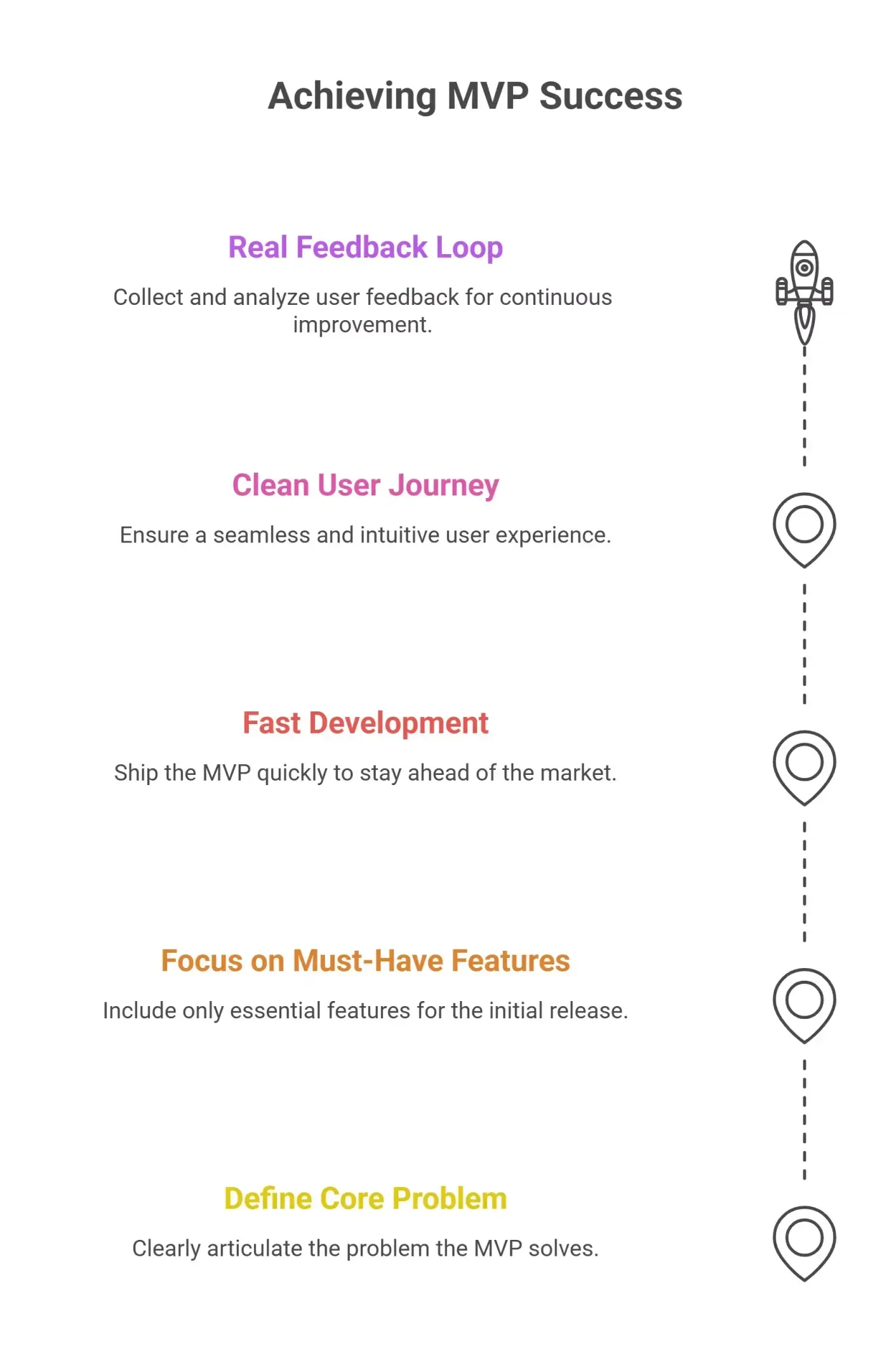 Skipping any of these steps, especially the last one, is how startup MVPs turn into expensive lessons. The plan matters as much as the product idea. Lean startup methodology demands validated learning at every stage, not just at launch. The most basic version of a product that can gather real world feedback is always more valuable than a complete product that launches too late.
Core Features First: The Full Product Can Wait
The most successful startup MVPs launched with fewer resources than founders thought was necessary, and that restraint is exactly what made them work.
-
Instagram's first version let users share photos with basic filters, with no DMs, no Reels, no Stories, and it attracted millions of early users before any of those features existed.
-
Dropbox validated customer demand with a two-minute explainer video before writing a single line of backend logic, generating 75,000 signups in one night. This is a classic example of validating market demand before building the full product.
-
Airbnb started as a basic landing page where founders managed reservations manually in the early stages while testing whether the idea had real demand.
-
Every one of these products followed the same path: ship the focused first version, get to real users fast, and add new features based on what real feedback asks for rather than what the founders assumed.
Too many features at the early stages raise development costs, slow the team, and dilute the unique value proposition. Feature bloat is one of the most common reasons a successful MVP turns into an overbuilt product that confuses its target audience. The goal of the first version is to validate the core idea, not to build the full product. Avoid feature bloat by shipping only the core user flows that deliver the core value proposition.
Common Mistakes That Kill Startup MVPs Before Launch
Building Too Much Before Talking to Real Users
Spending months in development before reaching real users is the single most expensive mistake founders make in MVP app development.
-
Founders build features nobody asked for because assumptions go untested, and each unvalidated feature adds cost and development time with no guaranteed return.
-
Real money disappears into functionality that real users will never touch, leaving the budget thin before the product has collected a single piece of useful feedback.
-
By launch day, the overbuilt app reaches users with no budget left to fix what the feedback actually surfaces.
-
Without real data from real users, the next round of product decisions is just as likely to miss the mark as the ones that got the team there.
A shorter development cycle with a working product, even a rough one, gets founders to real user feedback faster than a polished app that launches six months too late. Speed to feedback is the actual success metric at the early stages. The primary goal is to gather feedback, analyze feedback, and iterate based on what early customers actually need, not what the product team assumed they would need.
The Cost Trap in MVP Development
Development costs are one of the most serious risks for early startups. Without tight scope control, even simple projects run over budget before a single user signs up.
| MVP Type | Typical Cost Range | Development Timeline |
|---|---|---|
| Simple web or mobile app | $10,000 - $30,000 | 4-8 weeks |
| Medium complexity (SaaS, B2B) | $30,000 - $75,000 | 8-14 weeks |
| Complex (AI features, marketplace MVP) | $75,000 - $150,000+ | 14-24 weeks |
| AI platform build (e.g. Rocket.new) | Fraction of above | Days to weeks |
Source: Ideas2IT MVP Development Cost Guide, 2026
Startups that exhaust the budget before collecting real feedback rarely find a way back. The development approach matters as much as the product idea, and picking the wrong one burns both money and time before any customers are won. MVP development cost is not just a budget question. It is a strategy question. The team that spends the least to validate demand has the most runway left to build what the market actually wants. For a full cost breakdown, read how much it costs to develop an app.
The MVP Development Path Most Founders Miss
App Development Without a Technical Lead
Non-technical founders and technical founders face different speed problems in MVP app development, but both end up slower than the market demands.
-
Non-technical founders depend entirely on agencies or freelancers to build the app, which creates delays, miscommunication, and a steady loss of control over the product vision and roadmap.
-
Technical founders who build in-house manage backend logic, mobile app builds, QA cycles, and deployment, all of which eat weeks per iteration, even with a solid team in place.
-
Building for iOS and Android at the same time doubles development costs before any early users have validated the core idea on a single platform.
-
Waiting for a technical lead to make architecture decisions stalls the product in the early stages for weeks before a single feature is shipped.
-
Many startups that run out of funding do so not because investors lost confidence in the idea, but because the development process burned through the budget before traction was shown.
AI-powered platforms have changed what is possible here. Founders can move from product idea to a deployable app in a fraction of the time that custom development requires, with no technical lead needed to get started. Non-technical founders can now build software products that were previously out of reach. The early-stage startup no longer needs a full engineering team to ship a working minimum viable product MVP to initial users.
From Product Vision to Mobile Apps: Without the Wait
Backend logic is where most MVP timelines quietly fall apart, and where most early founders overbuild without realizing it until the budget is already gone.
-
User authentication, data storage, permissions, and API connections are standard in most products, but each one takes significant development time when built from scratch by a custom team.
-
Most startups overbuild the backend by designing for scale before they have traction, adding complexity that slows the development process and pushes the launch date further out for no user-facing gain.
-
The smarter path is a platform that handles backend logic out of the box, so founders stay focused on core features and user journey instead of making infrastructure decisions they are not ready to validate yet.
-
Continuous development from product idea to launch only becomes realistic when the technology stack does not need to be assembled from zero, and when each iteration does not require a full re-briefing of the development team.
The product roadmap should be driven by what potential users need, not by what the technology stack makes easy to build. When the platform handles the infrastructure, founders can focus entirely on the user journey and the core value that makes the product worth using.
Launching Fast with Rocket.new: One System for the Whole Plan
Rocket.new is the world's first Vibe Solutioning platform, built for founders who want to move from product idea to real users without losing weeks to setup, re-explaining, or waiting on developers to get started.
-
Over 1.5 million people across 180 countries have used Rocket.new, including solo founders, product teams, engineering leads, and consultants running startup MVPs at every stage.
-
Solve handles market research and decision-making before the build starts, so founders know what to build and why before writing a single prompt.
-
Build takes the research brief straight into production-grade app development with no re-explaining, no lost context, and no starting over from a blank page.
-
Intelligence watches pricing pages, hiring moves, ad campaigns, and product signals across every company the founder follows and interprets what each change means for the team specifically, not just that it happened.
One system. One shared context. Every decision the founder makes in research flows directly into the build and into the post-launch strategy. The competitive landscape shifts constantly after launch, and Rocket.new Intelligence ensures the product team always knows what direct and indirect competitors are doing before it affects market positioning.
Learn more about the vibe solutioning platform that powers this workflow.
Built for Technical and Non-Technical Founders
Most no-code platforms make real tradeoffs: fast to start, but limited when the product needs real backend logic, custom user permissions, or workflows that go beyond a basic interface.
-
Rocket.new handles the full stack from the first prompt. Web apps, mobile apps, SaaS dashboards, and internal tools all include backend logic, user authentication, and data handling without extra configuration.
-
Non-technical founders get a real, deployable product, not a mockup or a low-code workaround that breaks the moment real users stress-test it.
-
Technical founders own the full codebase and can access, export, and extend everything the platform generates, with no lock-in and no loss of control.
-
No technical lead is required to get the first version of the product live, which removes the biggest delay most non-technical founders run into at the early stages.
-
Investors increasingly want to see a working product before committing to funding, and Rocket.new shortens the time between a product idea and something investors can actually click through.
Rocket.new makes that cycle faster than any other platform available today. For a comparison of how Rocket.new stacks up against other tools, read best AI MVP builders for startups.
How Rocket.new Maps to the MVP Launch Plan
The development process shifts from a series of slow, disconnected stages to a single connected flow when Rocket.new handles the build.
Each stage that would normally require separate tools, separate teams, or a dedicated technical lead runs inside one platform, with context carried from research into build and into post-launch monitoring.
What Rocket.new Offers for MVP Development
-
Prompt-to-app build - Describe the product idea and get a working full-stack app ready to deploy, without writing code or briefing a development team.
-
Built-in market research - Research the core problem and the competition before the first feature gets prioritized, so the product vision is grounded in real data.
-
Mobile app and web app support - Build across platforms without doubling development time, cost, or the complexity of managing two separate codebases.
-
Full backend included - User authentication, data storage, permissions, and business logic are handled from the first prompt, with no separate backend developer needed.
-
One-click deploy - Ship to staging and production without setting up separate infrastructure or managing cloud configurations.
-
25,000+ templates - Starting points for every use case, adapted to the team's context, brand, and technology stack.
-
Continuous competitor tracking - Monitor what competitors change after the MVP ships so the product roadmap always reflects what is happening in the market.
-
Role-shaped intelligence - Intelligence doesn't just collect signals. It asks why the founder is watching each company and delivers briefs shaped by that context, so what a product lead sees and what a sales lead sees from the same company is never the same brief.
-
Code ownership - Technical founders can access, export, and extend the full codebase at any point. The platform generates real code, not a proprietary black box.
No other platform connects market research, app development, and competitive intelligence in a single product with one shared context that carries through every stage. This is a significant advantage for any early-stage startup trying to validate a business idea and reach product-market fit before the runway runs out.
Rocket.new vs Other MVP Development Options
Choosing the right platform for MVP development shapes how fast the team ships, how much the build costs, and how much control the founder keeps once the product is in front of real users.
| Capability | Rocket.new | Bubble | Webflow | Custom Dev |
|---|---|---|---|---|
| Market research built in | Yes | No | No | No |
| Full-stack app generation | Yes | Partial | No | Yes |
| Mobile apps supported | Yes | Limited | No | Yes |
| Competitor tracking | Yes | No | No | No |
| Code ownership | Yes | No | Limited | Yes |
| Time to first launch | Days | Weeks | Weeks | Months |
| Development cost | Low | Medium | Medium | High |
See the full Rocket.new vs Bolt.new comparison and Rocket.new vs Lovable for more context.
Every Founder Needs a Faster Path to Real Users
Startups often fail not because the idea is wrong, but because they build too much before validating it or move too slowly to reach the market in time.
The real goal of an MVP is validated learning, not a finished product.
Using Rocket.new helps teams ship faster, reduce build time, and focus on early users instead of long development cycles. Non-technical founders get a working product, while technical teams keep control and move faster, both reaching real feedback sooner.
Ready to build your minimum viable product (MVP) the right way? Start building on Rocket.new today and go from idea to live product faster than any traditional development path allows.
Table of contents
- -The Real Cost of Waiting Too Long to Launch Your MVP
- -Why Founders Struggle to Move Fast
- -What the MVP Development Process Actually Needs
- -Core Features First: The Full Product Can Wait
- -Common Mistakes That Kill Startup MVPs Before Launch
- -Building Too Much Before Talking to Real Users
- -The Cost Trap in MVP Development
- -The MVP Development Path Most Founders Miss
- -App Development Without a Technical Lead
- -From Product Vision to Mobile Apps: Without the Wait
- -Launching Fast with Rocket.new: One System for the Whole Plan
- -Built for Technical and Non-Technical Founders
- -How Rocket.new Maps to the MVP Launch Plan
- -What Rocket.new Offers for MVP Development
- -Rocket.new vs Other MVP Development Options
- -Every Founder Needs a Faster Path to Real Users