A practical guide for non-technical founders on how to prioritize MVP features using proven frameworks like MoSCoW, RICE, and the Kano model. Covers how to build a lean feature list, gather early feedback, and use Rocket.new Intelligence to validate decisions against real market signals.
What if the reason your product fails has nothing to do with your idea?
For most non-technical founders, the biggest risk is not building. It is building the wrong things. A 2024 GoodFirms survey of 680 businesses found that 42% of startups still fail because no one wants what they built. MVP feature prioritization is how you change those odds.
It is the process of deciding which features belong in your first version and which ones wait, and it does not require a single line of code to get right.
What is MVP Feature Prioritization?
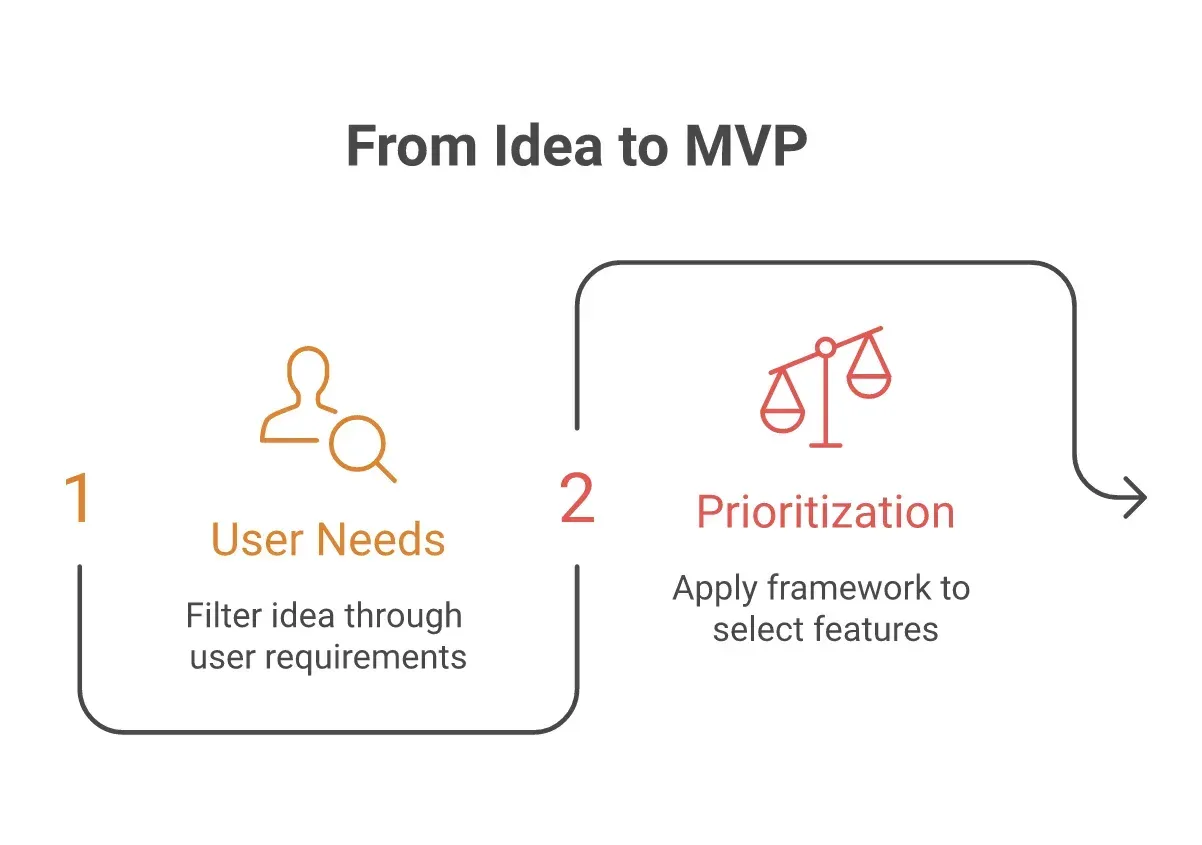
A minimum viable product is a strategic starting point, not a stripped-down finished product. MVP feature prioritization is the discipline of deciding what the starting point actually contains.
-
MVP feature prioritization is the process of choosing which features your first version must have to solve the core problem for real users, and ruling out everything else.
-
The goal of your MVP features is not to impress anyone. It is to generate real user data as fast as possible.
-
Every feature on your MVP feature list carries a direct cost: development time, testing hours, and budget.
-
Good feature prioritization cuts scope creep before your MVP development even begins, protecting your runway and your timeline.
-
A minimum viable product with three to five focused features gives you something testable and shippable, not something perfect.
-
Non-technical founders often confuse having more features with having a better product. The data consistently says the opposite.
-
MVP feature prioritization is also a communication tool: a clear, prioritized feature list tells your development team exactly what to build and exactly why.
Treat your feature list as a decision tool rather than a wish list, and your MVP development process stays focused from day one.
The Core Problem Most Non-Technical Founders Face
Feature decisions feel personal when it is your idea on the line. That emotional attachment is where most MVP feature prioritization breaks down.
Founders building in isolation for six or more months see an 11% success rate, compared to 67% for founders who launched in six weeks and gathered user feedback early. (Source: r/SaaS analysis of 50+ startups)
-
Failed MVPs averaged 23 features at launch. Successful MVPs averaged just 3.
-
Without proper feature prioritization, most teams spend an average of $73,000 before they get their first customer.
-
The core problem is not a shortage of ideas. It is the absence of a filter to separate must-have features from nice-to-have ones.
-
Non-technical founders often cannot evaluate development complexity, which means they cannot push back when a developer says a simple feature will take three weeks.
-
Scope creep is the most common budget killer in MVP development. Every small addition delays your initial launch and raises your burn rate.
-
Building features based on assumptions rather than user needs leads to a product that never actually addresses the real pain points users care about.
"Founders spend months or even years developing features that never get used. They overthink and overbuild, resulting in a product that nobody uses." - Rohan Mishra, LinkedIn
The solution is not fewer ideas. It is a clear framework for deciding which ideas make it into your MVP features and which ones wait for a future release.
The Lean Startup Methodology Behind MVP Feature Prioritization
The lean startup methodology is the clearest foundation for MVP feature prioritization, and understanding it changes how you approach every feature decision you make.
-
The lean startup methodology is built around a core business hypothesis: you believe users have a specific problem, and you believe your product solves it.
-
Before you build everything, you test that hypothesis with a minimum viable product, and MVP feature prioritization is how you decide what goes into that test.
-
The build-measure-learn loop at the heart of lean startup methodology puts user feedback ahead of every other input.
-
Your first version does not need to be the best. It needs to produce real user data quickly enough to guide your next version.
-
User story mapping, a technique tied to lean thinking, helps non-technical founders trace every feature back to a real user journey and a real pain point.
-
Lean startup methodology protects you from building features based on imagination rather than evidence from real users.
-
Business goals and user needs must both be visible when you make prioritization decisions. One without the other creates a product that either users love, but you cannot monetize, or one that generates revenue but drives early users away.
Lean startup methodology is not a startup buzzword. It is the reason MVP feature prioritization exists, and it gives non-technical founders a repeatable process for making confident product decisions without needing a technical background.
MVP Feature Prioritization Frameworks That Work Without Technical Knowledge
Non-technical founders do not need to understand code to make sharp feature prioritization decisions, but they do need a framework. Here are the three most widely used ones.
The MoSCoW Method
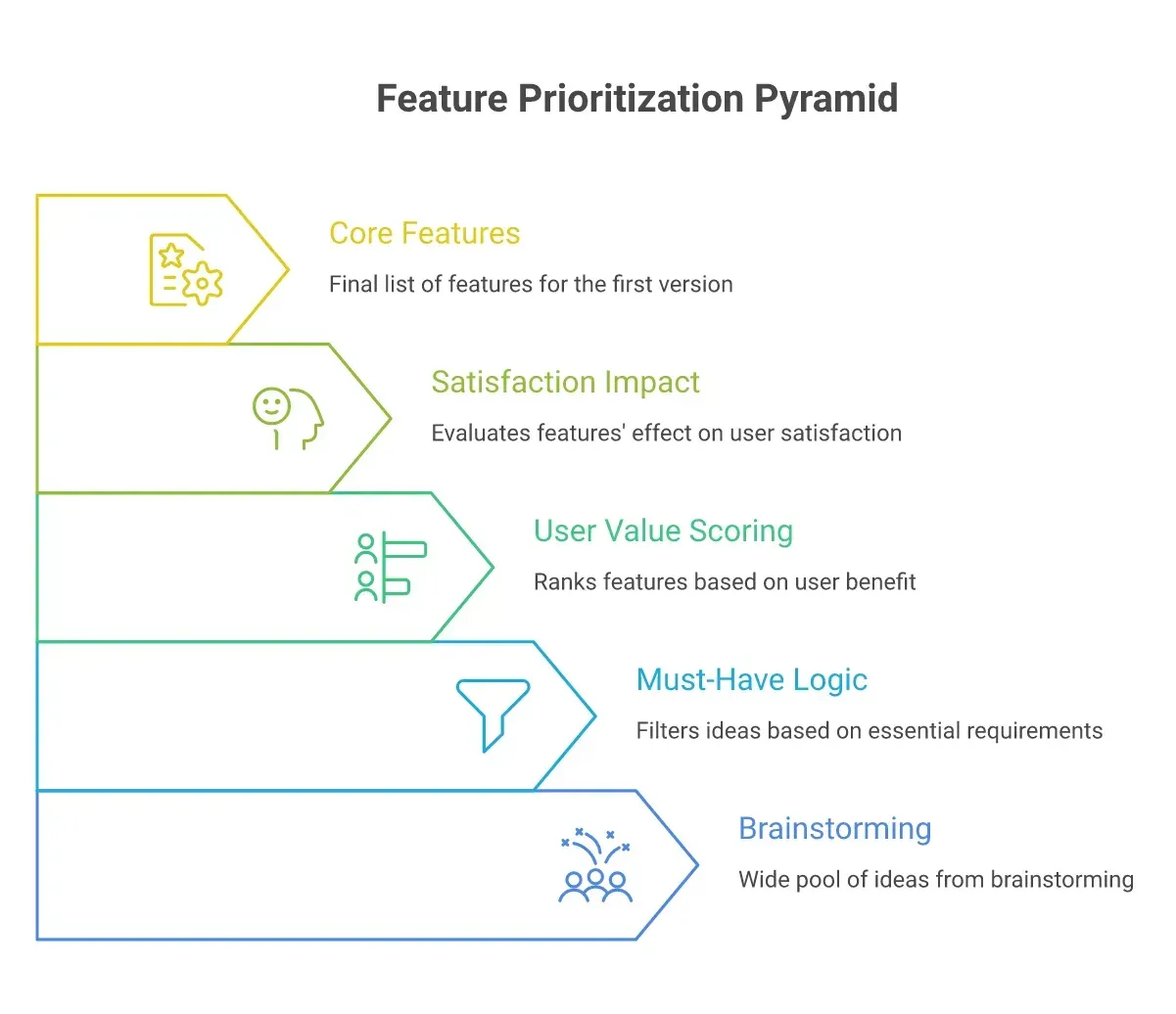
The MoSCoW method divides your full feature list into four categories, giving you a clear MVP prioritization matrix that even a first-time founder can apply in an afternoon.
-
Must have - Features without which the product cannot function at all. These are the non-negotiable core features. If a feature is not a must-have, it does not ship in version one, full stop.
-
Should have - Features that are important but not launch-blocking. They should have a home in your product roadmap, just not in your initial release alongside the core features.
-
Could have - Nice-to-have additions that would improve user satisfaction but are not tied to your core value proposition. These could have a place in a future release, only if time permits after must-have and should-have features are complete.
-
Won't have - Features explicitly ruled out of this version. Writing this list is just as important as writing your must-have list, as it prevents scope creep before it starts.
-
Running your entire feature list through MoSCoW forces a decision on every item rather than leaving features in a vague holding pattern.
-
Most founders discover that features they assumed were must-haves are actually should-haves or could-haves once they apply this filter honestly.
-
Running user interviews before applying MoSCoW gives your categorization a real user foundation rather than founder assumptions.
The MoSCoW method does not require technical knowledge. It requires honesty about what your core value proposition actually is and what user needs you are solving on day one.
The RICE Scoring Model
The RICE scoring model ranks features using four measurable factors, giving non-technical founders a data-driven way to justify their feature priorities to developers, co-founders, and investors.
-
Reach - How many users will this feature affect within a given time period? Expressed as a number of real users.
-
Impact - How significantly will it improve user satisfaction or change user behavior for those users? Scored on a scale of 0.25 to 3.
-
Confidence - How sure are you about your Reach and Impact estimates, based on real user data? Expressed as a percentage.
-
Effort - How many person-weeks of development effort does building this feature require? Comes from your development team.
-
The RICE score formula is: (Reach x Impact x Confidence) / Effort. Higher scores go first on your MVP feature list.
-
The RICE scoring model removes gut-feel from feature prioritization and replaces it with a number you can defend.
-
When two features seem equally important to your business goals, RICE scoring reveals which one delivers more user value per unit of development effort.
-
Running the model after your first round of user interviews gives your confidence scores a real foundation rather than a guess.
The RICE scoring model is best applied after you have at least some user data, because even a handful of user interviews changes the quality of your estimates significantly.
The Kano Model
The Kano model categorizes features by how they affect user satisfaction, and it reveals something most founders do not expect: not all features deliver equal value to the people using your product.
-
Basic features (Must-be quality) - Features users expect without asking. If missing, users are disappointed immediately. If present, users barely notice. A working login screen or a functioning search bar are basic features for most products.
-
Performance features - Features where more is always better. Speed, reliability, and accuracy fall here. The Kano model shows that improving these directly and proportionally increases user satisfaction.
-
Excitement features (Delighters) - Features users did not ask for but love when they discover them. These are the ones that generate word-of-mouth from early adopters and drive organic growth.
-
The Kano model shows that over-investing in basic features will not increase user satisfaction. It will only prevent dissatisfaction.
-
For MVP development, the Kano model gives clear direction: get basic features right first, layer in performance features, and save excitement features for later versions when you have validated your core.
-
Running a short customer survey through a Kano lens helps you gather feedback that directly shapes your MVP feature prioritization decisions.
-
The Kano model is particularly useful for closing the gap between what you think users want and what they actually want.
-
Combining the Kano model with the MoSCoW method gives you a more complete MVP prioritization matrix than either framework alone.
The Kano model is a reality check. It tells you which features will make users stay and which ones are consuming development time without moving user satisfaction.
Framework Comparison: Choosing the Right MVP Prioritization Tool
| Framework | Best For | Key Question | Effort to Apply |
|---|---|---|---|
| MoSCoW Method | Categorizing your full feature list | Does this ship in version one? | Low |
| RICE Scoring Model | Ranking features by potential value | What score does this feature earn? | Medium |
| Kano Model | Understanding user satisfaction impact | Does this delight or just satisfy? | Medium |
| User Story Mapping | Mapping features to the user journey | Does this fit the real user flow? | Medium |
How to Build Your MVP Feature List Step by Step
Your MVP feature list is a document before it is a product. Getting it right before you brief a developer saves weeks of rework and thousands of dollars in misdirected development effort.
-
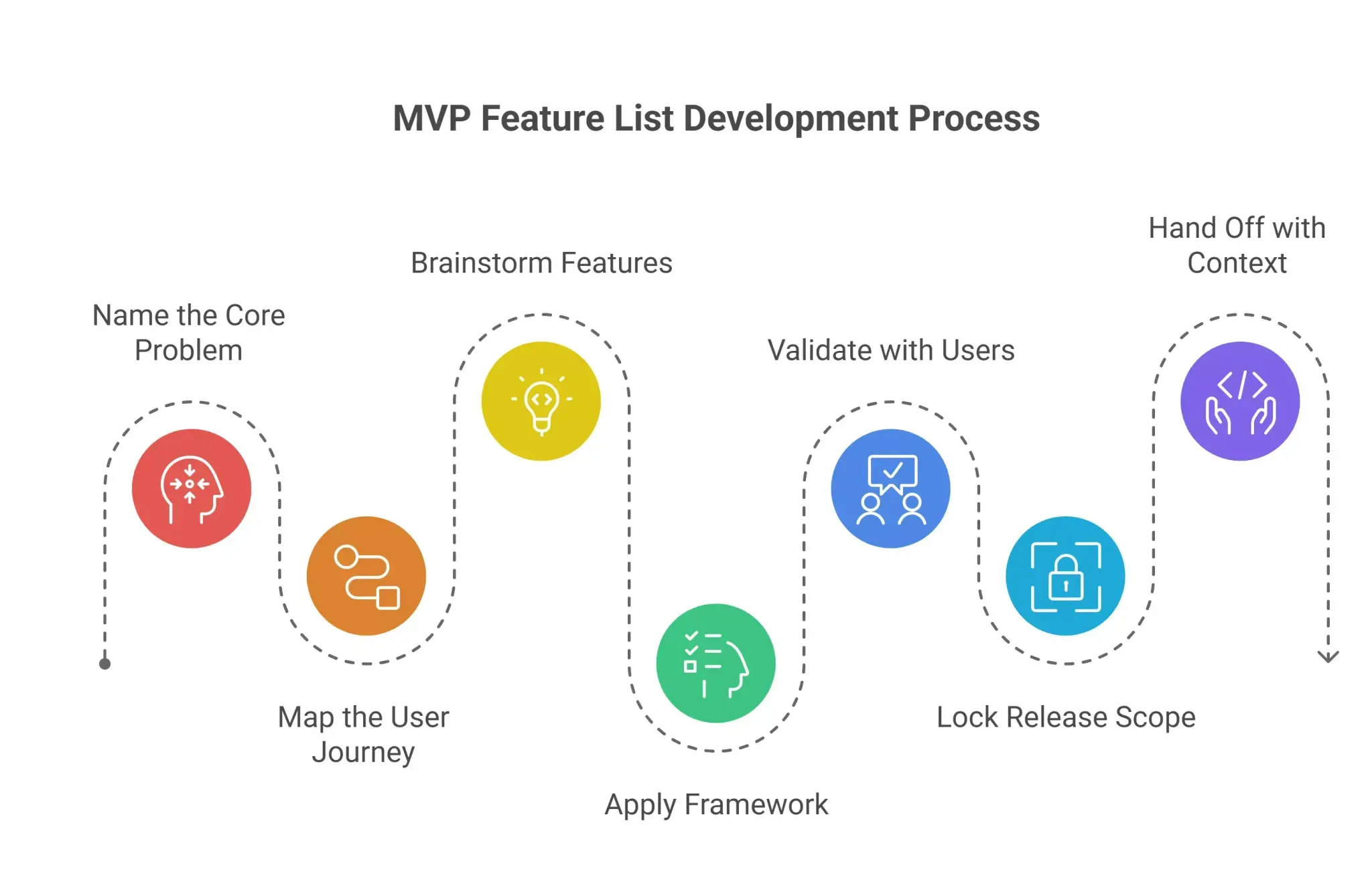
Step 1: Name the core problem. Write one sentence describing the specific pain point your product solves. All MVP feature prioritization starts here, and every item on your feature list should trace back to this sentence.
-
Step 2: Map the user journey. Trace the path your target audience takes from experiencing the pain point to finding a solution. User story mapping at this stage shows which features belong in the natural flow and which ones are tangents.
-
Step 3: Brainstorm without filtering. Write every possible feature down, no matter how small or speculative. Do not evaluate yet. Capture everything first, then prioritize.
-
Step 4: Apply your chosen framework. Run your full feature list through MoSCoW, RICE, or the Kano model. Let the framework, not your gut, determine which MVP features make the cut.
-
Step 5: Validate with real users. Share your prioritized feature list with five to ten potential users before writing a single developer brief. User interviews and customer surveys at this stage prevent you from building features nobody asked for.
-
Step 6: Lock your initial release scope. Commit only to must-have features. Everything else goes on a clearly labeled future release list, where it stays until you have real user data to justify adding it.
-
Step 7: Hand off with context. A clear, prioritized MVP feature list tied to user needs gives your development team what they need to give you an honest timeline, a realistic budget estimate, and early warnings about technical risk.
A step-by-step feature list process turns MVP development from a guessing game into a structured discipline that produces better products in less time.
How Many Features Does Your MVP Actually Need?
This is the most common question from non-technical founders, and the answer is almost always fewer than you think.
-
Research tracking 50+ startups found that successful MVPs average just three core features at launch. Failed ones averaged 23.
-
Each feature you add multiplies your testing time, raises the chances of something breaking, and pushes your launch date further out.
-
A minimum viable product with three to five must-have features is enough to validate your core business hypothesis with real users in most markets.
-
Too many features muddy your user feedback. You cannot tell which part of the product users love or find frustrating when everything launches at once.
-
The number of features in your initial release should be determined by what is necessary to deliver your core value, and nothing else qualifies.
-
Fewer features means a faster time-to-market, which means real user feedback sooner and less cash burned before you have validated a single assumption.
-
Basic features done right consistently beat a larger number of performance features done halfway. User satisfaction tracks quality, not quantity.
When you are unsure whether a feature belongs in your MVP, leave it out. You can always add features in the next version based on real user feedback from early adopters.
Gathering Early Feedback to Refine Your Feature Priorities
Early feedback is not a bonus in MVP development. It is the entire reason you build a minimum viable product before committing to a full product.
-
Run structured user interviews with your early users and ask about pain points specifically. Open-ended questions about features give you opinions. Questions about pain points give you priorities.
-
Use user surveys to gather feedback at scale once you have a small base of real users interacting with your product regularly.
-
Watch user behavior through analytics before making any feature decisions. What users do with your product is often very different from what they say they want.
-
Prioritize features based on patterns in feedback, not single requests from individual users. One person asking for a feature is a data point. Five people asking for the same feature is a signal.
-
Customer requests that repeat across multiple users should move directly to the top of your next MVP feature list.
-
Early feedback also reveals which features users expect as basic quality versus which ones genuinely delight them, and this maps cleanly onto your Kano model analysis.
-
Avoid adding features before you understand what early users think of your current version. New features added too soon create noise that makes it harder to read existing user behavior.
-
Gather feedback in a continuous loop, not just at launch. User needs and user expectations both change as people spend more time with your product.
The faster you gather real user feedback, the faster your MVP feature prioritization shifts from informed guesswork to genuine, data-backed insight. Use a structured market research approach to turn those signals into confident product decisions.
Know What to Build Before You Build It With Rocket.new
Most intelligence tools start with data and hope you figure out what it means. Rocket.new starts with you.
For non-technical founders making MVP feature prioritization decisions, the hardest part is not applying a framework. It is knowing what your market actually looks like before you commit to a feature list. What are competitors already building? What are their users complaining about? Where are they investing next? That intelligence is what separates a feature list built on assumptions from one built on evidence.
Rocket.new's Intelligence product is a personalized, always-on intelligence engine that continuously monitors companies across nine signal pillars and delivers insights shaped by your role and your purpose for watching each company. The same signal means something entirely different to a founder deciding what to build versus a marketer deciding how to position. Rocket.new knows who you are and why you are watching, and the brief you get reflects that.
Here is what Rocket.new watches that directly shape smarter MVP feature prioritization:
-
Website Intelligence - Every change to a competitor's homepage, pricing page, product pages, and feature descriptions is captured. When a competitor quietly removes a feature, that feature is losing traction. When they add new product language, they are repositioning. These are the signals that tell you what the market is moving away from and what it is moving toward.
-
Product and Technology signals - Releases, new feature announcements, API changes, and engineering velocity are tracked continuously. What competitors shipped in the last 90 days tells you what they decided was worth building. That is your competitive baseline before you finalize your own MVP feature list.
-
People and Hiring - Before a competitor ships their next feature, they hire for it. Rocket.new tracks every role, every department surge, and every executive hire, and tells you what the pattern signals. This is the most honest thing a company publishes, and most founders never think to read it.
-
Reviews and Community - G2, Trustpilot, Reddit, App Store, HackerNews, Product Hunt. Competitor users leave unfiltered, unmanaged feedback every day. The pain points real users describe in competitor reviews are the gaps your MVP feature list should be built to fill.
-
GTM signals - Live ad campaigns, creator and influencer activity, content marketing moves, and PR strategy. What a competitor is promoting right now tells you what they are betting on, which informs which features in your own list carry real market demand.
-
Social Media - Posts, patterns, engagement anomalies, and executive activity across X, LinkedIn, TikTok, Instagram, Facebook, YouTube, and Reddit. The strategy underneath the posts is visible to anyone who knows how to read it.
Where generic competitive intelligence falls short for non-technical founders:
-
Manual monitoring means you only catch what you happen to check on a given day. Rocket.new catches everything, every day, across every signal source simultaneously.
-
Generic tools surface raw data and leave interpretation to you. Rocket.new interprets what signals mean for your specific role and the companies you are following, not just what changed.
-
Most founders do competitor research once, before building. Rocket.new runs continuously, so your feature priorities can evolve as the market evolves, not just at the start.
-
A weekly newsletter or one-off search cannot show you the pattern between a competitor's pricing change, their hiring surge, and their defensive G2 responses. Rocket.new reads signal clusters and connects them into a single, clear strategic picture.
Rocket.new Intelligence is free to search with no login required. Go to Rocket.new, search any company in your category, and the full company canvas loads immediately with pillar summaries, significant signals, confidence ratings, and interpreted intelligence. That is your market research baseline before your first feature decision is made. See exactly what Rocket.new catches before your bi-weekly analyst brief arrives.
Get Your MVP Feature Prioritization Right From Day One
Building the right product starts with saying no to the wrong features. MVP feature prioritization for non-technical founders is not a technical skill. It is a strategic one that any founder can apply with the right framework and the right data.
The pattern is consistent: startups that ship fewer, better-chosen features get user feedback faster, spend less money, and reach their business goals sooner. The founders who succeed are not the ones who build the most. They are the ones who build the right things first and let real users guide everything after that.
Pick the core problem. Build your MVP feature list around real user needs. Apply MoSCoW, RICE, or the Kano model to filter ruthlessly. Ship your minimum viable product. Gather early feedback. Iterate. That cycle, not perfection, is what turns a good idea into a product people actually pay for.
Ready to build your MVP the right way? Start building on Rocket.new today and go from a validated feature list to a live product faster than you thought possible.
Table of contents
- -What is MVP Feature Prioritization?
- -The Core Problem Most Non-Technical Founders Face
- -The Lean Startup Methodology Behind MVP Feature Prioritization
- -MVP Feature Prioritization Frameworks That Work Without Technical Knowledge
- -The MoSCoW Method
- -The RICE Scoring Model
- -The Kano Model
- -Framework Comparison: Choosing the Right MVP Prioritization Tool
- -How to Build Your MVP Feature List Step by Step
- -How Many Features Does Your MVP Actually Need?
- -Gathering Early Feedback to Refine Your Feature Priorities
- -Know What to Build Before You Build It With Rocket.new
- -Get Your MVP Feature Prioritization Right From Day One