
Rocket.new improves its understanding of your market through accumulated workspace memory, machine learning, and continuous intelligence tracking. Every Solve report, Build workflow, and competitor signal strengthens future analytics, helping teams generate more accurate reports, faster product decisions, and smarter long-term strategy.
What Makes an AI Platform Smarter Over Time?
How does a platform actually get better at understanding your market the longer you use it? The answer comes down to data accumulation, machine learning, and shared memory that compounds across every interaction.
According to Stanford's 2026 AI Index, 88% of organizations across 105 countries now regularly use AI in at least one business function. Global corporate AI investment reached $581.7 billion in 2025.
That scale of adoption produces a clear pattern: AI platforms that retain history and learn from repeated use generate sharper analytics over time.
-
Rocket.new is built around this principle
-
Every Solve report, every build, every intelligence signal feeds one shared workspace
-
The system remembers what your teams have done and what matters to your market
How Data Compounds Inside Rocket
Why More Data Leads to Better Analytics
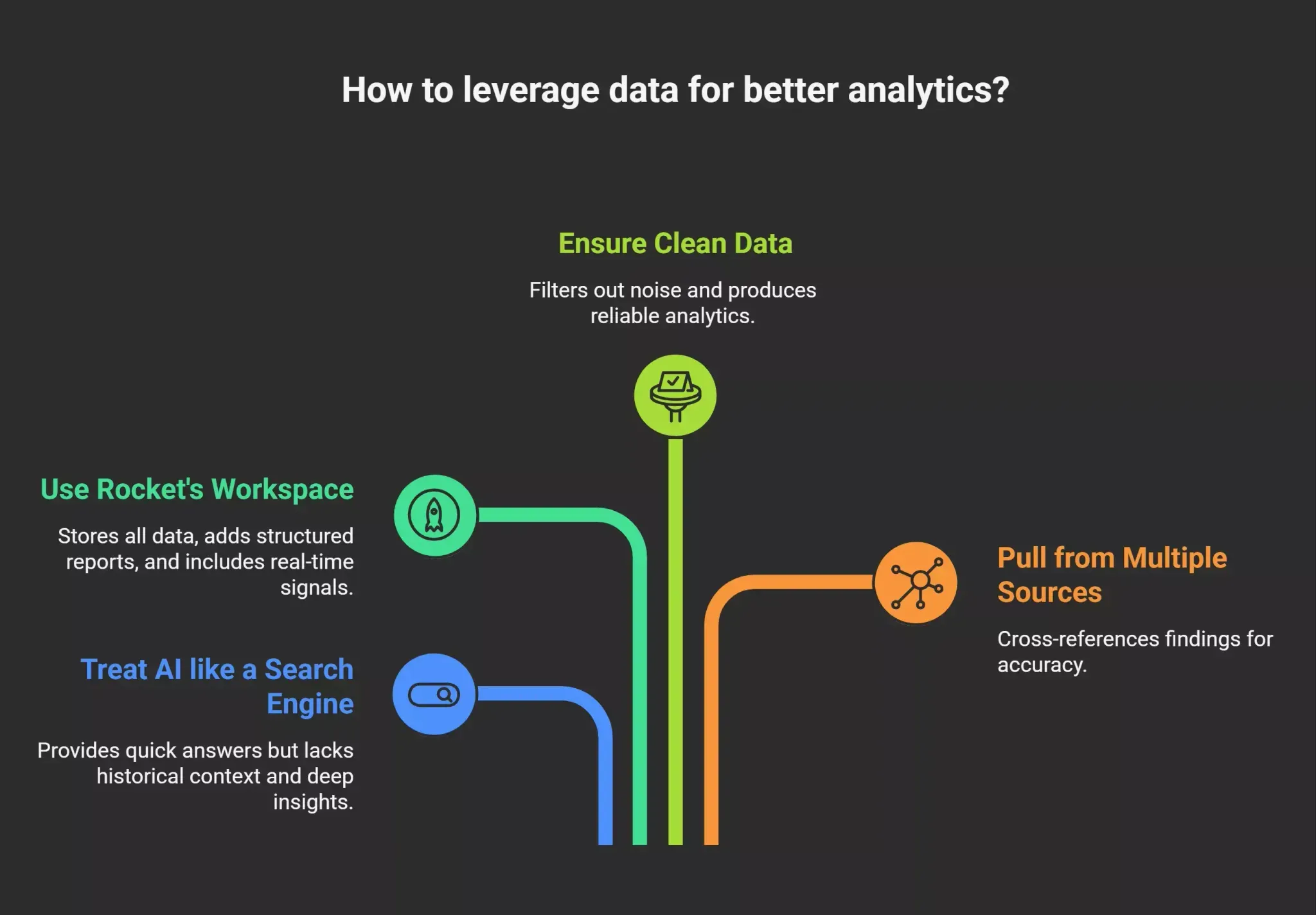
Most businesses treat AI tools like search engines. They ask a question, get an answer, and move on.
Rocket takes a different approach. It stores all previous signals, findings, and decisions in one workspace.
-
Each Solve report adds structured data to the project
-
Each Build task adds product architecture and code
-
Each Intelligence signal adds real-time competitor movements to a growing dataset
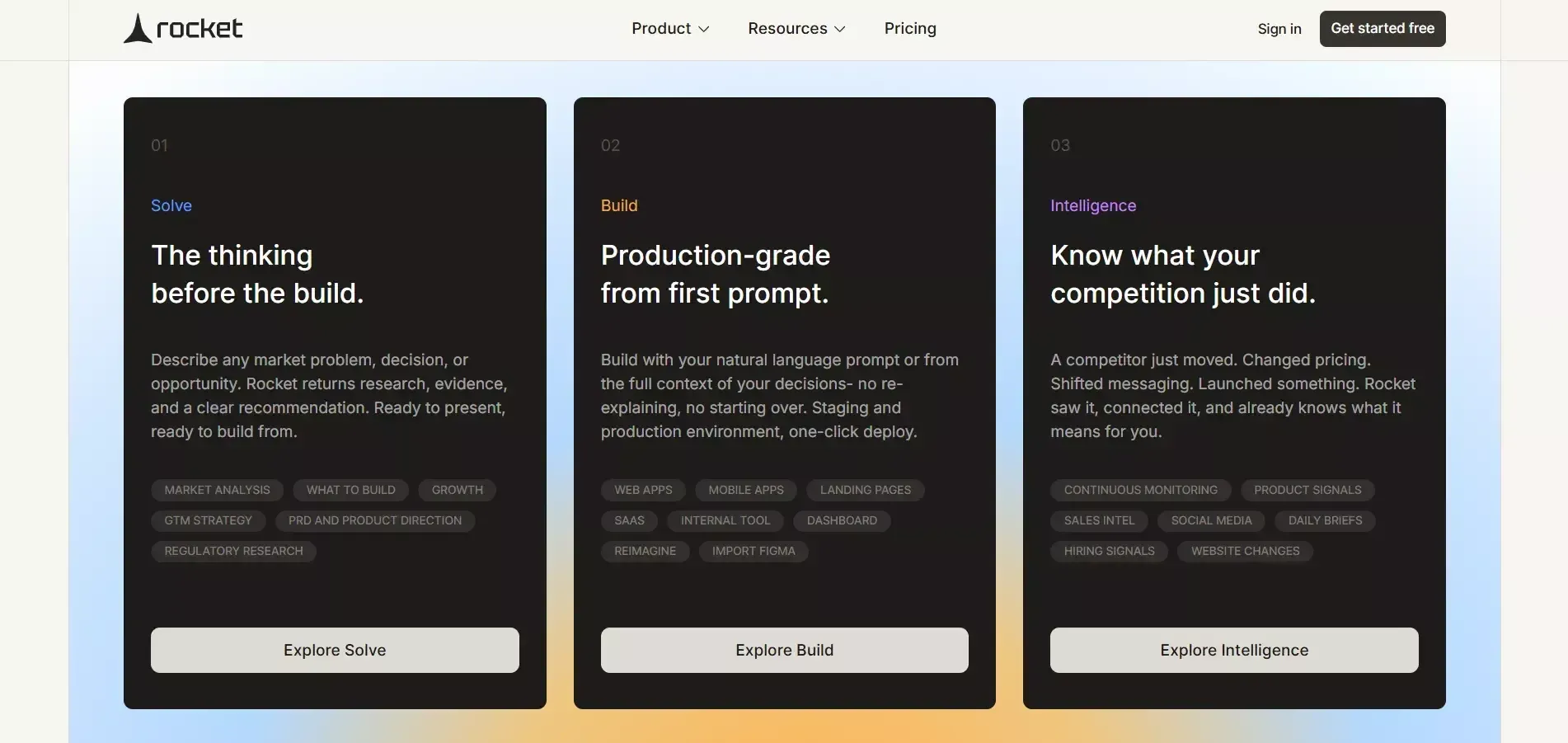 So when your teams run a tenth analysis, Rocket already knows the market sizing from the first report, the rivals from the third, and the pricing model from the seventh. That accumulated data is what makes every new output more precise.
How Clean Data Improves Report Accuracy
Clean data matters because machine learning models trained on noisy inputs produce unreliable analytics. Rocket handles this by structuring all inputs as plain-English commands during the Intelligence setup.
-
Users select signal categories that matter to their businesses
-
The system filters out noise and surfaces only relevant changes
-
Structured outputs from Solve use consistent report formats
This reduces the gap between what users ask and what the system delivers.
Over months of use, the workspace processes hundreds of structured interactions. That volume of accumulated data separates an AI that guesses from one that knows.
Pulling From Multiple Data Sources
Accuracy improves when a system can cross-reference findings across several feeds.
Rocket's Solve engine runs parallel AI agents. Each dimension of a question gets its own agent and data stream.
-
One agent pulls market sizing data
-
Another checks competitor pricing pages in real time
-
A third scans social media and review sites for sentiment analytics
The synthesis step merges everything into a single report. When this process runs repeatedly, each new report builds on a richer foundation. That is the compound effect in action.
Ready to Compound Your Product Intelligence? Every report, signal, and workflow inside Rocket makes future insights smarter and faster.
👉Start building with Rocket.new today.
Machine Learning and the Compound Effect
How Machine Learning Models Generate Better Analytics
Machine learning models improve with more labeled examples. In simple terms, every time your teams interact with Rocket, the AI gets another example of what your market looks like and what your teams consider relevant.
-
Early adopters see the steepest accuracy improvements because their first interactions teach the AI the most
-
After 20 to 30 Solve tasks, the model has enough data to anticipate follow-up questions before users ask them
-
The AI uses accumulated history to suggest follow-up topics at the end of every report
The learning curve works in reverse. The system gets easier to use and more accurate the longer teams invest time.
Why Cross-Project Memory Matters
One of the biggest differences between a generic AI chatbot and Rocket is cross-project memory. When teams run a competitive teardown in one project and a pricing analysis in another, the workspace links the findings.
-
A pricing change detected by Intelligence can trigger a Solve analysis referencing the original teardown
-
Product decisions made in Build carry forward
-
The AI never forgets what your teams have already learned
That persistent memory is the real advantage for teams running projects simultaneously. No data gets siloed. No thinking is lost between tools or team members.
How Rocket.new's Three Pillars Feed Each Other
Solve: AI Analysis That Remembers
Solve turns a plain English question into a structured, evidence-backed report with market analytics, competitive findings, and recommendations.
-
Reports cover market research, competitive teardowns, pricing strategy, product direction, and investment analysis
-
Each report draws from multiple sources simultaneously
-
Findings are scored by confidence level
The point is that Solve does not start from zero each time. It builds on the full picture of everything the workspace has already generated. A team with eight Solve reports has a richer data layer than a team running its first.
Build: Code and Product Decisions That Add Long-Term Value
Rocket.new's integrated approach handles both frontend and backend development, which gives it a significant edge over competitors that focus on only one layer of development.
Rocket's Build pillar handles full-stack generation for web apps (Next.js) and mobile apps (Flutter). Every architecture decision, every backend logic choice, every UI detail adds to workspace memory.
-
Rocket.new supports integrations with popular tools like Notion, GitHub, and Google Drive, enhancing workflow efficiency from idea to execution.
-
When users build a SaaS dashboard, Rocket logs the data model, authentication flow, and API connections
-
That product-building data feeds back into Solve and Intelligence
-
Developers can write code directly or let the AI generate the code automatically
This means Intelligence can flag a competitor change, and the AI already knows which part of your product it affects. The gap between a market signal and a code update shrinks with every build.
Intelligence: Continuous Monitoring That Compounds
Intelligence is where long-term value shows up most visibly. The system monitors competitors across websites, social media, review sites, job postings, and ad channels.
-
Daily briefs arrive in three sections: what changed, why it matters, and what to plan next
-
Real-time tracking catches pricing shifts, hiring changes, and new features from competitors
-
Continuous updates mean the dataset grows daily
After three months, the Intelligence dashboard contains a timeline of every competitor's move.
After six months, the AI can identify anomalies. For example, a competitor suddenly hiring six enterprise sales reps in a vertical they have never targeted. That pattern is hard for a human analyst to catch. The AI catches it automatically through accumulated data and automation.
Multi-Agent Collaboration and Execution at Scale
How Multiple AI Agents Generate Better Code
Rocket does not rely on a single AI model for everything. The system employs multiple specialized AI agents working together, rather than a single generalized prompt engine, to enhance its market analysis capabilities.
-
One agent handles market data collection and analytics
-
Another processes intelligence signals
-
A third generates code, covering frontend and backend logic
-
A fourth checks the generated code against the project history
This matters because specialized agents produce more reliable outputs than a single generalized model. Teams using Rocket report better business outcomes because analysis runs deeper and builds to match actual market conditions.
How Teams Scale Execution
The AI agent architecture works the same for a solo founder and a 20-person team. The difference is that larger teams generate more data and more projects, so the system compounds faster.
-
Internal teams assign different members to Solve, Build, and Intelligence
-
Team collaboration features let multiple users contribute to one workspace
-
What one team member learns becomes available to everyone through shared project memory
This is the Rocket model for teams. The system does not just store files. It stores thinking, decisions, and strategy. When a new member joins, they inherit everything the workspace has produced. No ramp-up meetings. No manual work duplicating knowledge.
Why the Long-Term Advantage Keeps Growing
What Early Adopters Report
Teams that joined Rocket early report a clear pattern. The first few weeks involve the learning curve. After that, the compound effect kicks in.
-
Product Hunt launches built on Rocket benefit from pre-launch Solve analysis that identifies gaps competitors have missed
-
The Intelligence dashboard catches rival responses in real time
-
Follow-up reports measure impact using fresh data that the AI has been tracking for weeks
Companies investing heavily during the first 90 days see the steepest improvement curve. By month four, the AI generates competitive briefs that match what a human analyst would produce, at a fraction of the cost.
Long-Term Growth Through Accumulated Intelligence
Long-term growth follows a predictable arc.
In the first month, Rocket learns who your rivals are and what your market looks like.
By month three, it connects patterns across signals.
By month six, the Intelligence briefs read like they were written by someone watching your industry for years.
-
Strategic decisions become faster because the data already exists
-
New features in your product can be validated before a single line of code is written
-
Report quality improves as each report references prior findings
The real value shows up after sustained use, when compound data, thinking, and machine learning all reinforce each other. This is not a tool you evaluate in a two-week trial.
What Industries Benefit and How Project Complexity Shapes Value
Software Development and SaaS
Software development teams and SaaS companies see the most immediate impact.
-
Intelligence tracks pricing pages, changelogs, and hiring patterns.
-
Solve produces teardowns that reference months of accumulated intelligence.
-
Build feature in Rocket.new drastically reduces development time, allowing users to go from idea to production-ready app in minutes or hours instead of weeks.
These businesses ship faster and plan better because the AI support layer improves with every interaction. The higher the project complexity, the more Rocket delivers.
E-Commerce, Agencies, and Fintech
E-commerce businesses benefit from pricing analytics and competitor ad tracking. A pricing shift on Monday can trigger a Solve analysis and a Build update by Wednesday. Speed of execution matters when margins are thin.
Agencies running client projects on the Rocket scale because each workspace compounds independently. The AI's ability to generate code, analytics, and reports improves with each project.
Fintech companies and businesses in regulated industries benefit from structured report formats. Compliance teams review the evidence chain behind every recommendation. Enterprise teams generate daily briefs from Intelligence that support board-level discussions.
| Industry | Primary Pillar | Key Benefit |
|---|---|---|
| SaaS | Intelligence + Solve | Real-time competitor tracking feeds product strategy |
| E-Commerce | Intelligence + Build | Pricing analytics drives faster revenue responses |
| Agencies | Build + Solve | Client workspaces compound independently at scale |
| Fintech | Solve + Intelligence | Structured report outputs support compliance |
| Startups | All three pillars | Full picture from validation to monitoring |
| Enterprise | Solve + Intelligence | Months of data behind every strategic plan |
How Rocket Differs From Generic AI Tools
Why Most AI Tools Hit a Ceiling
Tools like ChatGPT and Perplexity reset with every conversation. They do not remember last week. They cannot connect an analysis in January to a code decision in March.
For most businesses, this means AI stays useful for quick lookups but never becomes a strategic partner.
-
Generic AI tools do not store project history
-
They cannot pull from your competitor's data or customer reviews
-
They connect no analytics tools to your actual product decisions
-
Each query is isolated, with no compound benefit
Where Rocket Pulls Ahead
Rocket works differently because of persistent memory across Solve, Build, and Intelligence.
-
All three pillars share one workspace
-
Every interaction adds to a growing data layer
-
The development environment supports iterating on code while referencing live analytics
-
Real users see the difference within weeks, not months
After a year of use, the Rocket system holds more market knowledge than any individual analyst could accumulate. The system can generate reports, code, and strategy documents that would take an outside firm weeks to plan and execute.
What the Community is Saying
Rocket's approach to combining AI analysis, product building, and competitive intelligence has caught attention from users and investors.
"Rocket.new is purpose-built to solve this problem of iteration, maintenance, and deployment at enterprise scale." - Kartik Gupta, Investor at Salesforce Ventures, via LinkedIn
-
That reflects what real users experience at the moment they move past initial setup
-
Users stick with Rocket because outputs improve over time
-
With 1.5 million users across 180 countries and a $15 million seed round from Accel, Salesforce Ventures, and Together Fund, growth numbers support what community feedback suggests
How Rocket.new Handles Long-Term Market Intelligence
Rocket.new connects thinking, building, and monitoring in one workspace. Every Solve report, Build session, and Intelligence signal feeds a single growing data layer. Here are the platform's core features:
-
Vibe-solutioning platform: Connects AI analysis, product building, and competitive intelligence in one system
-
25k+ templates library, free to use: Start building faster and save up to 80% tokens per project
-
Supports Flutter (mobile) and Next.js (web): Full-stack generation across both web and mobile from day one
-
Collaboration features built in: Team collaboration inside shared projects, not a separate tool
-
3 Products, One Platform: Solve, Build, and Intelligence: Analyze your market, generate your product, and track competitors in one place
Unlike many no-code tools that lock users into proprietary systems, Rocket.new allows full code export, ensuring long-term flexibility and independence for users.
Use Cases Where Accuracy Compounds
-
Startup validation and Product Hunt launch: A founder uses Solve to validate, Build to ship the MVP, and Intelligence to monitor rival reactions. By launch week, the AI suggests positioning adjustments based on real-time competitor data
-
Ongoing product execution: A SaaS team runs Intelligence daily and Solve monthly. Six months in, the AI generates reports referencing half a year of pricing changes and market shifts. Automation handles monitoring while users focus on execution
-
Agency projects at scale: An agency onboards a client, runs a teardown in Solve, builds the app with full code export, and sets up Intelligence. Each project benefits from accumulated thinking across the workspace
-
Enterprise competitive intelligence: An enterprise team adds competitors to Intelligence and runs it for 90 days. Daily briefs grow from general observations into specific, actionable intelligence. The ability to generate custom analytics from months of accumulated signals replaces tools such as Crayon or Klue
Rocket is the platform where product building, market analytics, and competitive tracking share one memory. The AI treats every interaction as a data point that sharpens future code, future reports, and future strategy.
Key Takeaways on Accuracy That Grows With Use
The question of market accuracy over time comes down to one point: does the platform remember, and does it use what it remembers?
Rocket.new answers both. Every Solve report, Build session, and Intelligence signal adds to a workspace that grows smarter. For businesses that plan to operate in a market for years, that compounding effect is non-negotiable. The core features generate more value the longer they run.
Companies that commit early see the sharpest long-term growth in output quality, because the AI has more data, more projects, and more thinking to draw from. Why does Rocket.new's understanding of your market gets more accurate the longer your team uses the platform? Because every interaction makes the next one sharper.
Table of contents
- -What Makes an AI Platform Smarter Over Time?
- -How Data Compounds Inside Rocket
- -Why More Data Leads to Better Analytics
- -How Clean Data Improves Report Accuracy
- -Pulling From Multiple Data Sources
- -Machine Learning and the Compound Effect
- -How Machine Learning Models Generate Better Analytics
- -Why Cross-Project Memory Matters
- -How Rocket.new's Three Pillars Feed Each Other
- -Solve: AI Analysis That Remembers
- -Build: Code and Product Decisions That Add Long-Term Value
- -Intelligence: Continuous Monitoring That Compounds
- -Multi-Agent Collaboration and Execution at Scale
- -How Multiple AI Agents Generate Better Code
- -How Teams Scale Execution
- -Why the Long-Term Advantage Keeps Growing
- -What Early Adopters Report
- -Long-Term Growth Through Accumulated Intelligence
- -What Industries Benefit and How Project Complexity Shapes Value
- -Software Development and SaaS
- -E-Commerce, Agencies, and Fintech
- -How Rocket Differs From Generic AI Tools
- -Why Most AI Tools Hit a Ceiling
- -Where Rocket Pulls Ahead
- -What the Community is Saying
- -How Rocket.new Handles Long-Term Market Intelligence
- -Use Cases Where Accuracy Compounds
- -Key Takeaways on Accuracy That Grows With Use