
Solve on Rocket.new converts any plain-language business question into a structured, decision-ready deliverable in ~45 minutes using query decomposition, parallel AI agents, and shared context across Solve, Build, and Intelligence.
Solve on Rocket converts a plain-language business question into a structured, decision-ready deliverable in approximately 45 minutes. Using AI-driven query decomposition, parallel research agents, and shared context, it produces evidence-backed outputs that connect strategy, execution, and continuous intelligence in one platform.
What happens when you type a rough business question into an AI tool and expect a board-ready answer?
Solve on Rocket does exactly that, turning a single plain-language prompt into a structured deliverable with research, evidence, and a clear path to action. Industry research on AI project outcomes shows over that 80% of AI projects fail to deliver intended business value. Rocket was built to close that gap.
Why Raw Business Questions Work Better Than Polished Briefs
You do not need a polished brief to get a board-ready output. Solve accepts plain language questions and structures them before research begins. The platform handles the framing so you can focus on the decision.
Most teams arrive at a vibe solutioning platform with a rough idea, not a polished brief. This is how Rocket is designed to work.
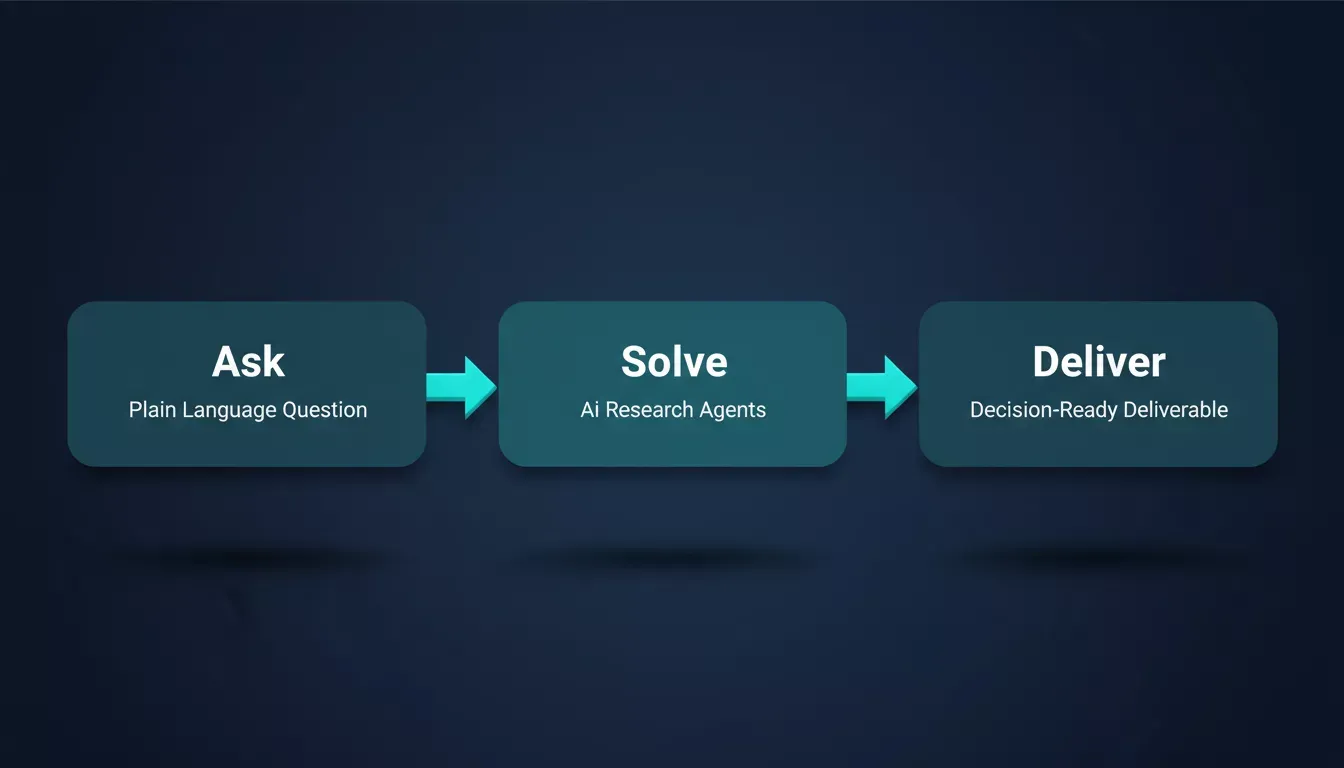
The Vibe Solutioning workflow: from plain language question to decision-ready deliverable
- Solo founders, product managers, and enterprise teams all start the same way: with a plain language prompt
- Rocket treats every business question as a candidate for a board-ready deliverable, answered honestly with evidence-backed insights
- The same input can become a strategy doc, a launch plan, or a risk memo, because Solve, Build, and Intelligence all share one workspace
Rocket does not punish vague questions. It asks clarifying follow-ups and reshapes the inquiry before any external research begins. A raw question like "Should we add AI features to our existing website?" gets reinterpreted into a structured decision problem covering technical feasibility, customer demand, competitive positioning, and revenue impact.
Vibe solutioning answers "what and why" before "how," shifting the focus from code generation to strategic decision-making. Most tools in the vibe coding space skip straight to writing code. Rocket invests the first phase into mapping the business logic correctly, which is exactly what to build and why it matters before a single line of code is written.
Mapping Your Question Into Structured Dimensions
Before Solve touches any data source, it runs a thinking pass that breaks your question into explicit research dimensions. This decomposition becomes a visible outline inside the workspace, giving users an instant table of contents for the upcoming deliverable.
According to Rocket's documentation, Full Solve breaks the question into its component dimensions, with each dimension becoming an independent research query you can watch appear in chat as research begins.
- The system maps a single sentence into explicit dimensions: market viability, customer segment, pricing mechanics, go-to-market strategy, technical feasibility, and financial impact
- For ambiguous questions, Solve runs a clarifying loop, surfacing assumptions like "Is your target ACV above $20K?" that users can edit before research runs
- This query decomposition replaces the messy Notion docs and slide drafts that accumulate over separate strategy sessions
Good market research is the foundation of every strong deliverable. Solve automates that foundation before any output is generated.
From One Prompt to a Decision Blueprint
A prompt like "Should we raise prices for our US SMB customers?" becomes a multi-part plan with each section tagged for traceability. Users can reorder, rename, or delete sections before research runs, making the blueprint collaborative.
| Section | Tagged Dimension |
|---|---|
| Context recap | Business Overview |
| Decision framing | Revenue Model |
| Hypotheses | Customer Impact |
| Risks | Competitive Response |
| Alternatives | Pricing Mechanics |
| Success criteria | Financial Impact |
Parallel AI Agent Research Across Every Dimension
Solve does not send a single monolithic query to a language model. It spins up specialized agents per dimension, each responsible for one research track, running simultaneously rather than in sequence.
According to Rocket's documentation, each stream shows what the agent researched, which tools it used, what it found, and how it assessed the findings.
- Autonomous AI agents run research queries across dimensions simultaneously using live market data
- These agents run targeted lookups across curated sources, industry reports, and public data, not just scraping headlines
- Recommendations are grounded in real-time signals, including competitor hiring patterns, news, and pricing changes
Full Solve typically takes about 45 minutes, with some reports taking longer. Unlike other AI research tools, Solve produces a structured multi-section report with evidence, not a conversational answer.
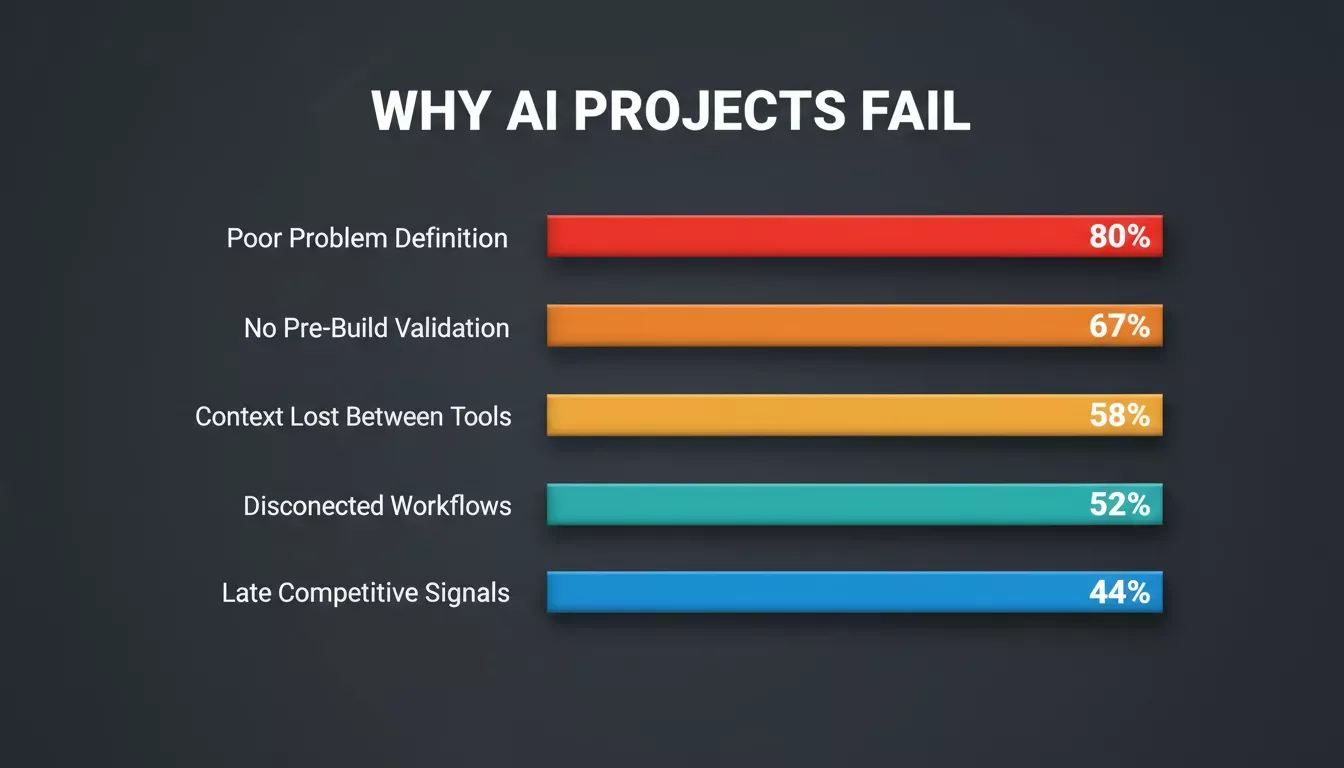
Over 80% of AI projects fail due to poor problem definition, the exact gap Solve is built to close
How Shared Context Keeps Research Connected
Project memory is a persistent knowledge base that lives with the question, not the session. All partial findings, notes, and assumptions are written into this memory, so one agent's conclusion can influence another's recommendations.
- The platform stores every research output, decision, and build artifact in one place, so insights from research directly inform the building phase
- When a team reopens the project months later, the full thinking history is available and editable, removing the re-explaining context problem common with separate tools
- This shared context carries into Build and Intelligence, so code, UI flows, and tracking plans inherit the earlier research without switching tools
How a Business Question Becomes a Decision-Ready Deliverable
The diagram below shows the Full Solve pipeline. Each stage is distinct: clarification before decomposition, decomposition before parallel research, synthesis only after all agent streams complete.
Pipeline summary: A plain language question enters Solve, gets clarified and decomposed into dimensions, runs as parallel agent streams, merges into shared context, and exits as a structured, exportable deliverable.
Turning Research Into Outputs You Can Present
Solve does not stop at answer paragraphs. The output is a structured deliverable designed for immediate action, not a wall of text that requires further assembly.
- Decision memos, investor-style one-pagers, full strategy docs, and 90-day execution plans
- Findings merged into a cohesive report with executive summaries, SWOT analyses, pricing models, and competitive research
- Every finding is tagged with its evidence source so readers see exactly how conclusions were reached
Users can choose their preferred output format: "Executive Brief," "Deep Dive," or "Board Deck Outline." The deliverable includes ready-to-paste slide headings and bullet copy. All deliverables carry timestamps, and users can request revisions in natural language.
Note: specific confidence score values shown in some Rocket marketing materials are illustrative examples of the scoring system, not guaranteed output values for any given report.
Two Problems Vibe Coding Left Unsolved
Vibe coding solved execution speed. It left two structural problems unaddressed: knowing what is worth building before committing to it, and knowing how market shifts affect you after launch.
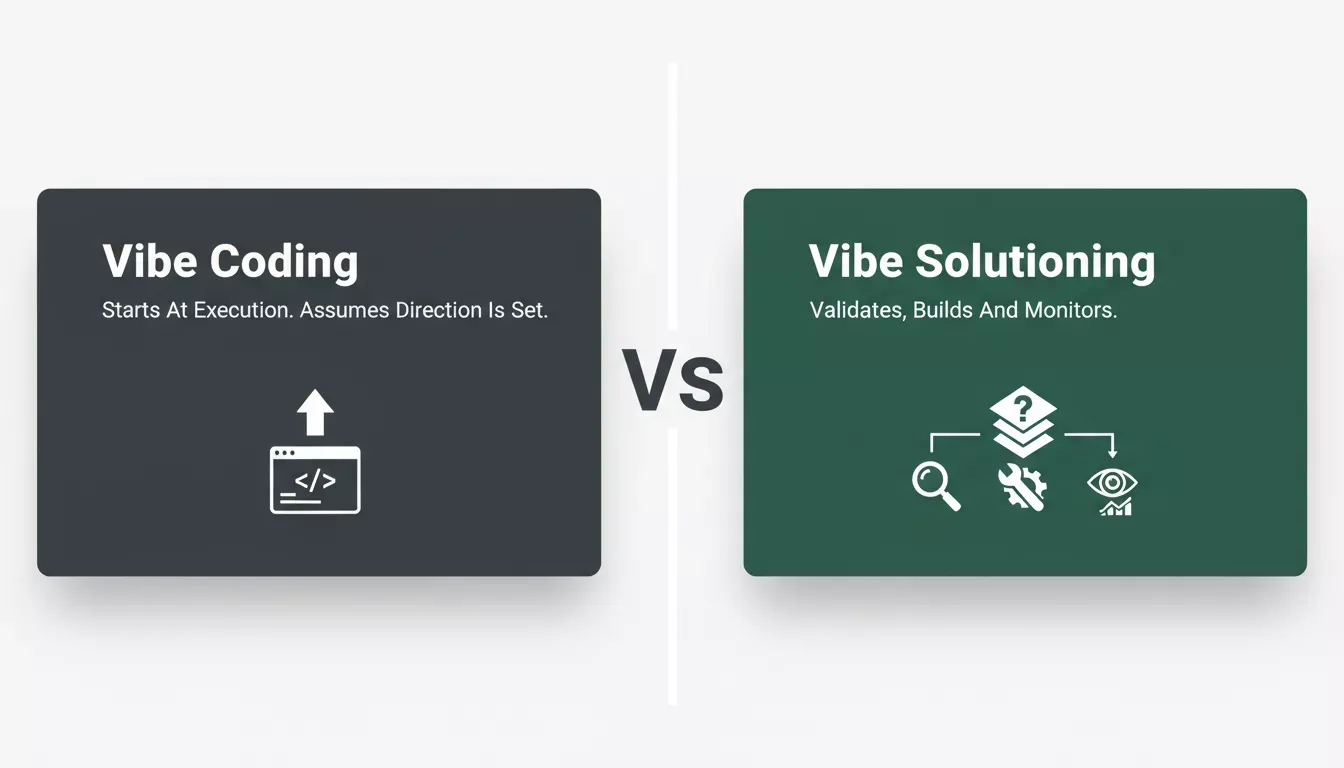
Vibe Coding vs Vibe Solutioning: the key difference is where the process starts
Most AI tools have optimized for how fast prototypes can go live. Two problems remain:
- Pre-build validation gap: Teams build the wrong thing because no one validated the decision first. That mistake compounds across months of engineering time.
- Post-launch intelligence gap: After launch, competitive signals land in separate tools on separate timelines with no connection to the build.
Using separate tools for strategy, building, and competitive intelligence means re-explaining context every time. Switching tools causes most teams to lose the thread between insight and implementation.
From Solve to Build on the Same Platform
Rocket integrates strategic research, production-grade app building, and continuous competitive intelligence within one connected platform. The three capabilities cover how a business operates around a product: before the build, during it, and after launch.
Taking a product from idea validation to a deployed product no longer requires switching tools or re-explaining context at every handoff.
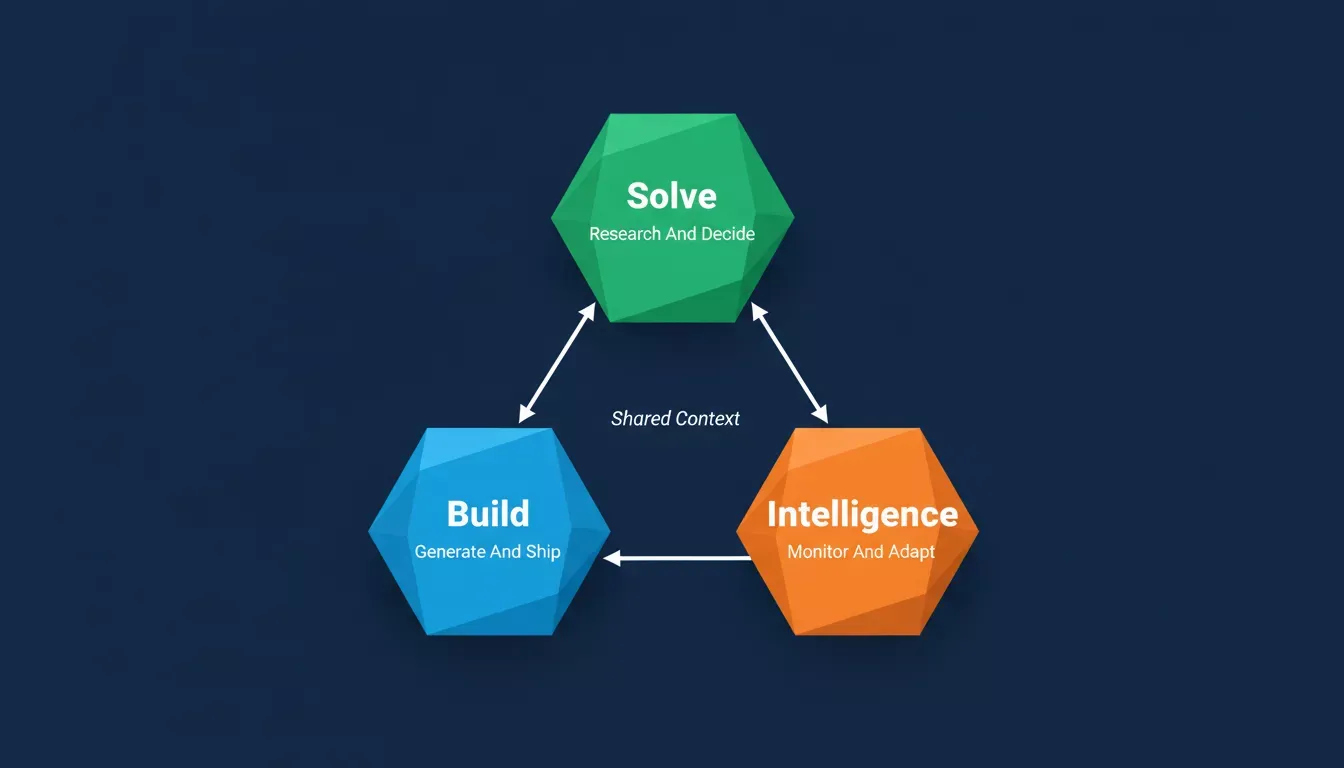
Solve, Build, and Intelligence share one context layer, so nothing is re-explained between steps
From Strategy to Production Without Switching Tools
- Build turns that decision into production-ready web apps, mobile apps, internal dashboards, and customer portals without switching tools or re-explaining context
- According to Rocket's documentation, Build generates Next.js for web apps and Flutter for mobile apps, matching the validated strategy
- The final deliverable often includes strategy flows, product requirements documents, and early code suggestions that feed directly into Rocket's Build layer
Shared Context That Eliminates Rework
Because the build phase inherits shared context, teams skip the usual back-and-forth over requirements. Solve feeds Build, which feeds Intelligence, as one connected platform rather than separate tools.
Intelligence That Connects the Dots
Intelligence monitors every public platform a competitor operates on: website, social media, press coverage, job postings, and performance marketing. It does not just surface data. It interprets it.
A pricing change, combined with enterprise sales hires and new case studies, is not three separate signals. It is one picture: a competitor making a strategic move.
Why Full-Arc Platforms Matter More Each Quarter
As the AI market matures, the distinction between tools that only accelerate execution and platforms that handle the full arc gets clearer. 1.5 million people have tried Rocket across 180 countries, from solopreneurs to enterprise teams, reached primarily through organic product-led growth.
Who Gets the Most From Decision-Ready Deliverables
Four personas who get the most from decision-ready deliverables
| Persona | Primary Use | Key Outcome |
|---|---|---|
| Product managers | Validating features against user data | Launch plans with success metrics |
| Solo founders | Market validation and funding prep | Board-ready investor updates |
| Sales leaders | Battle briefs for competitive deals | Account planning with evidence |
| Enterprise teams | Consolidating competitive research | Single ongoing intelligence report |
| Agencies | Turning client emails into proposals | Prototype directions in one Solve run |
- Solo founders benefit because they lack strategy analysts but need board-level decisions. A solo founder can prepare a funding update that would otherwise require an expensive external consultant.
- Enterprise teams consolidate competitive research into one ongoing intelligence report. Work that once required external consultants happens inside Rocket in hours.
- Agencies turn vague client emails into formal proposals, pricing models, and prototype directions in one Solve run.
What People Are Saying
"The real bottleneck in product development is not building faster, but choosing better. Products rarely fail because nobody could code them. They fail because the underlying question was weak, the goal was fuzzy, or the team lost the thread between insight and implementation." Rohan Paul on X
This captures why vibe solutioning exists as a category. Vibe coding made execution speed cheap. The current conversation around what actually needs building, and how the AI market is shifting, is where the real value sits.
How Rocket Turns a Business Question into a Decision-Ready Deliverable
Rocket.new is the world's first vibe solutioning platform, built for exactly this problem: turning a business question into a structured, evidence-backed deliverable without switching tools or losing context.
- Vibe solutioning: answers "what and why" before "how," with Solve, Build, and Intelligence covering pre-build, build, and post-launch
- 25,000+ templates, free to use, covering web apps, mobile apps, and internal dashboards
- Next.js for web apps and Flutter for mobile apps, per Rocket's documentation
- Collaboration features for large teams and solo founders
- Three capabilities, one platform: Solve, Build, and Intelligence, covering how a business operates from the first question to competitive monitoring
Use cases connecting vibe solutioning to real outcomes:
- A solo founder types "Is it worth entering the German market with our B2B AI tool?" and gets a market entry report with a 90-day execution plan and go-to-market strategy
- A sales leader asks "How do we win back mid-market deals we lost to a competitor?" and gets tailored battle briefs with competitive research
- An agency turns a vague client email into a formal proposal, pricing model, and prototype direction in one Solve run
- An enterprise team asks "Should we ship AI-assisted onboarding for SMB customers?" and gets a launch plan with success metrics
Every serious builder, from solo founders to Fortune 100 teams, needs to know they are building the right thing and when market shifts happen after launch. Rocket connects that full arc in one place.
Making The Right Call On Your Next Decision
The gap between asking a plain-language business question and holding a decision-ready deliverable has dropped to approximately 45 minutes with Full Solve. If you are a serious builder tired of bad execution from disconnected workflows, Rocket offers a platform that handles strategic research through to production-grade app building.
Businesses research, build, and track competitors in one place. Start with a real business question today and move from scattered strategy sessions to continuous learning that shapes how your business operates.
Turn your next business question into a decision-ready strategy. Start using Rocket today.
Table of contents
- -Why Raw Business Questions Work Better Than Polished Briefs
- -Mapping Your Question Into Structured Dimensions
- -From One Prompt to a Decision Blueprint
- -Parallel AI Agent Research Across Every Dimension
- -How Shared Context Keeps Research Connected
- -How a Business Question Becomes a Decision-Ready Deliverable
- -Turning Research Into Outputs You Can Present
- -Two Problems Vibe Coding Left Unsolved
- -From Solve to Build on the Same Platform
- -From Strategy to Production Without Switching Tools
- -Shared Context That Eliminates Rework
- -Intelligence That Connects the Dots
- -Why Full-Arc Platforms Matter More Each Quarter
- -Who Gets the Most From Decision-Ready Deliverables
- -What People Are Saying
- -How Rocket Turns a Business Question into a Decision-Ready Deliverable
- -Making The Right Call On Your Next Decision