
Build a tiered support agent that routes simple queries to rules, complex ones to AI, and sensitive cases to humans. Rocket.new lets you ship this from a single prompt with no enterprise contract, no drag-and-drop limits, and a built-in feedback loop that improves routing accuracy automatically.!
Build a tiered customer support agent that routes simple queries to rules, complex ones to AI, and sensitive cases to humans. Rocket lets you ship this entire system from a single prompt. This guide covers the full architecture, feedback loop, no-code deployment, and how to measure success once you are live.
Why Do Most AI Support Platforms Waste Money on Simple Queries?
Most no-code AI agent platforms treat every incoming ticket the same way: send it to a large language model, wait for the AI agent to process it, and bill you per token. For high-volume teams handling thousands of tickets per day, that approach burns through budgets fast while delivering no better outcomes than a simple rules engine could on routine tasks.
According to TechCrunch's recent report on Omilia's $67M raise, CEO Dimitris Vassos argues that companies like Sierra and Decagon limit themselves by deploying generative AI for every single query, including basic ones like account balances that need no language model at all.
60% of support tickets are repetitive, predictable queries: order status checks, password resets, opening hours, that need zero AI reasoning. Deploying a language model on every one of those tickets creates unnecessary cost, longer response times, and wasted compute. A tiered architecture that matches the right tool to each query type solves this directly.
- Rule-based tier handles the predictable majority at under a penny per ticket
- AI agent tier handles complex queries that genuinely need reasoning
- Human escalation tier handles sensitive cases where judgment matters
Not every query needs a bazooka. Sometimes you need a knife. Matching the response method to actual query complexity is the foundation of cost-efficient support automation.
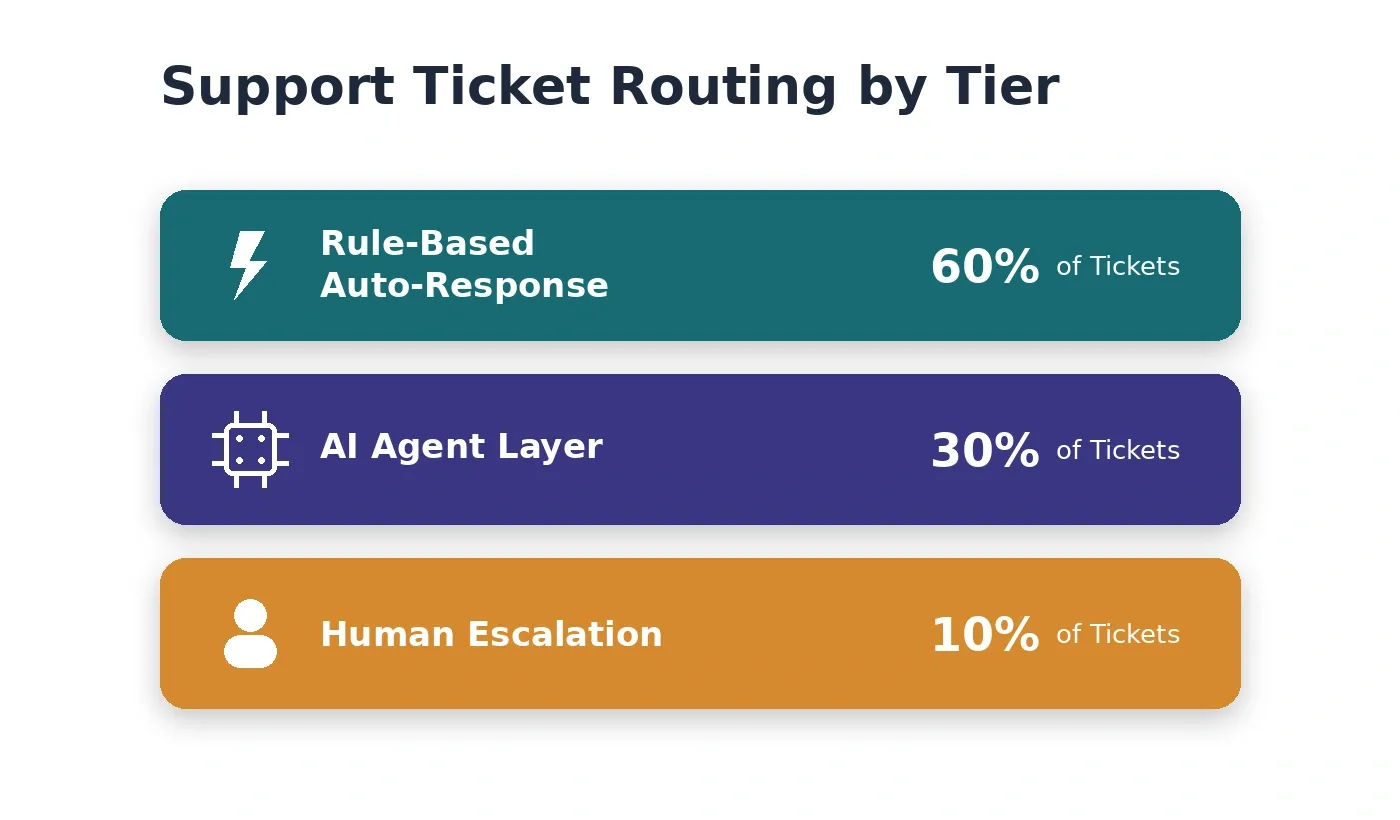
Three-tier support architecture
What Does a Self-Learning Support System Actually Do?
A self-learning support agent classifies incoming queries, routes them to the correct tier, and uses outcome data to improve its own routing accuracy over time, without manual intervention. The key difference from a static chatbot is the feedback loop: every resolved ticket generates a signal that retrains the classifier. The agent gets smarter with use.
The three tiers handle different categories of requests based on complexity and risk. The knowledge base for the rule-based tier is populated from a CSV import of existing FAQ content, manual Q&A pairs, or a live sync from your help docs. The AI agent tier connects to customer databases and order history in real time. The human tier receives pre-loaded context from the AI's draft response so agents spend seconds approving, not minutes researching.
If you are exploring the terminology before committing to a build, agentic AI vs AI agents is a useful primer on the design differences that affect how you structure your tiers.
Every ticket enters the intent classifier, routes to the appropriate tier, generates an outcome log, and feeds back into classifier retraining. The loop runs automatically with no human intervention required between cycles.
How Does Query Classification and Response Routing Work?
Query classification is the brain of a tiered support agent. It reads each incoming ticket, determines intent, estimates complexity, and routes it to the appropriate tier. Getting this step right is what separates genuine automation from a chatbot that sends everything to an expensive AI model.
The classifier uses keyword matching, intent detection, and confidence scoring:
- Keyword and pattern matching catch known query types immediately; order status, opening hours, and password resets route straight to the auto-response library without burning any AI tokens.
- Intent classification uses a lightweight AI model to categorize ambiguous queries into known buckets: billing, technical support, product questions, account changes.
- Confidence scoring determines whether the AI agent should respond or escalate. Low confidence triggers human review; high confidence lets the agent proceed.
- Context enrichment pulls order history, account status, and previous ticket data before the AI agent generates its response.
Routing Tier Comparison
| Query Type | Example | Routing Tier | Response Time | Typical Cost Range |
|---|---|---|---|---|
| Simple lookup | Order status, hours, FAQ | Rule-based auto-response | Under 1 second | Under $0.01 |
| Complex query | Billing dispute, troubleshooting | AI agent with knowledge base | Under 30 seconds | $0.10 to $0.50 |
| Sensitive case | Refunds over $500, legal questions | Human escalation queue | Under 5 minutes | $2 to $10 (agent time) |
| Ambiguous intent | Unclear request, multiple issues | AI agent with human fallback | Under 45 seconds | $0.15 to $0.60 |
Cost ranges are illustrative. Actual figures vary by AI provider pricing, agent wage rates, and ticket complexity.
Routing 60% of tickets to the rule-based tier at under a penny each drops your blended cost per ticket dramatically compared to platforms that run every query through a language model.
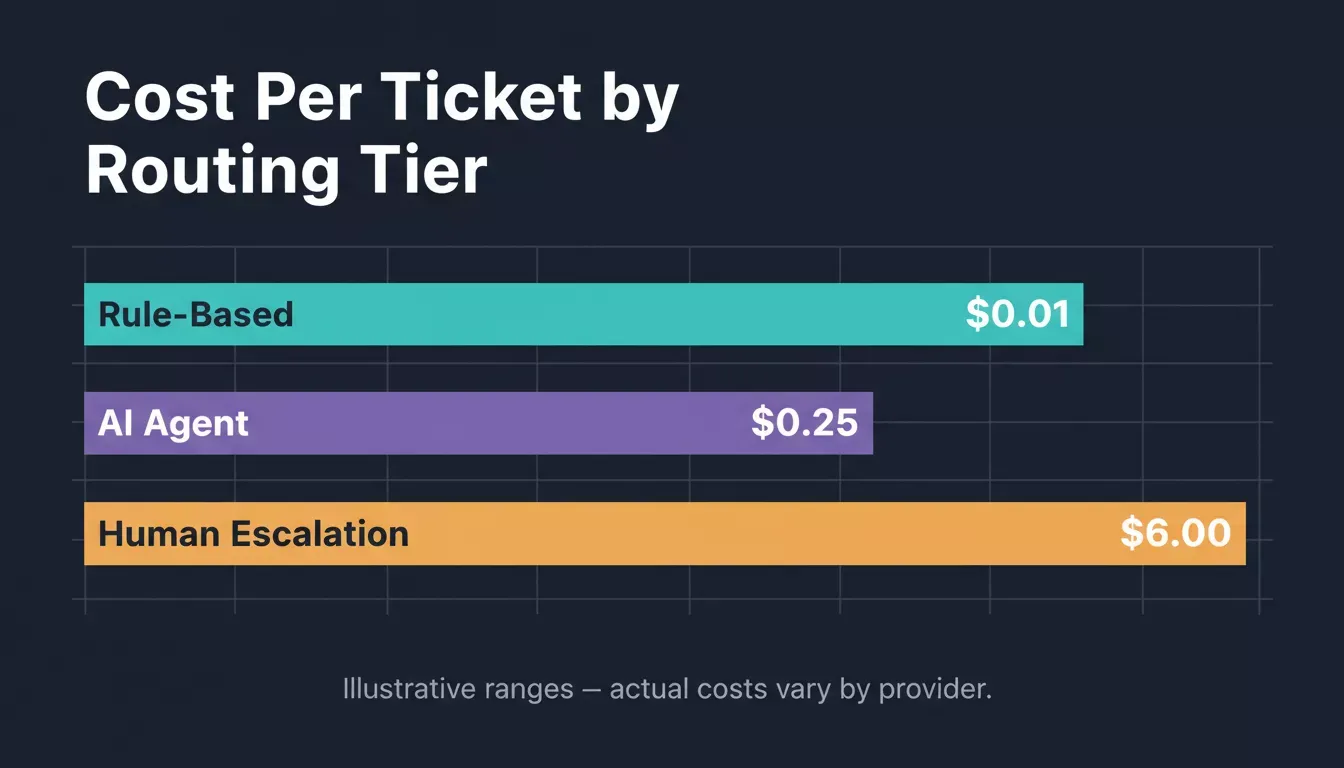
Cost per ticket by routing tier
The real power comes from connecting your customer support portal to live data sources. When the AI agent can pull order information and account status in real time, it resolves queries faster with fewer follow-up messages. Teams that use workflow automation tools to connect their agent systems to existing apps see even faster deployment times.
A Worked Example: The $600 Refund Request
Here is how a real support flow moves through all three tiers. A customer submits: "I want a refund for my order from last week. It was $600, and the product arrived damaged."
Tier 1 (rule-based): The classifier matches "refund" as a known intent. But the $600 amount exceeds the auto-approve threshold. The rule-based tier passes it to Tier 2.
Tier 2 (AI agent): The agent pulls the customer's order history, confirms the order is 6 days old, and checks the return policy, which allows refunds for damaged goods within 30 days. The confidence score is 0.71, but the routing rule flags any refund over $500 for human review regardless. The agent drafts a response and sets the ticket to "pending human approval."
Tier 3 (human escalation): The support agent receives the ticket with the AI's draft, order data, and policy check pre-loaded. A person finalizes the refund after a human clicks approve in two steps. Total human time: under 90 seconds. The outcome logs back to the classifier; future tickets matching this pattern route identically.
For teams building conversational AI agents for the first time, this example shows how the tiers interact before you start configuring routing rules.
How Rocket Fits in the Tiered Support Architecture
Rocket is a three-pillar platform: Solve (decision intelligence, any business question to a structured output), Build (production-grade generation of web apps, mobile apps, internal tools, and customer portals), and Intelligence (continuous competitive monitoring across every public platform a competitor operates on). All three connect through a shared context architecture so the research you run in Solve flows directly into Build.
Before you build, use Solve. Ask: "Should I build a tiered support agent? What ticket volume makes it cost-effective?" Solve runs thousands of queries across 150+ sources simultaneously and returns a structured analysis within 60 to 90 minutes. That output becomes the foundation of your Build task.
To build the agent, use Build. Describe your tiered support system in plain English. Rocket generates the complete Next.js application: query classifier, auto-response library, AI agent fallback layer, human escalation queue, and the Supabase-backed database that stores your knowledge base and ticket history, so teams can build AI agents using standardized API components. Every build ships with SEO-ready structure, WCAG accessibility compliance, GDPR coverage, and enterprise-grade security by default.
No-code platforms allow API integrations without coding, and these agents can connect to over 1,000 applications.
After launch, use Intelligence. Track what competitors like Intercom, Zendesk, and Decagon are doing with their AI support products. Intelligence delivers daily briefs that tell you not just what changed, but what it means for your product decisions.
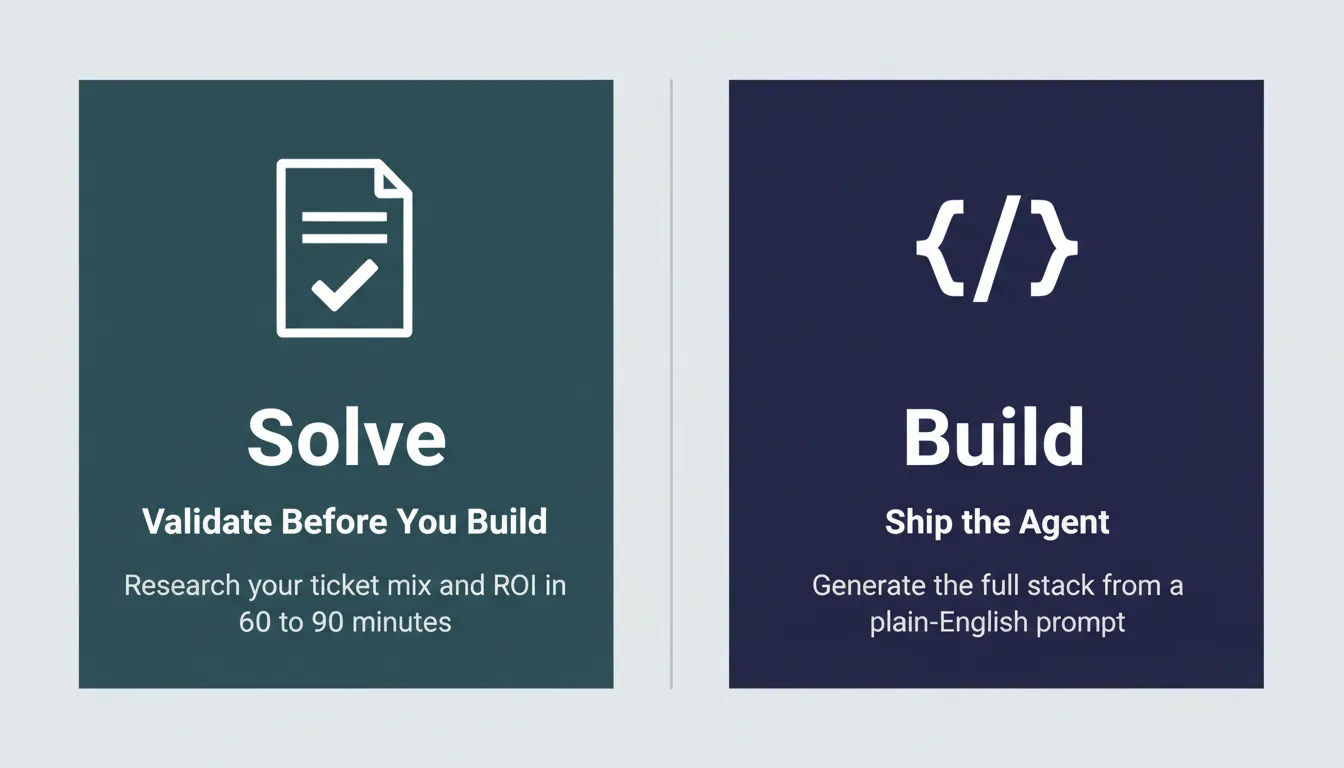
Rocket.new: Solve and Build
Rocket's Solve pillar validates the architecture decision before you build. The Build pillar generates the full-stack agent from a plain-English prompt. Both share the same project context.
How Rocket Compares to Enterprise Customer Support Platforms
| Capability | Zendesk AI | Intercom Fin | Sierra / Decagon | Rocket (Build) |
|---|---|---|---|---|
| Tiered routing architecture | Partial | Partial | No (all-LLM) | Yes, full three-tier |
| No-code setup | Yes | Yes | No | Yes |
| Custom AI model selection | No | No | Yes (enterprise) | Yes |
| Supabase / custom DB integration | No | No | Custom only | Built-in |
| Competitive monitoring included | No | No | No | Yes (Intelligence pillar) |
| Pre-built decision intelligence | No | No | No | Yes (Solve pillar) |
| Pricing model | Per-seat + resolution fee | Per-seat + resolution fee | Enterprise contract | Free tier + usage |
Feature comparison based on publicly available documentation as of August 2026. Enterprise platform capabilities vary by plan tier, and no code platforms can reduce development time by 90% for AI solutions.
Sierra and Decagon process every ticket through a language model at full cost. Rocket lets you route appropriately, so you pay for AI reasoning only when it adds value. Teams that build internal tools with AI on Rocket report shipping production applications in hours rather than weeks. That speed aligns with broader adoption trends: 60% of executives believe no-code tools will drive digital strategy by 2026.
The Feedback Loop That Makes Your Agent Smarter Over Time
A self-learning agent gets better every week without manual work. The feedback loop identifies misroutes, logs corrections, and retrains the classifier automatically, while supervised learning loops help prevent the agent from learning bad habits from users.
- Outcome logging: Is every resolution tracked? Did the customer get their answer? Reopen the ticket, or escalate? These signals provide relevant data and confirm whether the routing decision was correct.
- Misroute detection: When an AI-handled ticket escalates to a human, or a rule-based response receives negative feedback, the system flags it and triggers classifier retraining.
- Confidence calibration: The agent learns which query patterns it handles well and adjusts confidence thresholds automatically based on historical outcomes.
- Knowledge base expansion: Queries the agent resolves successfully migrate to the auto-response library. What started as an AI task becomes a rule-based task once the pattern is proven reliable.
As Dimitris Vassos, CEO of Omilia, put it in a recent TechCrunch interview: "We will use any available weapon to win the battle for customer service. You may have a bazooka, but if your enemy is near you, you need a knife. This is the reality of the contact center, where you need multiple tools." The feedback loop is what makes that multi-tool approach work: the agent learns which weapon fits each fight.
Research on AI customer service expectations shows that 67% of consumers now expect more personalized service because AI can analyze their interactions. A self-learning agent delivers on that expectation by getting more people the right answer faster, every week.
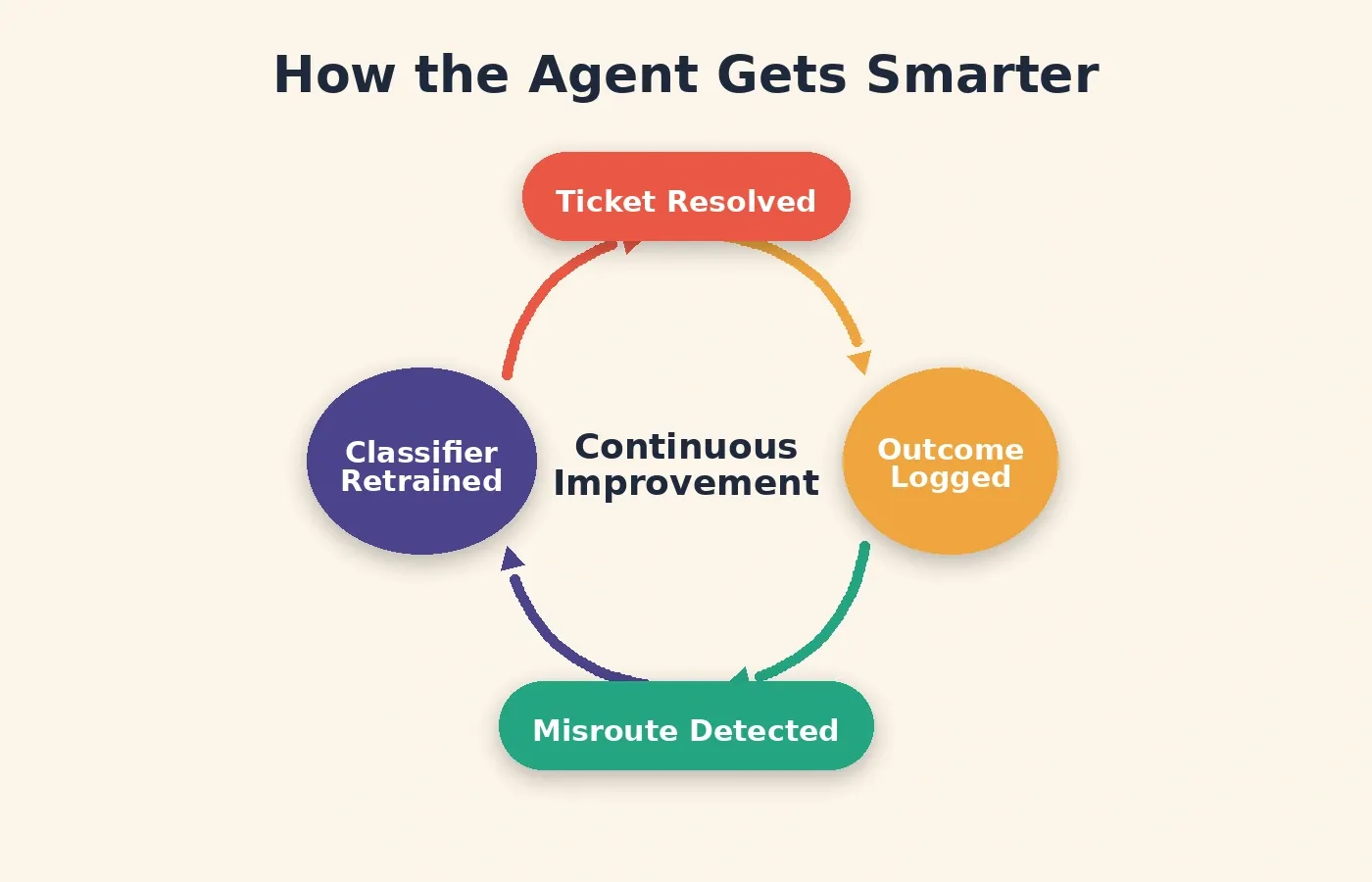
Agent gets smarter with the self-learning feedback loop
The self-learning feedback loop: every resolved ticket generates an outcome signal, misroutes are flagged, and the classifier retrains on corrections. Each cycle narrows the gap between routing decision and correct answer.
The result is a support system that starts good and gets great. Your rule-based tier grows as proven patterns migrate down from the AI layer. Your human team focuses on the cases that genuinely need judgment, not on answering the same order status question for the hundredth time. Understanding how generative AI differs from conversational AI helps clarify which layer of your stack should use which type of model.
How to Measure Success After Launch
Shipping the agent is step one. Knowing whether it is working is step two. Three metrics matter most. In practice, AI agents can reduce customer wait times from hours to 33 seconds.
Deflection rate is the percentage of tickets resolved without human involvement. A well-tuned tiered agent should deflect 55 to 70% of total ticket volume within 60 days of launch. Track this weekly, not monthly, because the feedback loop moves fast.
First-response time by tier should be measured separately. If any tier is consistently outside the ranges in the table above, the routing rules need adjustment, not the tier itself.
CSAT by routing tier shows how satisfied customers are, broken down by which tier resolved the ticket. If AI agent CSAT is materially lower than human CSAT on similar query types, the confidence threshold for that category is set too high. Raise the escalation threshold until scores converge.
Rocket's built-in analytics tracks visitors, conversions, and Core Web Vitals for every deployed project. For support-specific metrics, connect your Supabase database to a Mixpanel or custom analytics integration. Teams building AI apps for operations teams often use this same pattern to connect agent outcome data to existing reporting workflows.
When Not to Use This Architecture
Tiered routing is not the right choice for every team. Three situations where a simpler setup serves better.
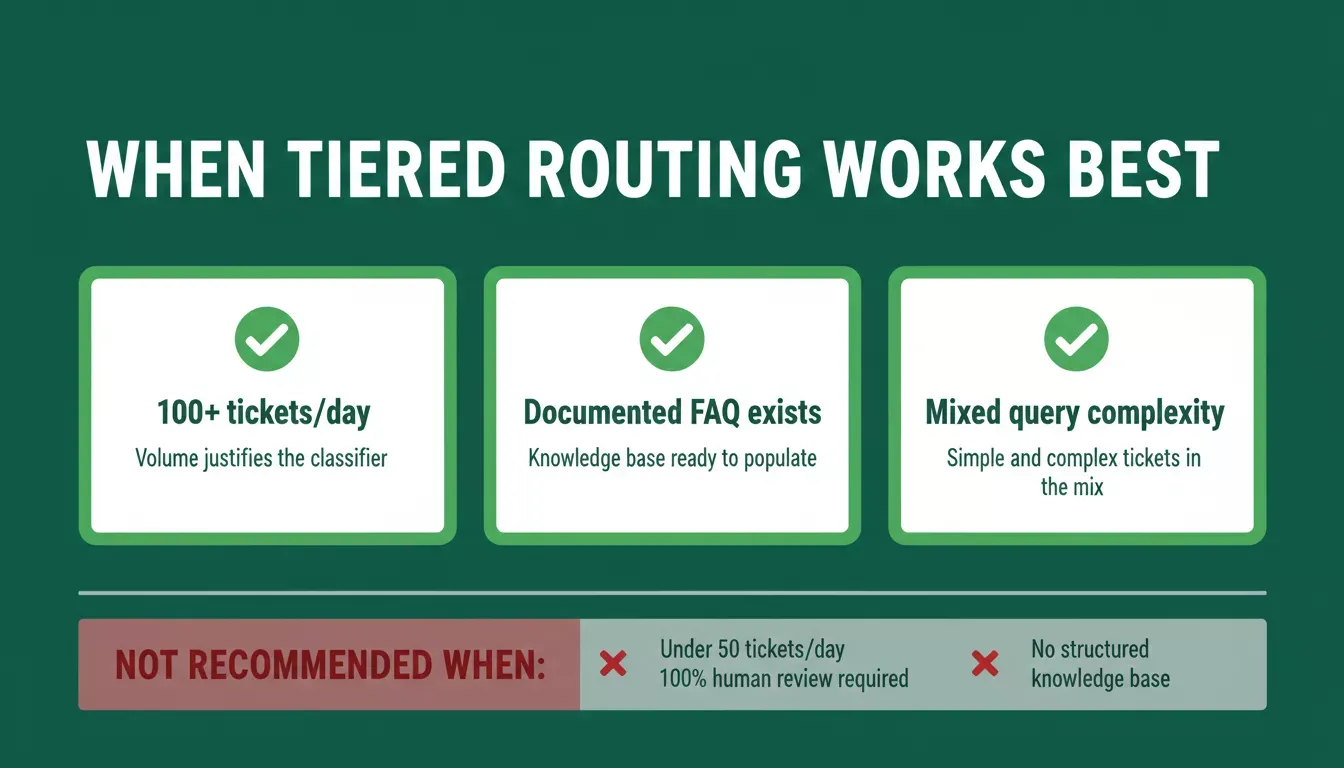
Very low ticket volume (under 50 tickets per day). The overhead of building and maintaining a classifier outweighs the cost savings. A single AI agent layer with human fallback is sufficient, and the feedback loop does not have enough data to retrain meaningfully.
Highly regulated industries requiring 100% human review. Financial services, healthcare, and legal support often mandate human review on every customer interaction. As a reality check, many vendor security and compliance claims do not hold up against basic review. A tiered architecture can still reduce agent preparation time, but the routing logic must send everything to Tier 3 by default, and teams still need to maintain compliance and review controls over time.
Teams without a defined knowledge base. The rule-based tier is only as good as the Q&A pairs that populate it. Start by documenting common questions in a structured format before building the classifier.
When Tiered Routing Works Best
Tiered routing delivers the most value when ticket volume is high, query complexity is mixed, and a structured knowledge base already exists. Below 50 tickets per day or in fully regulated environments, a simpler setup is more practical.
For teams in regulated industries who still want to reduce agent prep time, building a B2B SaaS product with AI covers how to structure compliance-aware workflows that keep humans in the loop by design.
Smart Support Starts with Smarter Architecture
The days of throwing a language model at every support ticket are ending. Companies that build tiered agent systems, ones that match the right response method to each query's actual complexity, will save time, reduce costs, and deliver faster resolutions than competitors still running everything through a single AI layer.
The architecture is clear: rules for simple tasks, AI for complex ones, humans for sensitive cases, and a feedback loop that makes the whole system smarter over time.
Ready to build? Start with a Solve task to validate the architecture for your ticket mix, then describe your system in a Build prompt on Rocket and ship a working prototype today: no enterprise pricing, no drag-and-drop limitations, just intelligent automation from your first build.
Table of contents
- -Why Do Most AI Support Platforms Waste Money on Simple Queries?
- -What Does a Self-Learning Support System Actually Do?
- -How Does Query Classification and Response Routing Work?
- -Routing Tier Comparison
- -A Worked Example: The $600 Refund Request
- -How Rocket Fits in the Tiered Support Architecture
- -How Rocket Compares to Enterprise Customer Support Platforms
- -The Feedback Loop That Makes Your Agent Smarter Over Time
- -How to Measure Success After Launch
- -When Not to Use This Architecture
- -Smart Support Starts with Smarter Architecture